
.webp?language=en-US)

.webp?language=en-US)
When Heat Does Not Stop Walking? Landscape Adaptation for Older Adults
Yining Liu, Student ASLA; Xiaoyu Li, Assoc. ASLA

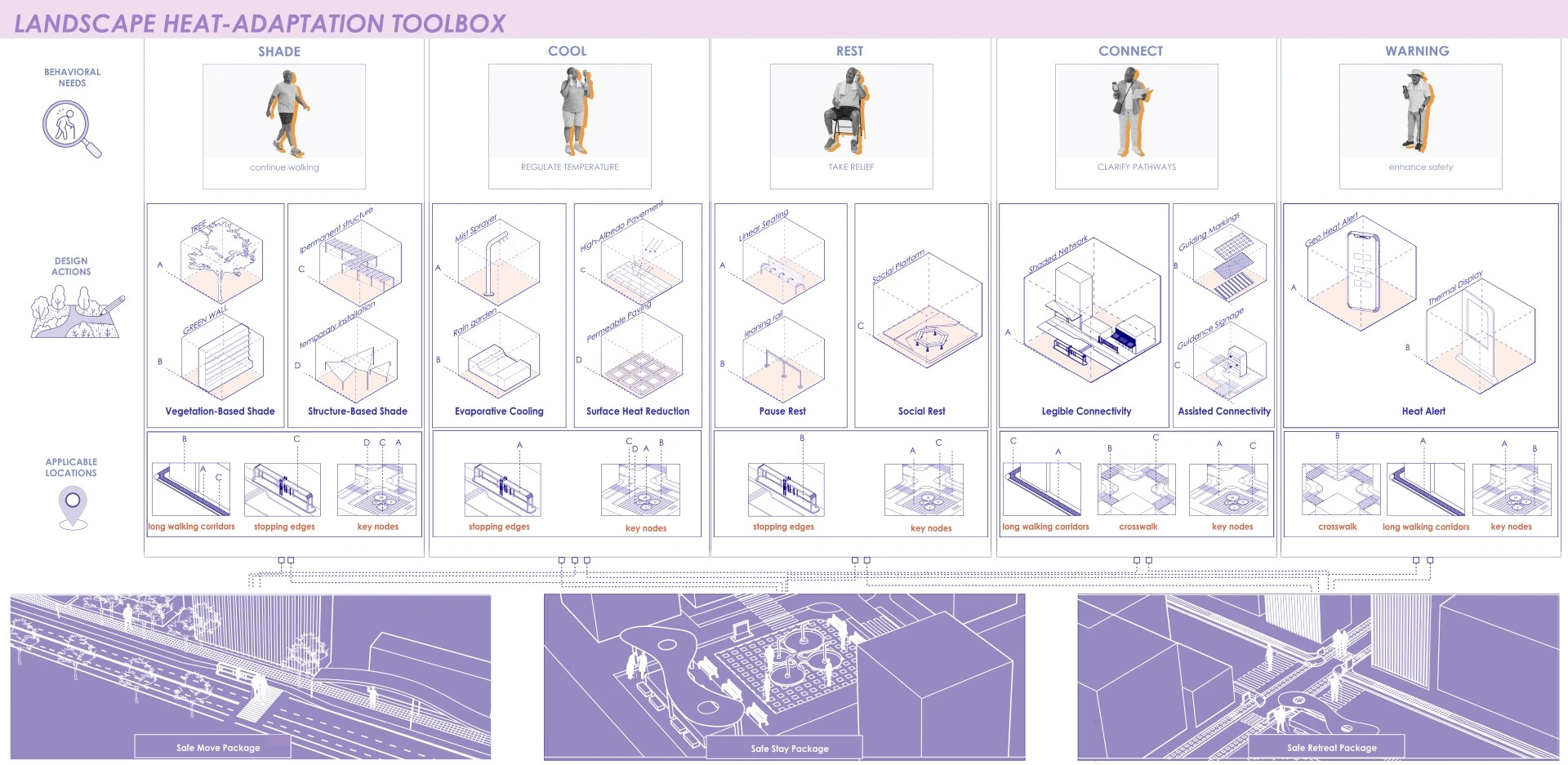
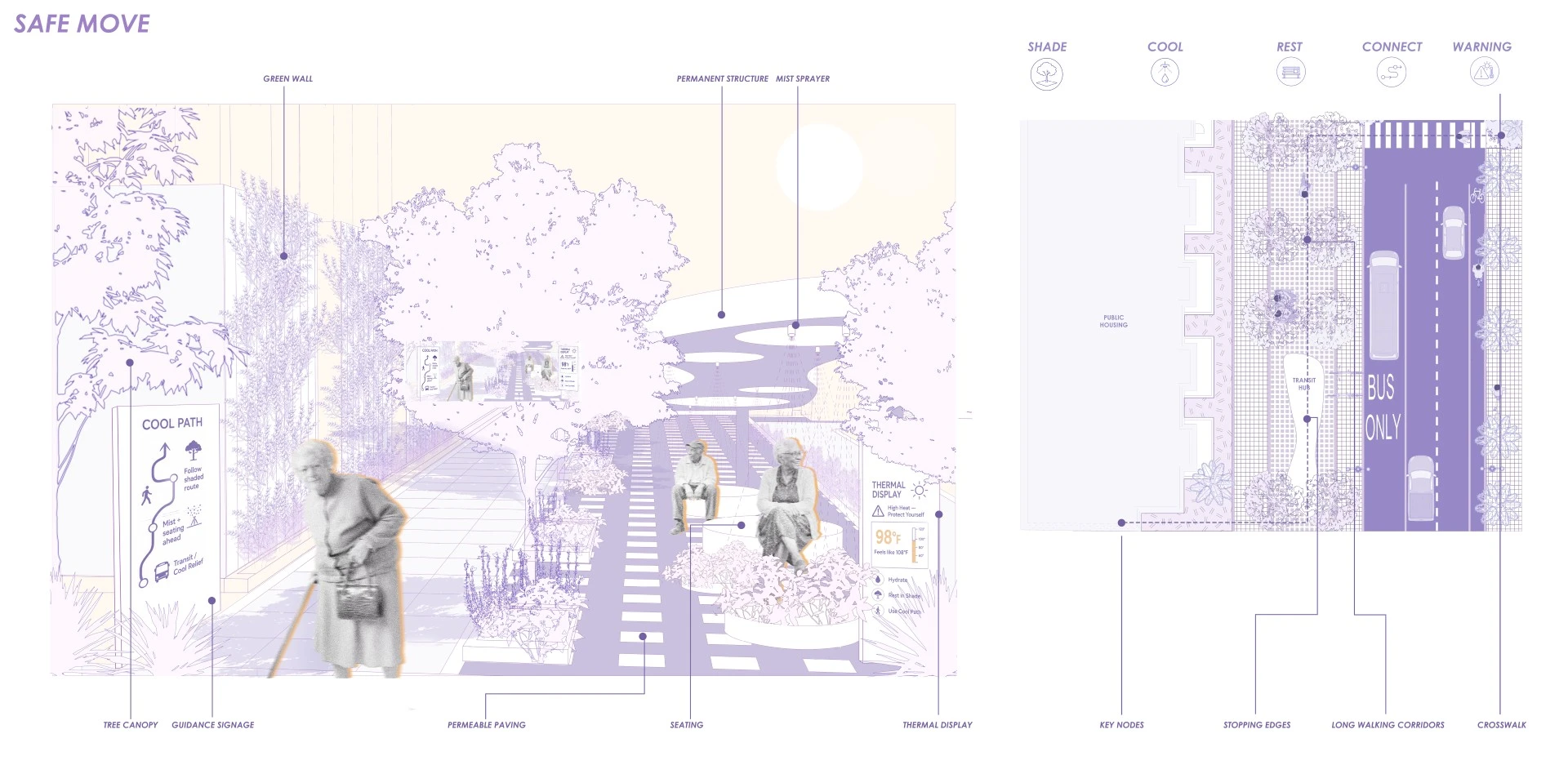
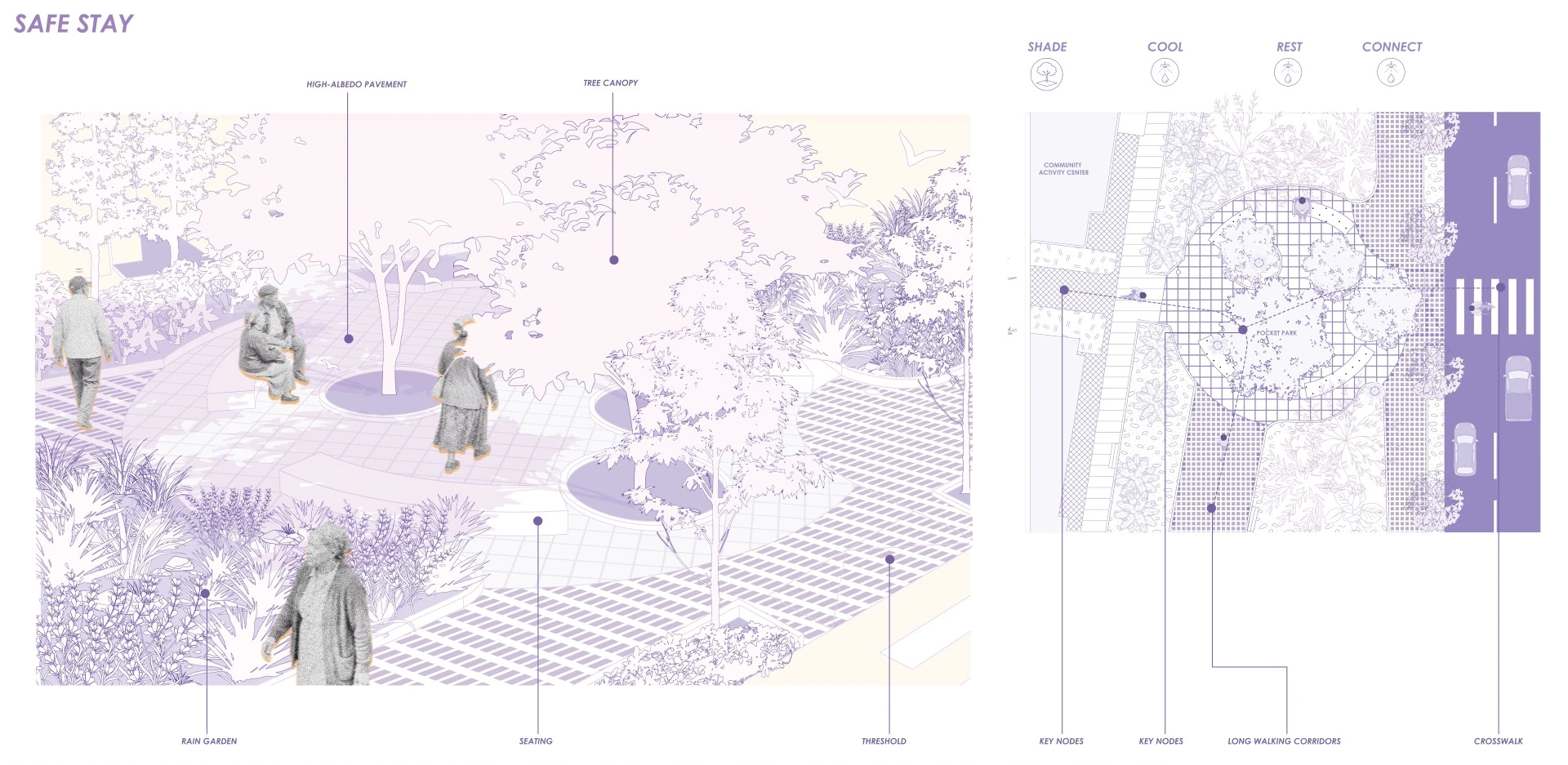
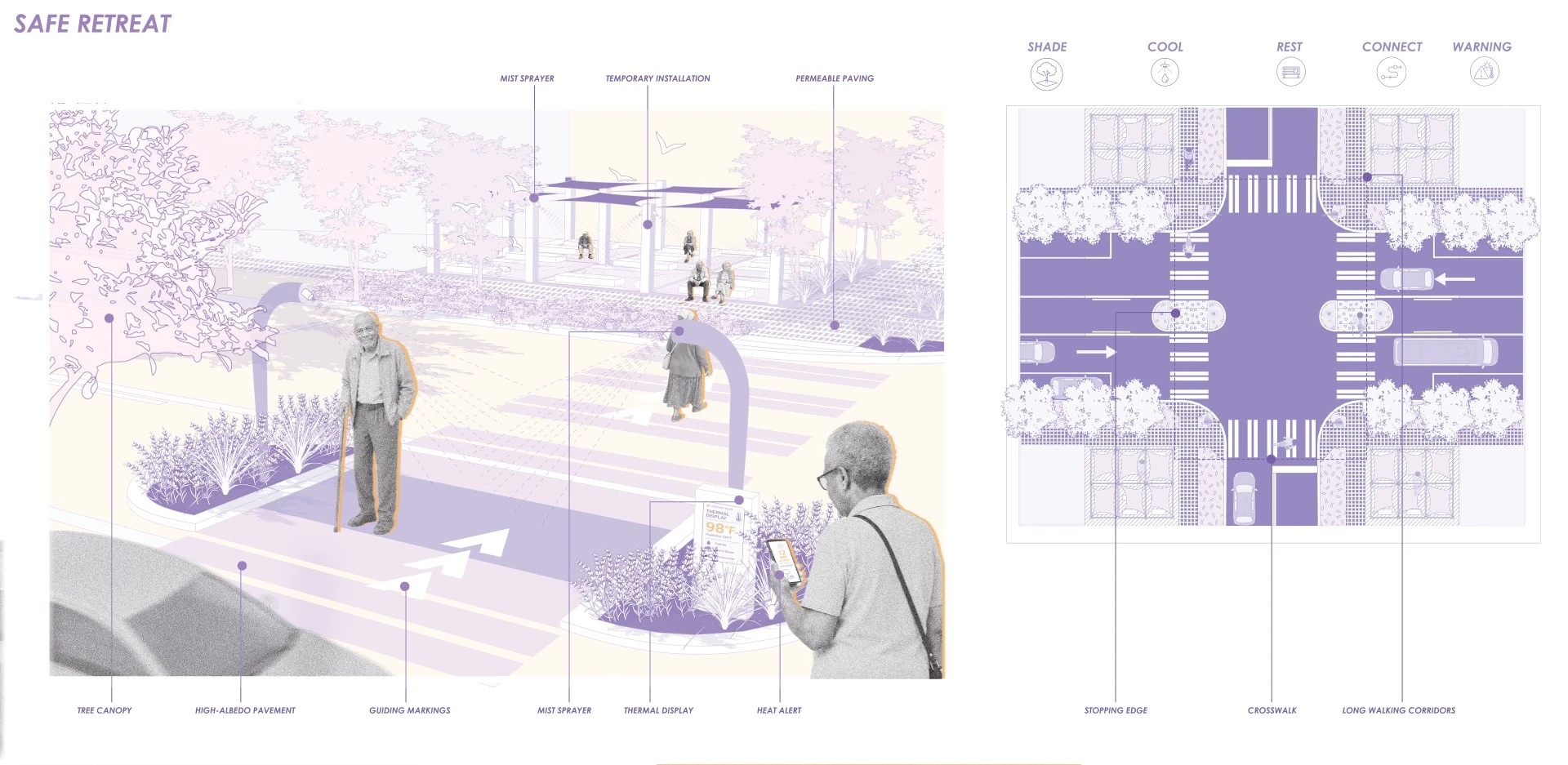

Very important research moving into these climate uncertain times. Nice toolkit.
Awards Jury
-
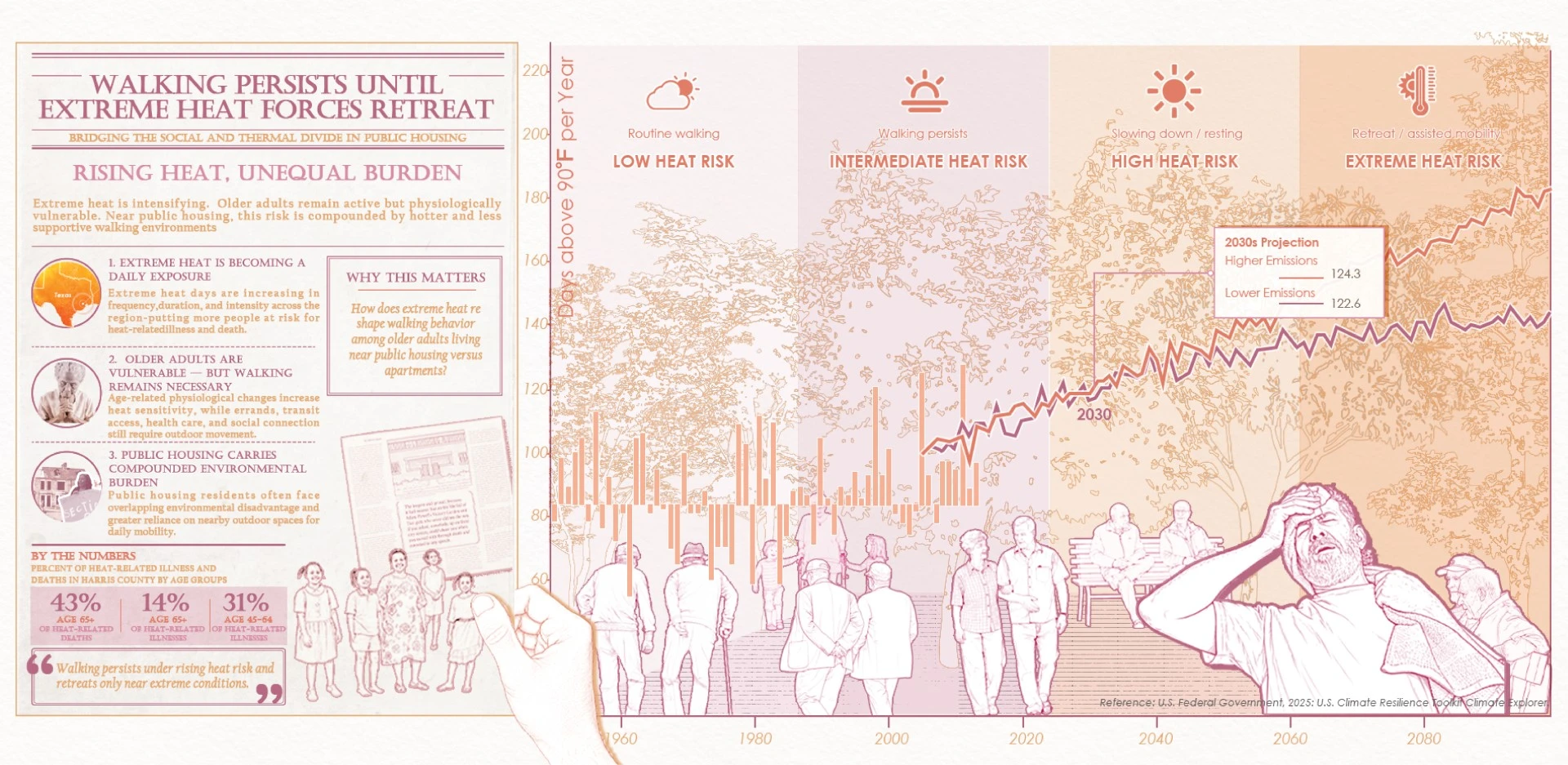
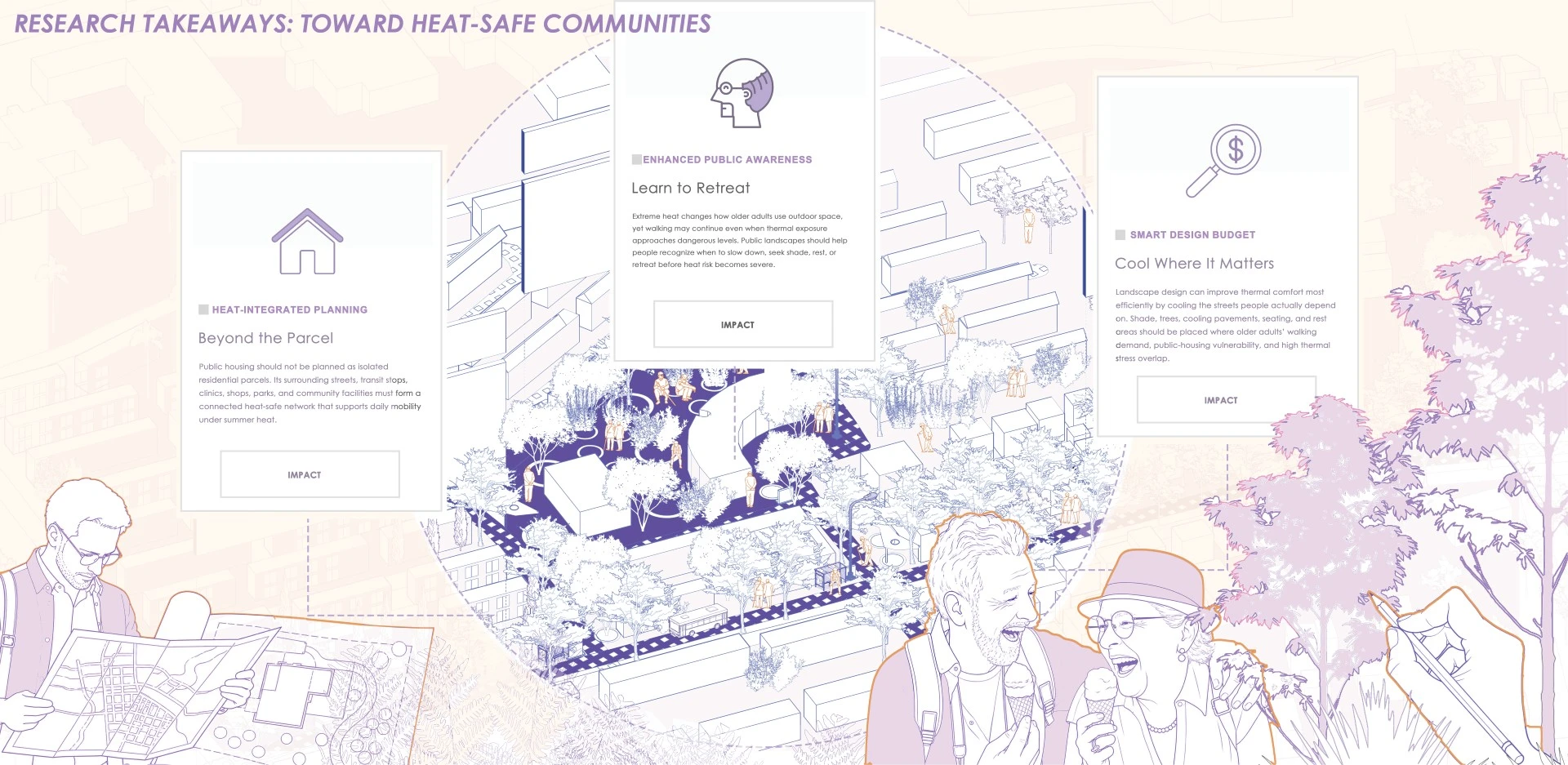
This project examines heat-related walking among older adults near public housing in Harris County and translates evidence into climate-adaptive landscape design. Integrating walking data for ages 55+, the COMFA-OA thermal stress model, and housing-type comparisons, the study identifies walking thresholds under different heat-risk levels. Findings show older adults near public housing continue walking under high thermal stress and reduce trips only near dangerous thresholds, revealing limited mobility alternatives. The project turns this "delayed withdrawal" pattern into a design framework for cooling corridors, refuge nodes, shaded routes, cool pavements, transit-stop microclimate improvements, and stronger community-edge connections.
-
1. Background: In Houston, the most dangerous street may not be the hottest one on the map, but the one an older adult must use to reach a bus stop, pharmacy, or grocery store. Older adults are highly vulnerable to heat, especially when age, income, transportation, and street conditions overlap (Nunes, 2020). Many older adults still need to walk because they lack cars, transit is limited, or destinations are dispersed (Bennett, 2007). Car-oriented streets can become landscapes of heat risk.
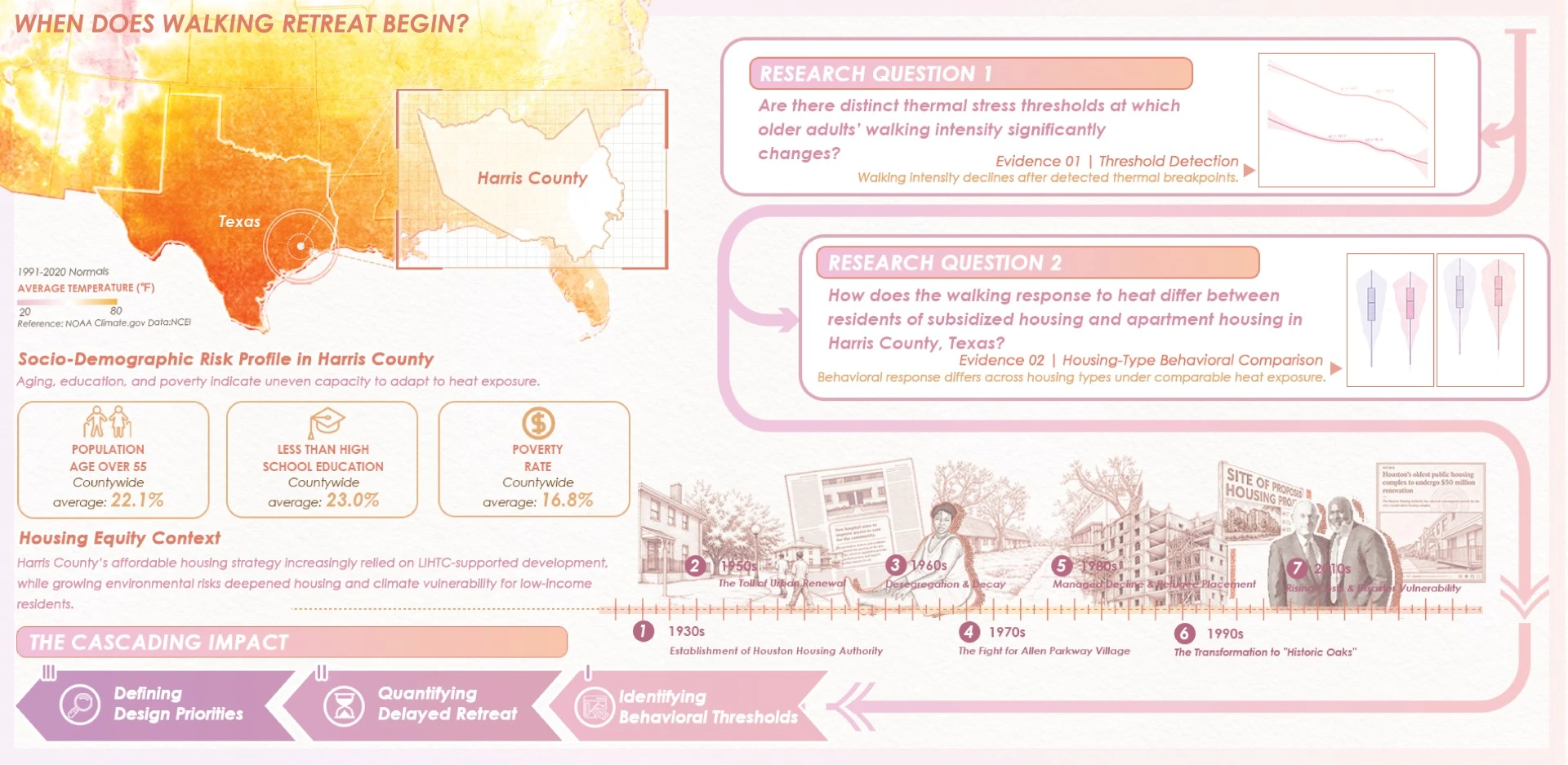
This project asks: if heat adaptation must identify not only where streets are hottest, but also who must keep moving through heat, how should design priorities change? Focusing on older adults near public housing in Harris County, Houston, TX, the study examines heat load, housing context, and walking behavior. It asks:
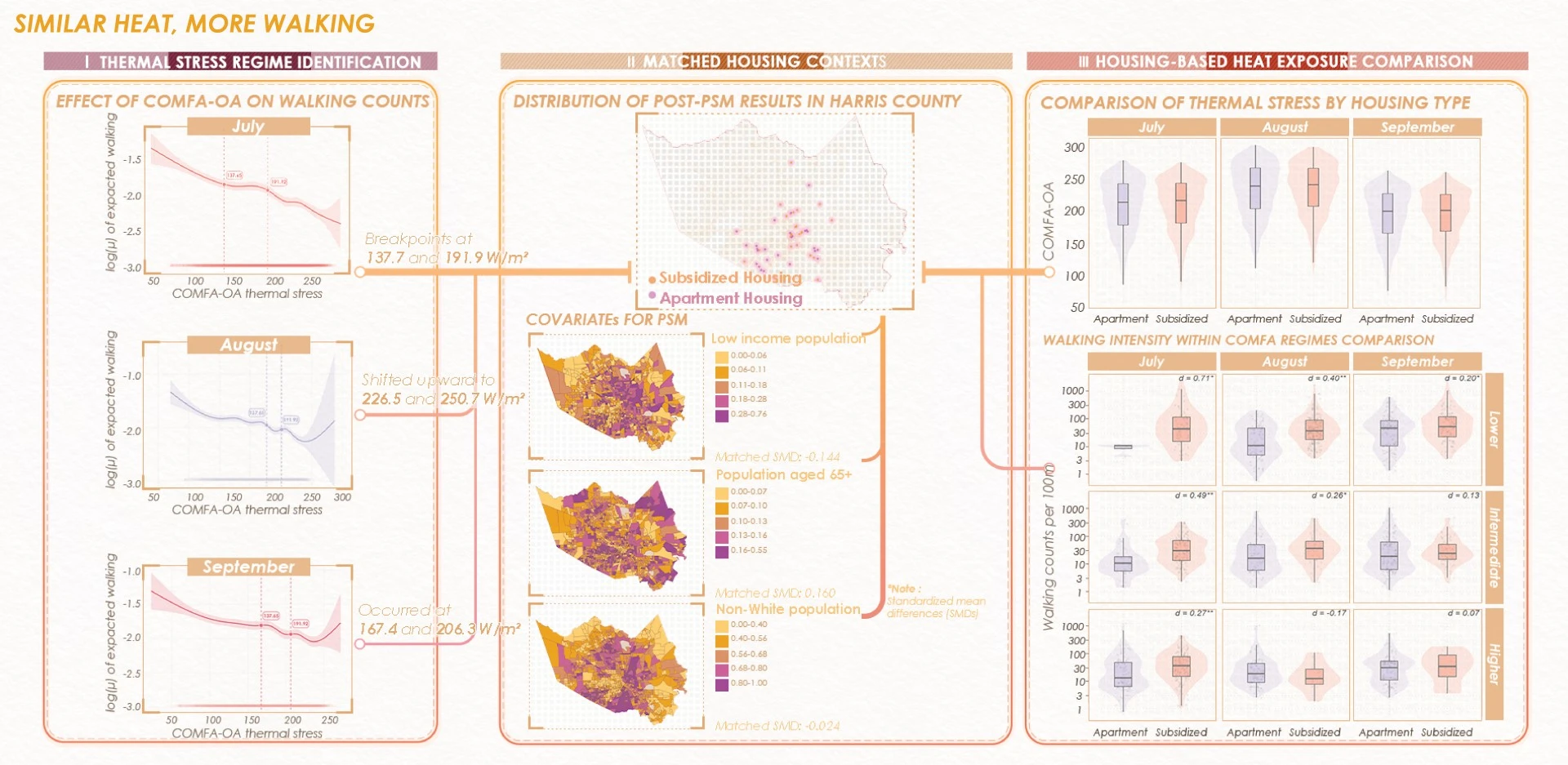
a) At which heat-load levels does older-adult walking begin to decline?
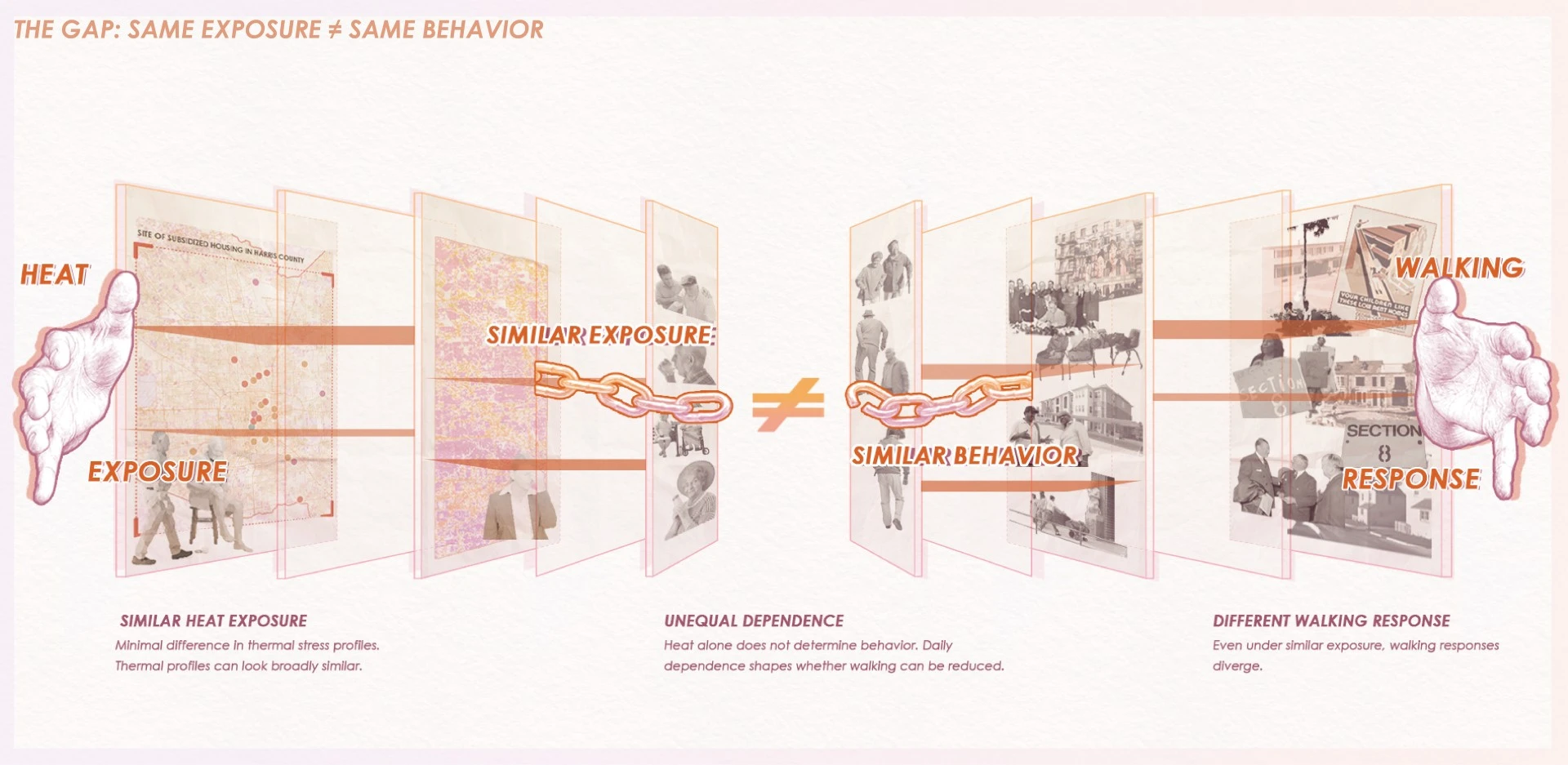
b) Do older adults near public housing respond differently to heat than those near market-rate apartments?
These thresholds inform shade, cooling, rest, and connection systems along essential routes.
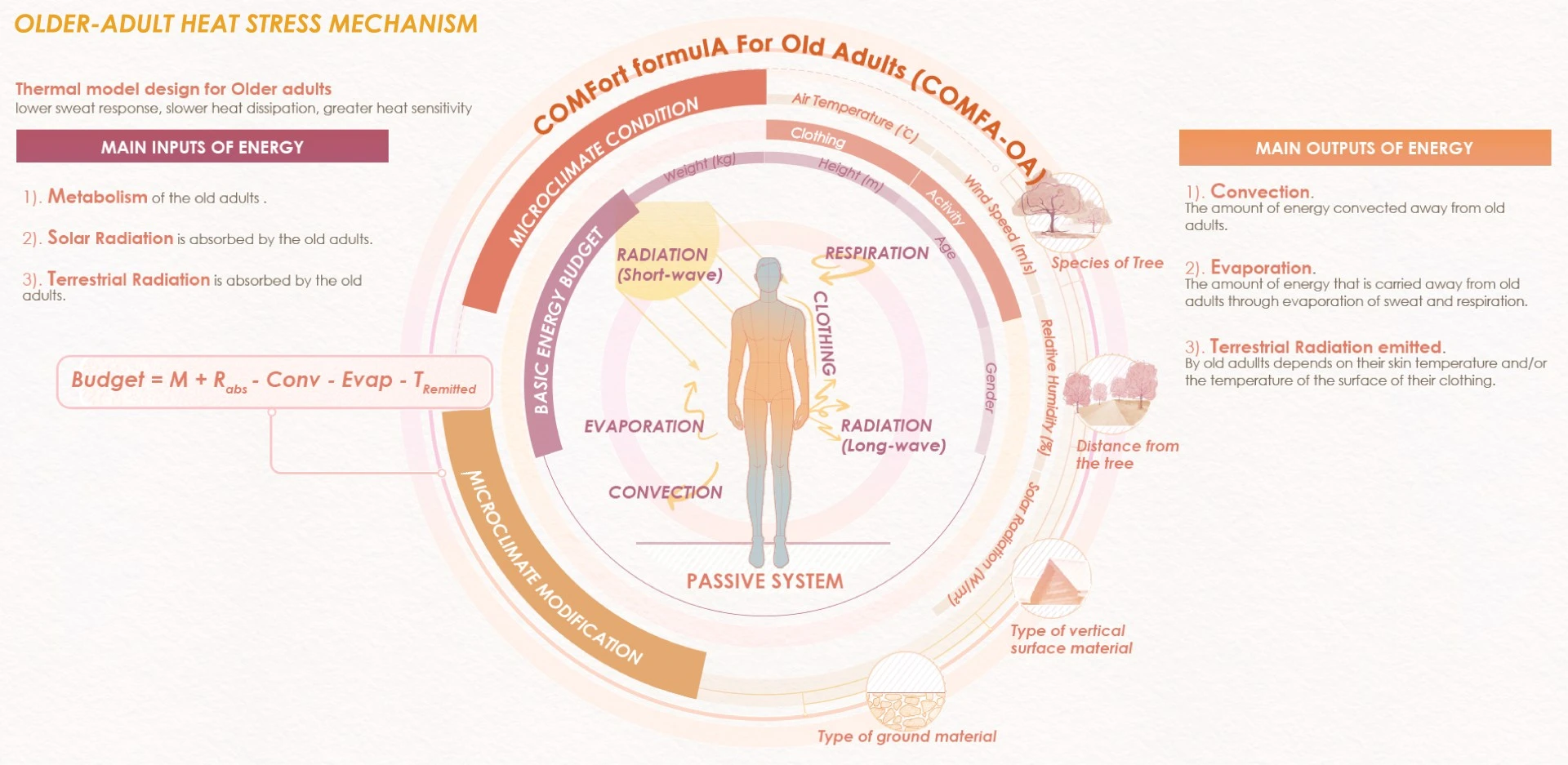
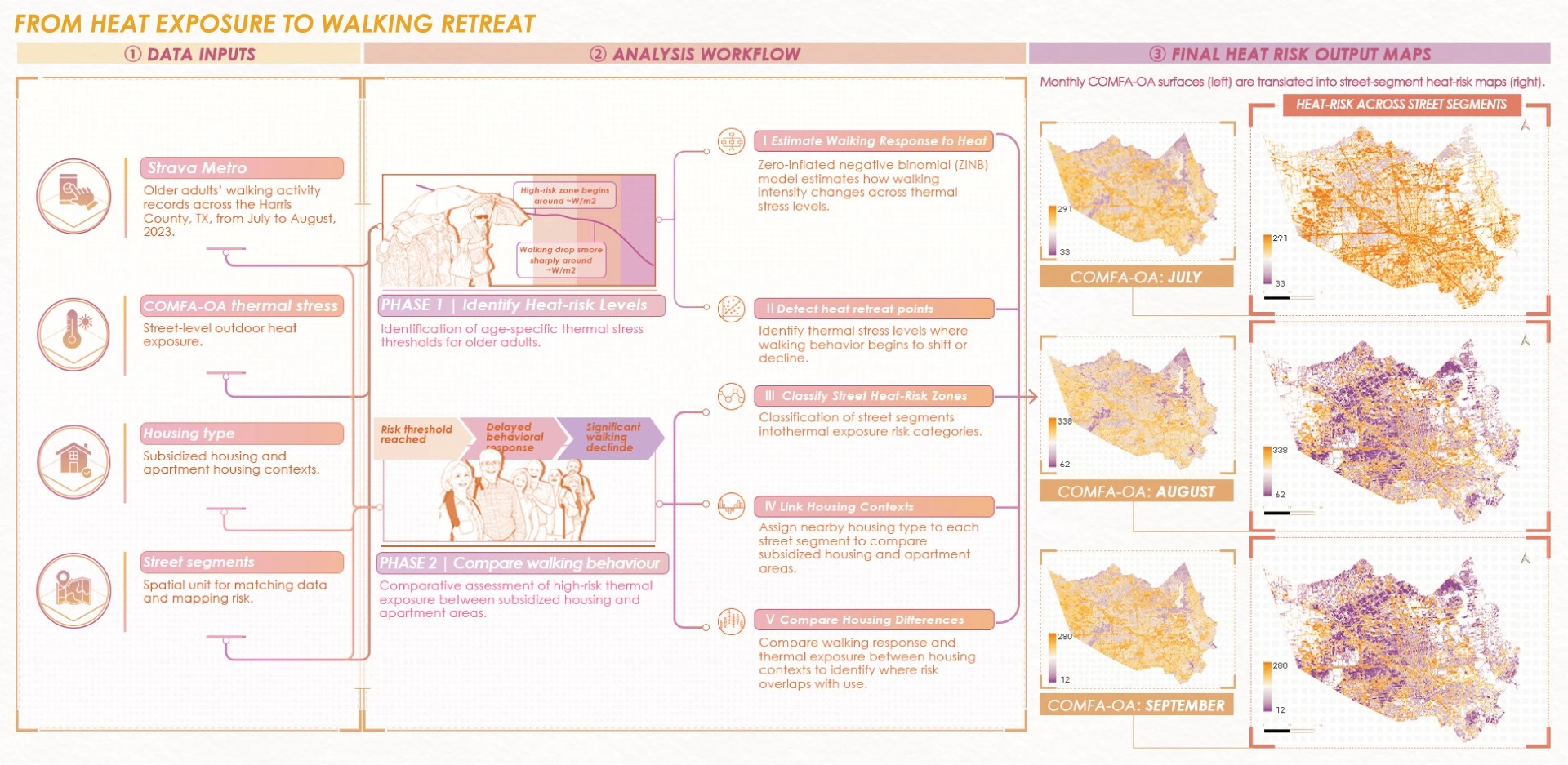
2. Method: The method combined Strava Metro walking data for users aged 55 and older, the COMFA-OA heat stress model calibrated for older adults (Li et al. 2025), housing-type comparison, and street-segment analysis. Walking activity was assigned to heat-risk categories and compared between streets near public housing and market-rate apartments. This linked climate, housing context, street conditions, and mobility, shifting heat adaptation from exposure mapping toward behavior-informed design judgment.
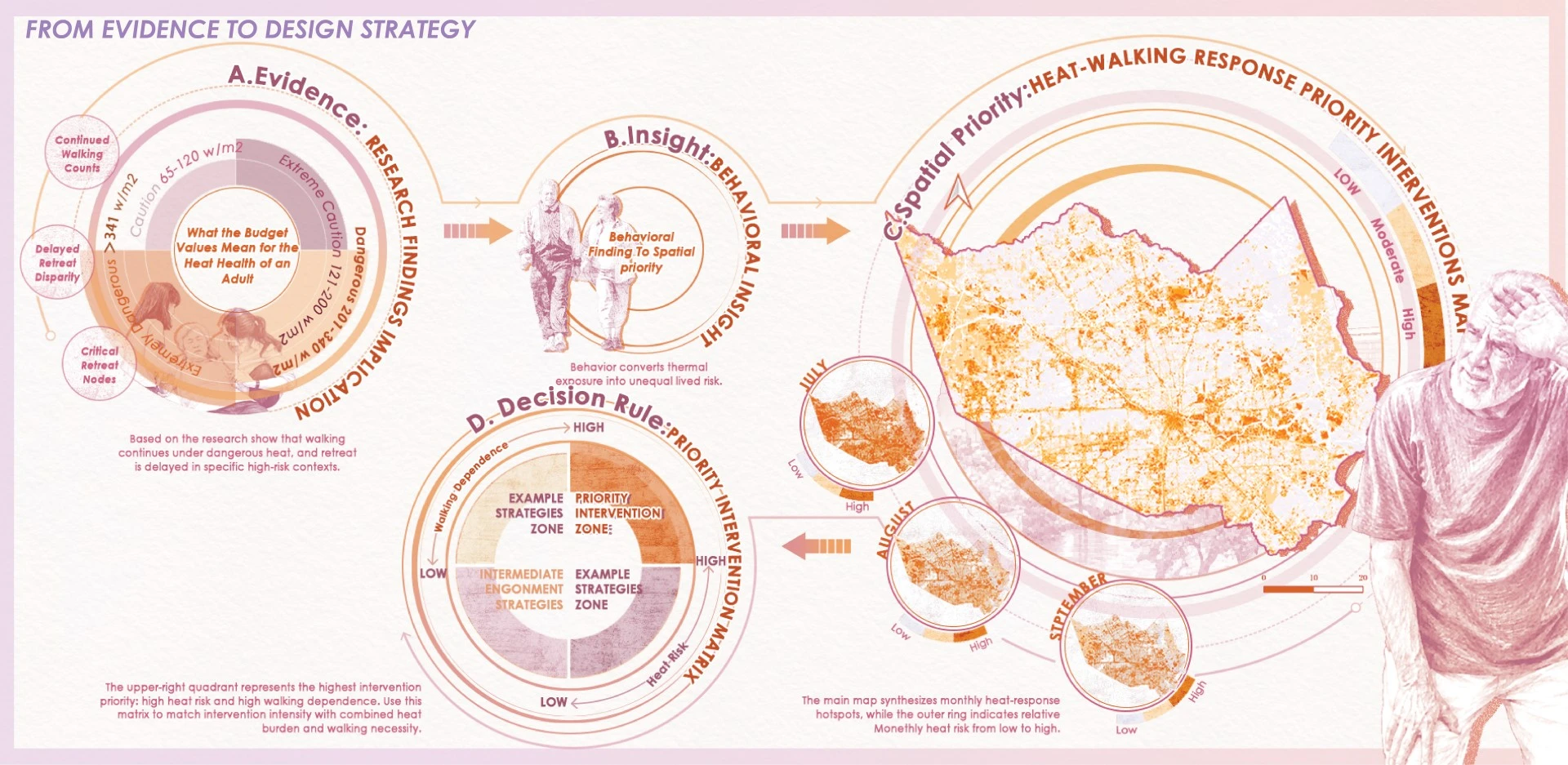
3. Findings: Older adults appear to withdraw from heat too late. Walking continued under low and moderate heat risk and dropped only near dangerous levels. Streets around public housing maintained higher older-adult walking from low through high heat risk than streets around market-rate apartments. At extreme heat risk, this difference largely disappeared, suggesting severe heat overwhelmed both groups' ability to remain outdoors. By combining heat load with walking activity, the study identified street segments that were both dangerous and frequently used. These places should be prioritized not simply because they are hot, but because older adults rely on them. Risk around public housing is not only "hotter space," but necessary space used under high heat. These findings inform safe walking corridors, cooling stay nodes, and safe retreat networks.
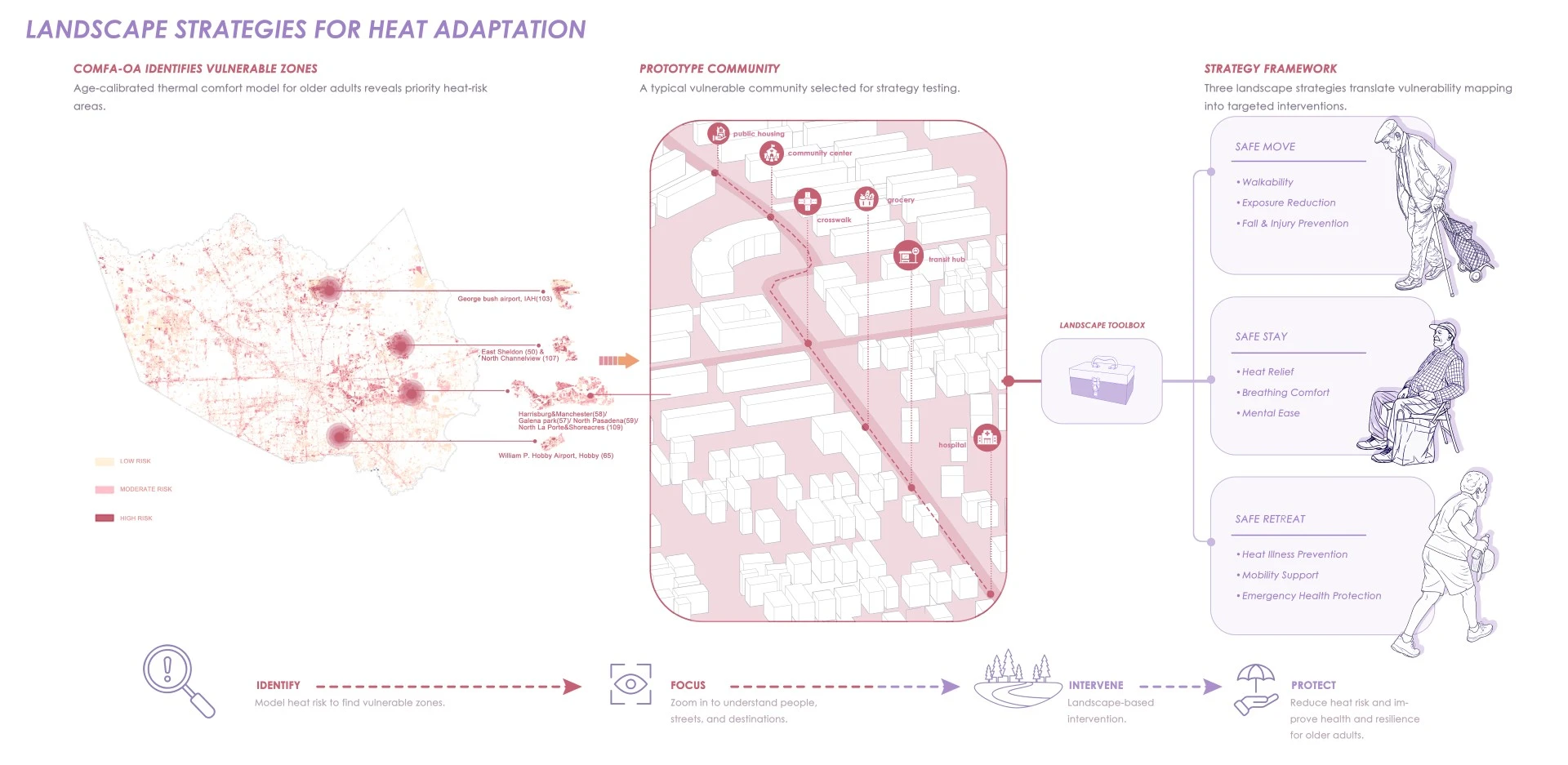
4. Implications: We propose three design strategies: Safe walking corridors connect public housing with transit, health care, food, and services through shade, canopy, shade structures, cool paving, safer crossings, and continuous sidewalks (Brown, 2010). Cooling stay nodes at hot segments, bus stops, intersections, and community entrances combine shade, water, seating, and lighting so older adults can pause and recover. Safe retreat networks use signage, heat alerts, and links to indoor or semi-outdoor cooling spaces.
Compared with research solely focused on heat stress, this project contributes a behavior-threshold approach for design practice. Mobility data show where people walk and when they fail to leave danger soon enough. For landscape architects, this evidence turns heat adaptation into a spatial design task: where shade must be continuous, rest within reach, cooling interrupt exposure, and retreat visible. Streets around public housing can become a protected heat-safety network for everyday survival.
-
- William C. Sullivan (Professor, University Of Illinois Urbana-Champaign)
- Chanam Lee (Professor, Texas A&M University)
- Huiyan Sang (Professor, Texas A&M University)
- Jay Maddock (Professor, Texas A&M University)
- Chunwu Zhu (Assistant Research Scientist, Texas A&M Transportation Institute)
- Yue Zhang (Research Assistant, Texas A&M University)
-
- Honey Mesquite (Prosopis Glandulosa)
- Live Oak (Quercus Virginiana)
- Century Plant (Agave Americana)
- False Yucca (Hesperaloe Parviflora)
- Desert Willow (Chilopsis Linearis)
- Cedar Elm (Ulmus Crassifolia)
- American Sycamore (Platanus Occidentalis)
- Bur Oak (Quercus Macrocarpa)
Advertisement
Related Awards
Honor Award, Research
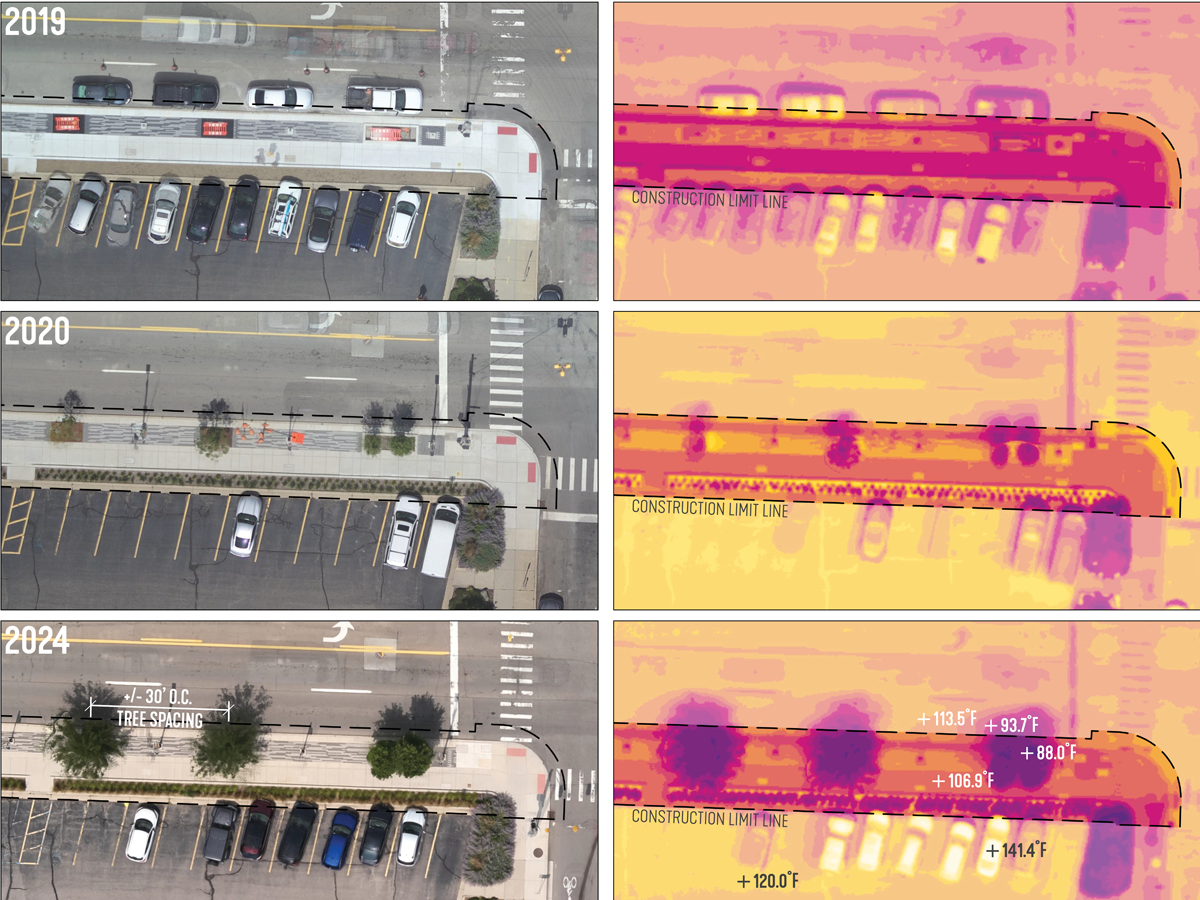
Heat Health: A pre- and 5-year post-occupancy thermal case study
This is not a design solution. It is a case study to inform better design solutions and policy. Novel research uses cutting-edge drone-based thermal visualization to address the heat island effect, which contributes to severe health risks. By combining high-resolution thermal and color imagery, this study reveals how materials and green space impact surface temperatures, offering a precise, scalable method for assessing heat in any setting.