






Communication
Recognizes excellence in communicating landscape architecture, including its works, techniques, technologies, sustainable design, history, and theory, with emphasis on effective messaging, innovative delivery, and value to the intended audience.
Explore:
Category Overview
What This Category Recognizes
Achievements in communicating landscape architecture works, techniques, technologies, sustainable design, history, or theory, and the lesson value of that communication to an intended audience.
Typical Entries Include
Online and interactive communications, multimedia projects, print media, film, video, audio and podcasts, interpretive design, exhibition design, public-awareness campaigns, and other forms of communication related to landscape architecture.
Entries that reference media hosted online, including video or social media content, should provide a direct, ad-free link whenever possible.

Eligibility
The official entrant in the Professional Awards Communication category must be an Affiliate, Associate, Full, or International ASLA member, or eligible to join ASLA in one of those categories.
This category is intended for work whose primary achievement is the communication itself, including the way landscape architecture ideas, projects, techniques, technologies, history, theory, or other knowledge are interpreted and presented to an audience.
Consider another Professional Awards category if the communication primarily documents or presents a landscape architecture project and the project itself, rather than the communication, is the achievement you want the jury to recognize.
How Your Entry Will Be Evaluated
The jury will consider the effectiveness of the message and its presentation, innovation in the communication’s approach or delivery, and its value to the intended audience.
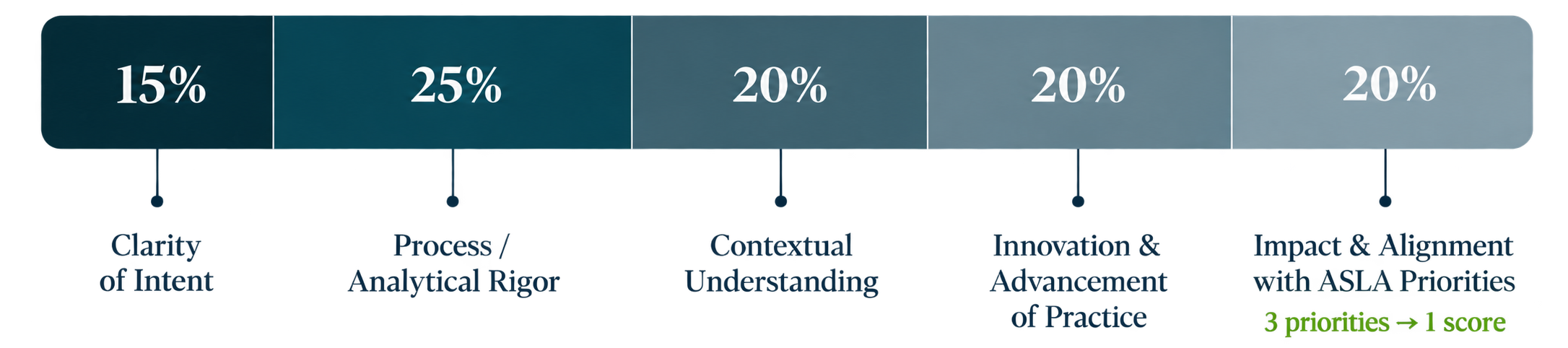
Communication Jury Rubric
Expand each criterion to see the scoring guidance used by the jury.
15% · Clarity of Intent
5 · Exceptional
Demonstrates exceptional clarity of project intent, goals, and objectives that lead to an effective message of demonstrated value to the intended audience.
4 · Strong
Demonstrates strong clarity of project intent, goals, and objectives that lead to an effective message of demonstrated value to the intended audience.
3 · Good
Demonstrates clarity of project intent, goals, and objectives that lead to an effective message of demonstrated value to the intended audience.
2 · Limited
Demonstrates some clarity of project intent, goals, and objectives that lead to an effective message of demonstrated value to the intended audience.
1 · Poor / Not Demonstrated
Does not demonstrate clarity of project intent, goals, and objectives that lead to an effective message of demonstrated value to the intended audience.
25% · Process / Analytical Rigor
5 · Exceptional
Demonstrates an exceptional process for creation of the end product.
4 · Strong
Demonstrates a strong process for creation of the end product.
3 · Good
Demonstrates an appropriate process for creation of the end product.
2 · Limited
Demonstrates a process for creation of the end product.
1 · Poor / Not Demonstrated
Does not demonstrate an appropriate process for creation of the end product.
20% · Contextual Understanding
5 · Exceptional
Demonstrates exceptional response to the communication’s context.
4 · Strong
Demonstrates strong response to the communication’s context.
3 · Good
Demonstrates appropriate response to the communication’s context.
2 · Limited
Demonstrates some response to the communication’s context.
1 · Poor / Not Demonstrated
Does not respond appropriately to the communication’s context.
20% · Innovation & Advancement of Practice
5 · Exceptional
Demonstrates exceptional innovation in approach or delivery and presents compelling communication related to the profession.
4 · Strong
Demonstrates strong innovation in approach or delivery and presents compelling communication related to the profession.
3 · Good
Demonstrates innovation in approach or delivery and presents compelling communication related to the profession.
2 · Limited
Demonstrates some innovation in approach or delivery and presents somewhat compelling communication related to the profession.
1 · Poor / Not Demonstrated
Does not demonstrate innovation in approach or delivery or present compelling communication related to the profession.
20% · Impact & Alignment with ASLA Priorities
The three ASLA Priorities below are considered together as part of the single Impact & Alignment with ASLA Priorities criterion, worth 20% of the overall score.
Jurors do not assign separate scores to each Priority. Instead, they use the guidance below to assess the entry’s performance across all three and then assign one overall score from 1 to 5.
An entry does not need to demonstrate equal strength across all three Priorities. However, significant weakness or lack of evidence in one area should be reflected in the overall score.
Overall Impact & Alignment Score
5 · Exceptional
Demonstrates exceptional alignment with one or more key ASLA Priorities.
4 · Strong
Demonstrates strong alignment with one or more key ASLA Priorities.
3 · Good
Demonstrates some alignment with one or more key ASLA Priorities.
2 · Limited
Demonstrates limited alignment with one or more key ASLA Priorities.
1 · Poor / Not Demonstrated
Demonstrates poor or no alignment with any of the key ASLA Priorities.
The guidance below helps jurors assess the strength of the entry across each ASLA Priority. These assessments inform the single overall Impact & Alignment score above.
Climate & Biodiversity Action
Exceptional
Focused on climate resilience, mitigation, adaptation, and/or the protection, conservation, and enhancement of biodiversity.
Strong
Addresses climate resilience, mitigation, adaptation, and/or the protection, conservation, and enhancement of biodiversity through transformative action and scalable solutions.
Good
Considers climate resilience, mitigation, adaptation, and/or the protection, conservation, and enhancement of biodiversity.
Limited
Mentions climate resilience, mitigation, adaptation, and/or the protection, conservation, and enhancement of biodiversity through transformative action and scalable solutions.
Poor / Not Demonstrated
Does not consider climate resilience, mitigation, adaptation, and/or the protection, conservation, and enhancement of biodiversity.
Health and Well-Being
Exceptional
Focused on physical, mental, and community health using evidence-based strategies to create spaces that provide access to nature, support movement, reduce heat, improve air and water quality, and enhance social connections.
Strong
Addresses physical, mental, and community health using evidence-based strategies to create spaces that provide access to nature, support movement, reduce heat, improve air and water quality, and enhance social connections.
Good
Considers physical, mental, and community health using evidence-based strategies to create spaces that provide access to nature, support movement, reduce heat, improve air and water quality, and enhance social connections.
Limited
Mentions physical, mental, and community health using evidence-based strategies to create spaces that provide access to nature, support movement, reduce heat, improve air and water quality, and enhance social connections.
Poor / Not Demonstrated
Does not consider physical, mental, and community health using evidence-based strategies to create spaces that provide access to nature, support movement, reduce heat, improve air and water quality, and enhance social connections.
Diversity, Equity, Inclusion and Universal Design
Exceptional
Focused on equity and inclusion of stakeholder engagement and application of stakeholder input and/or universal design.
Strong
Addresses equity and inclusion of stakeholder engagement and application of stakeholder input and/or universal design.
Good
Considers equity and inclusion of stakeholder engagement and application of stakeholder input and/or universal design.
Limited
Mentions limited equity and inclusion of stakeholder engagement and application of stakeholder input in the final product and demonstrates limited attention to universal design principles.
Poor / Not Demonstrated
Does not consider equity and inclusion of stakeholder engagement and application of stakeholder input in the final product and does not demonstrate attention to universal design principles.
What to Submit
Prepare each component of your entry carefully. Communication entries may also include supplemental materials that allow the jury to experience or review the work in its intended format.
Entrant Identification
Unlike most Professional Awards categories, Communication submissions are not required to conceal the identities of the entrant, creators, organizations, or other contributors where those identities appear naturally within the submitted work.
Text Requirements
Supplemental Materials
Supplemental materials may be provided when appropriate to the entry. These may include links or other supporting materials necessary for jurors to review digital, interactive, multimedia, video, audio, social media, or other communication work.
When an entry references media hosted online, provide a direct, ad-free link whenever possible.
Image Requirements
Artificial Intelligence Disclosure
Applicants must disclose any use of AI in the project itself and in the preparation of the award submission. This includes, but is not limited to, AI used for design exploration, research, analysis, modeling, visualization, image generation or modification, data analysis, text preparation, and presentation graphics.
Applicants will be asked to identify the tasks for which AI was used and, where applicable, the platforms used.
The jury will consider disclosed AI use in the context of the entry, including the relationship between the tools used and the project’s authorship, design process, analysis, evidence, decision-making, and visual communication. Disclosure of AI use does not, by itself, disqualify or diminish an entry.
Recognition
The Professional Awards Jury may select one Award of Excellence and any number of Honor Awards in the Communication category.