
.webp?language=en-US)

.webp?language=en-US)
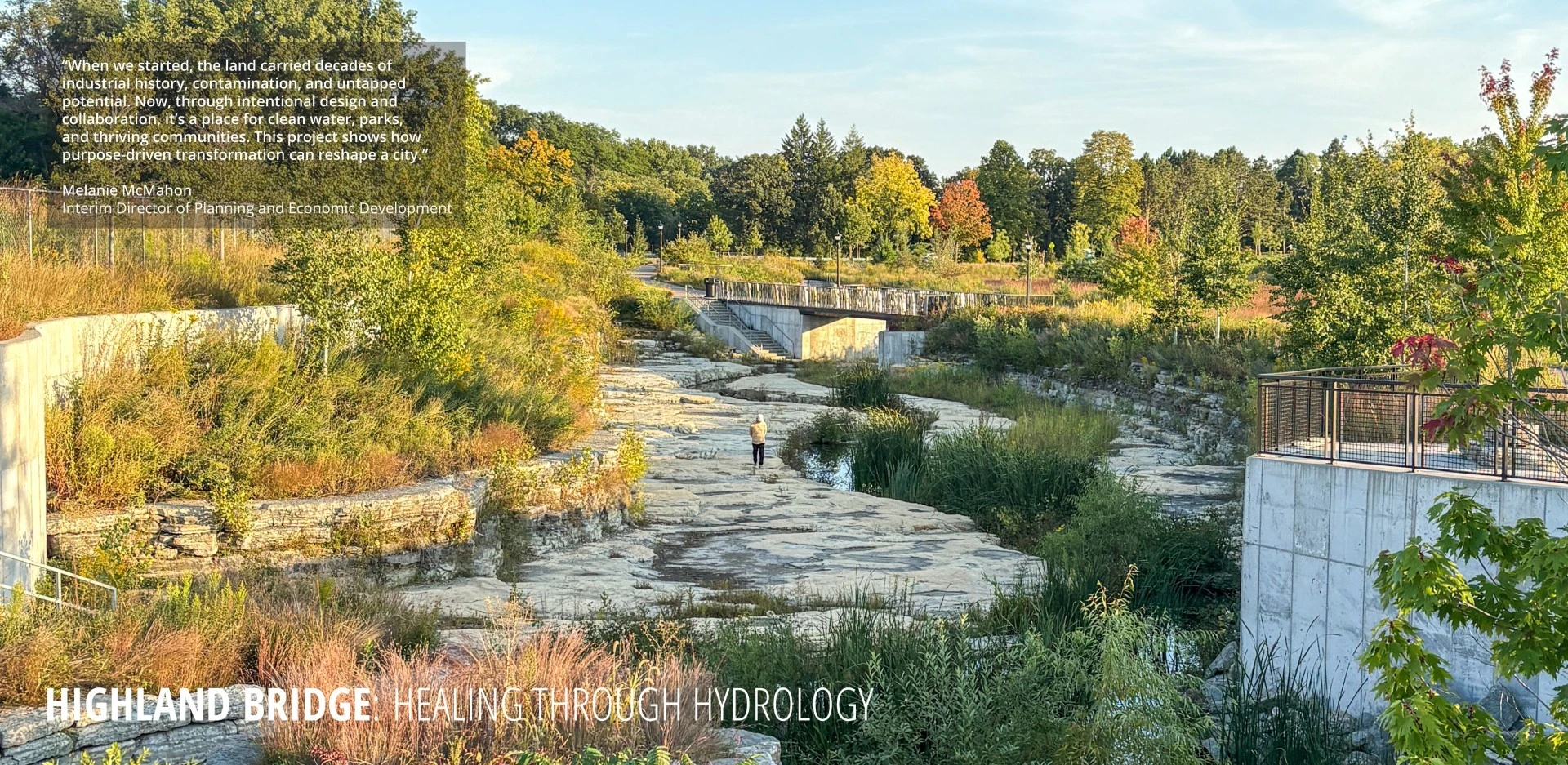
Highland Bridge: Healing through Hydrology
-
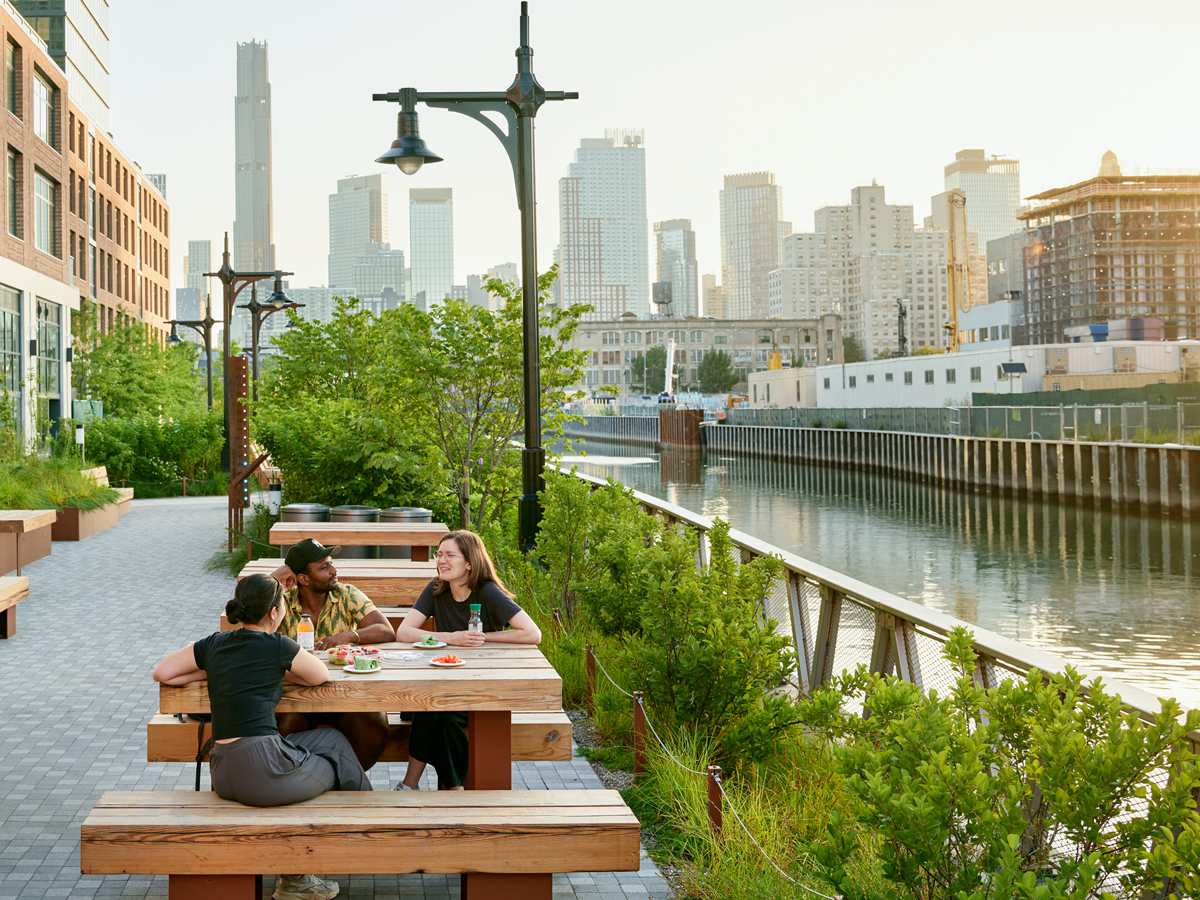
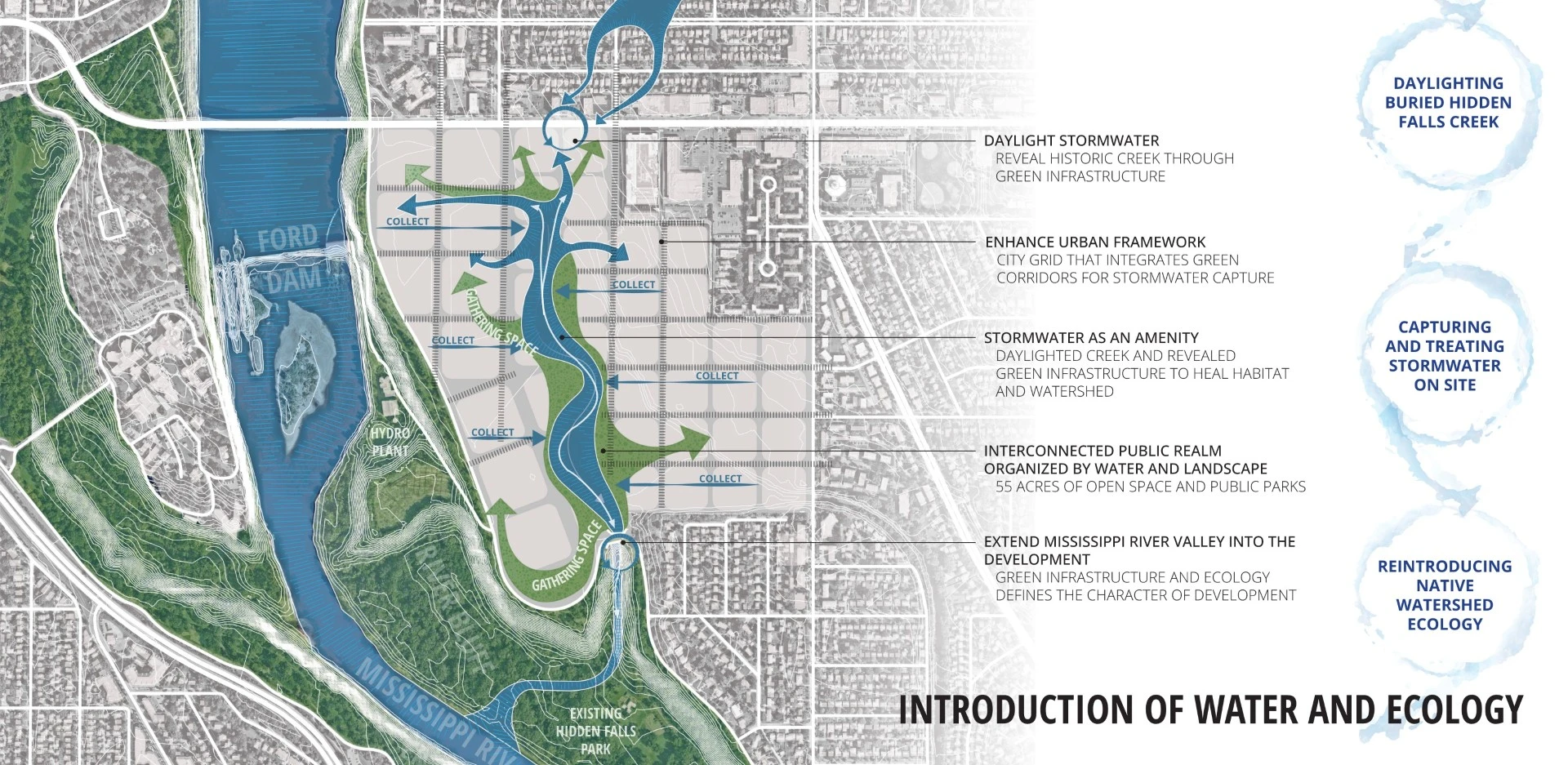
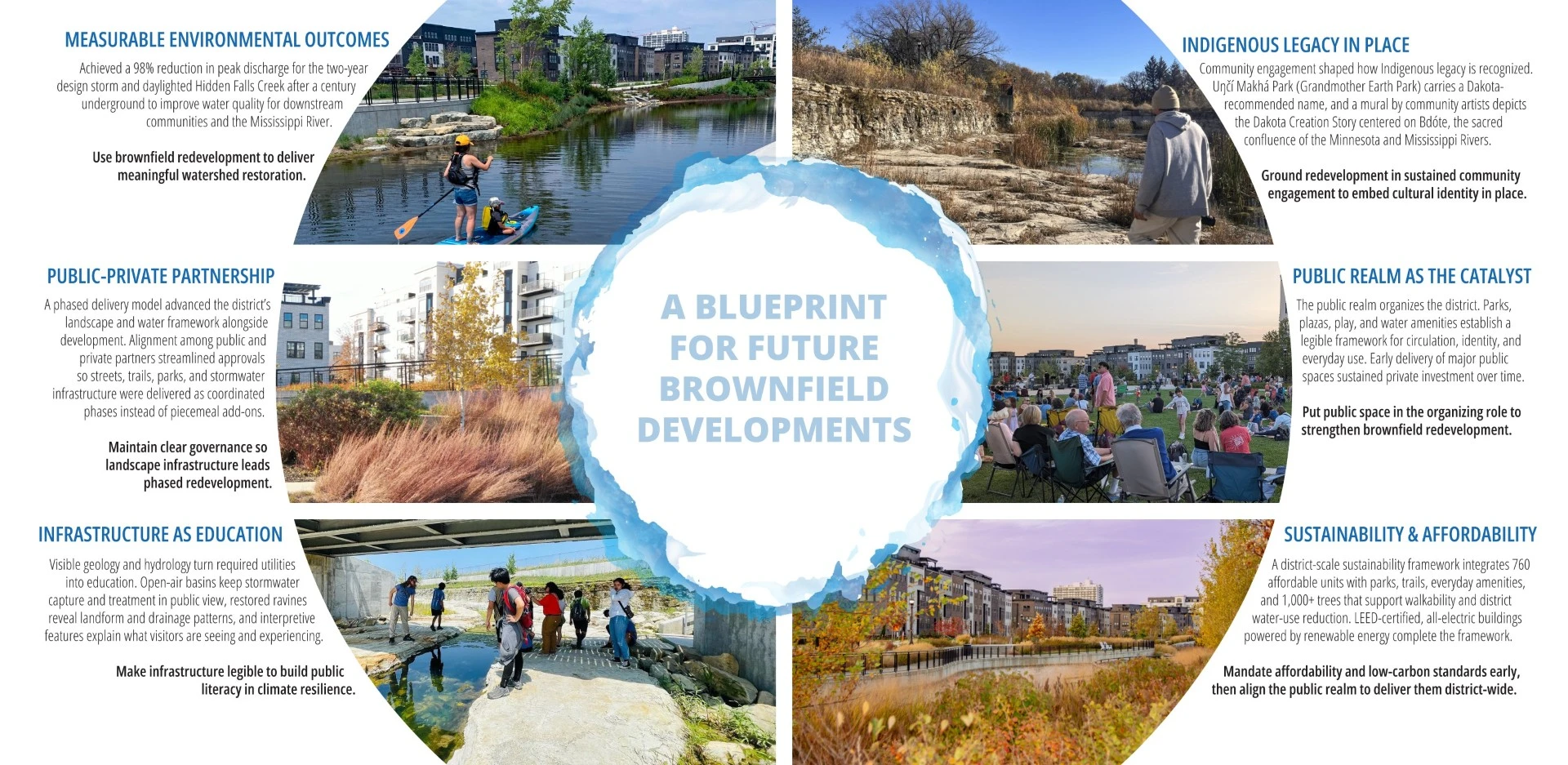
Highland Bridge heals through hydrology, rebuilding a riverfront district from a former industrial brownfield along the Mississippi River in Saint Paul, Minnesota, around public space and clean water. Fifty-five acres of parks and gathering spaces and 10 miles of bike and pedestrian routes support 3,800 homes, including 20% affordable housing. In 1925 the creek to Hidden Falls was buried and stormwater was sent downstream untreated; today a district-scale green system treats 64 million gallons annually before returning water to the river in public view. Highland Bridge provides a landscape-led replicable model for river cities: public space functions as civic infrastructure that advances equitable growth and environmental repair.
-
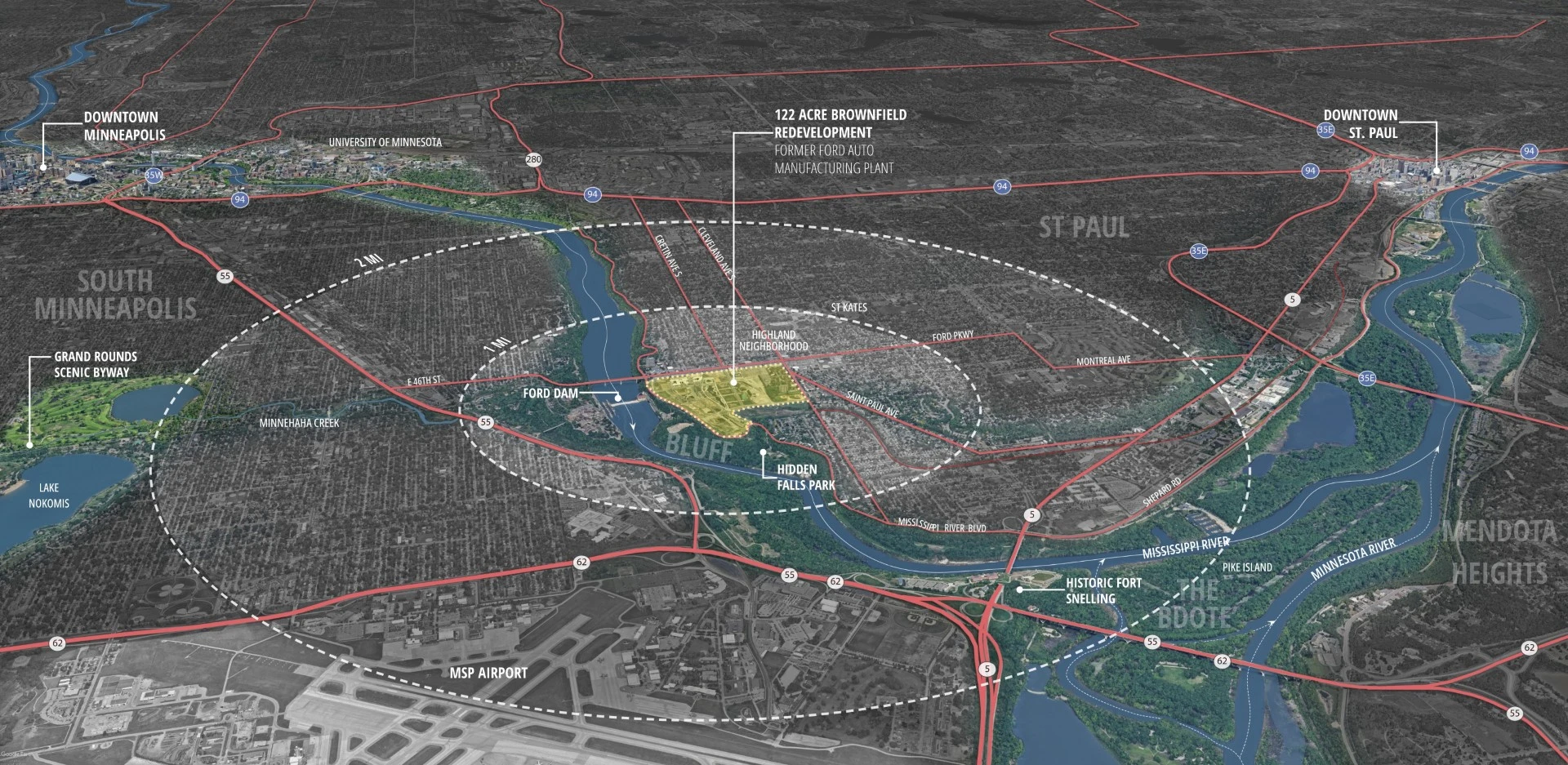
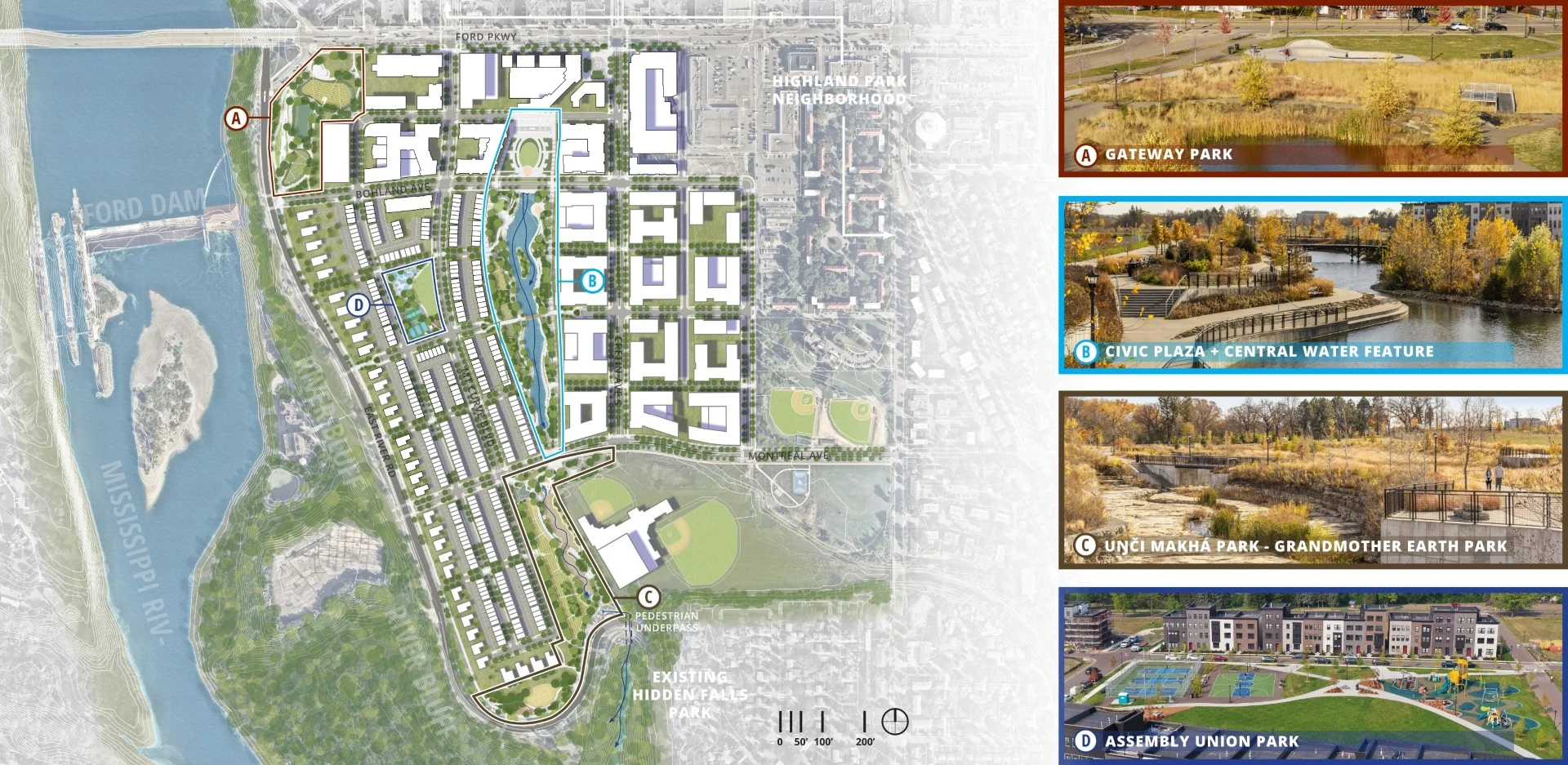
Highland Bridge is a 122-acre brownfield redevelopment beside the Mississippi River in Saint Paul, Minnesota, transforming the former Ford Assembly Plant site into a connected, mixed-income neighborhood organized by public space and water. More than 55 acres of parks and gathering spaces and 10 miles of bike and pedestrian routes establish a continuous public-realm network that connects neighborhoods to the river and supports 3,800 homes, including 20% affordable housing. This landscape-first framework offers a replicable model for river cities by treating public space as civic infrastructure that advances equitable growth and environmental repair.
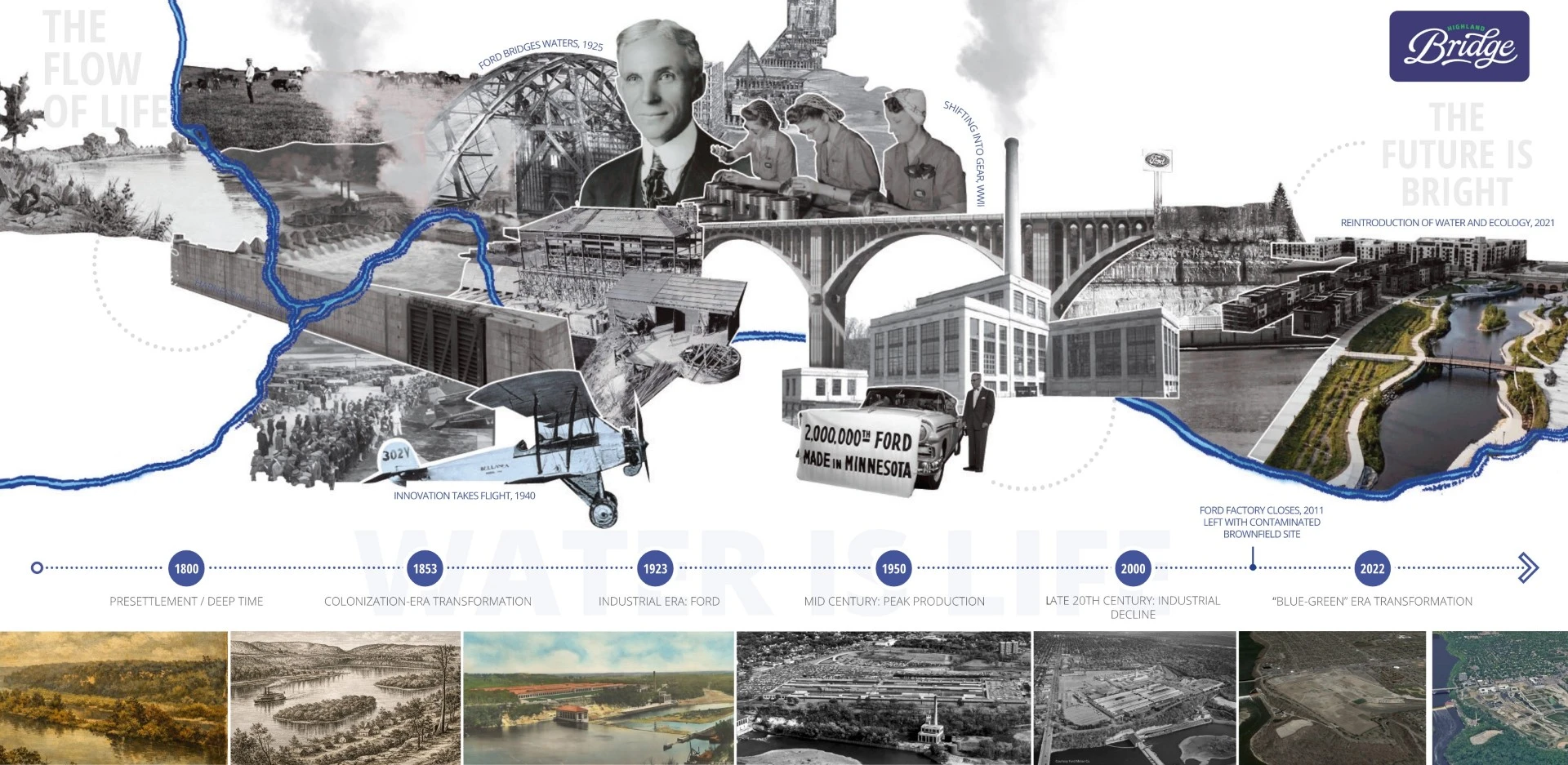
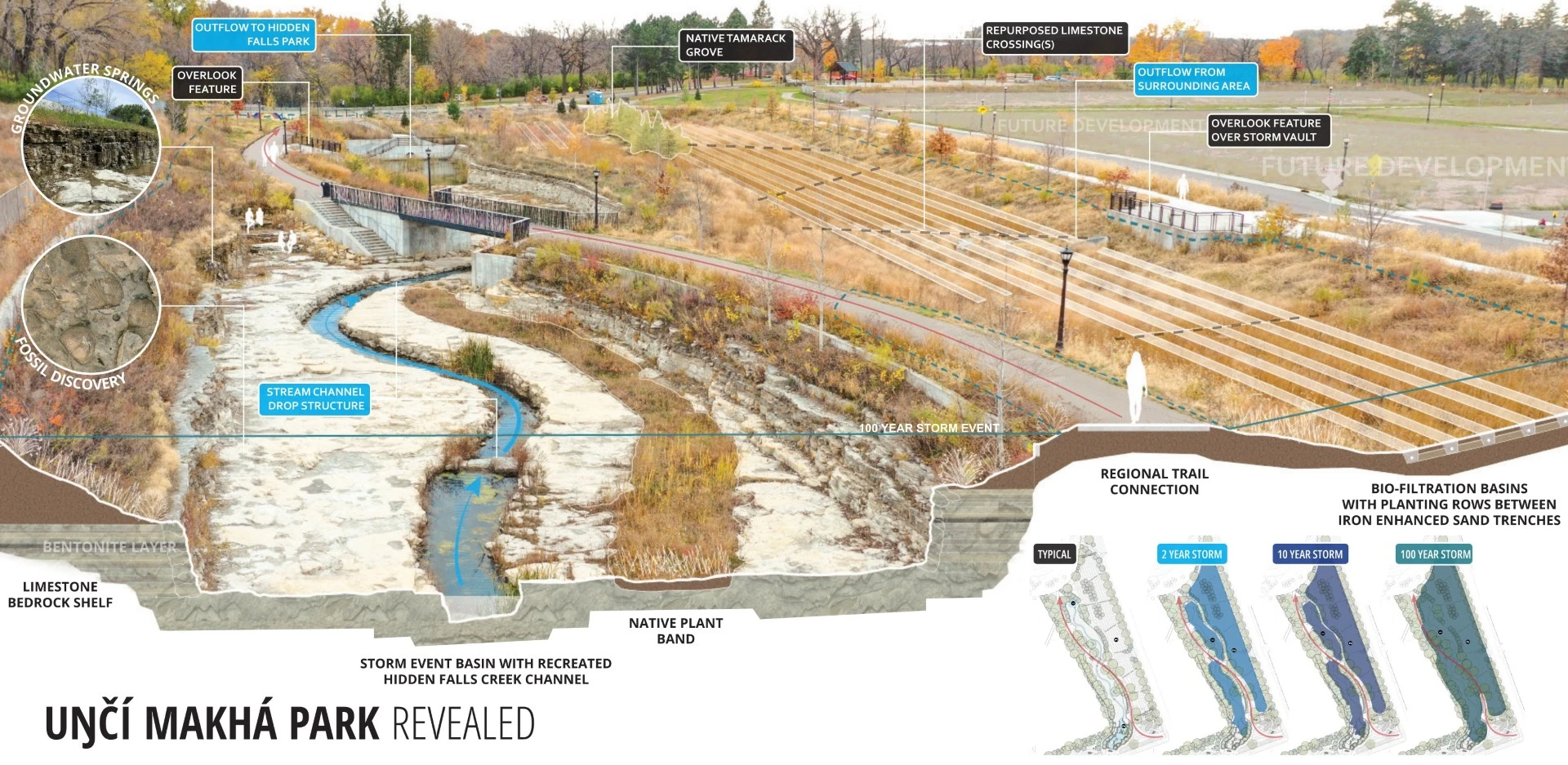
Highland Bridge is a healing story, and the medium is water. Long before the Ford plant rose on this site, the Dakota understood the nearby confluence of the Mississippi and Minnesota Rivers as sacred; water carried meaning as well as flow. With the Ford plant’s construction in 1925, Hidden Falls Creek was routed underground through a storm sewer. For decades, stormwater from the industrial landscape was conveyed downstream without treatment.
Cleanup came first. More than 440,000 cubic yards of contaminated soil were removed and properly managed, dismantling an industrial barrier that had severed the site’s connection to the river and surrounding neighborhoods. The redevelopment then made a defining decision: water and the public realm would organize the district.
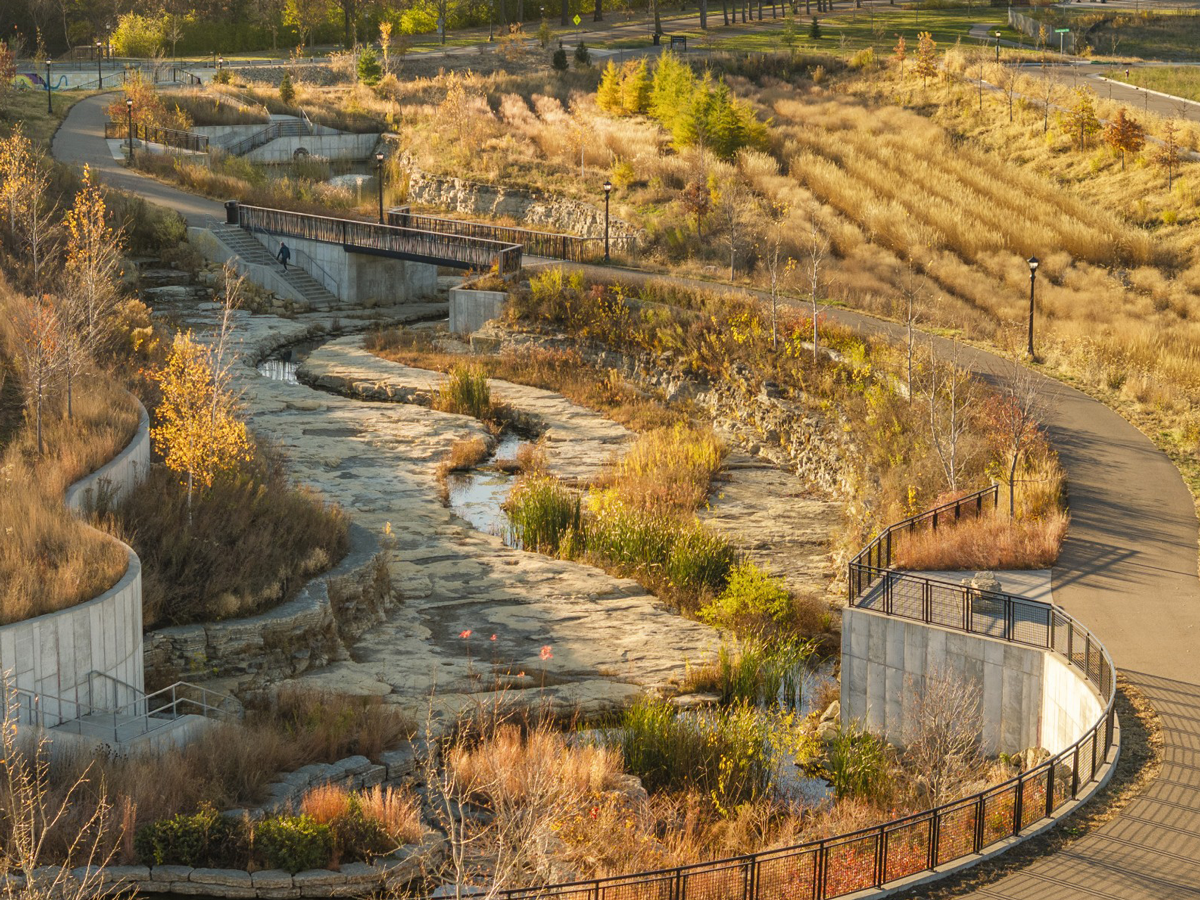
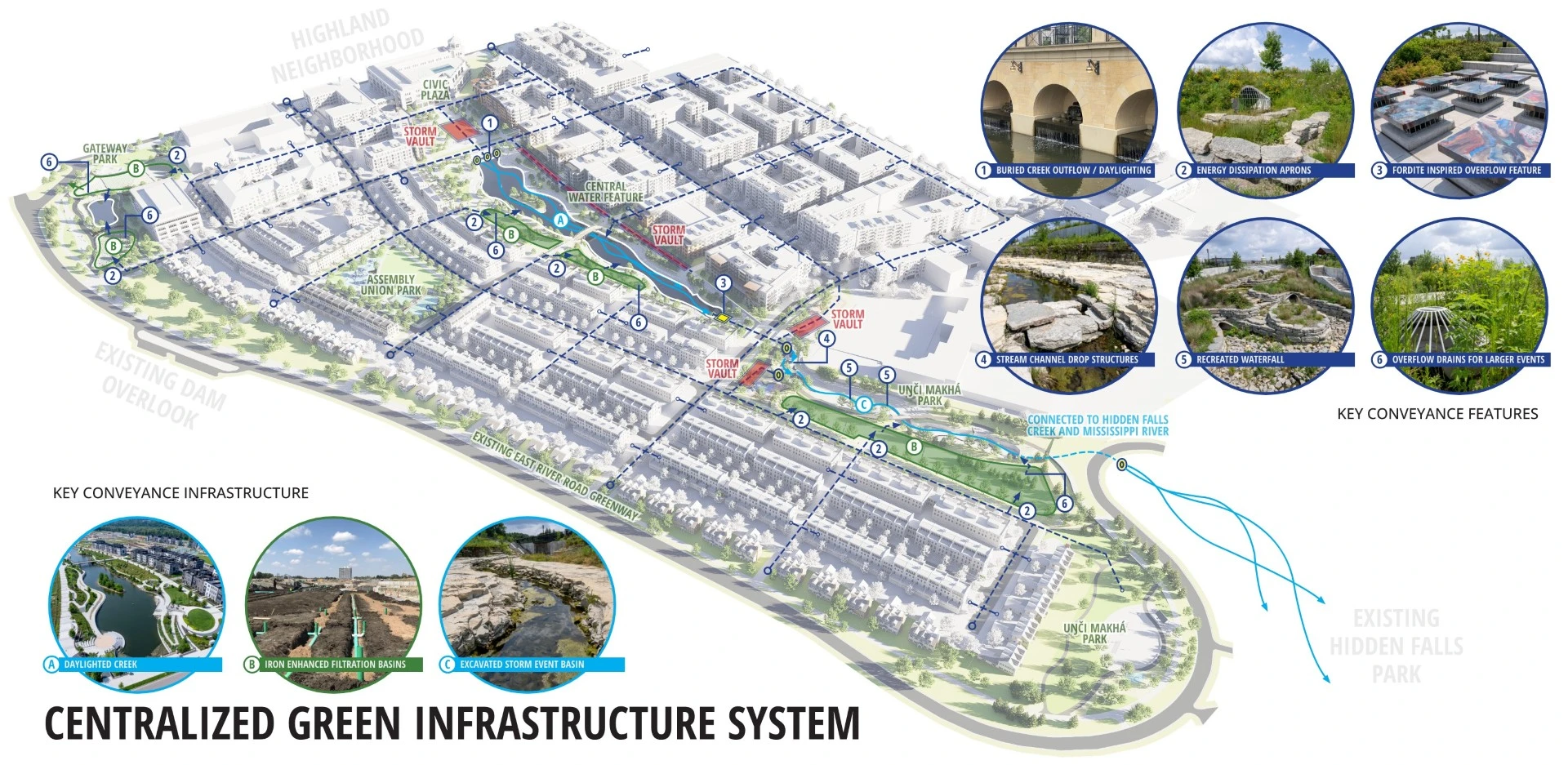
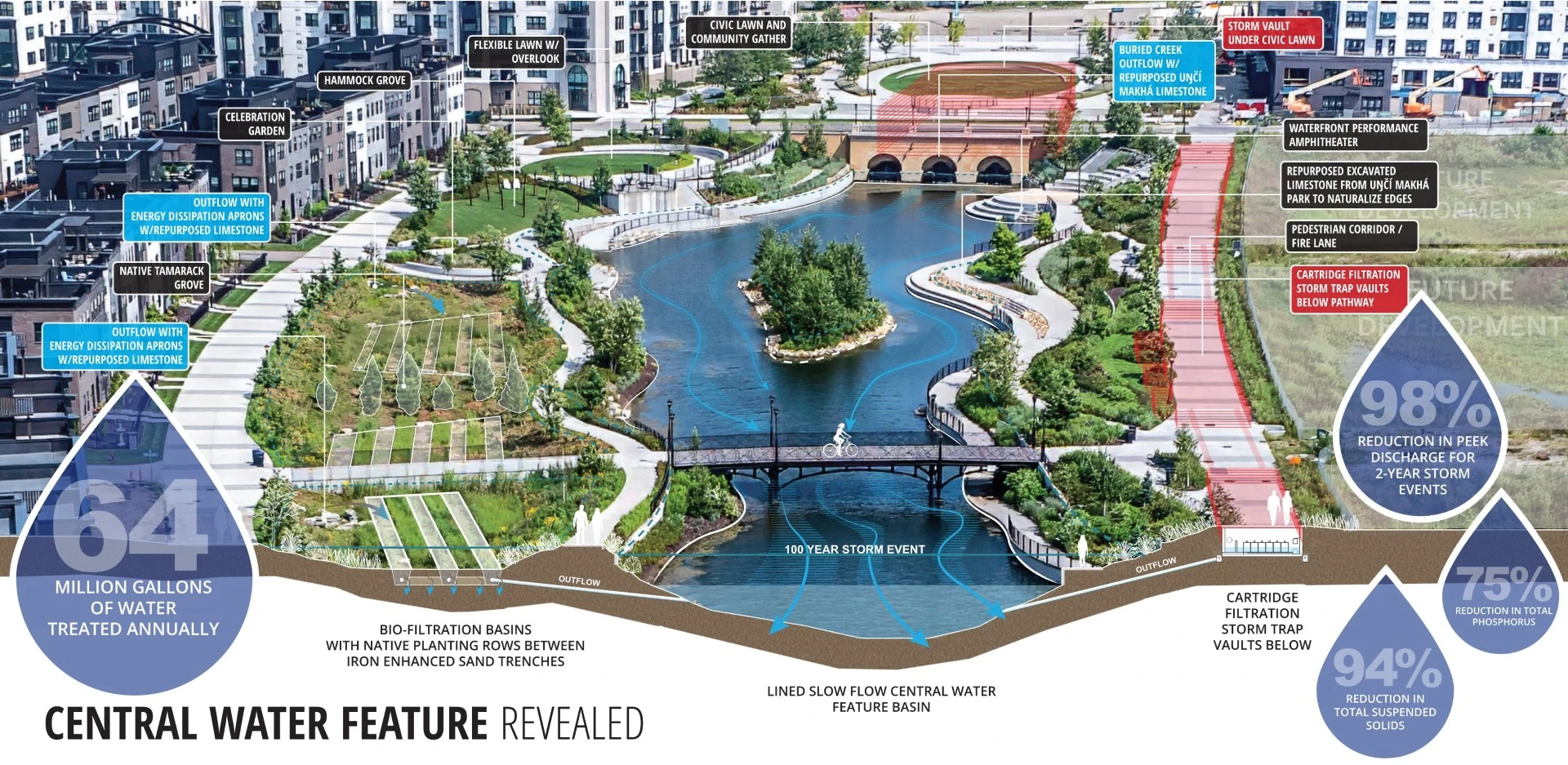
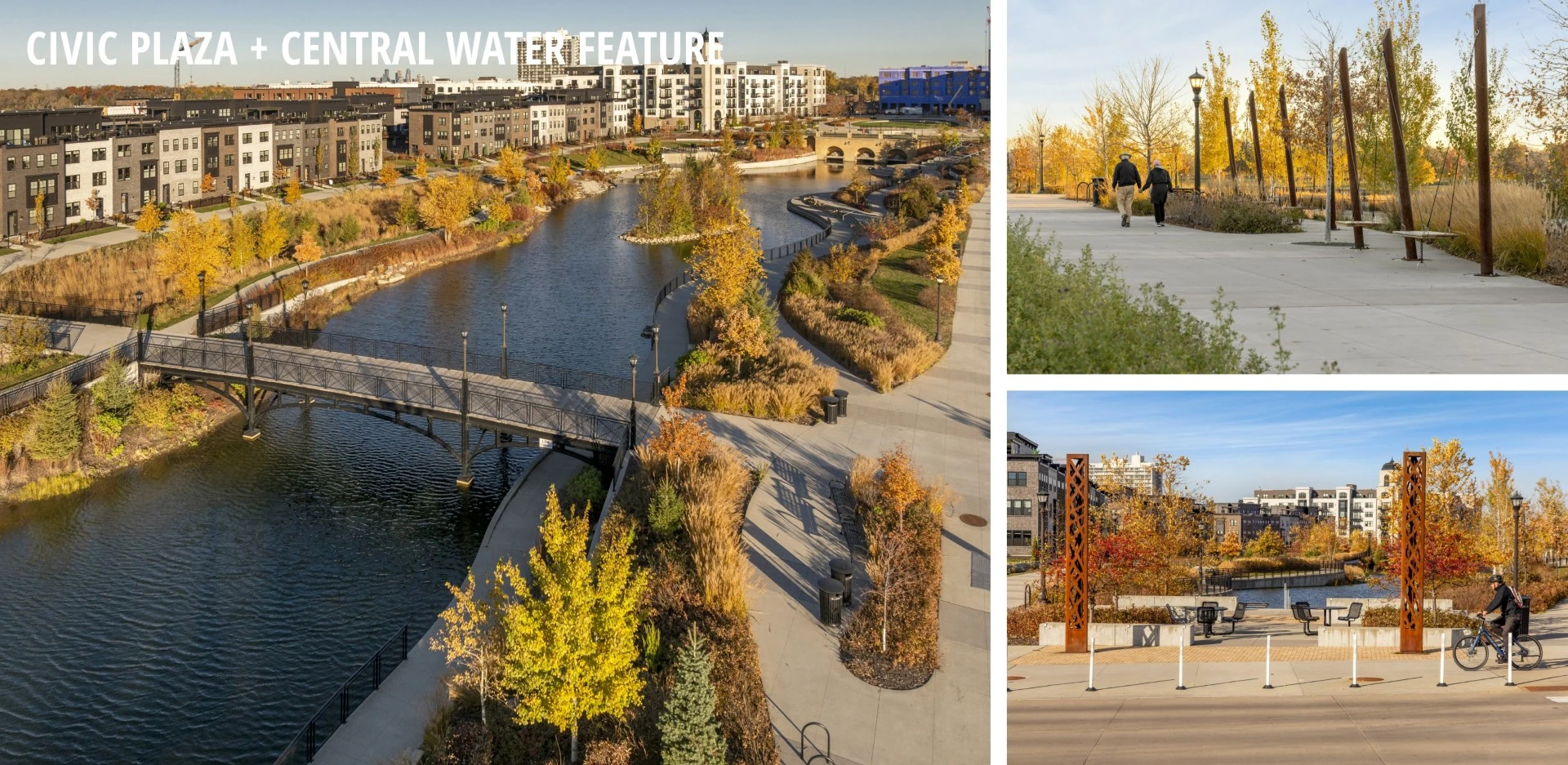
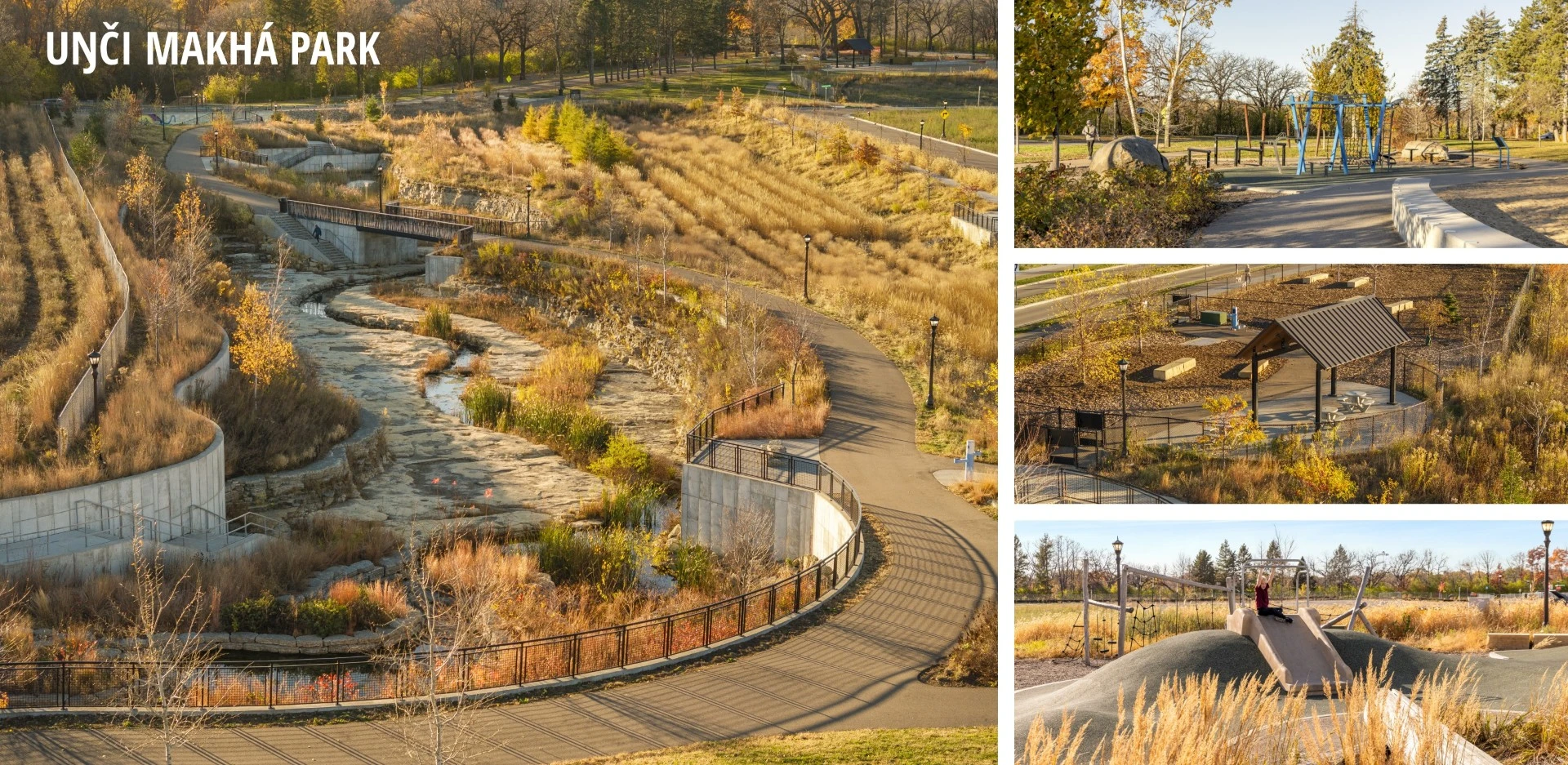
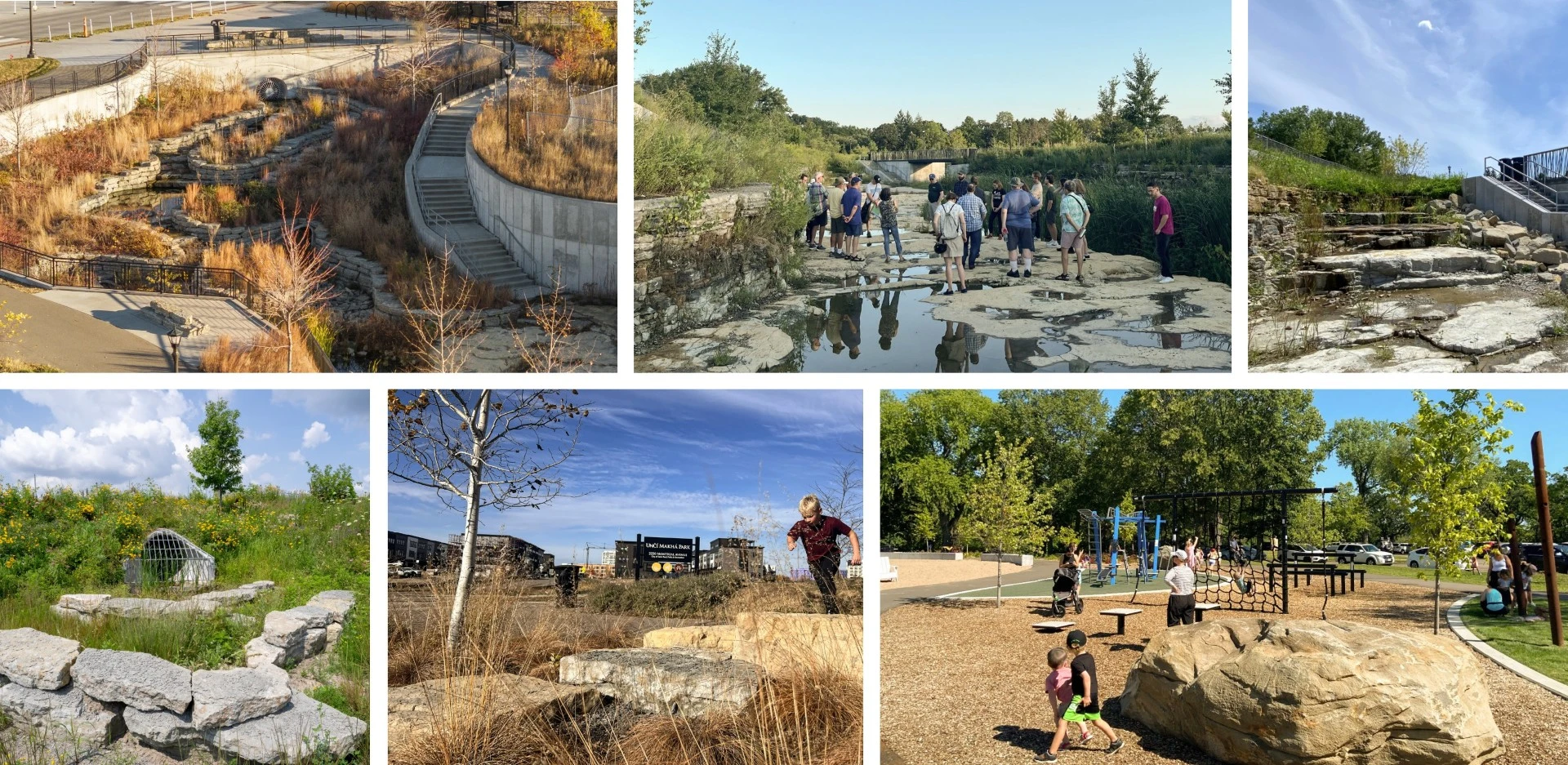
Instead of sending runoff directly into pipes, a centralized green-infrastructure system treats stormwater as a civic utility and a visible public amenity. Five biofiltration basins, two rate-control ponds, and five underground storage and filtration systems reduce peak flows and meter discharge. Engineered media, including iron-enhanced sand, binds dissolved pollutants. Treated water fills the central water feature as a civic focal point, anchoring a plaza with seating and water-edge access, then continues through a daylighted creek corridor that supports walking and exploration in normal conditions and safely carries storm flows before returning to the Mississippi. Roughly 64 million gallons from on- and off-site sources are treated annually, with measured reductions in total suspended solids and phosphorus and a 98% reduction in peak discharge for the two-year design storm. In 2025, the Water Environment Federation recognized this district-scale stormwater framework with a Project Excellence Award for water-quality performance.
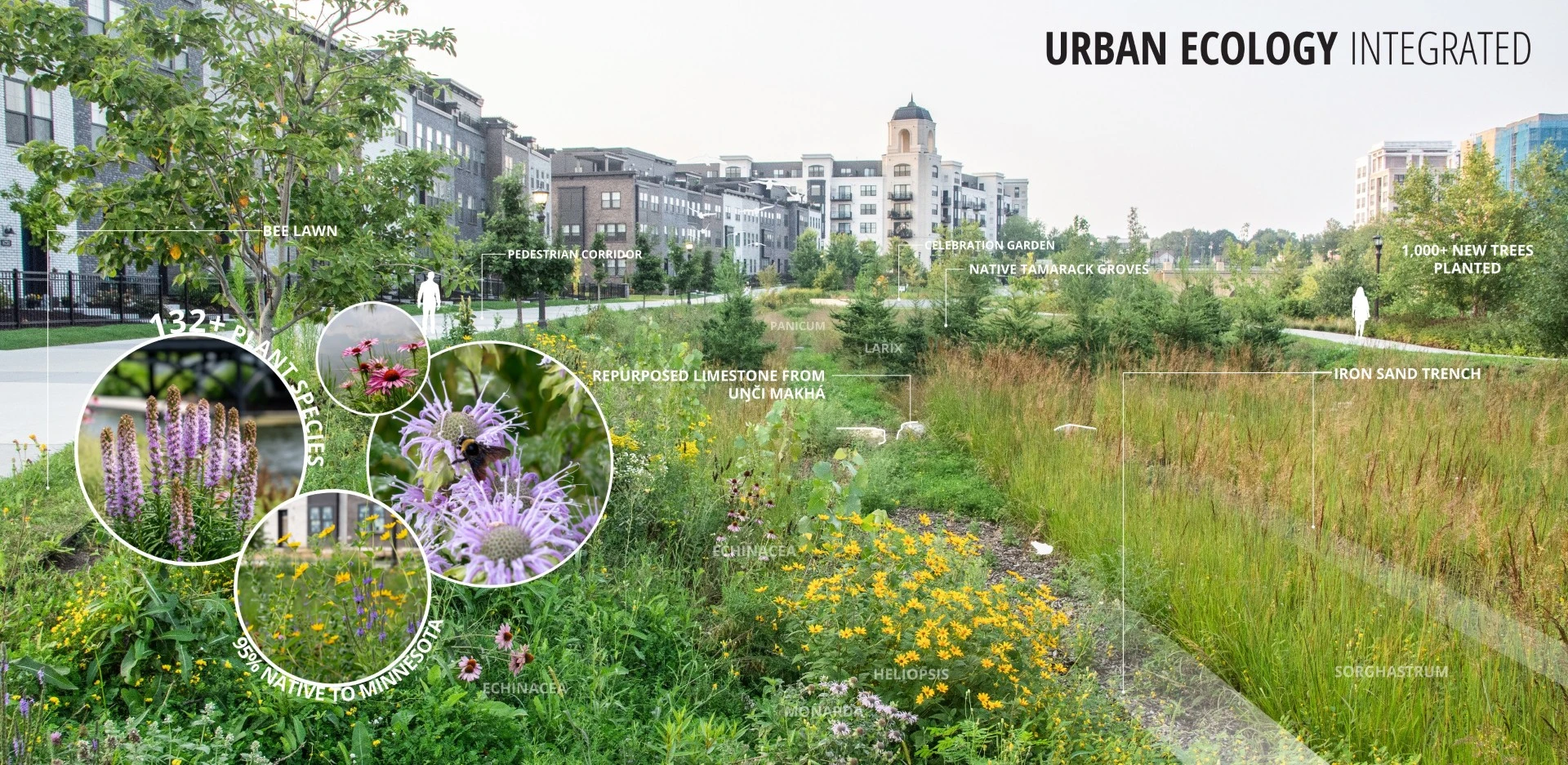
Stewardship is built into the ground plane. Remediation, testing, and soil rebuilding created a foundation for more than 1,000 new trees and 132 plant species, 95% native to Minnesota, strengthening habitat, shade, and seasonal identity while reducing irrigation demand and maintenance requirements. A decade-long public process with more than 200 community events shaped priorities for inclusive everyday use, supporting long-term neighborhood viability and reinvestment.
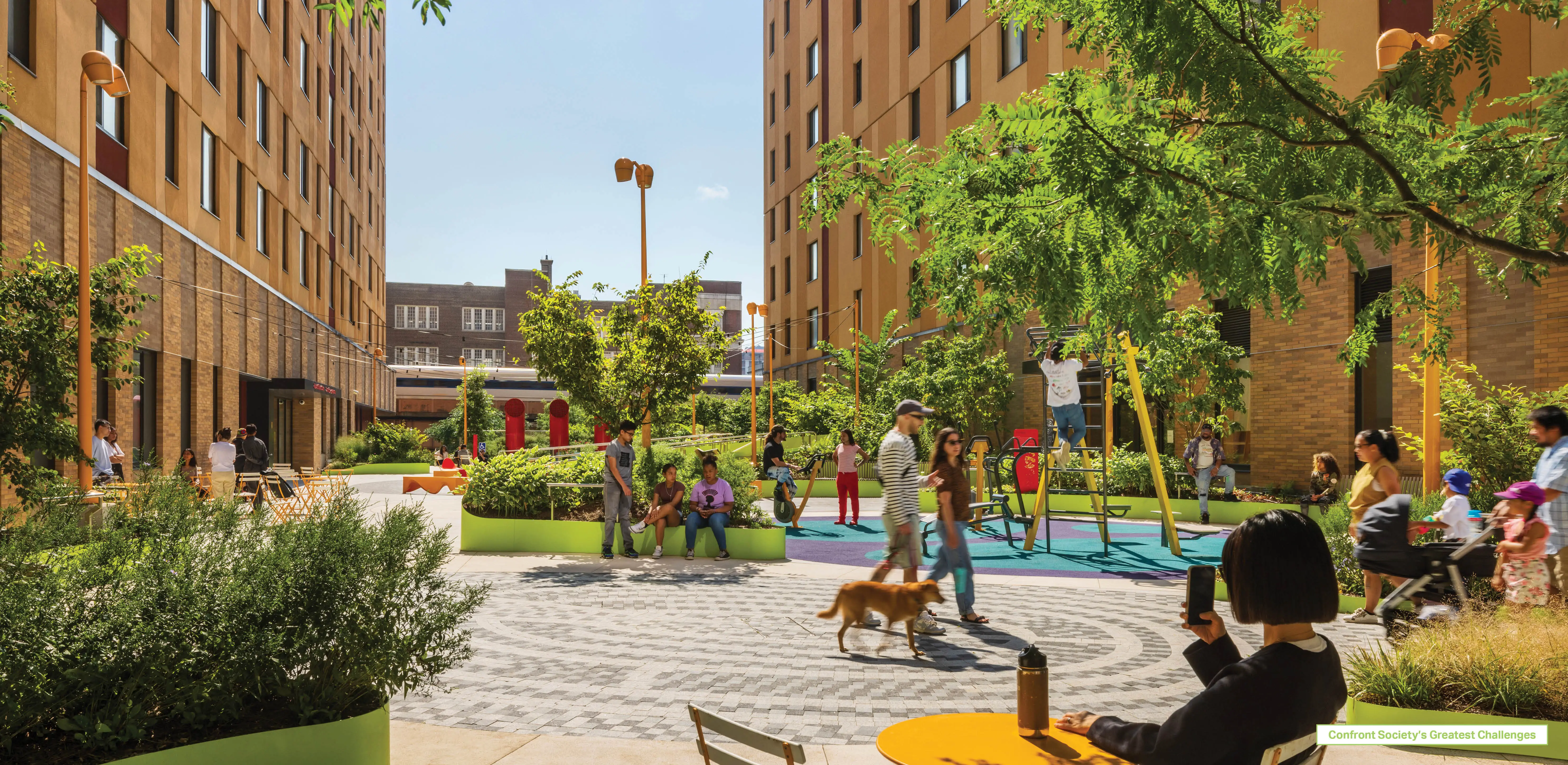
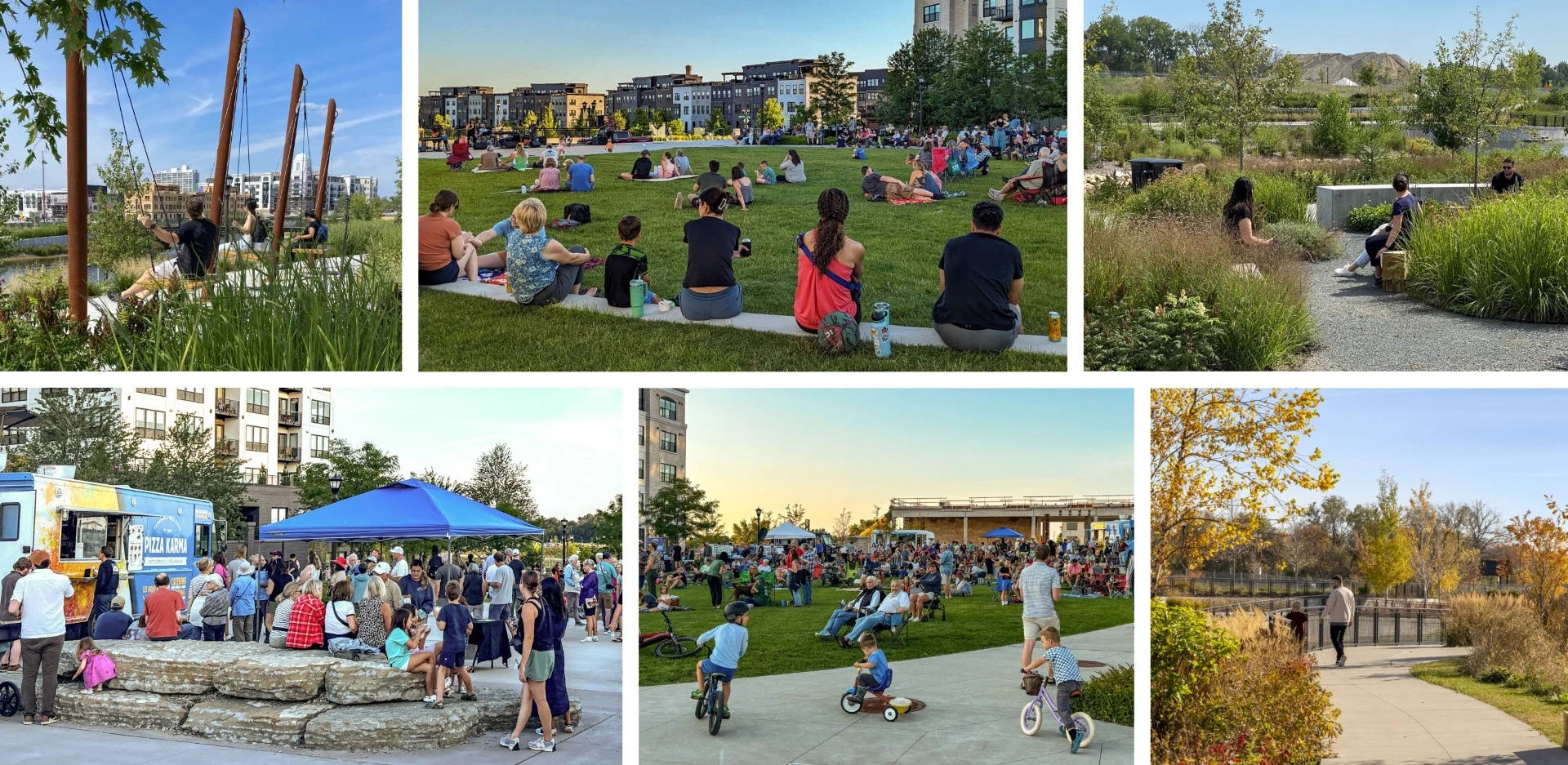
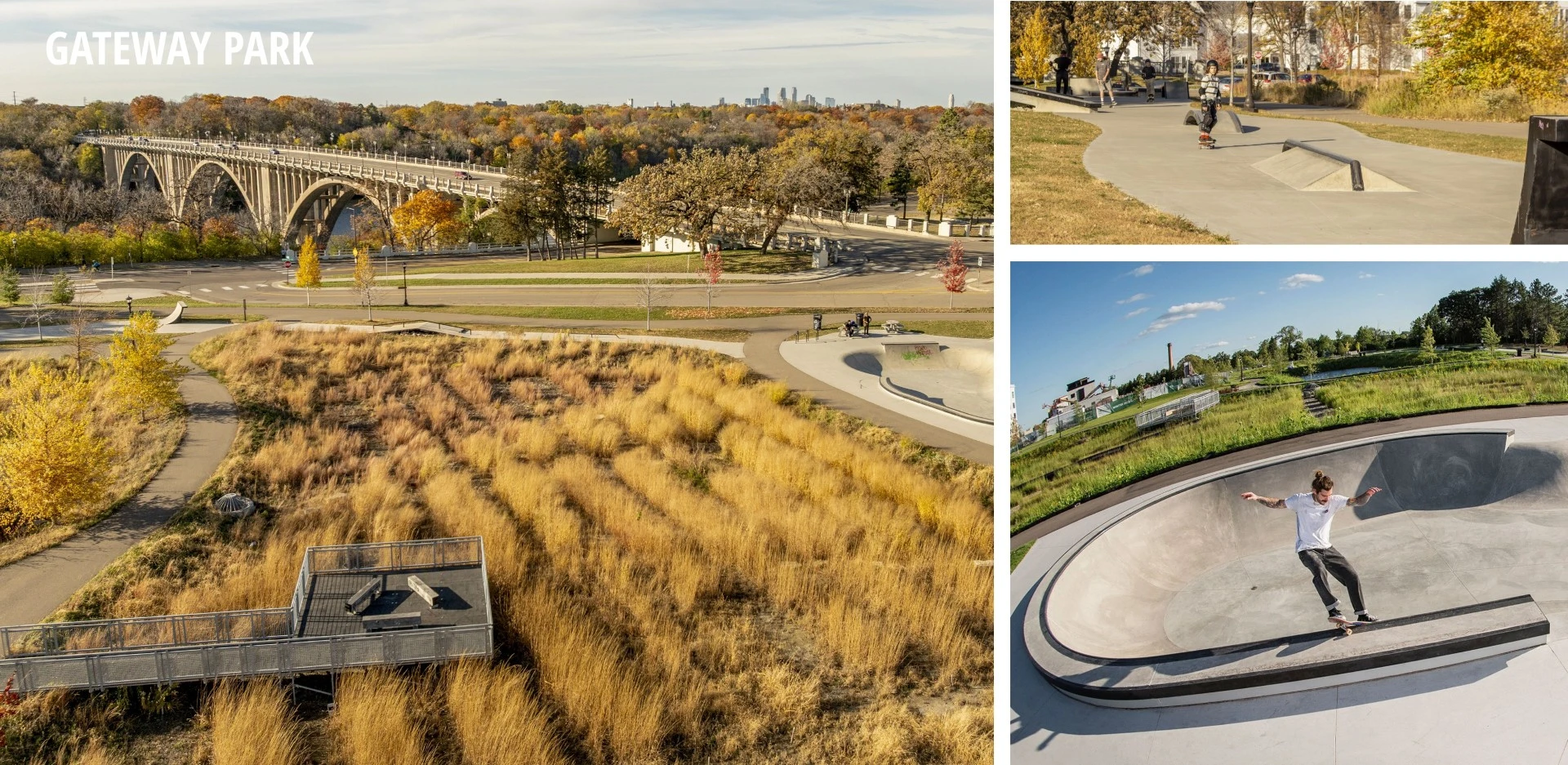
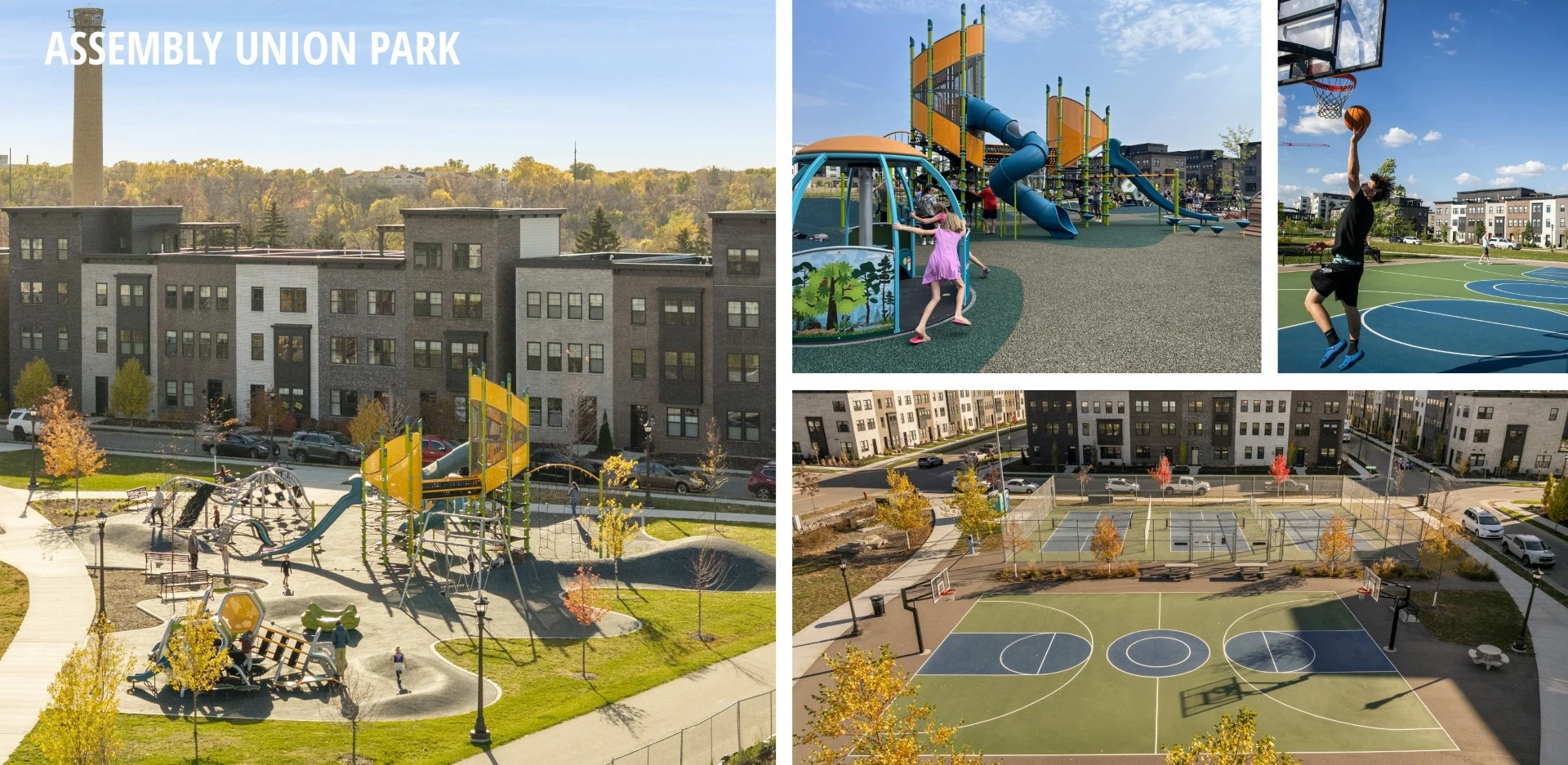
Highland Bridge’s public realm is conceived as a connected sequence of parks, plazas, play environments, and flexible lawns that support daily use across ages and abilities and carry the water story through the neighborhood, making water a shared amenity and a visible act of repair. Delivering that outcome required close coordination among the city, watershed and engineering partners, and the master developer to align remediation, streets and trails, public spaces, and stormwater treatment as one urban framework.
-
- Ryan Companies, Developer/General Contractor - Client
- City of St. Paul, Parks and Recreation - Client
- Capitol Region Watershed District (CRWD), Approval Agency - Project Partner
- Barr Engineering, Water Resource Engineer
- Kimley Horn Engineering, Civil Engineer
- Bolander, Earthworks Contractor
- Windsor Landscaping, Landscape Contractor
- Peterson Companies, Landscape Contractor
- ERA, Structural Engineers
- Spohn Ranch, skatepark contractor
- Ryan Companies Engineering, Civil Engineering
- Sambatek, Engineering
-
- Freeman Maple / Acer freemanii ‘Sienna Glen’
- River Birch / Betula nigra
- Common Hackberry / Celtis occidentalis
- Kentucky Coffeetree / Gymnocladus dioica ‘Espresso’
- Prairie Gold Aspen / Populus tremuloides ‘NE Arb’
- Swamp White Oak / Quercus bicolor
- Northern Pin Oak / Quercus ellipsoidalis
- Firefall Maple / Acer × freemanii ‘Af#1’
- Skyline Thornless Honey Locust / Gleditsia triacanthos inermis ‘Skycole’
- Autumn Splendor Buckeye / Aesculus × arnoldiana ‘Autumn Splendor’
- Whitespire Birch / Betula populifolia ‘Whitespire’
- True North Kentucky Coffeetree / Gymnocladus dioica ‘UMNSynergy’
- White Oak / Quercus alba
- Prairie Expedition American Elm / Ulmus americana ‘Lewis & Clark’
- American Elm / Ulmus americana ‘New Harmony’
- Imperial Honeylocust / Gleditsia triacanthos inermis ‘Impcole’
- Prairie Dream Paper Birch / Betula papyrifera ‘Varen’
- Quaking Aspen / Populus tremuloides
- Norway Spruce / Picea abies
- Korean Fir / Abies koreana
- Eastern Red Cedar / Juniperus virginiana
- Tamarack / Larix laricina
- Royal Splendor Norway Spruce / Picea abies ‘Noel’
- Black Hills Spruce / Picea glauca ‘Densata’
- White Pine / Pinus strobus
- Autumn Brilliance Serviceberry / Amelanchier × grandiflora ‘Autumn Brilliance’
- Sugar Tyme Crabapple / Malus × ‘Sugar Tyme’
- Prairie Maid Crabapple / Malus × ‘Prairie Maid’
- Thornless Cockspur Hawthorn / Crataegus crus-galli inermis
- Prairie Crabapple / Malus × ‘Prairifire’
- Spring Flurry Allegheny Serviceberry / Amelanchier laevis ‘JFS-Arb’
- Muskingum Gray Dogwood / Cornus racemosa ‘Muszam’
- Dwarf Bush Honeysuckle / Diervilla lonicera
- Sem Ash Leaf Spirea / Sorbaria sorbifolia ‘Sem’
- Iroquois Beauty Black Chokeberry / Aronia melanocarpa ‘Iroquois Beauty’
- Gray Dogwood / Cornus racemosa
- Fragrant Sumac / Rhus aromatica
- Gro-low Fragrant Sumac / Rhus aromatica ‘Grow-Low’
- Cardinal Red Twig Dogwood / Cornus sericea ‘Cardinal’
- Arctic Fire Red Twig Dogwood / Cornus stolonifera ‘Farrow’
- American Black Currant / Ribes americanum
- Arctic Blue Leaf Willow / Salix purpurea ‘Nana’
- Blue Muffin Arrowwood Viburnum / Viburnum dentatum ‘Christom’
- Walkers Low Catmint / Nepeta × faassenii ‘Walkers Low’
- Korean Feather Reed Grass / Calamagrostis arundinacea brachytricha
- Prairie Dropseed / Sporobolus heterolepis
- Red October Big Bluestem / Andropogon gerardii ‘Red October’
- Blue False Indigo / Baptisia australis
- Blonde Ambition Blue Grama / Bouteloua gracilis ‘Blonde Ambition’
- Coneflower / Echinacea purpurea
- Kobold Spike Gayfeather / Liatris spicata ‘Kobold’
- Shenandoah Switch Grass / Panicum virgatum ‘Shenandoah’
- Little Bluestem Grass / Schizachyrium scoparium
- Blue Heaven Little Bluestem / Schizachyrium scoparium ‘MinnblueA’
- Showy Goldenrod / Solidago speciosa
- Gold Dew Tufted Hair Grass / Deschampsia cespitosa ‘Goldtau’
- Ruby Star Coneflower / Echinacea purpurea ‘Ruby Star’
- Goatsbeard / Aruncus dioicus
- Swamp Milkweed / Asclepias incarnata
- Raspberry Wine Bee Balm / Monarda didyma ‘Raspberry Wine’
- Hoary Vervain / Verbena stricta
- Filtration Basin Plug Mix – Little Bluestem, Indian Grass, Switch Grass
- Native Seed Mix – MnDOT Seed Mix 35-24
- Storm Seed Mix – MnDOT Seed Mix 33-261
- Bee Lawn Seed Mix – Shooting Star Native Seed ‘Bee Lawn Mix’
Advertisement
Related Awards
Honors Award, Urban Design
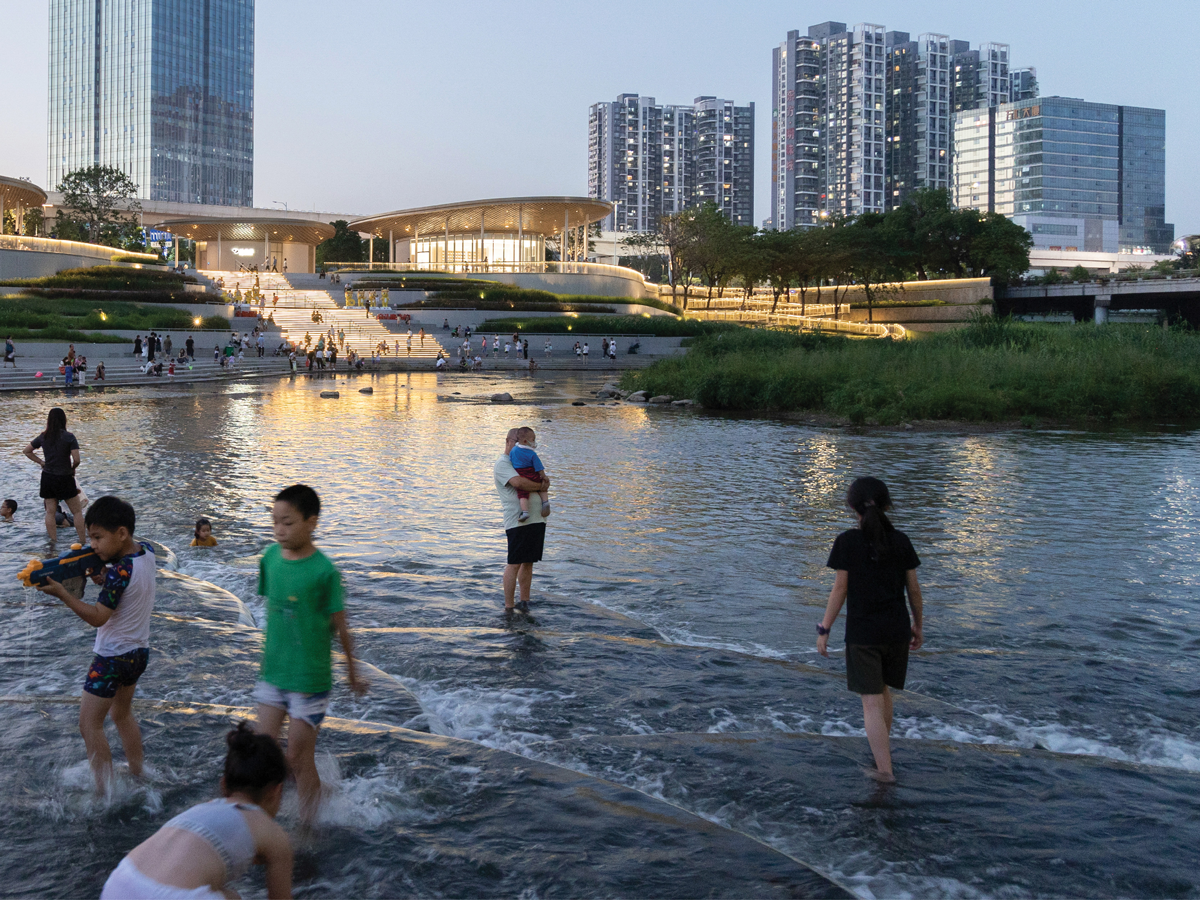
Restoring a River, Reconnecting a City: Longgang River Blueway
Over the past half century, rapid urbanization forced Shenzhen rivers into concrete channels, cutting communities off from nature and increasing flood risk. Spanning 20 kilometers, the Longgang River Blueway reshapes a former drainage corridor into a resilient, accessible public landscape.