
.webp?language=en-US)
.webp?language=en-US)
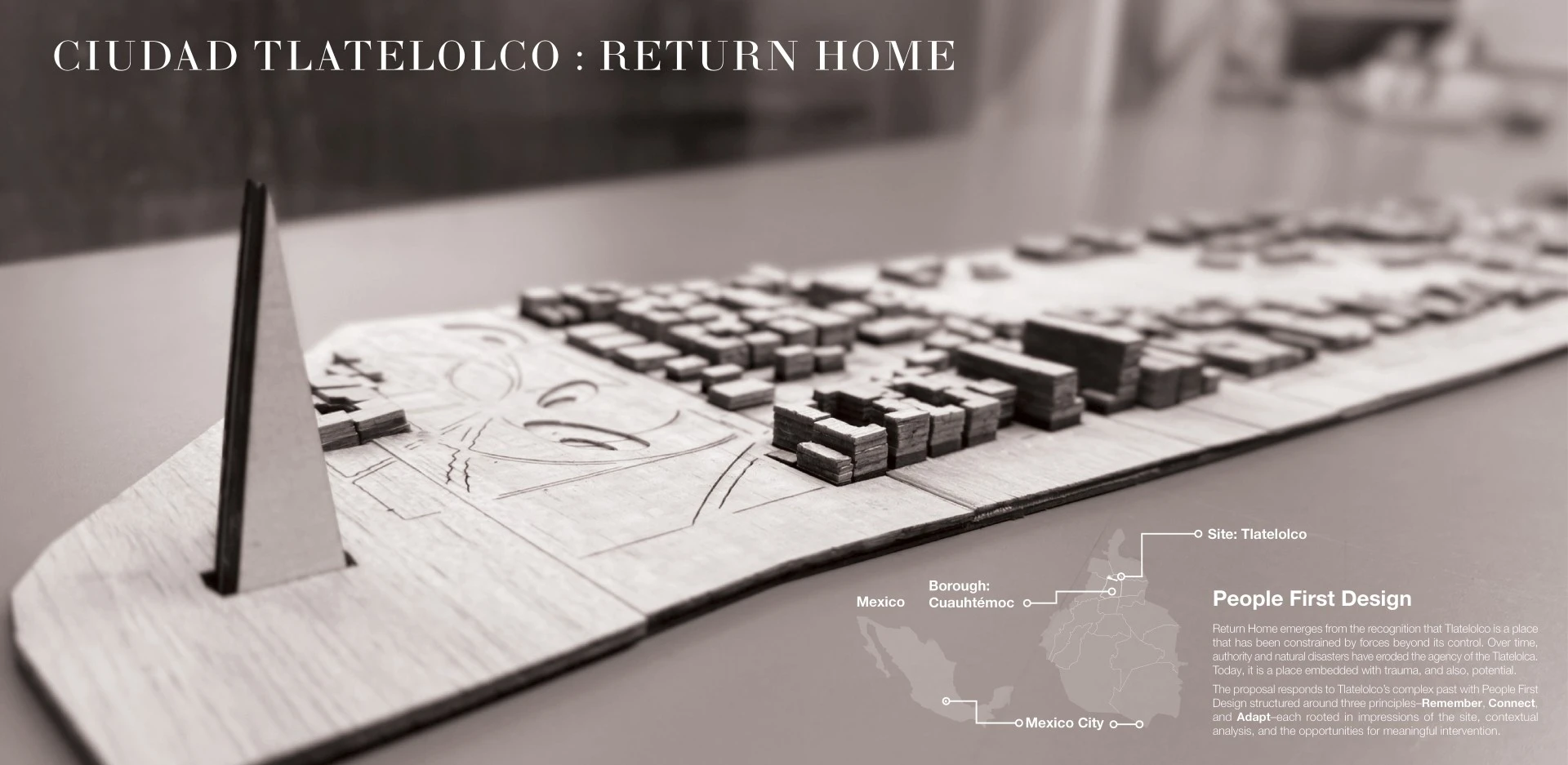
Ciudad Tlatelolco: Return Home
Anna Michelle Earley, Student ASLA; Jacob Bratsch; Halina Pyzdrowski, Student ASLA


Plan is well thought-out, with elements addressing historical, environmental and urban density concerns.
Awards Jury
-
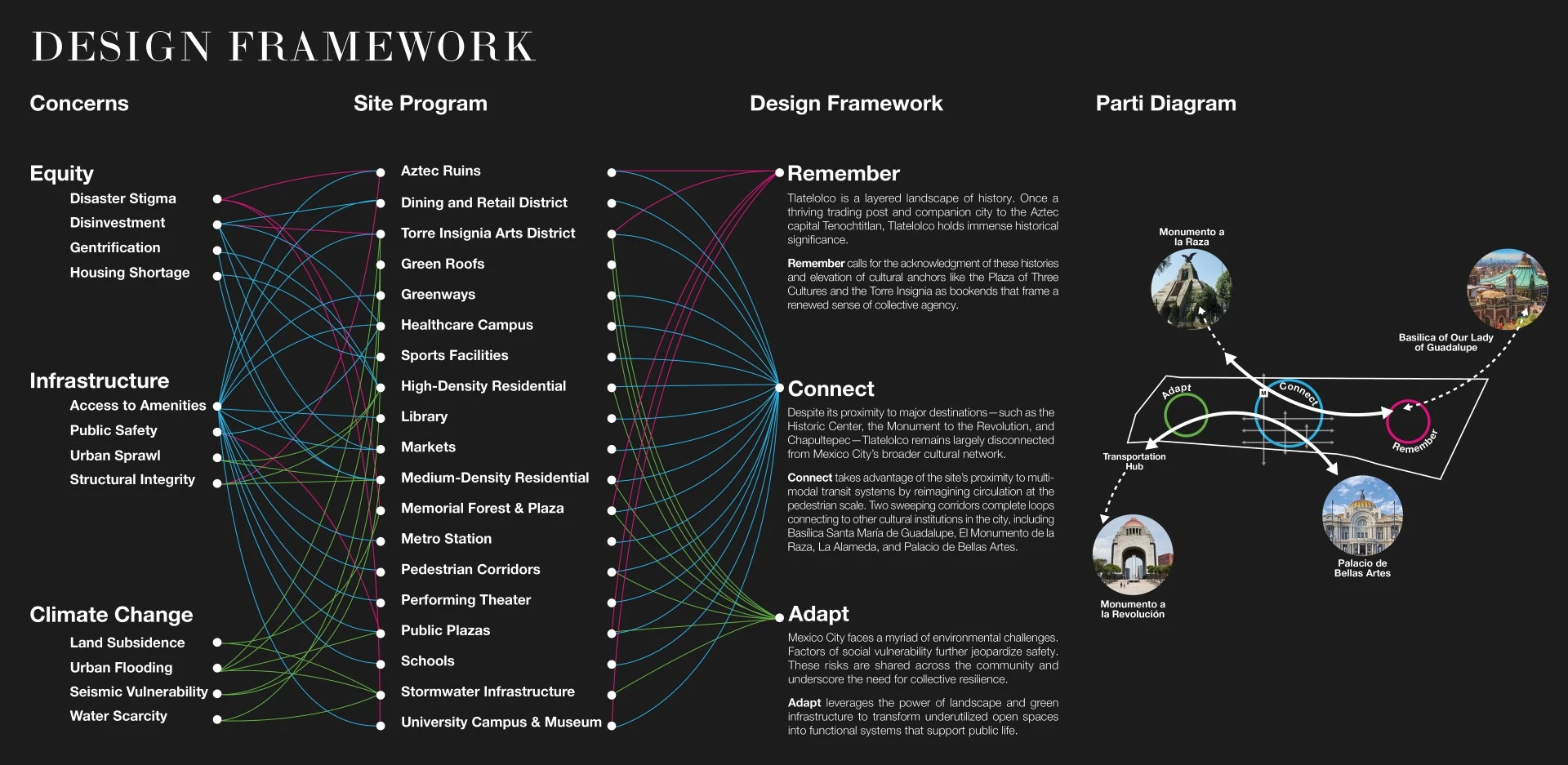
Once a companion city to Tenochtitlan, Tlatelolco carries one of Mexico City's most layered cultural legacies. A site of Spanish conquest, a student massacre, and deadly earthquake, Tlatelolco has become synonymous with the nation's greatest tragedies. Ciudad Tlatelolco: Return Home responds with People First Design grounded in three principles: Remember elevates cultural anchors to restore collective agency; Connect reintegrates Tlatelolco into the urban fabric; Adapt transforms open space into functional green infrastructure. Three pilot projects ground-truth these strategies and make the case for landscape-forward urbanism as a powerful tool for restoration.
-
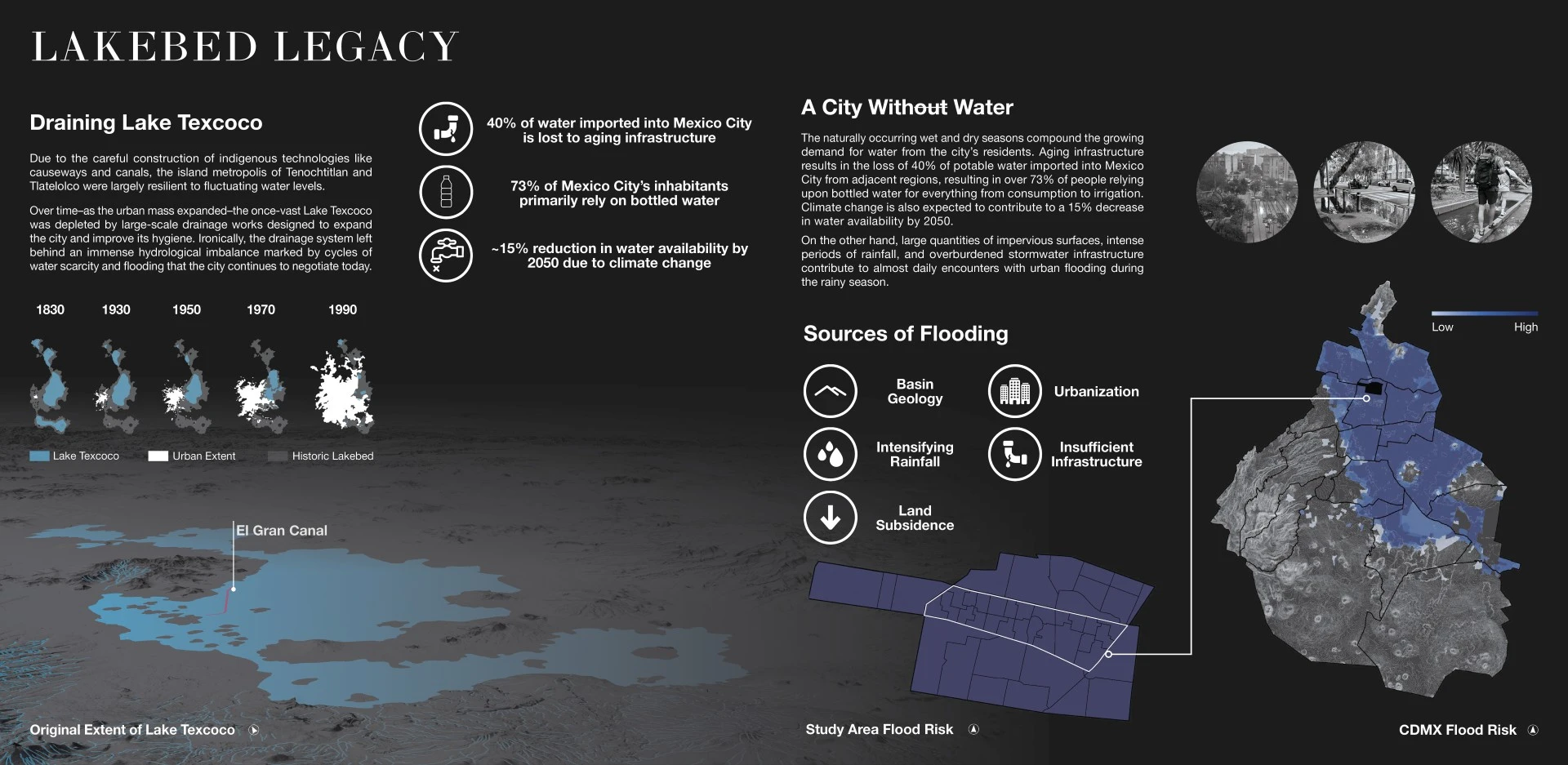
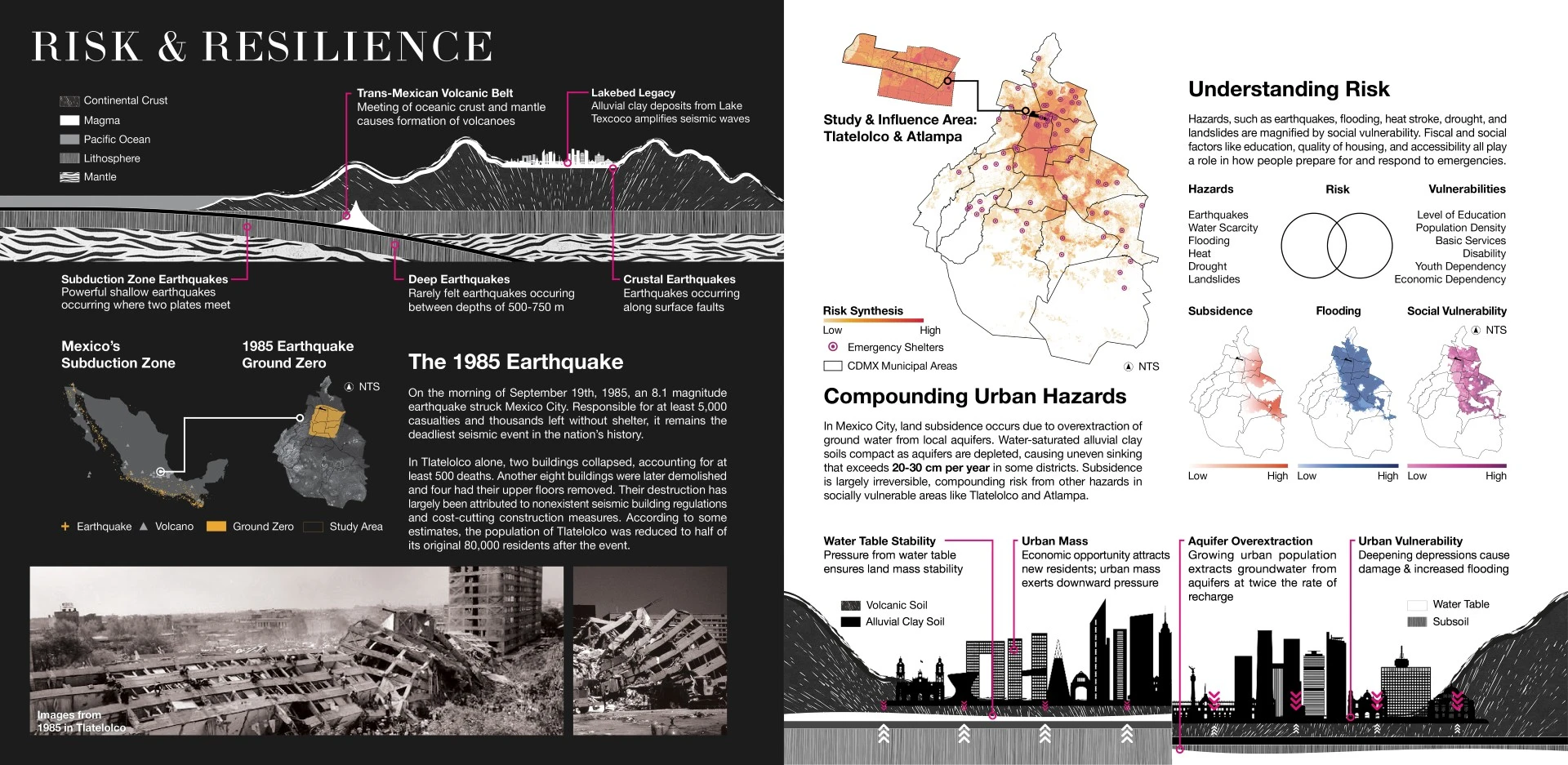
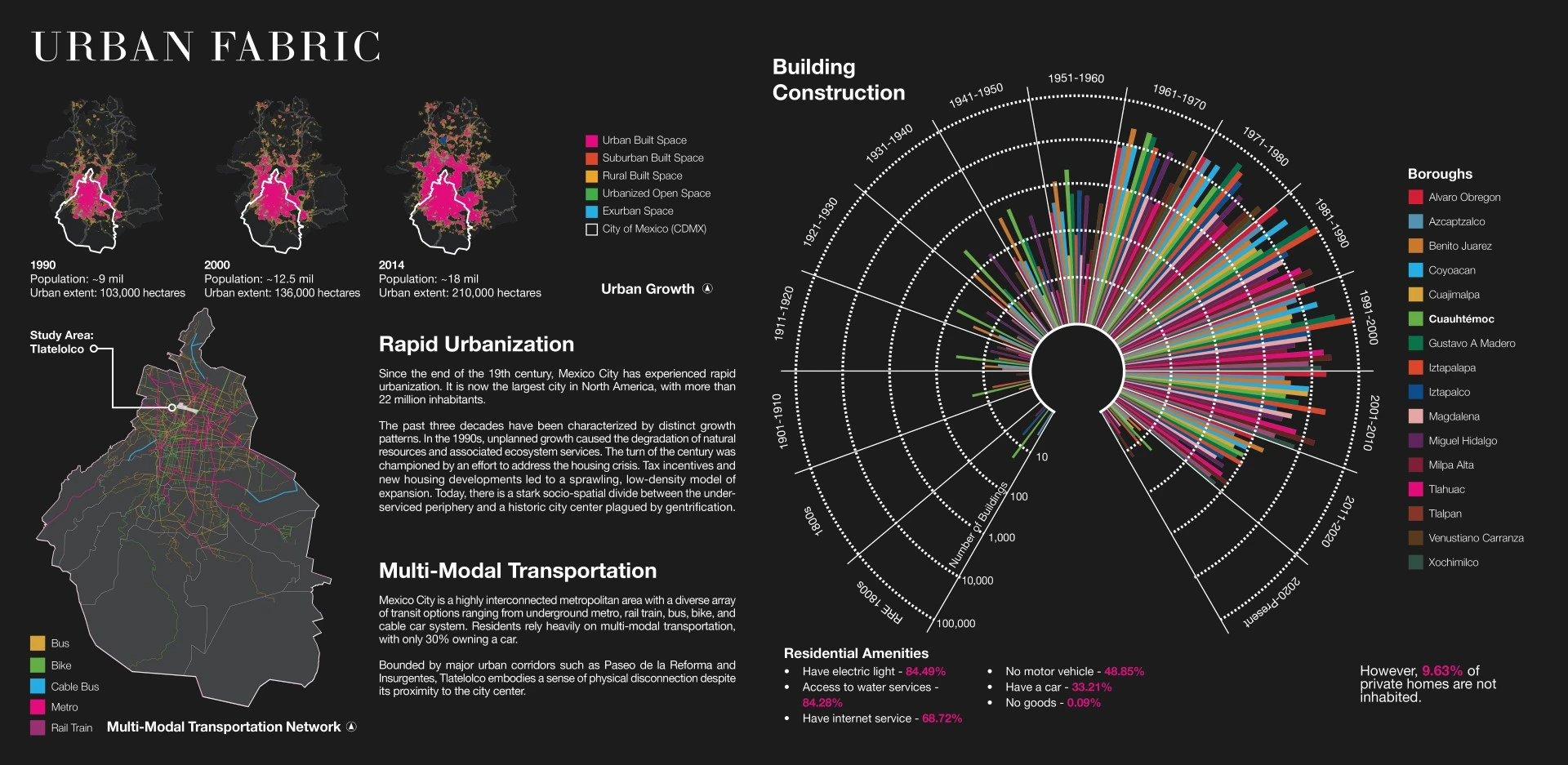
Mexico City was originally founded as an island metropolis within Lake Texcoco. After the Spanish conquest, large-scale drainage works ushered water from the city, contributing to water scarcity, flooding, and land subsidence. Mexico City's location along the Trans-Mexican Volcanic Belt also intensifies seismic hazard, disproportionately increasing risk in the historic center. Now home to more than 22 million inhabitants, rapid urbanization and inequity compound vulnerability to climate change.
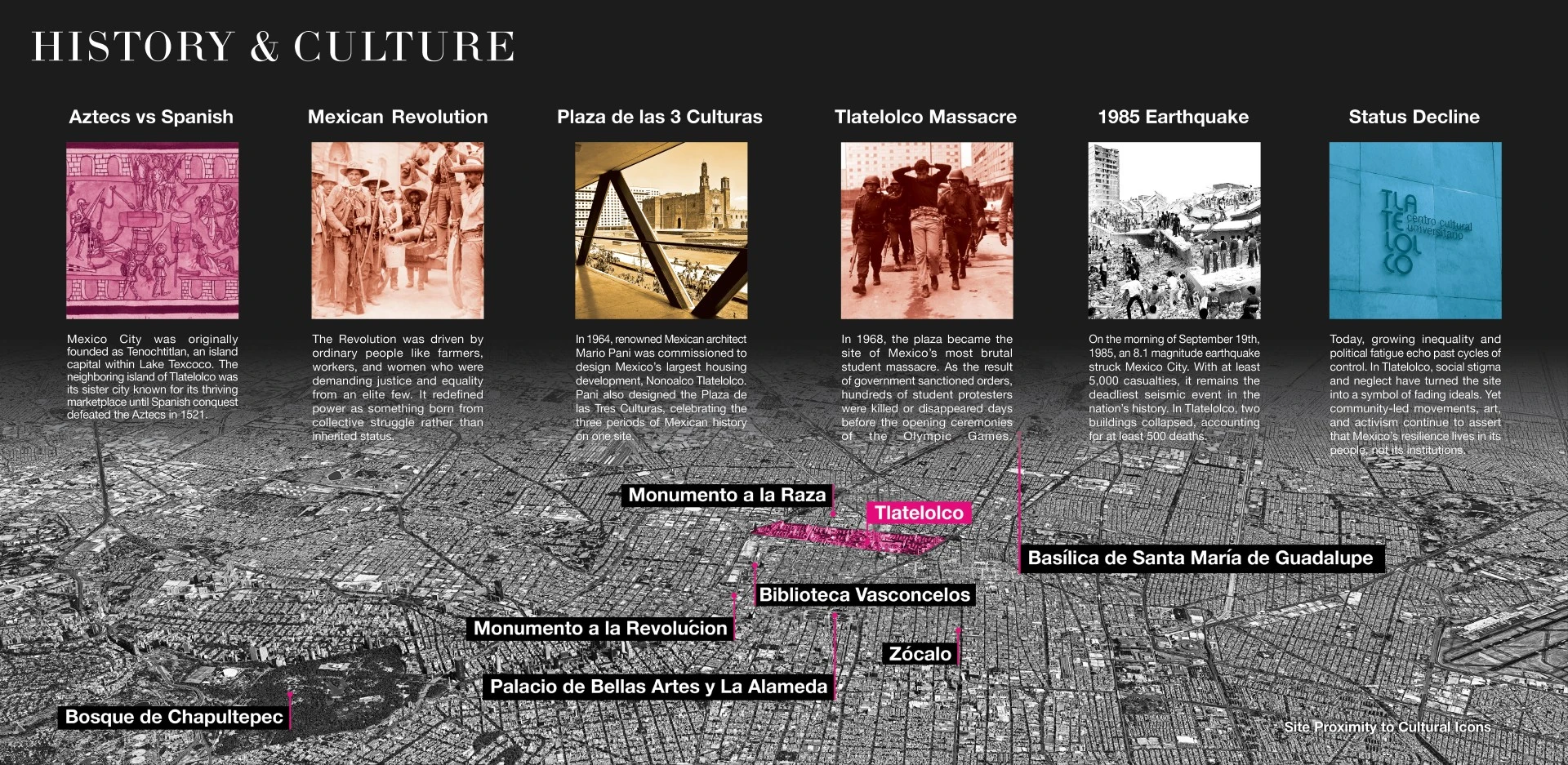
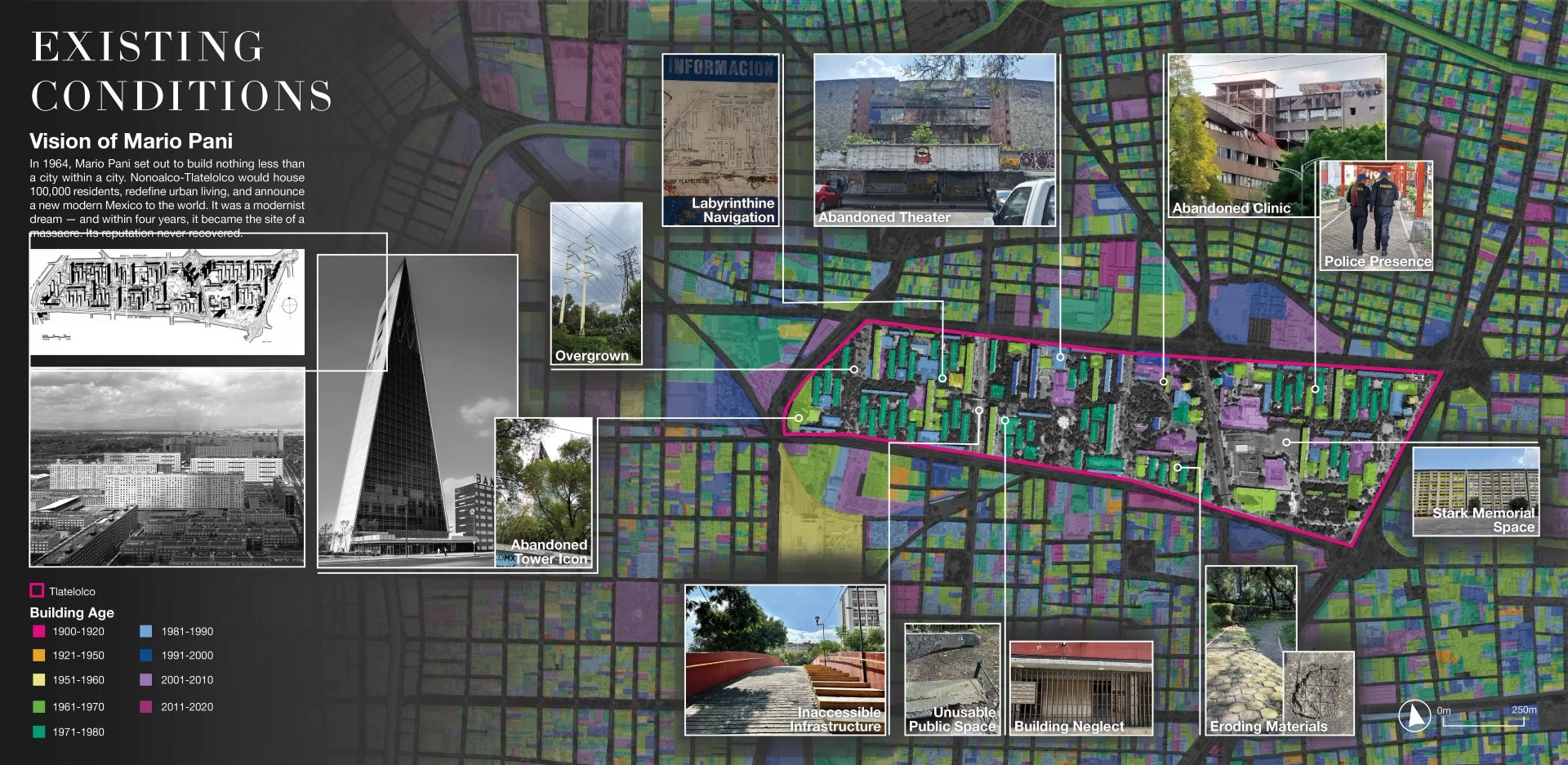
In 1964, Mario Pani was commissioned to redesign Tlatelolco into Mexico's largest mixed-use development. His utopic design for Conjunto Urbano Nonoalco Tlatelolco imagined "A City Within A City" and sought to position Mexico as a progressive leader on the world stage.
Central to his vision was the Plaza de las Tres Culturas which honored the nation's indigenous, colonial, and modernist histories. Four years after its completion, the plaza became the site of a government-sanctioned massacre of student protesters prior to the 1968 Olympic Games.
Less than a decade later, an 8.1 magnitude earthquake caused the collapse of two apartment buildings in Tlatelolco. According to some estimates, the population of Tlatelolco was reduced to half of its original occupancy.
Today, deteriorated buildings, unusable green spaces, and major automobile corridors like Paseo de la Reforma physically isolate Tlatelolco from the vibrant city surrounding it.
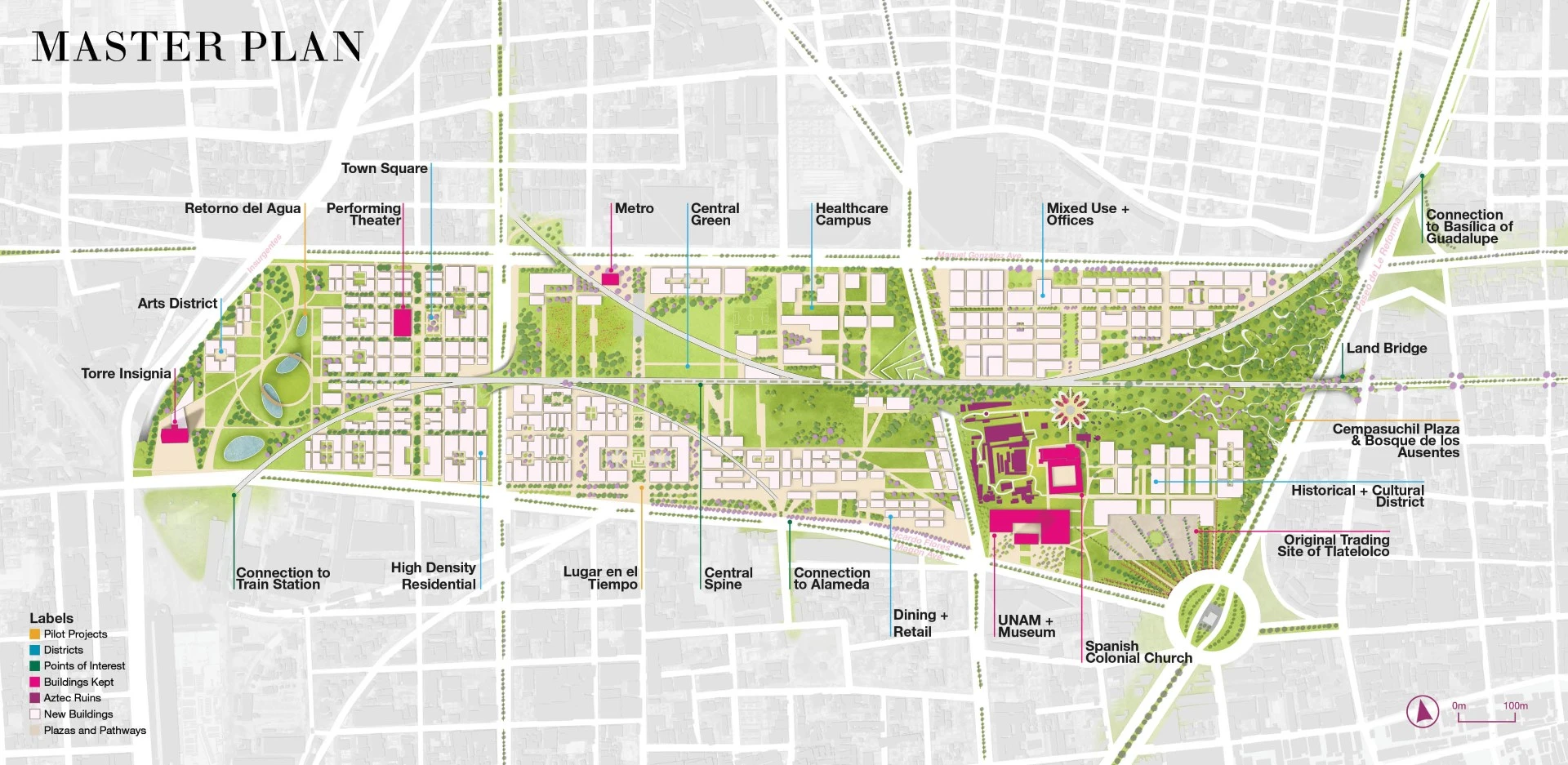
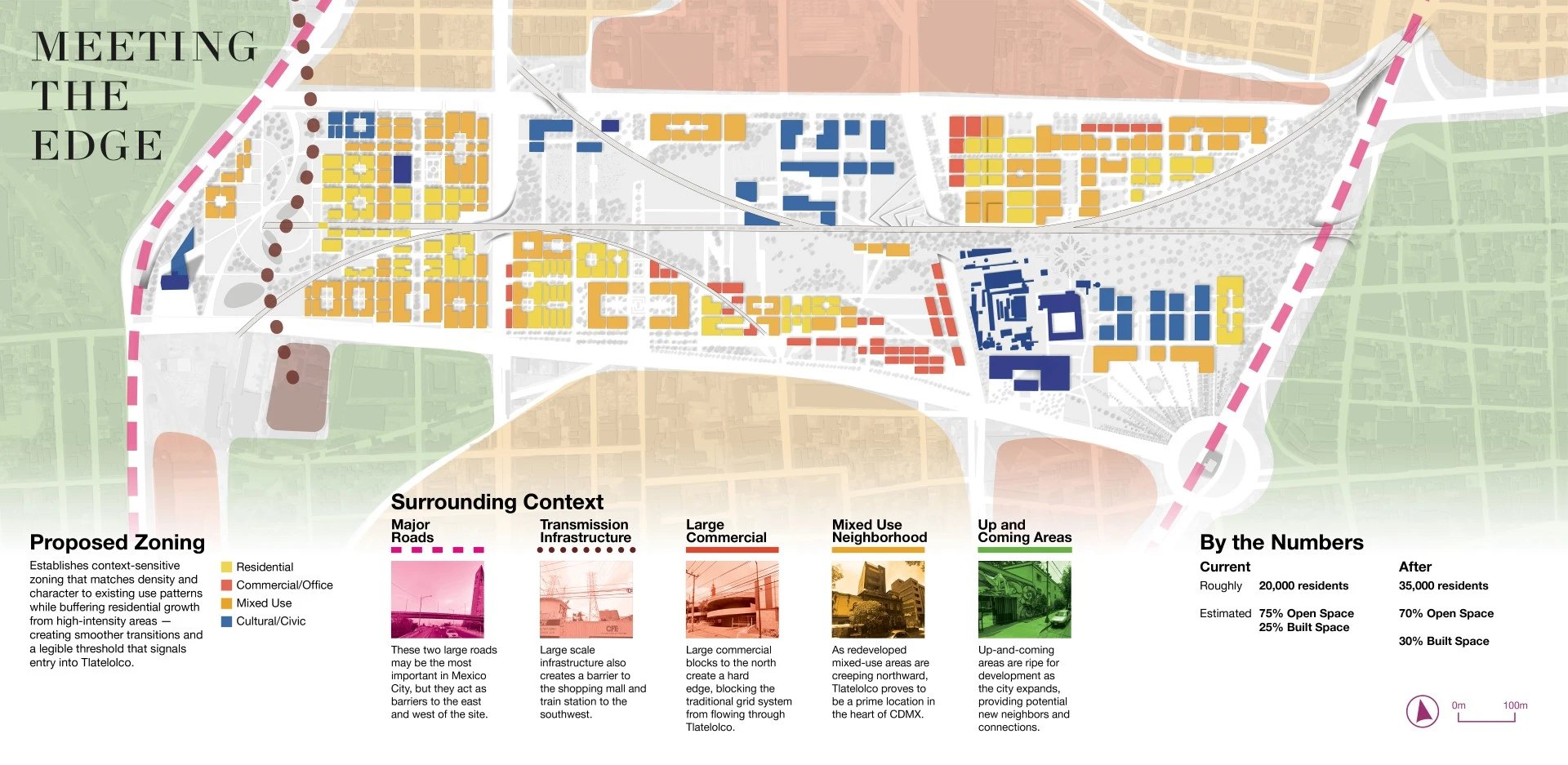
The proposal responds with a People First Design framework structured around three principles–Remeber, Connect, and Adapt. Spanning 232 acres, the master plan replaces structurally unstable building stock with a mixed-use program of residential, commercial, institutional, and open-space development. Two arching pedestrian corridors stitch the site into the urban network, expanding equitable access to major cultural destinations like the Palacio de Bellas Artes, Alameda, Basilica de Guadalupe, and Monumento a la Raza.
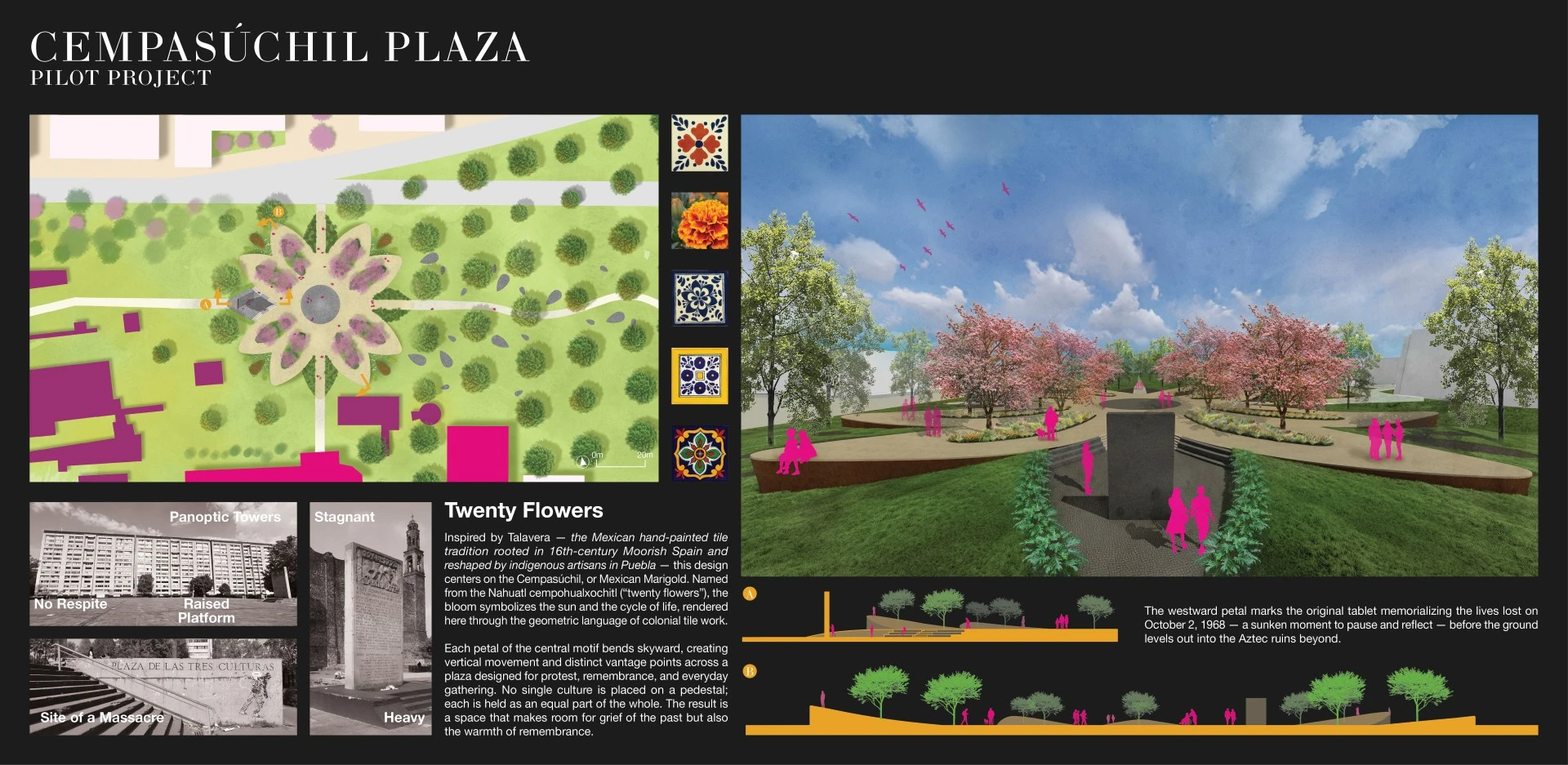
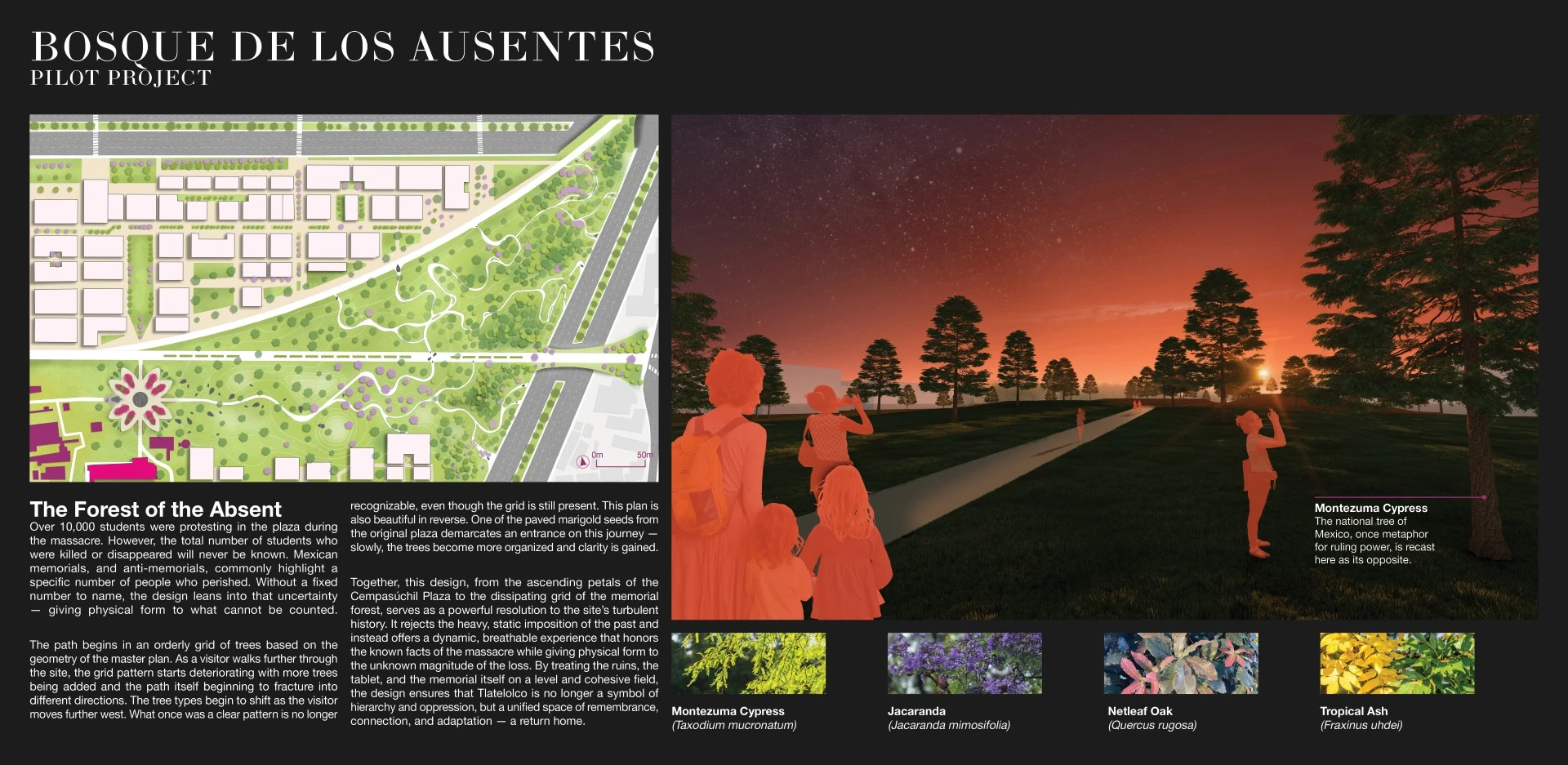
Cempasúchil Plaza and Bosque de los Ausentes reimagines the Plaza de las Tres Culturas as a living memorial. Inspired by the marigold, the redesigned plaza unifies the Aztec ruins, colonial church, and modern context on one ground plane. The adjacent memorial forest gives physical form to the unknown number of casualties from the 1968 massacre. An ordered grid of trees slowly deteriorates as visitors move through it, mirroring the impossibility of accounting for every absence.
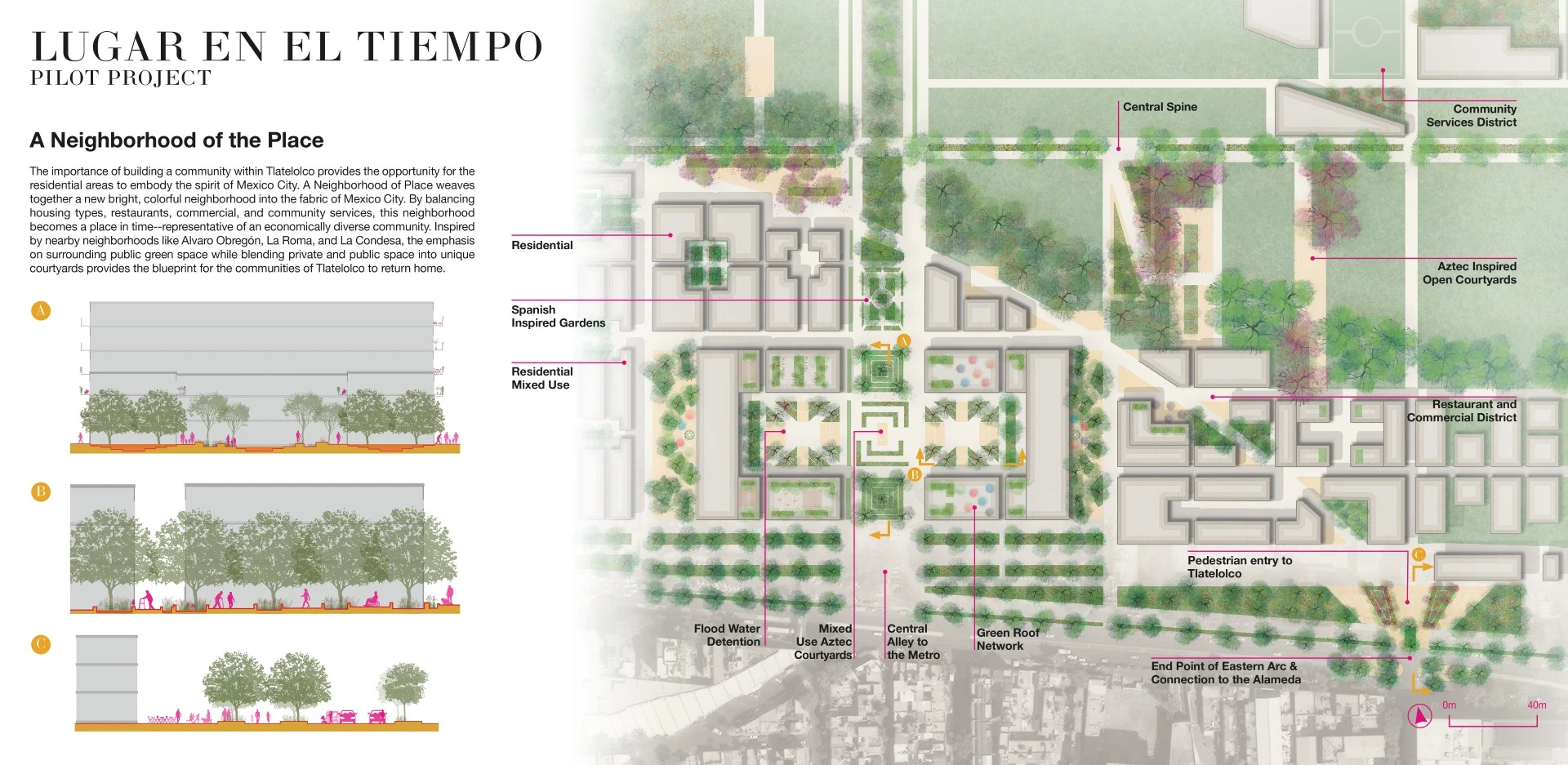
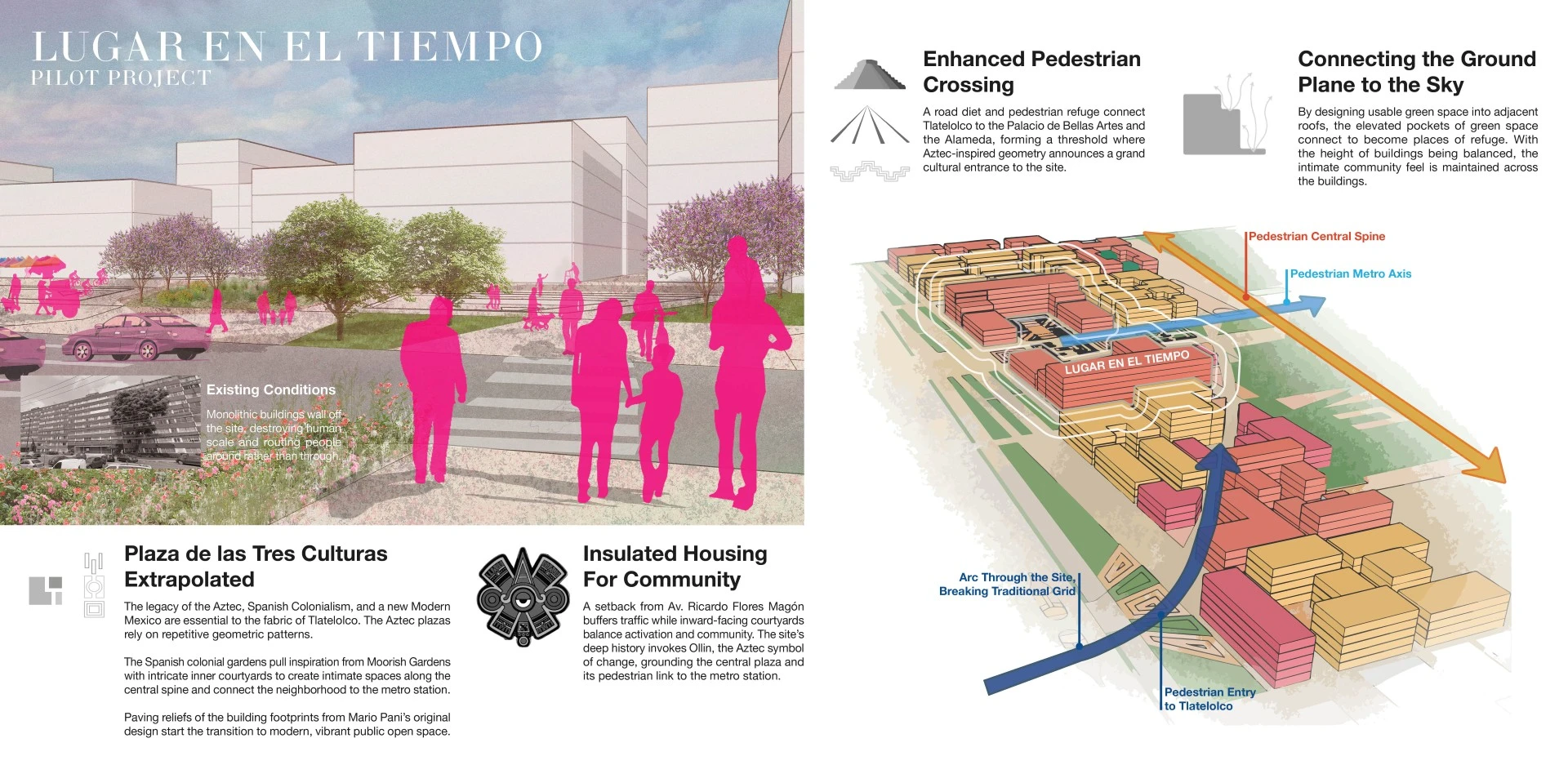
Lugar en el Tiempo weaves mixed-use development into an affordable high-density neighborhood. Aztec geometry anchors the design language throughout, while an emphasis on streetscapes, plazas, and markets draws from the traditions of Mexico City's most beloved neighborhoods.
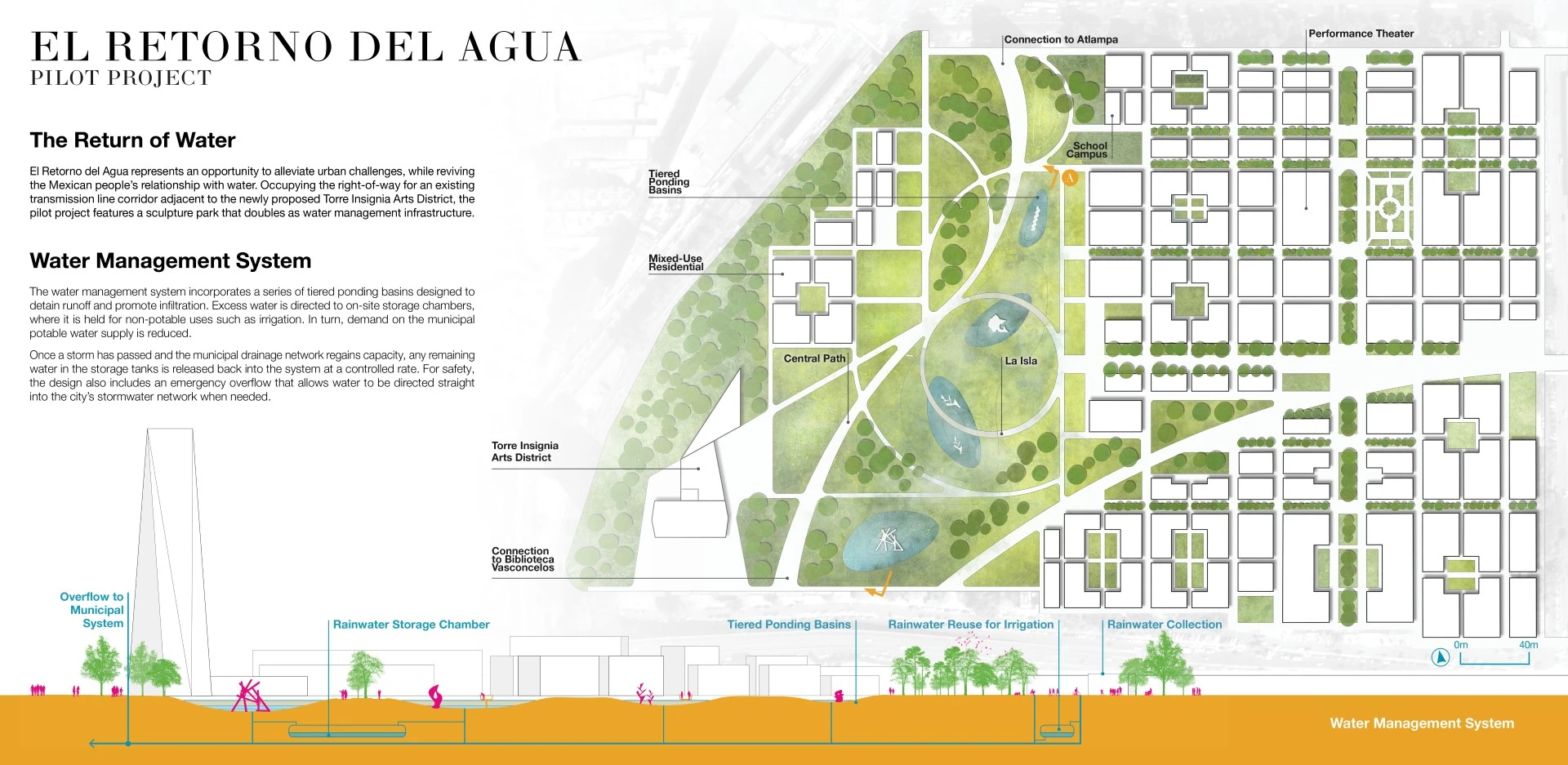
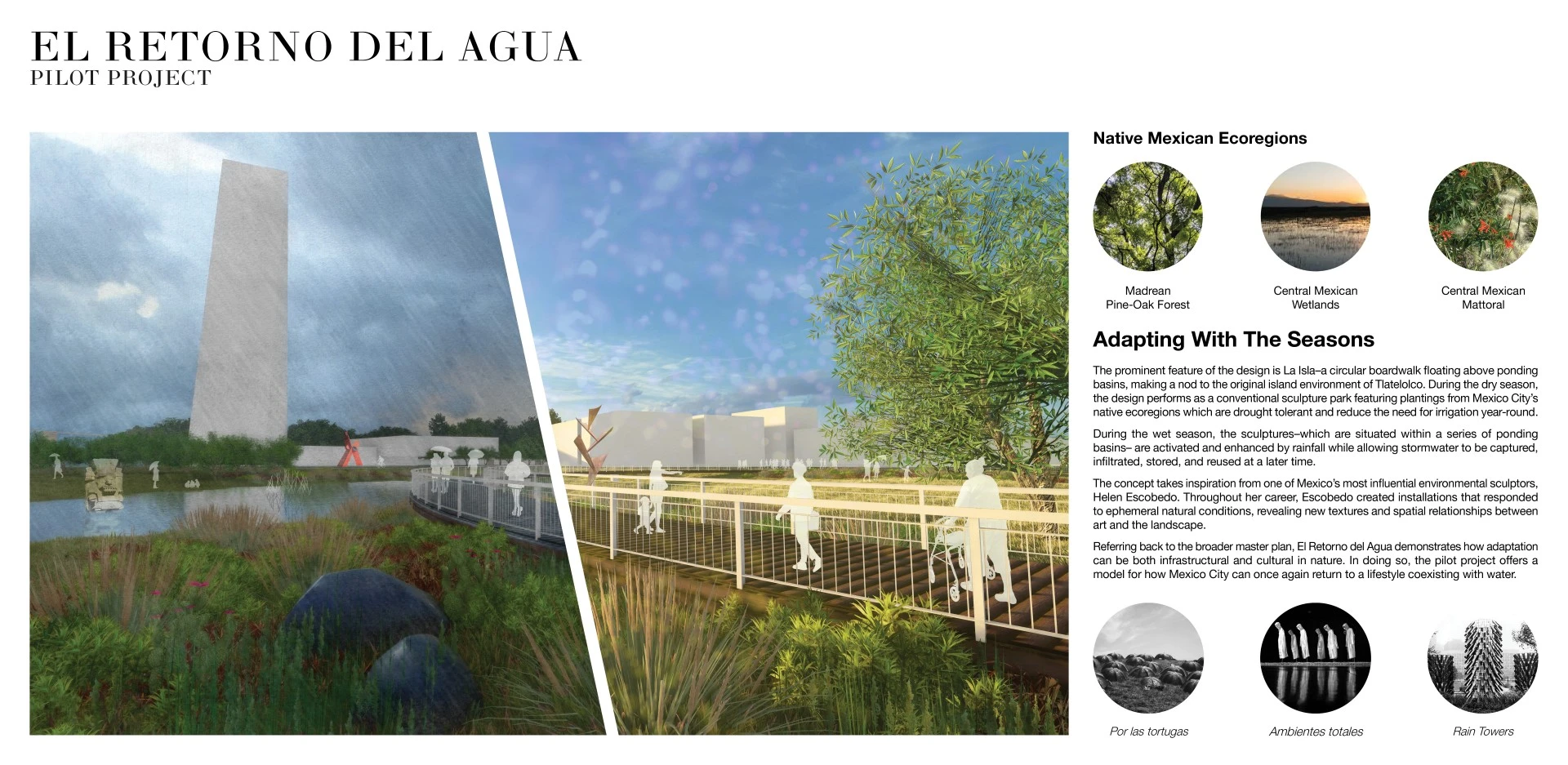
El Retorno del Agua transforms an existing infrastructure right-of-way into a stormwater sculpture park. The design features tiered ponding basins which contain sculptural works from Mexico's most prominent artists. During the wet season, the installations are activated and enhanced by rainfall, while stormwater is captured, stored, and reused at a later time. In doing so, the project offers a vision for how Mexico City can once again return to a lifestyle coexisting with water.
Together, Ciudad Tlatelolco: Return Home envisions landscape-forward urbanism fueled by the city's cultural restoration.
-
- Montezuma Cypress
- Mexican Marigold
- Trumpet Tree
- Jacaranda
- Smooth-bark Mexican Pine
- Mexican Red Oak
- Century Plant
- Chairmaker's Bulrush
- Red Willow
- Barbary Fig
- Mediterranean Cypress
- Holm Oak
- Tropical Ash
Advertisement
Related Awards
Honors Award, Urban Design
Restoring a River, Reconnecting a City: Longgang River Blueway
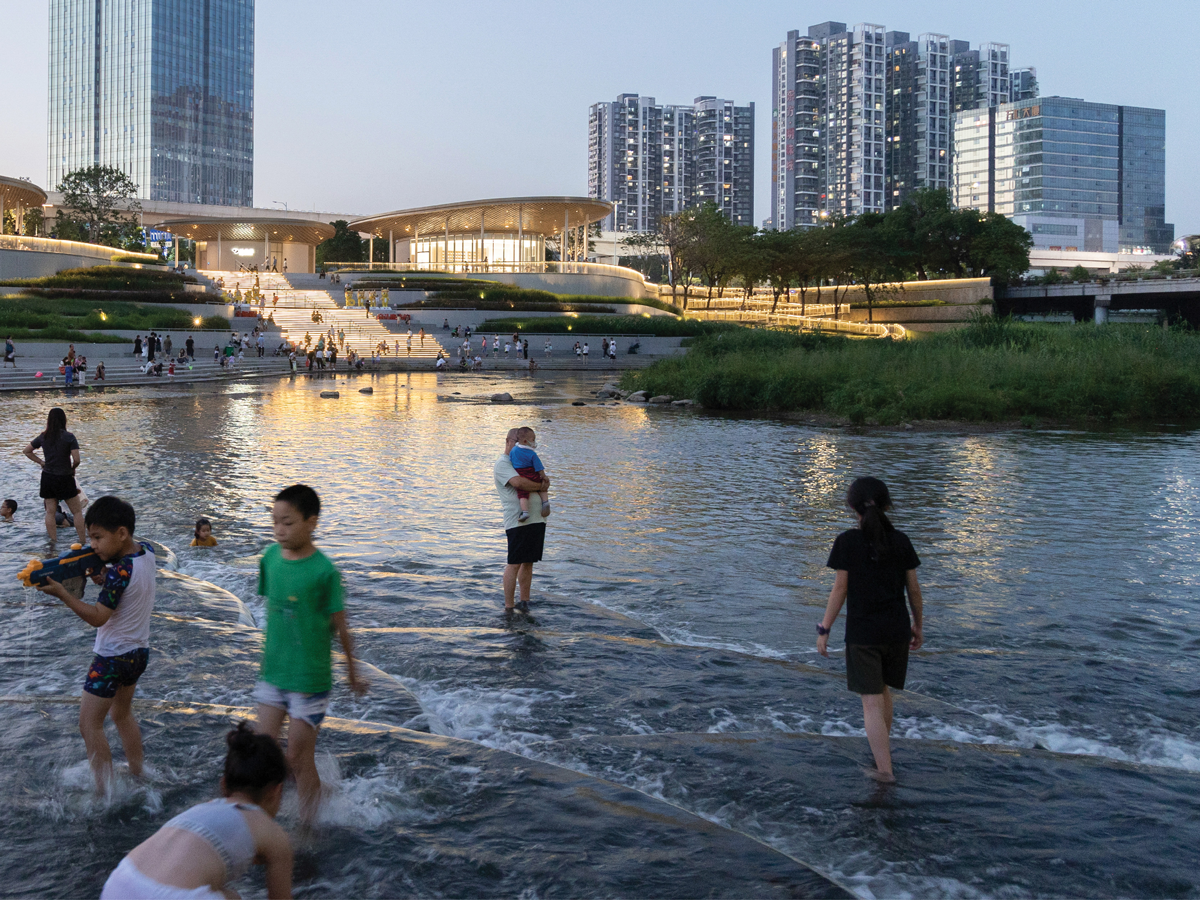
Over the past half century, rapid urbanization forced Shenzhen rivers into concrete channels, cutting communities off from nature and increasing flood risk. Spanning 20 kilometers, the Longgang River Blueway reshapes a former drainage corridor into a resilient, accessible public landscape.