
.webp?language=en-US)

.webp?language=en-US)
Atmospheric Springs: The Future of Fog in Los Angeles
Nathan Sweitzer, Student ASLA


Unique by reframing the overlooked environmental phenomenon of fog and advancing a new idea. The narrative has a strong historical arc (Past, Present, Future).
Awards Jury
-
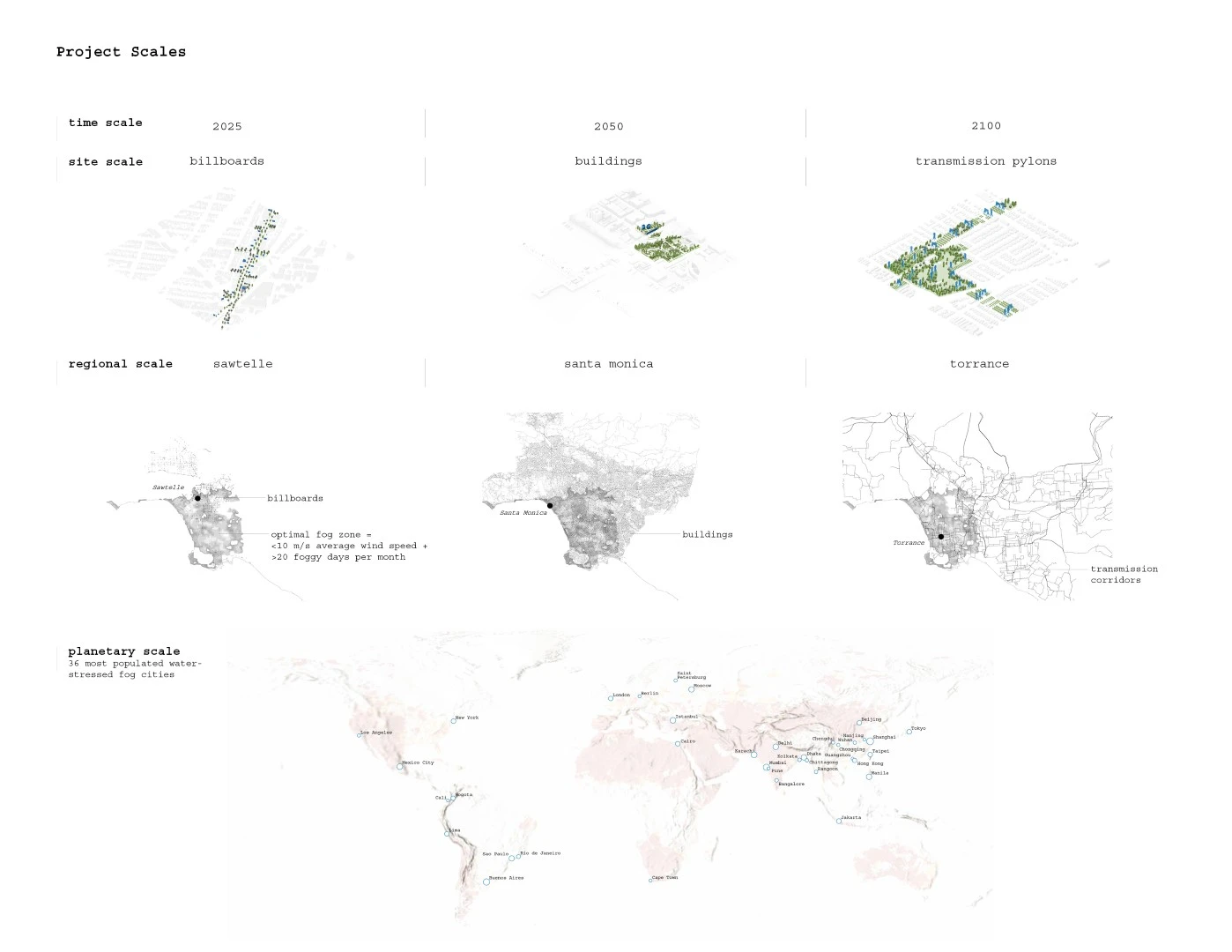
For millennia, coastal fog sustained the ecosystems of the Los Angeles basin, nourishing the vegetation and soils above the natural springs where Indigenous communities gathered, long before the city buried its waterways beneath asphalt. That fog still arrives every summer, during the very months when water systems are most stressed. Atmospheric Springs reimagines coastal fog as civic infrastructure, using atmospheric cycles of the region as a design driver. The project transforms overlooked urban infrastructure into seasonal water sources, equipping billboards, buildings, and transmission pylons with fog-harvesting technology to irrigate street trees, sustain community gardens, and return the ritual of gathering to the public landscape.
-
Purpose and Context
Los Angeles imports nearly 66 percent of its water from sources hundreds of miles away, yet every summer morning, coastal fog drifts across the city uncaptured. Atmospheric Springs develops a scalable framework for fog harvesting as civic water infrastructure, adapting existing urban structures to collect atmospheric moisture and return it to the landscape as irrigation, aquifer recharge, and public drinking water. Drawing from Indigenous practice and the logic of natural springs as communal space, the project captures atmospheric moisture to return water, and the ritual of gathering, to the public landscape.Three Intervention Scales
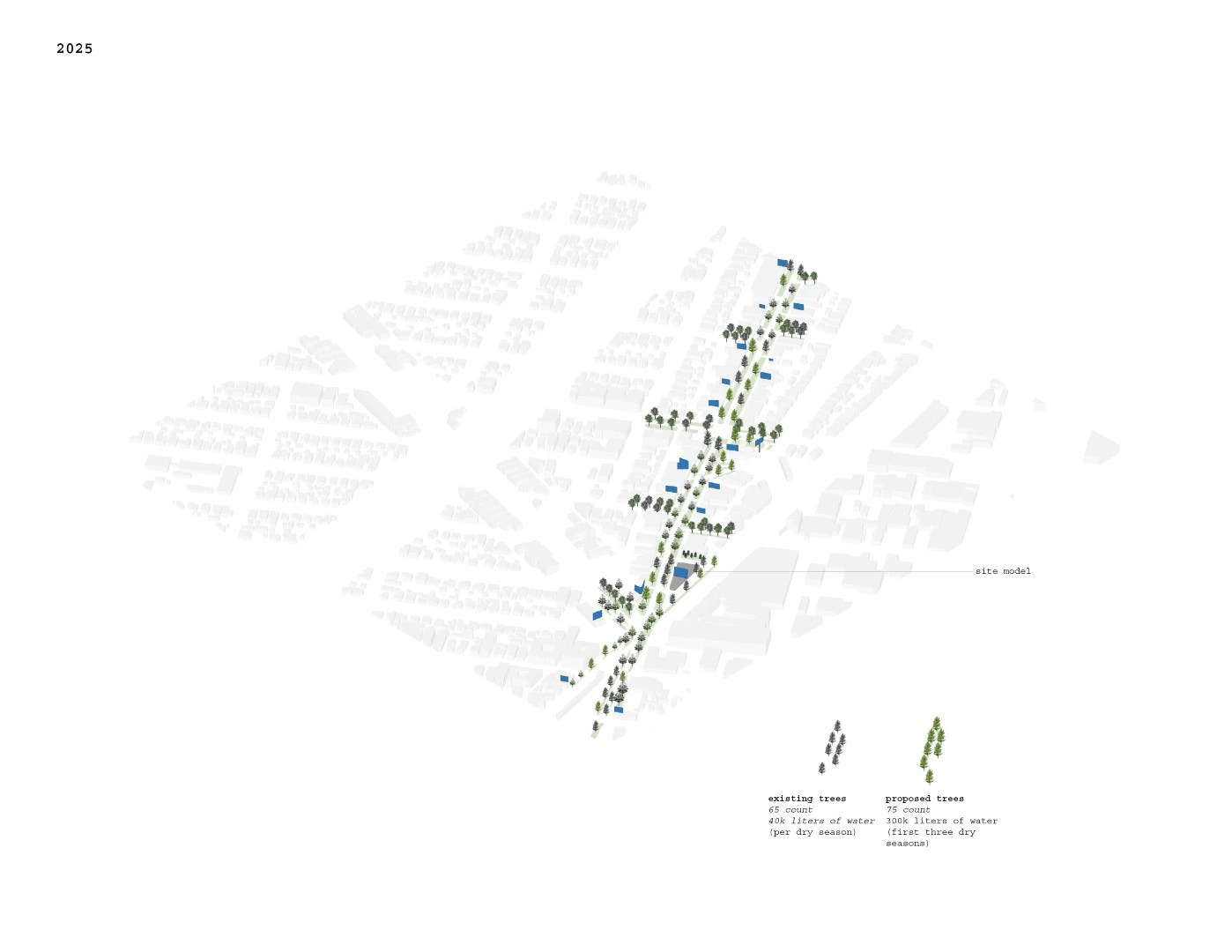
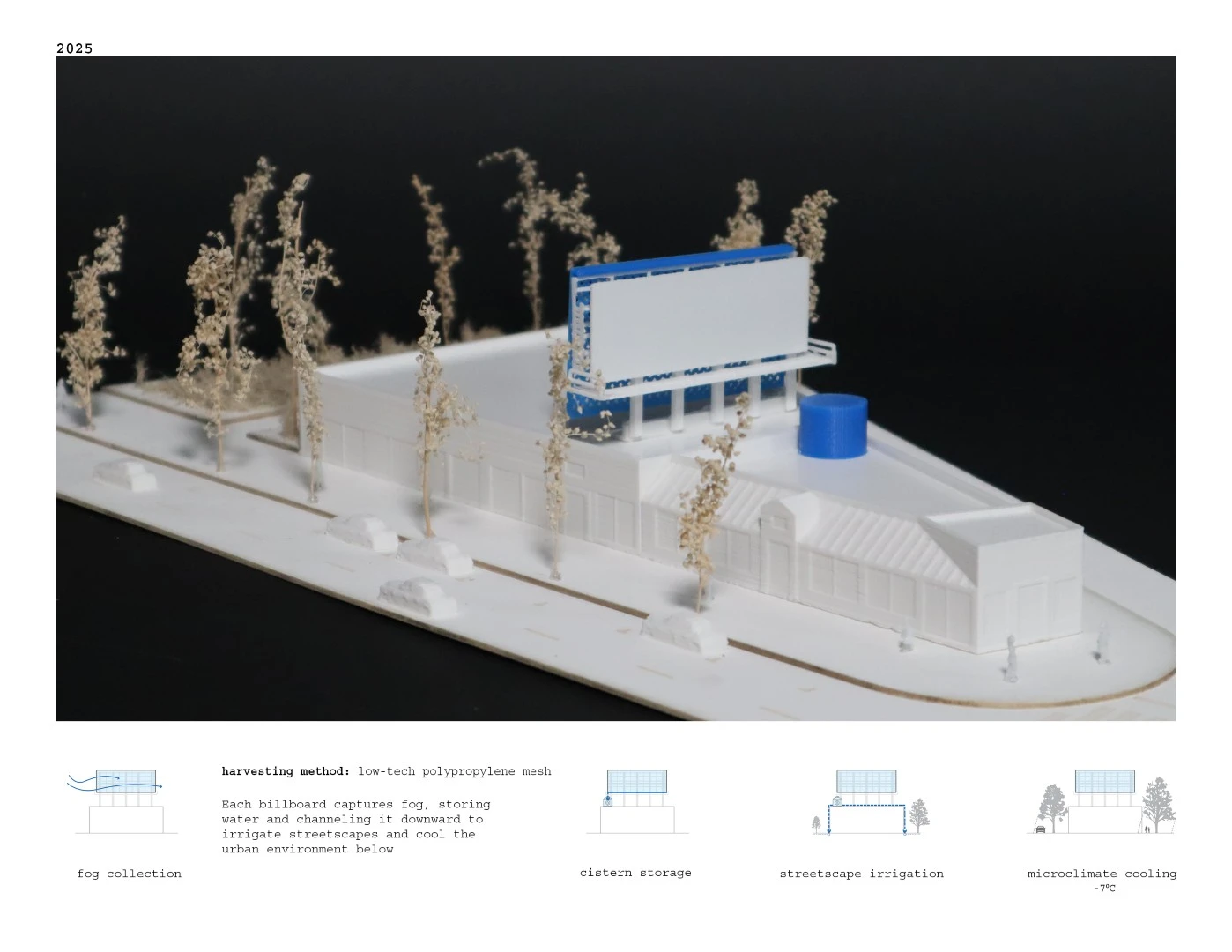
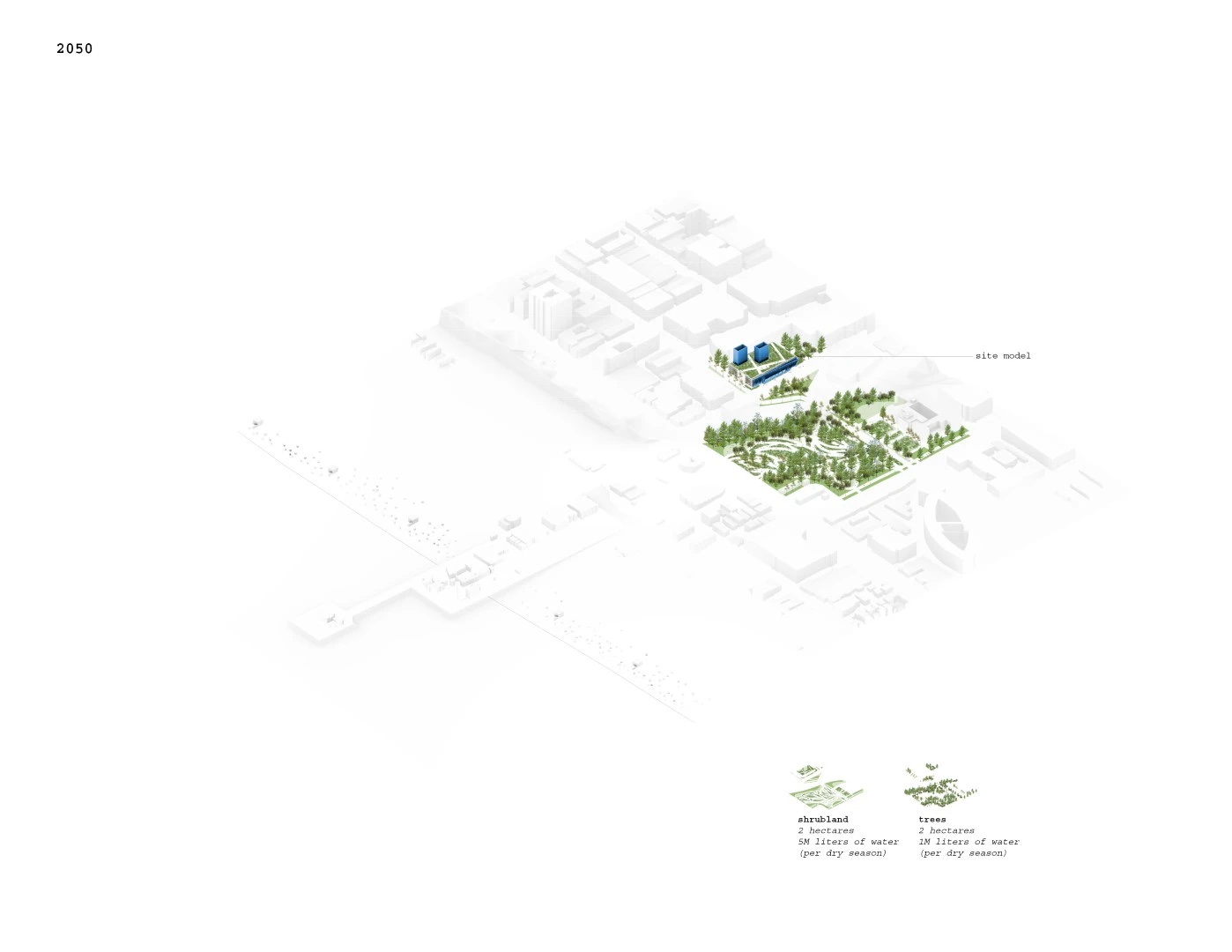
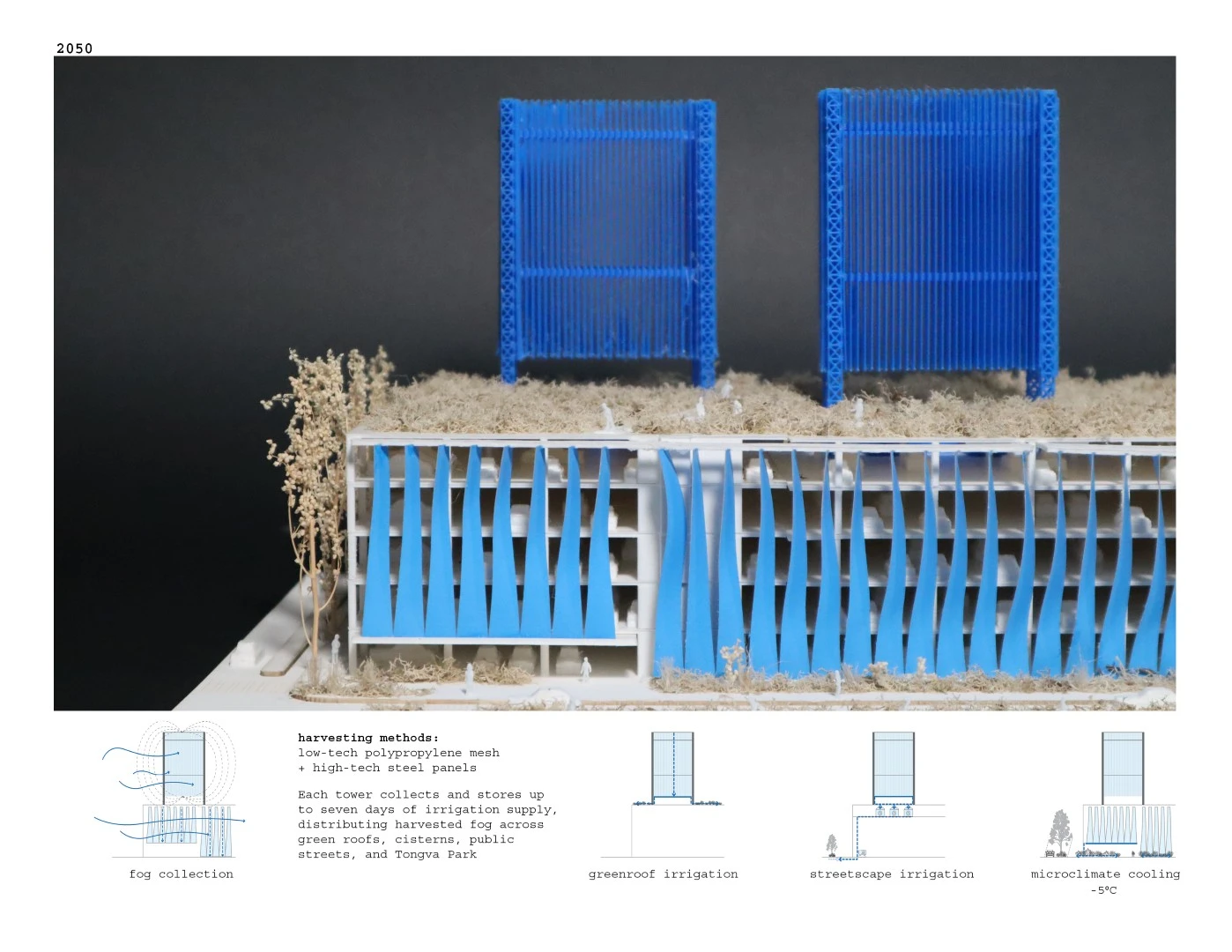
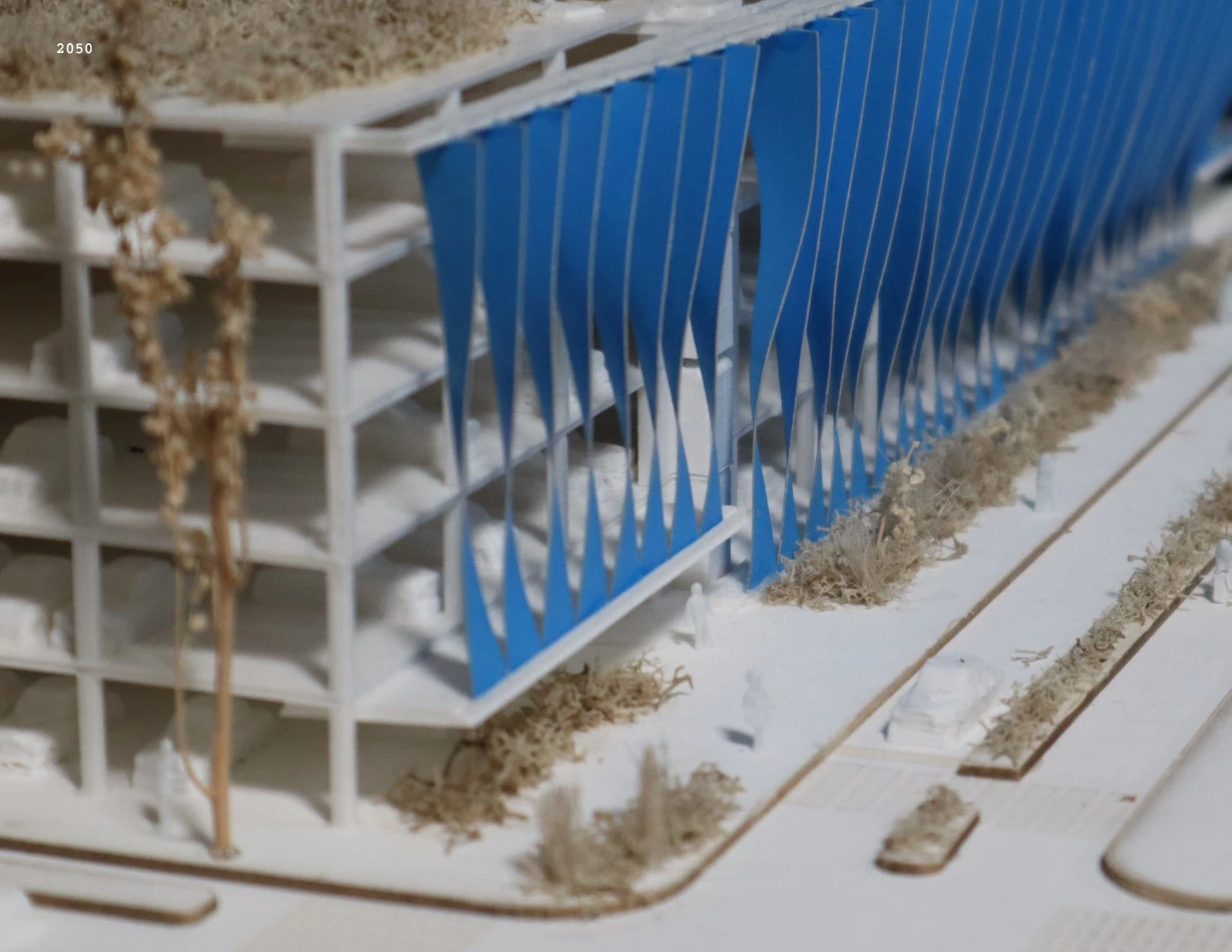
2025: At the site scale, 19 existing billboards along Pico Boulevard in Sawtelle are equipped with low-tech polypropylene mesh, channeling water by gravity to street-level irrigation below. The network yields 370,000 liters per dry season, watering 65 existing street trees and establishing 75 new ones, reducing perceived radiant heat by up to 7°C in a dense commercial corridor.2050: At the block scale, an existing parking garage adjacent to Tongva Park in Santa Monica is retrofitted with two electrostatic harvesting towers and 1,250 square meters of mesh sails integrated into the building facade, collecting 6.75 million liters per dry season, meeting Tongva Park's full dry season irrigation demand without municipal water input. Water is stored in rooftop cisterns providing seven days of irrigation buffer, then gravity-fed to green roofs, street plantings, and the park's existing irrigation system.
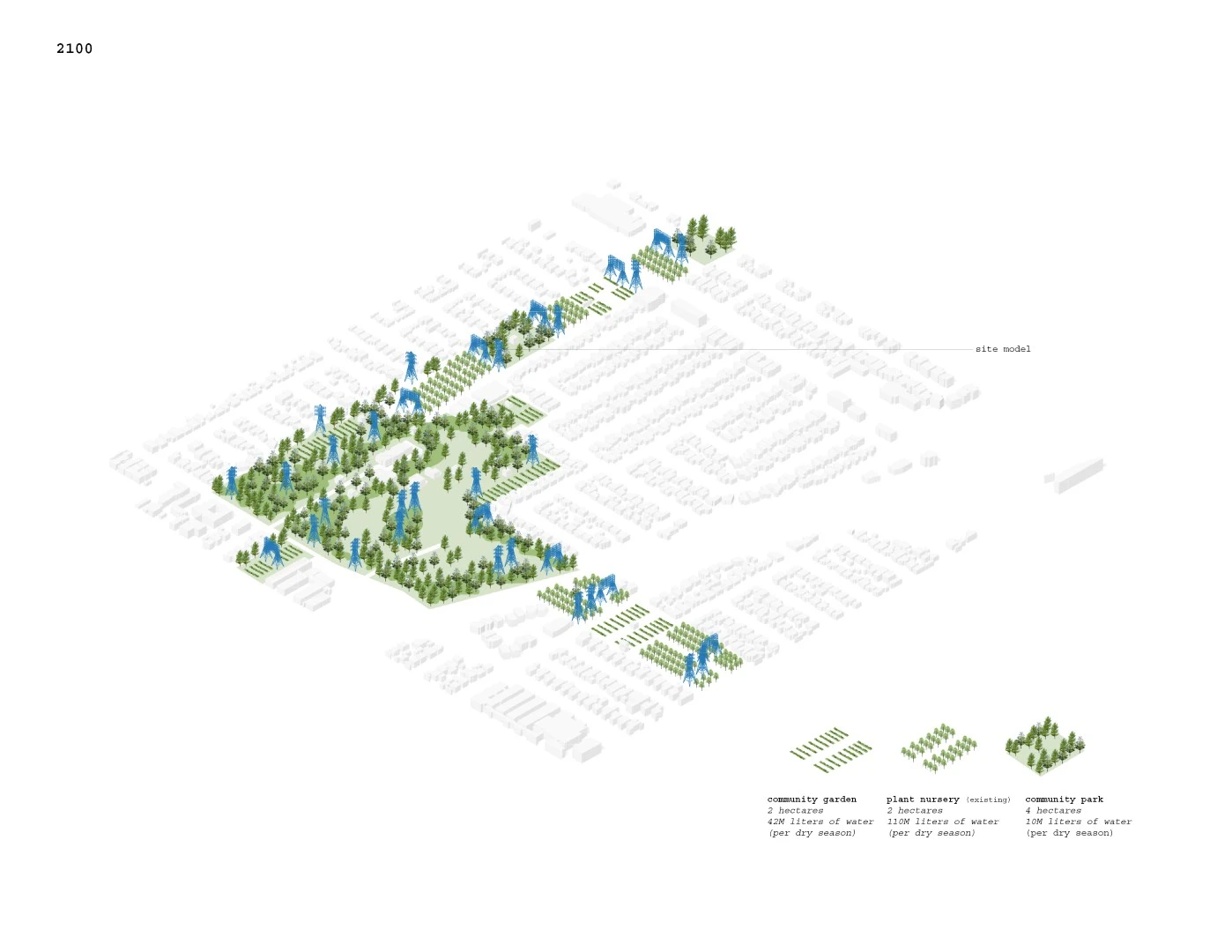
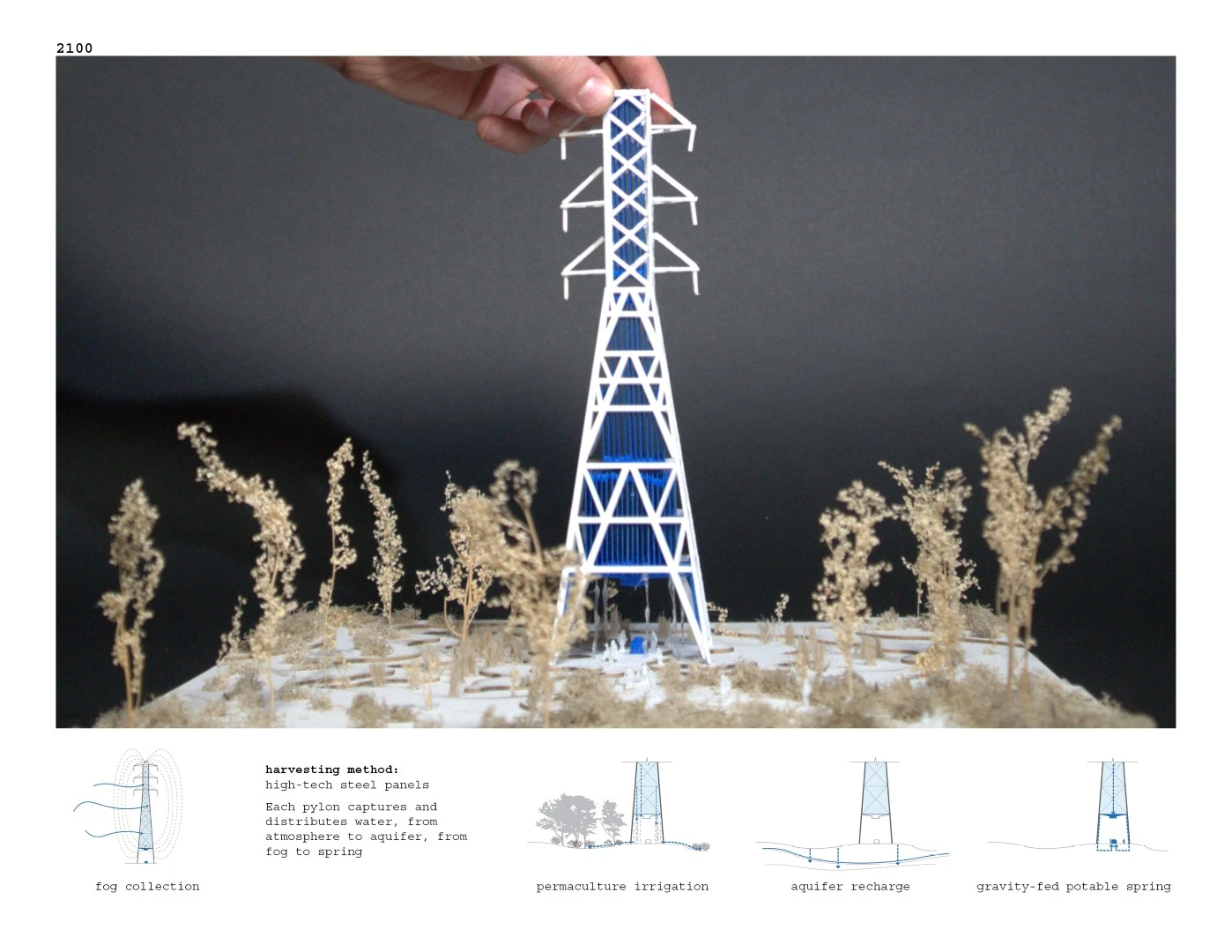
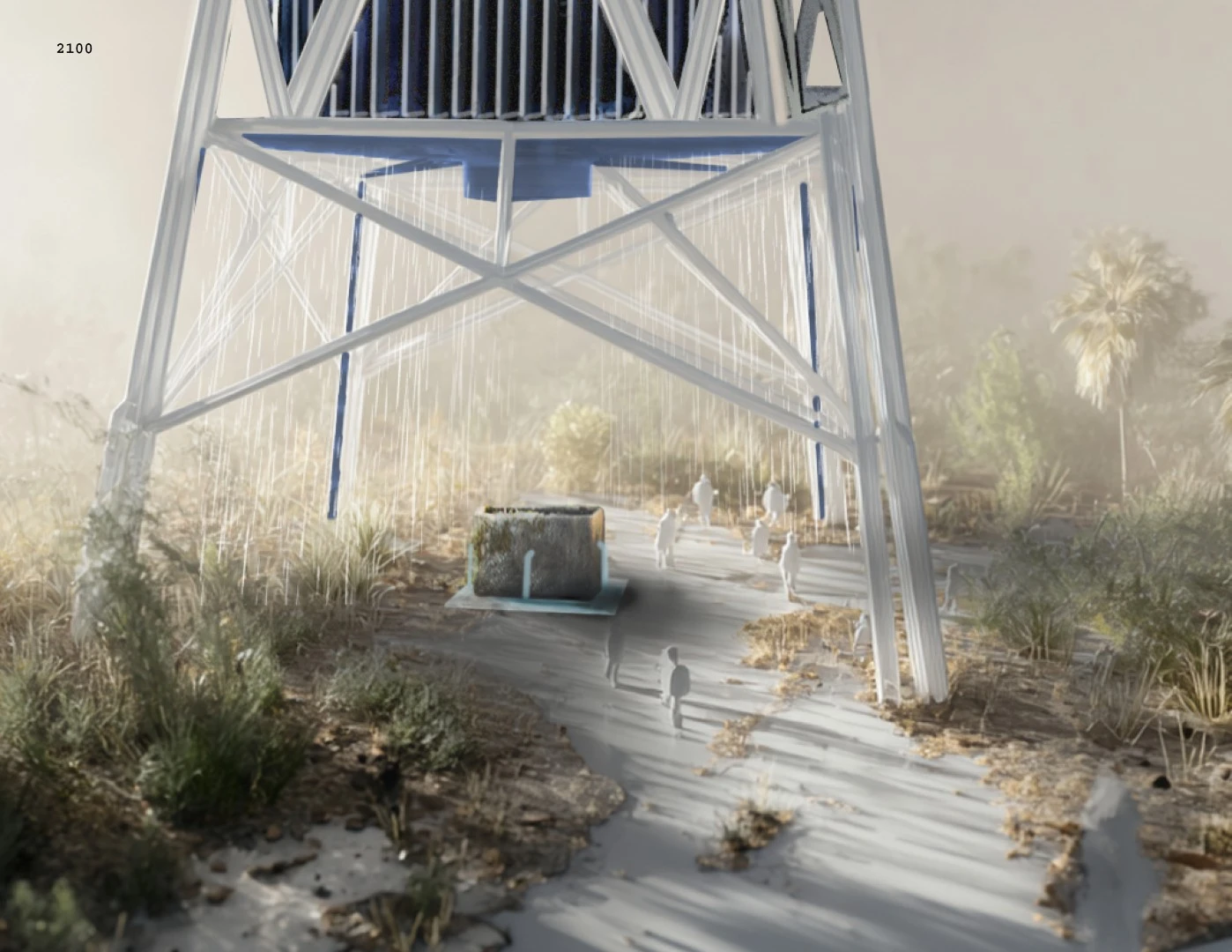
2100: At the neighborhood scale, 34 transmission pylons in an underserved corridor in Torrance are retrofitted with electrostatic steel panels integrated into each tower's existing geometry. The corridor currently houses active plant nurseries; fog-harvested irrigation supplements their water supply, while two hectares of community gardens and four hectares of new park space are proposed alongside. Select pylons feed planted oases directly below through permaculture-informed channels; the remainder collect water into cisterns for redistribution across the corridor, while gravity-fed percolation recharges the underlying aquifer. A filtered portion resurfaces at a public drinking spout at the base of each tower, a modern spring from atmospheric moisture, freely accessible to the future community in a water-scarce region.
Technology and Innovation
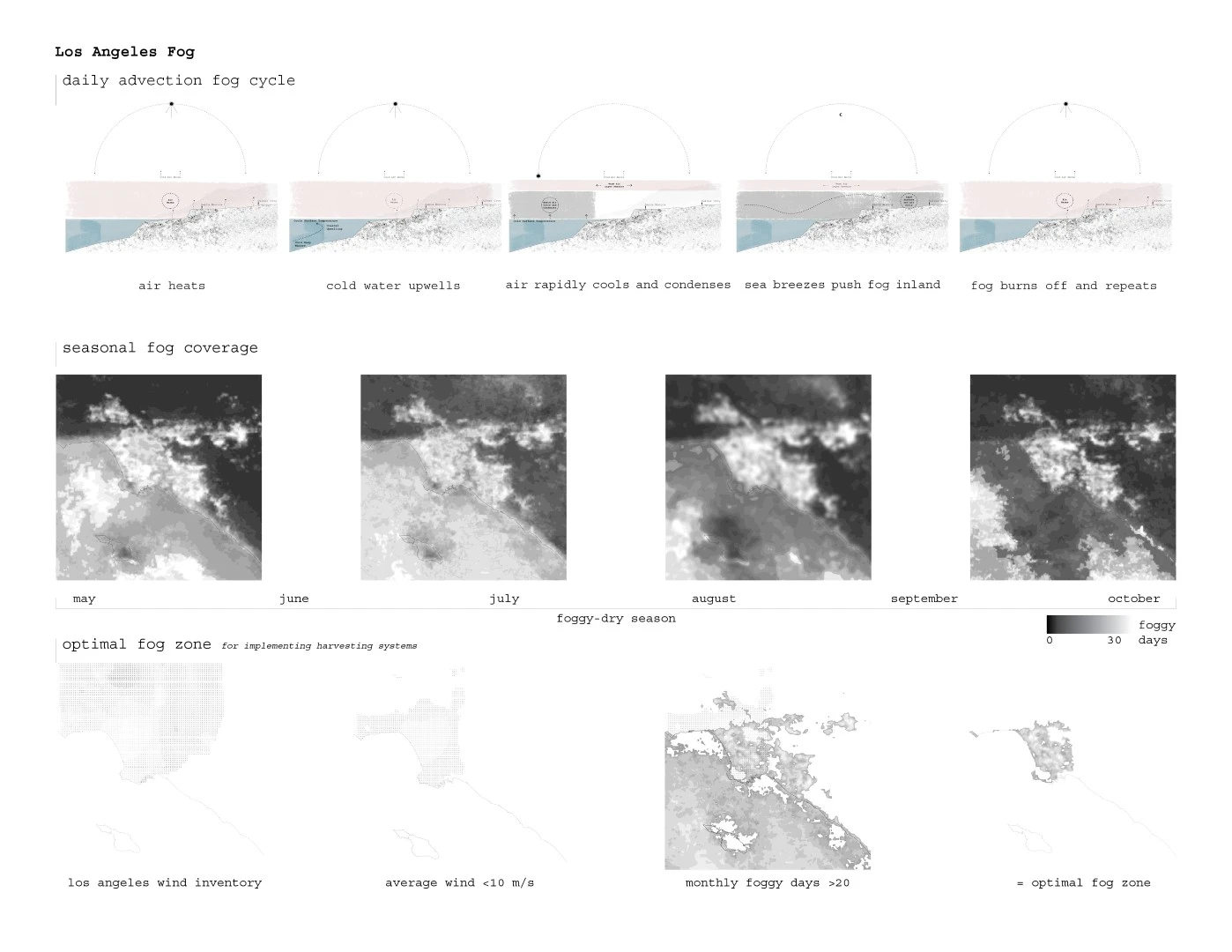
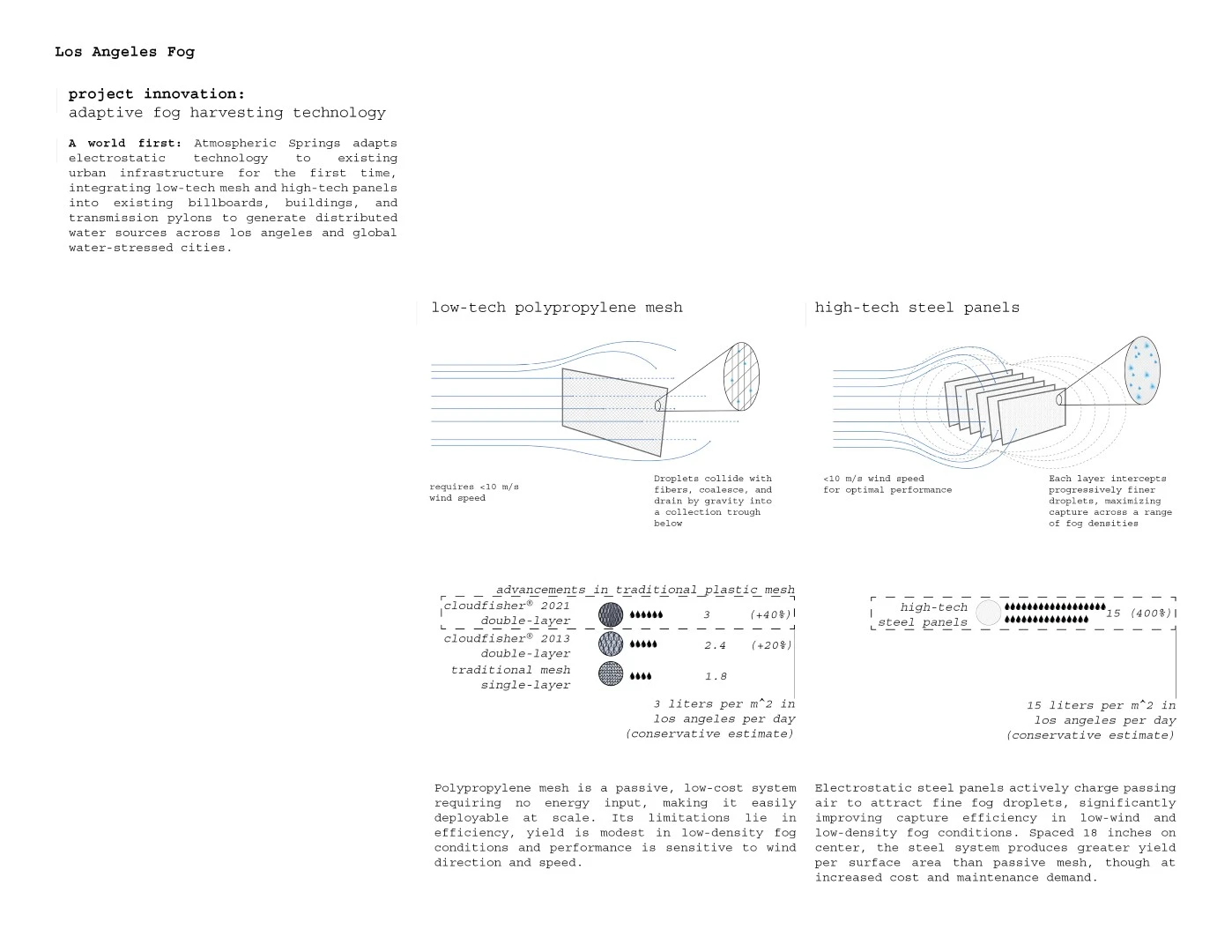
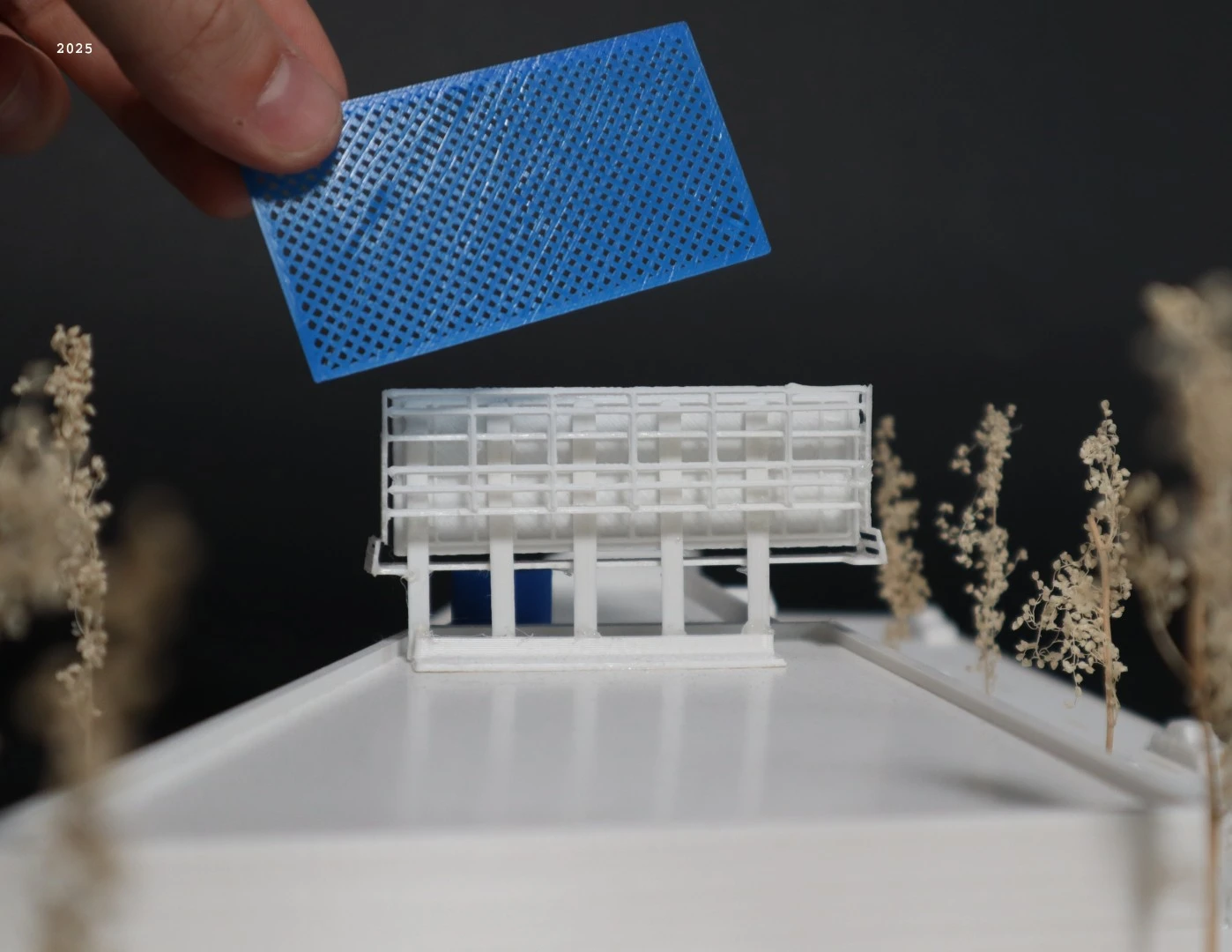
Using satellite-derived fog frequency data cross-referenced with wind velocity mapping, the project delineates an optimal harvesting zone across western Los Angeles. Two technologies are deployed: low-tech polypropylene mesh, a passive no-energy system achieving 3 liters per square meter per day, and high-tech electrostatic steel panels achieving up to 15 liters per square meter per day, a 400 percent improvement. Both systems channel captured water by gravity. Low-tech fog mesh has been used in rural communities for decades but never at urban scale, and electrostatic water droplet capture has been demonstrated by MIT venture Infinite Cooling but never deployed for natural fog harvesting, anywhere in the world. Atmospheric Springs is the first proposal to adapt both technologies to existing urban infrastructure as a distributed civic water system, scalable, non-extractive, and low-energy. Its three-scale framework is transferable to water-stressed fog cities globally, with pilot deployment opportunities currently in development by the author. -
- Polypropylene Mesh
- Electrostatic Steel Panels
- Electrostatic Harvesting Towers
- Mesh Sails
- Rooftop Cisterns
- Transmission Pylons
- Billboards
- Infinite Cooling (MIT Venture)
-
- Coast Live Oak
- California Sycamore
- California Pepper Tree
- Jacaranda
- Canyon Live Oak
- Toyon
- California Buckeye
- Desert Willow
- Western Redbud
Advertisement
Related Awards
Honors Award, Urban Design
Restoring a River, Reconnecting a City: Longgang River Blueway
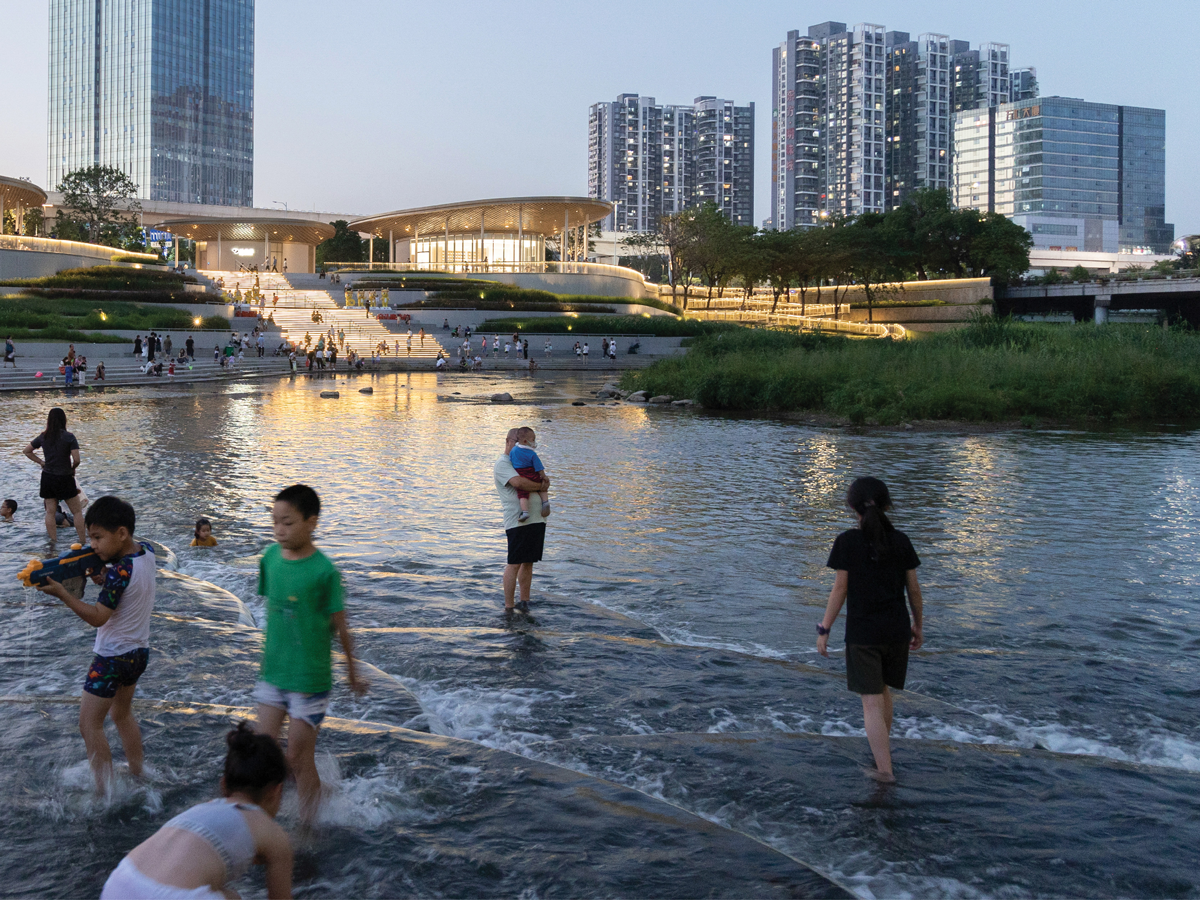
Over the past half century, rapid urbanization forced Shenzhen rivers into concrete channels, cutting communities off from nature and increasing flood risk. Spanning 20 kilometers, the Longgang River Blueway reshapes a former drainage corridor into a resilient, accessible public landscape.