
.webp?language=en-US)
.webp?language=en-US)
A Botanical and Inclusive Vision for Escobedo
Junyi Yang, Student ASLA; Wei-Ting Su, Student ASLA; Phurit Sheeranangsu, Student ASLA


Very comprehensive design with clear graphics and interesting overlapping connections!
Awards Jury
-
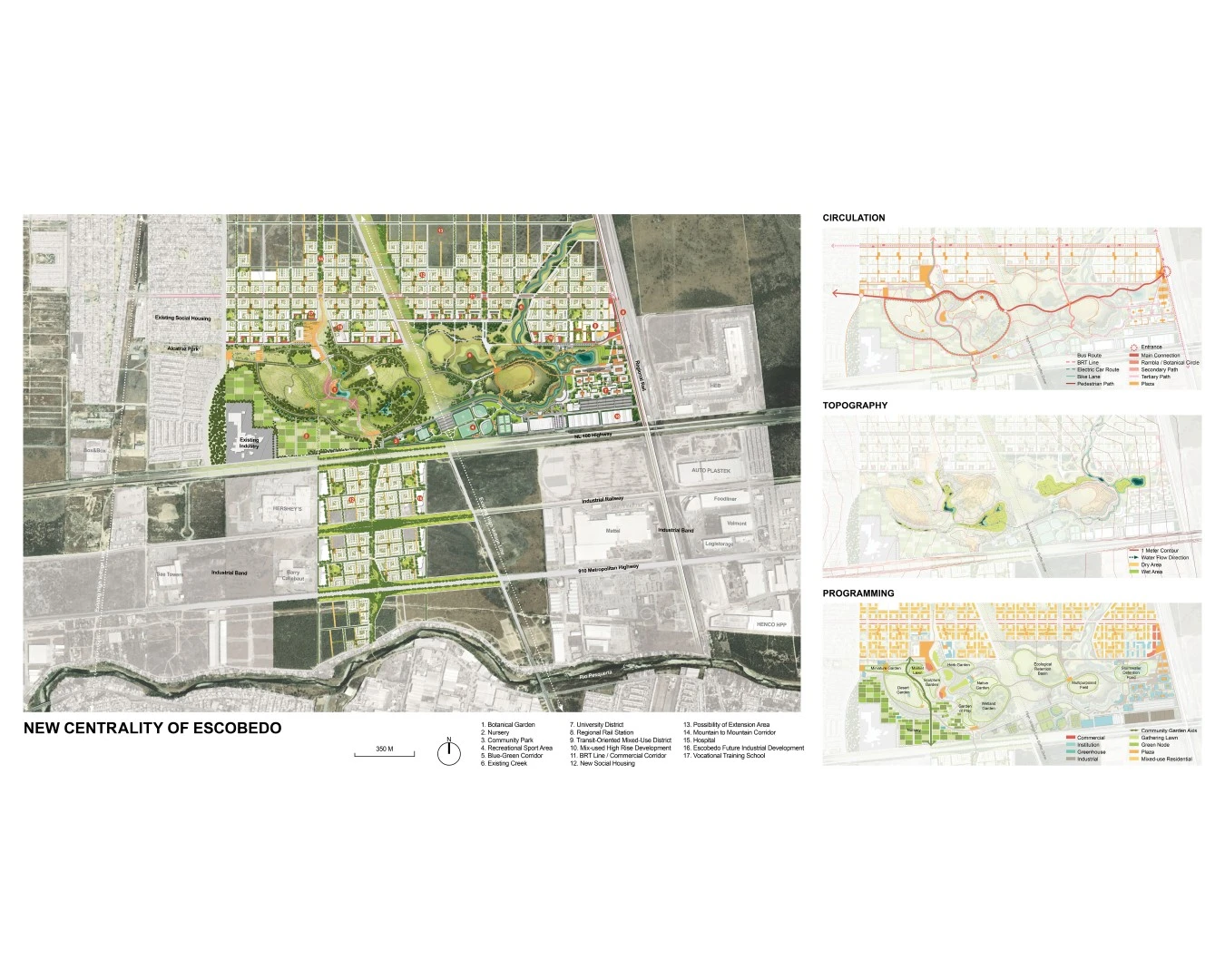
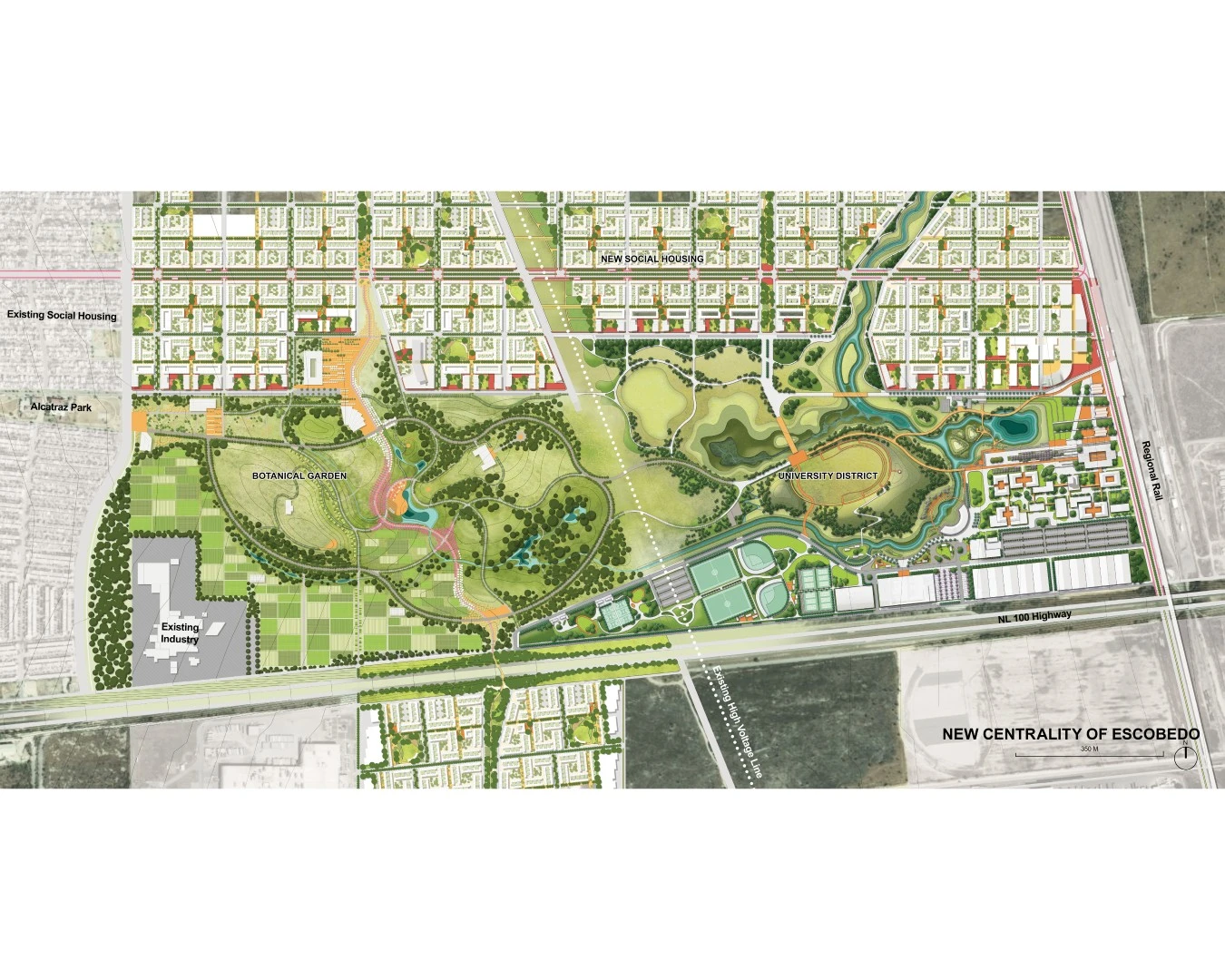
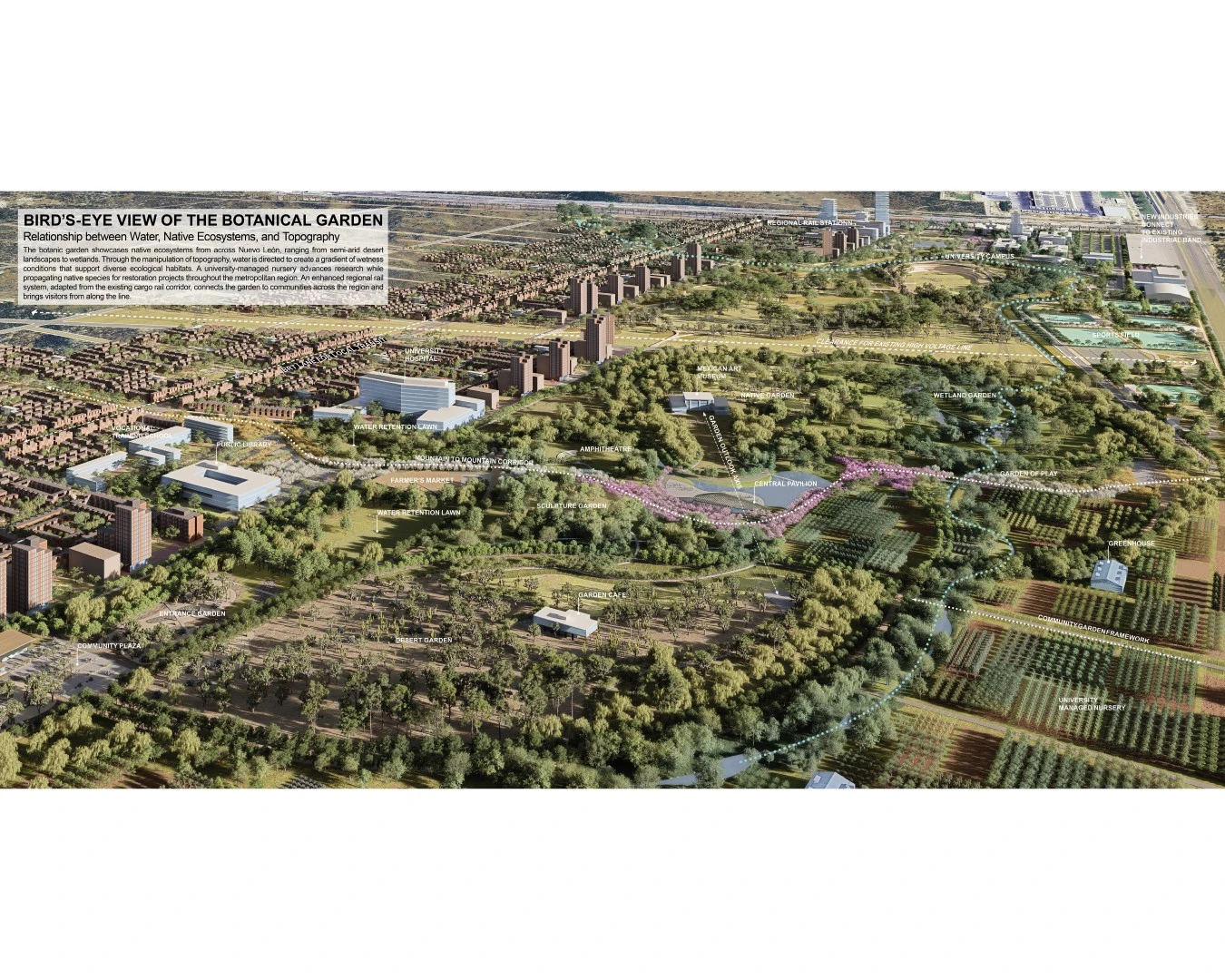
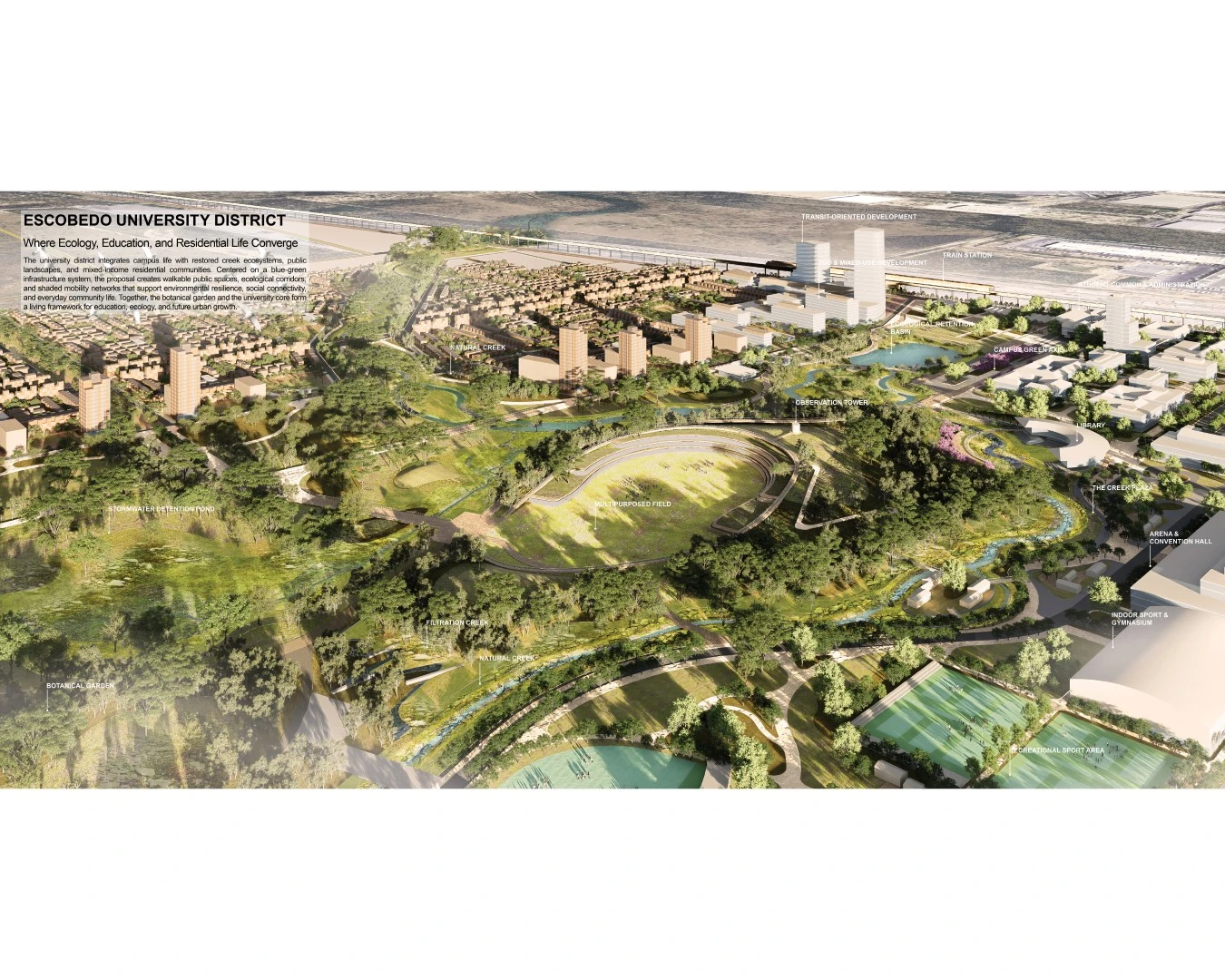
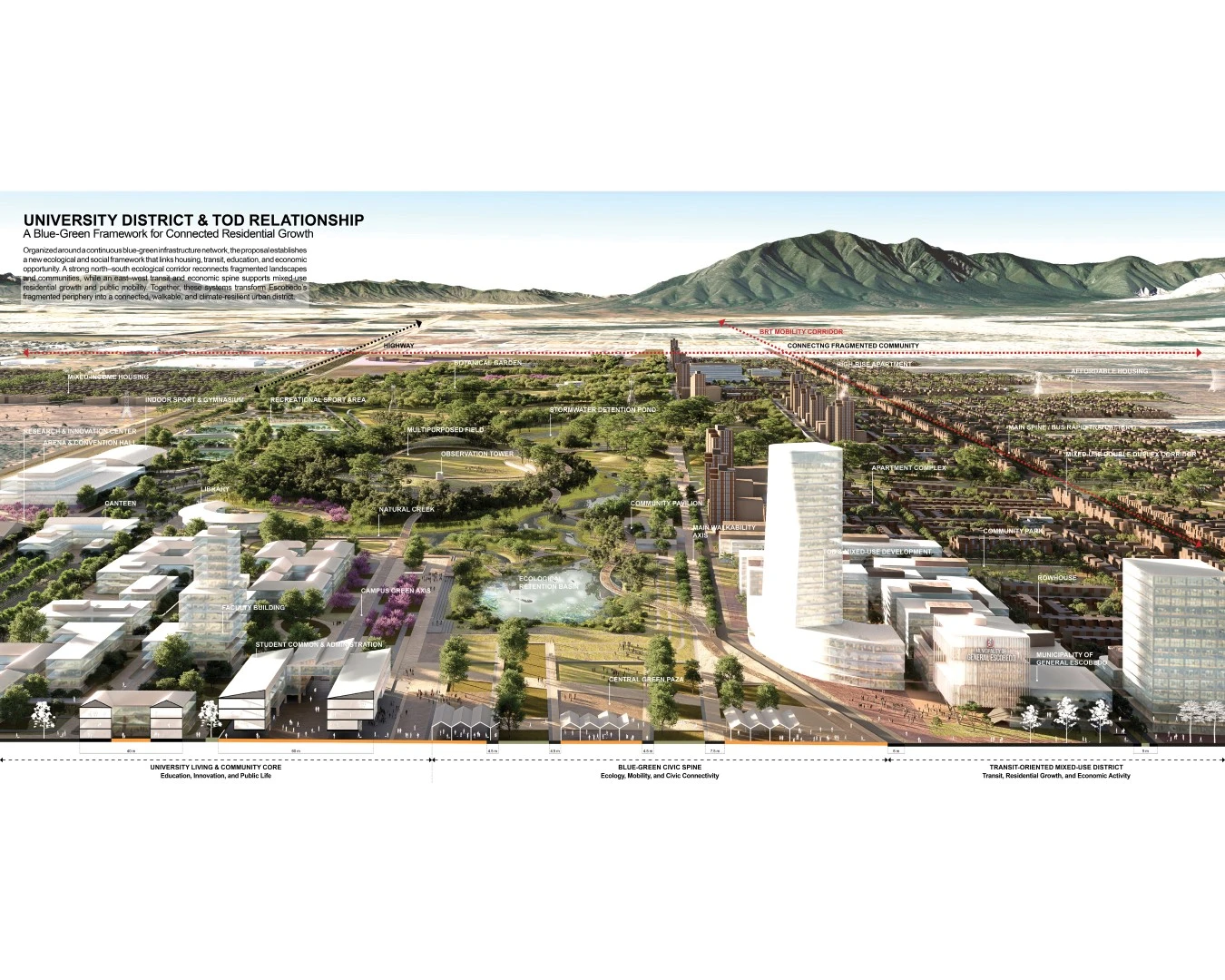
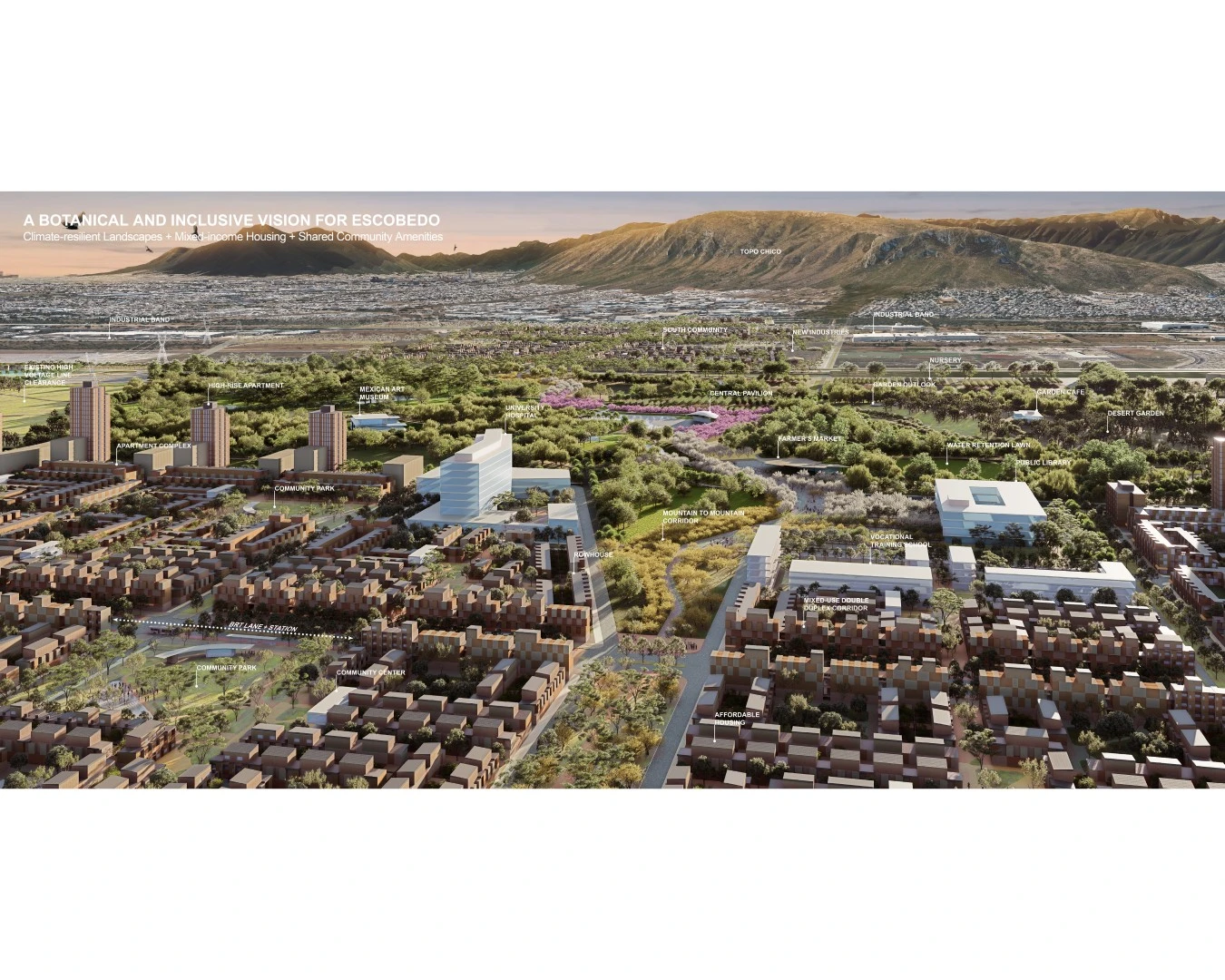
Located on Monterrey's periphery, the project reimagines fragmented social housing as an ecologically driven mixed-use community. Centered on a botanical/recreational park and a university-managed nursery, the design integrates climate resilience, mixed-income housing, and shared amenities. Vocational programs connect residents to employment in the nearby industrial band. Green corridors restore creeks, reduce flooding & heat, and reconnect residents to the mountains. The project also leverages BRT, local, and regional rails to improve mobility and regional access. By combining ecological restoration, equitable transit, and mixed-use urbanism, the project creates a socially inclusive and environmentally resilient model for Escobedo.
-
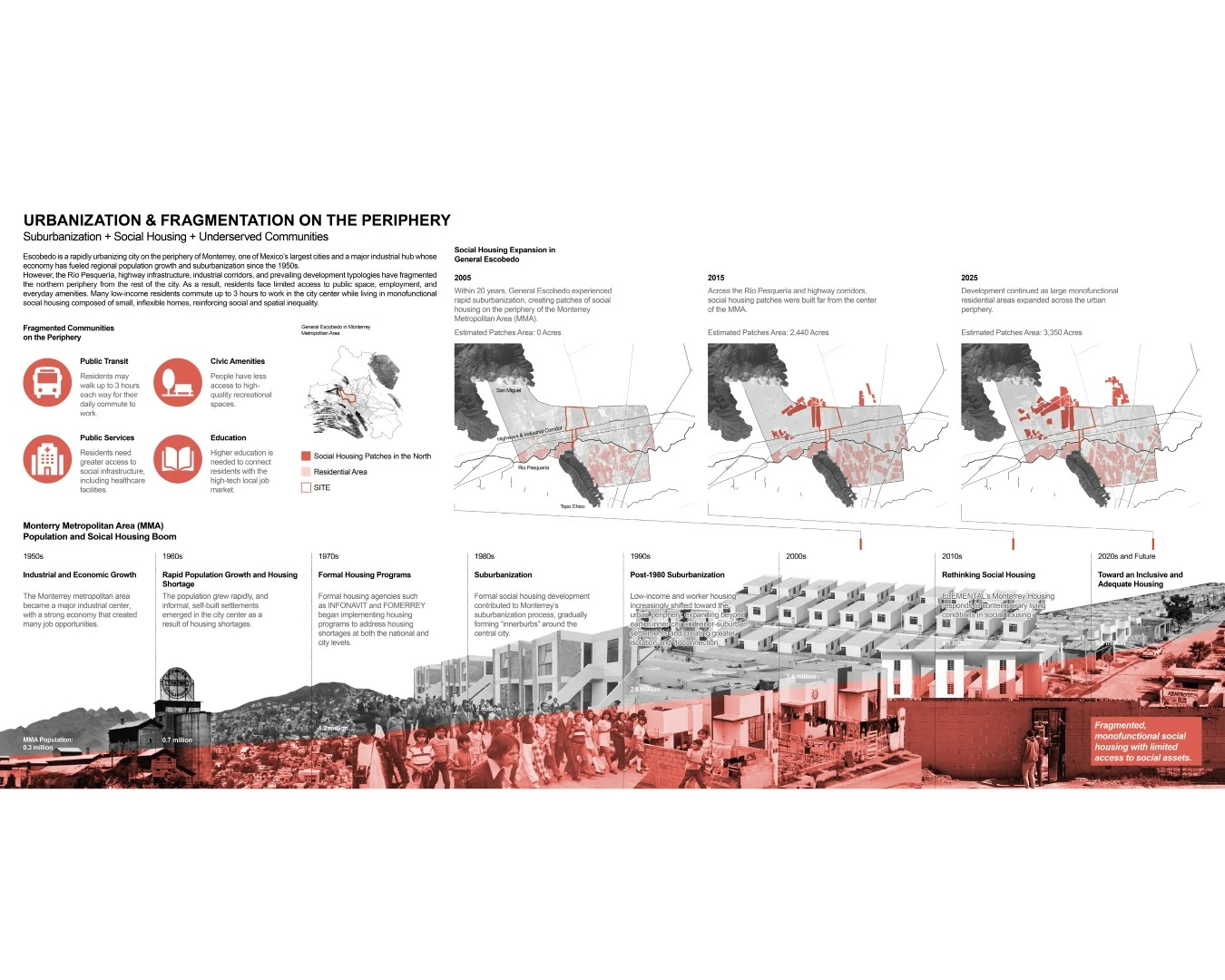
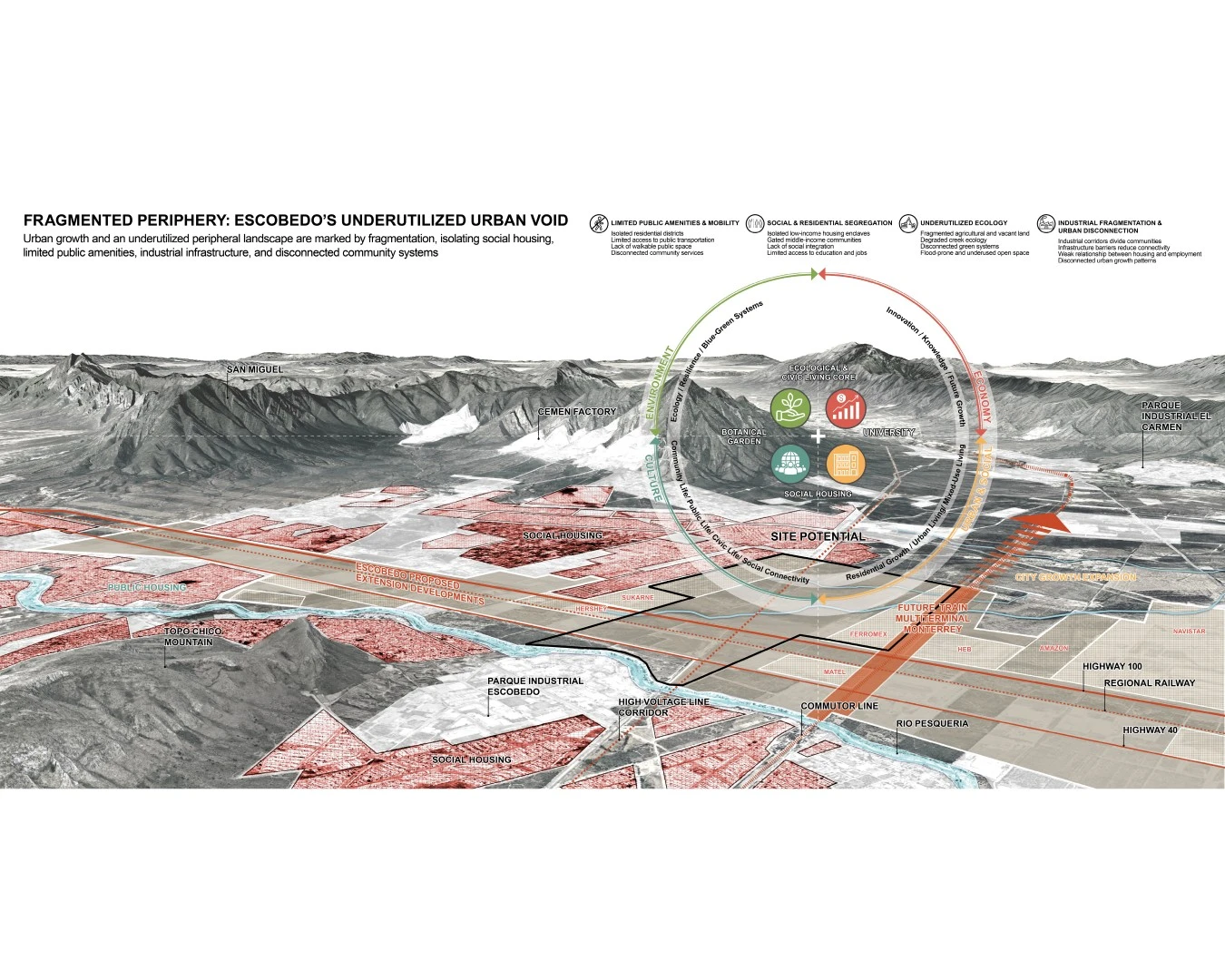
Located on Monterrey's expanding periphery, Escobedo has undergone rapid urbanization driven by industrial growth. The area is characterized by fragmented social housing, limited public amenities, and disconnected community systems that reinforce social and spatial inequality. Residents often commute for up to 6 hours daily for work and services, while heat, flooding, and limited green infrastructure further reduce environmental resilience. Despite these challenges, Escobedo remains a strategic area for growth, driven by policy and industrial development.
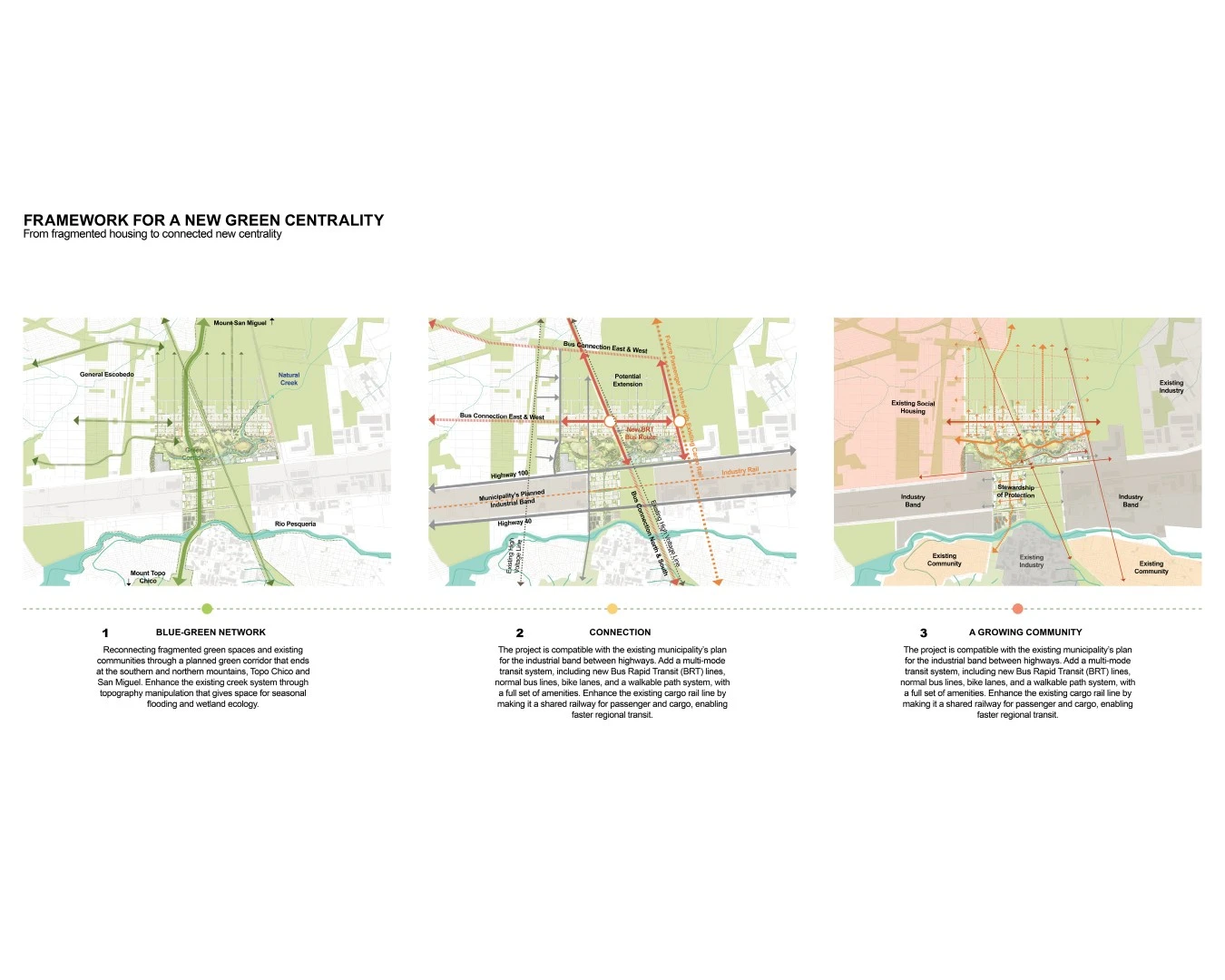
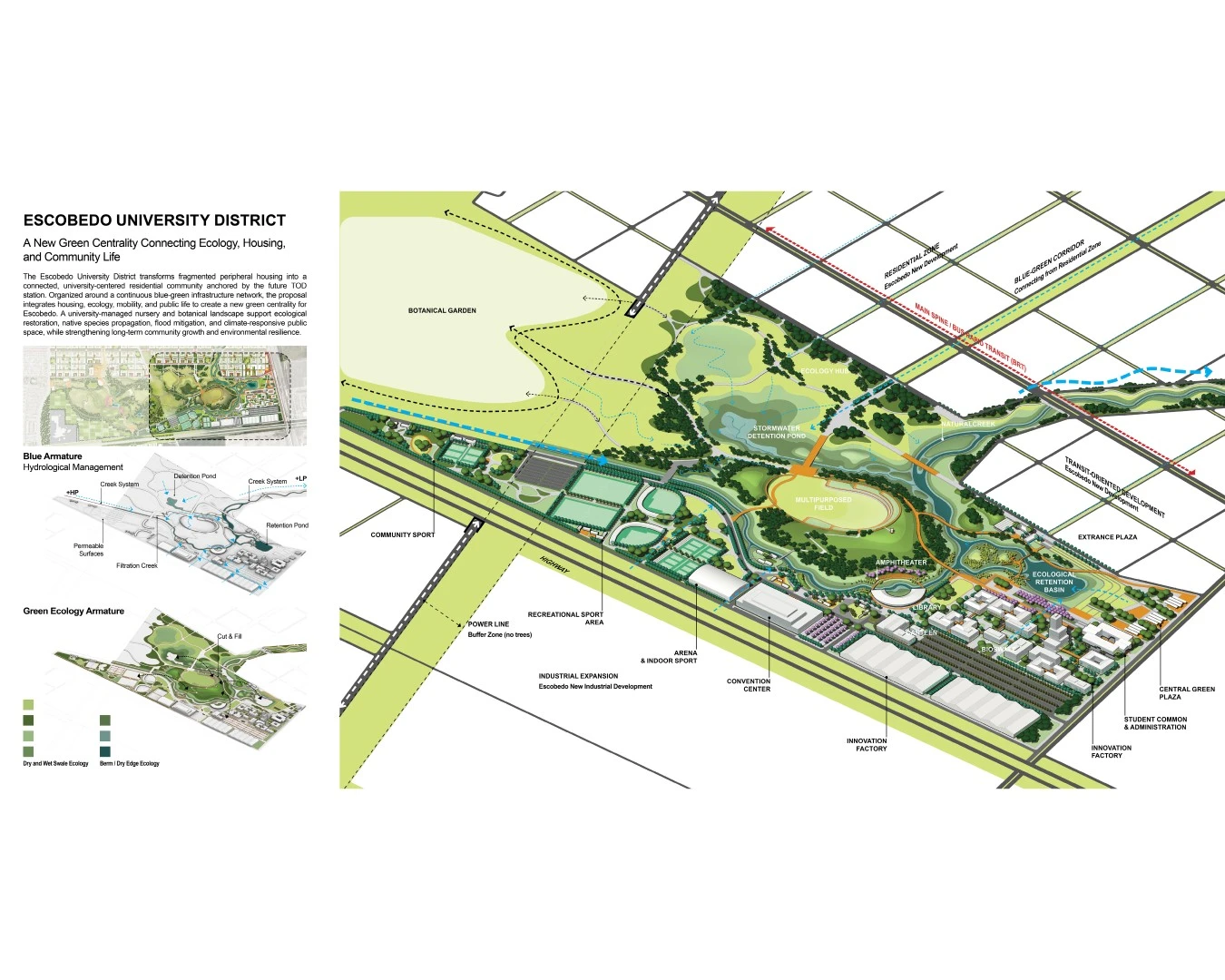
In response, the project transforms Escobedo's fragmented housing condition into a centrality of mixed-use, mixed-income, and ecologically driven district that weaves existing social housing, parks, and industries through blue-green infrastructure, diverse housing typologies, and community-centered public space.
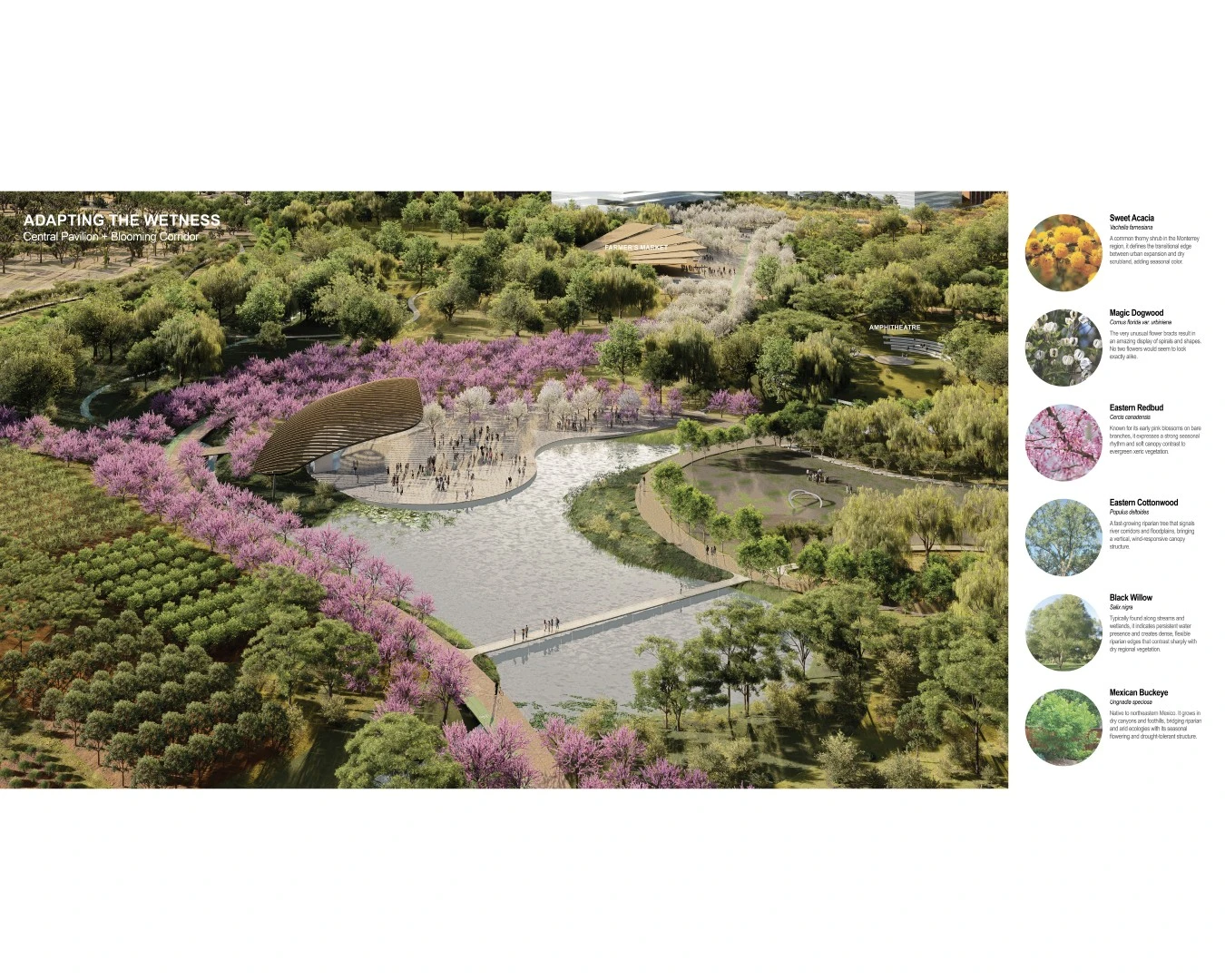
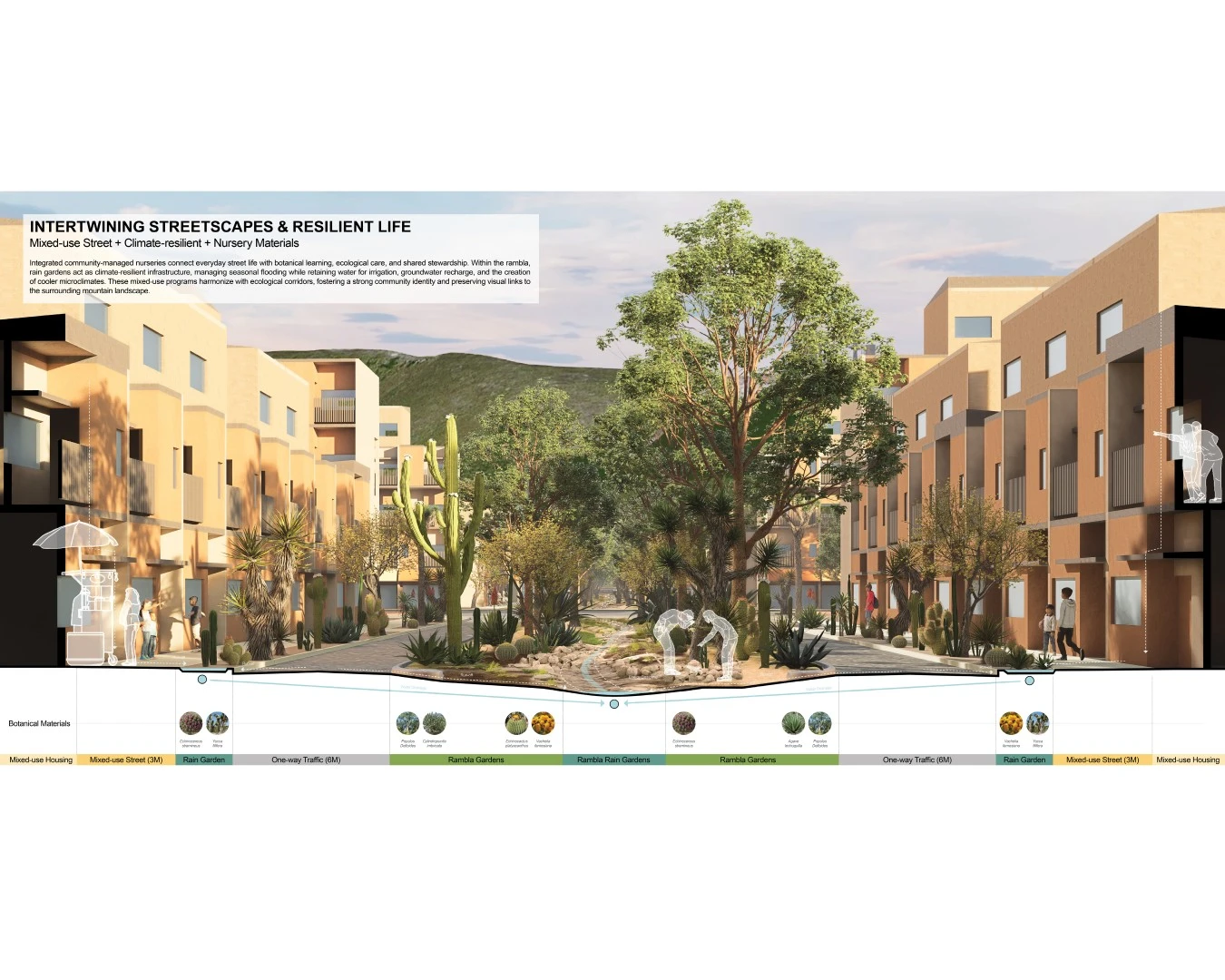
Meetings with public officials and doing a collaborative design charrette revealed a shared vision for Monterrey's first botanical garden and recreational park, a university, and mixed-use housing frameworks. Together, these elements form the ecological and civic core of Escobedo. Anchored by a continuous blue-green network, the proposal restores existing creeks, reconnects ecological corridors, and extends into new mixed-use residential communities. The system addresses flooding and urban heat through restored waterways, bioswales, infiltration landscapes, shaded public spaces, and water-retention zones.
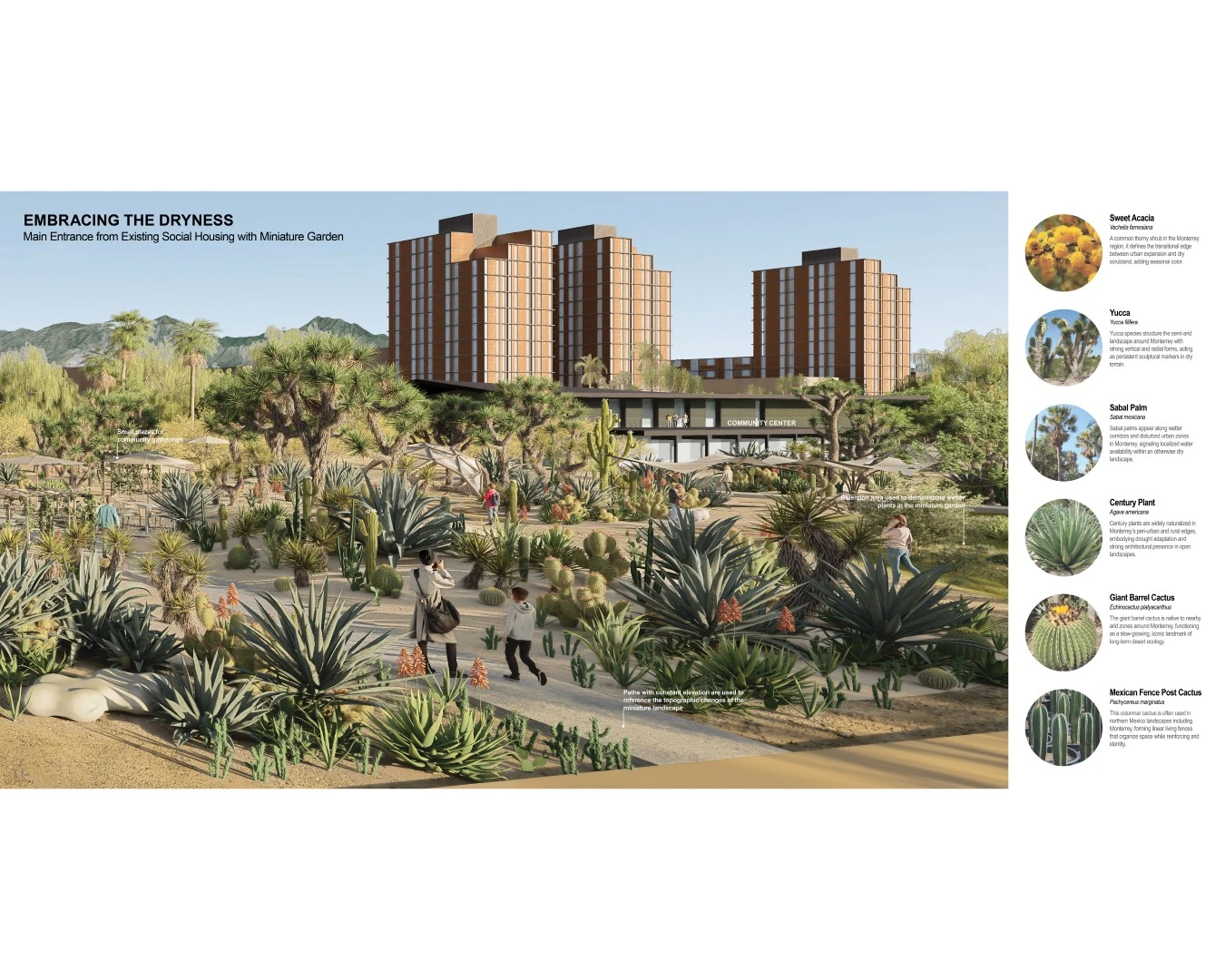
The garden showcases native ecosystems across Nuevo León, from semi-arid deserts to wetlands, while highlighting the relationships among water, ecology, and topography. A university-managed nursery supports regional ecological restoration and the propagation of native species. The botanical garden also becomes a public destination that reconnects residents to the surrounding mountains, waterways, and Escobedo's ecological identity.
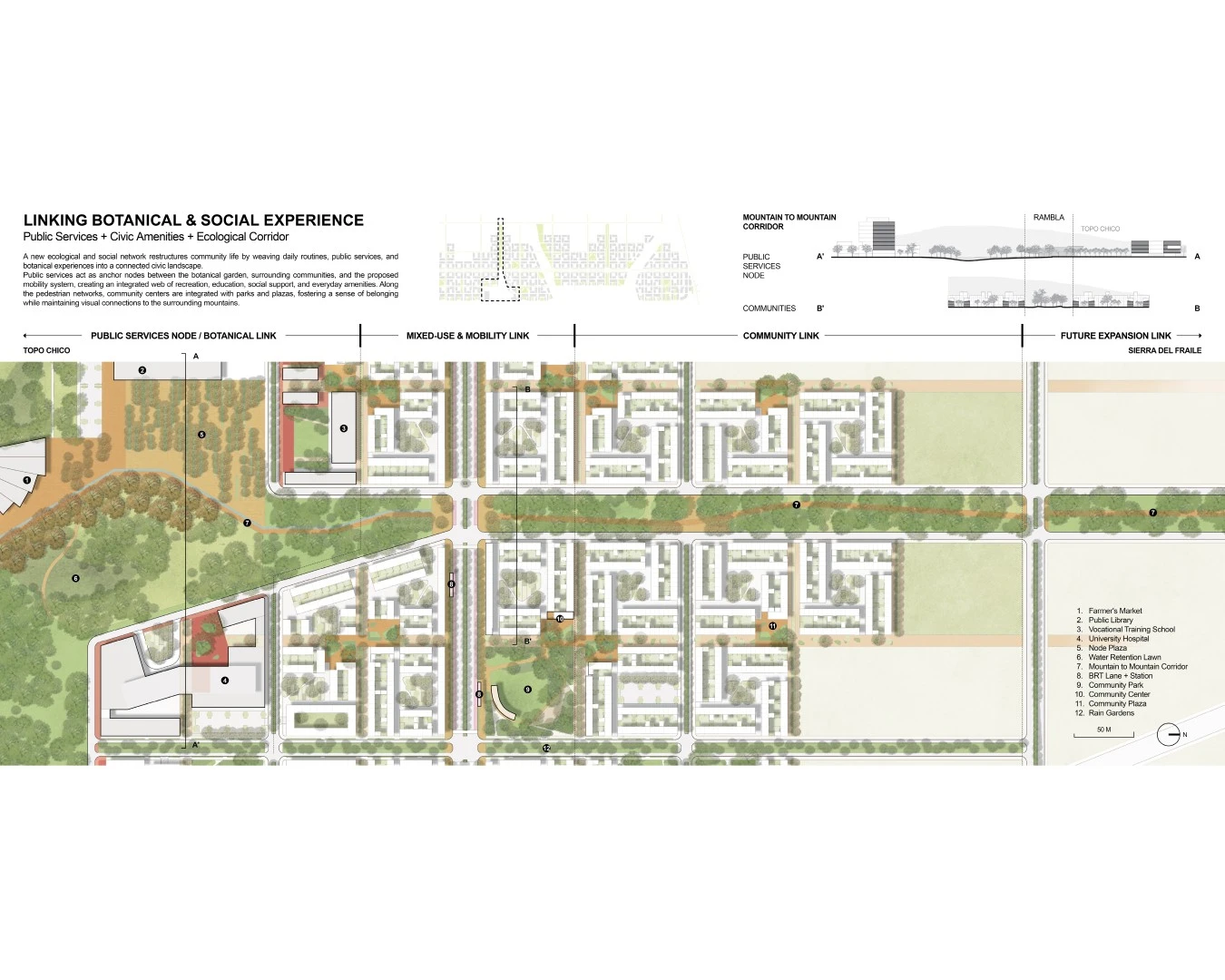
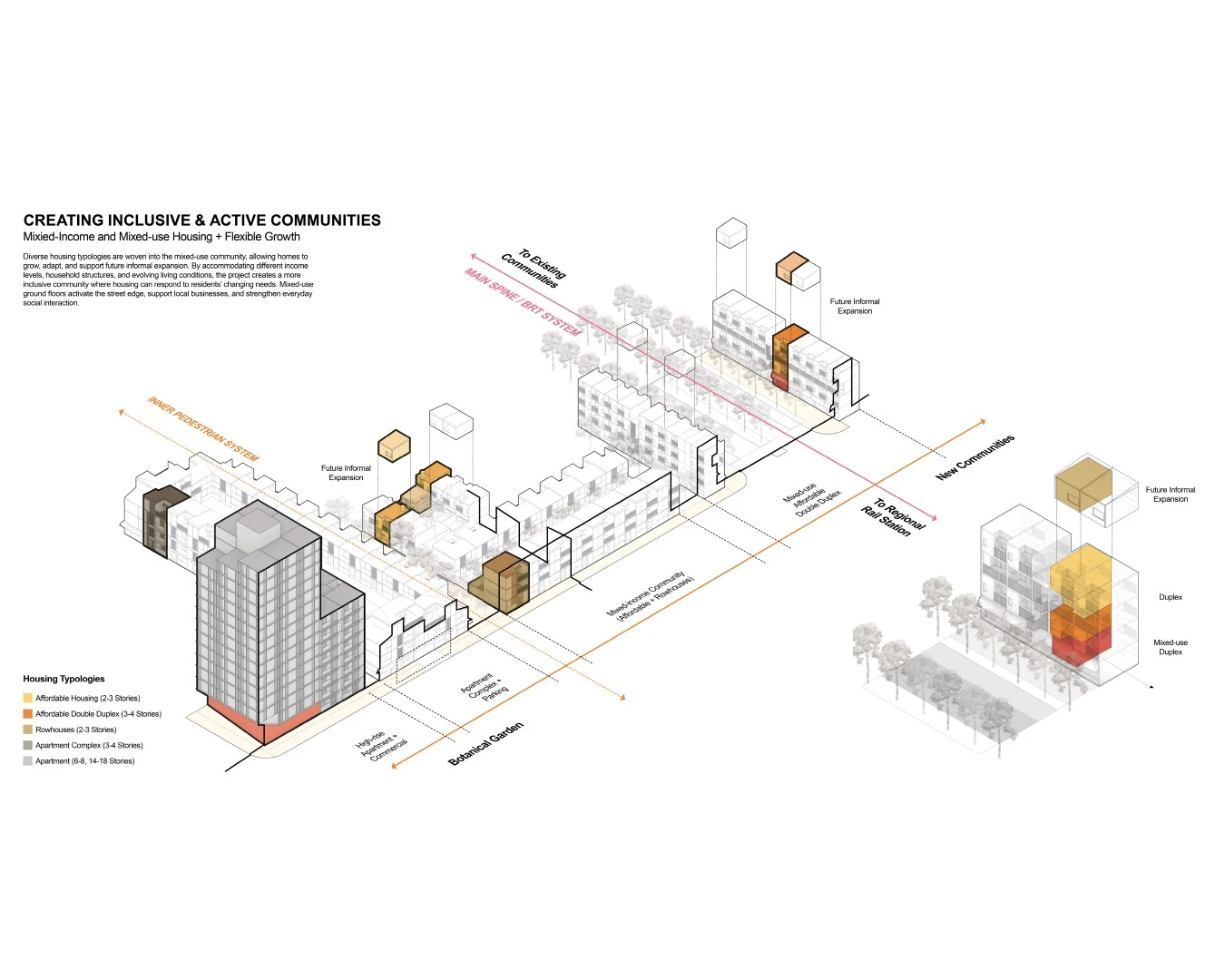
The project strengthens social equity through diverse housing typologies that support different income levels, household needs, and evolving living conditions. Affordable apartments, townhouses, and mixed-use duplexes are designed as flexible live-work units that allow incremental resident-driven expansion over time.
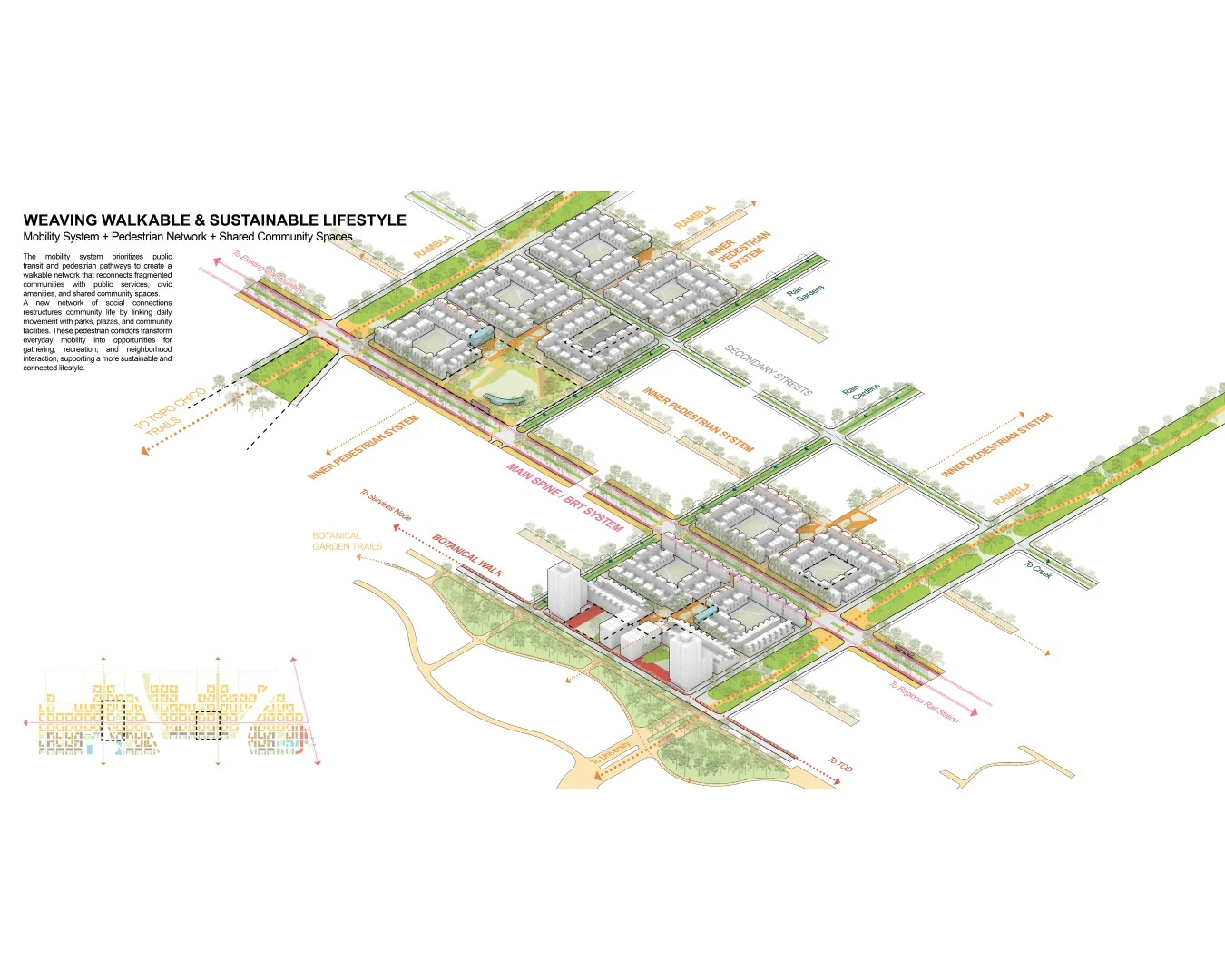
The proposal restructures mobility and public space through transit-oriented and pedestrian-focused development. Vacant land is transformed into shaded streets, bike lanes, BRT corridors, and walkable public spaces, connected to a new regional rail station. Higher-density mixed-use development is concentrated around transit and the botanical garden, integrating housing, offices, retail, and civic amenities while lower-rise residential clusters within a 350-by-350-meter framework with ramblas and vegetated pedestrian networks. Together, these systems create connected, walkable neighborhoods shaped by the principles of the 20-minute city.
By intertwining ecological restoration with interconnected public spaces and amenities at both metropolitan and neighborhood scales, the proposal creates diverse housing opportunities, strengthens the relationship between jobs and residential communities, and improves accessibility through transit and pedestrian mobility. These systems position Escobedo as a model for equitable and climate-resilient urban growth within Monterrey's expanding metropolitan region, transforming its periphery into a more socially connected and resilient district.
-
- Sweet Acacia (Vachelia Farnesiana)
- Yucca (Yucca Filifera)
- Sabal Palm (Sabal Mexicana)
- Century Plant (Agave Americana)
- Giant Barrel Cactus (Echinocactus Platyacanthus)
- Mexican Fence Post Cactus (Pachycereus Marginatus)
- Magic Dogwood (Cornus Florida Var. Urbiniana)
- Eastern Redbud (Cercis Canadensis)
- Eastern Cottonwood (Populus Deltoides)
- Black Willow (Salix Nigra)
- Mexican Buckeye (Ungnadia Speciosa)
- Strawberry Hedgehog Cactus (Echinocereus Stramineus)
- Tree Cholla (Cylindropuntia Imbricata)
- Lechuguilla (Agave Lechuguilla)
- Desert Marigold
- Texas Sage
- Palo Verde
Advertisement
Related Awards
Honors Award, Urban Design
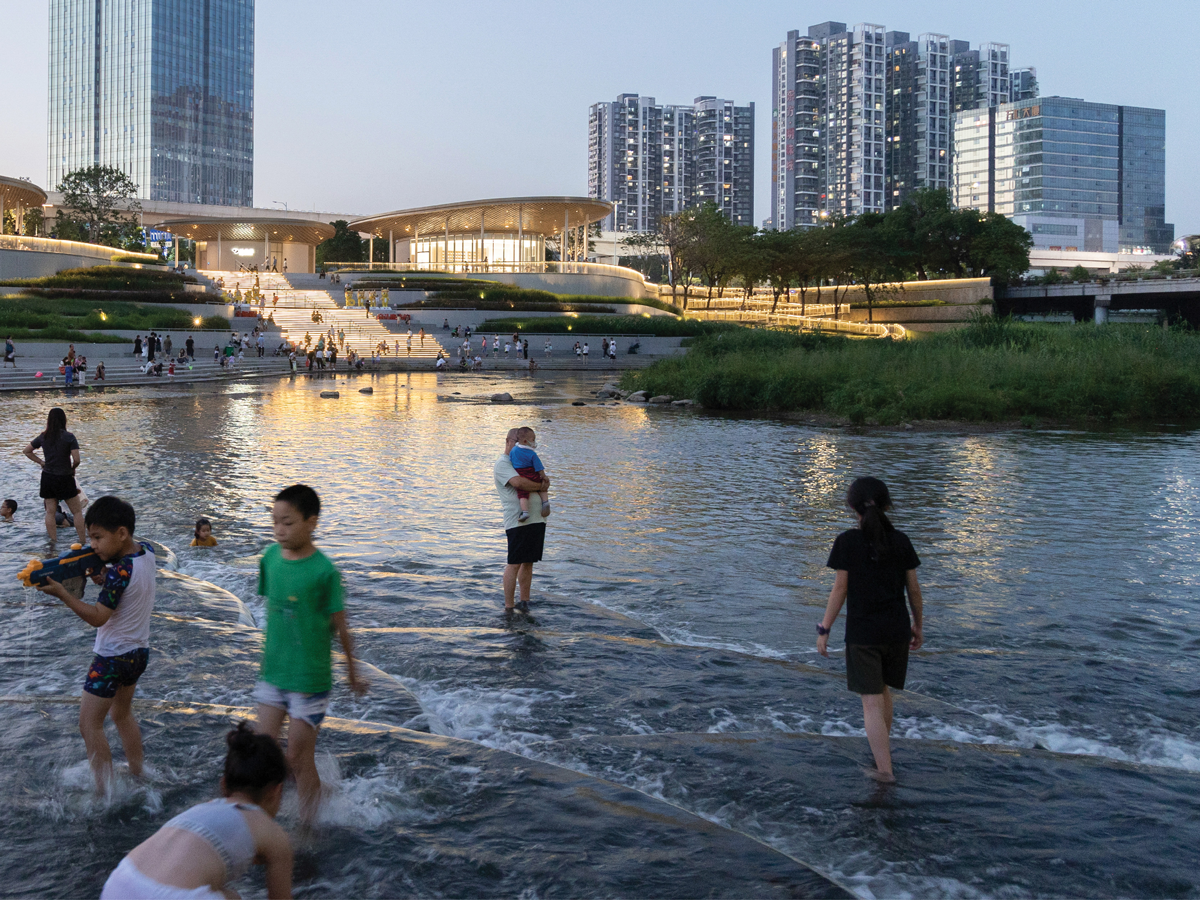
Restoring a River, Reconnecting a City: Longgang River Blueway
Over the past half century, rapid urbanization forced Shenzhen rivers into concrete channels, cutting communities off from nature and increasing flood risk. Spanning 20 kilometers, the Longgang River Blueway reshapes a former drainage corridor into a resilient, accessible public landscape.