

.webp?language=en-US)

.webp?language=en-US)
Riverside Revival: Urban Design Strategies for Coastal Development
Jules Mainor, Student ASLA; Anna Desmone, Student ASLA; Jui Dudhiya, Associate ASLA; Tatiana Veloso, Associate ASLA; Omori Yui, Student International ASLA
-
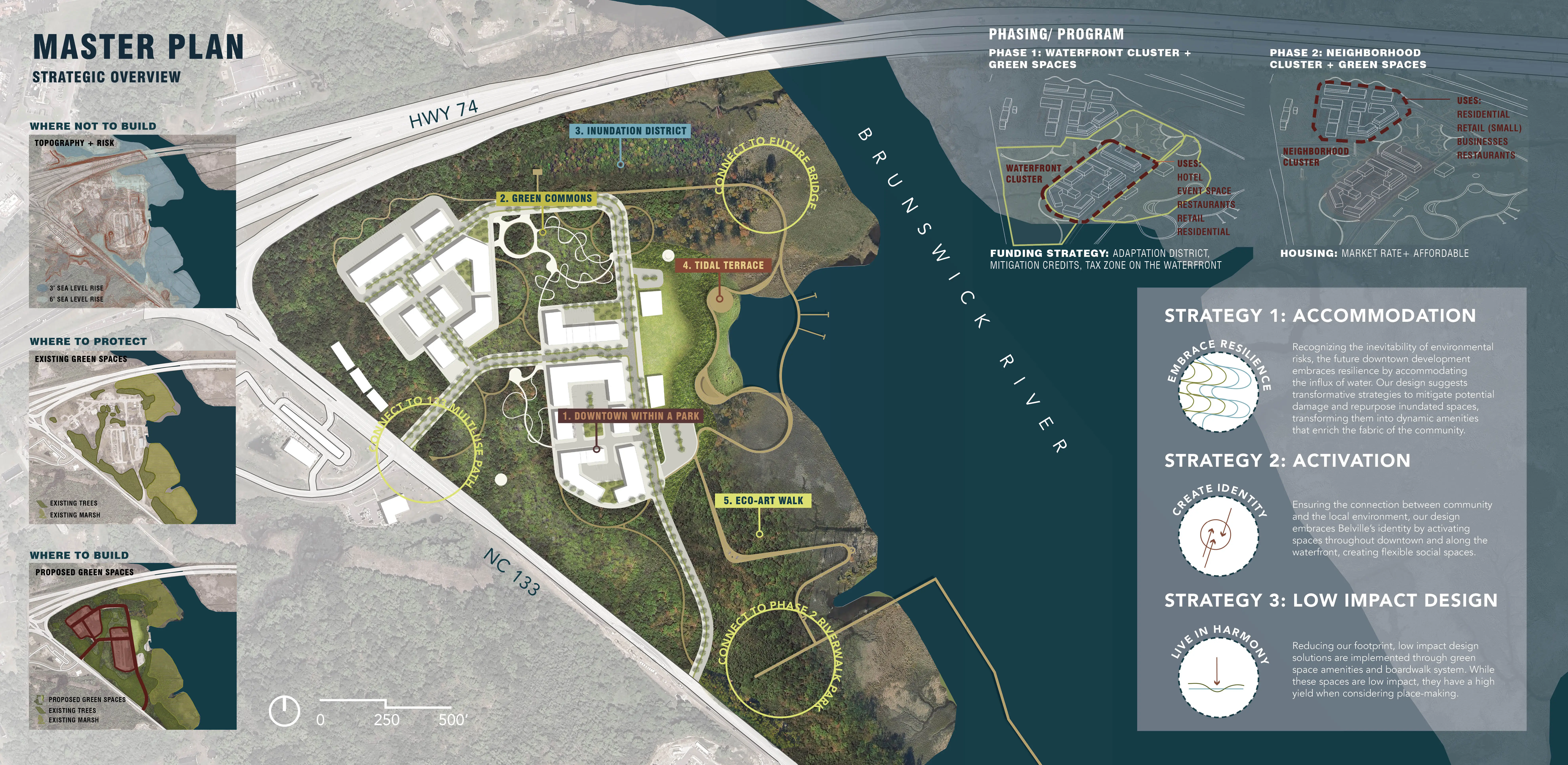
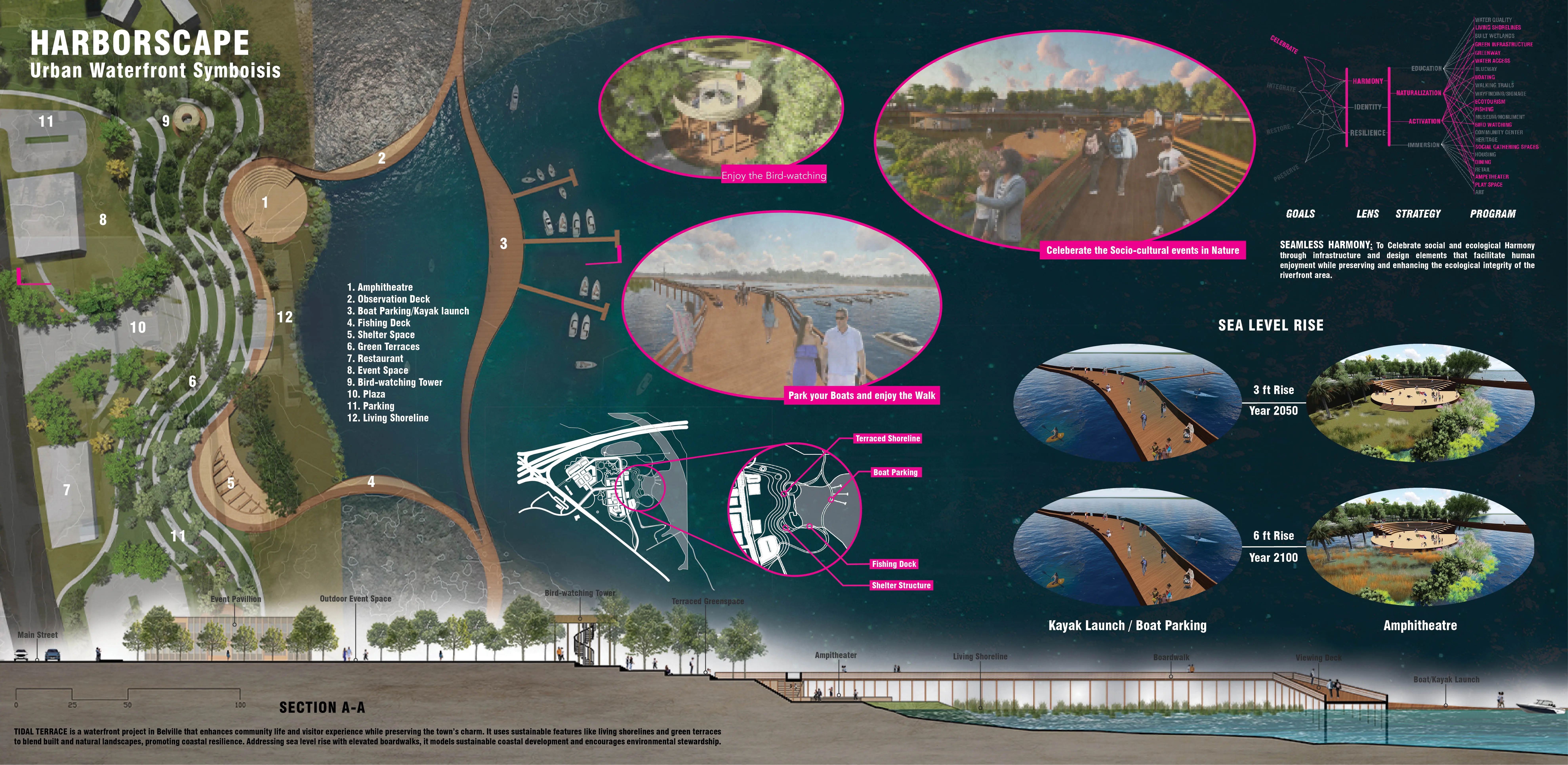
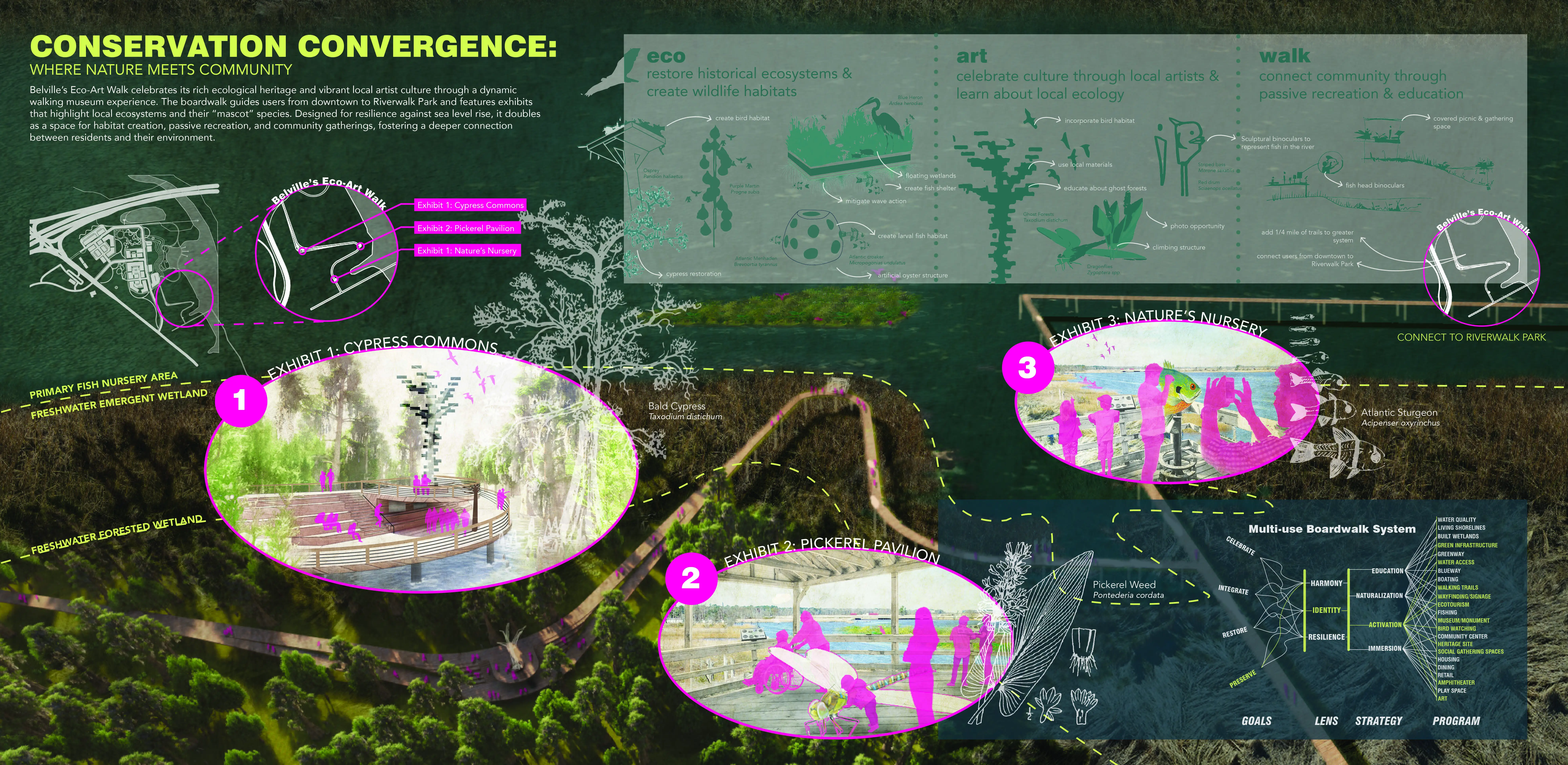
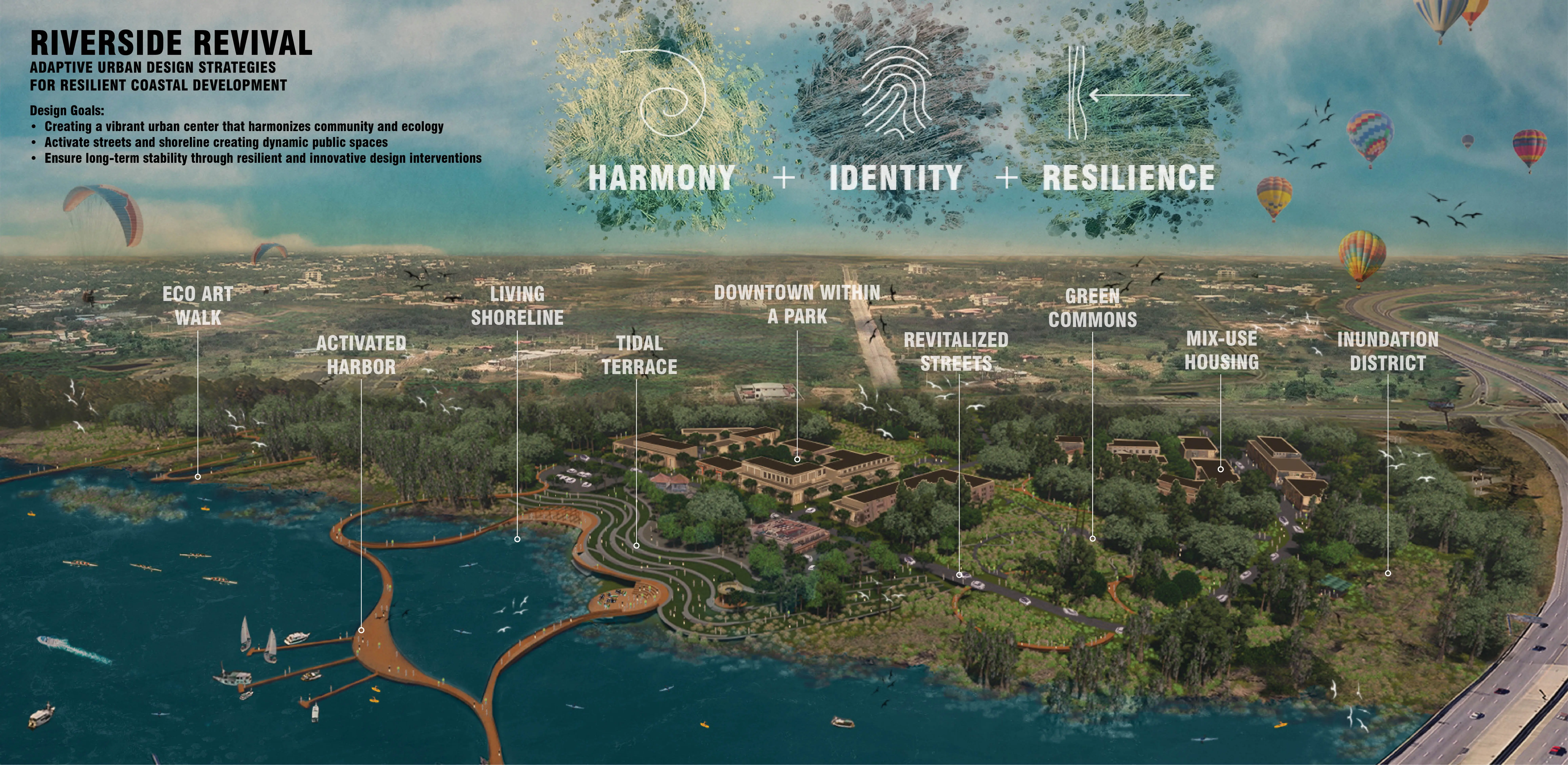
How should we think about urban design in a small coastal town facing climate change? Riverside Revival weaves the urban fabric of the new downtown of Belville, North Carolina. Despite increased vulnerability to climate hazards, the town is rapidly growing and risks losing its identity. To address these challenges, we propose leveraging Belville’s greatest assets—its unique ecology and natural beauty—to create harmony, identity, and resilience. Guided by these values, our analysis-driven proposal maximizes green spaces to adapt to future uncertainties, activate the public realm, minimize impact on the land, and seamlessly integrate people with their environment. The new downtown accommodates growth and benefits the town and broader region.
-
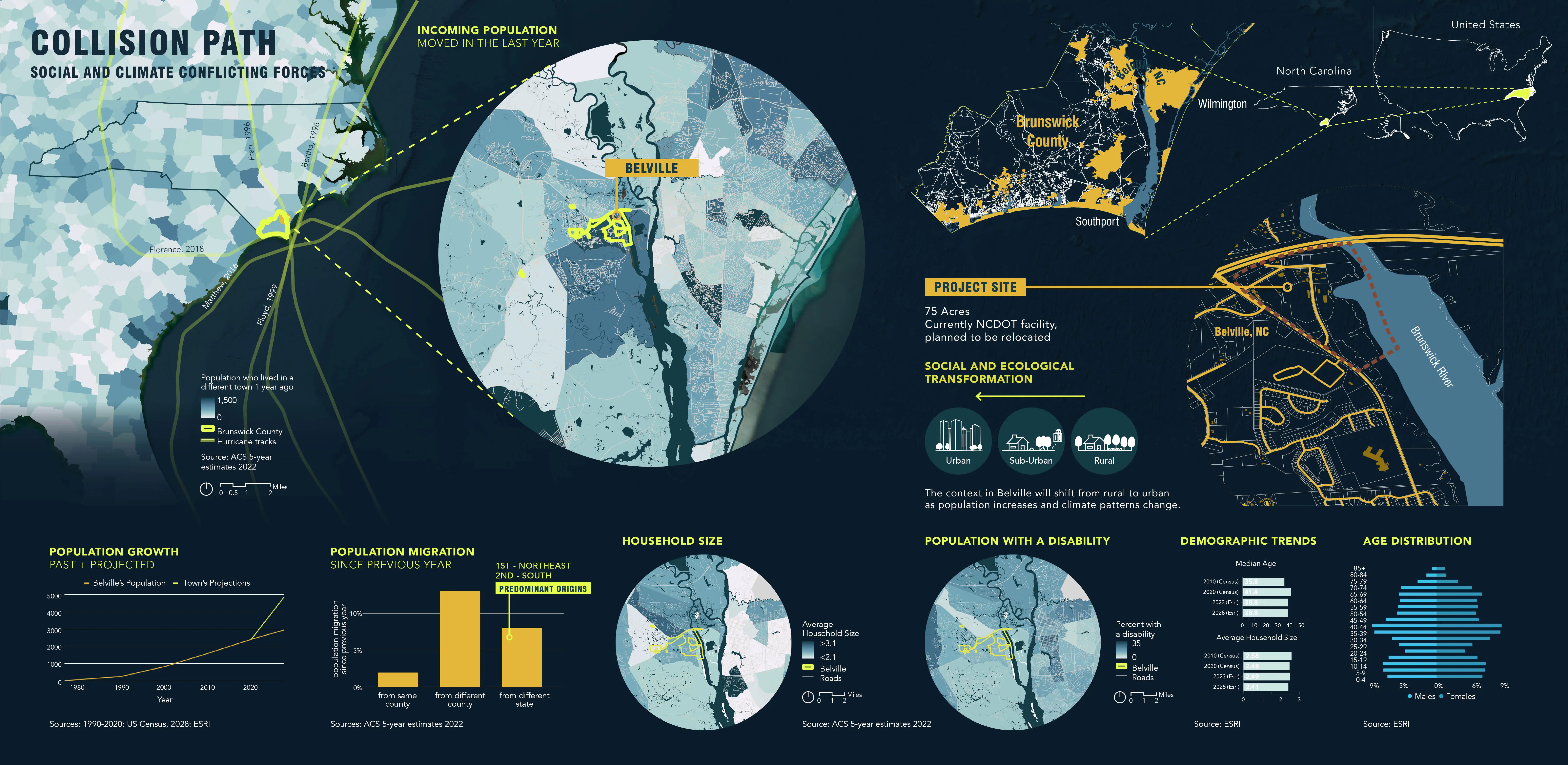
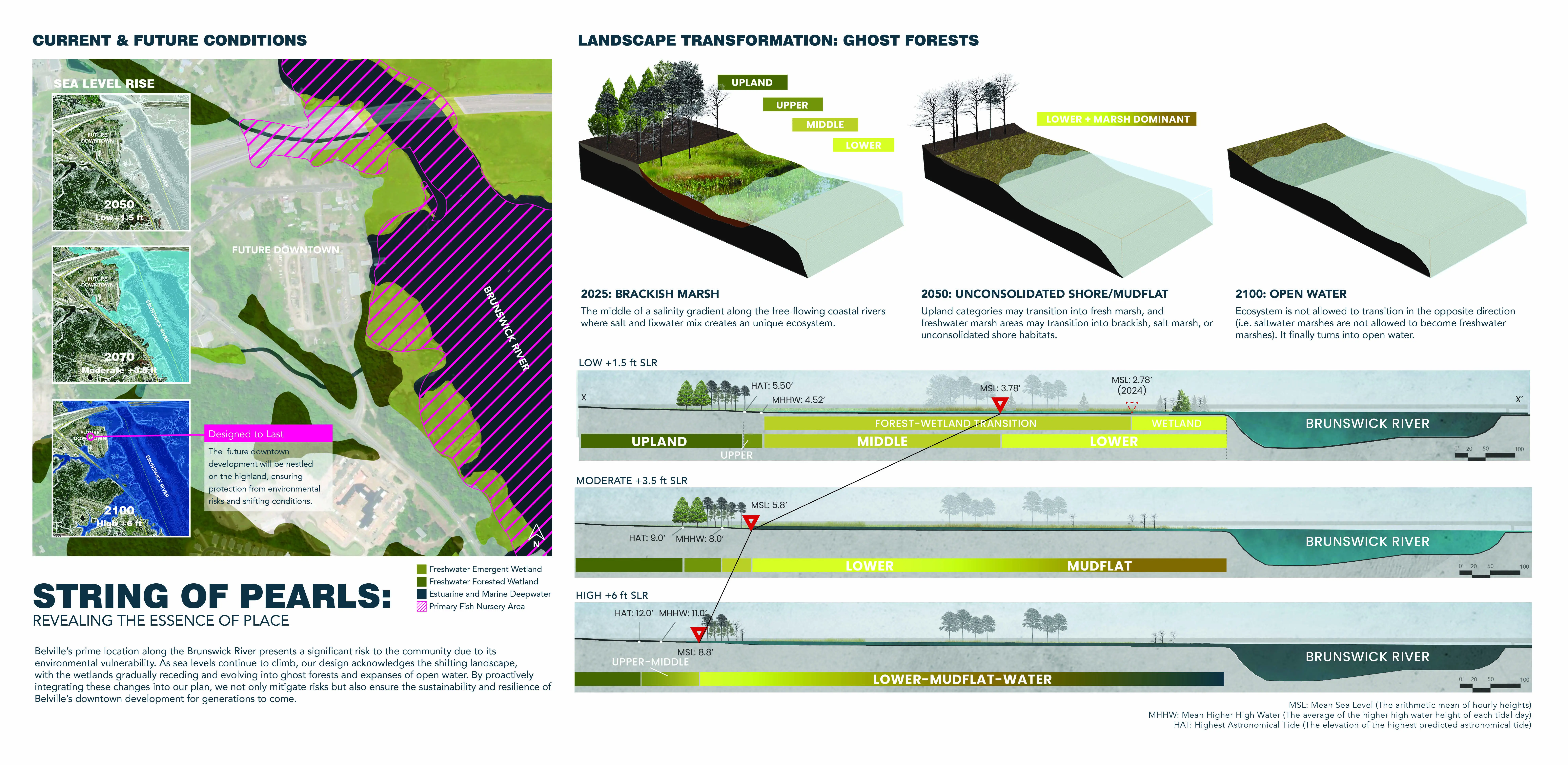
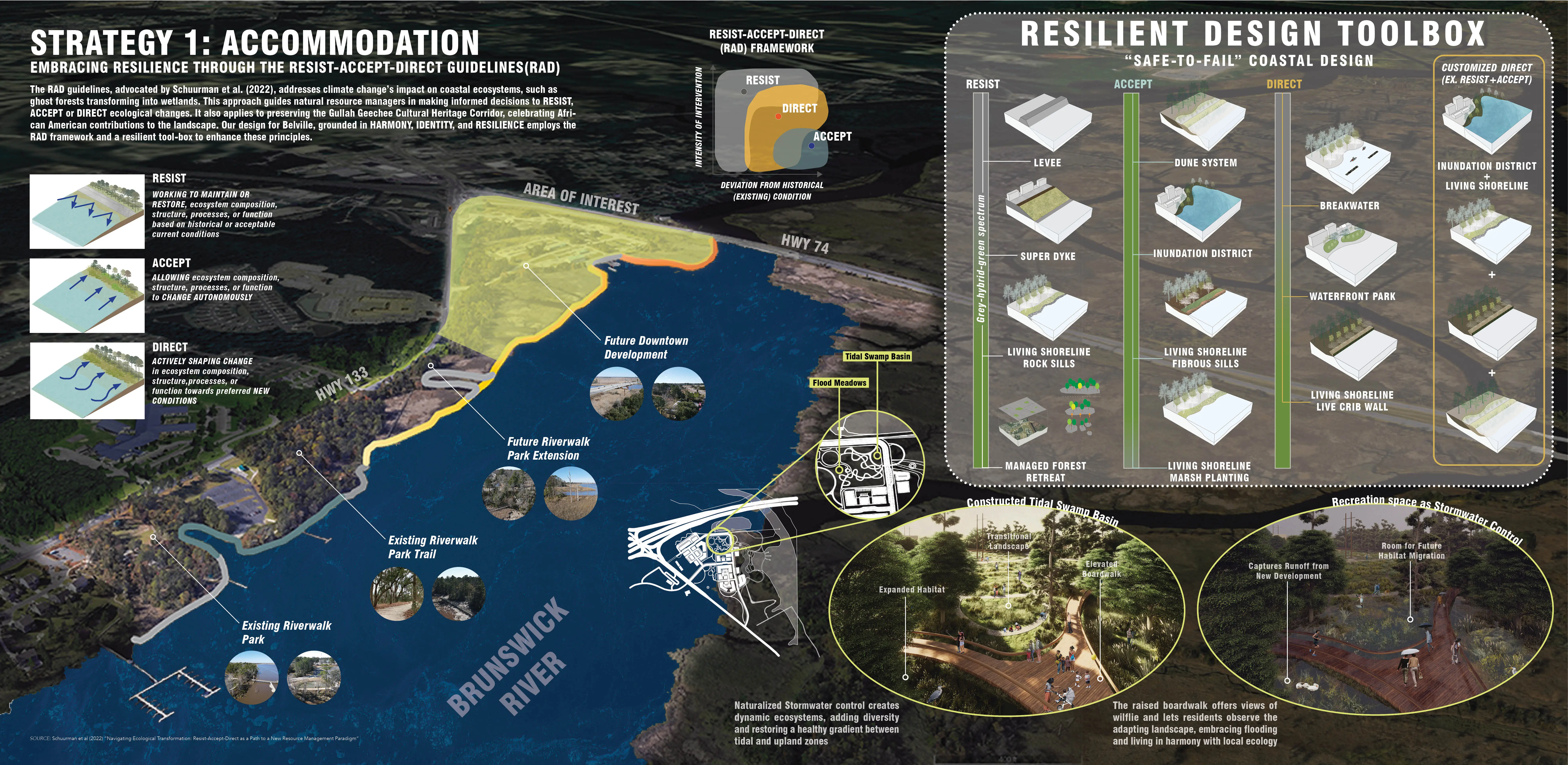
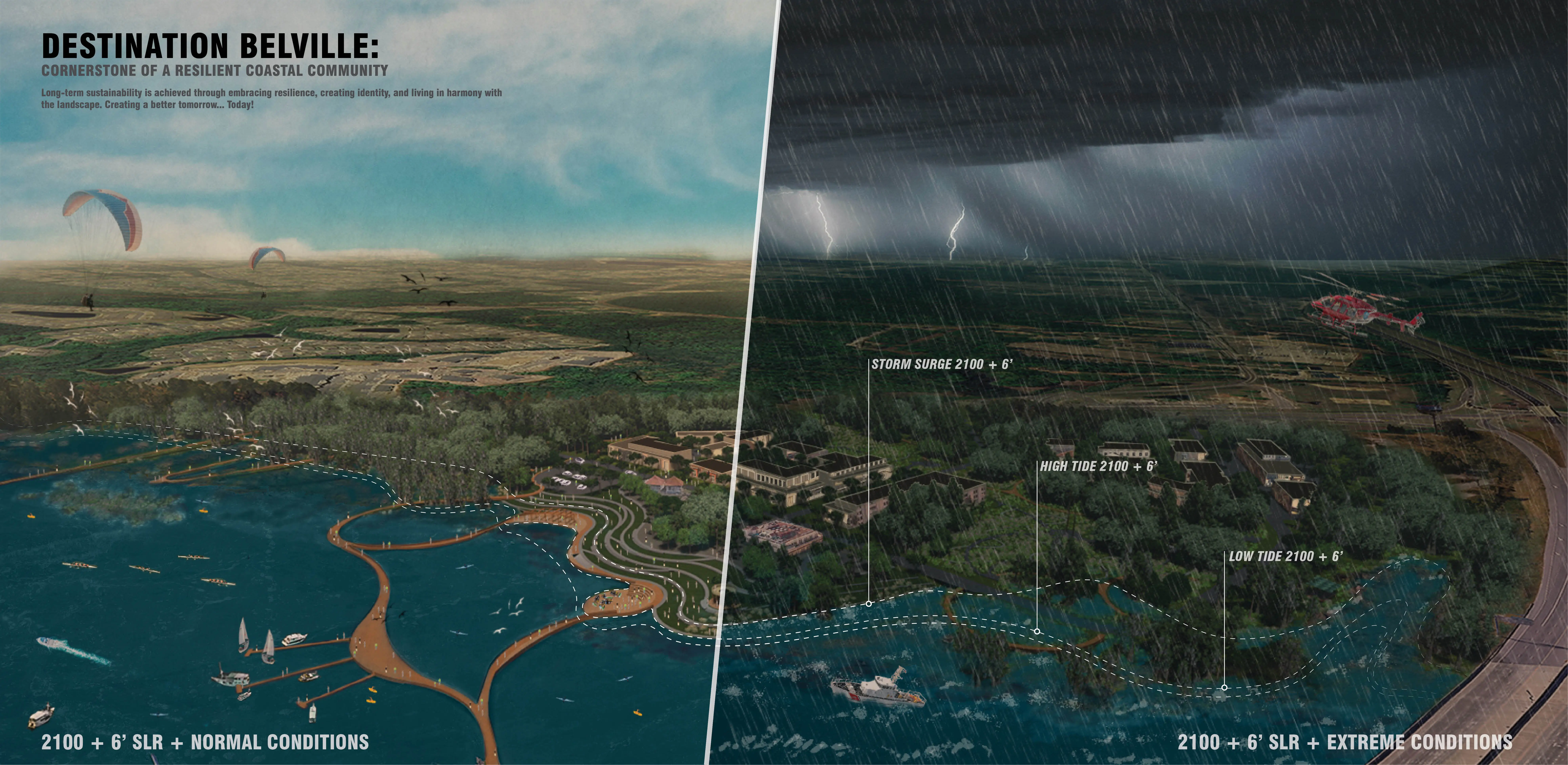
The Town of Belville, located outside Wilmington, NC, is experiencing significant social and ecological changes. Brunswick County, the 4th fastest-growing county in the U.S., expects Belville’s population to double by 2030. Situated within 20 miles of the ocean on the Brunswick River, the town faces tides, storm surges, and increasing climate hazards like sea-level rise. Development limits wetland migration inland, risking the transformation of forest wetlands into open water.
To manage growth and strengthen the local economy, the town’s 2030 Vision Plan proposes a new downtown on the riverfront, where the old Main Street once thrived before being abandoned due to Highway 74 construction. Our analysis revealed that, due to the site’s unique topography, 55% of the future downtown area will be inundated in the worst-case scenario of SLR by 2100, while the upland areas are some of the safest in Belville.
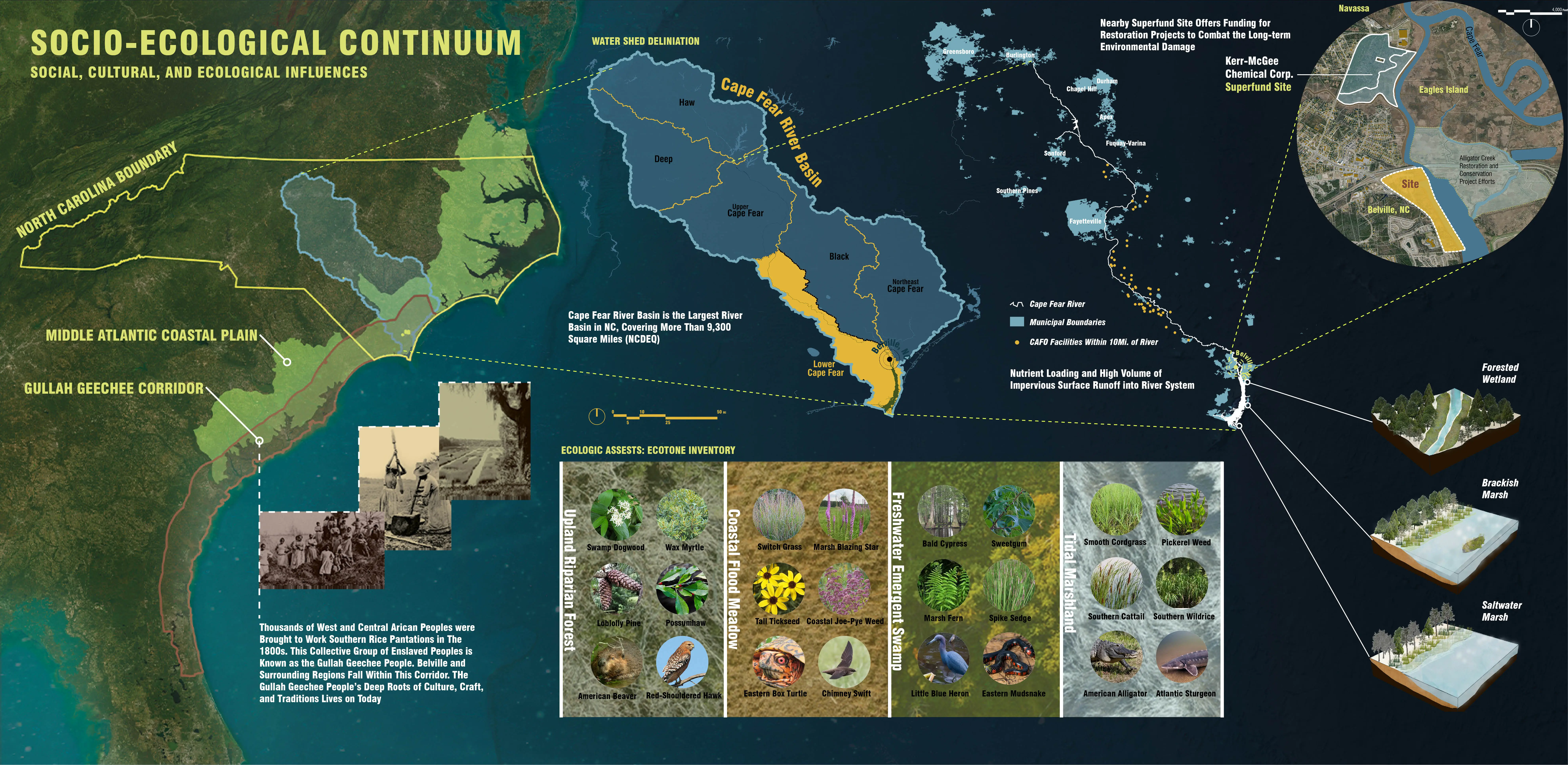
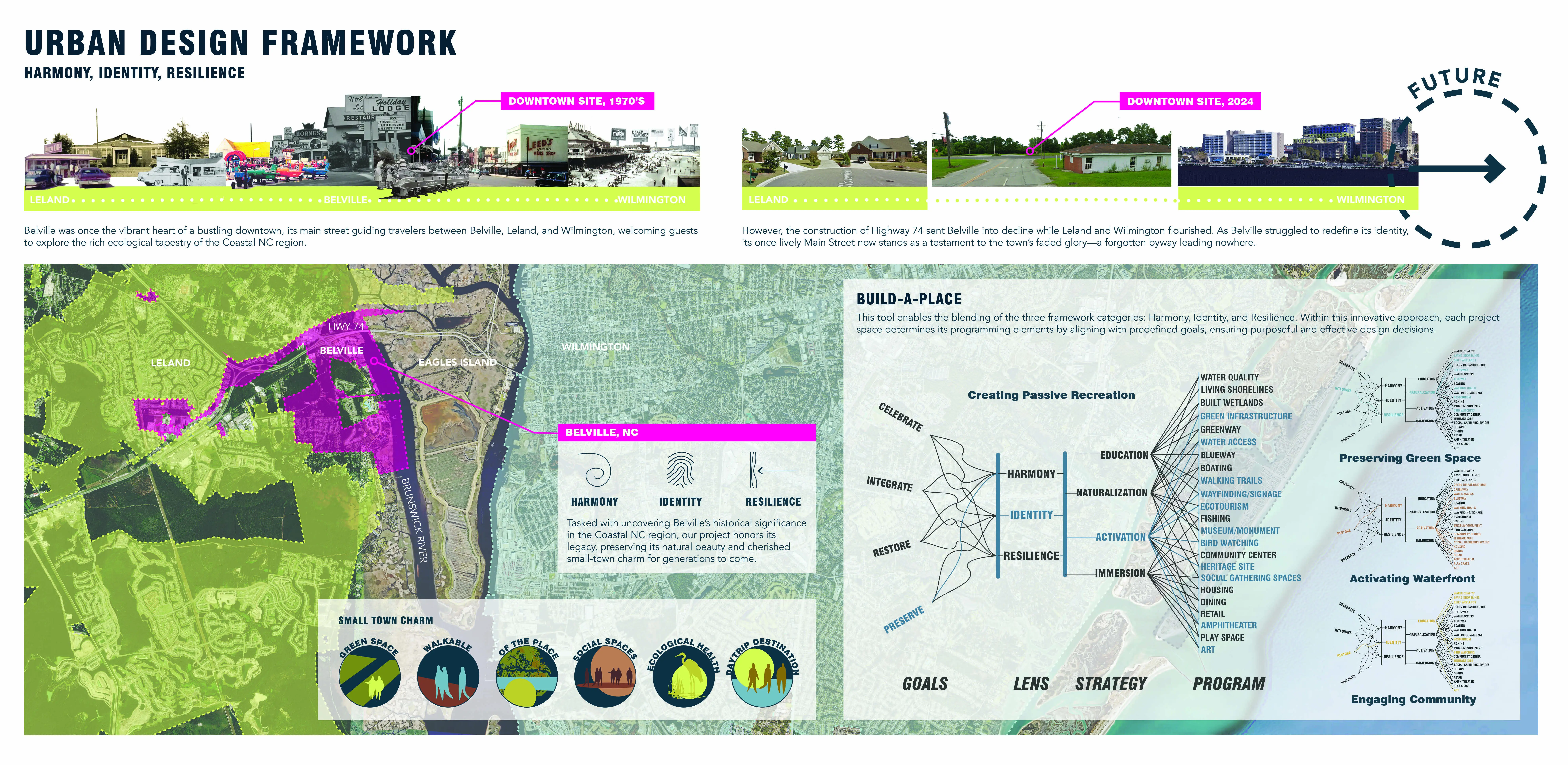
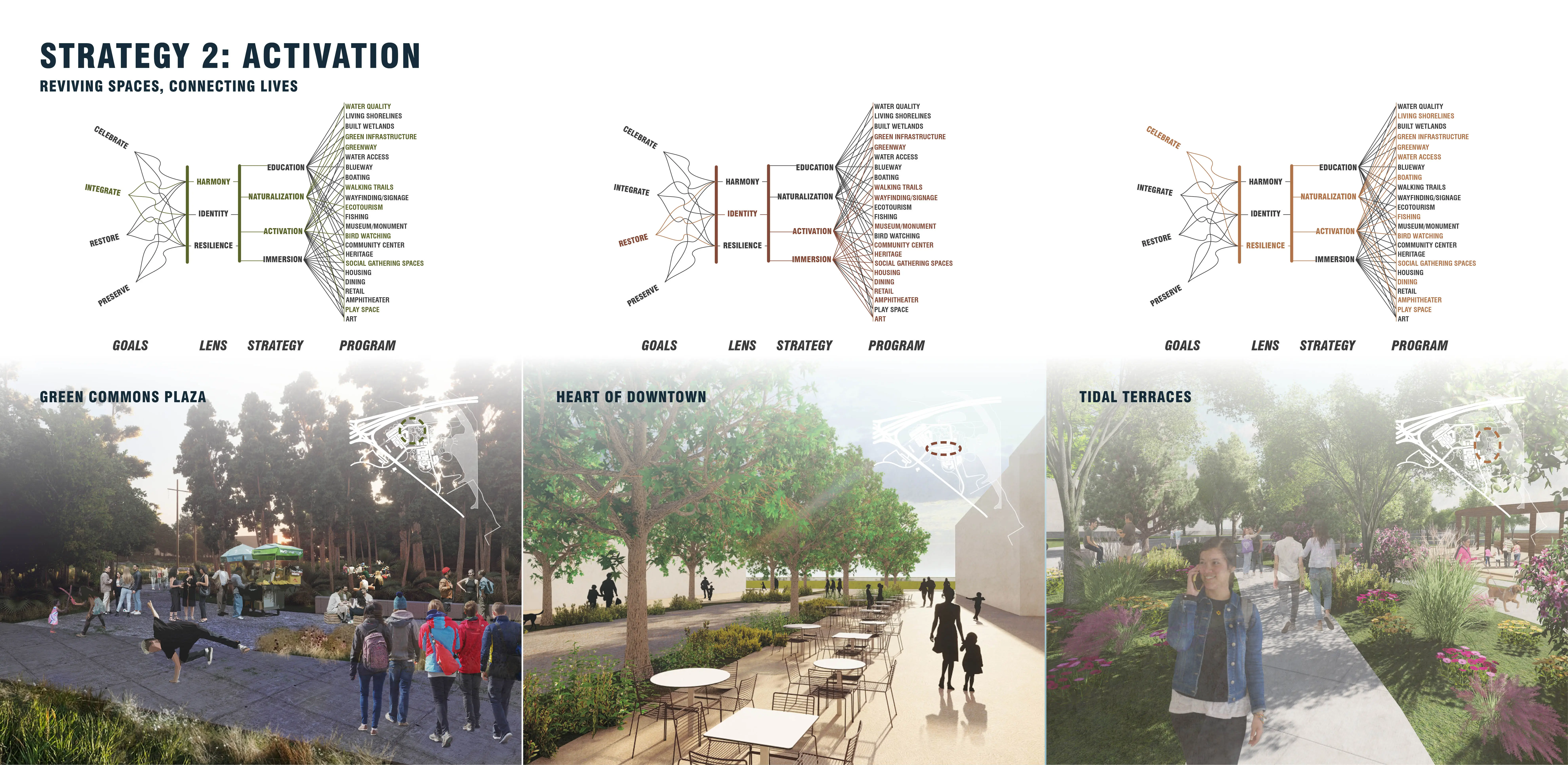
In our conversations with the town, we understood that residents are concerned about losing the town's small-town charm and identity. Most importantly, integrating green spaces in the new downtown is crucial for the community, creating a seamless transition to the adjacent Riverwalk Park. We decided to explore this idea further to see what can be achieved when a new downtown is designed with green space as the main driver. We aim to strengthen Belville’s identity by celebrating and enhancing the natural beauty and local ecologies that make the town unique. Our plan preserves and enhances Belville’s small-town charm by creating a green, walkable downtown with authentic character. It includes ample gathering spaces to build community, improve ecological health, and serve as a day trip destination for visitors and a treasured space for Belville residents to enjoy.
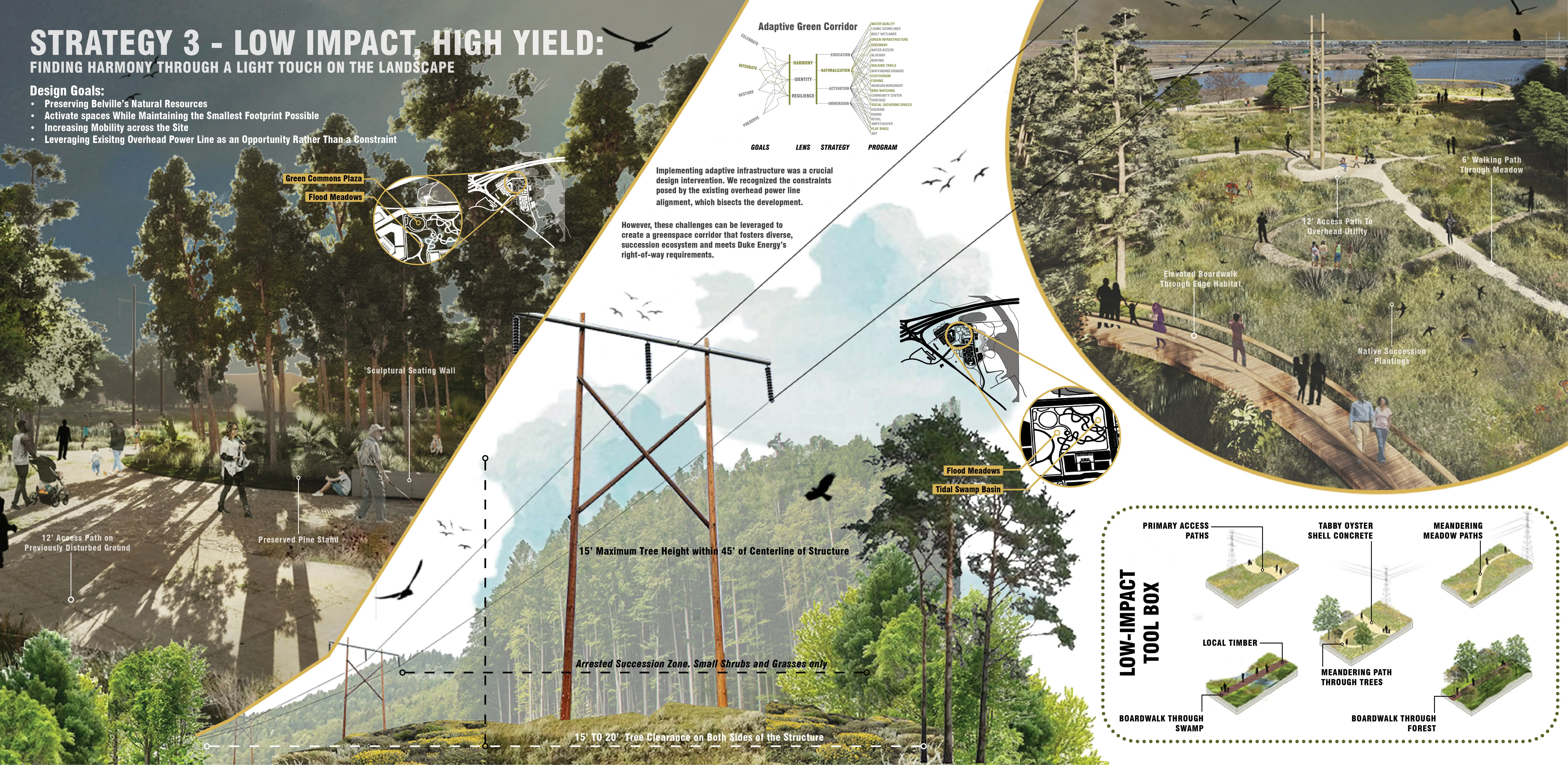
To guide decision-making, we developed an urban design framework. In addition to the lenses of harmony, identity, and resilience, we propose three strategies: accommodation of water, activation of the public realm, and low-impact design. For the most vulnerable areas, we use the Resist-Accept-Direct (RAD) Guidelines to address sea-level rise. To determine the program according to community goals, we developed the “Build a Place” tool, which can be used by designers and the community to facilitate placemaking.
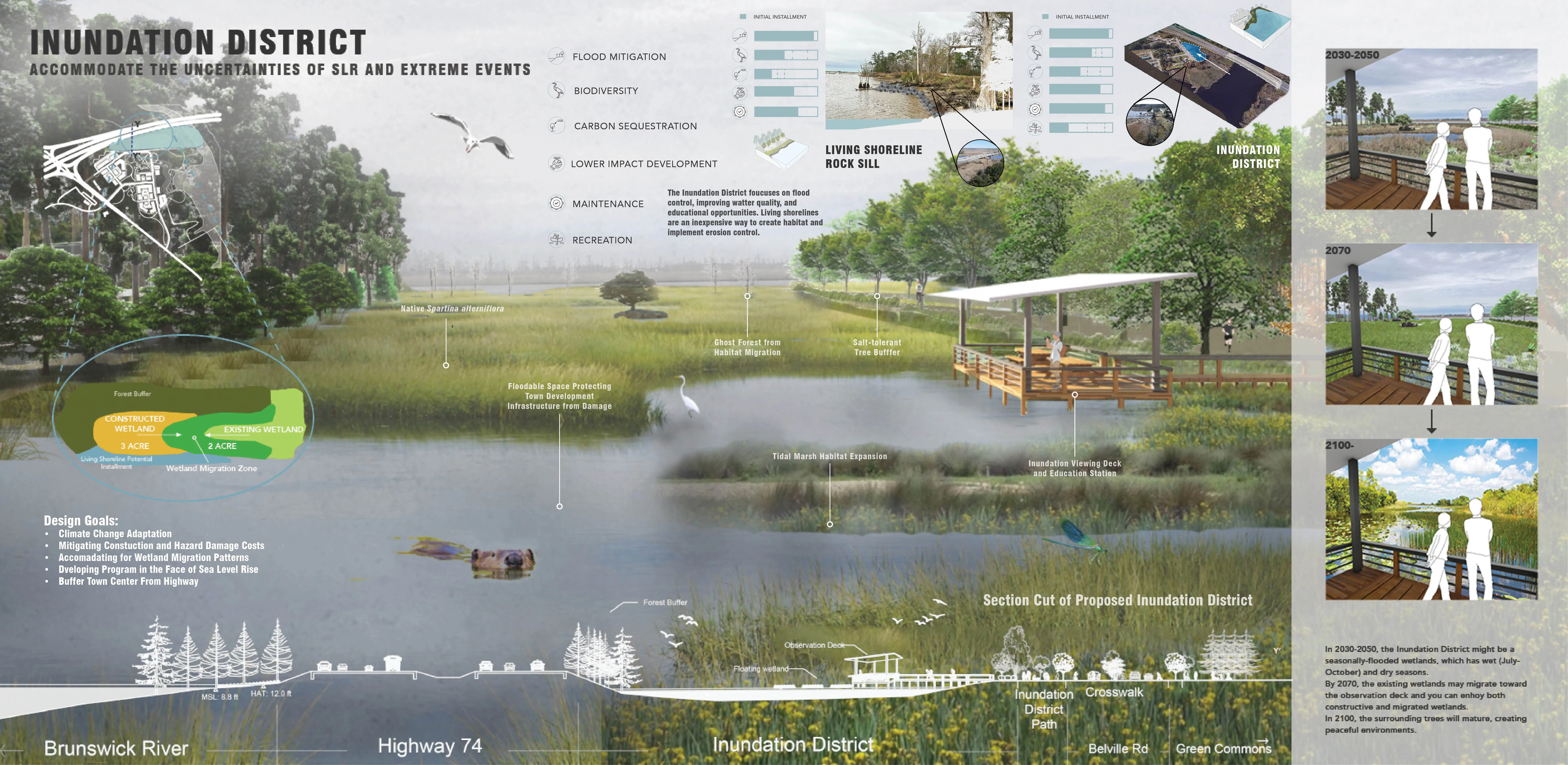
The project encompasses the downtown development itself with building clusters and the street network, the Green Commons within Downtown, and three different green spaces along the waterfront: Inundation District, Tidal Terrace, and Eco-Art Walk. We assessed topography, flooding risk, and existing vegetation to identify suitable building areas. This way, the master plan preserves existing vegetation and establishes key green spaces around which development can occur.
This project positions Belville as a model for sustainable small-town development in the face of climate change, accommodating future growth and climate uncertainties. By inviting water in, the project benefits the town and the broader region through avoided losses, improved water quality, and ecological integrity, allowing marsh migration. As the region grows and develops, this project will become a buffer, preserving the riverfront as a public green space. It will generate financial returns for the town, create jobs and green spaces accessible to Belville residents and the wider community. With a systems-based, integrated approach, Belville can turn threats into opportunities and thrive as a coastal community.
-
- Mike Allen - Mayor, Town of Belville
- Chuck Bost - Mayor Pro Tem, Town of Belville
- Athina Williams - Town Manager, Town of Belville
- Jim Bucher - Director of Parks and Recreation
- Ian McLeod - Events and Outreach Coordinator, Town of Belville
- Chad Staradumsky - Planning Director, Town of Belville
- Adrienne Harrington - Smart Moves Consulting
- Bolton & Menk, Inc. - Studio Sponsor
-
- Bald Cypress
- Loblolly Pine
- Sweetgum
- Swamp Dogwood
- Switch grass
- Spike Sedge
- Smooth Cordgrass
- Southern Cattail
- Southern Wildrice
- Marsh Fern
- Pickerel Weed
- Tall Tickseed
- Marsh Blazing Star
- Coastal Joe-Pye Weed
- Wax Myrtle
- Possumhaw
- Arrow-leaved Water-Lily
- Little BlueStem
- Swamp Titi
- Swamp Sunflower
- Splitbeard Andropogon
Advertisement
Related Awards
Honors Award, Urban Design
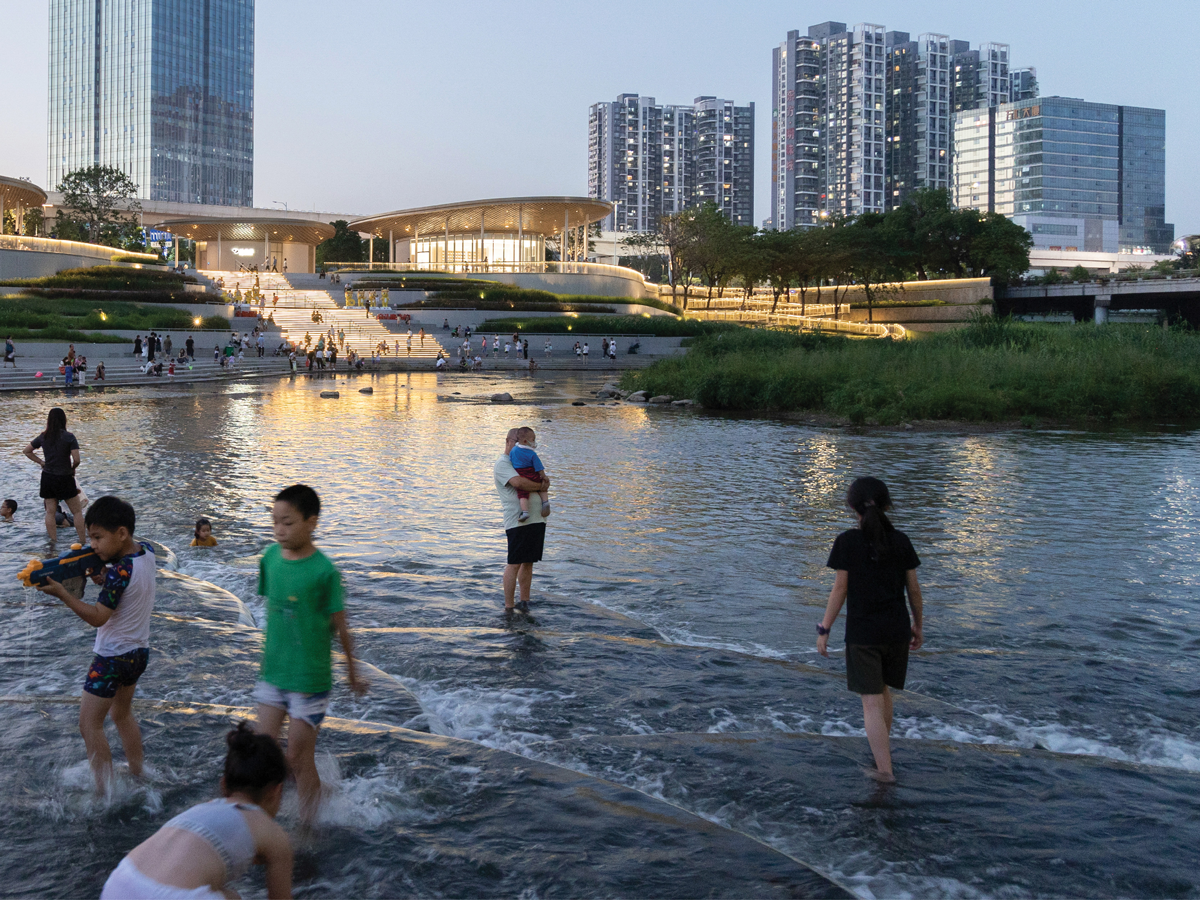
Restoring a River, Reconnecting a City: Longgang River Blueway
Over the past half century, rapid urbanization forced Shenzhen rivers into concrete channels, cutting communities off from nature and increasing flood risk. Spanning 20 kilometers, the Longgang River Blueway reshapes a former drainage corridor into a resilient, accessible public landscape.
Related Articles
ASLA Fund
American Society of Landscape Architects Announces its 2026 Student Awards
39 Student Award winners elevate the future of the landscape architecture profession
Aug 24 2026