

.webp?language=en-US)
.webp?language=en-US)
Voices of Women in Landscape Architecture, Part 17
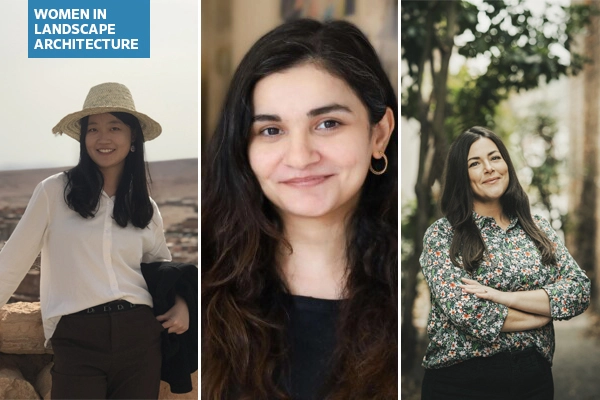
Magic Sun, Associate ASLA, Nehali Doshi, Associate ASLA, and Lindsay Corica
It is Women's History Month, which means Voices of Women in Landscape Architecture, the Women in Landscape Architecture Professional Practice Network (WILA PPN)'s profile series, has been going strong for a whole year.
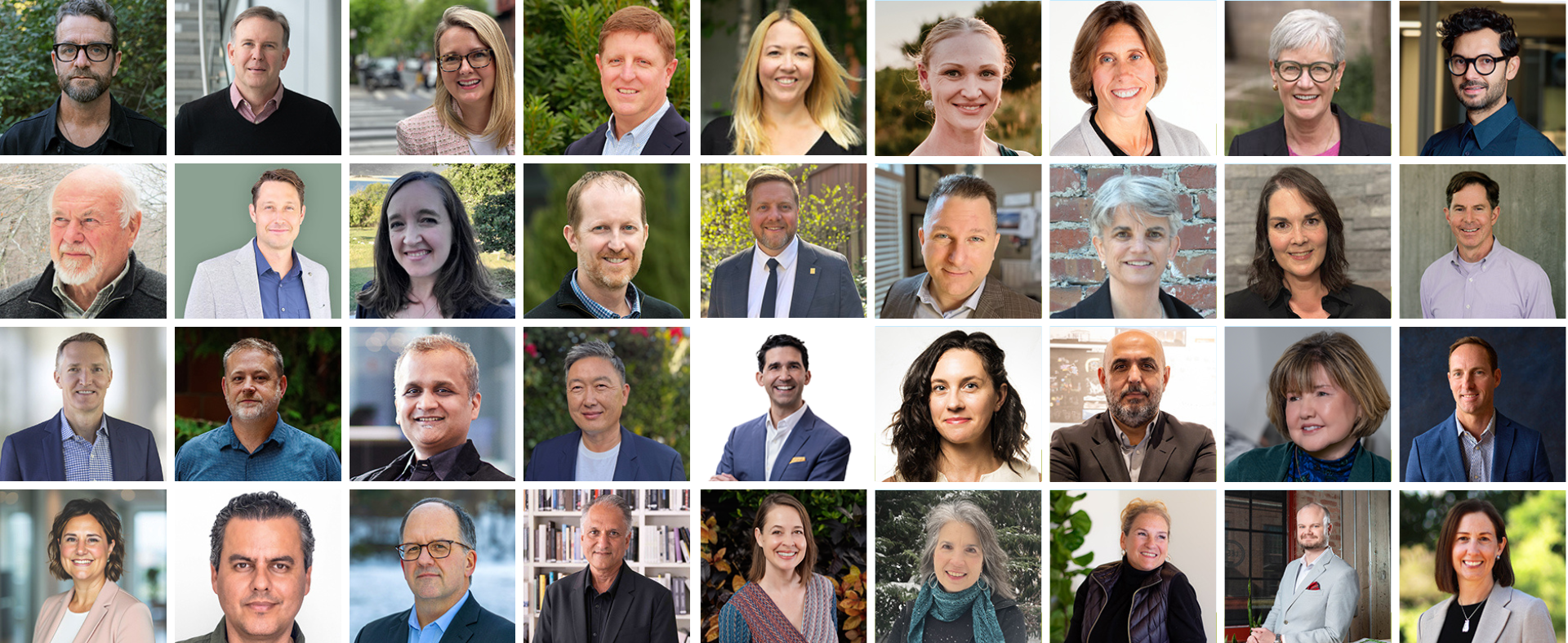
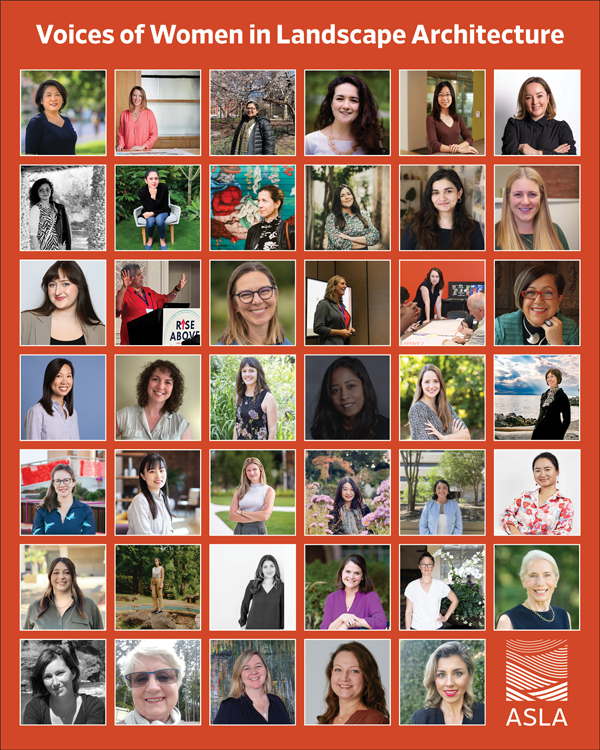
Profiles are shared on the PPN's LinkedIn group, Facebook group, and here on The Field. With 50+ submissions to explore, catch up on all these fantastic profiles, and see if you can spot anyone you know in the collage below.
Help keep this series going—consider being our next WILA profile, or share the call for submissions with others you know.
Today we continue the series with Magic Sun, Associate ASLA, Nehali Doshi, Associate ASLA, and Lindsay Corica.
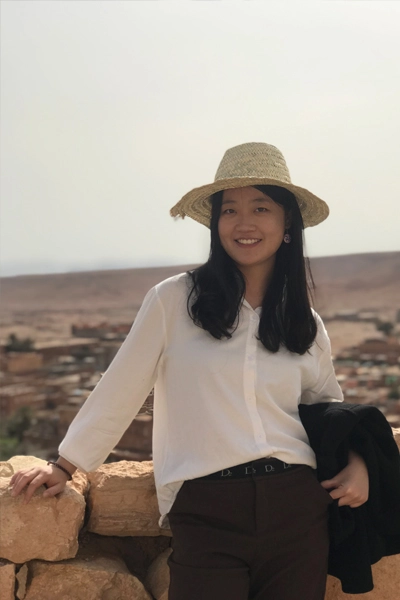
Magic Sun, Associate ASLA
What inspired you to pursue a career in landscape architecture?
I initially entered college searching for an applied science major and stumbled upon landscape architecture by accident. Over time, I fell in love with it. With educational training in both art and natural sciences, I gradually developed the ability to blend creativity with ecological and scientific principles in my thinking. The best part is the opportunity to apply our knowledge in real-world projects—building, testing, and refining ideas to make a tangible impact. Landscape architecture’s focus on environmental care, creating habitable spaces for public well-being, and its forward-thinking nature convinced me of its potential to drive meaningful change. Looking back, I’m grateful for choosing this path—it has allowed me to engage with brilliant minds and innovative ideas, continuously inspiring me to push the boundaries of what’s possible.
Who are the female role models who have influenced your career?
I’ve been fortunate to receive endless support and inspiration from many female landscape architects throughout my journey—so many that I couldn’t possibly list them all. However, a few have had a particularly profound influence on me.
Design-wise, I constantly draw inspiration from the works of Kathryn Gustafson and Christine Ten Eyck. Their designs are elegant, deeply sensitive to the spirit of the site, and uphold an unwavering standard of excellence in detail. Gustafson’s sculptural, flowing landscapes and Ten Eyck’s commitment to water-conscious, regionally rooted design both exemplify a thoughtful, timeless approach that I deeply admire.
On the theoretical and academic side, Anne Whiston Spirn, FASLA, and Anita Berrizbeitia, FASLA, have shaped my understanding of landscape architecture through their writing. Spirn’s work on landscape photography and Berrizbeitia’s sharp analytical perspective on design thinking and history have both challenged and refined my approach to the field. Their intellectual rigor and high standards continue to push me toward deeper critical thinking.
Career-wise, I’ve had the privilege of working with McKenzie Wilhelm, ASLA, who has been an incredible mentor. Her energy and passion in daily practice have always had a positive impact on me. She is the one who patiently listens, lays out a clear roadmap, and connects resources to help. From her, I’ve not only gained valuable advice on day-to-day work habits but also learned how to maintain a balanced life. I feel lucky to have learned from her firsthand, and I carry those lessons with me every day.

What advice do you have for other women pursuing a career in landscape architecture?
My advice is to find your talent and passion, dive deep, and take ownership of your work. It can sometimes be easy to “let go” or take a step back, but developing expertise and confidence in your abilities will allow you to make a real impact. Seek out projects and ideas that excite you, and don’t be afraid to carve out a niche where you can thrive.
At the same time, don’t underestimate the power of building a strong professional network. Join organizations and communities early on, find people who share your interests, and look for opportunities to collaborate. Having a network of supportive peers and mentors not only helps you grow but also creates a space where you can uplift and empower each other.
Most importantly, help and advocate for one another. Landscape architecture is a collaborative field, and the more we support each other—through sharing knowledge, making connections, or simply offering encouragement—the stronger we all become.
Can you share with us a project you are particularly proud of and why?
One project I’m particularly proud of is developing a sustainability design guideline for a confidential project in Saudi Arabia. In my first year on the job, I earned my SITES AP certification, but I didn’t have many opportunities to apply it to company projects. I’ve always advocated for integrating sustainability into the design narrative and establishing practical, measurable metrics, so when my project manager, Jennifer Knott, recognized my passion, she made sure to involve me in this effort.
In this project, I compared multiple green building standards, structured a clear framework for the client, and compiled precedents and best practices to strengthen the guideline. Despite limited references, I worked to make it a valuable resource that could inform future projects. Beyond the technical achievement, I’m particularly proud that I kept pushing for opportunities in sustainability until one came along. This experience reinforced the importance of persistence and advocating for what you believe in.
What advice would you give your younger self?
Since I’m still early in my career, the advice I’d give would be to my younger self as a landscape architecture student. I’d say, take full advantage of the opportunities at school and really push yourself. Spend time sharpening your technical skills and use the time you have to freely explore and test bold ideas—it’s the perfect time to experiment without pressure. Above all, believe in your talent and work harder. The foundation you build now will serve you throughout your career, so make the most of it.
Nehali Doshi, Associate ASLA
What inspired you to pursue a career in landscape architecture?
Born and raised in the cosmopolitan city of Mumbai, India, certain values and ethics have been instilled in me since childhood. Living in the ‘city of dreams’ and the financial capital of the country, I have been a witness to the urban development and the changes that the city has gone through in the last few decades. While the city has made attempts to accommodate everyone and improve its infrastructure, it has also lost a lot in the process. Year by year, I have seen the resources of the city—natural and man-made—become saturated and depleted thereafter. In the attempt to urbanize the city and its infrastructure, sometimes the cultures, the communities, and the natural resources of the city have been neglected or sacrificed. In testimony to all these scenarios of varying scales, I always knew that I wanted to make a difference, to break the cycle, in whatever way I can. That’s what made me inherently inclined towards choosing architecture as my field of undergraduate study. While in architecture school, I realized that I like producing designs that are more intimately tied to their contexts, and I like to develop and weave spaces rich in narratives. In my lectures and experience in landscape studios, it became evident to me that landscape architecture is the field that allows me to cater to these inclinations and also gives me the freedom to generate experiences like never before, due to the prime position it holds in the urban scenario today. Landscape architecture would provide me with a platform that sits right at the junction of the social, cultural, economic, ecological, and design strata and I knew then that landscape architecture is where I see my future.
Who are the female role models who have influenced your career?
My mother has been a huge influence in my life and a driving force in shaping my character. Being a strong, independent working woman in a time when this was rare in India, she has set a robust example for me. She works for a non-profit organization that deals with issues such as rape, gender equality, and sexual awareness among adolescents, and she fights for the rights of the LGBTQ community in India (which until very recently was a criminal offence), all of which are even today still considered taboo in Indian society. Thanks to her work, I developed an early sensitivity towards these issues that plague our societies and also got ample opportunities to contribute to making the world a better place. These were some of my first lessons in understanding the gifts of empathy, compassion, and gratitude. I have been a part of several teaching programs and awareness drives conducted for the marginalized and underprivileged segments of society and this has contributed greatly into making me the person that I am today. In many ways, my drive to contribute to the world in a meaningful way and create change through my work that focuses on equity, inclusivity, and environmental justice stems from my mother's impact on my life.
While in school, I have been extremely lucky to have some great female mentors and professors who helped me find my voice as a designer and supported me through my journey of learning. At the University of Southern California, professors such as Esther Margulies, ASLA, Alison B. Hirsch, and Aroussiak Gabrielian have been huge influences. They have guided me and helped me hone my critical design thinking skills, always encouraging me to be bold, ask questions, and look for answers in places less visited.
I have been very privileged to be working at SCAPE, a female-owned company led by Kate Orff, FASLA, RLA. Kate has been a personal idol for me as the bold voice and advocate for innovative, resilient, and climate- and ecology-focused designs, leading a shift in our profession. It has been great to be able to work with her and under her leadership, trying to make the world a better place, one resilient project at a time. Kate's design, critical thinking, and curiosity make SCAPE a great place to be a designer and to grow. Being at a majority women firm, I have also learned so much from all my hardworking and talented colleagues.
Apart from this, I have personally been influenced by the works, writings, and research of Anuradha Mathur, as her way of thinking resonates deeply with me. Her work on SOAK: Mumbai in an Estuary that focused on understanding, decoding, and graphically communicating the complex ecology of the city where I was born and raised has been one of the early influences in my life, demonstrating what landscape architecture is capable of doing. Her work and her legacy inspire me to become a better designer and to contribute to the profession and the world in more meaningful ways.
What advice do you have for other women pursuing a career in landscape architecture?
The advice I would give would be first and foremost to find and hone your voice as a young designer and to not be afraid to use that voice. Let it speak through your work and research but also actively use it to bolster and speak up for yourself in your work environment. Voicing your design opinions and thoughts in a clear and concise manner will benefit you and help you grow in your role and responsibilities.
Another piece of advice that I truly believe in is to be a sponge, always curious to learn and absorb more from your environment, co-workers, other fields and professions, etc.
I would also encourage young professionals to look for experiences that can help you grow as an individual, critical thinker, and designer: internships, research assistantships, teaching assistantships, volunteering with organizations, etc., and not necessarily restrict yourself to even design-related experiences but to venture into different things to gain more holistic experience.
Finding good mentors who you can go to for advice and questions and whose opinions you trust is also very important. Don't be afraid to reach out to peers, colleagues, and senior staff. Networking and putting yourself out there is a big part of growing and getting involved. Develop a close circle with your peers that supports and helps each other grow. (These connections are really helpful in the future.)
Work on developing soft design skills. We all focus on making the best designs and the best graphics but the most valued skill as a professional is how to communicate your ideas and thoughts clearly. Learn the value and skill of collaboration and being a teammate and learn to read a room. Learn to be empathetic and kind to everyone you work with.
Can you share with us a project you are particularly proud of and why?
There are a few projects that I have had the chance to work on and develop that I feel extremely proud of.
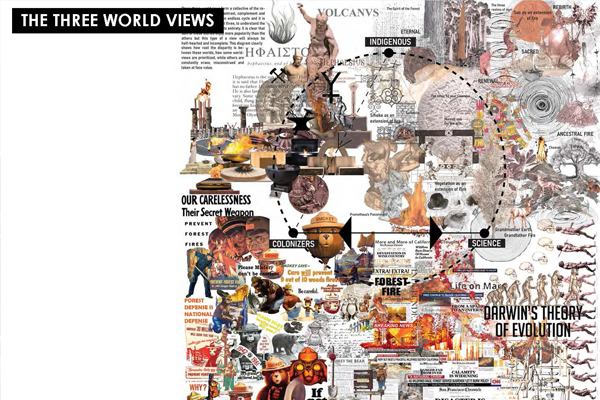
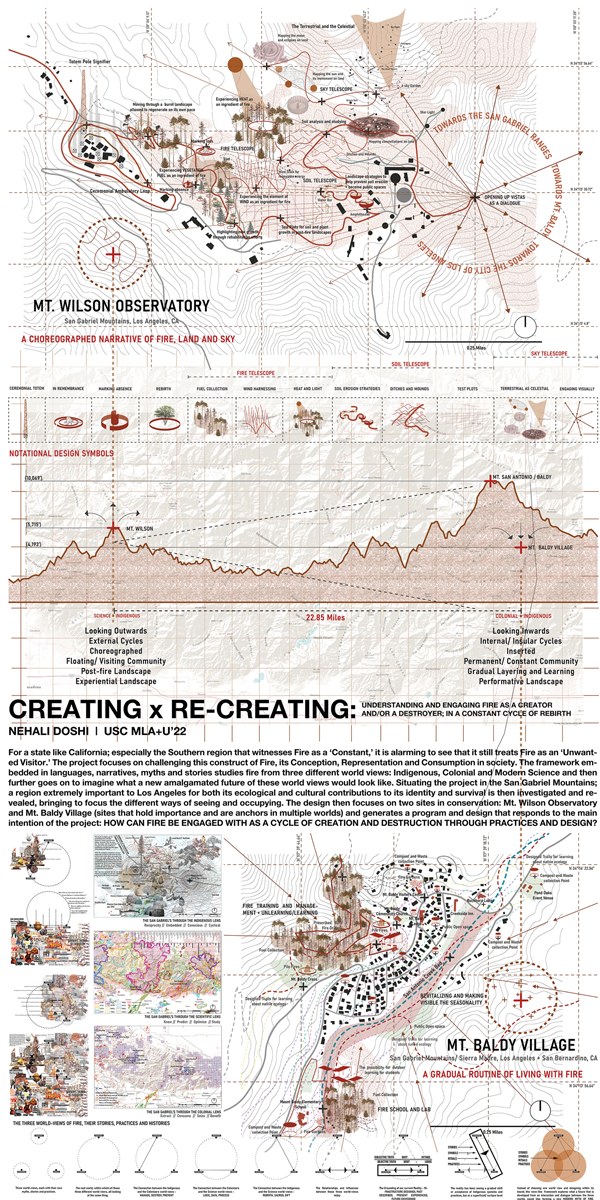
My master's thesis on wildfire—'Creating x Re-creating: Understanding and Engaging with FIRE as a Creator rather than a Destroyer,' focused on the Southern California ecology—was the beginning of a way of thinking and designing that has grown to be central to my voice as a designer. This continues to be a topic of interest that I actively am building research on and continuing the work I started. The project approached 'wildfire' from a cultural and narrative perspective, questioning, unlearning, and re-interpreting the origins and meaning of fire within the human psyche. Believing strongly that how we understand, think of, and talk about fire affects how we engage and design for it, I studied the language, media, etymologies, and indigenous stories around wildfire, studying it from different perspectives: the colonial, indigenous, and scientific. The project then grounded itself in the San Gabriel Mountains and designed strategies to help teach, engage, and design for wildfires in a landscape that has every inch of it burned at one point or another.
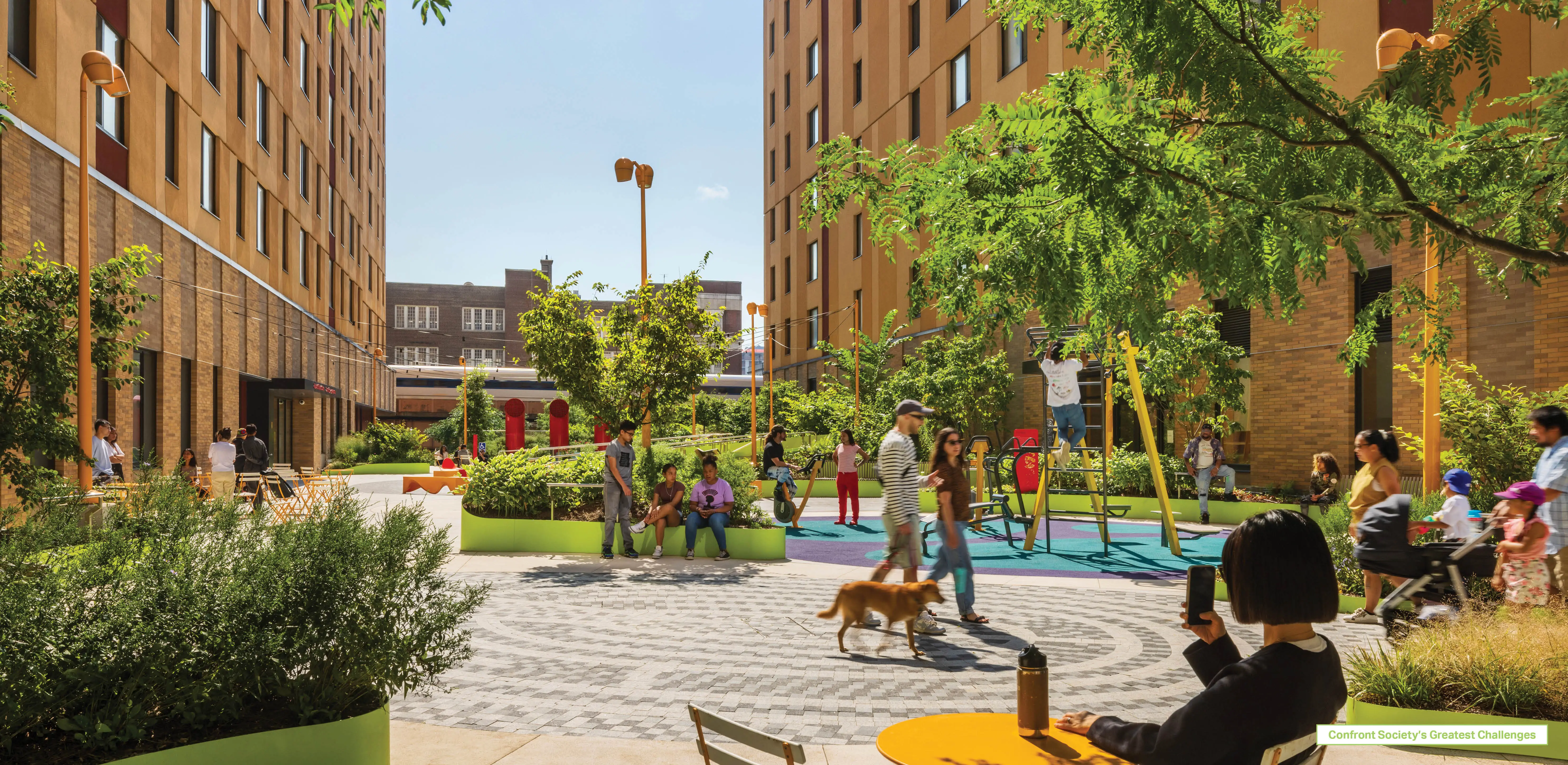
Another project that I feel very lucky to have worked on in my time at RIOS is Lulu's Place (see Urbanize and the TGR Foundation for more). This is a community recreation hub specifically designed for children and communities who do not have access to play, gathering spaces, and active recreation in a public park-deficient neighborhood in Los Angeles. The main concept was to design the hub to be a front porch for the neighboring community with multiple tennis, baseball, soccer courts, fitness zones, learning labs, flexible gathering areas, and vibrant event spaces that are all connected through a central paseo.
A current project that I am working on at SCAPE is for the University of California San Francisco Parnassus Campus that re-envisions a campus that sits on a topographically complex site with a deep cultural history and ecological past in San Francisco. The design of the project aims to create a central gathering space and to simplify and clarify wayfinding and access on campus as well as create a strong 'Park-to-Peak' connection between the historic Golden Gate Park and Mt. Sutro. One of the key concepts of the project is to create a strong ecological narrative, creating a landscape that bolsters nature's capacity to heal, provide for a native biodiverse habitat, and create experiences unique to the site's geography and context. The project has been a great learning experience for both the technical as well as the conceptual aspects of our profession.
What advice would you give your younger self?
Be okay with taking up the space you need in a room. Don't hold your voice back out of fear that you don't have enough experience. Build your confidence and take a more proactive role in everything you touch.
It's okay to feel lost and question things from time to time; it only makes you grow. Trust yourself and your intuition fully; it knows better and will always guide you right even when you feel lost.
Always remain curious, hungry to learn and understand more.
Put yourself out there by taking part in competitions, attending networking events, engaging in public speaking opportunities, etc.
Keep growing your knowledge and skillsets by actively reading, following news of the world as well as the profession.
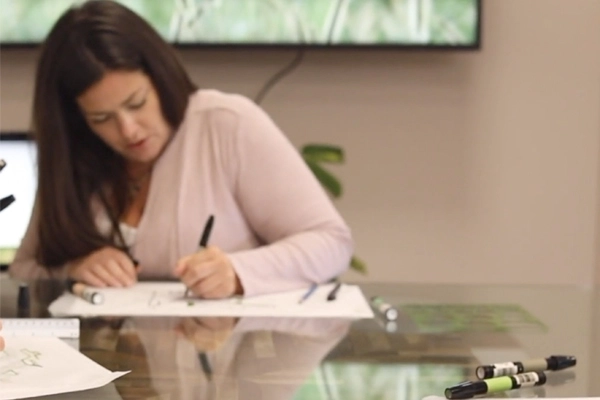
Lindsay Corica
What inspired you to pursue a career in landscape architecture?
In my college studies at I became passionate about landscape architecture through design fundamentals, history of architecture, site analysis, and botanical classes. Everything about the profession was inspiring. Initially I was driven to create spaces for people—to connect individuals to nature and blur the edges between the natural and built environment. Now as a small business owner, with a small design studio I work on projects ranging from custom residential, to multi-family and commercial, in addition to environmental planning.
Who are the female role models who have influenced your career?
Julia Morgan—as a pioneer in architecture, standing alongside men in a time when women were not in architecture and engineering, I am influenced to never give up, and continue to thrive as a female business owner. Visiting sites such as Hearst Castle have inspired me to see the boundless designs and creativity of Julia Morgan.
Also, personally in my career the past 15 years working alongside other female architects has inspired me to sit along the table with more women, and demonstrate how women provide team leadership and attain attention equally to men.
What advice do you have for other women pursuing a career in landscape architecture?
Maintain confidence in your knowledge as a landscape architect to develop design solutions and solve problems.
Can you share with us a project you are particularly proud of and why?
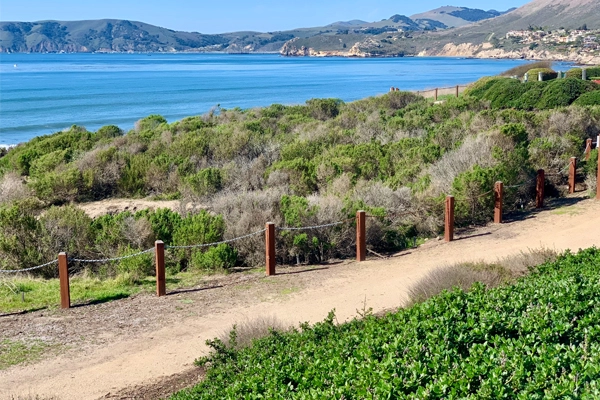
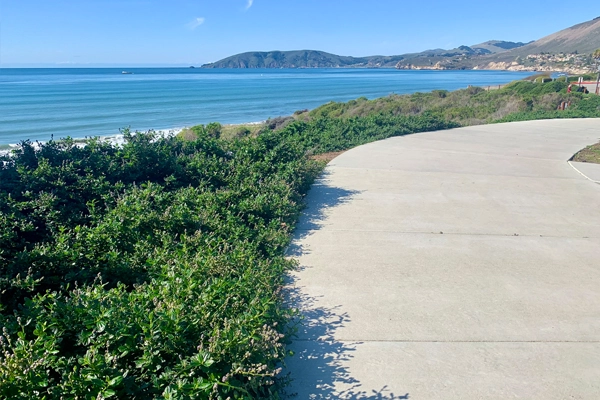
I am particularly proud of a restoration project at a local coastal development. Providing safe access and native plants to enhance habitat and diversify the ecosystem while also designing a trail to safely bring visitors (pedestrians) down a bluff to the beach below. This project does not have a large footprint; however it is a meaningful design experience, opening coastal access to the public and also revitalizing the local ecosystem.
What advice would you give your younger self?
To my younger self: it is okay to be uncertain of what is the very next step as long as you are certain to move in a direction that is aligned with your integrity as a landscape architect and steward of nature.
2025 WILA Profiles:
Voices of Women in Landscape Architecture, Part 15
- Inge Daniels, ASLA
- Alexandria Hernandez
- Abigail Thomas, ASLA
Voices of Women in Landscape Architecture, Part 16
- Lauren Colunga, ASLA
- Nusrat Jahan Nipu
- Tanya Olson, ASLA
2024 WILA Profiles:
Voices of Women in Landscape Architecture, Part 1
- Carolina Jaimes, ASLA
- Connie Scothorn, ASLA
- Emily Greenwood, ASLA
Voices of Women in Landscapes Architecture, Part 2
- Kathryn Talty, ASLA
- Aida Curtis, FASLA
- CeCe Haydock, ASLA
Voices of Women in Landscapes Architecture, Part 3
- Qing Lana Luo, ASLA
- Caeli Tolar, ASLA
- Jan Satterthwaite, ASLA
- Kristina Snyder, ASLA
Voices of Women in Landscapes Architecture, Part 4
- Jennifer Cooper, ASLA
- Anne Chen, ASLA
- Meghan Mick, ASLA
Voices of Women in Landscape Architecture, Part 5
- Dana Hernalsteen, ASLA
- Lucila Silva-Santisteban, ASLA
- Martha Fajardo
Voices of Women in Landscape Architecture, Part 6
- Rituparna Simlai, ASLA
- Laurie Hall, ASLA
- Kristen Sweatland
- Donna Rodman
Voices of Women in Landscape Architecture, Part 7
- Becky Rupel, ASLA
- Maria Debye Saxinger, ASLA
- Liwei Shen, Associate ASLA
Voices of Women in Landscape Architecture, Part 8
- Elizabeth "Violet" Mak, ASLA
- Nicole Cleary, ASLA
- Fatema Ali Tushi, ASLA
Voices of Women in Landscape Architecture, Part 9
- Whitner Kane, ASLA
- Carley Rickles, ASLA
- Rebecca Bradley, ASLA
Voices of Women in Landscape Architecture, Part 10
- Kelly Ream, ASLA
- Chuyi Yin, Associate ASLA
- Stevie Famulari
Voices of Women in Landscape Architecture, Part 11
- Amy Rampy, ASLA
- Peixuan Wu, Associate ASLA
- Jaime Zwiener
Voices of Women in Landscape Architecture, Part 12
- Jingyi Hu, ASLA
- Jolene Rieck, ASLA
- Kaylin Slaughter, Associate ASLA
Voices of Women in Landscape Architecture, Part 13
- Jessica Jacobs, Affiliate ASLA
- Salonee Chadha, Associate ASLA
- Katie Summers, ASLA
Voices of Women in Landscape Architecture, Part 14
- Caroline Donaldson, ASLA
- Emily Bousaada, ASLA
- Brittany Lowe
Voices of Women in Landscape Architecture, Part 15
- Inge Daniels, ASLA
- Alexandria Hernandez
- Abigail Thomas, ASLA
2023 WILA Profiles:
Women in Landscape Architecture Profiles, Part 1
- Alexandra Mei, ASLA
- Angelica Rockquemore, ASLA
- Sandy Meulners, ASLA
- SuLin Kotowicz, FASLA
Women in Landscape Architecture Profiles, Part 2
- Shuangwen Yang, Associate ASLA
- Heidi Hohmann, ASLA
- Tristan Fields, ASLA
- Joni Hammons, ASLA
- Sahar Teymouri, ASLA