

.webp?language=en-US)

.webp?language=en-US)
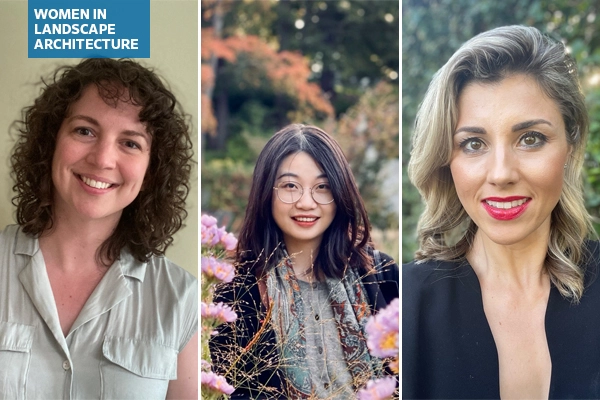
ASLA's Women in Landscape Architecture Professional Practice Network (WILA PPN) is sharing the next set of profiles of women in the profession. If you'd like to be featured, the PPN's call for submissions will remain open, with profiles being shared on an ongoing basis.
Submissions appear on the PPN's LinkedIn group, Facebook group, and here on The Field. This post includes Becky Rupel, ASLA, Maria Debye Saxinger, ASLA, and Liwei Shen, Associate ASLA. See the end of this post for links to previous profiles.
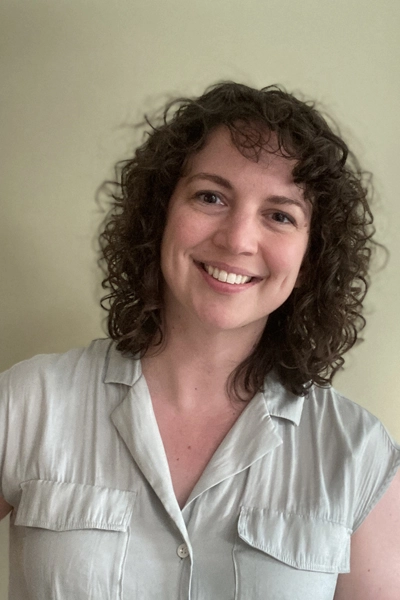
Becky Rupel, ASLA
What inspired you to pursue a career in landscape architecture?
I've always gravitated to a visual/spatial way of thinking and solving problems, so architecture had been on my long list of career ideas in high school, until I found myself at the University of Wisconsin, which, as it turns out, has no architecture program. Fortunately, while registering for my first semester of classes a student advisor saw my course selections—engineering prerequisites, limnology (they had the best building location on campus overlooking the lakeshore path and Lake Mendota!), and art—and redirected me toward the landscape architecture department. I wish I could find that person and thank them!
Who are the female role models who have influenced your career?
There have been many! I've worked at a number of firms and have been fortunate to work closely with a woman in a leadership position at almost all of them, particularly Barbara Austin, ASLA, at RVi Planning + Landscape Architecture, the late Lynn Wolff at Copley Wolff Design Group, and currently with Heidi Natura, FASLA, at Living Habitats.
While each of those women are talented designers in their own right, I think the most helpful lessons I learned were by observing how they carried themselves and how they navigated relationships within the office and with clients and stakeholders.
What advice do you have for other women pursuing a career in landscape architecture?
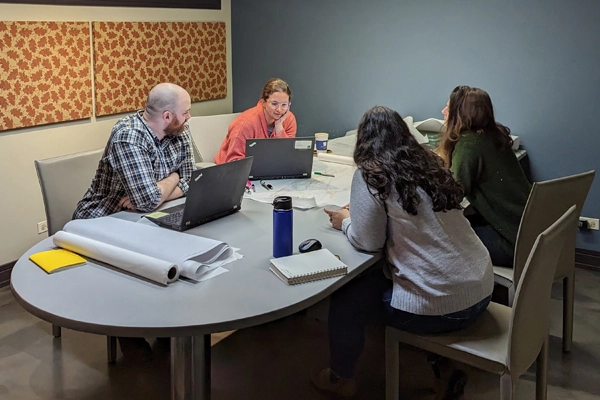
It can be so hard to carve out time outside of work, and everyone has different responsibilities and priorities, but I would encourage everyone to as much as possible nurture your OTHER interests. I find that creative cross-pollination can lead to some of the best ideas, but even if it doesn't, having hobbies that have nothing to do with how you make your living is great for balance and mental health!
Can you share with us a project you are particularly proud of and why?
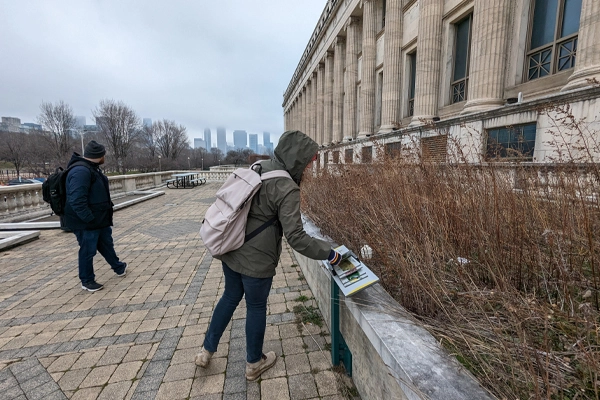
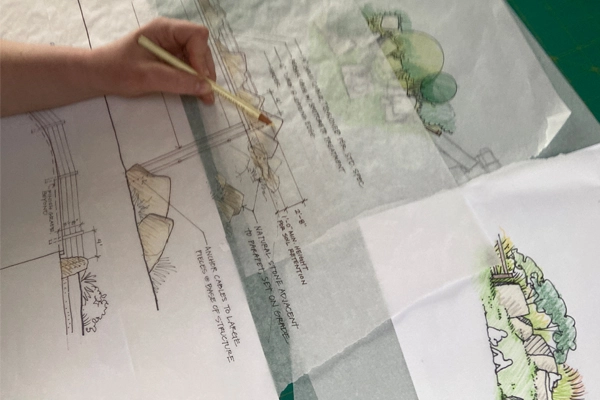
I'm honored to have been a part of the first phase of the Wallis Annenberg Wildlife Crossing. That project really made me think differently about what's possible in design and ecology, and was a testament to how much technical coordination and communication goes into even the smallest bit of innovation. We had an incredibly dedicated, smart, and talented team and I'm particularly proud that it was a landscape architecture-led team.
What advice would you give your younger self?
My advice would be: you don't have to take advice at face value. Ask questions, listen, and gather as much information as you can, but don't be afraid to trust your gut.
Maria Debye Saxinger, ASLA
What inspired you to pursue a career in landscape architecture?
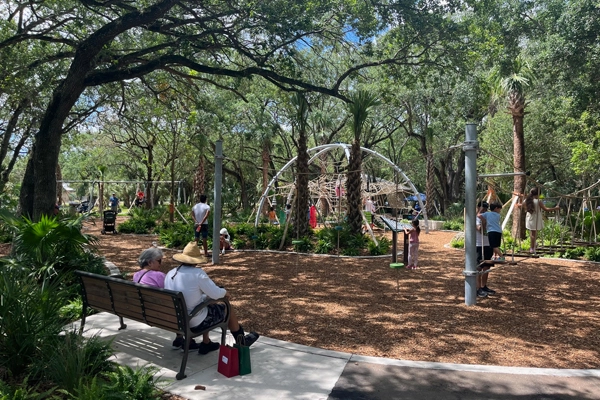
Growing up in upstate New York and visiting New York City as a child inspired me to find a career path aligned with filling the nature-deficit through planning and design of the built urban environment. I am most inspired when I am able to inspire others to make shared recreational and social experiences because I know the power of parks for people in cities. It re-energizes me to be able to find my peace, focus, and solitude in outdoor activities where I can push myself and engage in outdoor recreation such as running, swimming, cycling, taking my children to play, and more amongst other people doing the same thing in parks that are designed to help us take care of ourselves in the midst of busy schedules, skyscrapers, in between sunrises and sunsets, with changing views, and across all land-water-street-scapes! We need them and more importantly, we need each other, and city parks help bring us all together and bridge this gap.
Who are the female role models who have influenced your career?
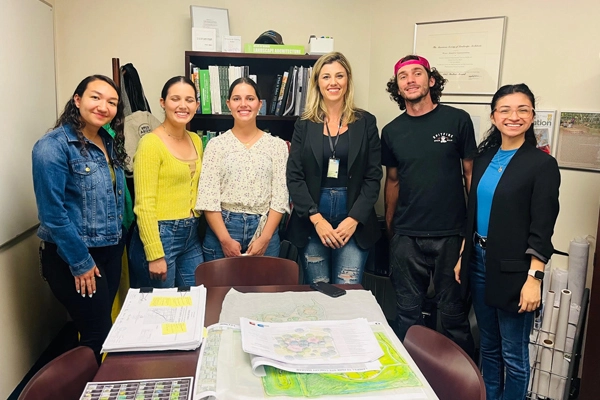
My mother. My sister. My art teacher. All of the women who helped raise me from here to Europe and back. Martha Schwartz, FASLA. Mary Margaret Jones, FASLA. My parks director, Maria I. Nardi.
What advice do you have for other women pursuing a career in landscape architecture?
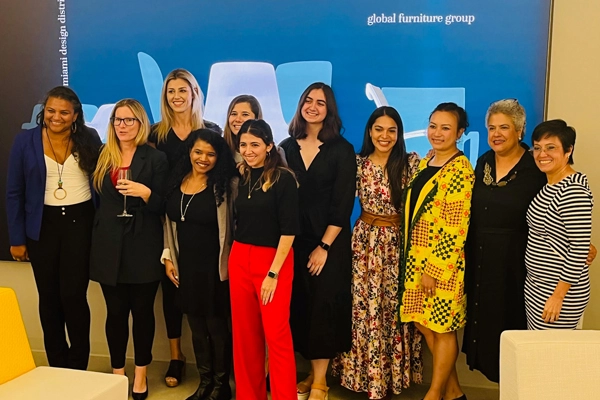
My best advice for anyone—but especially for hard-working, ambitious, career-driven human beings who are driven to make a positive impact—is to think hard and repeatedly throughout all phases of education and work experience on what exactly it makes them uniquely qualified to do. It is extremely important to be able to really know who you are and what you want to focus on so that you can prepare yourself to address not only the ability to work with a living medium itself, but for the capacity, knowledge, and expertise to envision the impact you want to make so that you can take on landscape architecture challenges in a way that will be functional, beautiful, and humane. We are not generalist masters-of-none if we really home in on what we do and take strategic deep-dives throughout our career paths.
Can you share with us a project you are particularly proud of and why?
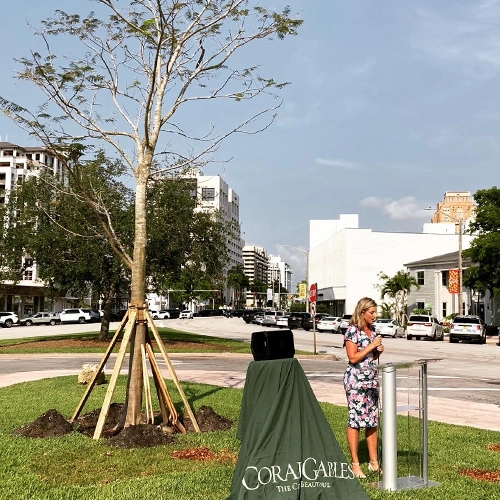
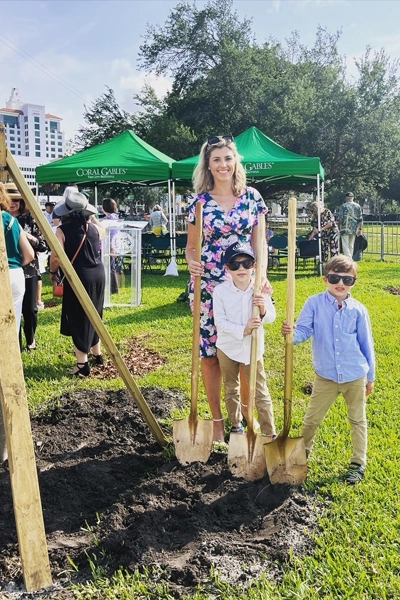
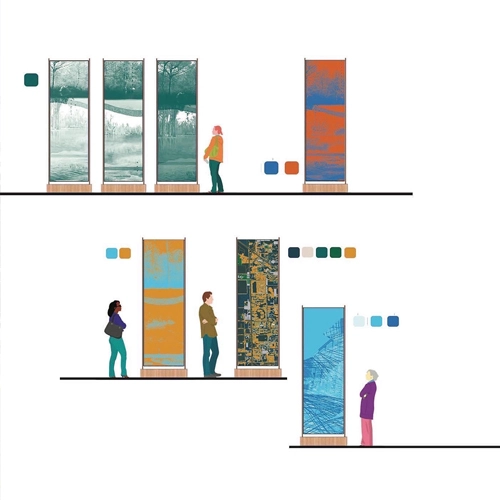
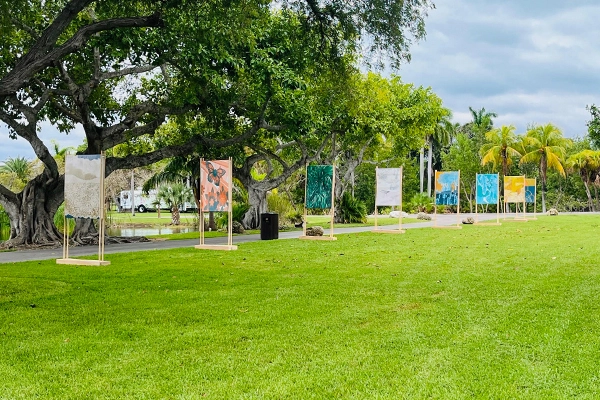
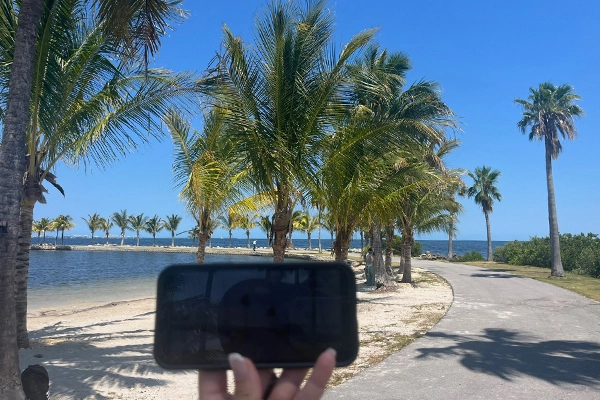
I am encouraged about our profession and its impact whenever I get to help behind-the-scenes in the making of publicly accessible nature-based art in parks. Last year, we celebrated Miami-Dade County’s Crandon Park’s 75 years of serving the community’s 2.8 million residents through eco-based art from entrants across the country. This was the result of an open call that resulted in the public display of selected works in an interactive manner along the beautiful pathways of the park, originally designed by William Lyman Phillips. This project highlights not only the importance of ecology as a diverse transect of environments, but also the importance of engaging the community we serve and emphasizing the communication tools we have as landscape architects and parks professionals to represent bold ideas, richness, and expression in innovative ways that elevate our collective knowledge about our natural world. These narratives are important to building community.
What advice would you give your younger self?
If I were to give my younger self career advice, I would tell myself to have sought out a public sector career path proudly and sooner. I would advise myself to learn about the various processes that make parks come to life: from public needs assessments and feedback to funding and beyond. I would let me know that there's a whole project in making a project even become a future project. All of the steps that go into the evolution of acquiring a site, researching a site, planning for the site, funding for a project, etc., are all critical components that come well before the design consultant is on-boarded and a site is constructed that is all a part of public sector landscape architecture. This life cycle is very interesting and also necessary. Public sector has also proven to include some of the most professional, hard-working, and talented people I know in a variety of allied disciplines across the world who are dedicated to serving others with purpose.
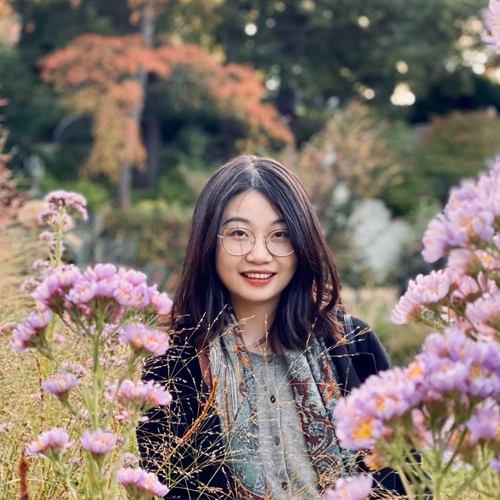
Liwei Shen, Associate ASLA
What inspired you to pursue a career in landscape architecture?
I grew up in Hangzhou, a city with harmonious relations of mountains, rivers, lakes, and urban areas. The integration of natural and artificial elements in my hometown has always inspired me. Designing spaces that respect both ethical and cultural perspectives is a challenge but can significantly benefit the public. I wish to develop innovative approaches that address contemporary issues and provide beautiful experiences accessible to everyone. Motivated by these aspirations, I devoted myself to the field of landscape architecture after completing my undergraduate studies in architecture.
Who are the female role models who have influenced your career?
Caitlyn Clauson was one of my principals during my work at Sasaki. She is an urban planner with a comprehensive and intelligent approach. She manages to maintain precise control over project details while accurately capturing the big picture. Dedicated to community engagement, she ensures that she listens to everyone involved. Caitlyn is always loving, collaborative, supportive, and committed to helping the environment become a just space.
Gena Wirth, ASLA, was one of my instructors during my graduate studies at Harvard GSD. From her, I learned every quality a landscape architect could aspire to possess. She is exceptionally talented and knowledgeable about every stage of landscape design while maintaining an intellectual vision of the overarching social, spatial, and ecological framework. She supported my research on butterflies as non-human agents, which opened up new perspectives on urban ecological restoration.
Additionally, there are many extraordinary female role models who have always inspired me. Influential scholars like Ruth Bader Ginsburg and Hannah Arendt, along with landscape architects such as Elizabeth K. Meyer, FASLA, from UVA, Danielle Choi, Jungyoon Kim, ASLA, and Rosalea Monacella from the GSD, have all played an important role in shaping my career. There are also loving colleagues from Sasaki who help me all the time: Anna Cawrse, ASLA, Muhan Cui, ASLA, Zixuan Tai, Felicia Jiang, and others.
What advice do you have for other women pursuing a career in landscape architecture?
I advise exploring disciplines beyond landscape architecture to deepen and enrich the research and practice of landscape architecture.
Can you share with us a project you are particularly proud of and why?
I am proud of a project I worked on at Sasaki: the UC Berkeley Accessible Paths and Places Master Plan. This project includes reviewing the historical campus plan and existing conditions, categorizing and applying ADA compliance, engaging the community, and conducting landscape spatial and experiential studies. It envisions a new campus with meandering pathways, social gathering spaces, and accessible ramps integrated into the picturesque environment. The project aims to promote social justice by creating a new campus framework that is accessible, experiential, and usable by everyone.
What advice would you give your younger self?
Read extensively and engage in public speaking opportunities as much as you can. Collaborate with people from diverse backgrounds and perspectives, learning from their experiences and forging friendships. Be brave, confident, and self-aware.
2024 WILA Profiles:
Voices of Women in Landscape Architecture, Part 1- Carolina Jaimes, ASLA
- Connie Scothorn, ASLA
- Emily Greenwood, ASLA
- Kathryn Talty, ASLA
- Aida Curtis, FASLA
- CeCe Haydock, ASLA
- Qing Lana Luo, ASLA
- Caeli Tolar, ASLA
- Jan Satterthwaite, ASLA
- Kristina Snyder, ASLA
- Jennifer Cooper, ASLA
- Anne Chen, ASLA
- Meghan Mick, ASLA
- Dana Hernalsteen, ASLA
- Lucila Silva-Santisteban, ASLA
- Martha Fajardo
- Rituparna Simlai, ASLA
- Laurie Hall, ASLA
- Kristen Sweatland
- Donna Rodman
2023 WILA Profiles:
Women in Landscape Architecture Profiles, Part 1- Alexandra Mei, ASLA
- Angelica Rockquemore, ASLA
- Sandy Meulners, ASLA
- SuLin Kotowicz, FASLA
- Shuangwen Yang, Associate ASLA
- Heidi Hohmann, ASLA
- Tristan Fields, ASLA
- Joni Hammons, ASLA
- Sahar Teymouri, ASLA