

.webp?language=en-US)

.webp?language=en-US)


Advertisement
Drought
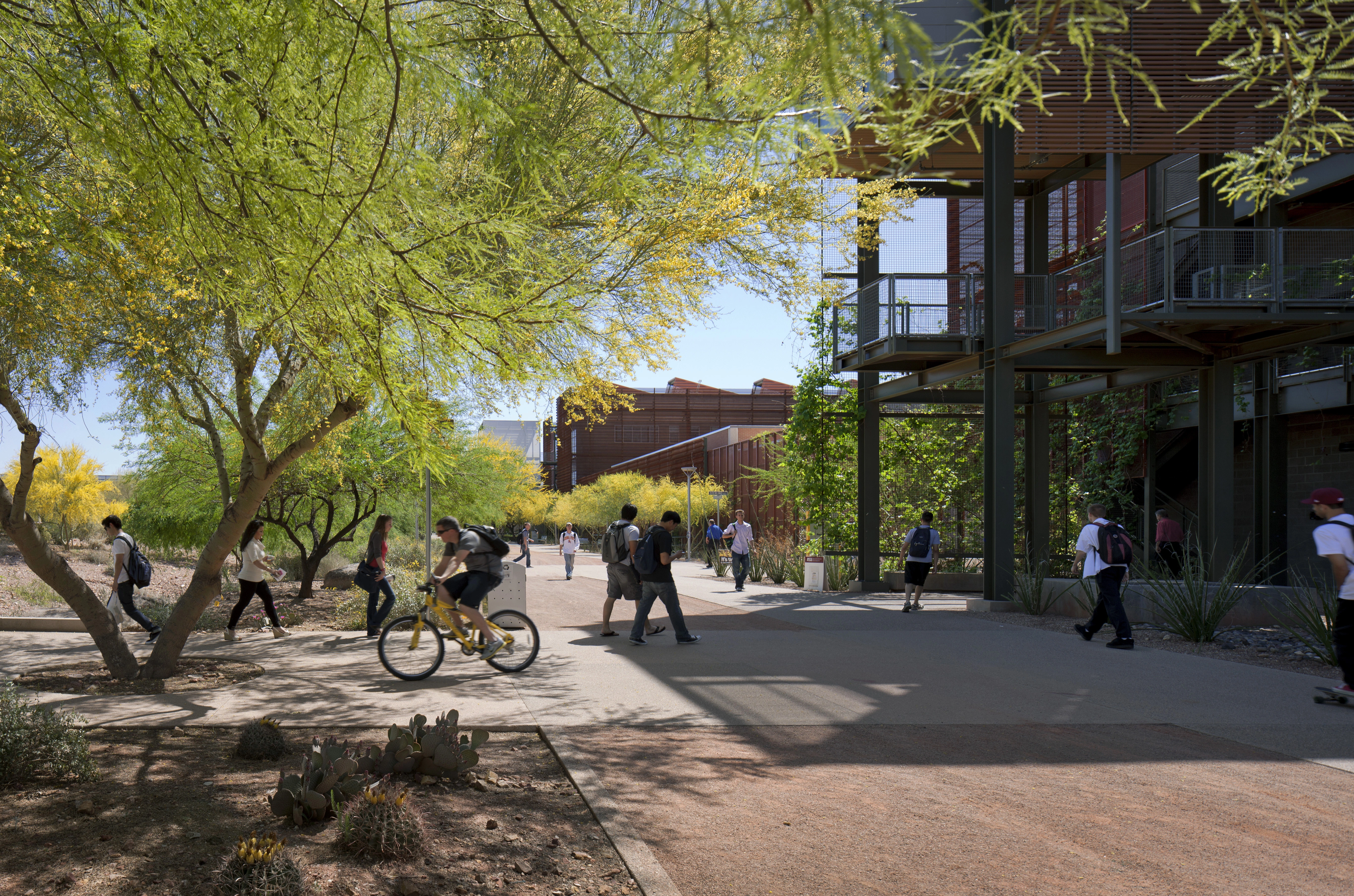
ASLA 2012 Professional General Design Honor Award. Arizona State University Polytechnic Campus — New Academic Complex, Mesa, Arizona. Ten Eyck Landscape Architects
Increases in global temperatures and the volatility of precipitation, which are linked to climate change, are two critical drivers of drought. Drought affects human society, impacting food and water security. Drought can impact an entire country, as what occurred in the dust bowl era in the United States, or regions and communities. The economic impact of prolonged drought is enormous: The impact of California’s ongoing drought to agriculture as of 2015 is $2.7 billion in losses and counting. But so is the impact on livelihoods.
How Resilient Planning and Design Helps
Water is a critical resource. To become resilient, communities must more effectively manage limited water resources through conservation and reuse. As an example, in the southwest U.S., where water is scarce, traditional Hispanic communities have used acequias for hundreds of years. These earthen canals offer a sustainable approach to water management in which scarce water resources are carefully managed, preserved, and stored, so future generations, and other species, can also access. This kind of multi-generational approach to water resource planning is what's needed moving forward, and should be reflected in contemporary systems of green infrastructure at all scales.
As part of this long-term effort to protect increasingly scarce water resources, communities can spur needed changes in behavior, encouraging greater conservation through smart regulations. Through the worst days of its drought, California imposed strict rules on residential water use and issued fines for wasteful practices, like watering lawns. This led to greater use of sustainable landscape design practices, featuring irrigation systems; underground cisterns; native, drought-resistant plants; and natural approaches that boost the retention of water in soils. The message was lush lawns are a luxury of the past; "brown can be beautiful," as landscape architect Christine Ten Eyck, FASLA, and others, have argued.
Through regulations, communities can also allow the safe re-use of gray water from showers and kitchen sinks for residential landscape irrigation. The Norris House in Tennessee is an example of how people can use gray water to sustain lawns and certain plants. To become drought-resilient, more communities will need to adopt these approaches moving forward.
Co-benefits
Native plants offer the added benefit of providing habitat for needed wildlife, thus sustaining natural ecosystems. Native plants attract pollinators such as birds and insects that are essential to agricultural production. Trees planted to shade water bodies will reduce evaporation and can provide wildlife habitats as well.
Role of Landscape Architect
Landscape architects play many roles in reducing the impact of drought. Working with planners and engineers, they can devise regional, urban, and local water management plans and design natural systems that help communities conserve and reuse water.
Project by project, landscape architects can change people’s perceptions of the value of water and the beauty of native plant species. Landscape architects can also use their knowledge of natural systems to store and protect water in ways that provide added benefits to communities and their environments, beyond providing water in times of drought.
Advertisement
Landscape Architecture 2040: Climate & Biodiversity Action Plan
Empowers landscape architects with bold targets—advancing biodiversity, reducing emissions, increasing sequestration, and delivering climate and biodiversity justice through every project.
Relevant Projects
LA River Revitalization, Los Angeles, CA, Mia Lehrer + Associates
The University of Texas at Austin Belo Center for New Media, Austin, TX, Ten Eyck Landscape Architects
Newport Beach Civic Center and Park, Newport Beach, CA, PWP Landscape Architecture
The University of Texas at El Paso Campus Transformation, El Paso, TX, Ten Eyck Landscape Architects
Greensburg Sustainable Comprehensive Plan, Greensburg, KS, BNIM
ASLA 2013 Design: Parks, Recreation, Trails and Open Space Honor Award, Malibu Legacy Park, Malibu, CA, RHAA
ASLA 2012 General Design Honor Award, Arizona State University Polytechnic Campus, Mesa, AZ, Ten Eyck Landscape Architects
ASLA 2015 General Design Honor Award, Phil Hardberger Park, San Antonio, TX, Stephen Stimson Associates Landscape Architects
Railyard Park, Santa Fe, NM, Ken Smith Landscape Architects
Garden/Garden, Santa Monica, CA, City of Santa Monica
Pete V. Domenici U.S. Courthouse, Albuquerque, NM, Rios Clementi Hale Studios
Resources
How to Save Water the Californian Way, The Dirt blog
Global Drought Information System, GDIS
Drought’s Economic Impact on Agriculture, UC Davis Center for Watershed Sciences
Adaptation Strategies for Transportation Infrastructure, California Department of Transportation
Securing Reliable Water Supplies for Southern California, Los Angeles County Economic Development Corporation
Sustainable Residential Design: Improving Water Efficiency, ASLA
Rainwater Harvesting and Collection, Landscaping Network