
.webp?language=en-US)

San Mateo County Sustainable Green Streets and Parking Lots Design Guidebook
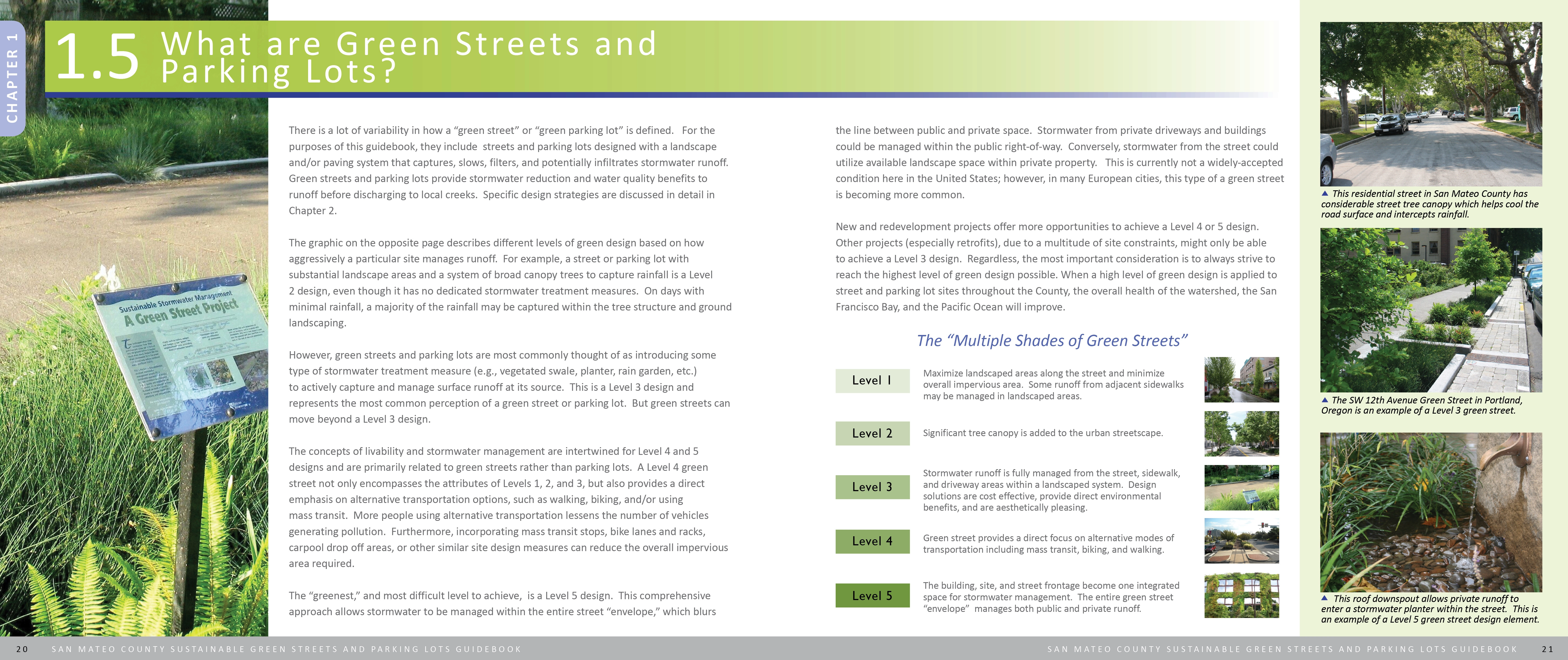
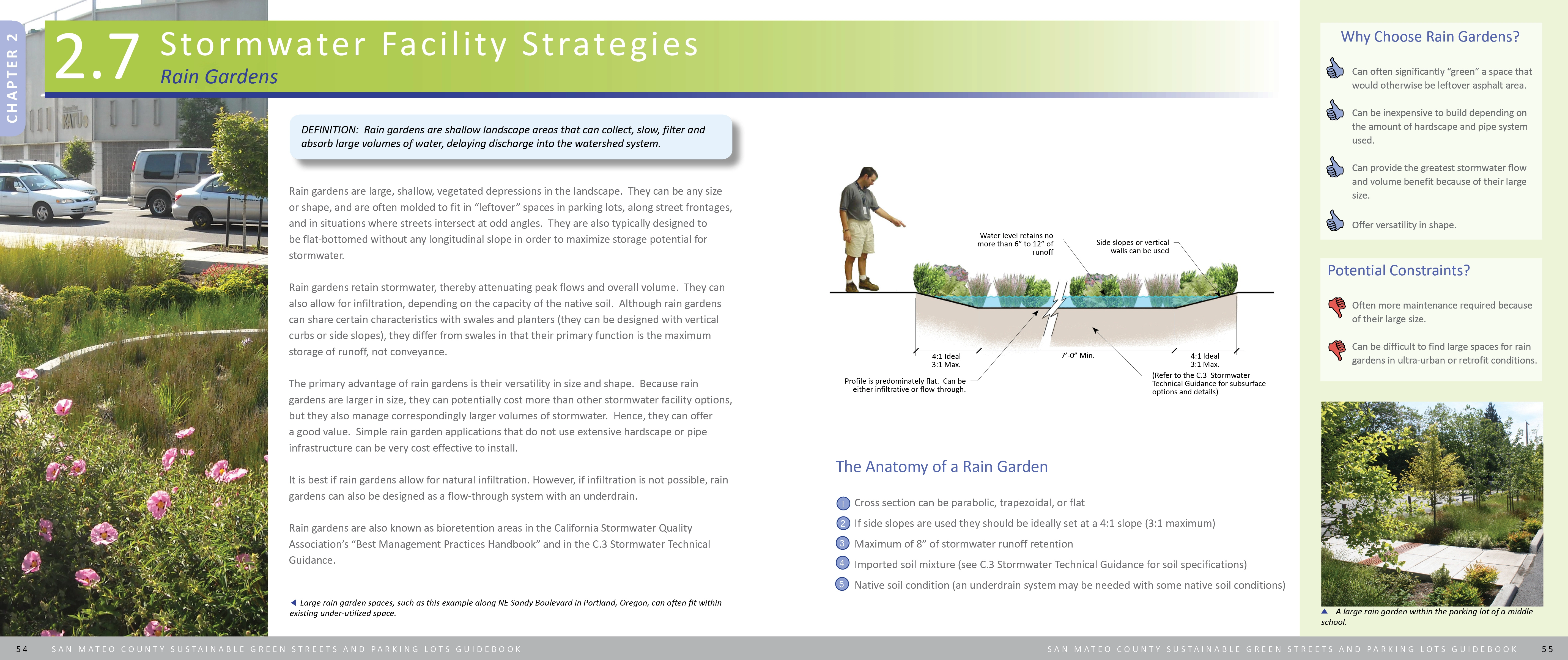
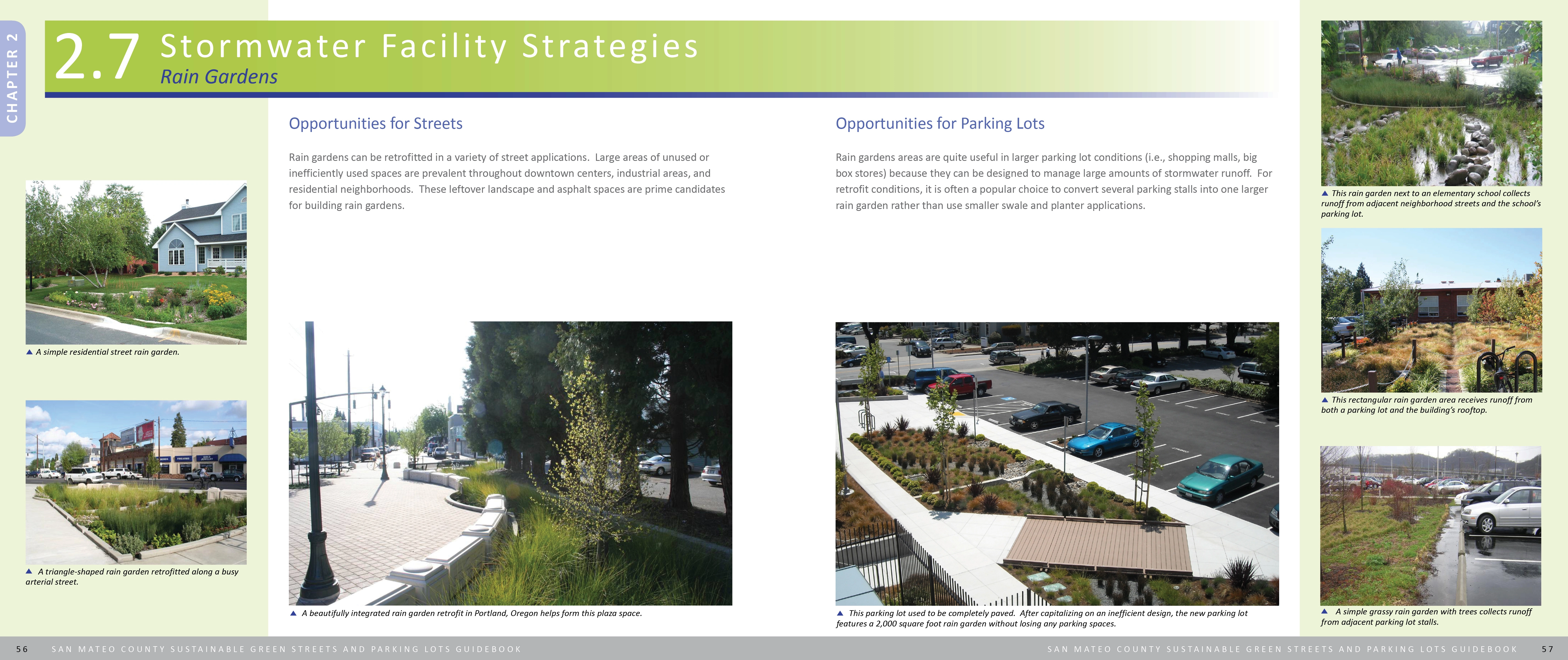
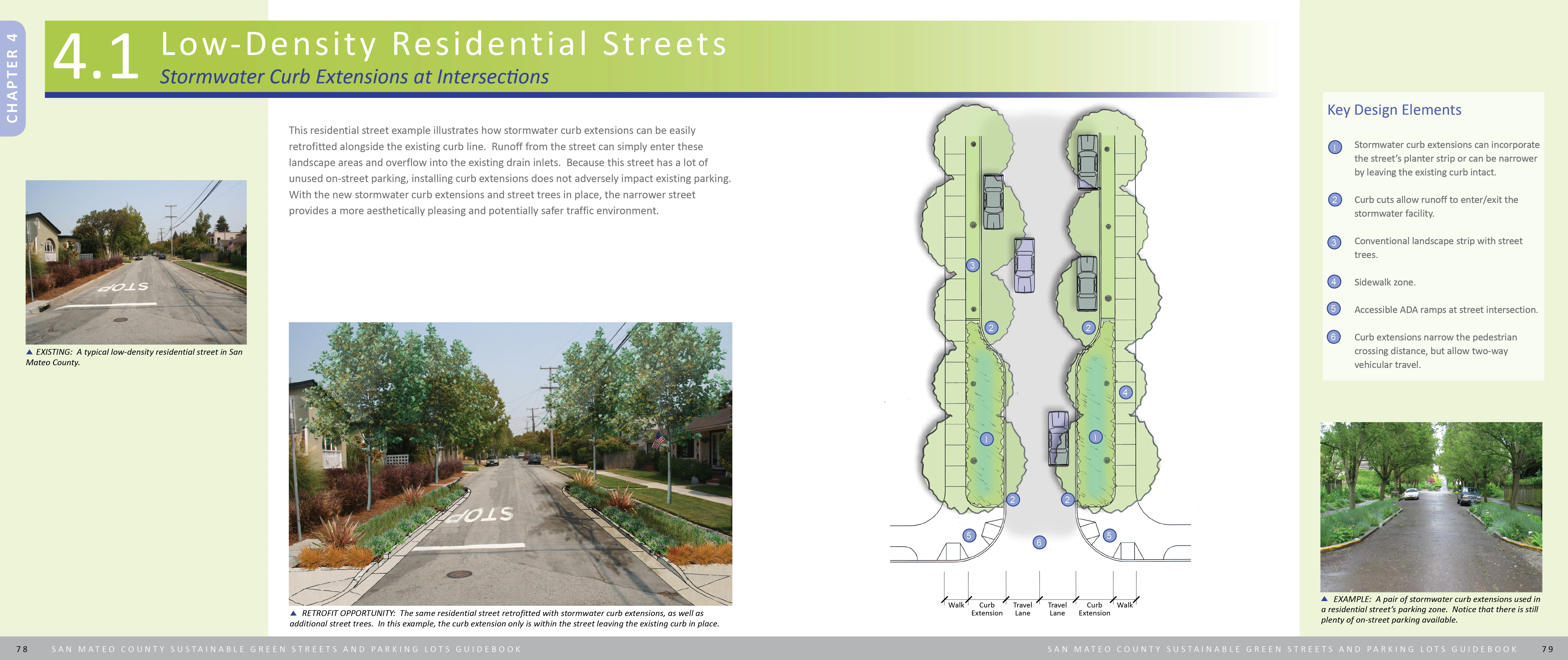
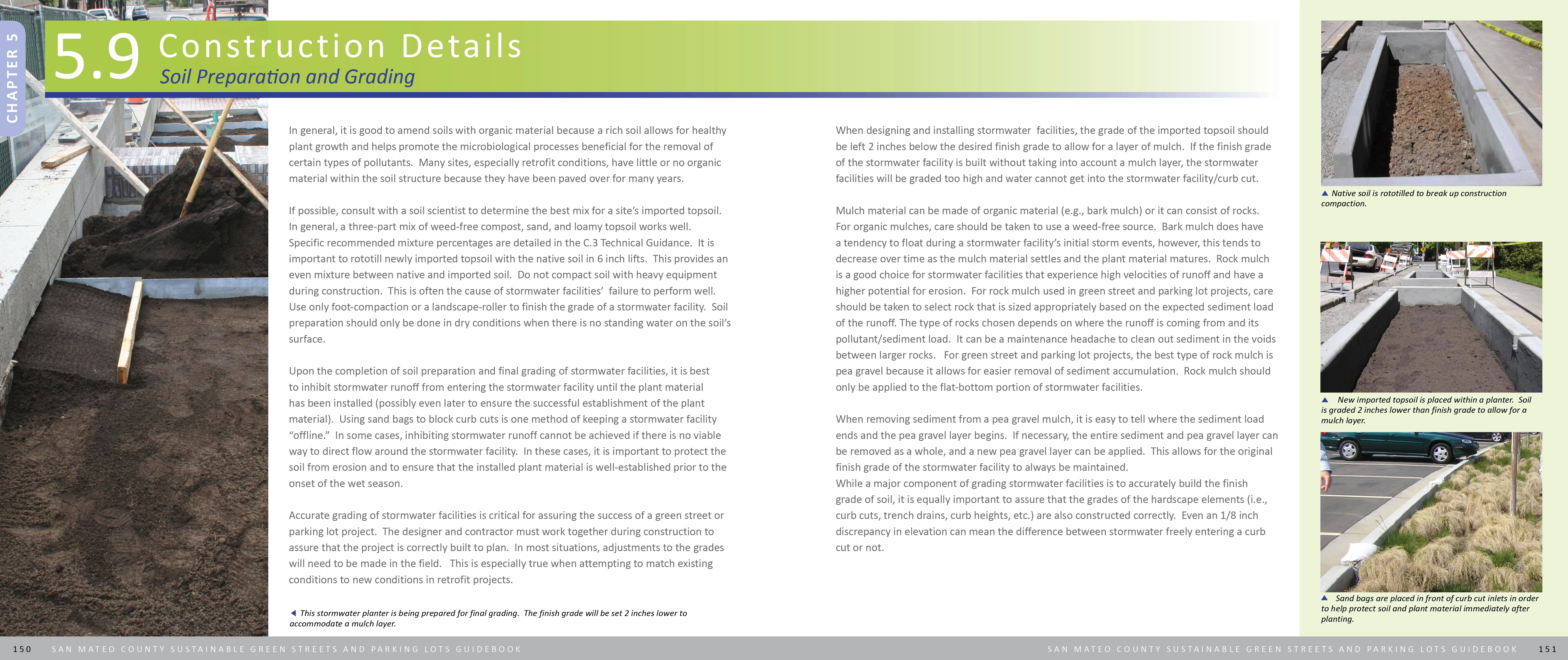
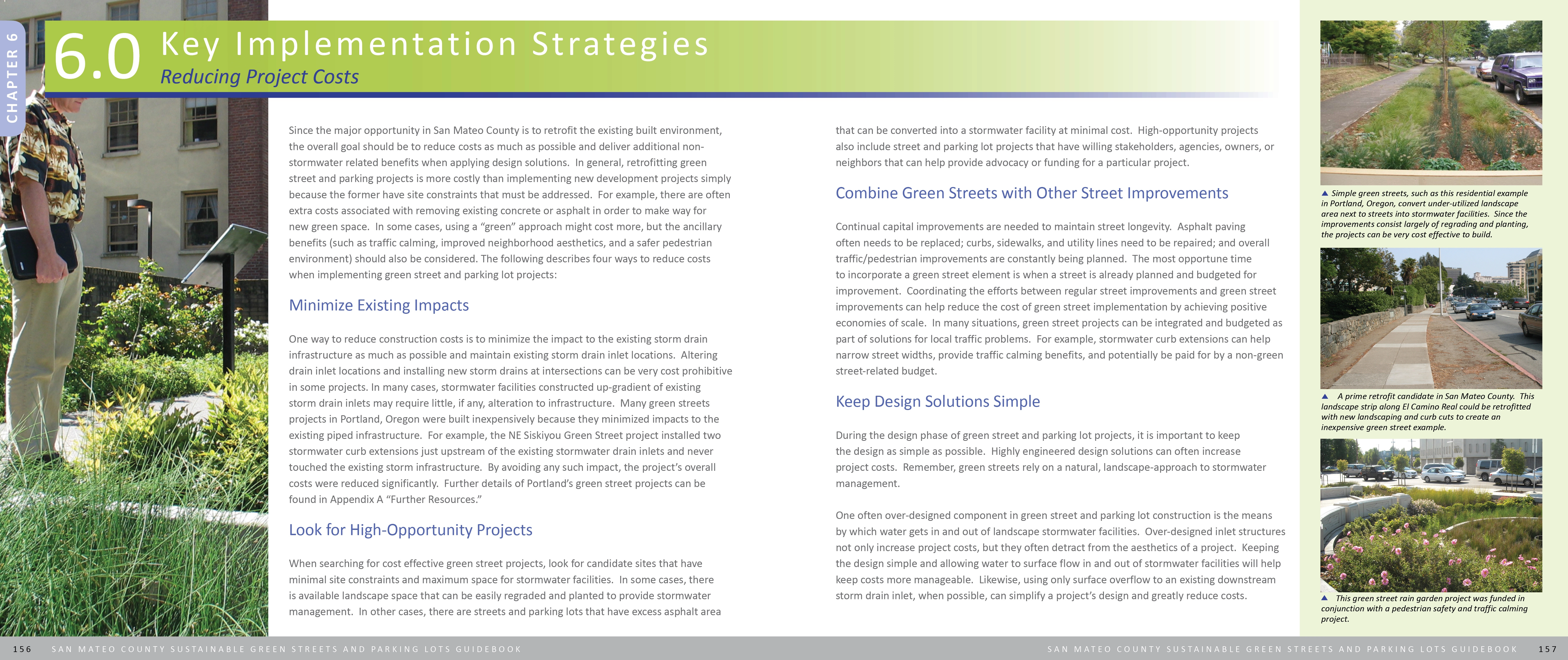
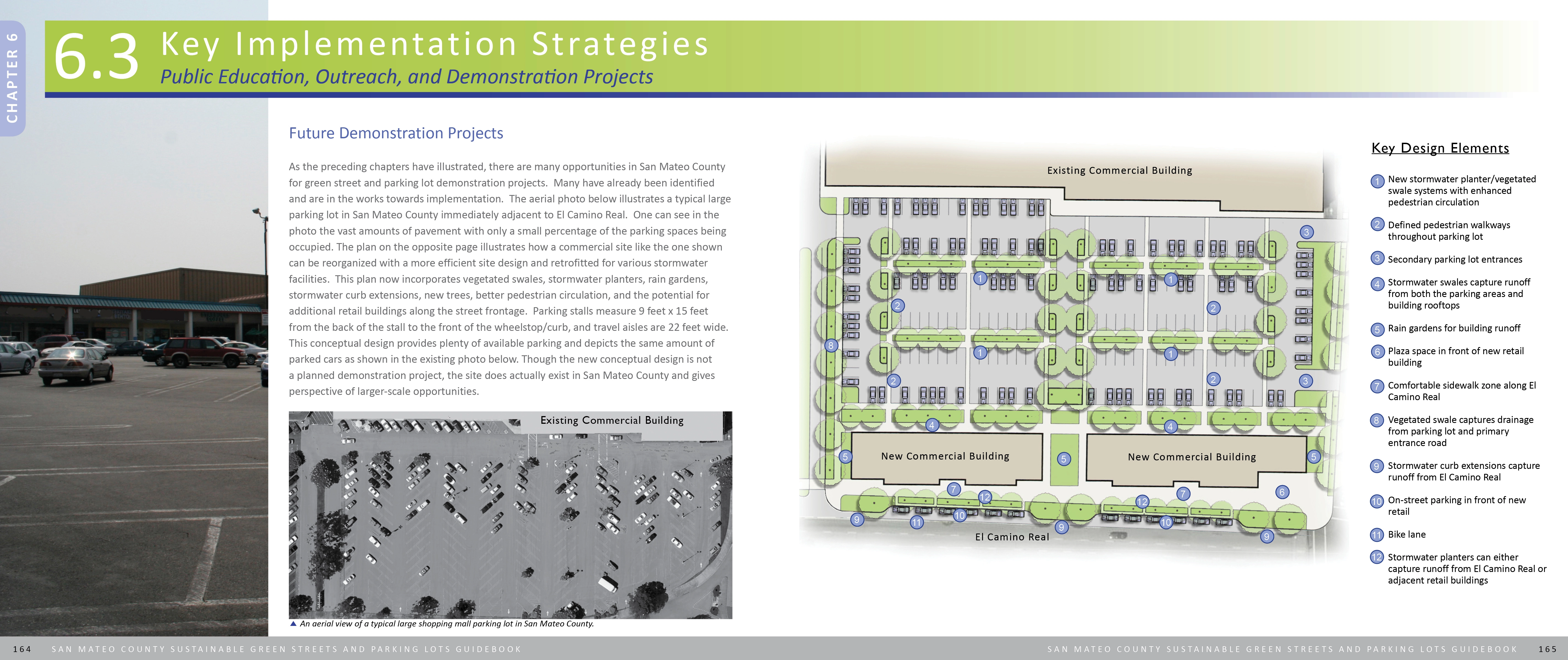
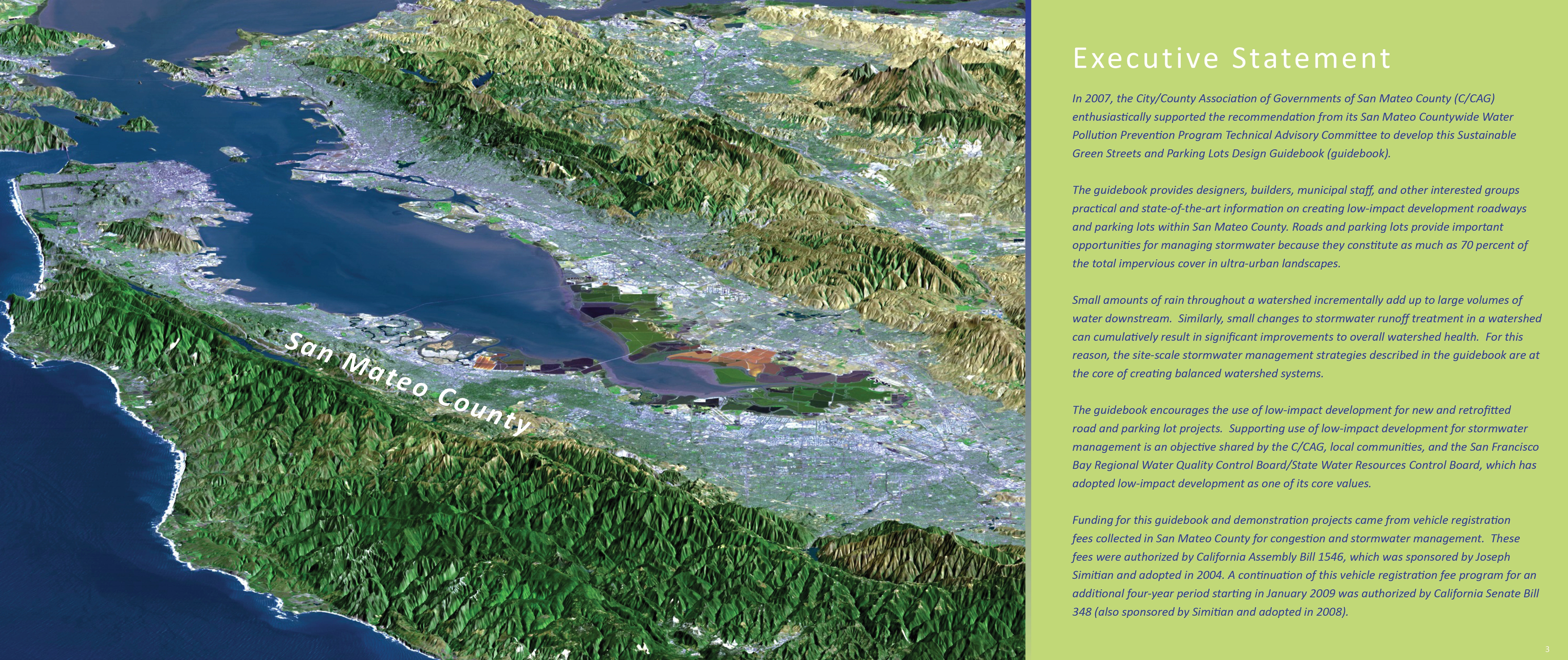
An excellent tool for communicating with public officials and constituents. Beautifully illustrated and very approachable. Great before and after shots and so many examples. Makes things seem familiar and achievable.
Awards Jury
-
Completed in January 2009, the San Mateo County Sustainable Green Streets and Parking Lots Design Guidebook is a 167-page document that richly illustrates how streets and parking lots can be designed to manage urban runoff in a more sustainable and natural way. The design guidebook provides a bold, clear, and “green” vision for 21 municipalities within San Mateo County, California, and is regarded as one of the most innovative and comprehensive guidance documents on green street design in the nation.
-
In December 2007, the San Mateo Countywide Water Pollution Prevention Program (SMCWPPP) initiated measures to address the detrimental impacts of stormwater runoff from transportation infrastructure on County waters. The initial measure involved creating a grant program that uses vehicle registration fees to fund the construction of stormwater demonstration projects within the County.To complement this effort and to assist San Mateo County municipalities with designing green street and parking lot demonstration projects, the landscape architect was commissioned by the SMCWPPP to produce the San Mateo County Sustainable Green Streets and Parking Lots Design Guidebook. In general, the guidebook is intended to inspire small but widespread changes that will improve San Mateo County’s watershed health. The more specific purpose of the guidebook is to help the user identify and realize various green street and parking lot retrofit opportunities, provide solutions to common implementation barriers, and provide guidance on how to best design, construct, and maintain successful projects. The guidebook serves to educate, inspire, and promote innovation.
Education
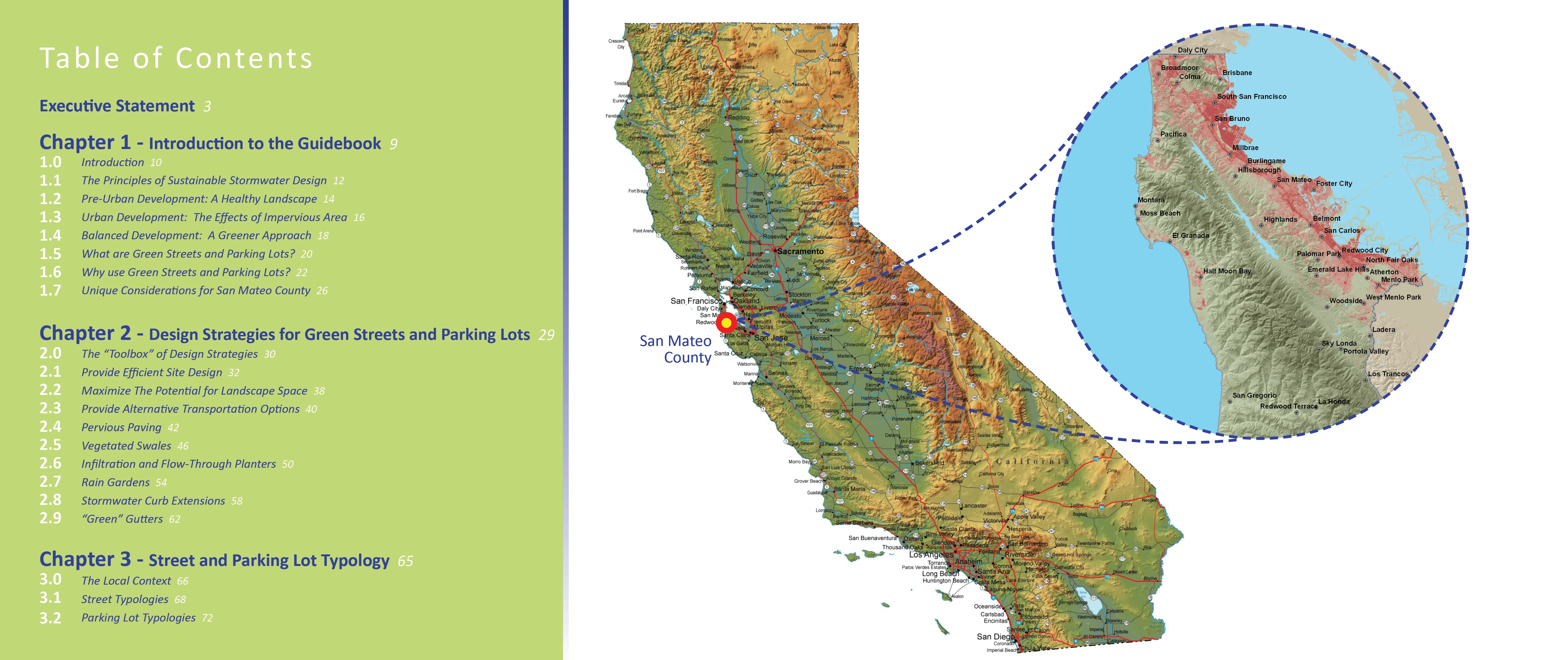
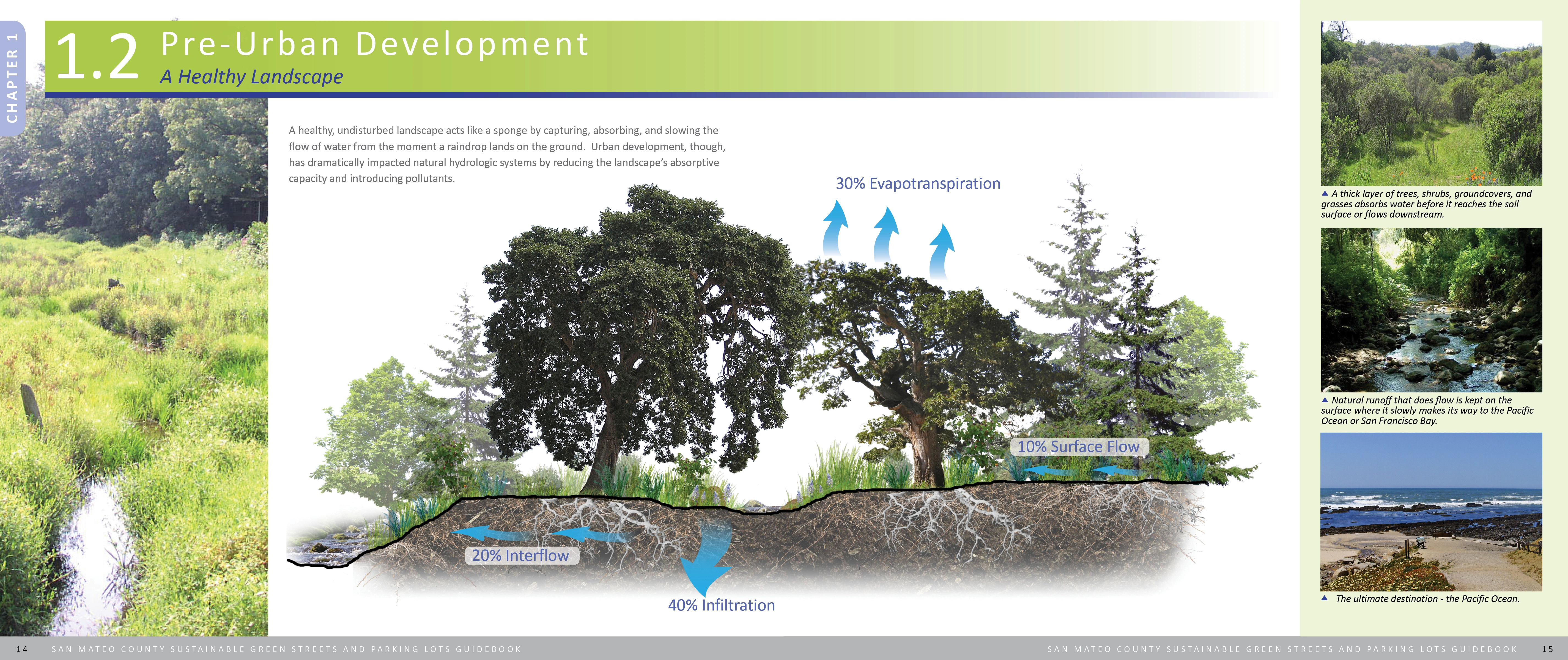
The early chapters of the guidebook provide a basic discussion on the principles of sustainable stormwater design, highlight why better site-scale stormwater strategies are needed in San Mateo County, define green streets and green parking lots, and illustrate the unique conditions found in San Mateo County as they relate to stormwater management. The landscape architect details a series of site layout and stormwater design strategies that formulate a tool box for green street and parking lot design. The intent is to encourage the user of the guidebook to think beyond “the grassy swale” and provide designers, builders, and municipal staff with a wide array of design options to choose from when retrofitting streets and parking lots in highly urban conditions.
Inspiration
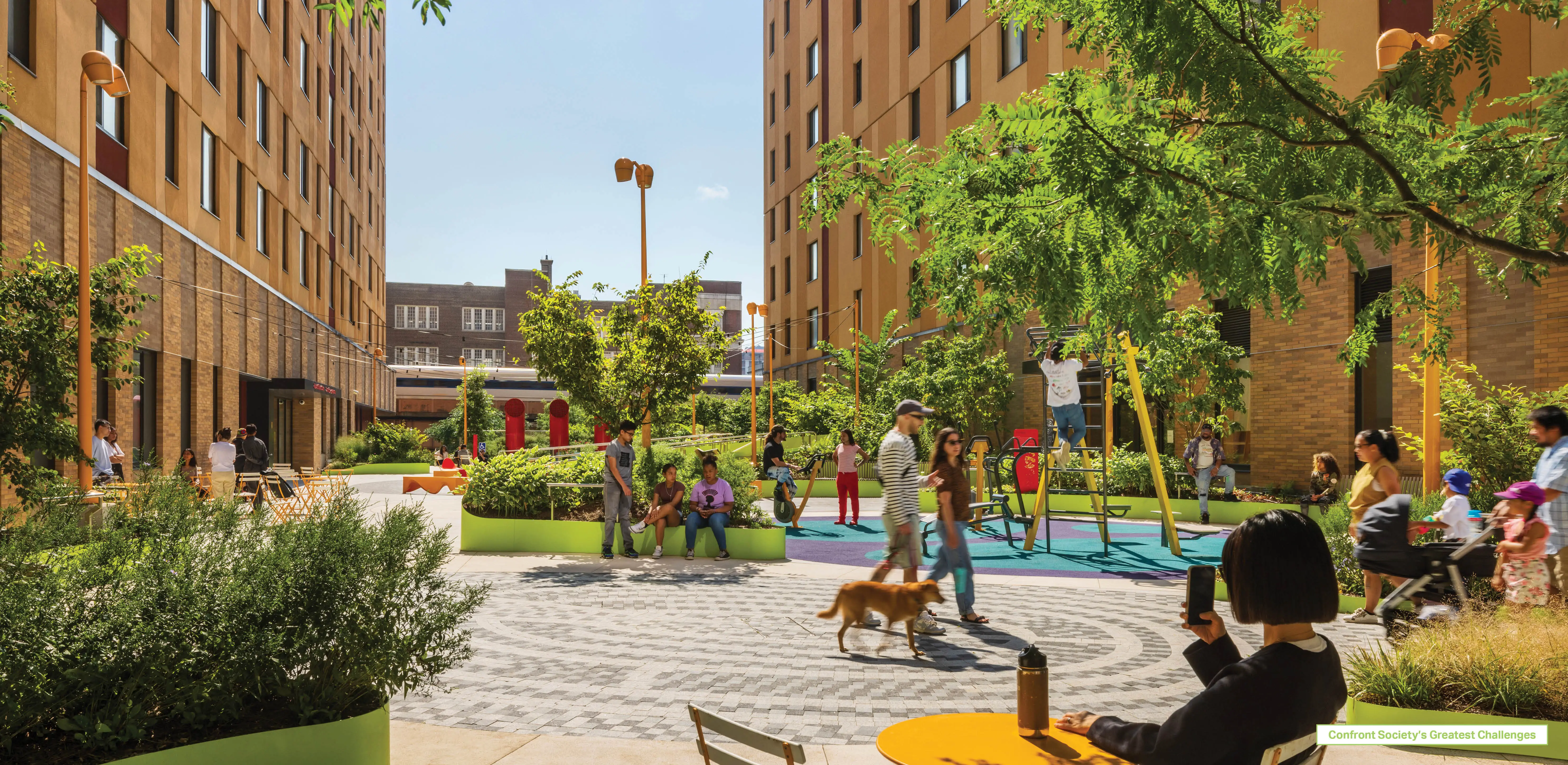
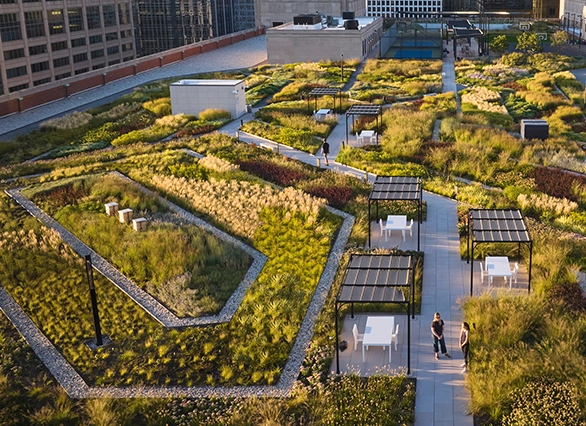
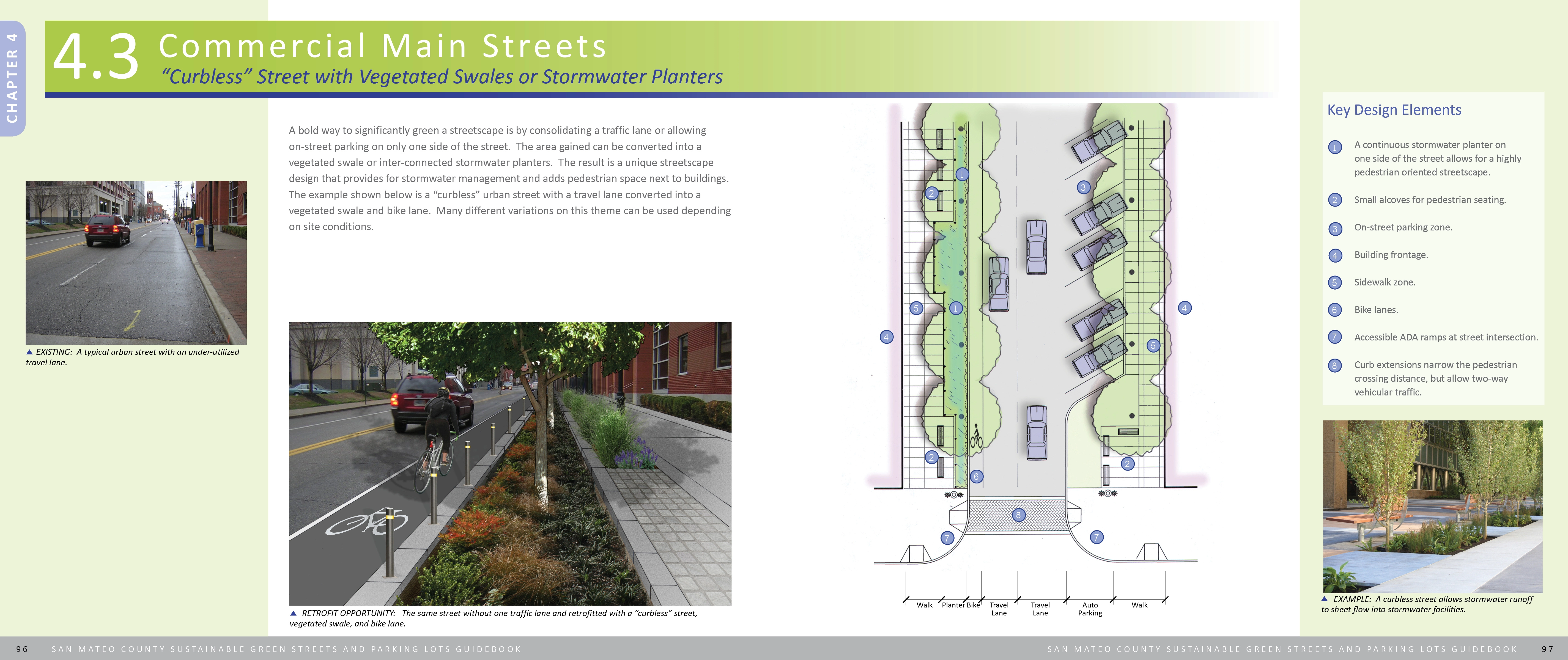
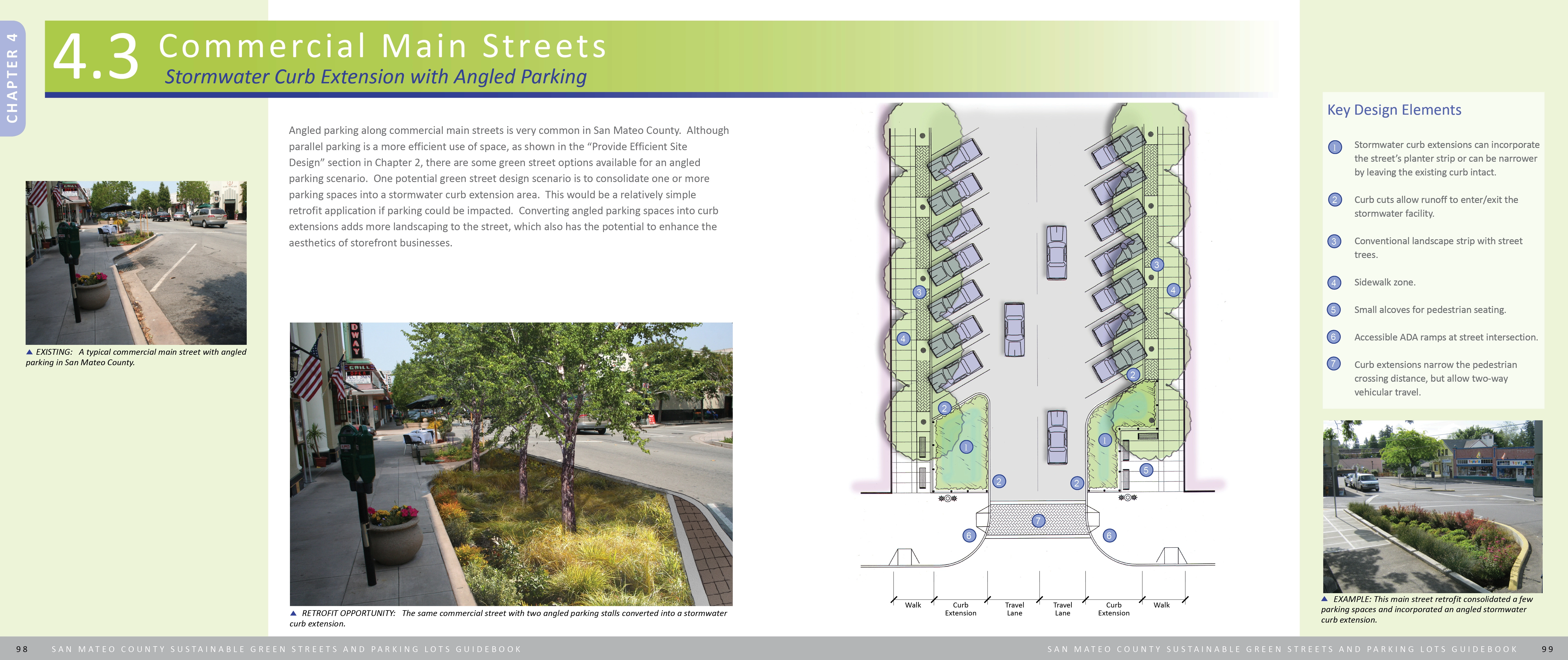
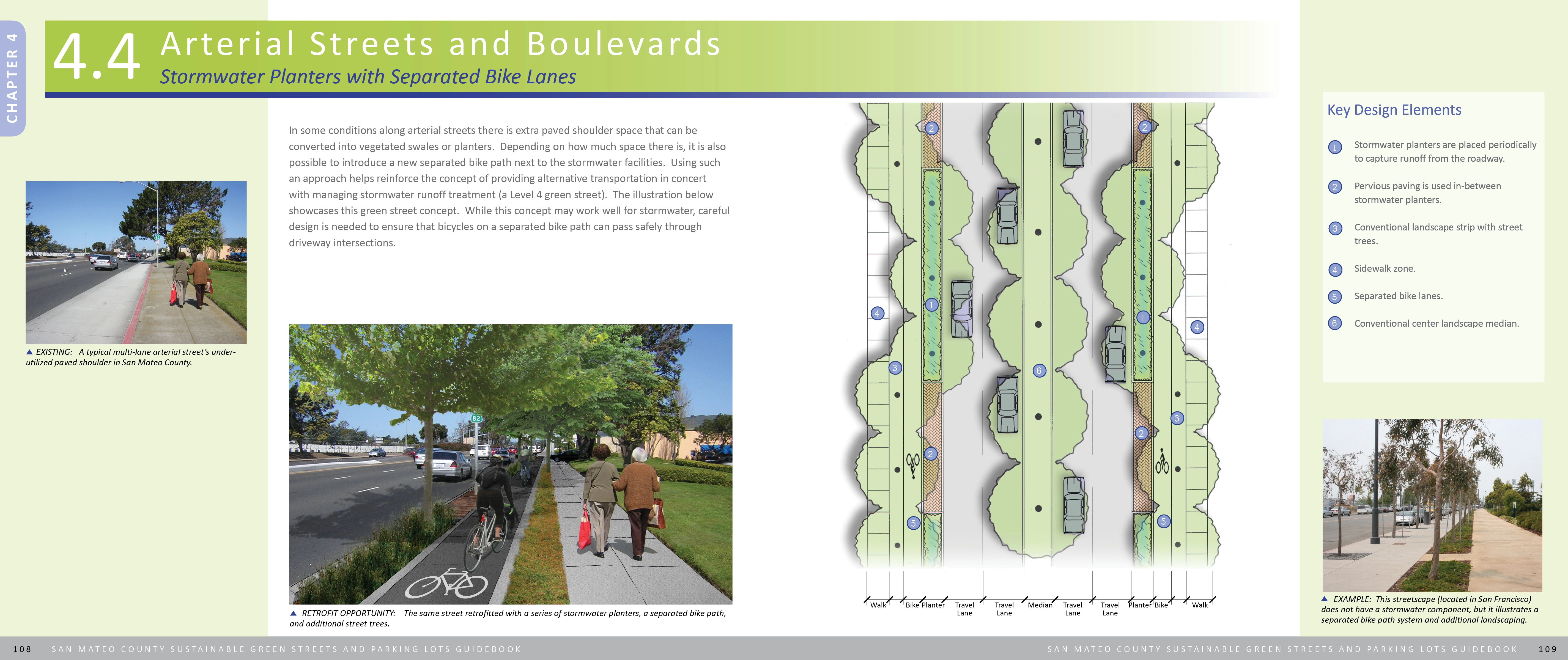
The San Mateo County Sustainable Green Streets and Parking Lots Design Guidebook contains nearly 400 drawings and photographs pertaining to green street design and implementation and uses this imagery to inspire green street projects throughout San Mateo County. Chapter 4, considered the most powerful section of the guidebook, illustrates a series of “before and after” sketches and plan view renderings of green street and parking lot retrofit opportunities applicable to a wide variety of conditions in San Mateo County. Whether a particular site is located in a low or high-density residential neighborhood, a commercial “main street” district, along an arterial or boulevard street, or within a small or large parking lot, the guidebook provides a bold vision of what sustainable stormwater design could look like in San Mateo County.
Innovation
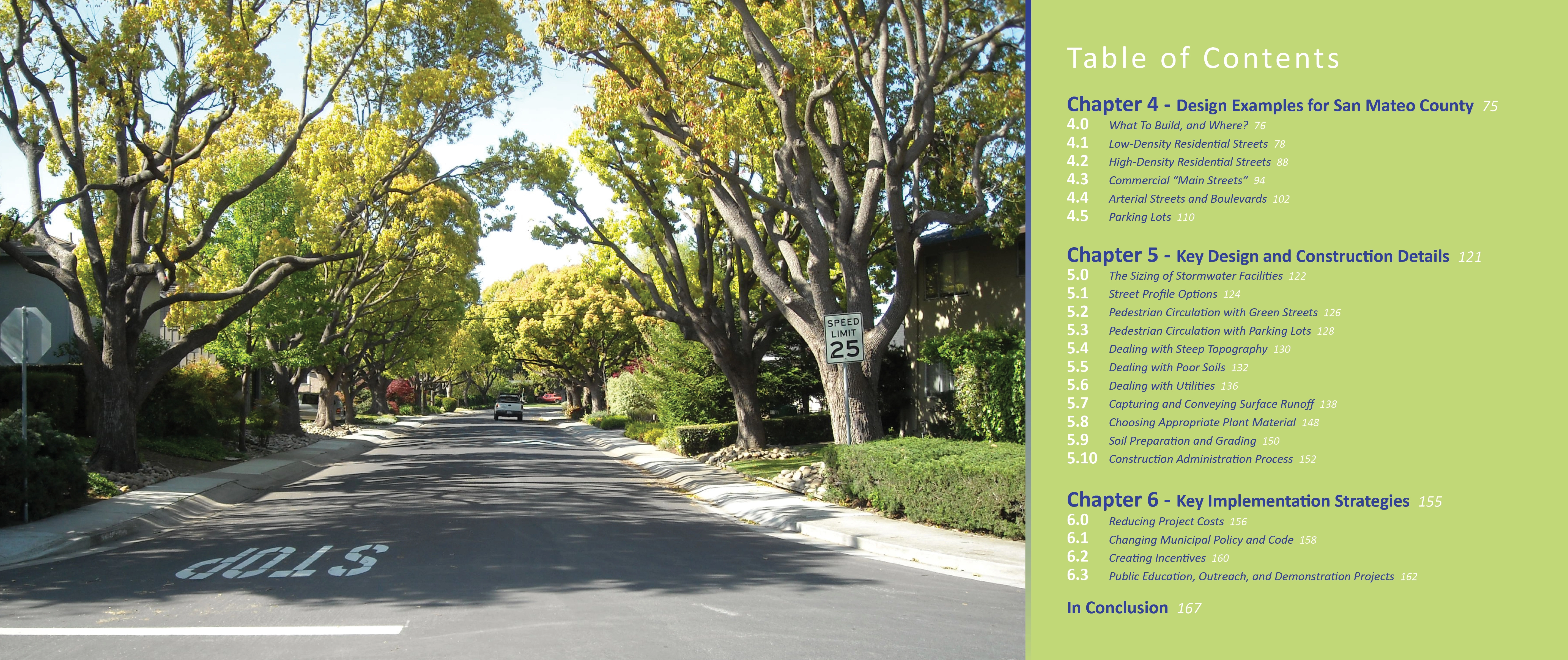
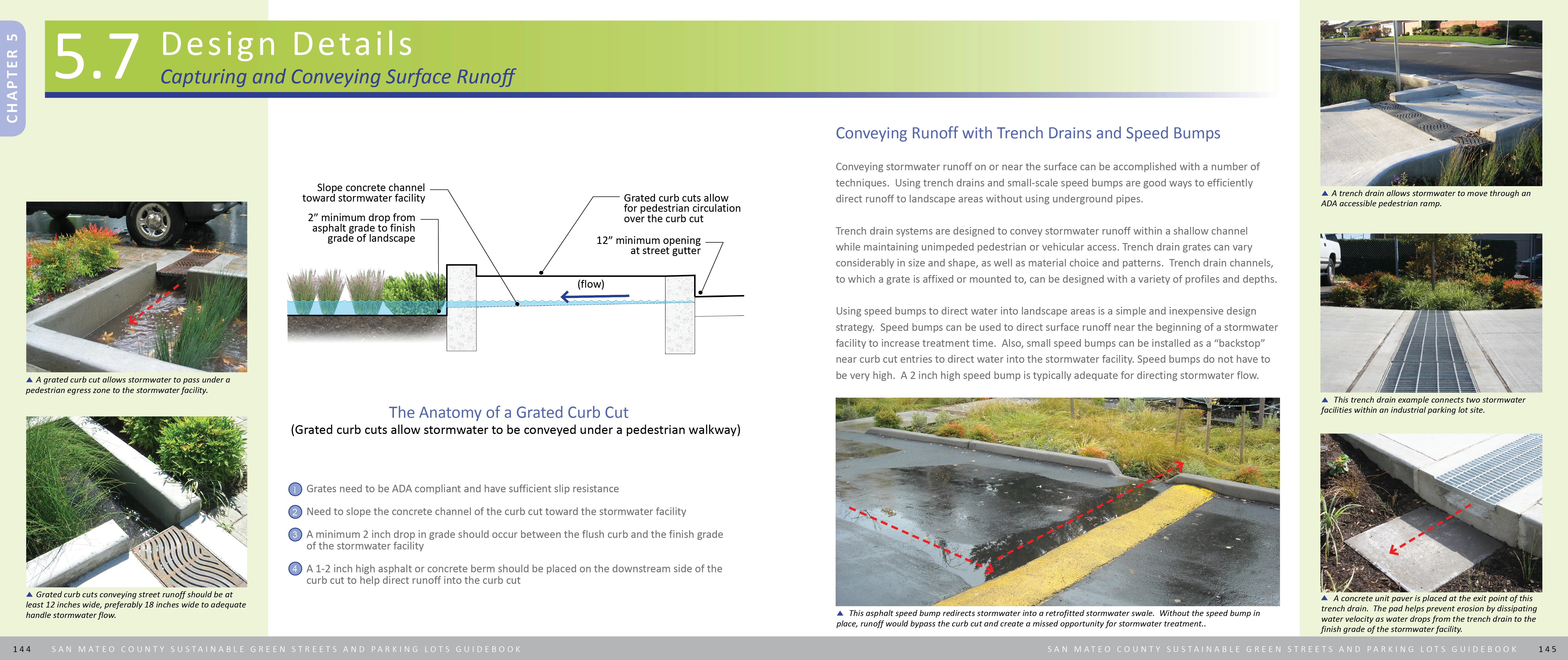
In addition to providing visual inspiration, the landscape architect was also asked to provide practical insight on how to successfully implement green street and parking lot projects. Chapter 5 of the guidebook provides a detailed discussion of the key design and construction details that can often prove problematic in building green street projects. Lastly, Chapter 6 of the guidebook goes beyond the design realm and presents how to best implement green streets and parking lots from a policy or programming perspective, such as identifying ways to reduce construction costs, creating incentive programs, and describing different approaches for developing demonstration projects.
Project Impact and Effectiveness
The San Mateo County Sustainable Green Streets and Parking Lots Design Guidebook has been recognized both locally and nationally. The design guidebook has earned the 2009 California American Planning Association’s “Innovation in Green Community Planning” Award of Excellence. Nationally, the guidebook is considered a leading reference in green infrastructure by multiple federal and state agencies as well as local municipalities within throughout the United States. Though the San Mateo County Sustainable Green Streets and Parking Lots Design Guidebook has proven to be a highly successful planning and design tool, it is the communicative value of the guidebook that has been truly impressive.
Within the last two years, the landscape architect has been invited to present the guidebook to various national audiences and has conducted green infrastructure workshops in several states including: Florida, Connecticut, Washington, and California. These interactive workshops have allowed landscape architects, engineers, planners, policy makers, and public officials to come together and gain a better understanding of the guidebook and how to apply what they have learned to their own communities. The crescendo of these workshops is having the landscape architect lead participants in a half-day design charrette that retrofits locally-selected project sites with the strategies presented within the design guidebook. In addition, the landscape architect was honored to present the design guidebook in Washington D.C. at the 2010 ASLA Annual Meeting.
The San Mateo County Water Pollution Prevention Program has a dedicated website for their Green Streets and Parking Lots Program. In an effort to conserve natural resources, the design guidebook has been digitally formatted and posted on the website and is available for immediate download. Visitors to the website can download the entire document, individual chapters, or specific topic sections depending on their interests. Since January 2009, thousands have downloaded the design guidebook and hundreds of people have attended green infrastructure workshops. In addition, a 2-hour video of the May 2009 Green Streets and Parking Lots Workshop in San Mateo County has been posted on online. Hence, the guidebook can be accessed in its original graphic form, in-person via workshops, or by video link.
In an effort to keep to its pledge of innovation, the San Mateo County Sustainable Green Streets and Parking Lots Design Guidebook has recently had its format and graphics updated to better communicate the content of the guidebook and to provide the most up-to-date photographs of green street and parking lot design options.
In conclusion, the San Mateo County Sustainable Green Streets and Parking Lots Design Guidebook has proven to be a valuable resource for those looking for a clear and visionary guide on green street and parking lot design. However, we believe that the most significant impact the guidebook has made is demonstrating how landscape architects are taking an immediate and leading role in helping communities realize their vision in the planning, design, and implementation of green infrastructure.
-
Lead Designers:
Kevin Robert Perry, ASLA, Olena Turula, Jason HirstLocal Civil Engineering Support:
Sherwood Design Engineers
Robert DusenburyGuidebook Technical Review
Karen Borrmann, City of Belmont
Elizabeth Claycomb, City of Pacifica
Matthew Fabry, City of Brisbane and SMCWPPP Program Coordinator
Jane Gomery, City of Burlingame
Fred Jarvis, EOA, Inc.
Rosey Jencks, San Francisco Public Utilities Commission
Jeannie Naughton, City of Daly City
Laura Russell, City of San Bruno
Gilbert Yau, City of Belmont
Advertisement
Related Awards
Honor Award, Communications
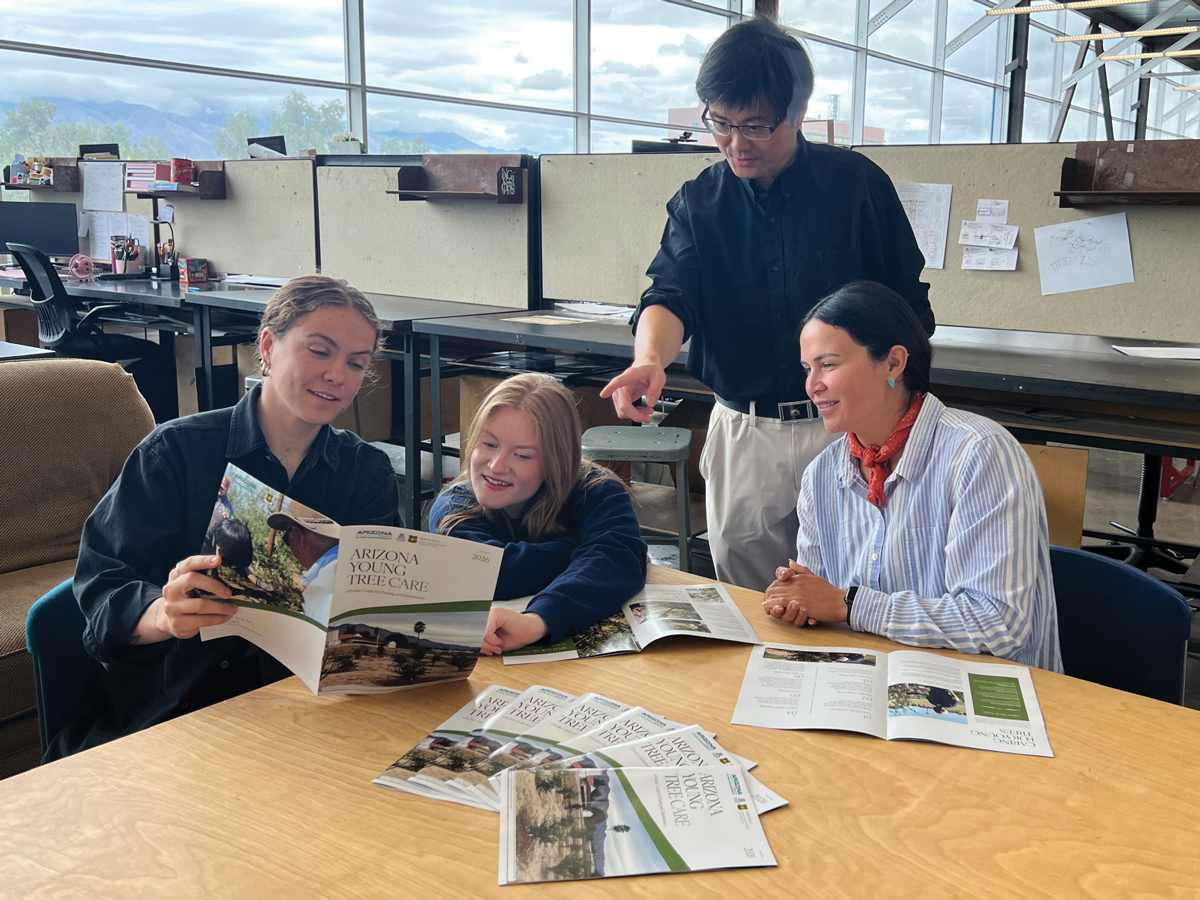
Growing Impact: Advancing Knowledge of Urban Desert Tree Care
The objective of this project is to create a knowledge hub for public education and engagement on tree care and maintenance to increase urban forestry benefits in desert cities of southern Arizona. From 2023-2026, the team has engaged practitioners, government agencies, and the public through workshops, public lectures, and hands-on training on young tree care, smart watering systems, and pruning techniques.