
.webp?language=en-US)


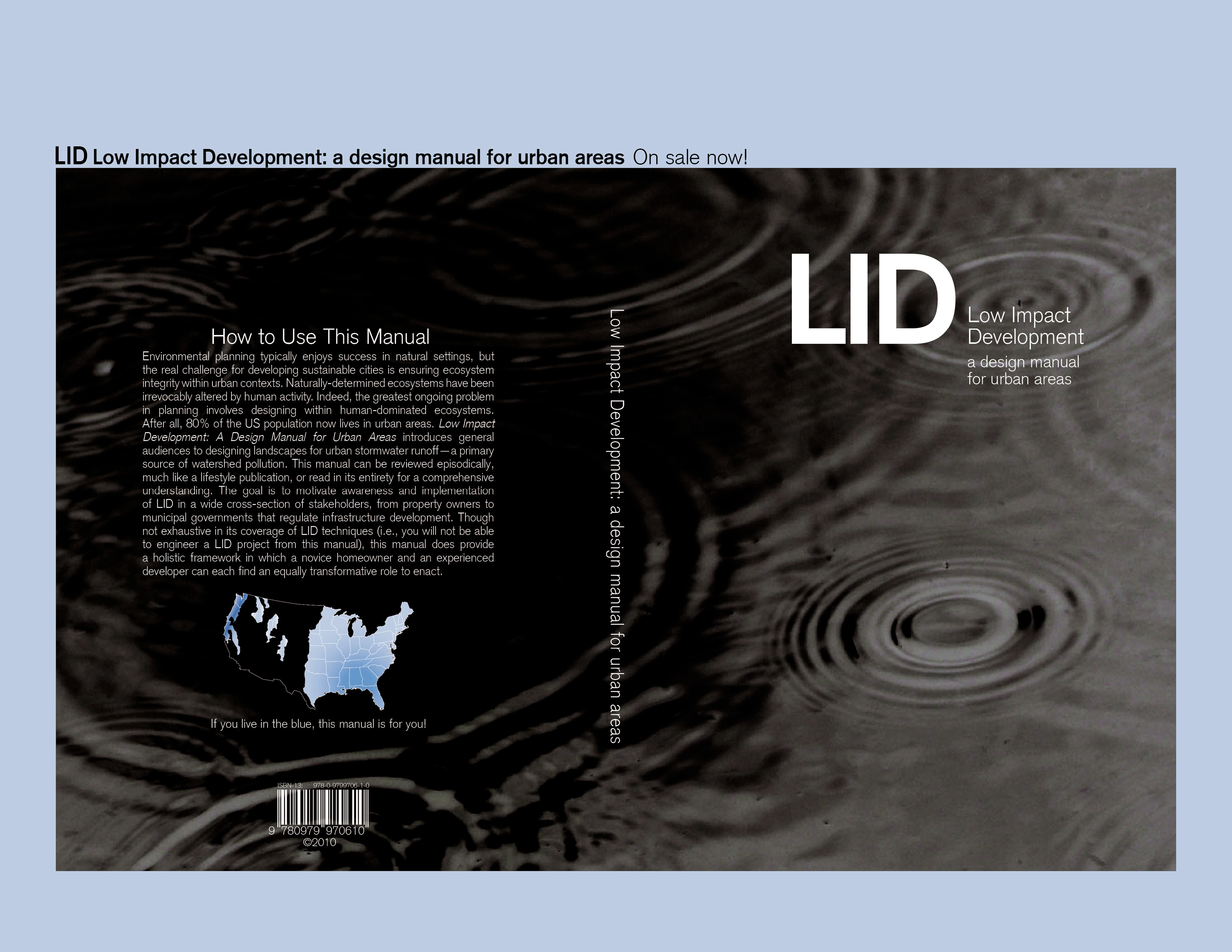
LID Low Impact Development: A Design Manual for Urban Areas
Beautifully composed and very accessibly written. Clear, brilliant, attractive, useful, and pertinent. All young people should read this, boy does it communicate.
Awards Jury
-
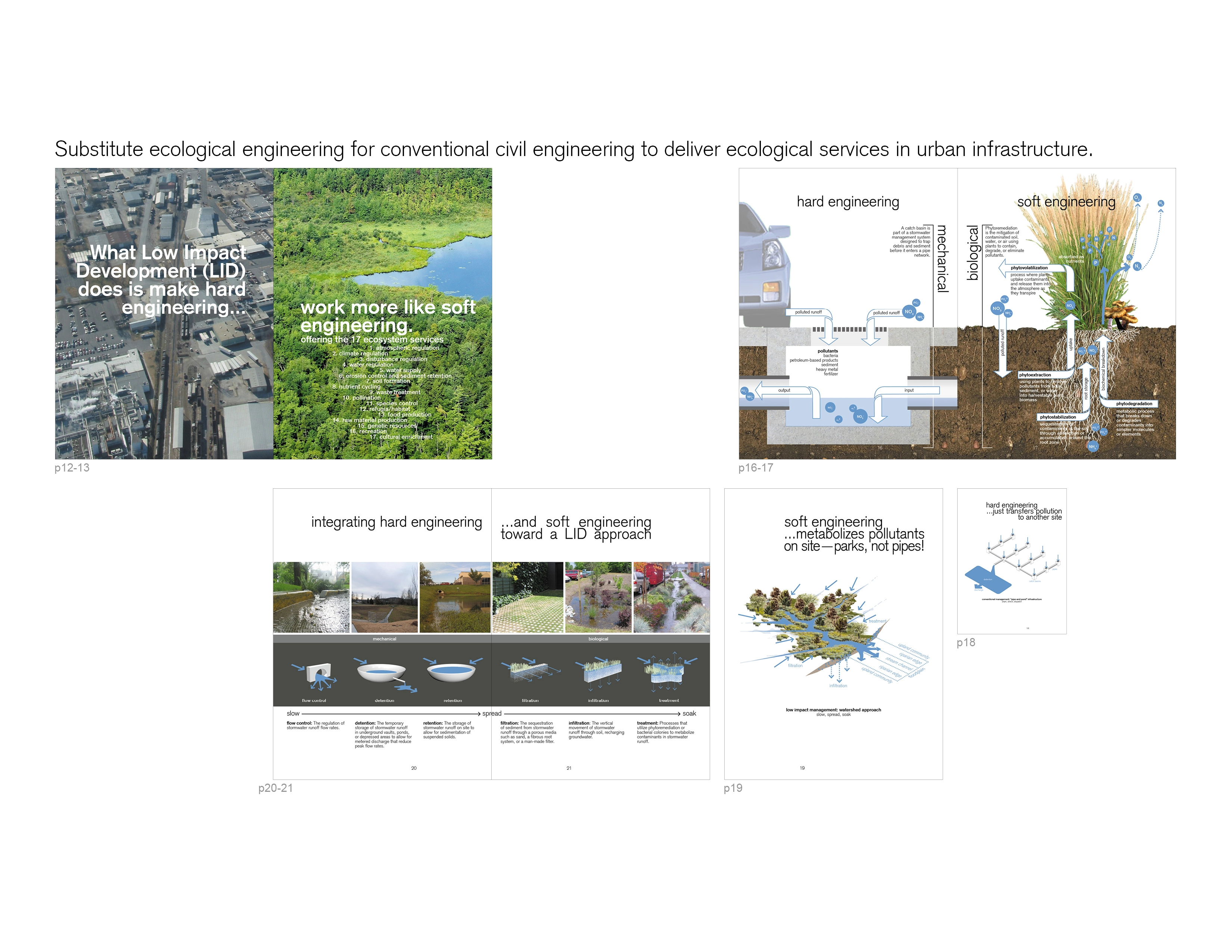
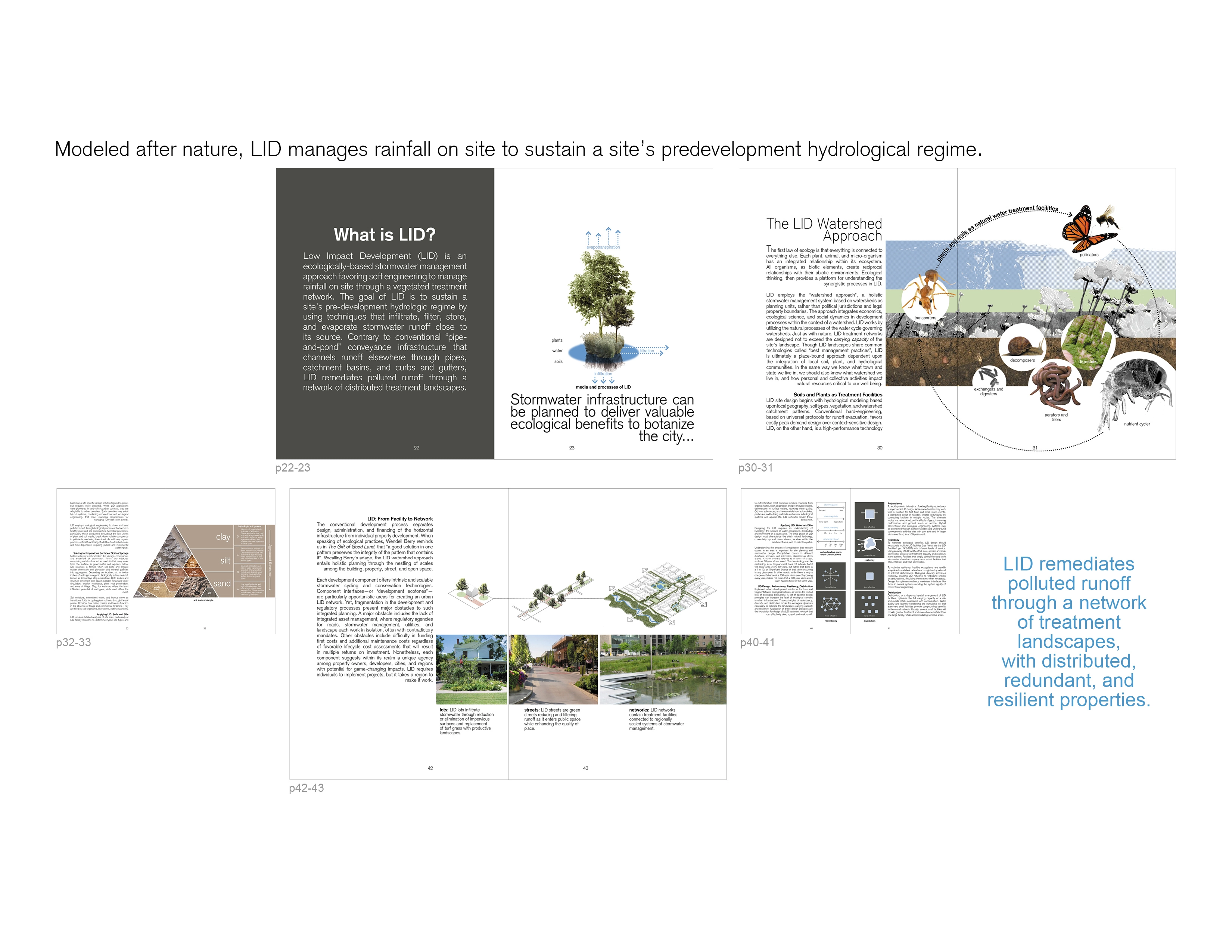
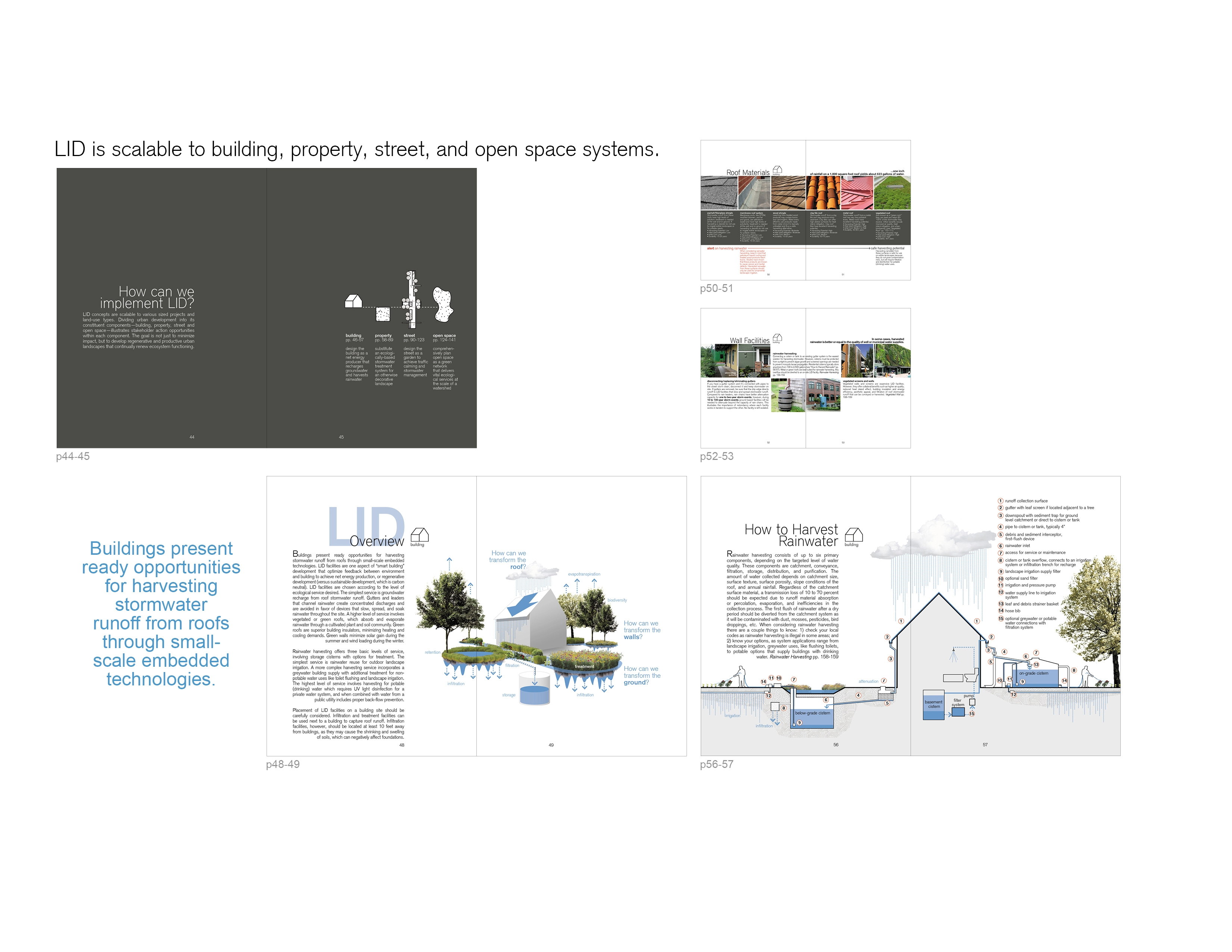
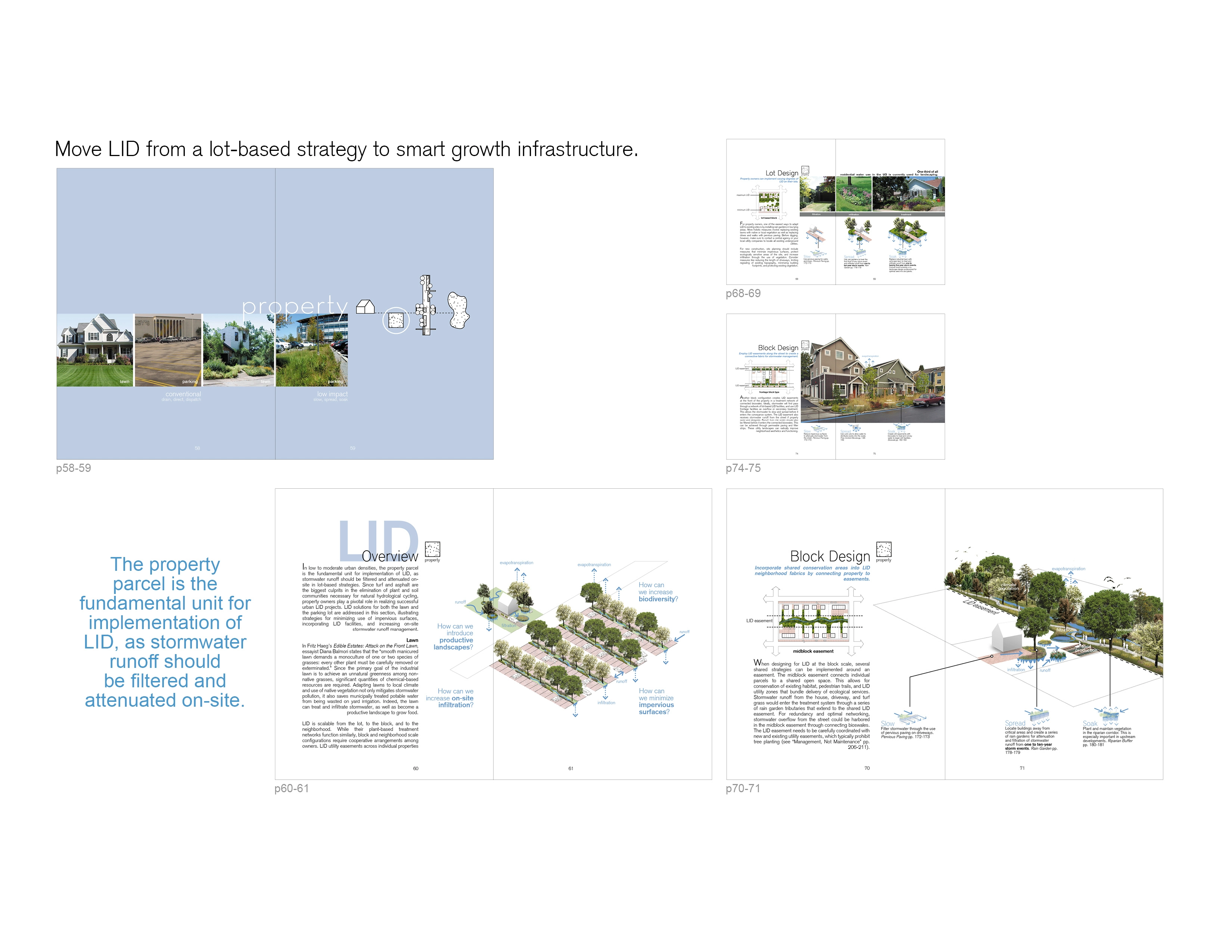
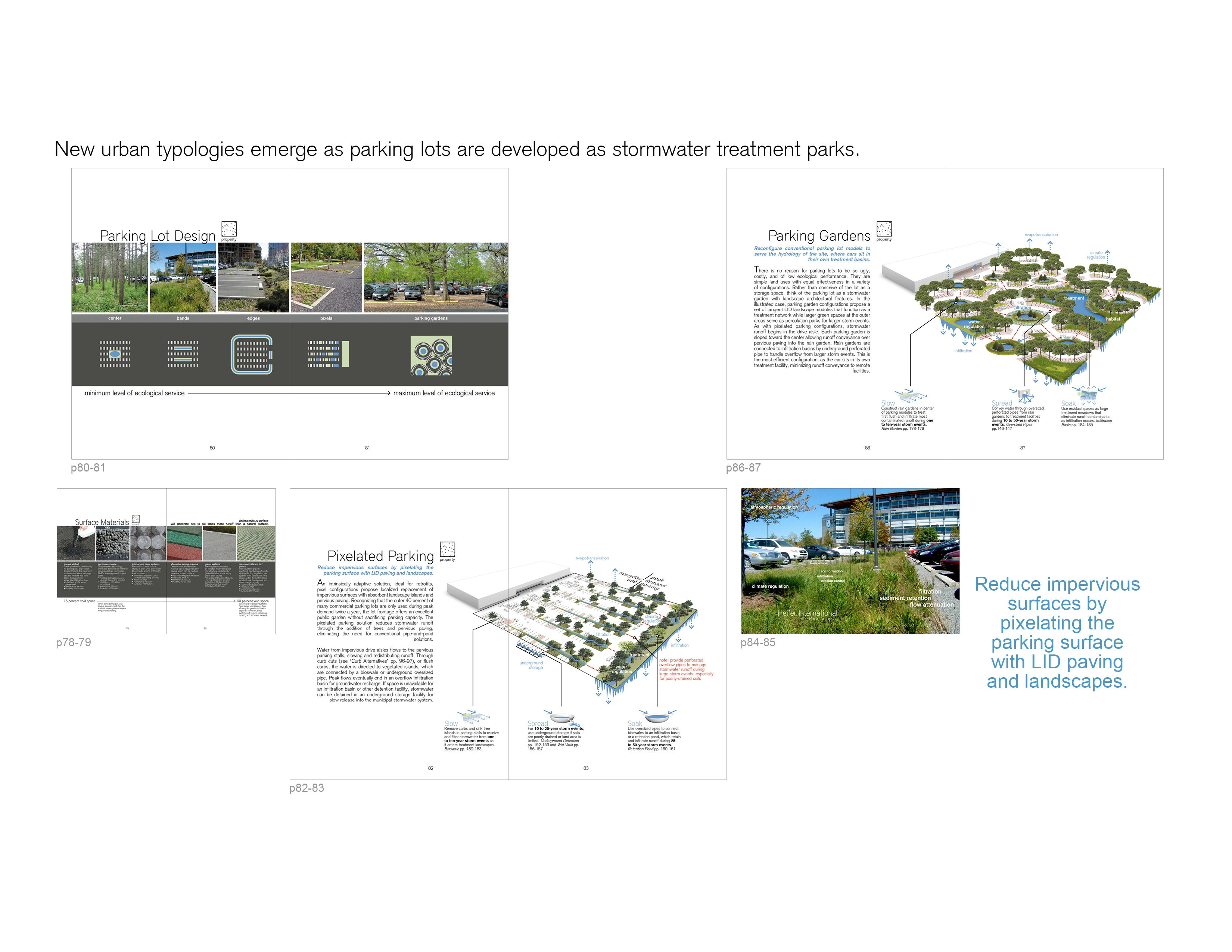
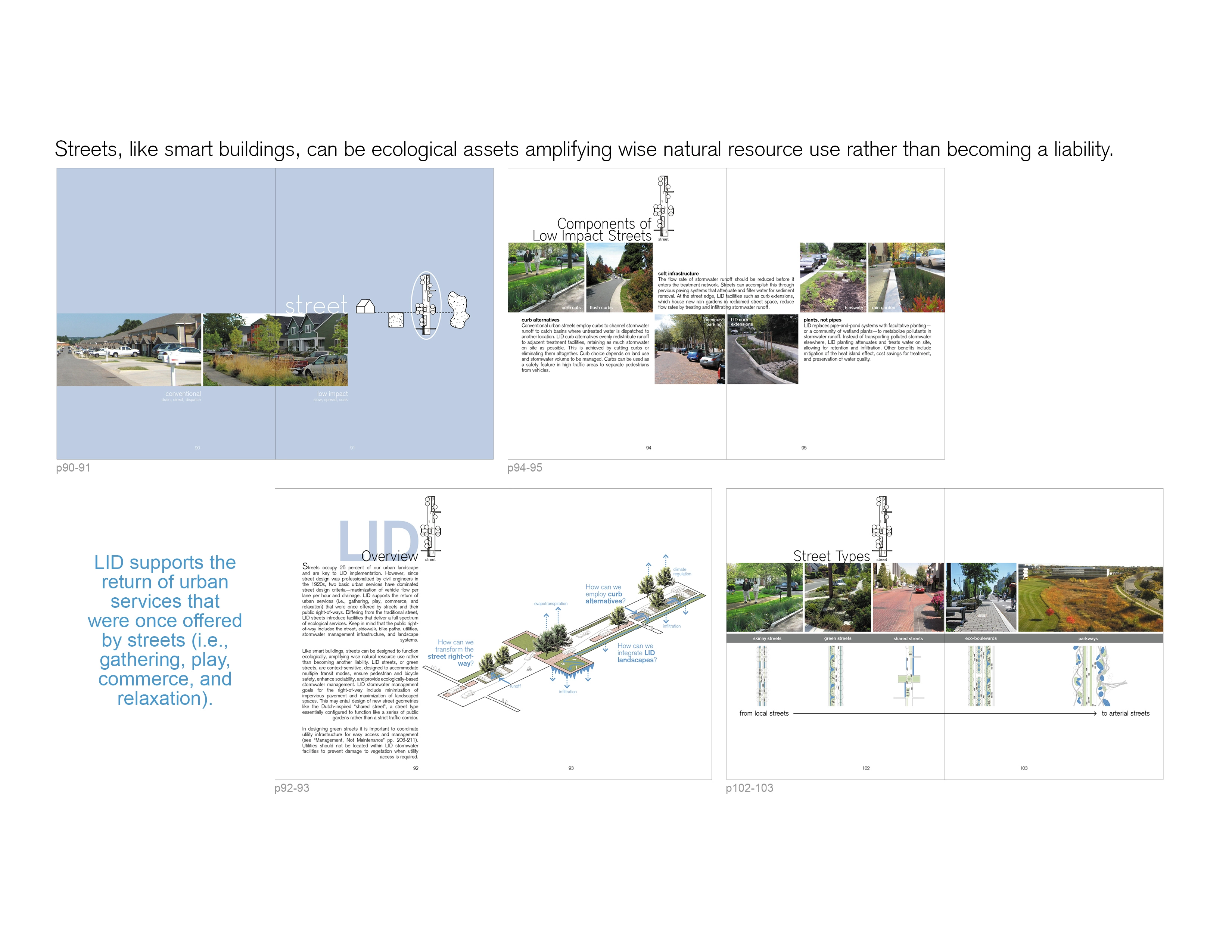
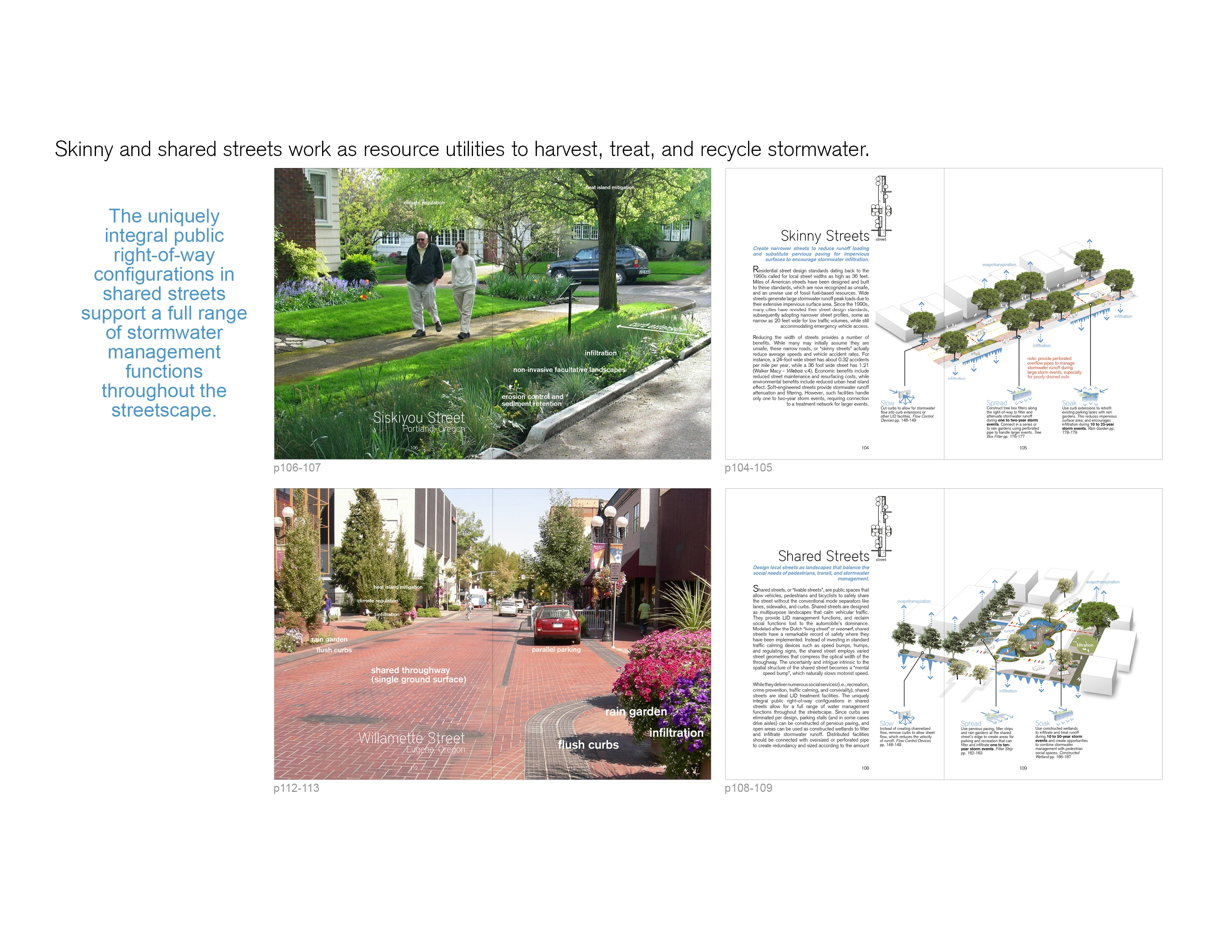
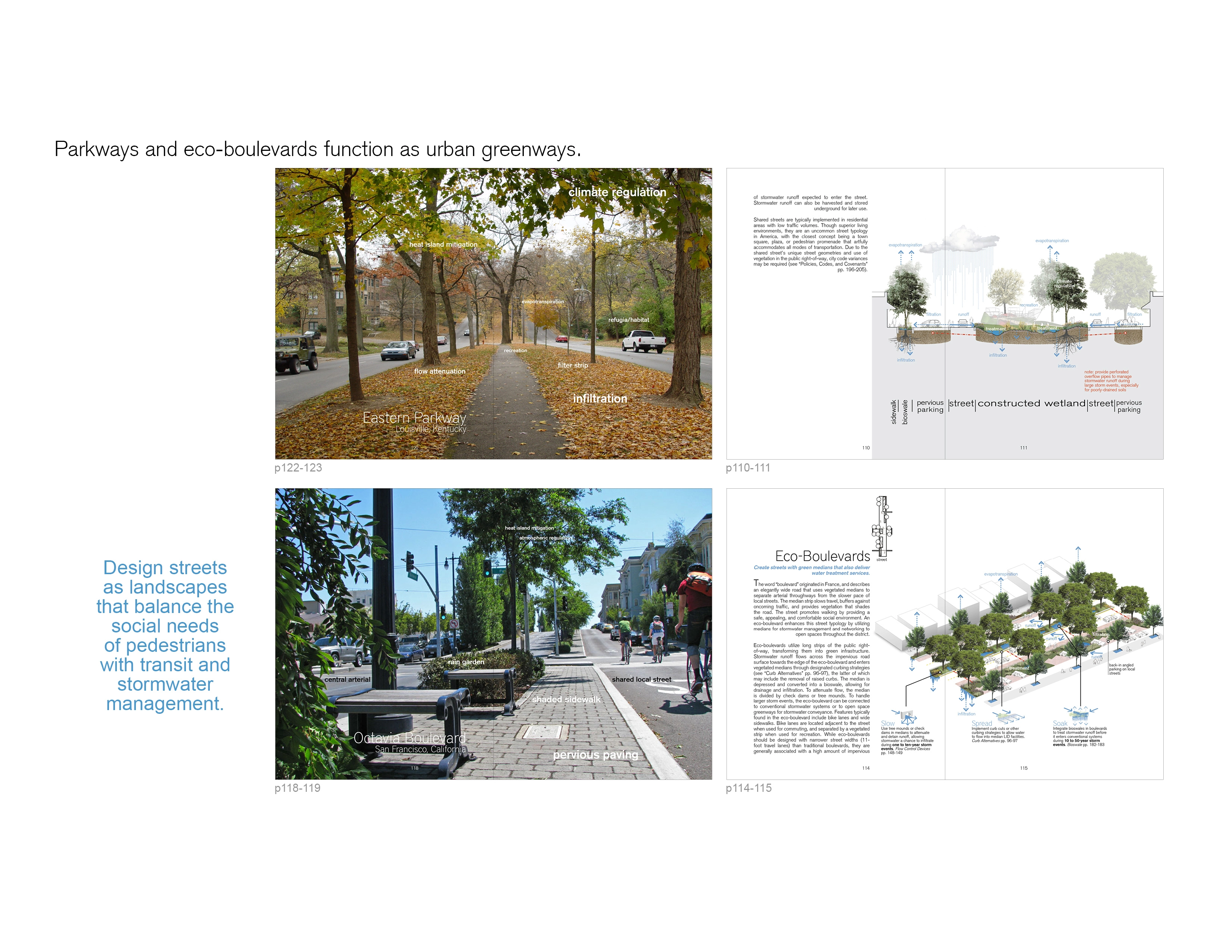
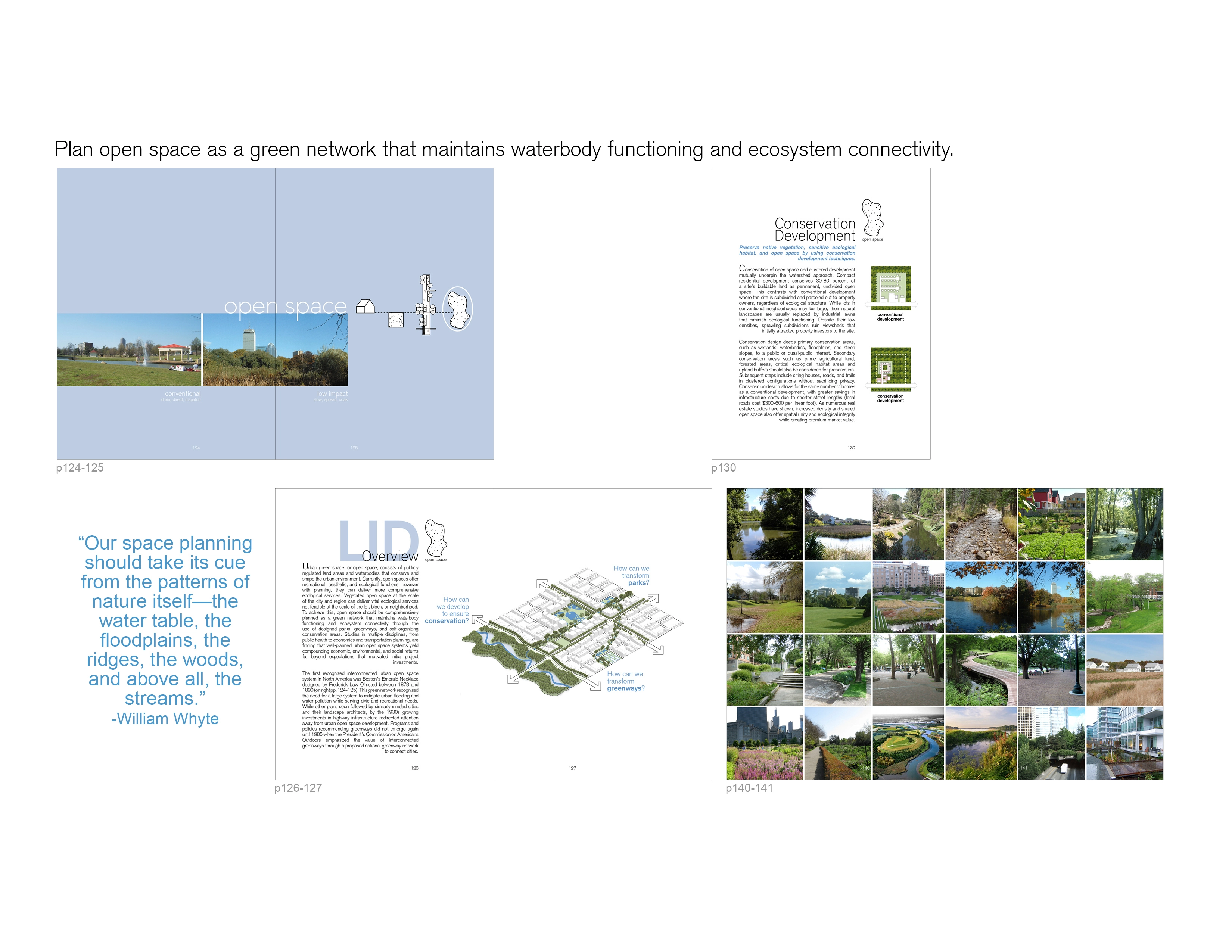
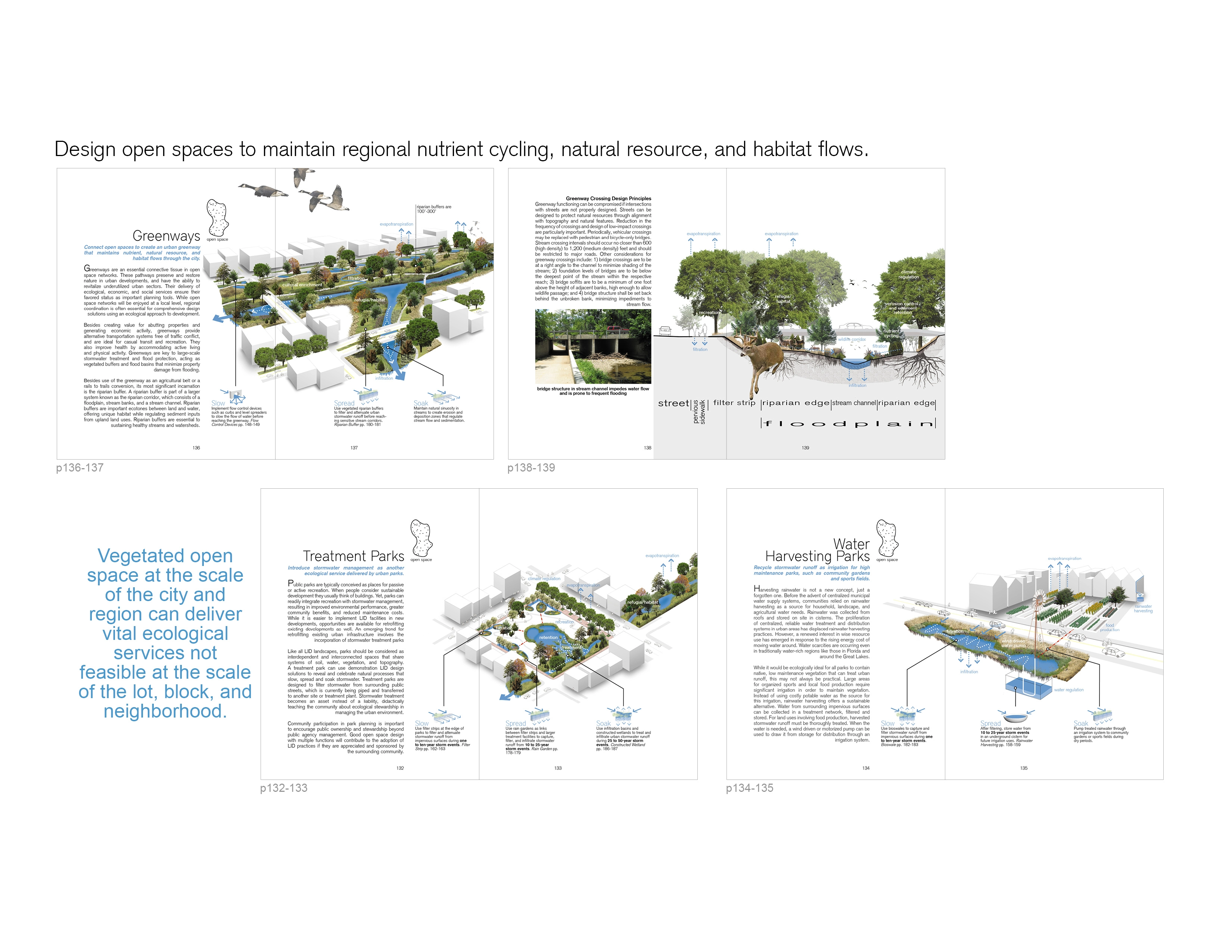
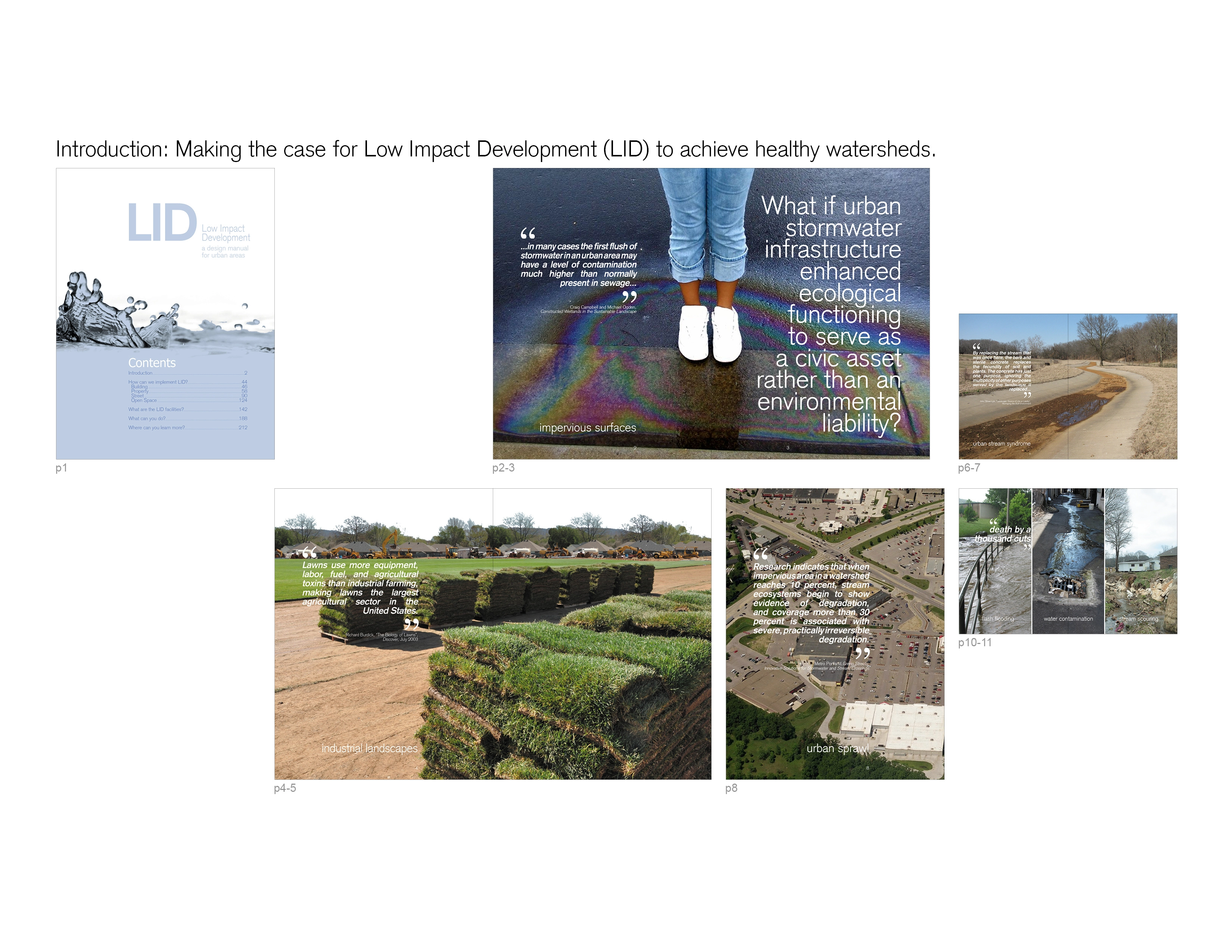
Low Impact Development: A Design Manual for Urban Areas is designed for those involved in urban property development, from homeowners, to institutions, developers, designers, cities, and regional authorities. The manual presents a graphic argument, illustrating the application of ecologically-based stormwater treatment technologies in urban contexts. The manual’s unique contribution is its advancement of LID from a set of suburban lot-based technologies to a distributed urban treatment network deployed at neighborhood, municipal, and regional scales.
-
Intended Purpose
The manual was commissioned by the US EPA under its Nonpoint Source Pollution program and the Arkansas Natural Resources Commission as part of a larger planning effort to promote implementation of Low Impact Development (LID) in urban areas. LID is an ecologically-based stormwater management approach favoring soft engineering to manage rainfall on site through a vegetated treatment network. The objective is to sustain a site’s pre-development hydrological regime by using techniques that infiltrate, filter, store, and evaporate stormwater runoff close to its source. Contrary to conventional “pipe-and-pond” conveyance infrastructure that transfers polluted runoff elsewhere through pipes, catchment basins, and curbs and gutters, LID remediates polluted runoff through a network of distributed treatment landscapes. The design and research team collaborated with state agencies, the City of Fayetteville, citizen environmental groups, and nonprofits to develop planning templates, codes, and best practices that enable implementation of LID. Currently, incorporation of LID facilities, like bioswales, pervious surfaces, rain gardens, tree box filters, and infiltration trenches, in public right-of-ways is illegal in most municipalities. In addition to publication of the book, the project team guided Fayetteville to become the first Arkansas city, and among a handful nationwide, to adopt a LID code, making LID a by-right (legal) development option.
Audience
The manual is intended for areas receiving more than 25” of rainfall annually, representing more than 60% of the US land mass. Low Impact Development: a design manual for urban areas is graphically formatted to function like a lifestyle publication, attracting general audiences while providing ample technical information for the development community to implement LID. Planning scenarios are organized along a development transect illustrating the various ecosystems services expected from building, property, street, and open space applications. The general argument is followed by implementation strategies and discussion of the twenty-one LID facilities, ending with policies and codes supportive of LID along with a bibliography for further research. Illustrations of novel and retrofit planning scenarios assist planners and designers “at the boards” to build a treatment network using the principles of redundancy, resiliency, and distribution. The goal is to mainstream incorporation of LID in project development, municipal infrastructure building, and open space regional planning. An unexpected consumer group of the book has been K-12 courses on sustainability.
Message
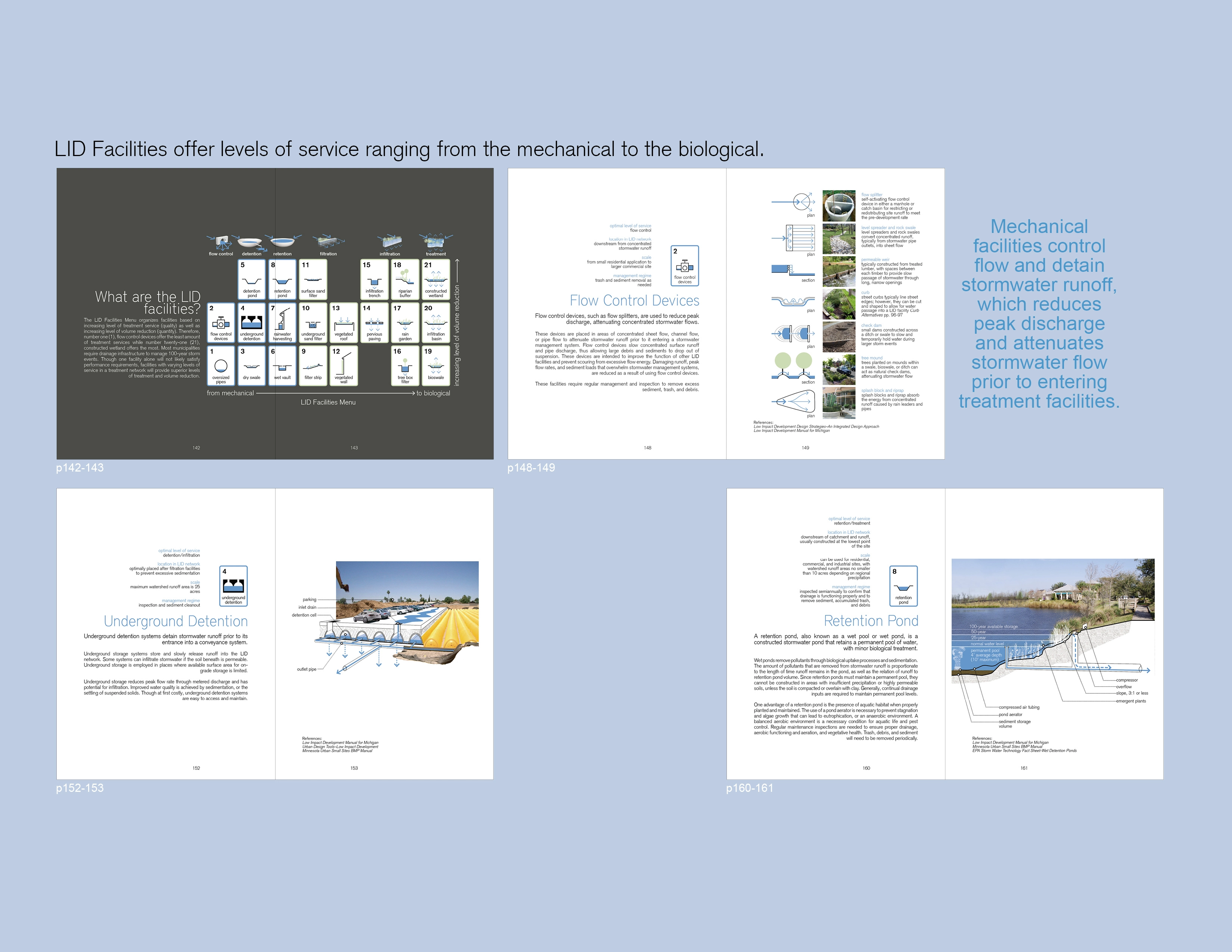
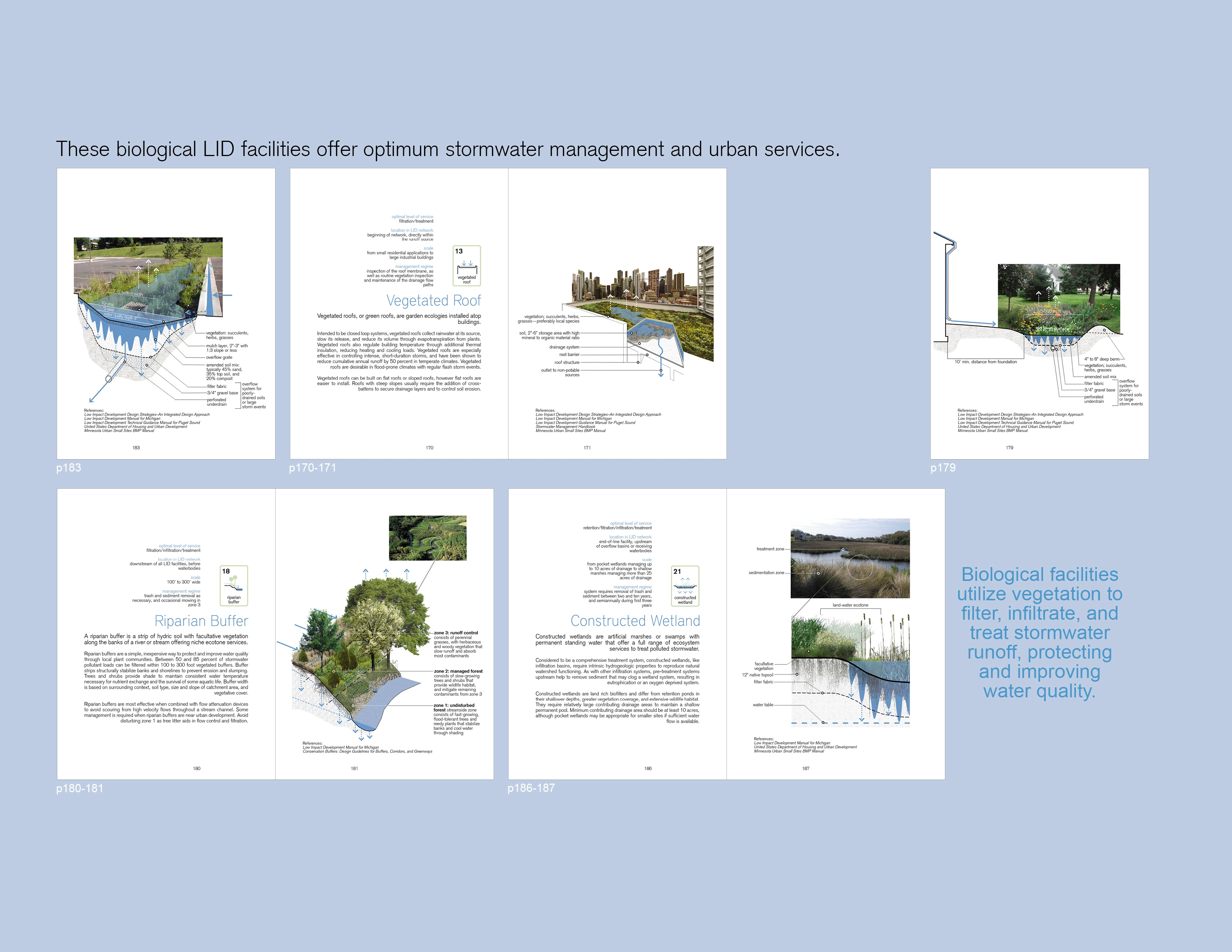
Urban elements must behave ecologically. Landscapes, cities, and buildings will be tasked with delivering ecological services that enhance environmental capital, including key services from ecologically-based stormwater management: flood control, clean water supply, erosion control, soil formation, nutrient cycling, waste treatment, refugia (habitat), carbon sequestration, and disturbance regulation. The current shortcoming in LID is that BMPs (Best Management Practices) are deployed as isolated lot-based facilities focused more on engineering than planning and the delivery of comprehensive ecological services. The manual is the first to devise a comprehensive LID design vocabulary through the six stormwater management technologies: flow control, detention, retention, filtration, infiltration, and treatment. Another innovation is our trademarked LID Facilities Menu of the 21 assemblages, organized from mechanical to biological functioning, and based on increasing level of treatment service (quality) as well as level of volume reduction service (quantity). These facilities are the building blocks of a distributed treatment network that can be retrofitted within urban context.
Impact and Effectiveness
Research, policy and design for the manual combined expertise in urban planning, architecture, landscape architecture, civil engineering, ecological engineering, and landscape architecture. The project design team, working with state agencies and citizen groups over a two year period on city codes and best practices development, developed a LID pattern language that reflected the Watershed Approach. The holistic approach illustrated in the manual is now advocated across several agencies, including two Arkansas state agencies in urban forestry and natural resource conservation, and the six environmental activist nonprofits in Missouri, Oklahoma, and Arkansas who funded publication and regional distribution of 2,000 book copies.
Distribution Method
The manual is available through website purchase from the authoring agency, as well as Barnes & Noble Bookseller website and select commercial bookstores nationally (including the AIA Bookstore). The book is currently being considered for national distribution by Greenleaf Book Group LLC, an independent book distributor.
Circulation/Distribution
2,400 copies have been sold since August 2010, including large blocs for sponsoring environmental interest groups.
-
University of Arkansas Community Design Center (UACDC)
Stephen Luoni, Director, Steven L. Anderson Chair in Architecture and Urban Studies
Jeffrey Huber, AIA, Affiliate ASLA, LEED AP, Project Designer
Cory A. Amos, Project Designer
Katie Breshears, AIA, LEED AP, Project Designer
Cade Jacobs, Project Designer
Stephen M. Reyenga, Project Designer
Linda Komlos, Administrative Specialist
Deborah Guzman, Student Intern
Becky Roark, Student InternUniversity of Arkansas Ecological Engineering Group
Dr. Marty Matlock, PE
Sarah Lewis, Graduate Associate
Rusty Tate, Graduate Associate
Zara Clayton-Niederman, Research AssociateFay Jones School of Architecture
Jeff Shannon, AIA, DeanManual Reviewers
Bobby Hernandez, USEPA Region Six
Dr. Carl Smith, CMLI, UA Department of Landscape Architecture
Christopher Suneson, RSLA, ASLA, APA, LEED AP
Katie Teague, UA Agricultural Extension ServicesManual Sponsors
Funding was made available in part by the Arkansas Natural Resources Commission (ANRC) through a grant from the United States Environmental Protection Agency (USEPA) Region 6
Section 319(h).
Publication was made possible by generous support from:
Arkansas Forestry Commission’s Urban Forestry Program and US Forest Service
Beaver Water District
Community Foundation of the Ozarks and Stewardship Ozarks Initiative
Ozarks Water Watch with Upper White River Basin Foundation
National Center for Appropriate Technology Southeast Field Office: Fayetteville, Arkansas
US Green Building Council Western Branch Arkansas Chapter: Northwest Arkansas
Illinois River Watershed Partnership
Advertisement
Related Awards

Honor Award, Communications
Growing Impact: Advancing Knowledge of Urban Desert Tree Care
The objective of this project is to create a knowledge hub for public education and engagement on tree care and maintenance to increase urban forestry benefits in desert cities of southern Arizona. From 2023-2026, the team has engaged practitioners, government agencies, and the public through workshops, public lectures, and hands-on training on young tree care, smart watering systems, and pruning techniques.