

.webp?language=en-US)

.webp?language=en-US)


To Design for Biodiversity, Understand the Reference Ecosystem
When designing landscapes to increase biodiversity, it's important to refer to local, native “proxy” habitats as models. This is called the reference ecosystem design approach.
In an online discussion organized by the ASLA Climate & Biodiversity Action Committee, Chris Cosma, PhD, ecologist with the Conservation Biology Institute, explained the approach is meant to restore the complexity of ecological networks.
"The more complex an ecological network is the more stable and resilient it is," he said. Ecological networks describe the many interactions between entire communities of species in a habitat.
Restoring the nodes of ecological networks is vital work. Nodes are the components of an ecosystem and can include a single species or group of species, or a patch of habitat. With increased development, climate change, agricultural expansion, and habitat fragmentation, "we have been erasing nodes from networks." This has led to a global decline in insects, birds, and a range of other species.
In the U.S. alone, there is now 40 million acres of turf grass lawns, which is larger than the state of Colorado. The chemicals used to maintain those lawns help to create ecological wastelands. "We instead need to design diverse, healthy habitats that turn ecological nodes back on."
"Landscape architects have a key role to play here." If they use at least 70 percent native plants and the plant communities from analogous reference ecosystems in their designs, there will be real biodiversity benefits. Designing for host plant specialists, native insects that rely on particular plants, particularly enhances the nodes.
Landscapes need to include keystone species, which support the stability of ecosystems. The identity of the keystone species changes depending on the eco-region.
"Overall, diversity is key: plant species diversity; structural diversity -- providing plants of different sizes and heights to support insect life cycles; and phenological diversity, or diversity in bloom times, which ensures that something is blooming at all times of the year," Cosma explained.
In addition to designing with reference ecosystems, including native plants and keystone species, and a range of diversity, landscape architects can also implement a few best practices:
- Avoid pesticides
- Reduce unnecessary light
- Limit intense maintenance
- Leave leaf litter, branches, etc
Cosma said designing with a reference ecosystem approach, and understanding and restoring existing ecological networks, improves other ecosystem services, including air and water quality, carbon sequestration, and health and well-being.
For ecosystem restoration to work, landscape architects need to study the underlying ecosystems, the reference points they are trying to model, explained John Hart Asher, principal and senior environmental designer, Blackland Collaborative.
Asher focuses on grasslands -- prairie ecosystems -- that range from Mexico to Canada. "There are grasses all over the U.S. that are formed by biotic and abiotic conditions."
For example, he explained how the Rocky Mountains forms a "rain shadow," creating wet and dry areas. The middle swath of the U.S. is also prone to drought. These factors make it challenging for woody species to grow in places. But prairies have evolved to take advantage of those conditions, developing root systems that can go up to 17-20 feet deep, enabling them to weather droughts.
Wildfires, prairie dogs, and bison also create "random instances of disturbance" that help maintain the grass ecosystems. Prairie dogs prevent the growth of trees -- they cut them down so they can better see predators -- and wildfires also remove trees.
As wildfires were increasingly controlled and bison nearly eradicated, there was a significant loss of prairie ecosystems across the U.S. Asher said "we now need to become the bison" -- the disturbance these ecosystems need to thrive.
At the George W. Bush Presidential Center in Dallas, Texas, Asher's team worked with landscape architecture firm Michael Van Valkenburgh Associates to develop the 15-acre Native Texas Park, designing native Blackland shortgrass prairie, Post Oak Savannah, and Cross Timbers Forest areas modeled on native ecosystems of the region. The library notes that today Blackland prairie occupies just 1 percent of its historic range in Texas.
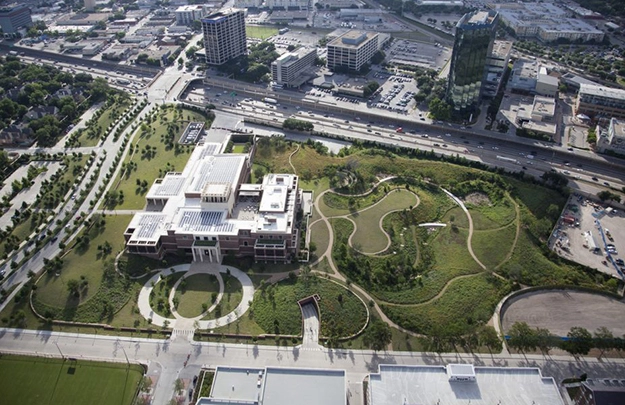
In these challenging urban conditions, modeling these landscapes meant creating a new water management system, including swales, irrigation systems, and cisterns. Mrs. Bush wanted a "big prairie bloom" every year, so the water system was key to supporting that.
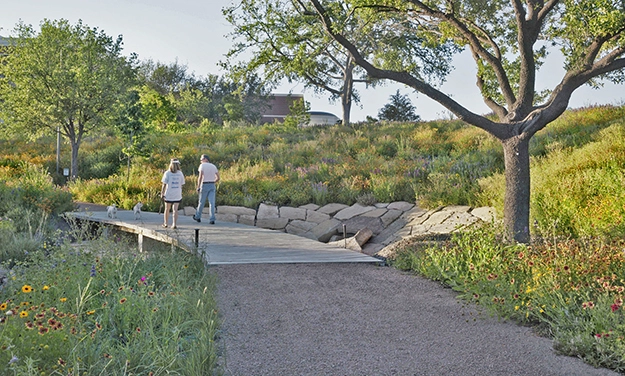
The Bush library landscape has evolved over time. When working with prairies and other ecosystems, "it's important to embrace change," Asher said. Native volunteer species are a sign of success. "Restoration is a trajectory, not an intervention."
At the landscape architecture, architecture, and urban planning firm Sasaki, Kelly Farrell, ASLA, a landscape designer and ecologist, uses a "template habitat approach." She said projects of all sizes in urban, suburban, and rural areas are opportunities for biodiversity. Even "little projects can make a difference."
Landscapes are highly variable. They can have different elevations, hydrology, slopes, aspects, geology, and soil conditions. They have different histories and ecological disturbances. So, given all the diversity, how do you choose a template habitat?
Farrell said it's important to look for analogous reference sites, whether they are coastal, urban, and have water or not. First, "work with the soils you have." Another guiding principle: "Choose the right plant for the right place."
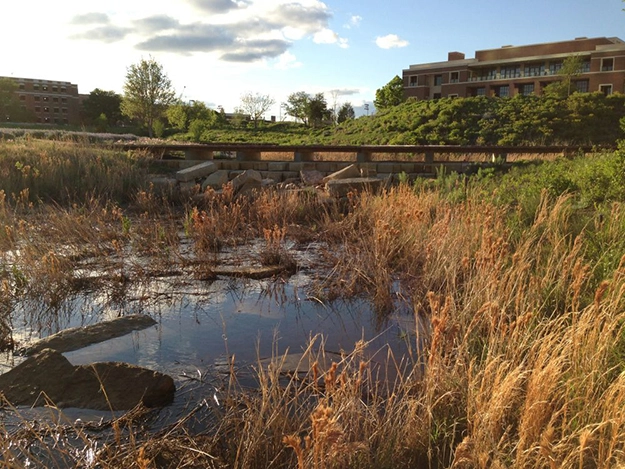
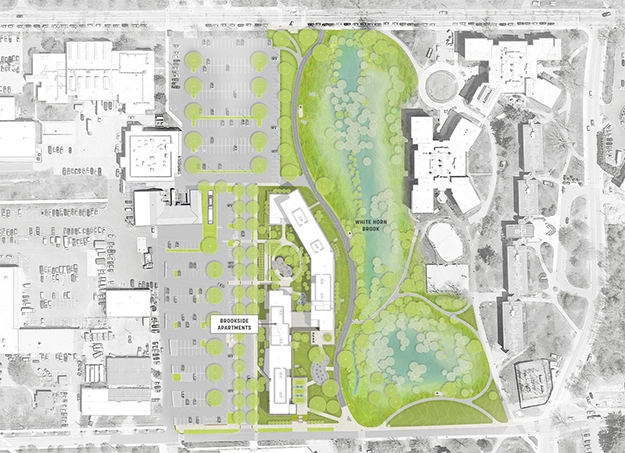
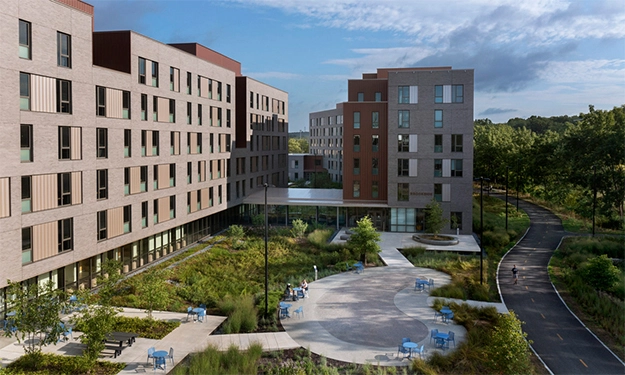
For a new campus building and landscape project at the University of Rhode Island, Sasaki found a stream impacted with invasive plants. To design a new landscape around a restored brook, they used a swamp area a few miles away as a reference ecosystem, planting the same species in the campus wetland.
Farrell added that it's important to use native plants but also local genotypes as much as possible. These are plants with genetic traits adapted to specific areas. "More genes, more resilience."
"No space is too small to make an impact," she reiterated.