



Redesigning Cities as Habitat: How We Can Live in Harmony with Nature
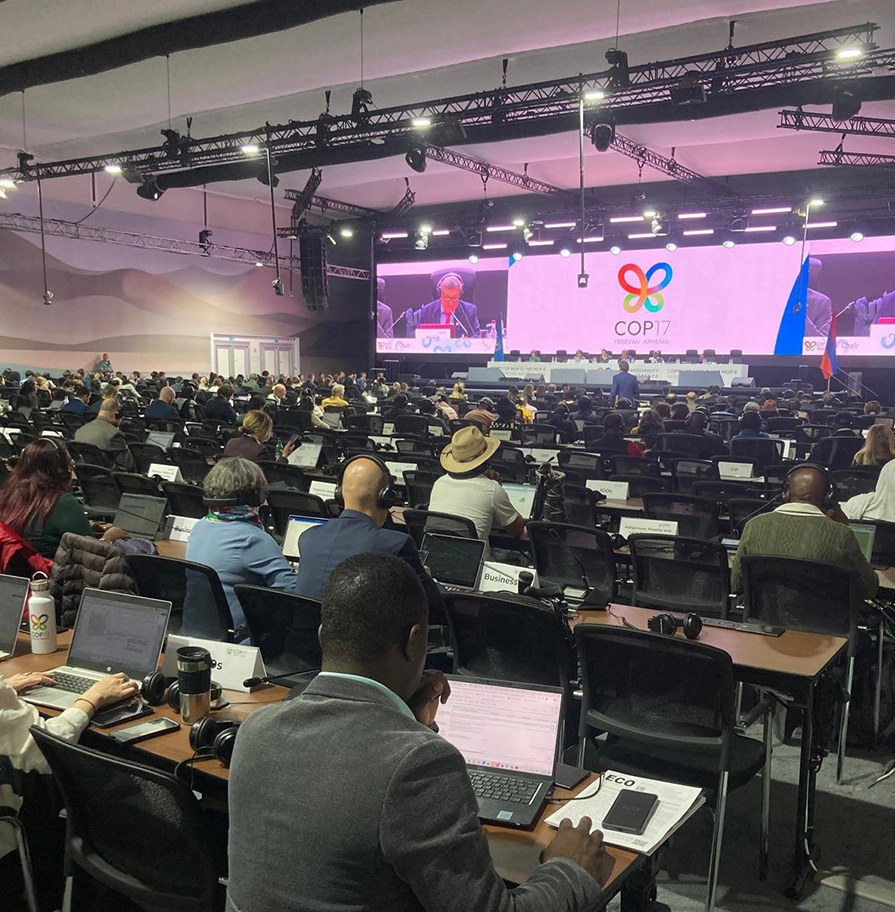 Opening plenary of UN Convention of Biological Diversity COP17, Yerevan, Armenia / MaFe Gonzalez
I’m writing these reflections from California. I’m still jet-lagged, and my mind is racing with everything I learned and experienced in Yerevan, Armenia at the UN Convention on Biological Diversity. I wake up at 2 am to the sound of the rain and remember a phrase I heard at COP17: “The rain is a gift from above.” And I wonder: At what point did we forget that? At what point did the rain go from being a gift to a burden that must leave the city as soon as its drops touch the impermeable surfaces with which we’ve covered the ground? At what point did we forget the sacred and fundamental connections of life: with the water, the Earth, the air, biodiversity, and ourselves?
COP17 led me to some uncomfortable reflections. It made me reflect on the loss of biodiversity and above all on what lies behind it: the overexploitation of ecosystems and peoples, the overconsumption, the economic greed, the historical debts that the Global North owes to the Global South, the assassinations of social and environmental leaders, the displacement of local and Indigenous communities, the injustices, the concentration of power, and the lack of political will.
Sometimes I think maybe nothing can change but then I cling tightly to the idea that perhaps everything can change. So I embrace the many opportunities and responsibilities we have as civil society and landscape architects. And I recharge myself with hope and determination, thinking that as long as there is a single wildflower left on this planet, every effort to protect and restore biodiversity is worthwhile.
To my surprise, little was said at COP17 about the role of cities, even though nearly 60 percent of the world’s population lives in them, they consume more than 75 percent of global material resources, and they produce around 70 percent of global greenhouse gas emissions.
Current forms of urbanization are a major threat to biodiversity. We have designed cities to exclude biodiversity by paving over natural habitats, burying ecological connectivity corridors, replacing native species with ornamental ones, disrupting water cycles, and so on.
So for our delegation, COP17 was an opportunity to highlight the immense potential landscape architects and allied professions have to:
- Design cities as habitats and refuges for biodiversity
- Implement local solutions aligned with the regional context
- Become better partners in meeting the goals of the Kunming-Montreal Global Biodiversity Framework
To meet the biodiversity targets, we need to protect and restore natural areas, increase sustainable production and consumption approaches, and reconnect people with the natural world. Cities are key to achieving all of this.
Here are some actions we can all take at different scales to better support nature in cities and contribute to the Convention on Biological Diversity’s overall vision of living in harmony with nature by 2050:
Local Level
Landscape architects and allied planning and design professions are already doing a lot at this scale, but we could do much more to conserve and restore urban biodiversity site by site, applying the tools we already have: Landscape Architecture 2040: ASLA Climate & Biodiversity Action Plan and the Biodiversity Primer for Landscape Architects.
We could unleash the profession’s great capabilities — its multidisciplinary nature, its ability to conduct multi-scale analysis, and its community engagement skills — to:
- Design diverse urban ecosystems
- Unlock citizens’ roles as stewards and caretakers of biodiversity
- Support governance and land rights for local communities, Indigenous peoples, women, and youth
- And educate ourselves and civil society about ecological responsibility
Our designs can restore what we have degraded, apply co-design strategies with local communities, and honor eons of evolution and millennia-old relationships between Indigenous people and their territories.
Our outcomes could be different ways of relating to nature.
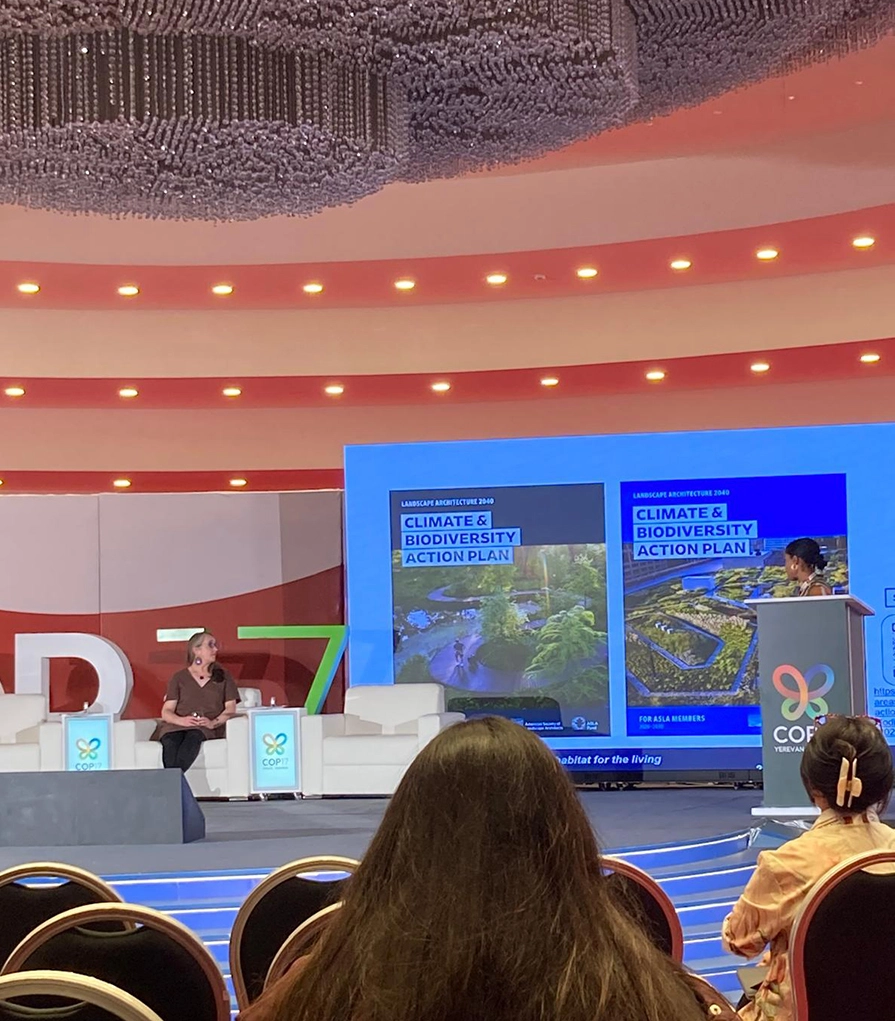
"Refuge by Design" Green Zone session at COP17, co-hosted by ASLA, IFLA, and U.S. Green Building Council / MaFe Gonzalez
National Level
Among the new resources shared at COP17, I chose two guidelines that could greatly inform all of our roles in urban biodiversity conservation and restoration at the national level:
Rights of Nature (RoN): A press conference entitled "A Voice for Nature" was held during COP17 to launch two new global coalitions dedicated to advancing this movement:
The For Nature Coalition of States: formed to advance international diplomatic dialogue and cooperation among governments toward recognizing the RoN within legal frameworks.
The Civil Society Coalition for a United Nations Universal Declaration of the RoN: created by civil society groups, Indigenous representatives, and conservation leaders to push for a global UN declaration.
The RoN adoption could profoundly transform the work of built environment professions, helping us to move from an anthropocentric to an ecocentric approach to landscape architecture, urban design, planning, and architecture, recognizing the intrinsic value of nature and nature’s guardians and caretakers. 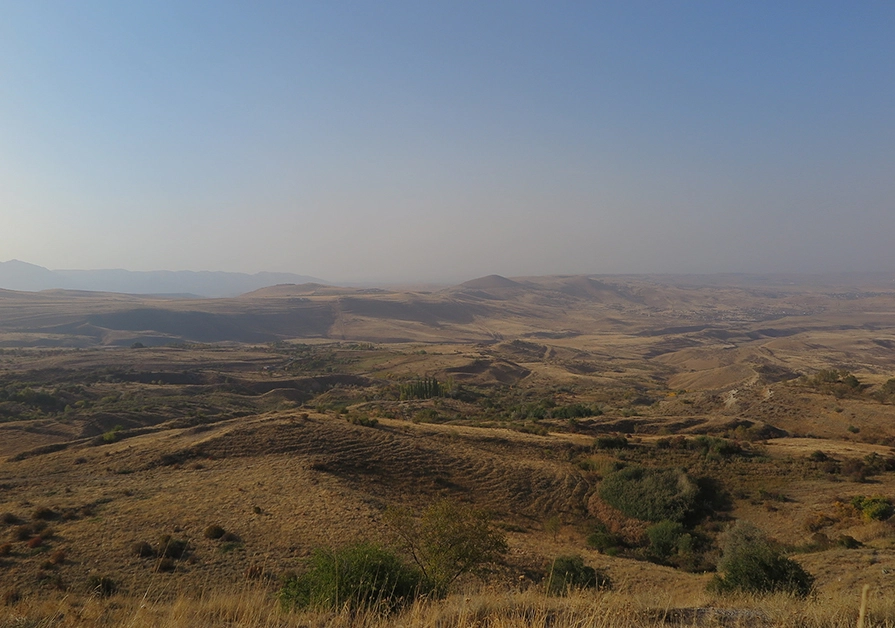
Countryside around Yerevan, Armenia / MaFe Gonzalez
Built environment organizations could join the Civil Society Coalition and include the fulfillment of these rights as outcomes of our designs. RoN is an approach that ASLA has already begun to explore in discussions and webinars.
Nature Relationship Index (NRI): The UN provided a preview of the 2026 Human Development Report, which will feature a new Nature Relationship Index. The new index is a strategy to rethinking human development for a nature-positive future. I am aware this is one more metric. However, I am glad to see the word “relationship” in it.
Most of the indicators for this new index are in the realm of landscape architecture:
1) Nature is accessible
2) Nature is used with respect
3) Nature is safeguarded
This index highlights the current development blind spot – frameworks that bypass nature –and acknowledges the need for new concepts for people and nature to thrive together. This index would also help us to redirect our collective efforts towards equity and justice for people and nature.
Global Level
As STEM professionals working primarily in cities, I think it would be essential for landscape architects to contribute more to the International Union for Conservation of Nature (IUCN) and the Society for Ecological Restoration (SER), supporting increased work on urban biodiversity.
Working with ecologists, biologists, planners, and other disciplines, landscape architects have a key role to play in healing cities, the land that we have impacted the most, and finding ways to restore ecosystems and the relationships between land and peoples.
Cities are only mentioned in the Kunming-Global Biodiversity Framework Target 12, but they are critical for shifting from an extractive to a regenerative mindset. In urban areas, we can re-learn how to relate to and care for nature again. 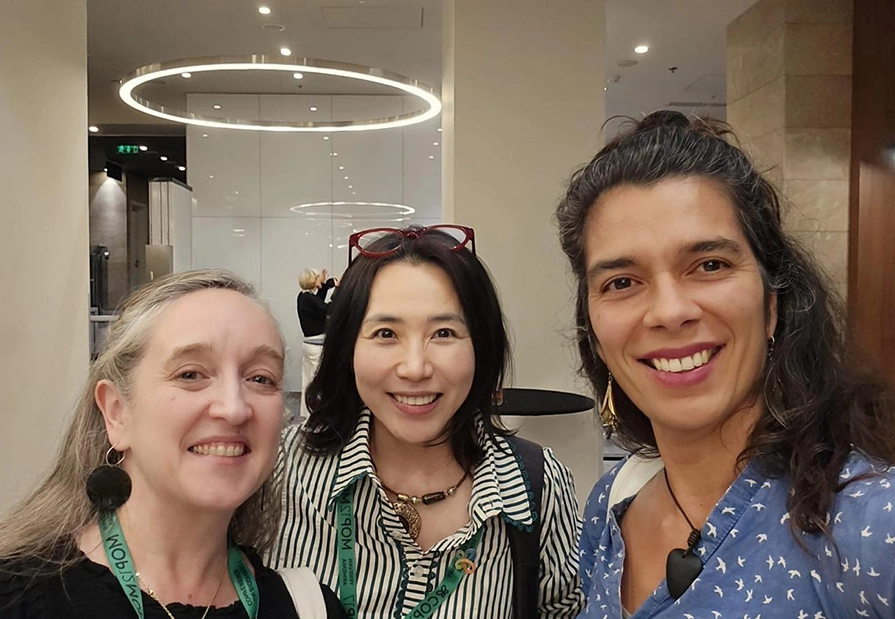
ASLA and IFLA delegates at COP17 in Yerevan, Armenia. Left to right: Jennifer Dowdell, FASLA (ASLA representative); Dr. Sohyun Park, ASLA (IFLA representative); MaFe Gonzalez, ASLA (ASLA representative) / MaFe Gonzalez