

.webp?language=en-US)

.webp?language=en-US)
How Developers Value Landscape Architecture (Part I)
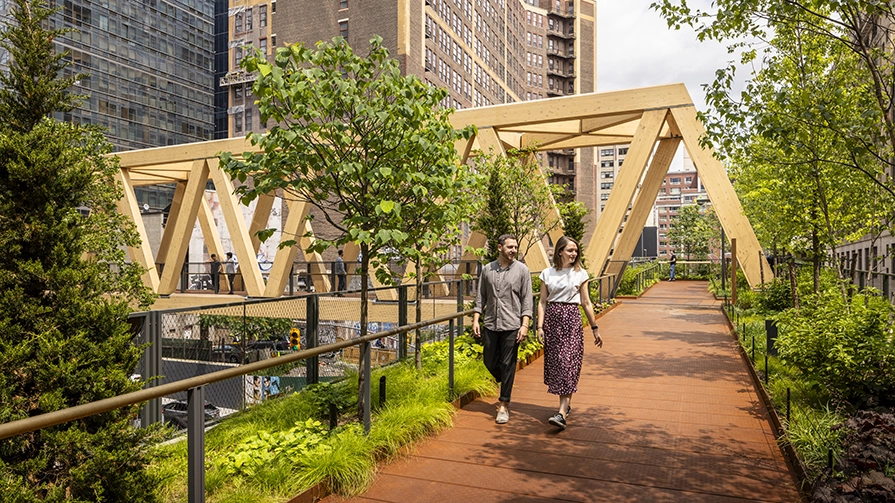
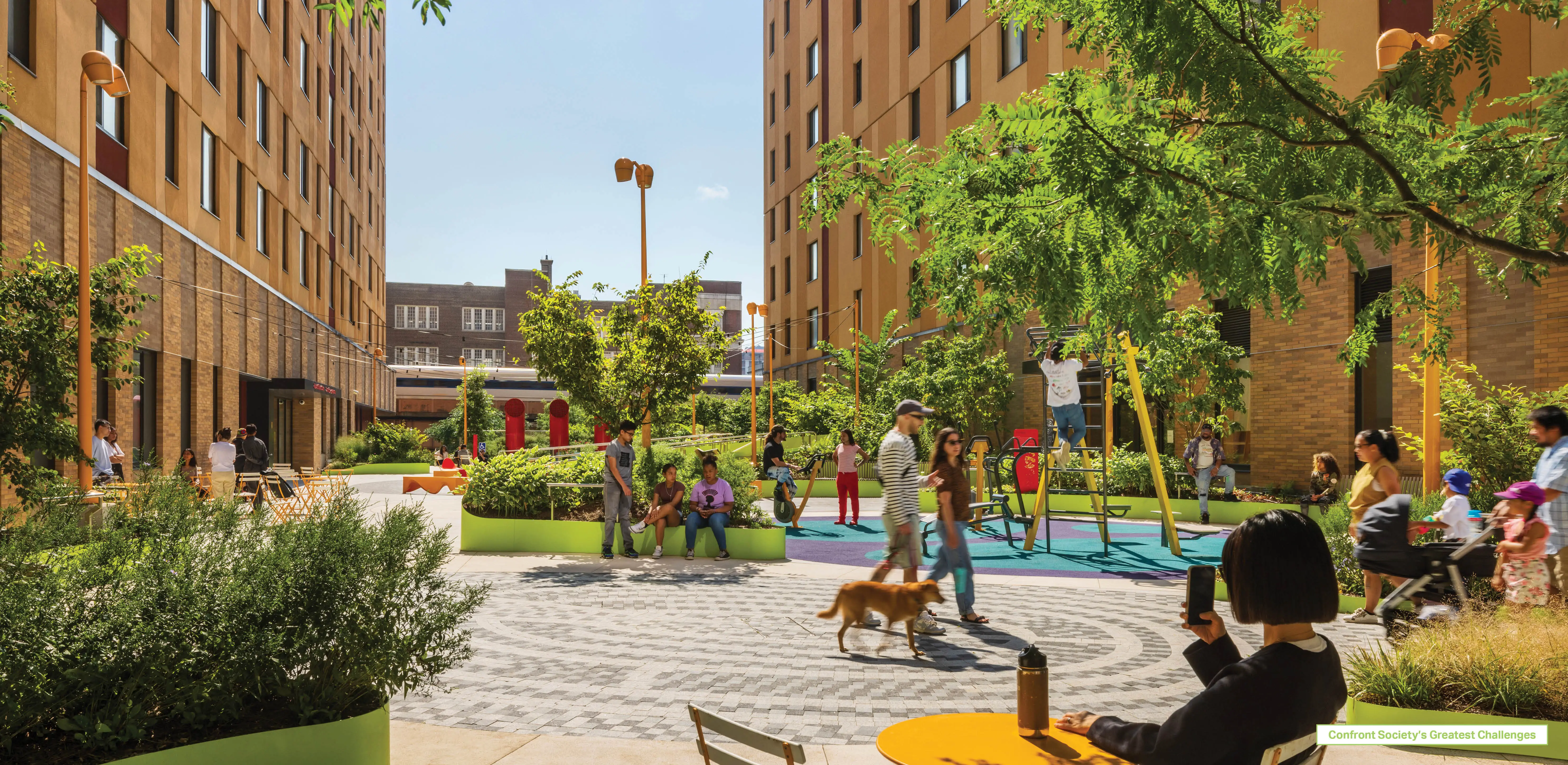
High Line – Moynihan Connector, New York, New York / Andrew Frasz, courtesy of the High Line
By Jared Green
Private developers can champion landscape architecture projects that reduce greenhouse gas emissions and climate impacts and increase community health and livability. But not all developers have the vision to achieve integrated ecological, social, and economic benefits.
There are economic arguments that can persuade developers to plan holistically and weave parks, green streets, and green infrastructure — nature-based solutions at all scales — into new communities. Landscape architects can use these arguments to move private developers in a more sustainable, competitive direction.
In an online discussion moderated by ASLA CEO Torey Carter-Conneen, Hon. ASLA, real estate and economic development advisors from HR&A and landscape architects from Gibbs Planning and LandDesign offered effective ways to make the case to developers.
First off, “if a landscape architecture project is not financially feasible, it will not move forward,” said Jill Schmidt Bengochea, director at HR&A, a real estate and economic development consultancy. “Generally, if a project doesn't pencil, a private real estate firm won’t advance it.”
Landscape architects can make the best case for including a park, green street, or green infrastructure system in a development by “putting benefits in economic terms and demonstrating value." And the good news is that developers are increasingly receptive to parks and other green systems because “they recognize the economic upside,” Schmidt Bengochea said.
In 2024, HR&A completed a study with the Trust for Public Land that offered some proof of the economic benefits of parks and green spaces. It found cities that invest in parks experience greater population and economic growth than peers that don't.
The study focused on five case study cities – Atlanta, Georgia; Boise, Idaho; Boston, Massachusetts; Minneapolis, Minnesota; and Plano, Texas – where park investment per acre was 2-7 times higher than the average among the 100 most populous U.S. cities.
Park investment in these cities has led companies to “start or expand their businesses,” Schmidt Bengochea said. This is because “high-quality work forces locate based on quality-of-life amenities.”
“Job growth rate between 2011 and 2021 in these cities was on par or higher than the national average. And Plano, Boise, and Atlanta showed exceptionally high growth rates for startups. These trends give confidence to real estate developers that the right product will attract tenants and command rents.”
In each city, HR&A interviewed developers that built new parks as part of their development. “They included open space programs because they saw them as essential to their project's success.”
In the Seaport District of Boston, WS Development included 10 acres of privately owned and managed publicly accessible open space, planned and designed by landscape architecture firms Sasaki, Reed Hilderbrand, and Field Operations, in its 33-acre development, “meaning roughly one-third of the project was devoted to open space.”
The developer invested more than $200 million in the public realm alone. “WS credits that investment with the success of its retail, leasing, and high visitation numbers.”
In the North Loop neighborhood of Minneapolis, Heinz and Marquis Development financed a one-acre park called The Green designed by ESG Architecture & Design as part of a mixed-use development. It includes 350,000 square feet of office space, hundreds of housing units, and 10,000 square feet of store fronts.
The developers credit The Green with “decreasing lease uptime, justifying rents, and increasing renewals of leases — all factors that helped make the project feasible.”
As a result, the developer has continually invested in the park. “The Green's design, construction, and ongoing programming and management has been entirely privately funded. Since it opened in 2024, they have hosted more than 100 events per year.”
Schmidt Bengochea said developers are investing in open space because "they see it driving leasing and rents." Office developers compete to lease to top tenant firms, which in turn compete to recruit top talent. That talent “requires amenities, such as recreation space and access to the outdoors.”
For most private developers, “there's a really obvious upside to investments in nature-based solutions,” said Gail Hankin, director at HR&A. “Since the pandemic, green places have become even more important to workers; they look at where they want to live and raise their families. But they are also important to employers who are encouraging their workers to come back to the office and are thinking about how to do that effectively.” Given there are now more options with remote work, “extra green space is really making a big difference in how employers think about locational decisions and the amenities they're able to offer.”
Other quantifiable categories of value are the economic and fiscal benefits that come from investments in green spaces, Hankin explained. This can be the “significant incremental tax revenue and tourist spending” that comes from a “signature park,” like the High Line in New York City, to the “return from property values, city building, and environmental benefits” generated by a network of neighborhood parks and trails in Dallas, Texas.
Signature open spaces that are “destinations in their own right” can increase a city's profile and help increase tourist spending. That value can in turn benefit developers.
One example is near Manhattan West, a 7-million square foot mixed-use development that is part of the Hudson Yards in New York City. Brookfield, its developer, contributed significant funding for the Moynihan Connector, a timber pedestrian footbridge designed by landscape architects at Field Operations and architects and engineers at Skidmore, Owings & Merrill (SOM) that connects Manhattan West to the High Line.
“One of the explicit goals of that bridge was to get tourists from the High Line to some of the retail spaces at Manhattan West. Having those open spaces that can get people — whether those are tourists or residents or office workers — to linger in a space and bring people in can do a lot for commercial business.”
Another example is Klyde Warren Park in Dallas, Texas, a 5.5-acre park designed by OJB Landscape Architecture and funded through a public-private partnership that included a $10 million investment from developer Kelcy Warren; and $50 million in donations from developers, including Crescent Real Estate, which has properties northwest of the park, and Hunt Consolidated Properties, which has development in the Dallas Arts District near the park, and many others. “These developers have benefited from increased property values and demand from enhanced pedestrian connectivity and amenities.”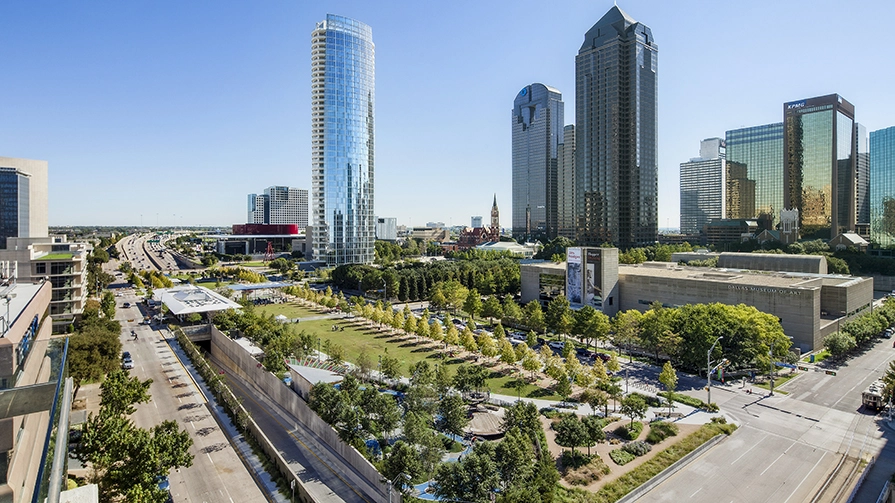
ASLA 2017 Professional General Design Award of Excellence. Klyde Warren Park - Bridging the Gap in Downtown Dallas. Dallas, Texas. OJB Landscape Architecture / Thomas McConnell
HR&A put some numbers on those benefits. “There is five-times faster growth and development near Klyde Warren Park than in the surrounding neighborhoods, 6 percent higher property values, and almost a million dollars of extra residential development value per acre in the area surrounding the park compared to other neighborhoods,” Hankin said.
There are other benefits in terms of office space performance. “Class A office space within 750 feet of Klyde Warren Park has consistently drawn higher rents and shown a more stable vacancy rate throughout the pandemic compared with the uptown neighborhood or the Central Business District.”
With increased climate impacts in the form of flooding, heatwaves, and sea level rise, climate resilience is also an emerging economic benefit that developers “might find compelling,” Hankin said.
HR&A worked with AECOM on a study of resilience projects in New York City’s Battery Park City, which are now in construction. The study found that for “each dollar invested, projects generated more than $2 in benefits.”
Climate resilience may lower insurance risks and costs in the future. “But in our experience, adjustments for an annual property risk policy for an existing building hasn't really caught up yet to the science of how these parks and nature-based solutions help protect properties.”
“Where they do show up is in longer-term investors and their lenders,” Hankin said. This may have been the case with the 5-acre Domino Park on the Brooklyn waterfront, which was designed by Field Operations and developed by Two Trees Management as part of a larger mixed-use project. It incorporates several climate resilience benefits – elevation against storm surges and flood-resilient design.
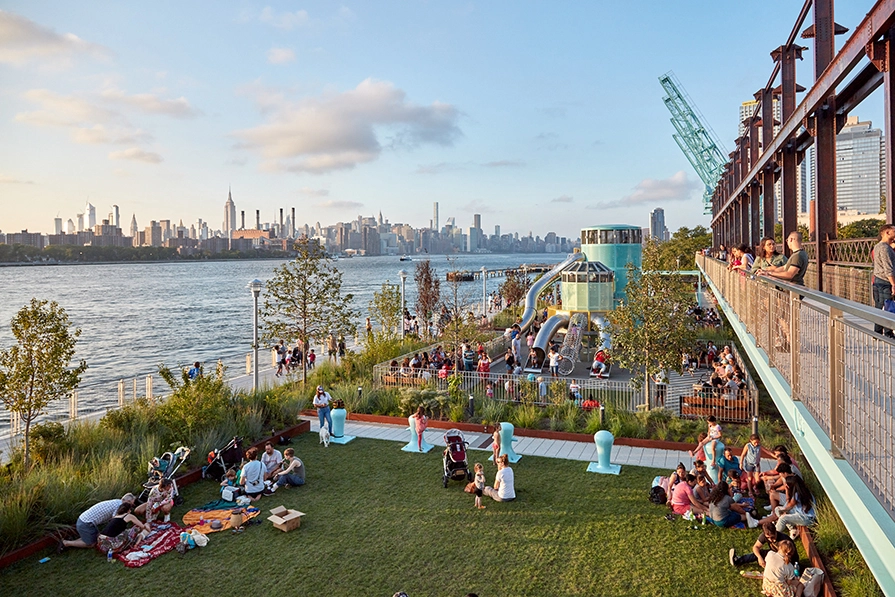
ASLA 2022 Professional General Design Honor Award. Domino Park, Brooklyn, New York. Field Operations / Daniel Levin
“Having a good design that includes resilience aspects helps with things like zoning permissions." And it can provide confidence to lenders and their lenders' insurance companies.
“These types of resilience elements will definitely come into play more and more as we are able to articulate some of these protective benefits in economic terms, like avoided property damage.”
Hankin said “private developers are most focused on real estate value and financial feasibility and the return that they can get. What's important for landscape architects to understand is that many, if not most, of these other categories of impact all affect real estate value. All of these benefits work in tandem and in service of the real estate value, improving the likelihood of financial feasibility, which motivates private developers to make these investments.”
Read part II