

.webp?language=en-US)





Insights from the 2024 ASLA Digital Technology Software Survey

In 2024, the ASLA Digital Technology Professional Practice Network (PPN) conducted a survey to better understand how landscape architects use digital tools and emerging technologies in their work. This article provides a snapshot of software adoption trends, workplace dynamics, and the growing role of artificial intelligence (AI) in practice. Over 370 respondents completed the survey.
Who Responded
More than half of respondents (52%) work at landscape architecture firms, while 27% were from multidisciplinary firms (architecture, engineering, or other multidisciplinary firms). Small firms were well represented, with 45% of respondents indicating they work at firms with fewer than 10 people.
Respondents work across diverse sectors, but parks and public space design lead the way at 76%, followed by campus/education (54%) and mixed-use development (54%).
Hardware and IT Infrastructure
An overwhelming 90% of respondents reported using PCs as their primary office computer. Firms are nearly evenly split on having dedicated IT staff, with 51% reporting dedicated IT support and 49% without.
Software in Practice
Drafting and Modeling Software
AutoCAD remains a cornerstone in the landscape architecture workflow, deemed “extremely important” by 73% of respondents. Other tools cited with less frequency include LandFX and Civil 3D, with about 23% of respondents saying they are “extremely important” to workflow. Among 3D modeling software, tools like Revit and Rhino show moderate use. Compounding the use of all BIM platforms included in the survey—Revit and Vectorworks, which together dominate the North American market—we see that about two-thirds of the respondents use either of these platforms with some consistency. BIM seems to have stepped into a more expected capability from all design offices, rather than the novelty it registered as in prior surveys.
3D Modeling Plug-ins, Add-ons, and Renderers
When it comes to 3D visualization tools, Lumion was rated “extremely important” by 22% of respondents, although 46% indicated their firms do not use the software. Enscape, another rendering tool, was considered “extremely important” by 11%, while 67% reported it is not in use at their firms. Most respondents indicated that their firms do not use many of the software options listed in this category.
2D Rendering & Visualization
Adobe Photoshop and Illustrator remain vital, with 53% and 38% of respondents respectively rating them as “extremely important.”
Among desktop publishing tools, Adobe InDesign stands out, with 58% of respondents indicating it is “extremely important” to their workflow. Most respondents noted that tools like Apple Pages and Microsoft Publisher are not used at their firms.
Geospatial & Analytical Tools
Google Earth and ArcGIS are still the most used geospatial tools, with Google Earth considered “very important” or “extremely important” by 67% of the respondents. A smaller number of respondents, about 33% combined, are experimenting with ArcGIS, ArcGIS StoryMaps, and QGIS, noting these platforms as “moderately important.”
Mobile Applications
In general, respondents are not using mobile and virtual reality with less than 5% of respondents identifying any of these applications as important.
Artificial Intelligence in Practice
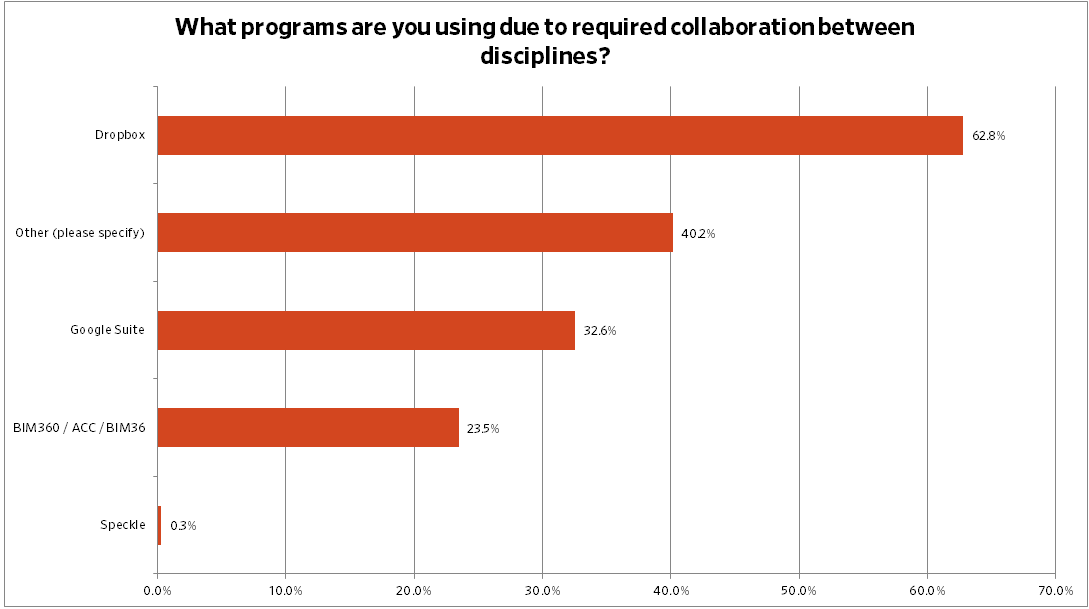
AI adoption is still in its early stages. ChatGPT leads the pack in awareness and usage, and Adobe AI and Google Gemini are not too far behind. One respondent noted, “AI is still in review at our organization,” reflecting caution. See the ASLA Digital Technology PPN AI survey results for more detailed information on AI in practice.
Other Emerging Technologies
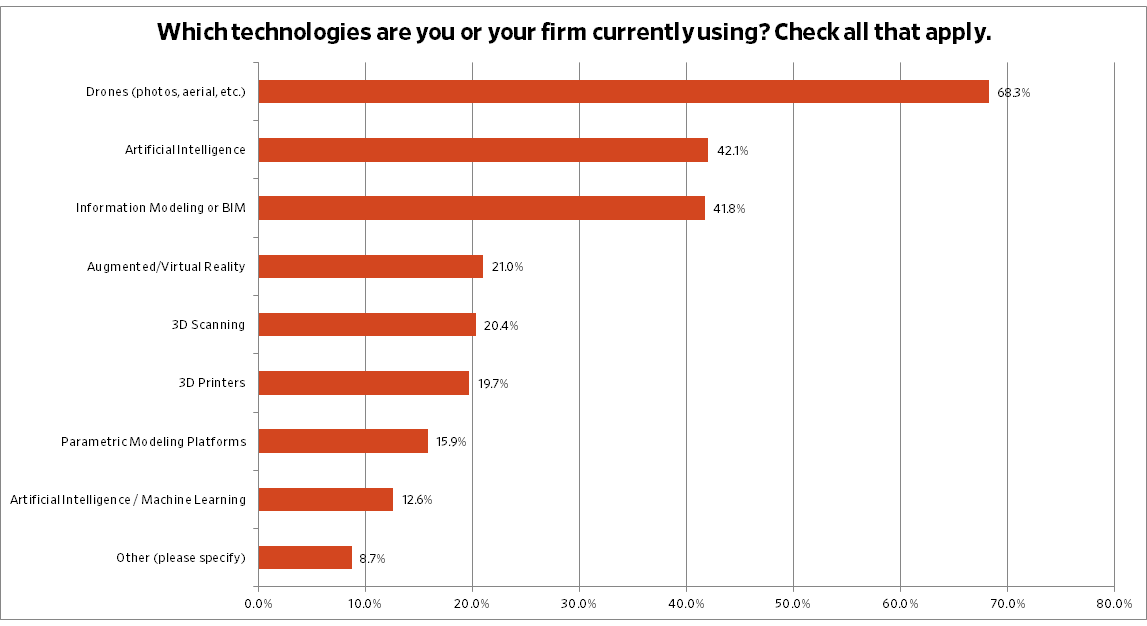
Over two-thirds of firms currently using drones in their project workflow. AI tools and Building Information Modeling (BIM) were each cited by around 40% of respondents.
Conclusion
The 2024 survey results affirm that while traditional tools like AutoCAD and Adobe Creative Suite remain central, respondents are actively exploring new technologies, particularly in the realms of AI and immersive visualization. As one respondent put it, “We’re trying to figure out what to embrace and what to wait on.”