

.webp?language=en-US)

.webp?language=en-US)


How Landscape Architects Are Incorporating Artificial Intelligence
How Landscape Architects Are Incorporating Artificial Intelligence: Insights from the 2024 ASLA Digital Technology PPN Survey
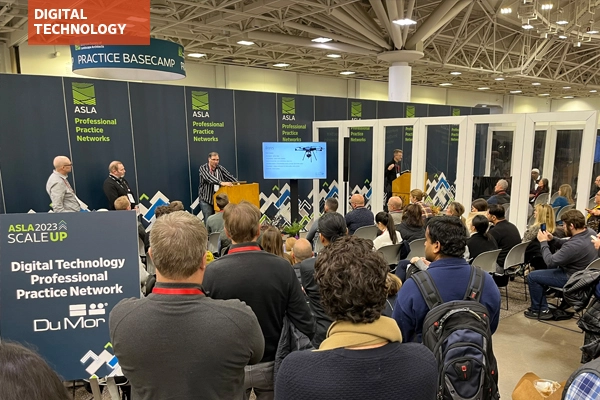
In 2024, the ASLA Digital Technology Professional Practice Network (PPN) distributed two surveys: one to learn how ASLA members are using artificial intelligence (AI) in their projects, receiving more than 300 responses, and one on software usage, with more than 350 responses. Today's post takes a look at the AI survey results; see the follow-up post about software.
Who Responded
Half of respondents (51%) work at landscape architecture firms, while others are employed by interdisciplinary design or engineering companies, government agencies, academic institutions, or in the private sector. Firms of all sizes were represented: 39% from firms with 50+ employees, 24% from 10–49, and 37% from fewer than 10.
Where They Work
Firms are active across a range of markets. The top sectors include:
- Parks, recreation, and public space (77%)
- Mixed-use development (53%)
- Campus and education (52%)
- Urban design (51%)
- Community planning and housing (44%)
- Multifamily residential (43%)
- Smaller shares reported work in infrastructure, resilience planning, historic preservation, and hospitality.
How AI is Being Used
Over half (55%) said they are using AI in practice, teaching, or research.
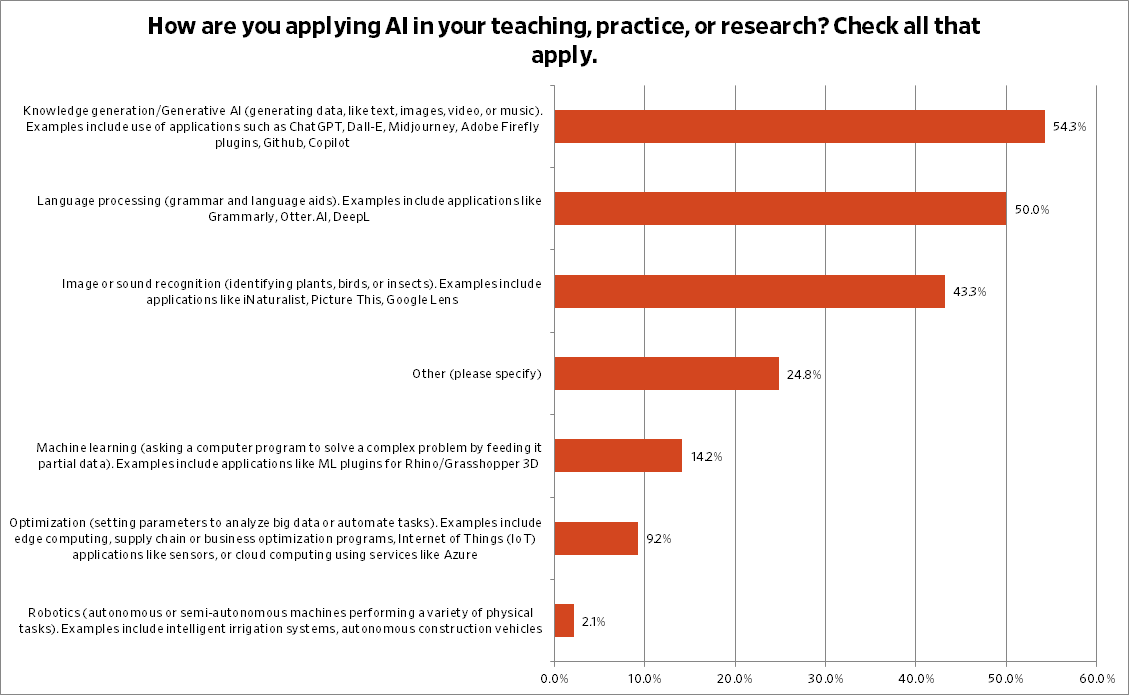
The most common applications include:
- Knowledge generation/Generative AI (e.g., ChatGPT, DALL·E, Adobe Firefly) for creating data, like text, images, video, or music (54%)
- Language processing (e.g., Grammarly, Otter.ai) for writing/editing (50%)
- Image or sound recognition apps (e.g., iNaturalist) for plant or animal ID (43%)
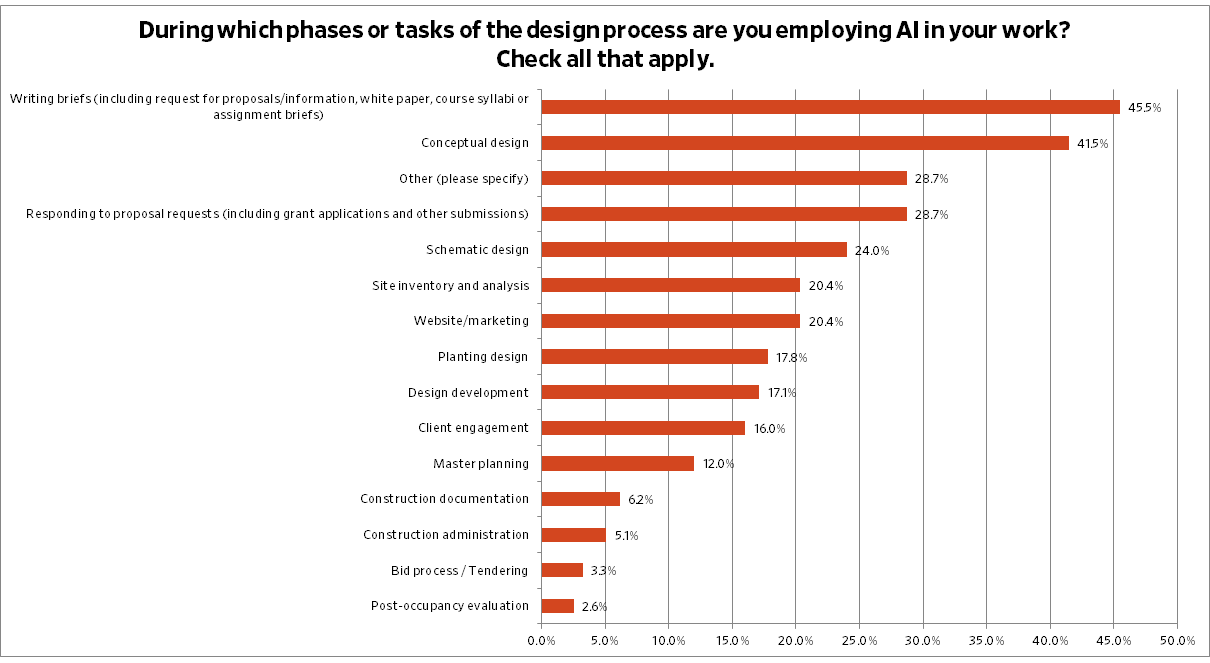
AI is primarily used in the early stages of design: writing reports (45%), conceptual design (41%), and responding to RFPs (29%).
“We use ChatGPT to help analyze/categorize large datasets with open-ended responses, particularly for community/stakeholder input.”– Survey respondent
Learning and Experimentation
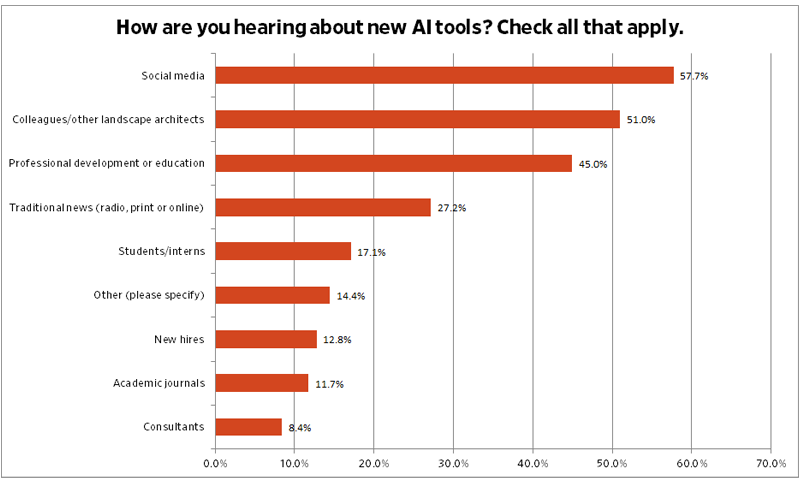
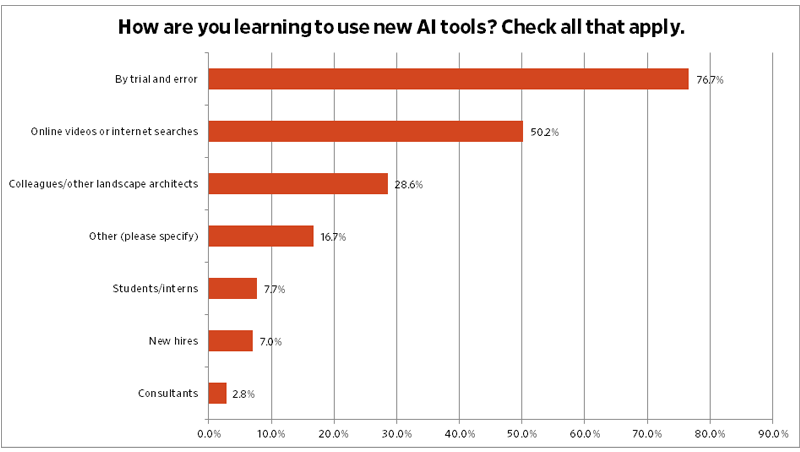
Most survey respondents are learning about AI informally—through social media, colleagues, and self-directed exploration. A large majority (77%) learn to use the tools through trial and error, while 50% use online tutorials. This suggests an opportunity for more structured learning opportunities tailored to the profession.
Impacts on Workflow
Only 27% said AI has saved them time; 48% were unsure, and 7% said it added time. Just 15% of firms allow the use of billable time to experiment with AI.
While AI use is still in the early phase for many, its role is expected to grow. Most say AI hasn’t yet impacted billable rates—and for many, that metric doesn’t apply to their role.
Disclosure and Ethics
Most respondents (56%) indicated that they do not include disclosure when AI is used in deliverables. Only 7% said their firm permits AI-generated content in stamped plans.
Looking Ahead
Many respondents (68%) anticipate that AI could help with repetitive or time-consuming tasks, like drawing plans in CAD, making plant lists, or fixing drawings when base plans change. Respondents also anticipate that AI could handle technical work, such as grading analysis or checking that designs follow code (63%) in the future.
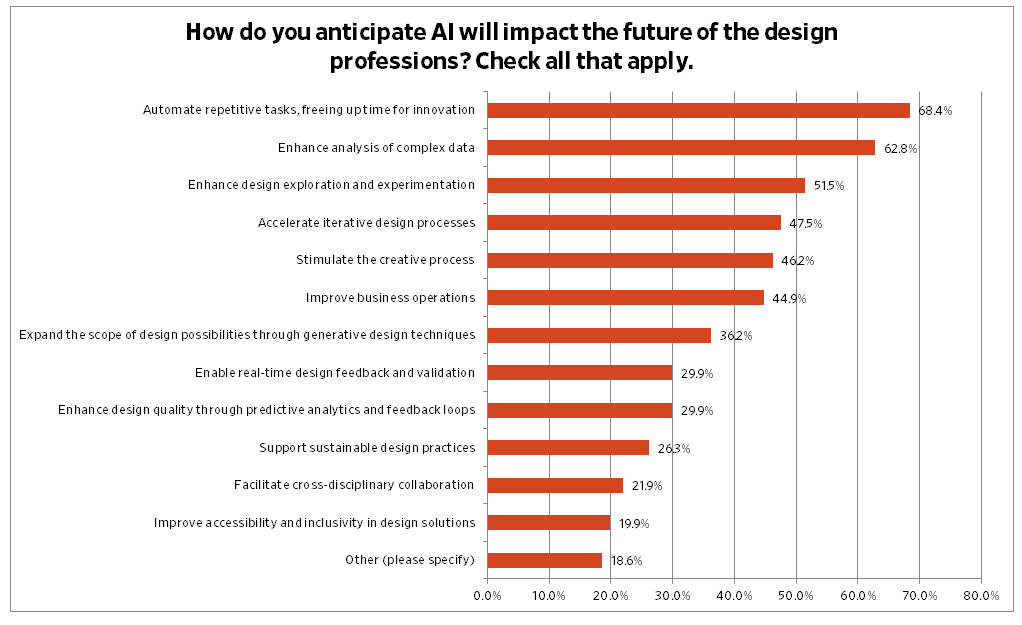
Respondents also anticipate AI will assist with creative tasks such as generating better renderings, exploring design ideas faster, or making visuals easier to share with clients (52%).
Still, respondents have reservations about AI. Some indicated that they don’t want AI involved in the design process at all. The biggest reservations are diminished human connection with design and uncertainty. They prefer AI to stay in the background, helping with small tasks while people stay in charge of the real design work.
Overall, the responses suggest that people want AI to make their jobs easier but not replace them. They see its value in support work, but they also want to protect the creative and human side of design.
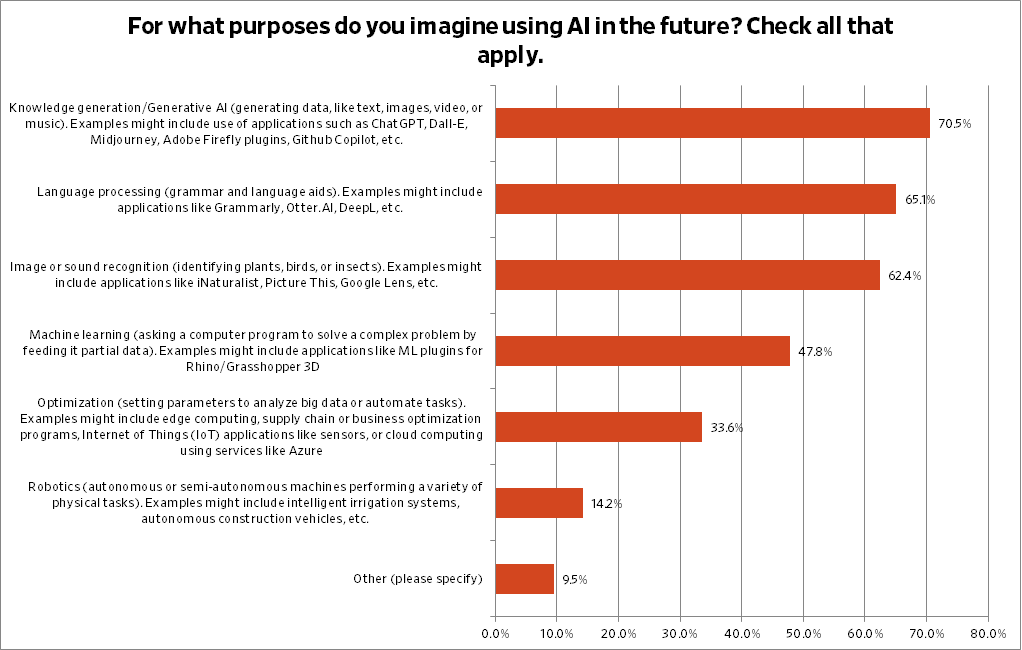
Almost half (49%) of respondents said they plan to use AI in the following year, with an additional 21% saying they will use it in the next five years. Looking to the future, respondents hope for more support, including:
- Web-based tutorials by academics, practitioners, and industry leaders (72%)
- Building bridges between academics and practitioners (52%)
- International AI working group, including practitioners, educators, researchers, and students (42%)
Final Thoughts
This survey reflects a profession that’s curious, cautious, and beginning to experiment. Landscape architects are actively exploring where AI fits in their workflows—and how it can be used ethically and creatively. As technology evolves, so will the profession’s role in shaping how AI supports design that serves people, place, and planet.
On July 16, ASLA presented the webinar Artificial Intelligence: It’s in Your Firm (Whether You Know It or Not) - 1.0 PDH (LA CES/non-HSW). The session explored how AI is already shaping daily practice in design firms often without practitioners realizing it. Topics included practical applications, risk and liability considerations, privacy concerns, and strategies for managing AI use both internally and externally. The webinar is available on-demand through ASLA’s Online Learning library, along with other AI-focused sessions, including SKILL | ED: Exploring AI's Impact on Landscape Architecture.