

.webp?language=en-US)


by Paul Reed, CID
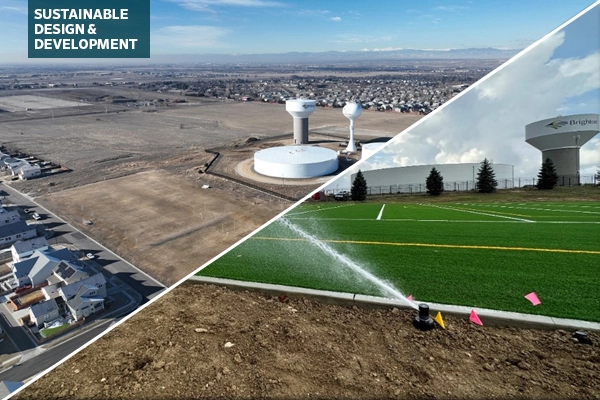
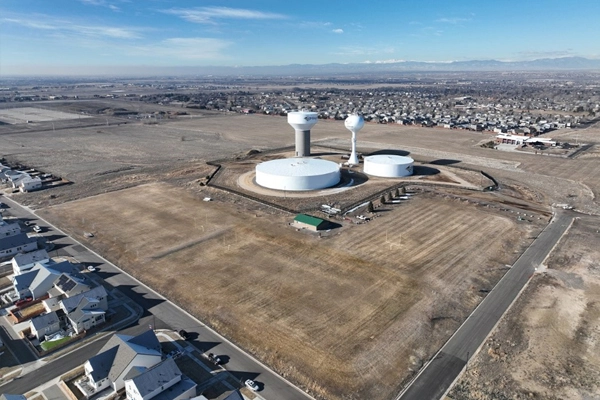
Welcome to Brighton, CO, a medium-sized city in the Denver Metro. With a rich history that dates to 1887, Brighton is growing because it offers all the amenities that young families could ask for. Parks, recreation, and open space trails routinely get the most support from the community, and to keep up with growth, Brighton is tasked with expanding their recreational offerings, which means providing multi-use sports fields wherever they can fit one. This also means the City’s annual water use is on the rise. While the benefits of natural grass are well known, there are several advantages to artificial turf—advantages that tipped the scale in its favor when the City renovated Water Tower Park.
Originally built in 2009, the land was given to the City as a part of the parks and open space dedication for the adjacent development. Water Tower Park was converted from natural grass to artificial turf in late-2023 with the goal of providing the City’s residents with multiple benefits such as:
Increased programming opportunities – Natural grass on the Front Range of Colorado can offer 7-8 months of programming. Water Tower Park’s new artificial turf fields will now support the community’s recreational needs all year long. The increased programming allows for a wider range of activities, tournaments, community gatherings, and other outdoor events, fostering community engagement and active lifestyles.
Long-term water savings – The City was using an average of 2.7 million gallons of water each year on the park’s fields. By converting 4.2 acres of grass, the City is expecting to save an estimated 1.85 million gallons per year. Colorado's semi-arid climate presents a constant challenge in managing water resources effectively. By replacing natural grass fields with artificial turf, Western-US communities can conserve water resources and reduce their dependence on dwindling water supplies.
More reliable playing surface – With hot summers and cold winters, Colorado’s climate poses additional challenges for maintaining natural grass fields. The extreme temperature fluctuations, combined with heavy usage, can lead to rapid wear and tear. Artificial turf, designed to withstand such conditions, offers increased durability and longevity. This durability translates into reduced maintenance costs and longer-lasting fields that can support the intensifying needs of the surrounding community.
Additional design considerations:
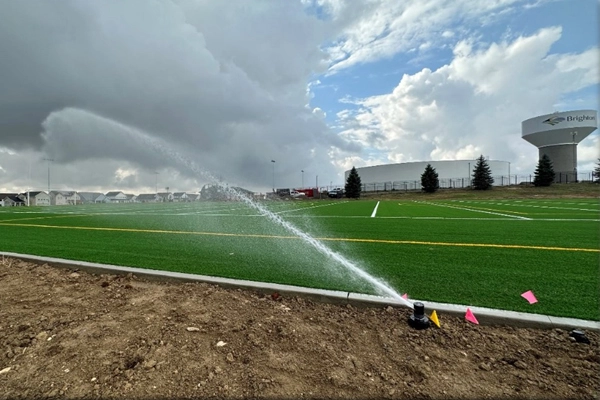
One of the most common design questions is whether or not artificial turf fields still need irrigation systems. While it doesn’t need your typical irrigation system, depending on the site’s location and climate, an artificial turf field may be served best with a cool-down system. The cool-down system must be paired with an absorbent infill material (ballast) such as hemp or cork which will release the water more slowly over time. This practice can have the reverse effect on more traditional artificial turf installations that use rubber infill because it increases humidity and can make the field feel even hotter.
Briefly irrigating turf fields is also good practice as it will flush the multitude of bio-liquids, organics, and other contaminants left behind. While some regions can count on mother nature to help flush fields, states like Arizona, Nevada, and Colorado cannot. With average precipitation less than a third of that of eastern states, Colorado must add cool-down irrigation systems to balance-out the decision to invest in artificial turf. Luckily, the irrigation industry has been supporting artificial turf for decades, and several manufacturers provide heads that can throw water well over 100’, a distance allowing irrigation designers to position the heads on the perimeter of the fields. With perimeter-only irrigation, the quantity of heads and linear feet of pipe is substantially reduced, aligning with the long-term cost-savings proposition offered by artificial turf.
Something to keep in mind when specifying the large radius cannons to be used on these types of projects is the installation of a “Coach’s Switch” to turn on and off the cool down system ONLY when safe to do so. These heads emit large amounts of water at high pressures that can injure the unsuspecting athlete. These systems should NOT run on automatic timers but must only be triggered on and off when a responsible party is monitoring the field to ensure no users could be injured while in operation.
As Brighton becomes a leader in turf conversion, other municipalities will weigh the pros and cons of natural grass vs. artificial turf. Large, established cities will likely choose to keep most of their current grass fields—nothing can replace that iconic experience. But for growing communities with limited staffing and maintenance budgets and increasing needs for recreation, artificial turf can be the sustainable solution they need.
See the ASLA Climate Action Plan and Climate Action Field Guide for more on ASLA’s goals for wise water management and designing with water, including recommendations to:
- Capture, use, and/or harvest all available stormwater and gray water.
- Account for increased water scarcity through landscape-scale catchment, aquifer replenishment, passive irrigation, and nature-based water systems management.
- Irrigation should be avoided or minimized to the greatest extent possible as moving water requires energy. (See SITES Prerequisite 3.1 Manage precipitation on site; Credit 3.3 Manage precipitation beyond baseline.)
Paul Reed, CID, is an irrigation designer at Kimley-Horn. Paul is an ASIC Professional member that specializes in irrigation design. His experience includes field work, cultural practice, installation, and water management. Paul has managed golf courses, municipal parks teams, and has worked in irrigation manufacturing. He is passionate about overcoming the industry’s biggest challenge: assuring that supervisors and technicians are provided the training required to implement and manage water-conserving landscapes.