

.webp?language=en-US)

.webp?language=en-US)

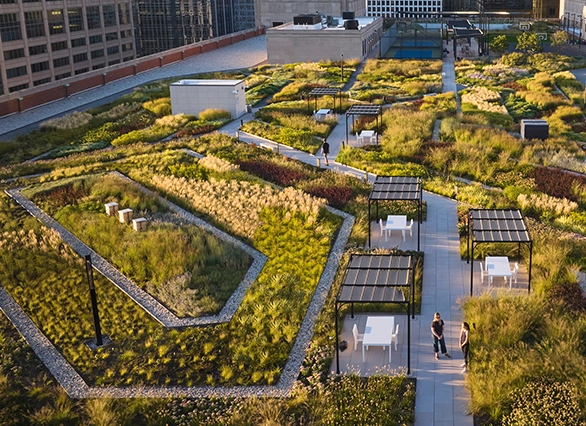


2025 ASLA Professional Award Honor Award, Residential Design. Sendero Verde, AECOM LAUD NYC. The landscape connects users to the environment through a strategy that incorporates native plants resilient to the site’s on-structure conditions.
Your Path to Landscape Architecture
Explore:
What Skills Do I Need?
A landscape architect needs:
- Sensitivity to landscape quality.
- Understanding of the arts and a humanistic approach to design.
- Ability to analyze problems in terms of design and physical form.
- Technical competence to translate a design into a built work.
Skills in all aspects of professional practice, including management and professional ethics.
The U.S. Department of Homeland Security has designated landscape architecture a STEM discipline. The designation recognizes the high degree of science, technology, engineering, and mathematics coursework required in landscape architecture collegiate programs.
A formal education is essential to gain these skills and knowledge. Professional education in landscape architecture can be obtained at the undergraduate or graduate level. There are two undergraduate professional degrees: a Bachelor of Landscape Architecture (BLA) and a Bachelor of Science in Landscape Architecture (BSLA). These usually require four or five years of study in design, construction techniques, art, history, natural and social sciences.
There are generally three types of graduate degree programs:
- The first: Professional Master of Landscape Architecture (MLA) is for persons who hold an undergraduate degree in a field other than landscape architecture and intend to become landscape architecture practitioners. It can usually be earned in three years of full-time study.
- The second: Professional Master of Landscape Architecture (MLA) is for persons who hold an undergraduate professional degree in landscape architecture. It normally takes two years.
- The third: MA/MS in Landscape Architecture is for persons who want to conduct research in landscape architecture, but do not seek to be registered professional practitioners.
Prospective students who hold degrees should investigate the specific aims and objectives of various graduate and undergraduate programs before deciding where to enroll.
The Landscape Architectural Accreditation Board, an autonomous committee of the American Society of Landscape Architects (ASLA), is the agency that accredits first-professional degree programs at the undergraduate and graduate levels in the United States. Other degree programs, such as the second professional MLA, the MA/MS, and the Ph.D., fall outside the scope of LAAB accreditation.