
.webp?language=en-US)


Reclaimed Edges: Uncovering History, Designing Resilient Futures
Zhiming Zhang, Student ASLA
Well executed! The holistic design is appreciated. Good kit of parts for other designers to consider.
Awards Jury
-
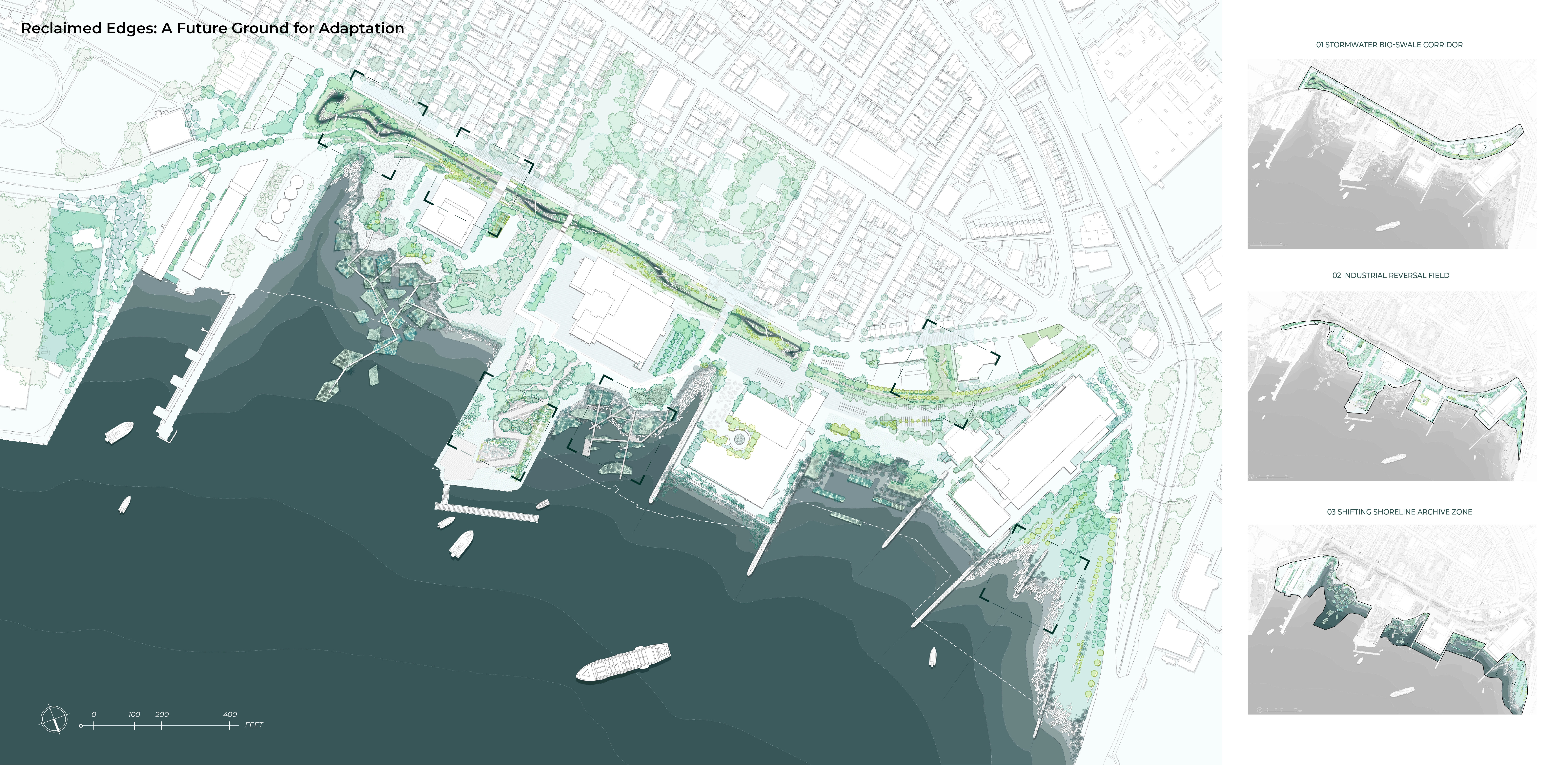
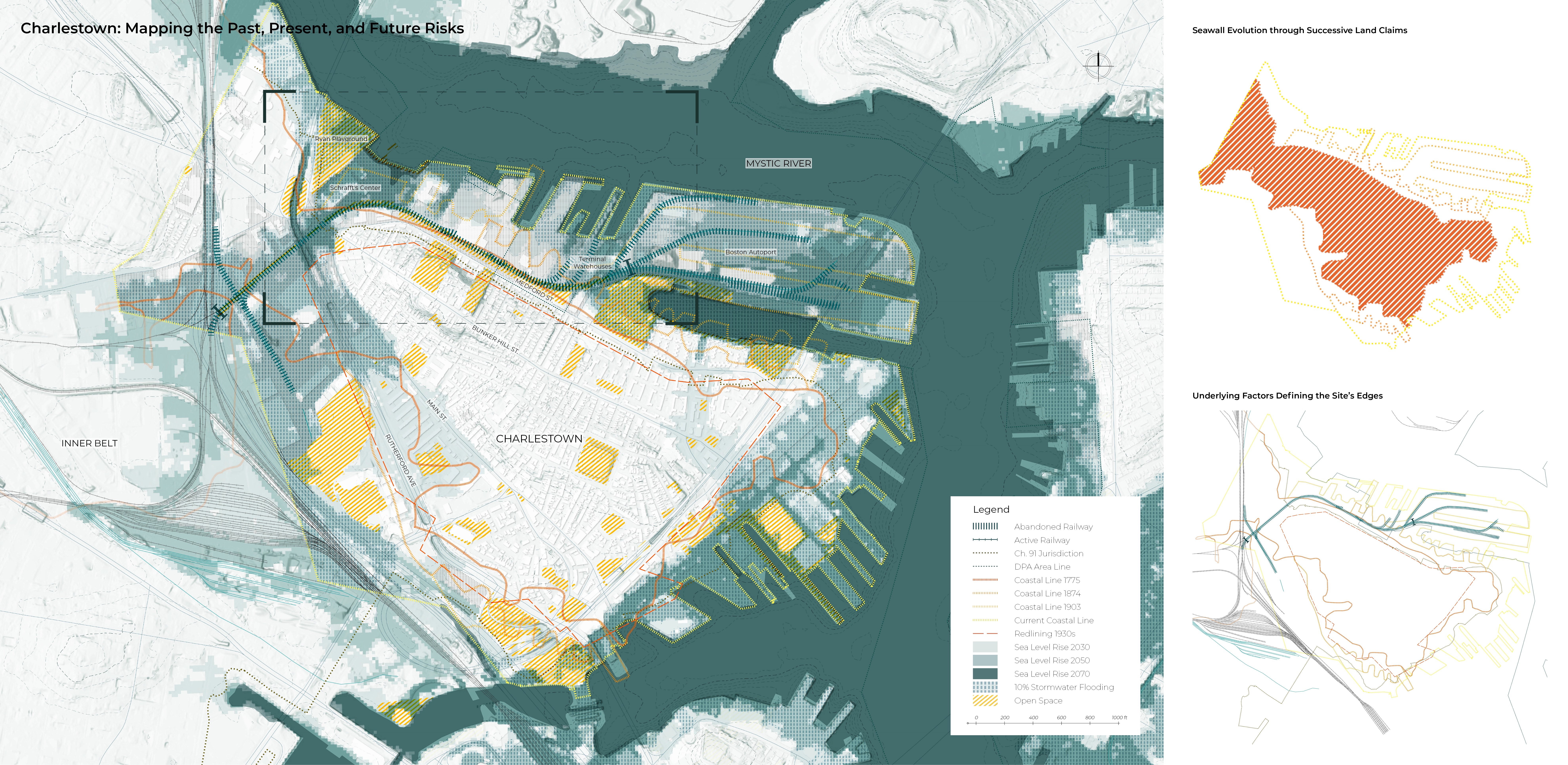
This project reimagines Charlestown’s waterfront as a dynamic archive—one that reveals layers of material history while adapting to future climate challenges. Historically, shifting seawalls and zoning lines fractured the relationship between the community and the water, producing two hardened edges: an abandoned rail corridor inland and a sealed waterfront. The design softens these boundaries through porosity, layering, and fragmentation, creating a new spatial framework across three zones: a tidal ecotone shoreline, reprogrammed industrial spaces, and a bioswale corridor. Together, they form a porous, resilient edge that blends memory, ecology, and transformation.
-
Context
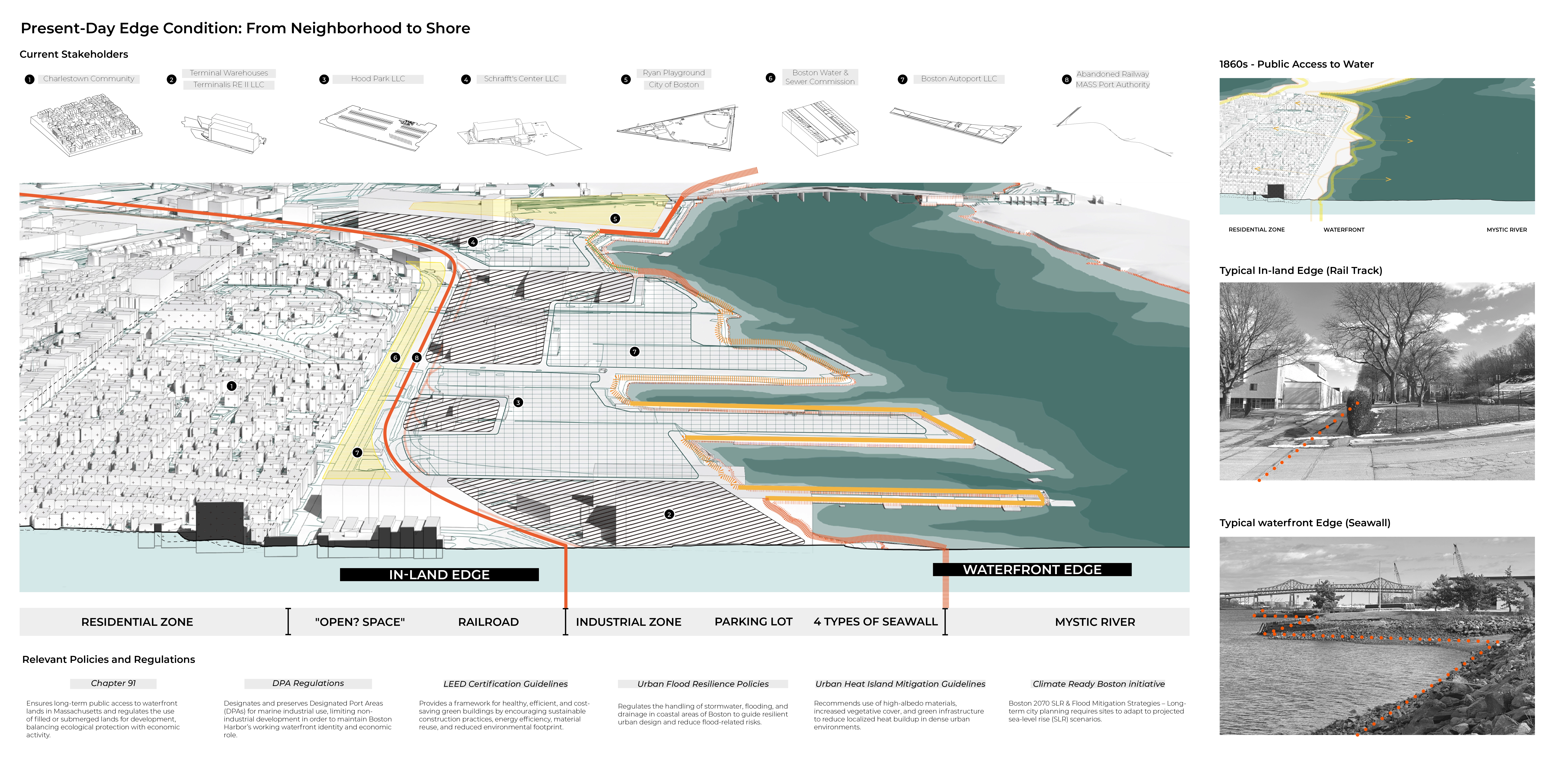
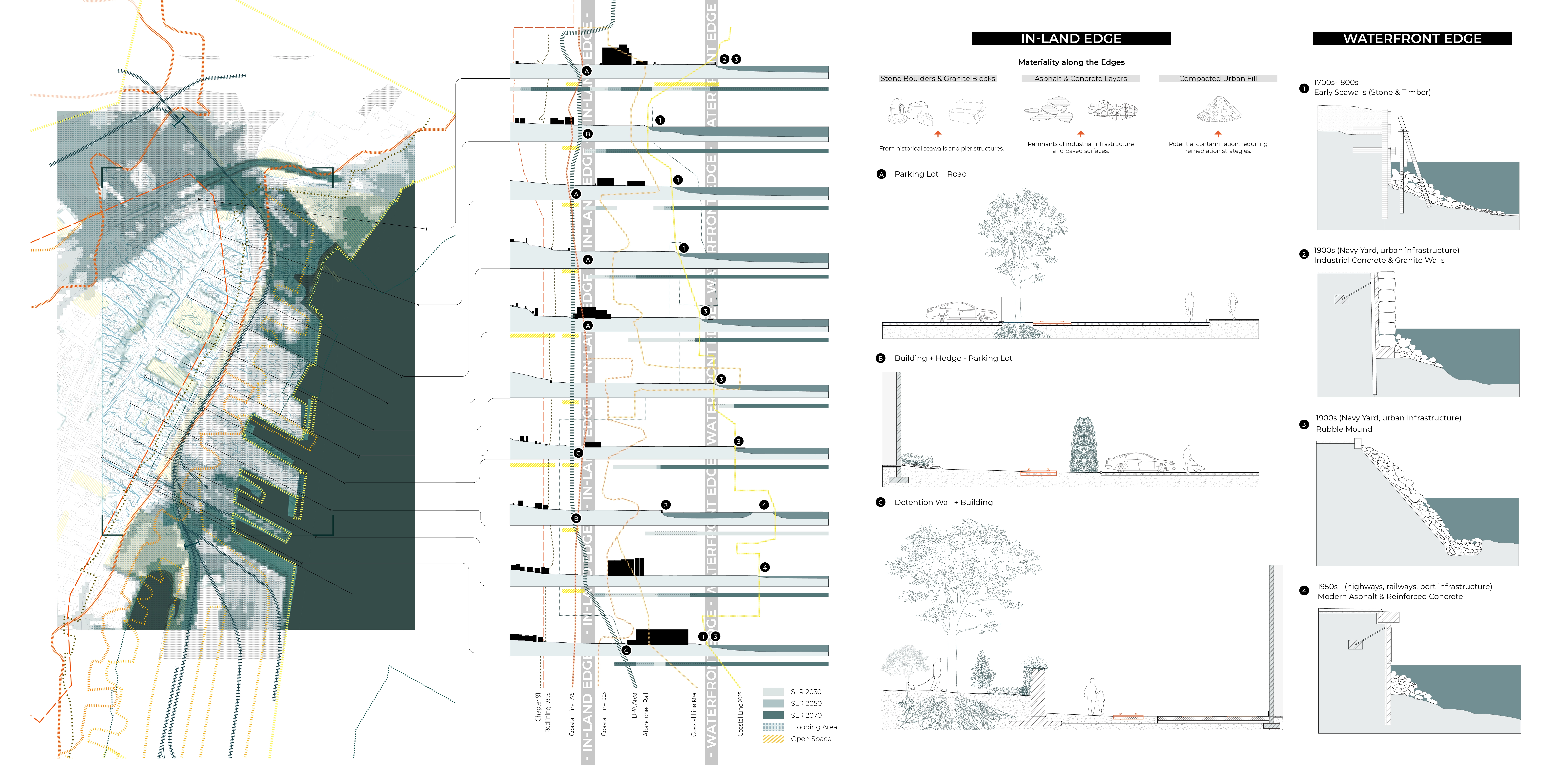
Charlestown's waterfront reflects a layered history of land reclamation, industrial expansion, and regulatory control. From the late 18th century through the 20th, aggressive landfilling and shifting shoreline infrastructure gradually severed connections between the community and the water. Overlays of policy—Chapter 91, Designated Port Area (DPA) boundaries, and redlining—further entrenched spatial segregation and hardened the edge. What was once a porous, working shoreline became increasingly inaccessible and ecologically degraded.
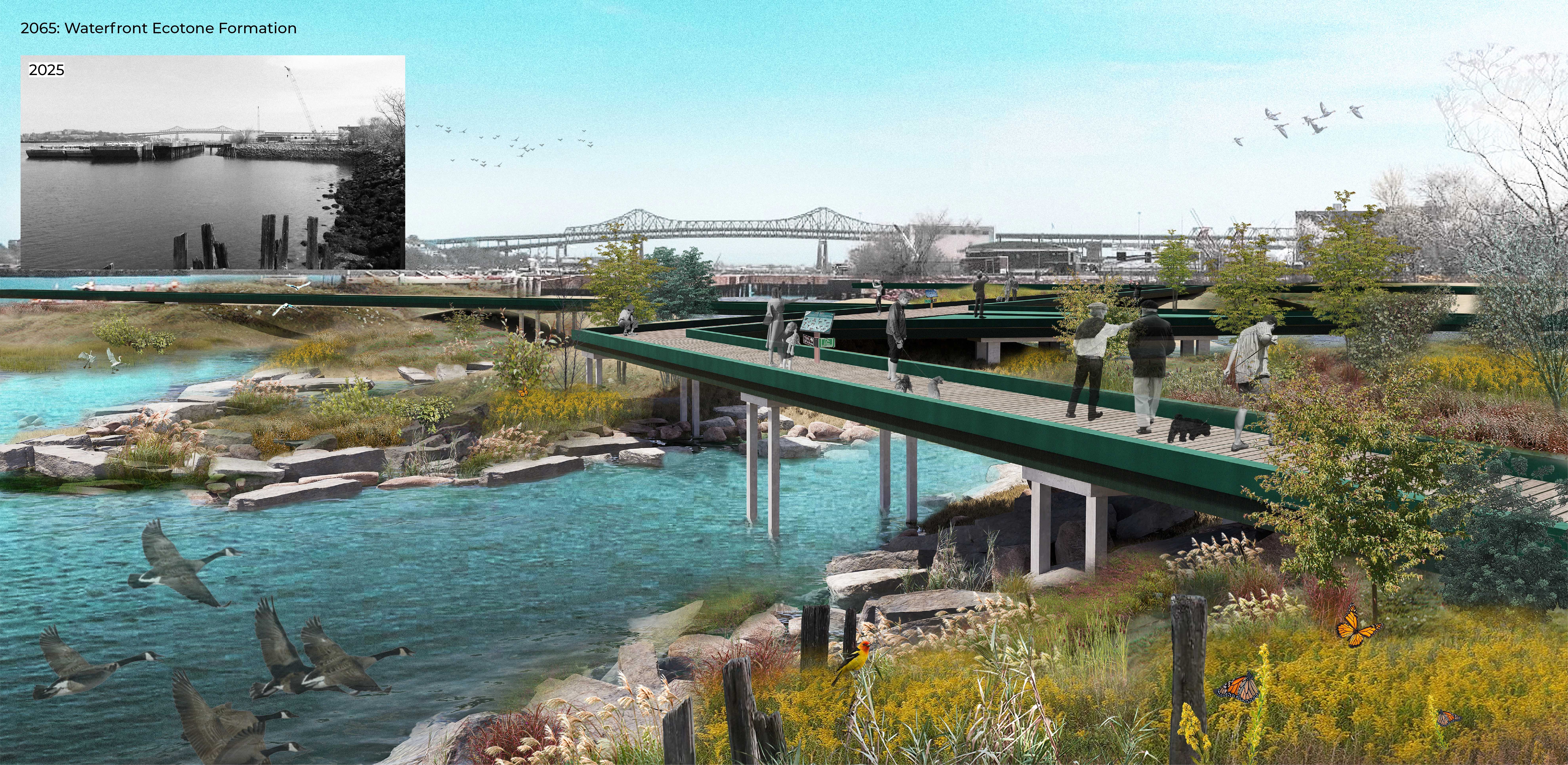
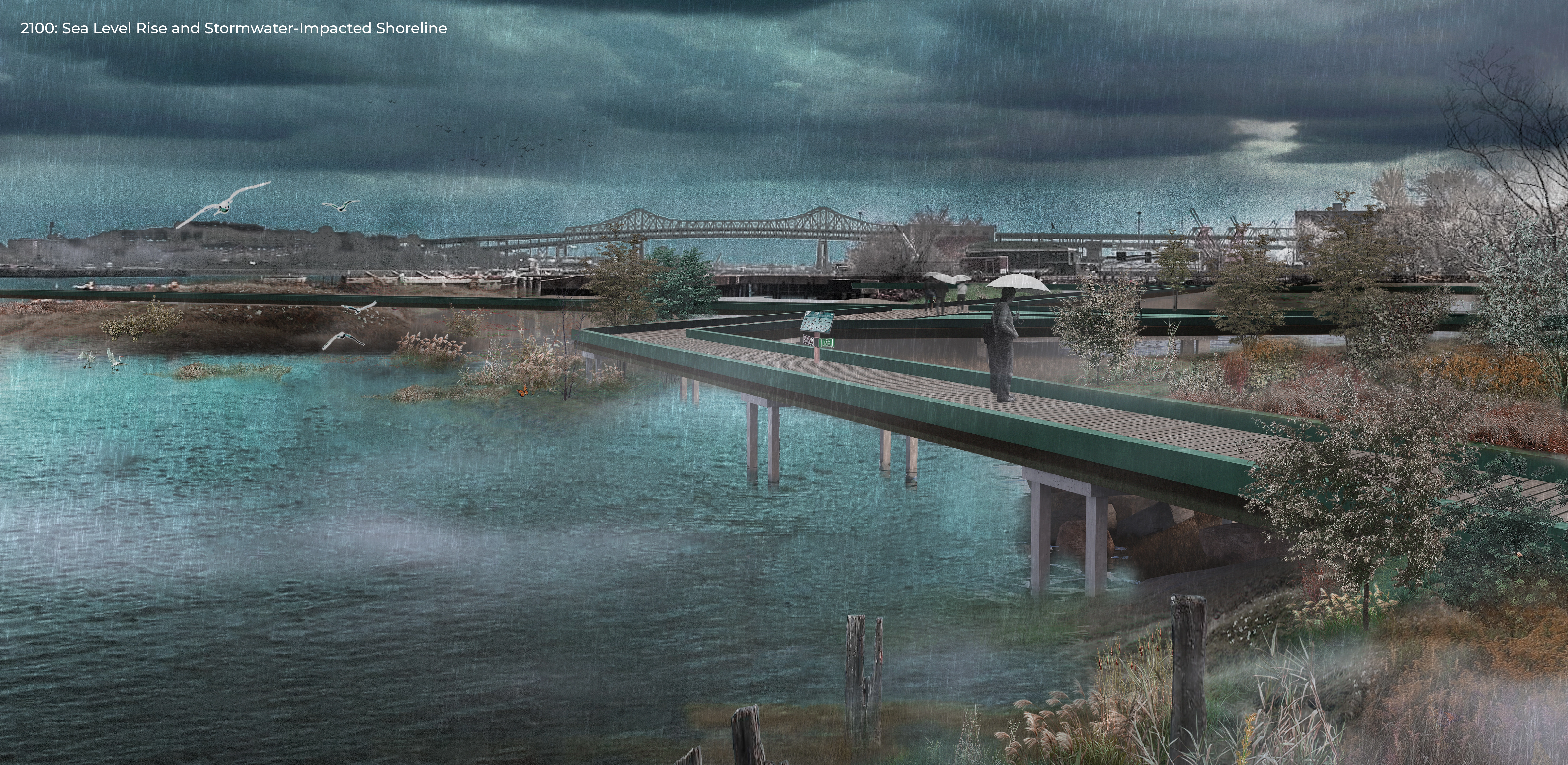
Looking forward, sea level rise, storm surge, and increased stormwater runoff threaten to reshape further Charlestown’s waterfront, overwhelming aging infrastructure and demanding new adaptive strategies.
Two Edge Conditions
Two hardened boundaries now define the site’s waterfront condition. Inland, an abandoned rail corridor once tied to industrial logistics remains a void—an infrastructural remnant that cuts across neighborhoods without public function. On the waterfront, a continuous seawall prevents both ecological exchange and public access, rendering the harbor edge static and detached. These two edges embody a broader breakdown: between land and water, between past use and future risk, between community and coastline.
Design Framework
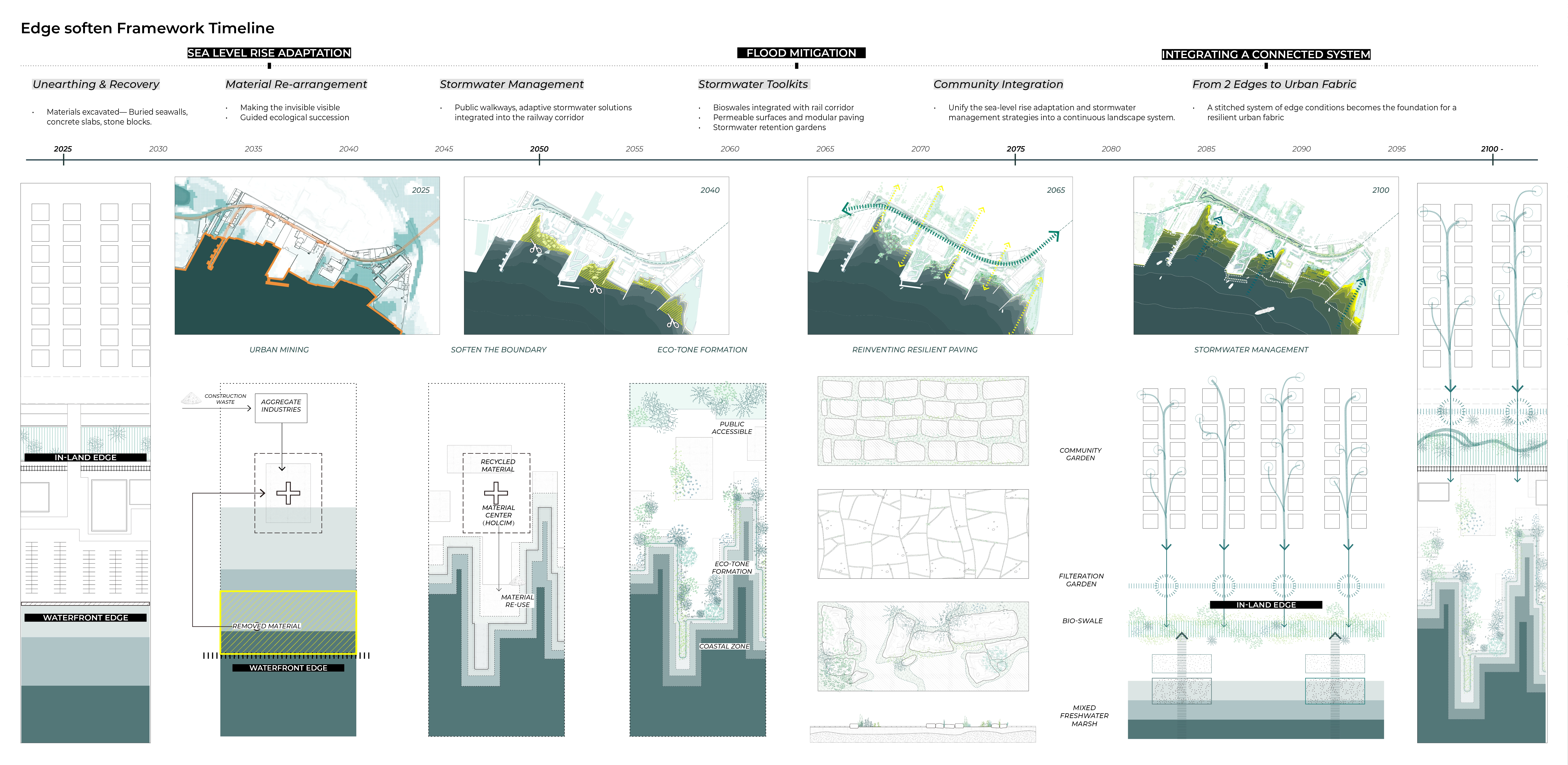
In response, this project proposes a spatial framework grounded in three principles: layering, porosity, and fragmentation. Interventions unfold across three interrelated zones:
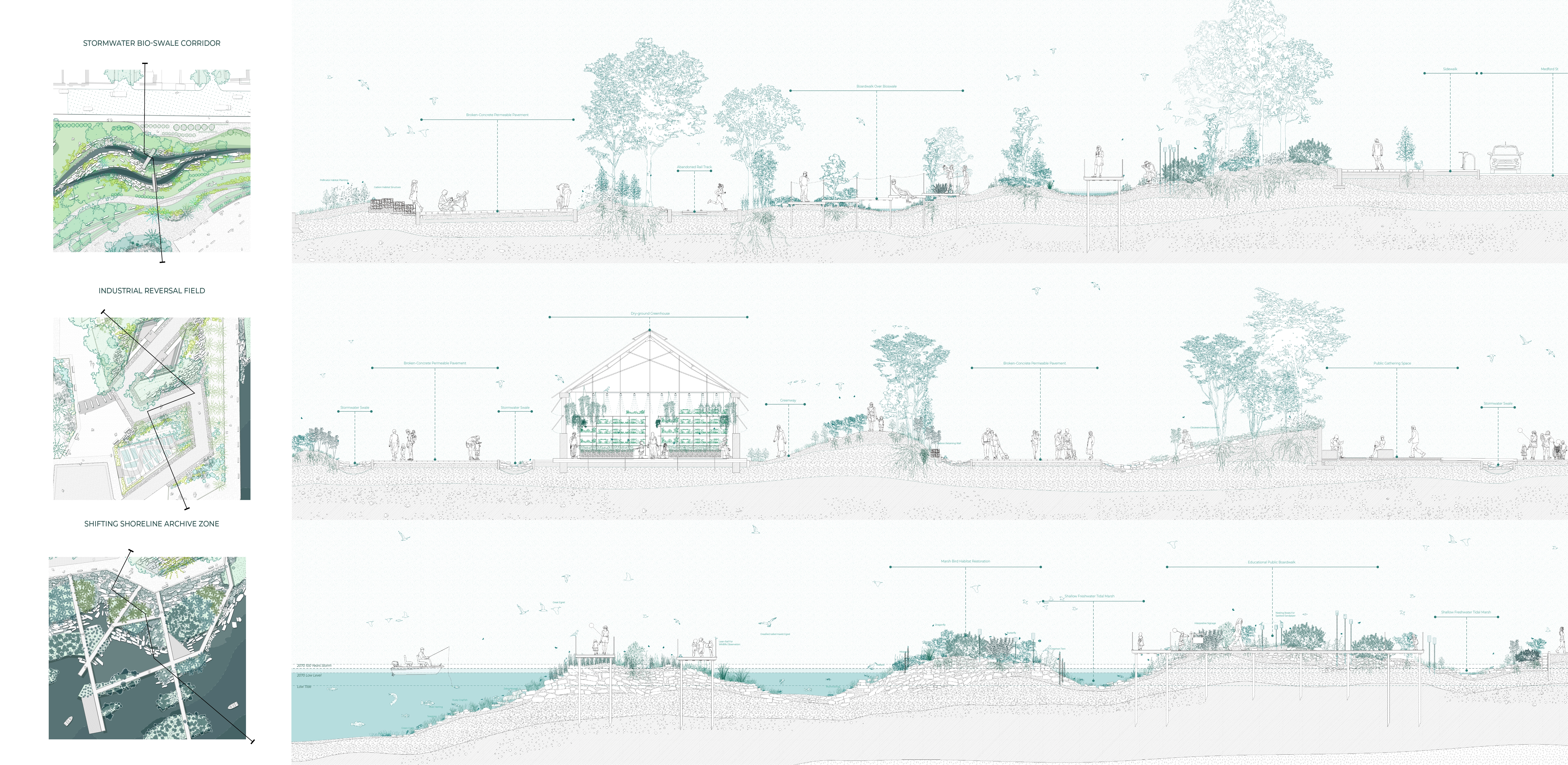
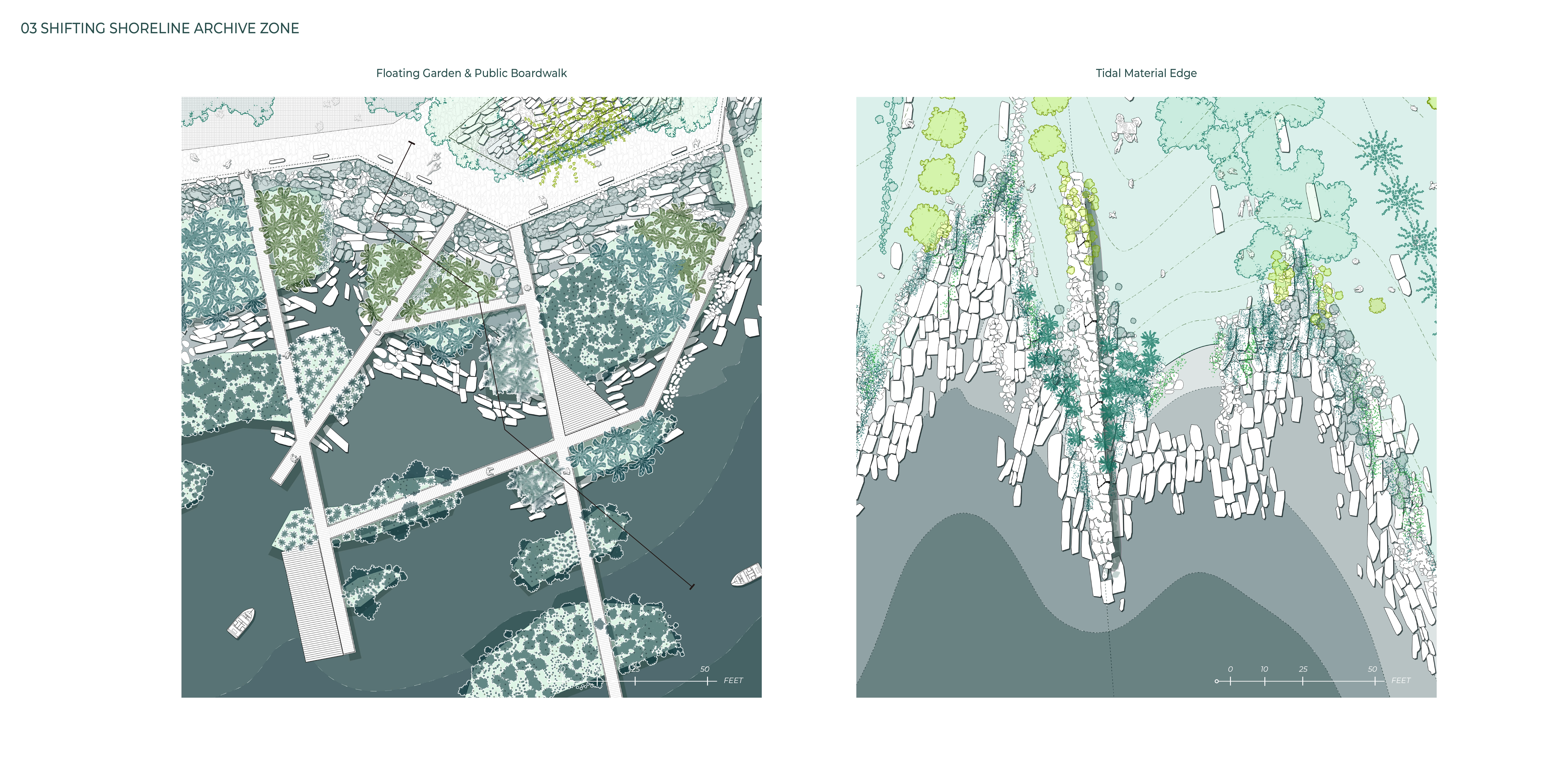
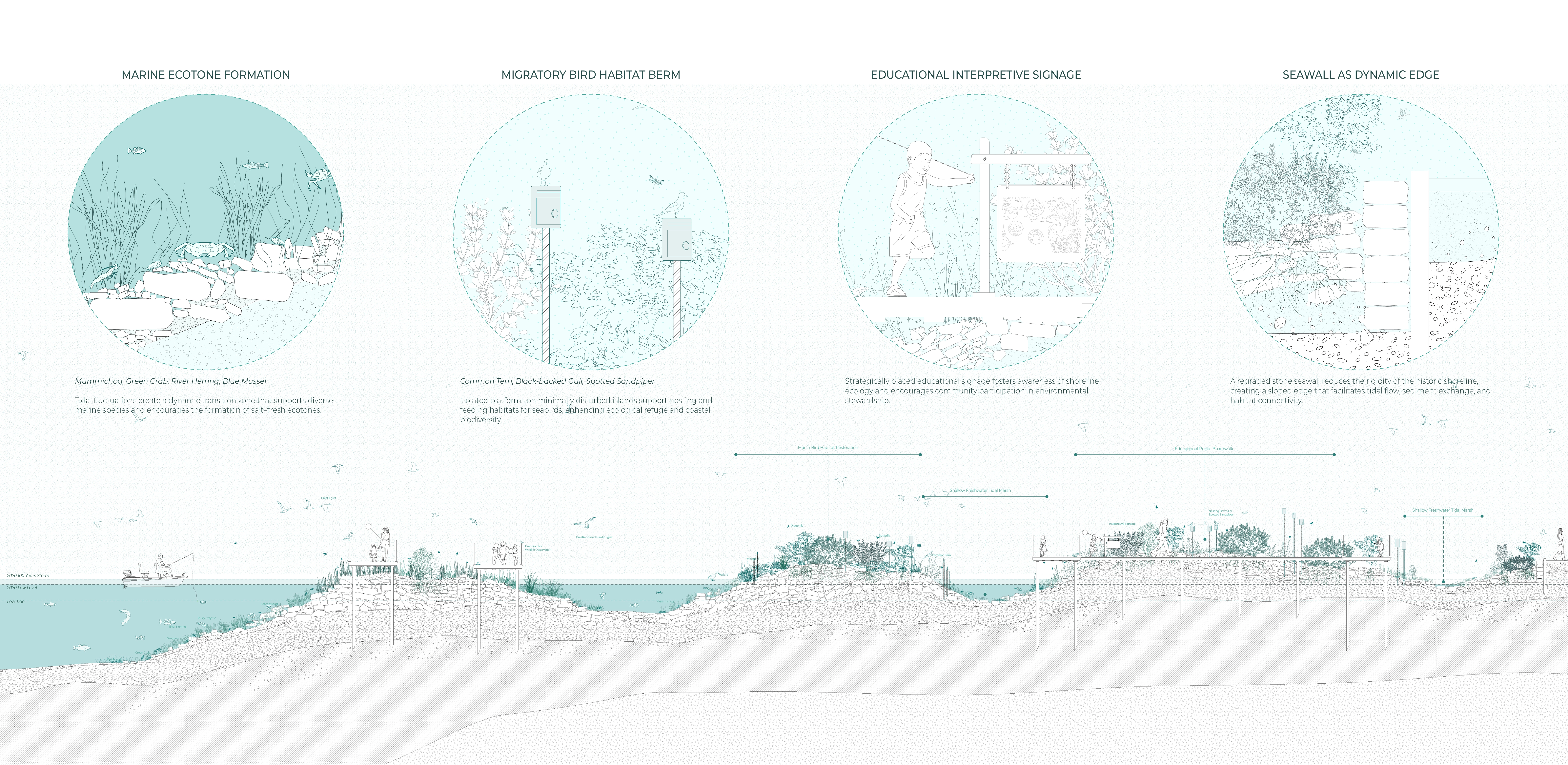
01 Shifting Shoreline Archive Zone: A formerly static seawall is reimagined as a dynamic shoreline that archives material history through tidal interaction with recycled debris and plantings.
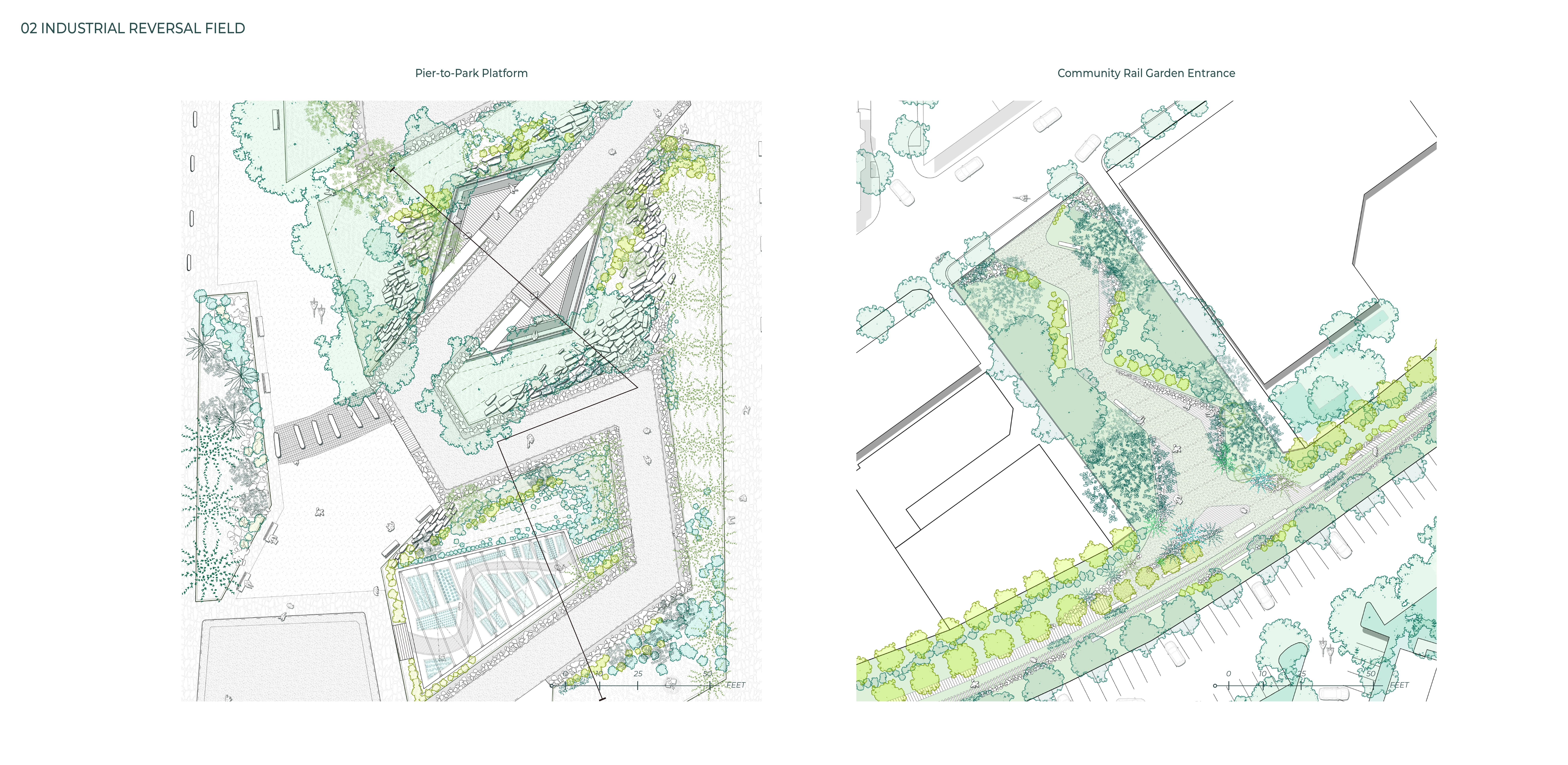
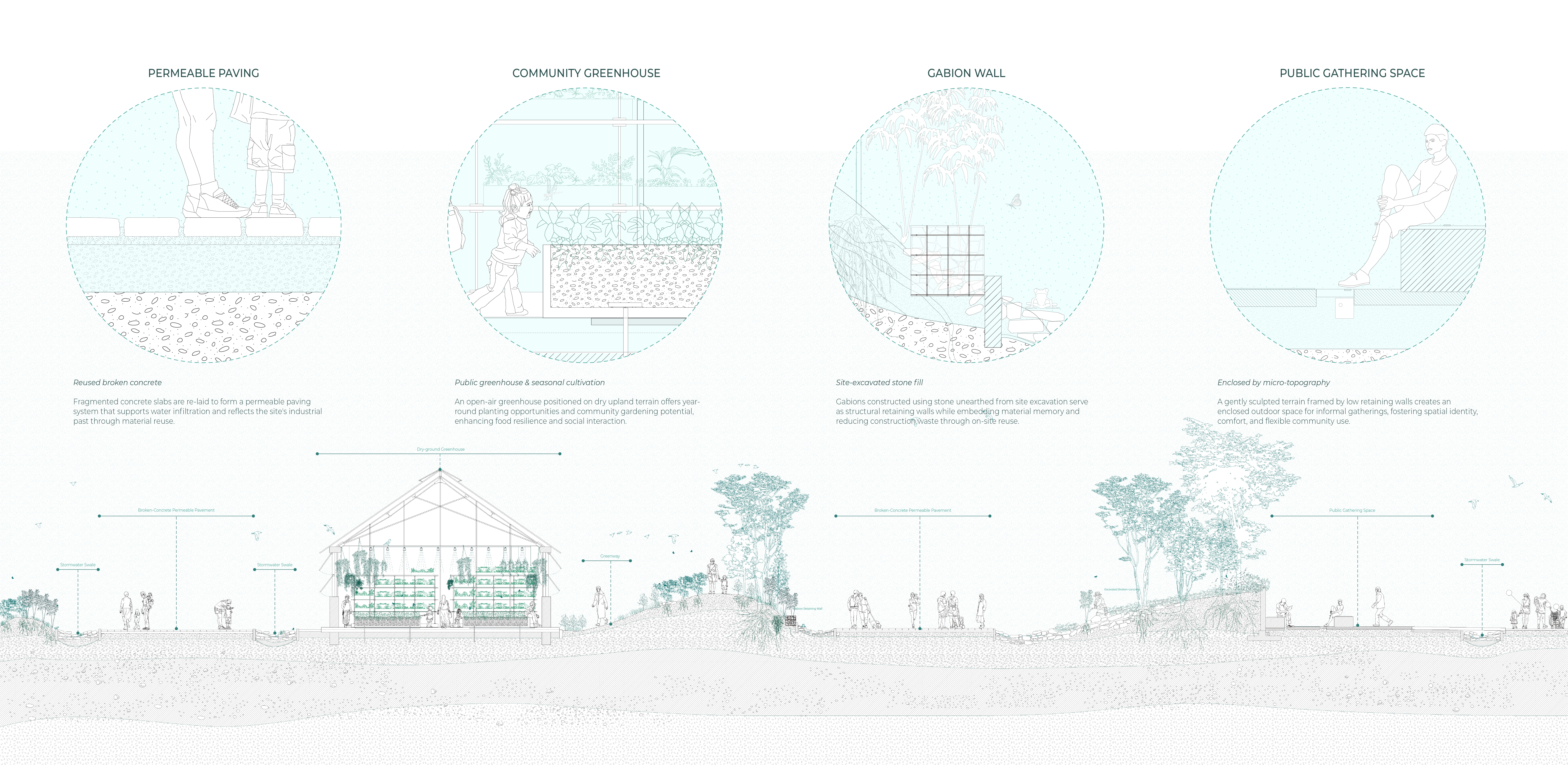
02 Industrial Reversal Field Zone: Paved lots and underutilized industrial spaces are transformed into transitional public commons that recover ecological and social function.
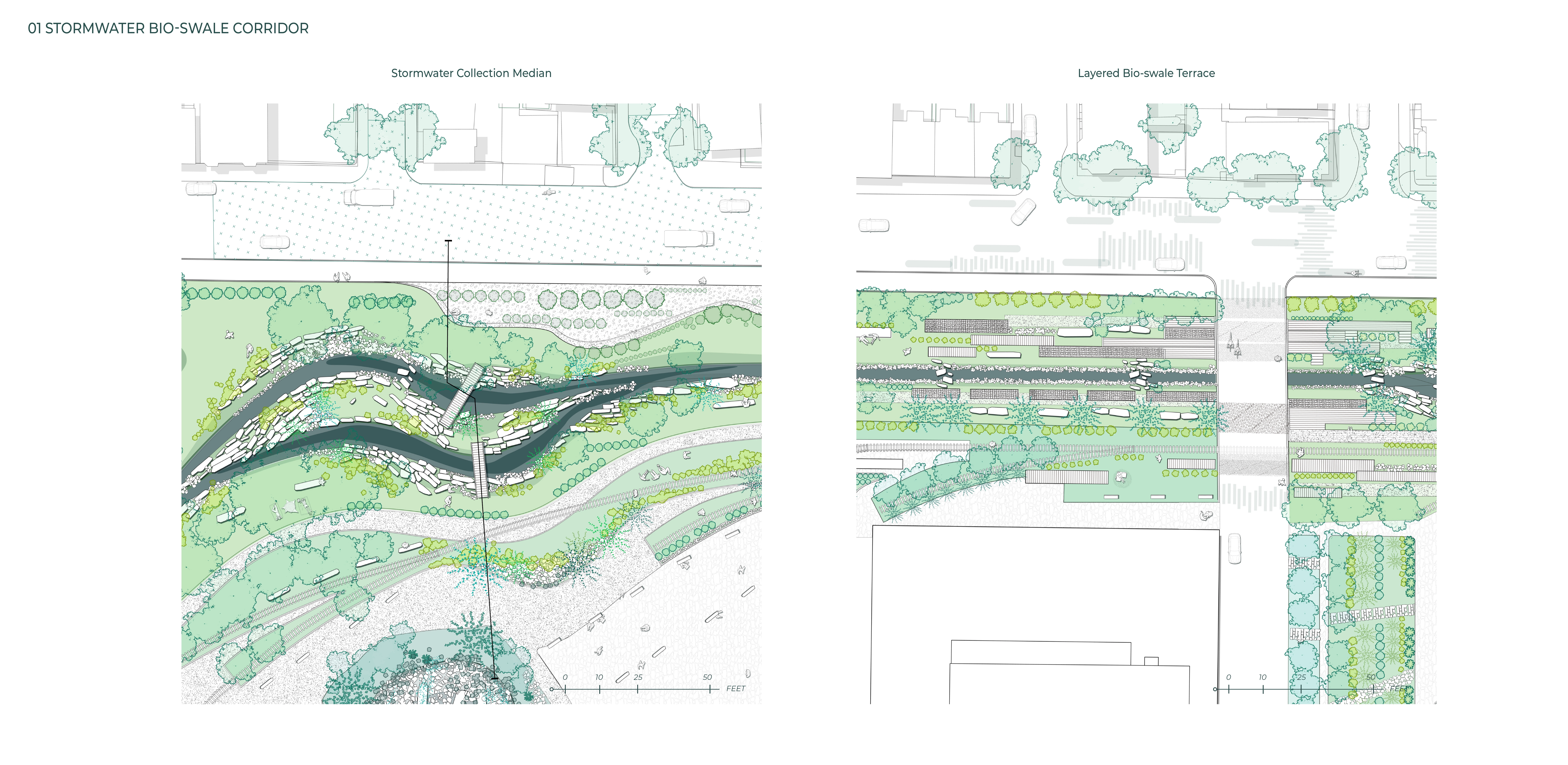
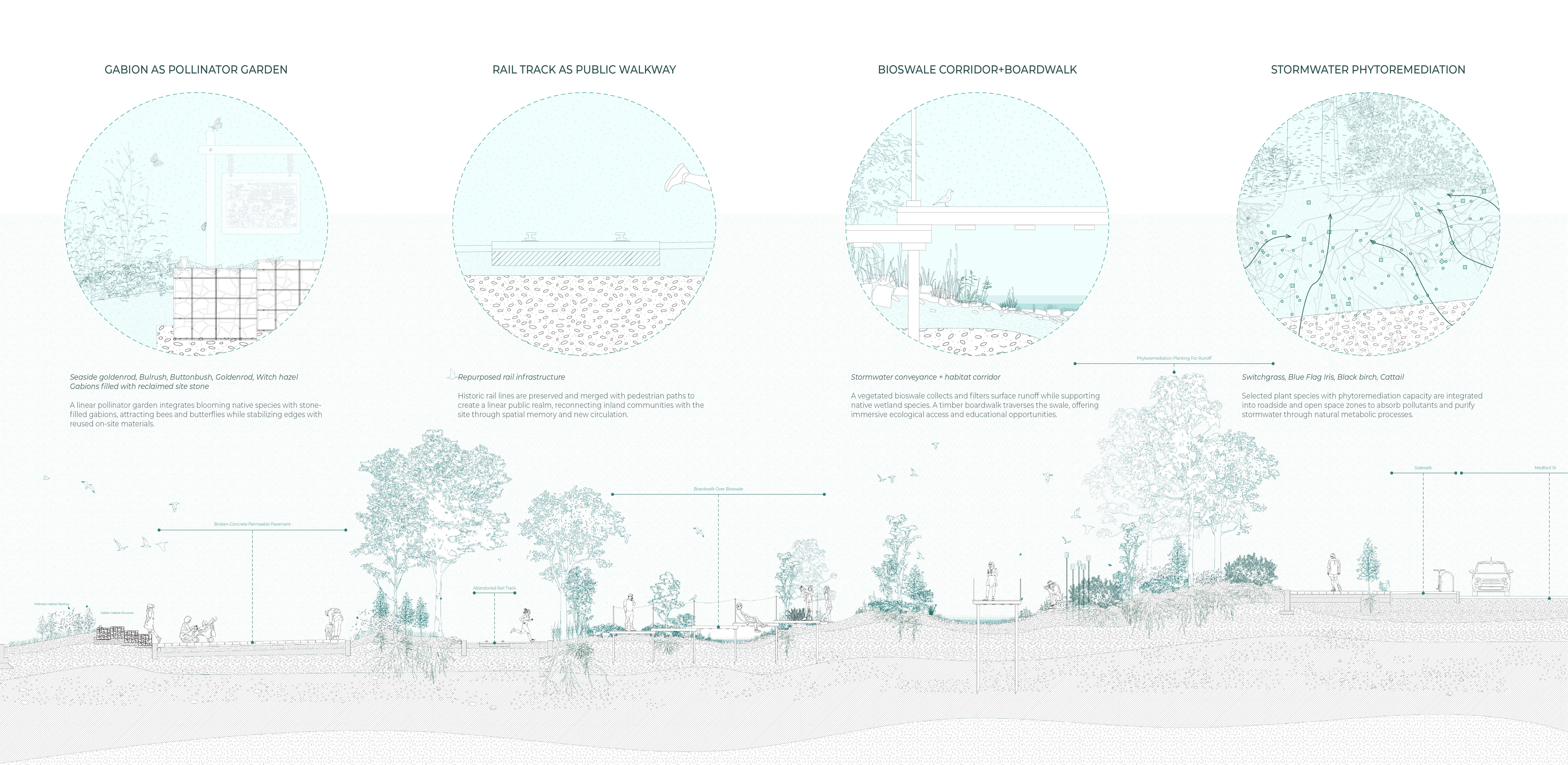
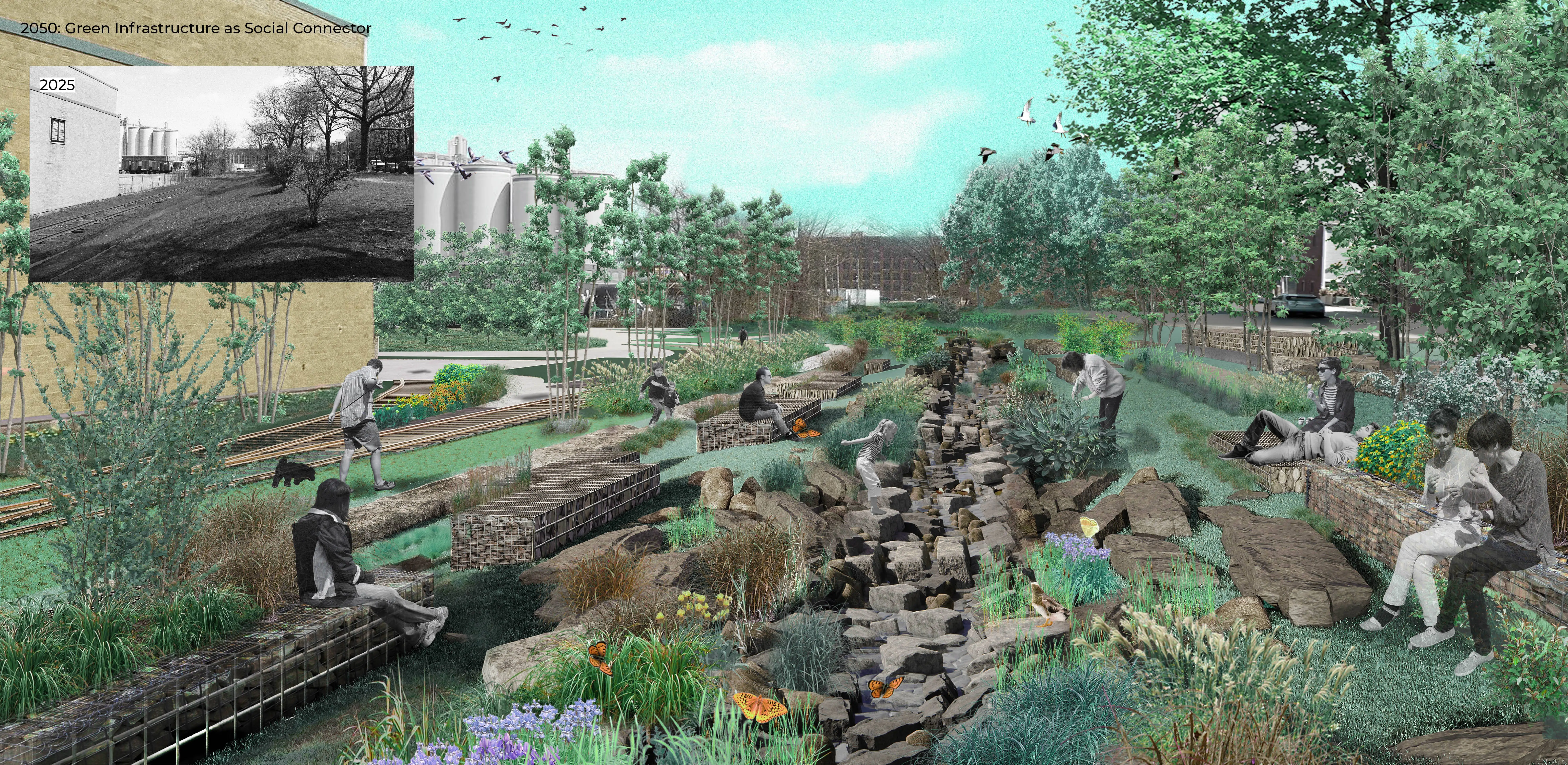
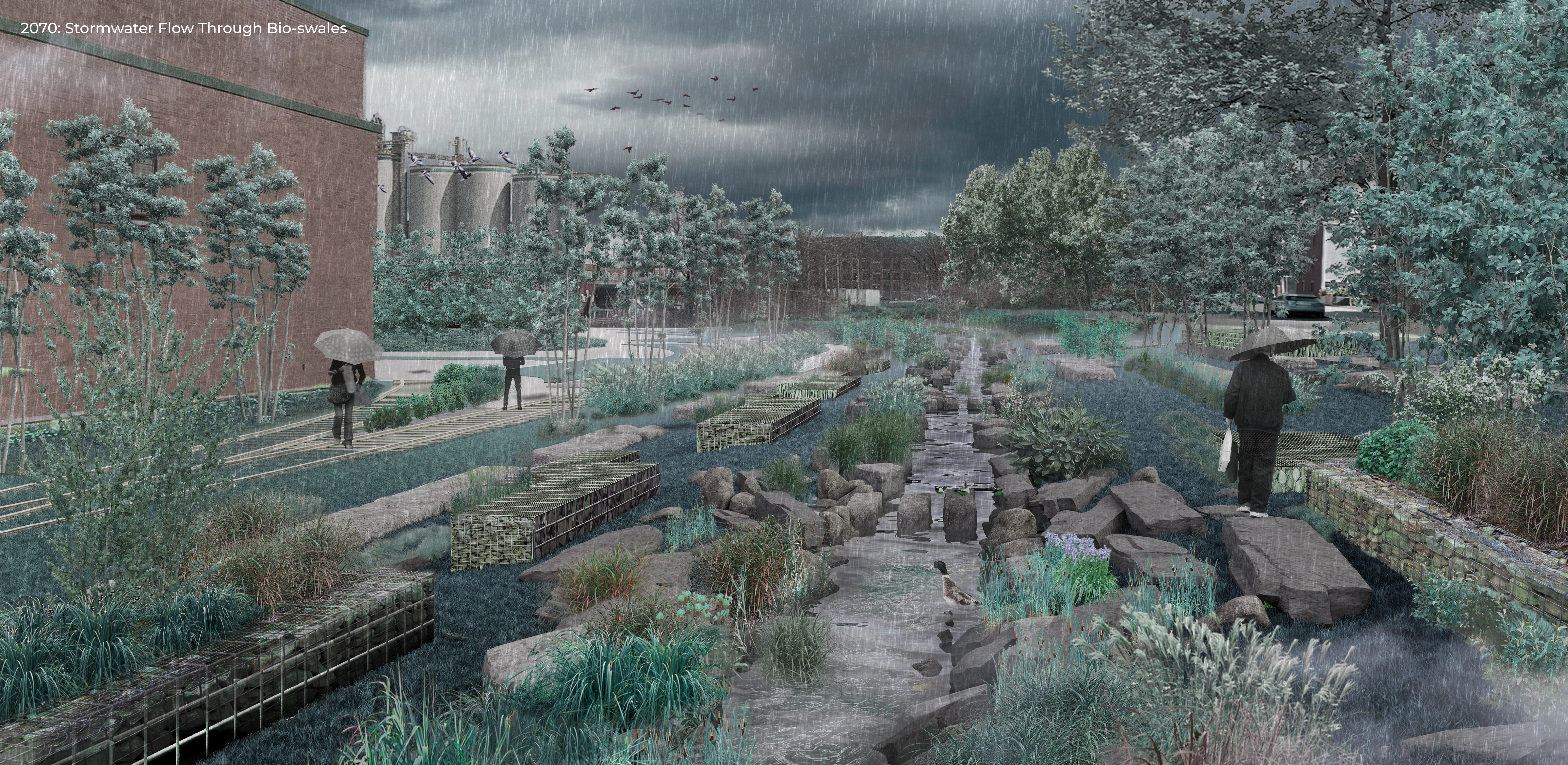
03 Stormwater Bio-swale Corridor Zone: The rail line is recast as an infrastructural spine, managing runoff while reweaving landscape, ecology, and access.
These zones collectively reposition the edge—not as a fixed line, but as a living system that integrates climate adaptation, public access, and historical memory.
Design Realization
In the Shifting Shoreline Archive, intertidal gradients and soft armoring blend with recycled concrete and rubble to form an adaptive edge. Floating gardens and a public boardwalk create spaces for education, observation, and ecological succession. In the Industrial Reversal Field, a former pier becomes a public platform, while a rail-adjacent entry is converted into a community garden park—turning zones of exclusion into active, collective landscapes. The Stormwater Bio-swale Corridor weaves through all three zones as a connective system: filtering runoff, supporting pollinators, and embedding green infrastructure into daily public life.
Rooted in site memory, policy context, and environmental urgency, this project constructs a new kind of waterfront—porous, resilient, and continually transforming with the shifting tides of both nature and history.
-
- American beachgrass
- Smooth Cordgrass
- Bayberry
- Dogwood
- Rhododendron
- Blue flag iris
- Seaside goldenrod
- Common Rush
- Tussock Sedge
- Switchgrass
- Canada Wild Rye
- Great Blue Lobelia
- Black Birch
- Witch Hazel
- Sweetbay Magnolia
- Swamp White Oak
Related Awards
Award of Excellence, General Design
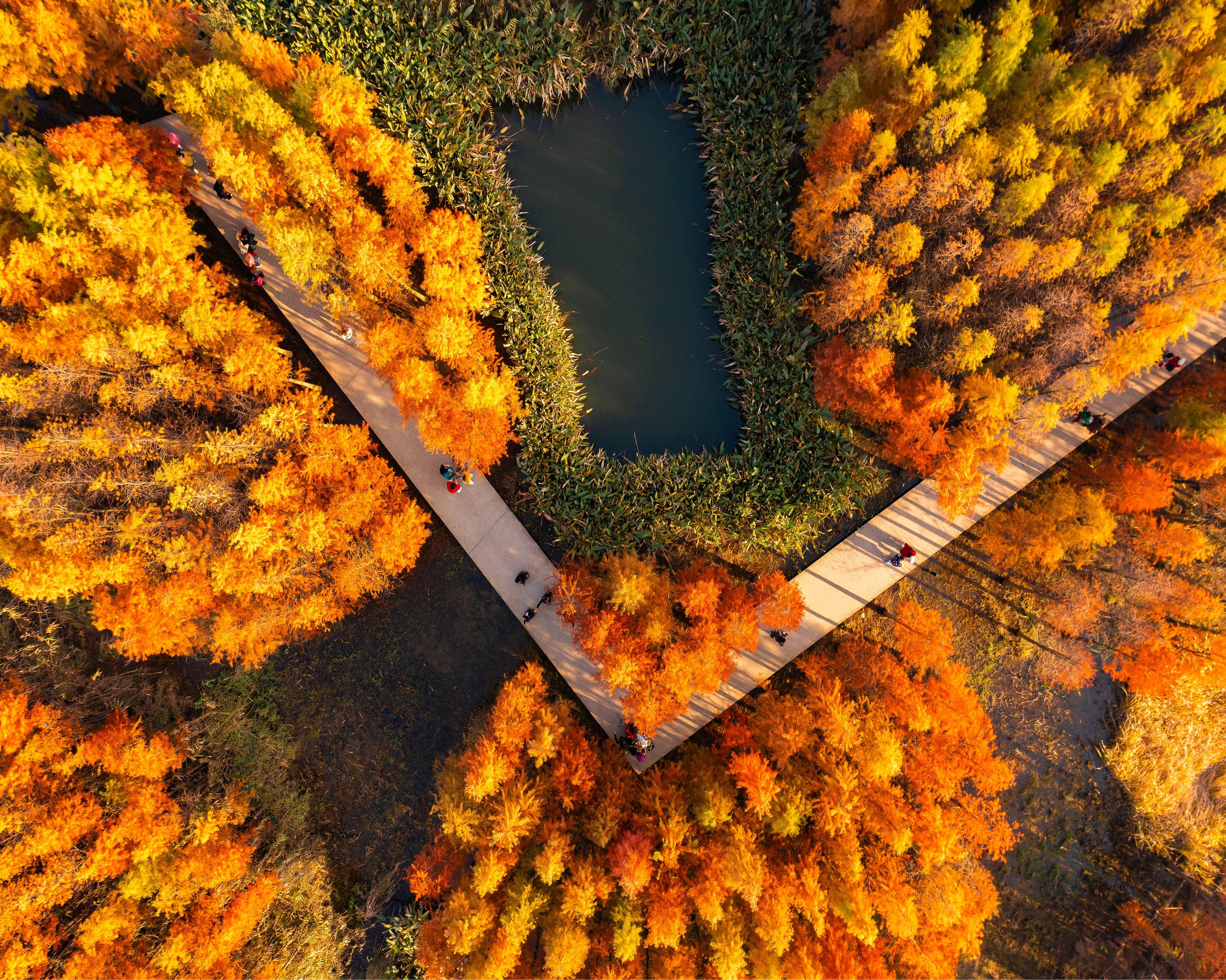
A Floating Forest: Fish Tail Park in Nanchang City
In Nanchang, within the Yangtze River floodplain, we revitalized a heavily degraded 126-acre landscape into a floating forest that manages stormwater, restores habitats, and provides diverse recreational spaces—all within a limited budget and a short timeline. This innovative urban nature model strengthens the district’s identity and spurs surrounding development. Fish Tail Park offers a scalable solution for flood-prone regions, seamlessly integrating flood resilience, ecological restoration