
.webp?language=en-US)


From Shelter to Home
Madison Sanders, Student ASLA
Christina J Hardeman, Student ASLA
Mckenna O'Neill
Candi Rosario, Student ASLA
Kady Shiro
Cameron Coronado, Student ASLA
Tressa Cummings, Student ASLA
Giffin Glastonbury
Sarah Goldstein
Katherine Harrison
Basil Khalid, Student ASLA
Ted Meyer, Student ASLA
Holly Phares, Student ASLA
Tristan Matlock, Student ASLA
Jac Noland
Noble residential project! Engagement is key! Excited for the construction! A thoughtful and empathetic project that could be replicable in other communities facing similar issues. The engagement process was an important methodology to build trust and create a sense of shared ownership as the result.
Awards Jury
-
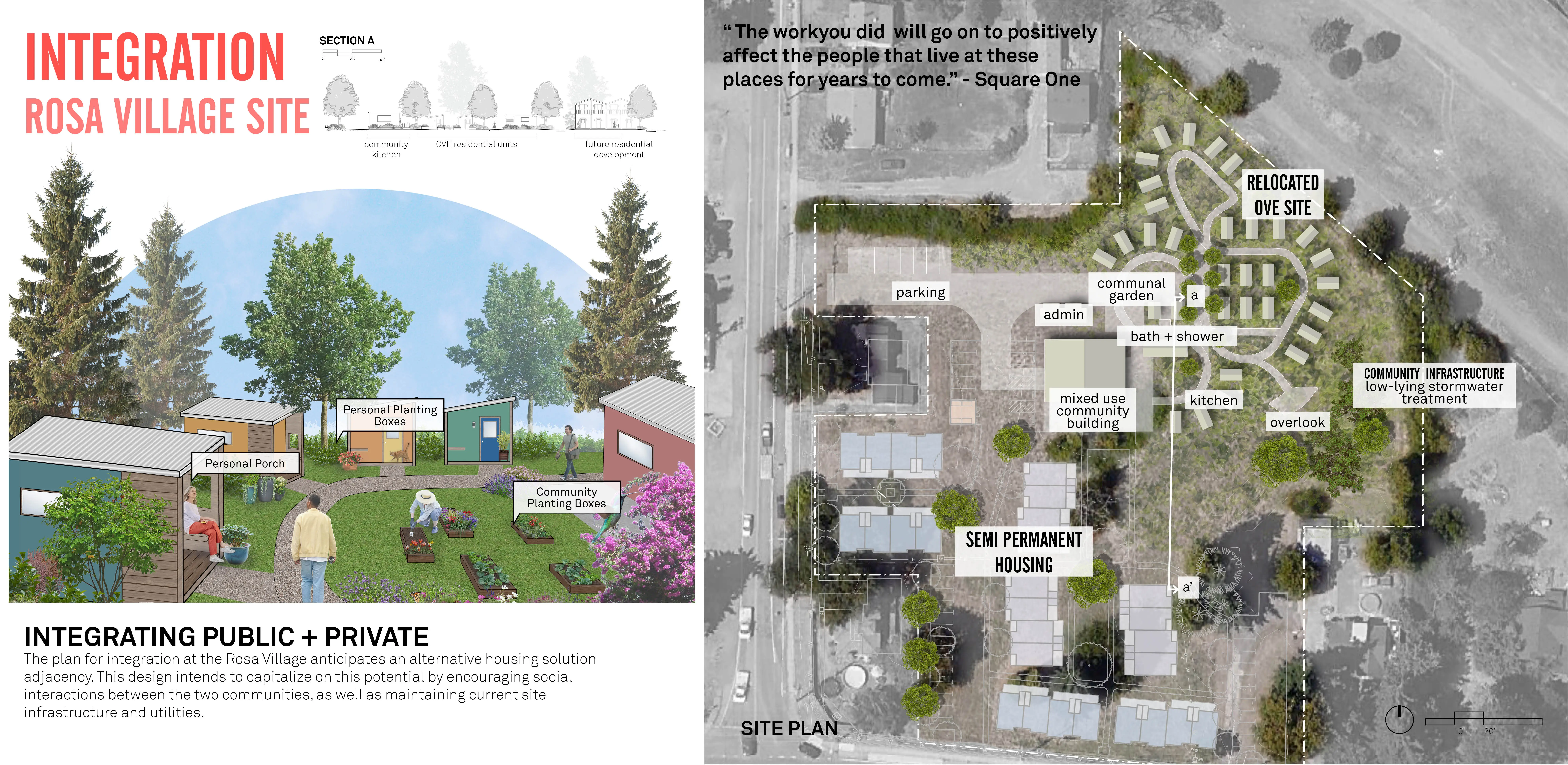
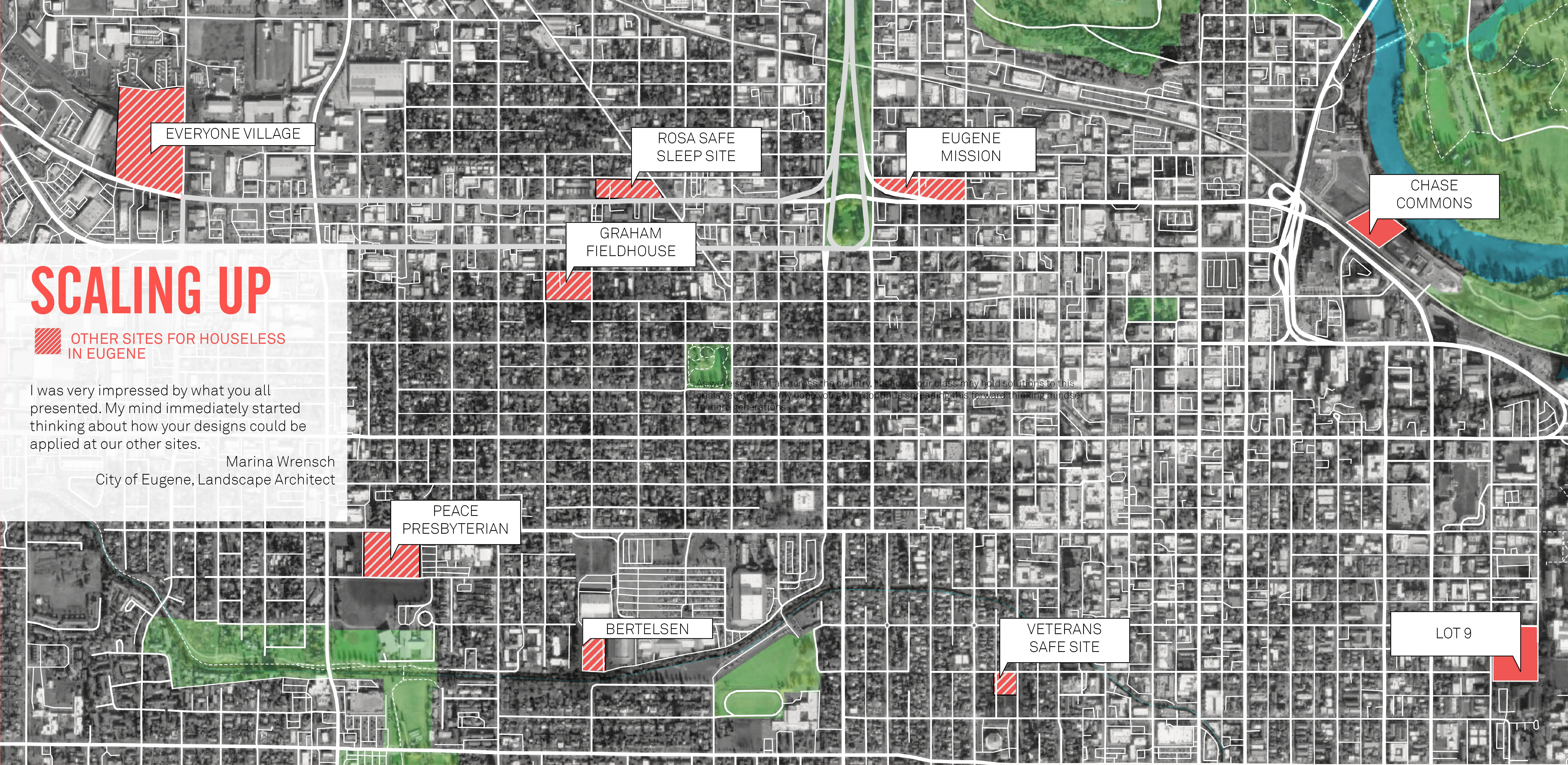
Houselessness is one of the defining crises of our time. The growing houseless crisis has affected 1 in 4 of us directly. As future landscape architects, we must use our unique ecological and cultural viewpoint to address this crisis. A real-world project, “From Shelter to Home” captures our year of work with Opportunity Village (OVE) a tiny home community for the otherwise houseless. With community partnership, we sought to understand how landscape architecture’s methods of inquiry, impact, and methods can help untangle the crisis. Our designs respond to daily routines, neighborhood concerns, and political, economic cultural practicalities. Construction planned for Fall 2023.
-
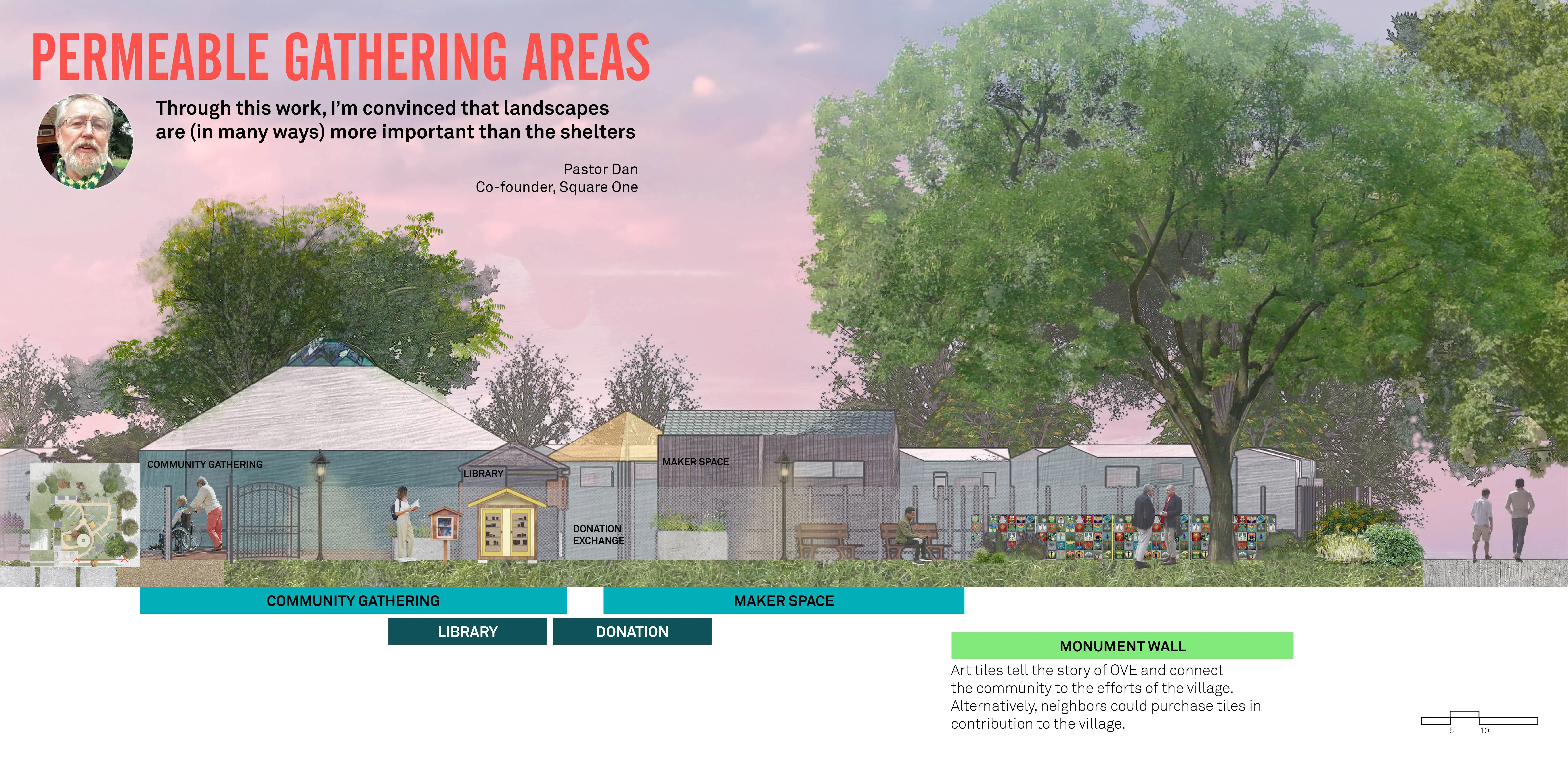
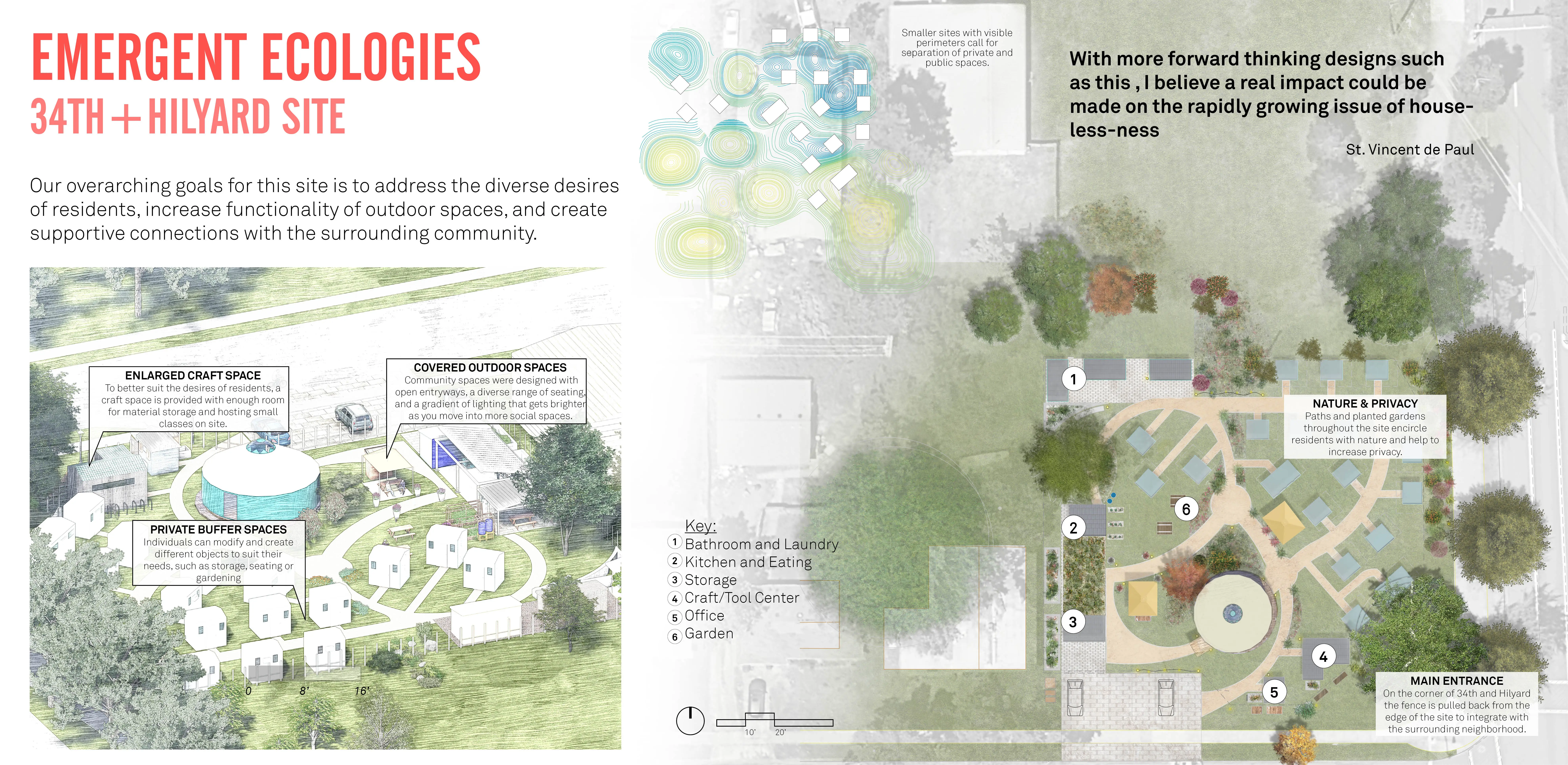
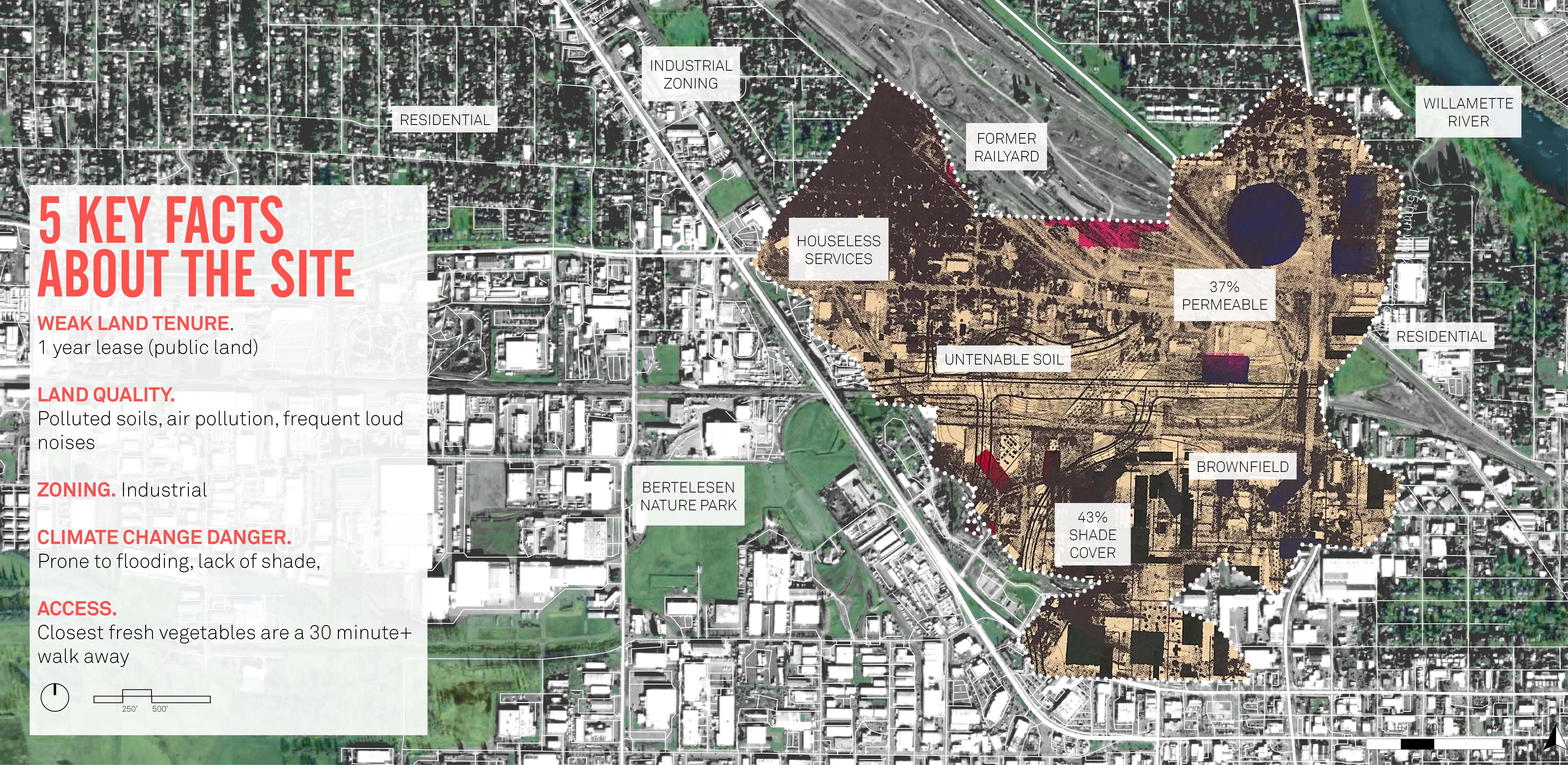
The lease is up. Opportunity Village Eugene (OVE), a tiny home community for otherwise houseless individuals and couples in Eugene must move the year. Located in Eugene’s (OR) industrial zone since 2011, Square One’s Opportunity Village is a unique collaboration between the housed and un-housed. Based on self-governance, partnership, and broad-based support, OVE has a unique approach to the houseless crisis. Our work this year considered how these values can manifest at the new site aesthetically, ecologically, culturally, and economically. We studied how the unique rhythm of a tiny home /gated/ formerly homeless community can inform new frameworks, synergies, cross-fertilization, and implications for landscape architecture.
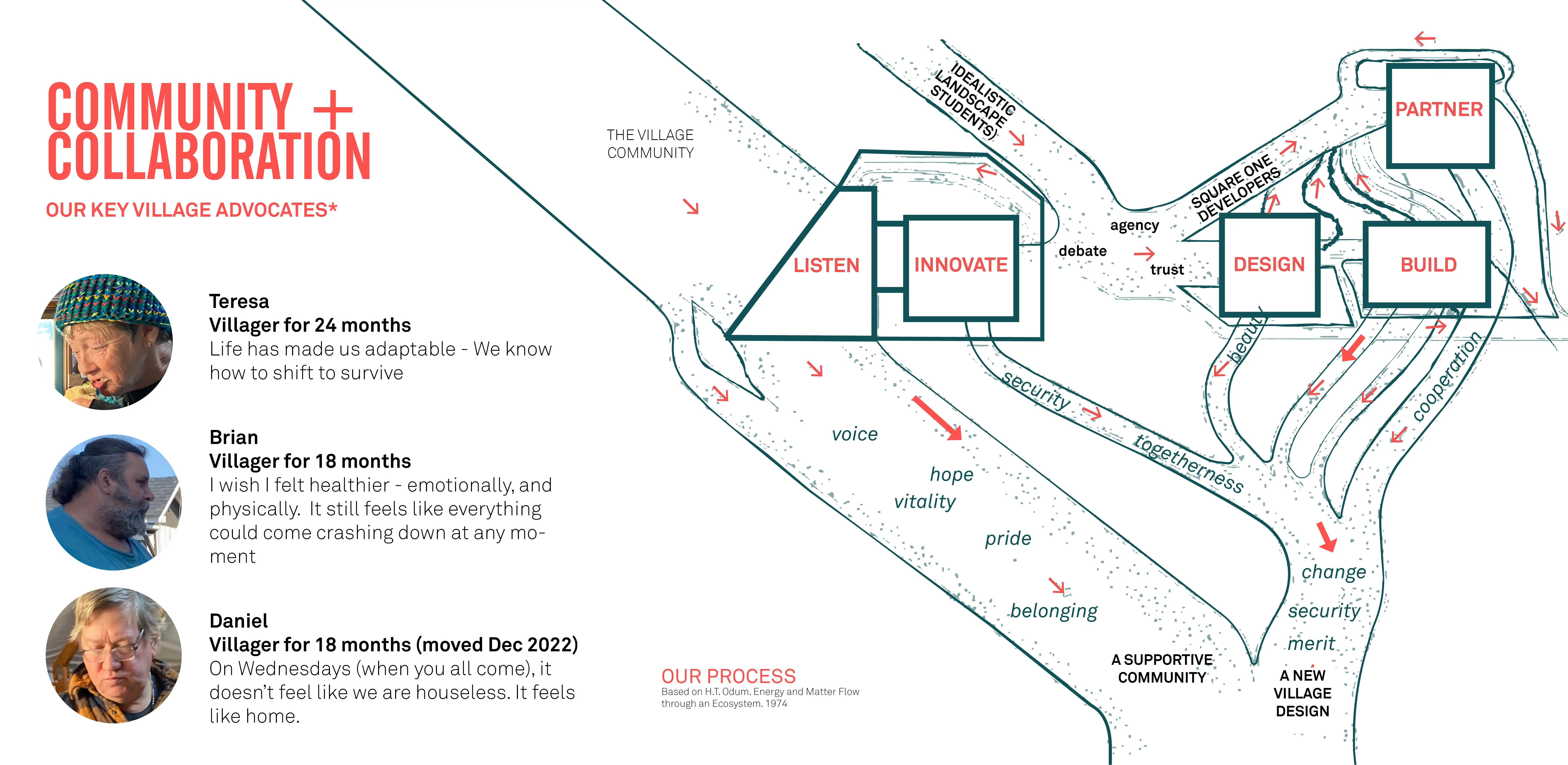
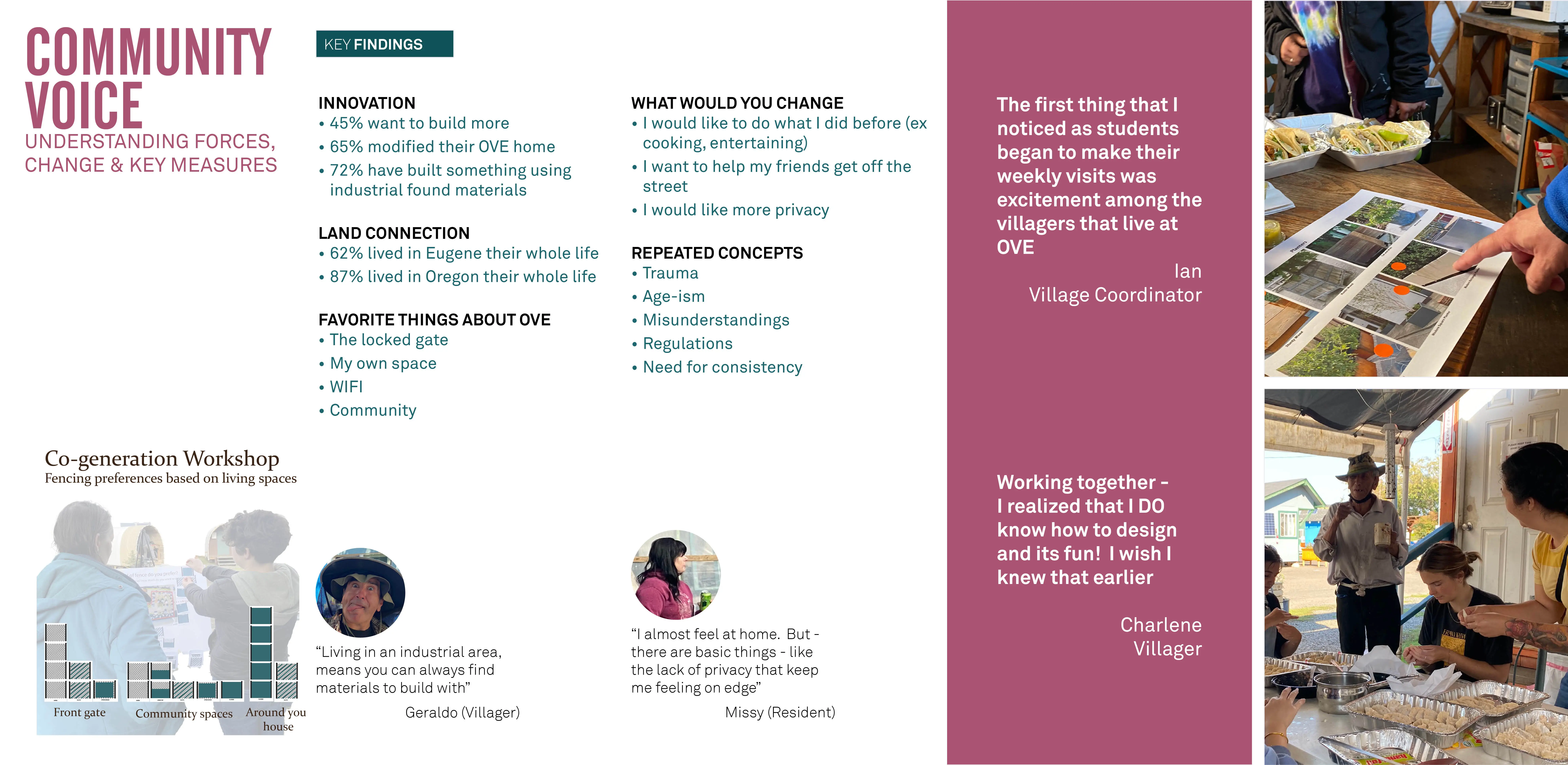
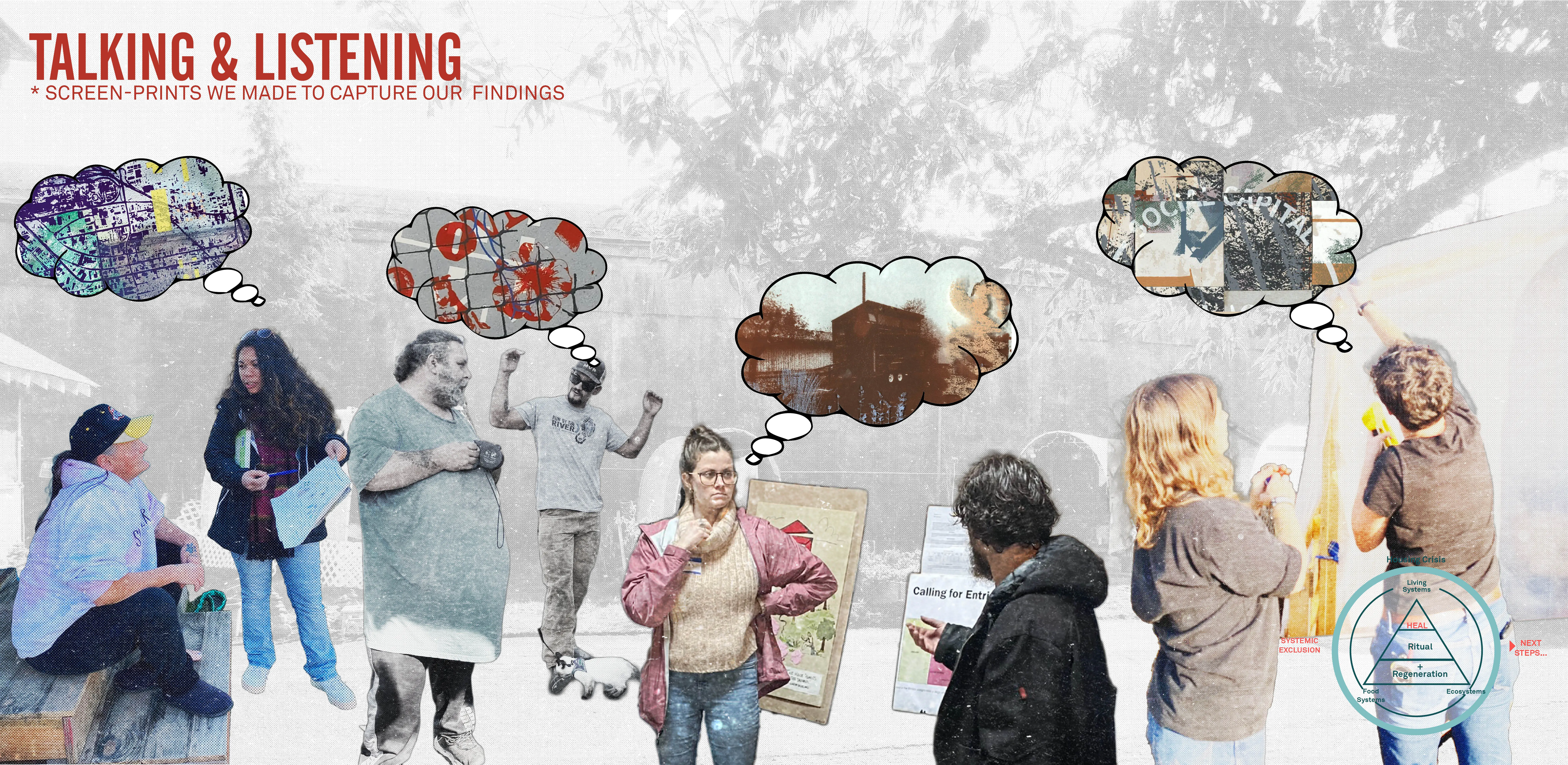
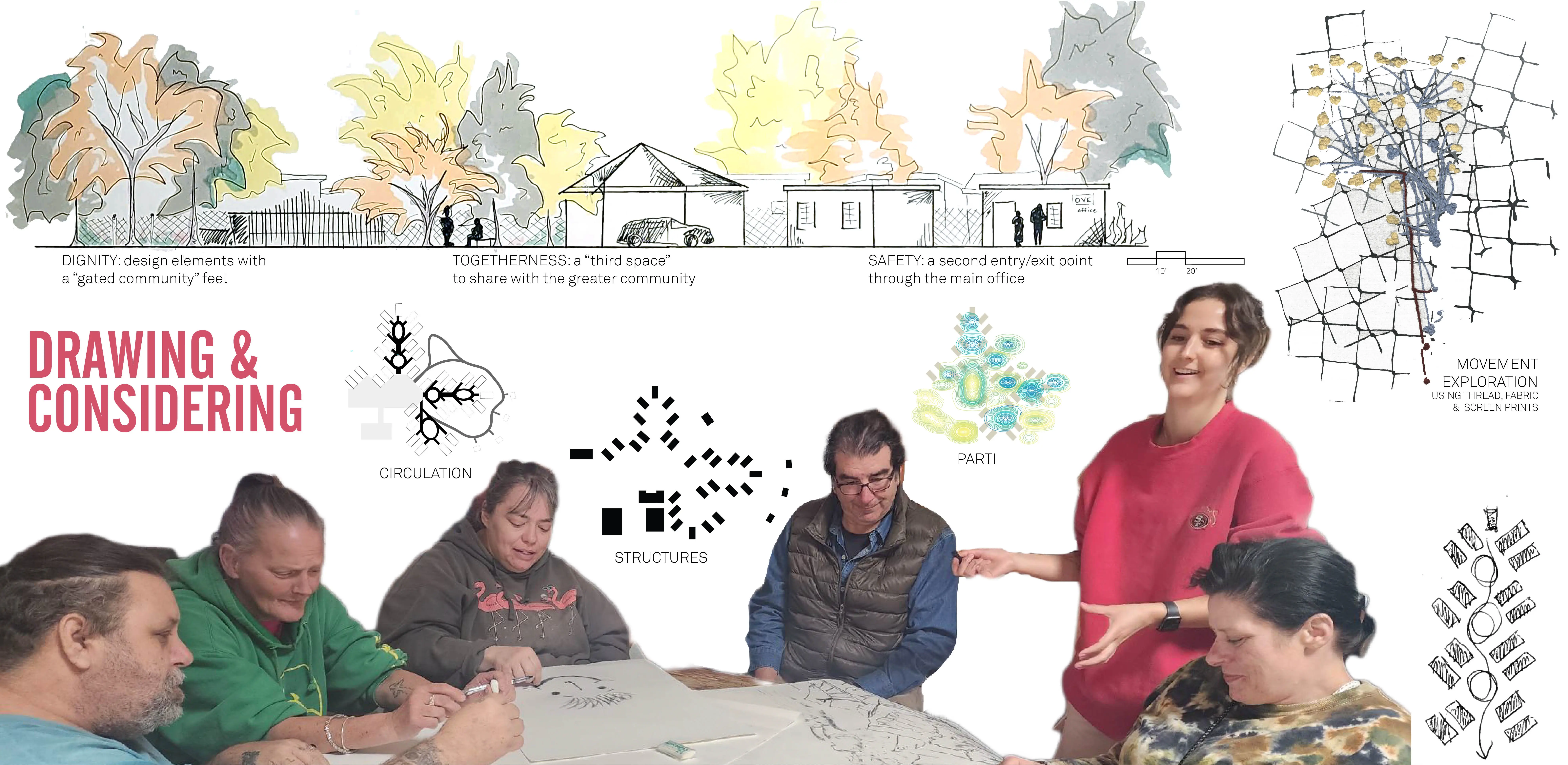
Our work started with engagement. We focused on building trust and understanding. Knowing how challenging and difficult engagement can be, especially in communities other than ours, we set up ground rules. We dedicated as much time as we could to being the village. We would “show up” the way one shows up to a friend’s houses – on time and remembering we were guests. We would put dignity and kindness first. We would be good friends, listen to their problems, and help them think of solutions. At a tactical level, we studied ideas in Design for Democracy (de la Pena et al, 2017) and revised them for the unique community characteristics. To allow for non-linear thinking and connections, we used screen prints instead of research papers to present our findings.
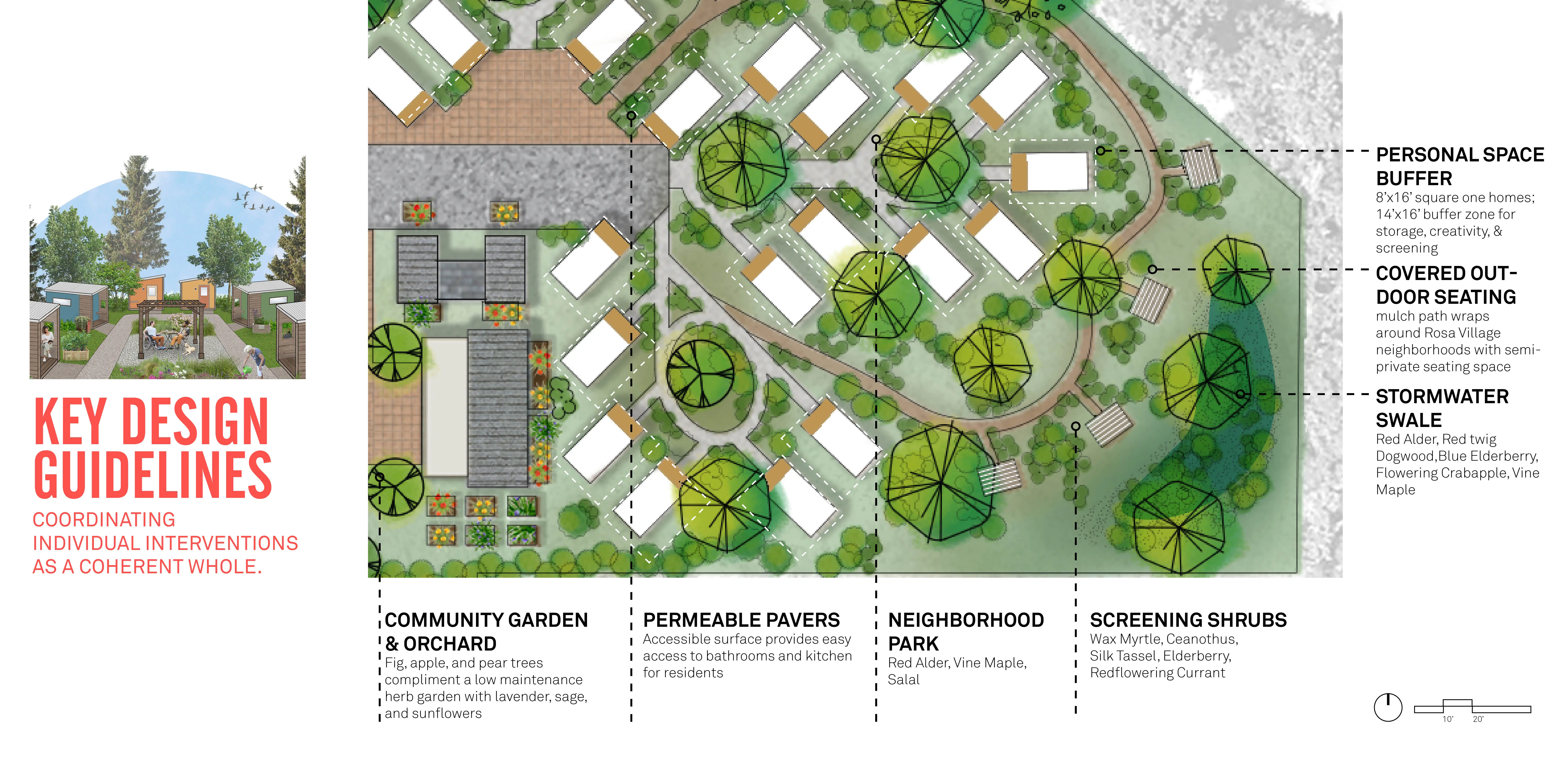
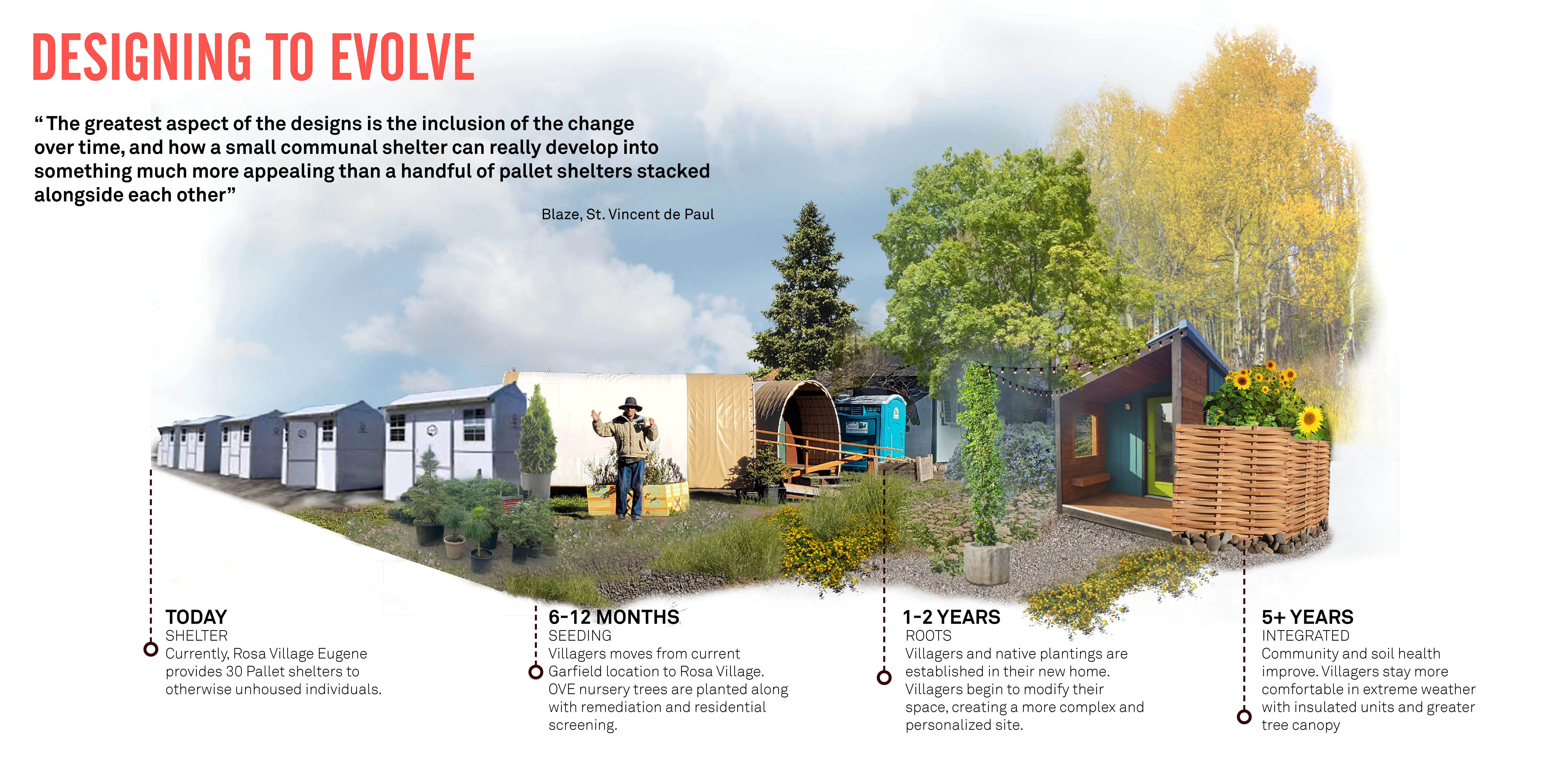
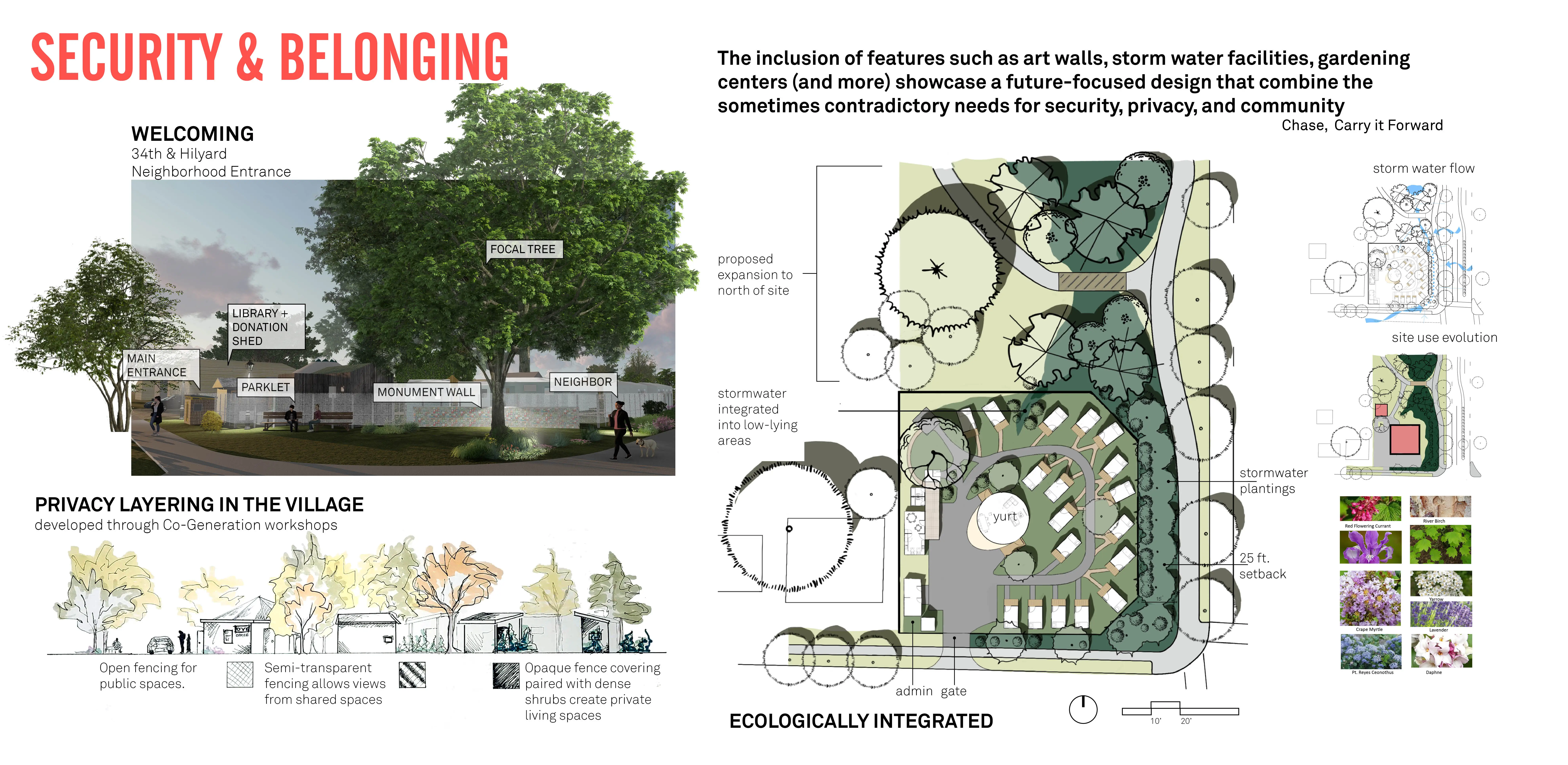
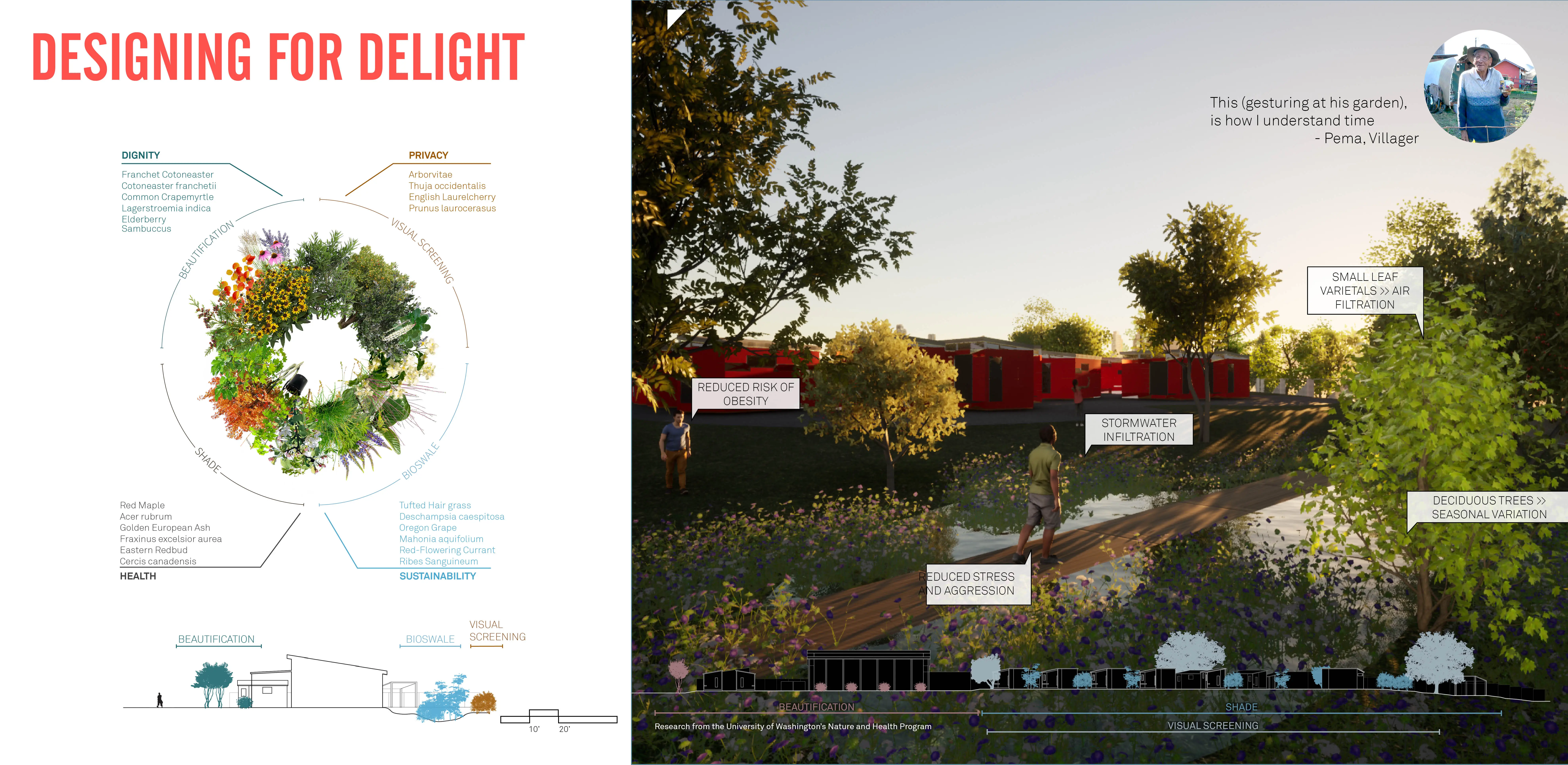
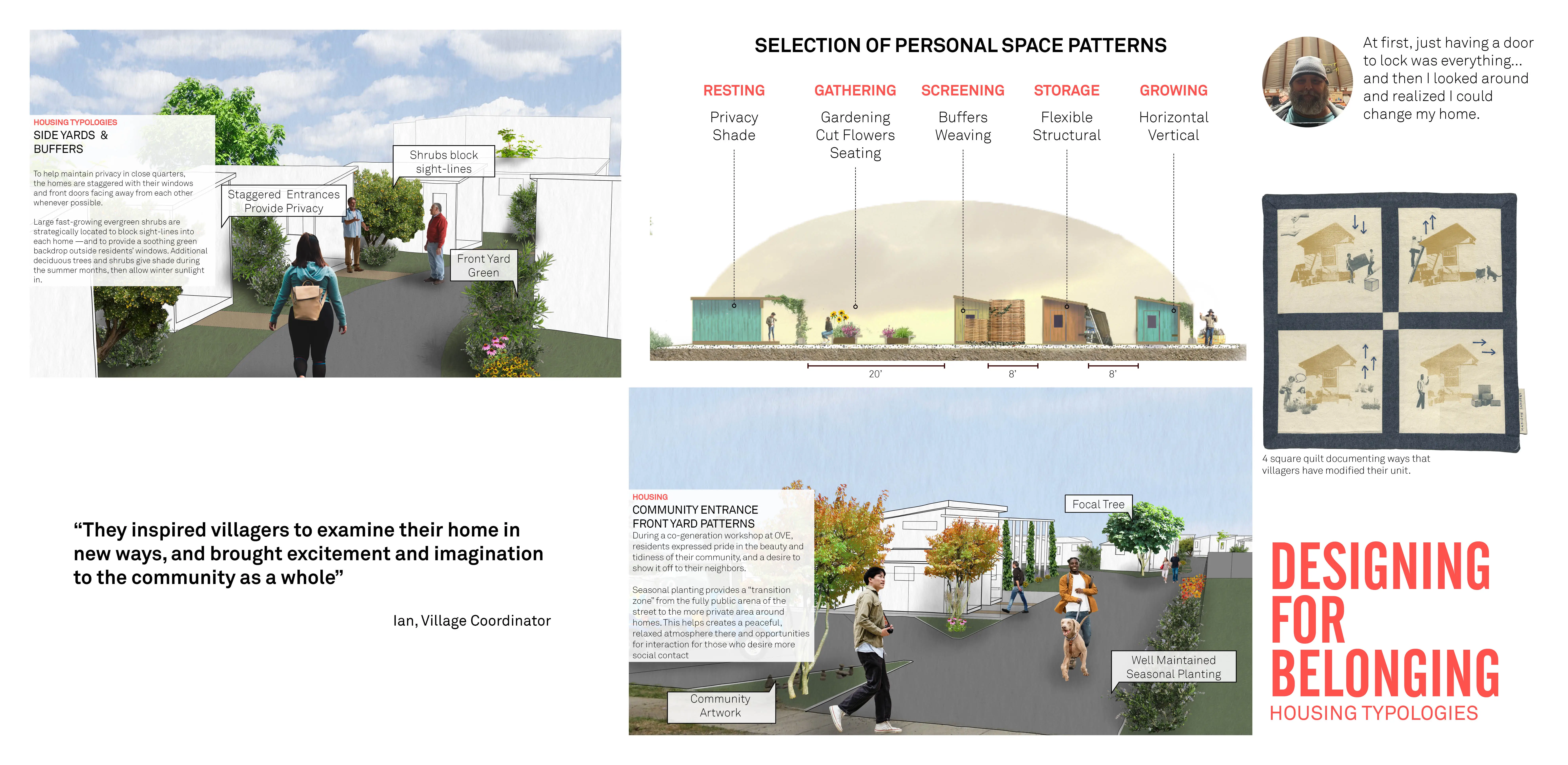
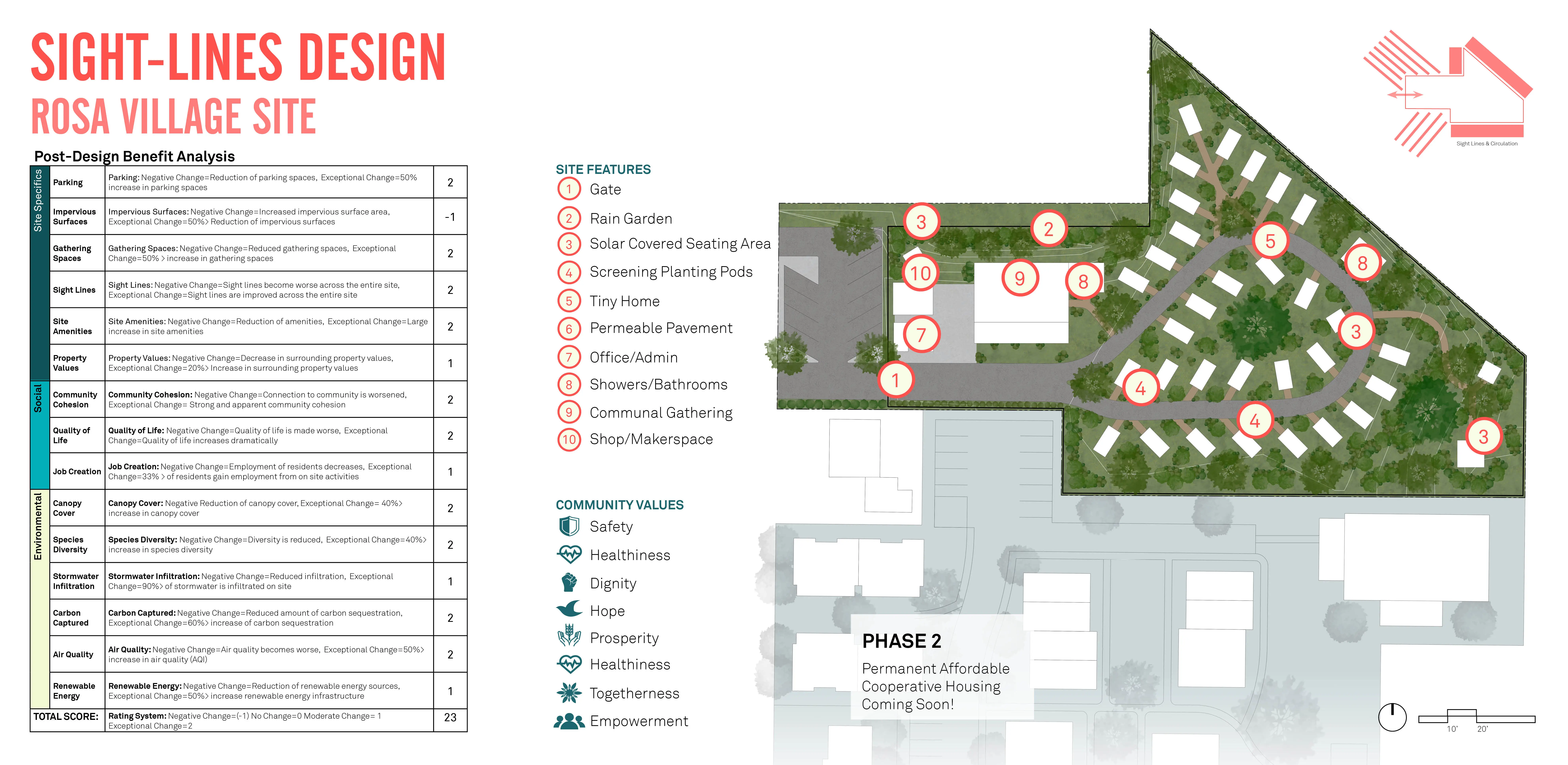
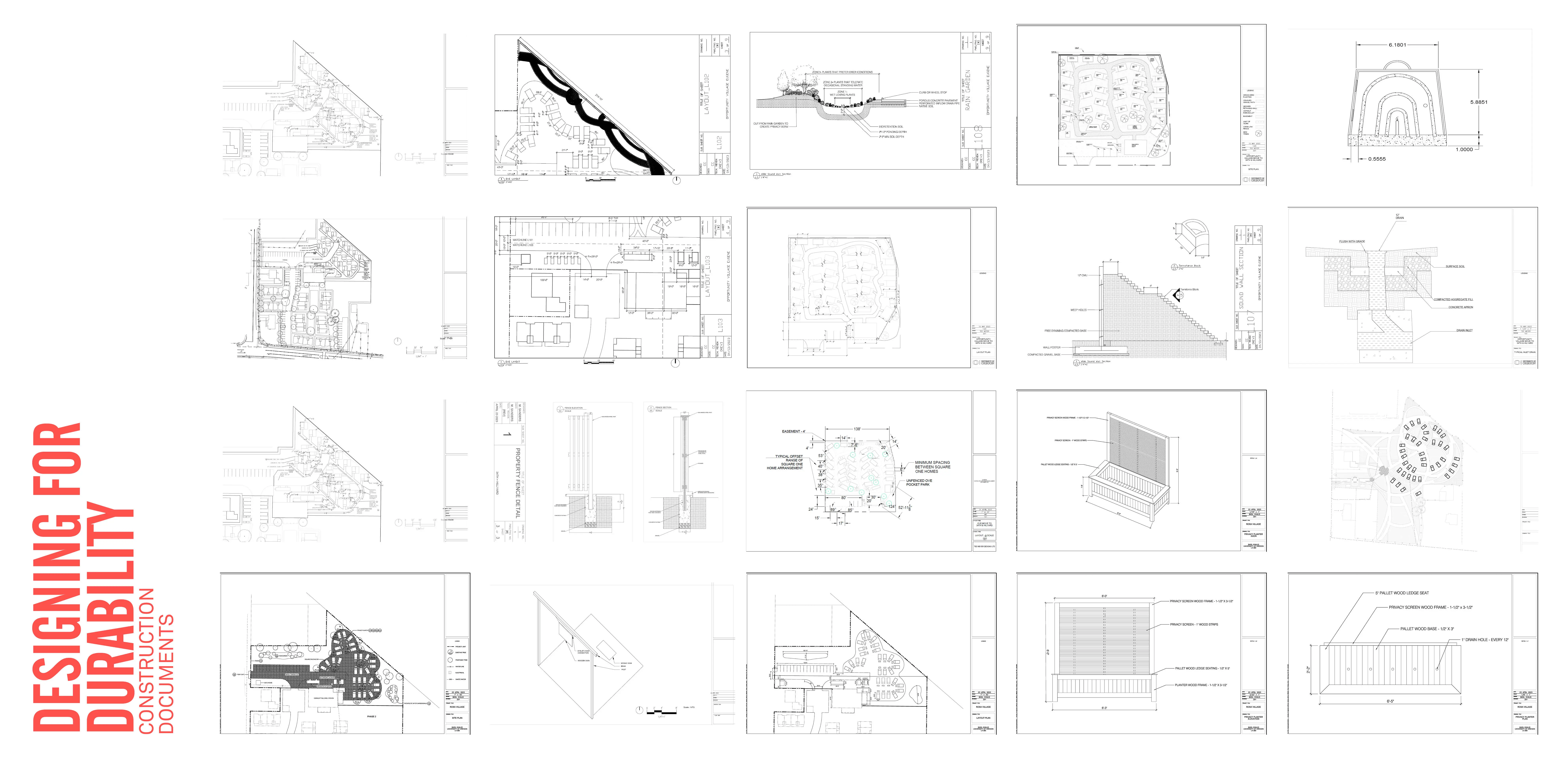
The design phase combined our education, community co-design, and the practicalities of the situation. We visited other tiny home / otherwise houseless communities. We met with the designers of pallet shelters and community supported shelters. We met with local leaders and village coordinators. We got advice from Jared McKnight (2021 ASLA Student Award Winner). We learned that providing as many beds as possible, as quickly as possible, was critical. So, we created site plans that maintain 30 dwelling units per acre - while also providing villagers with needed privacy. Because city designers usually only have a few days for each design – we create multiple site plans and typologies for planting, housing, open space, lighting, and security. Knowing that transient communities are usually placed on sites with high climate change risk, we drew up designs for stormwater capture, heat mitigation, and soil remediation. To reinforce the value of landscape - we clearly listed the multitude of design benefits (aesthetics, economic, cultural, ecological, physically, and mentally). Finally, we developed construction documents. Our sets are currently being reviewed by a panel of people (including registered landscape architects, architects, villagers, and City officials). We are looking forward to seeing our designs be built this Fall.
The design of transient communities typically focuses on efficiency. They fail to design for unique interconnections and interplays. Our approach focuses on sensitively working and designing with our vulnerable friends – creating more nuanced ways to organize territories, ecosystems, network, and infrastructure. The designs deconstruct community and housing concepts, while meeting objectives from the city, developer, and community. Permeating the village, our designs seek to redefine the relationship between villagers and the environment – supporting a rhythm of time and creativity.
-
- Geraldo - Key Community Advocate
- Teresa - Key Community Advocate
- Daniel - Key Community Advocate
- Brian - Key Community Advocate
- Charlene - Key Community Advocate
- Pema - Key Community Advocate
-
- California Incense Cedar (Calocedrus decurrens)
- Common Crapemyrtle (Lagerstroemia indica)
- Corneliancherry Dogwood ( Cornus mas)
- Coast Silktassel (Garrya elliptica)
- Dwarf Fothergilla ( Fothergilla gardenii)
- Russian Sedge (Perovskia atriplicifolia)
- Purple Coneflower ( Echinacea purpurea)
- Chinese Catalpa (Catalpa ovata)
- Black Hawthorn ( Crataegus douglasii)
- Common Fig (Ficus carica)
- Ironwood (Parrotia persica)
- California Wax Myrtle (Myrica californica)
- Strawberry madrone (Arbutus undeo)
- Feather Reed Grass (Calamagrostis x acutiflora ‘Karl Foerster’)
- Coast Silktassel (Garrya elliptica)
- Laurstinus Viburnum (Viburnum tinus)
- Douglas fir (Pseudotsuga menziesii)
- Rosemary (Rosmarinus officinalis)
- Bloodtwig Dogwood (Cornus sanguinea ‘Midwinter Fire’)
- River Birch (Betula nigra)
- Dwarf Oregon Grape (Mahonia aquifolium ‘Compacta’)
- Red-Flowering Currant (Ribes Sanquineum)
- Rush (Juncus sp)
Related Awards
Honor Award, Residential Design
Trinity Road
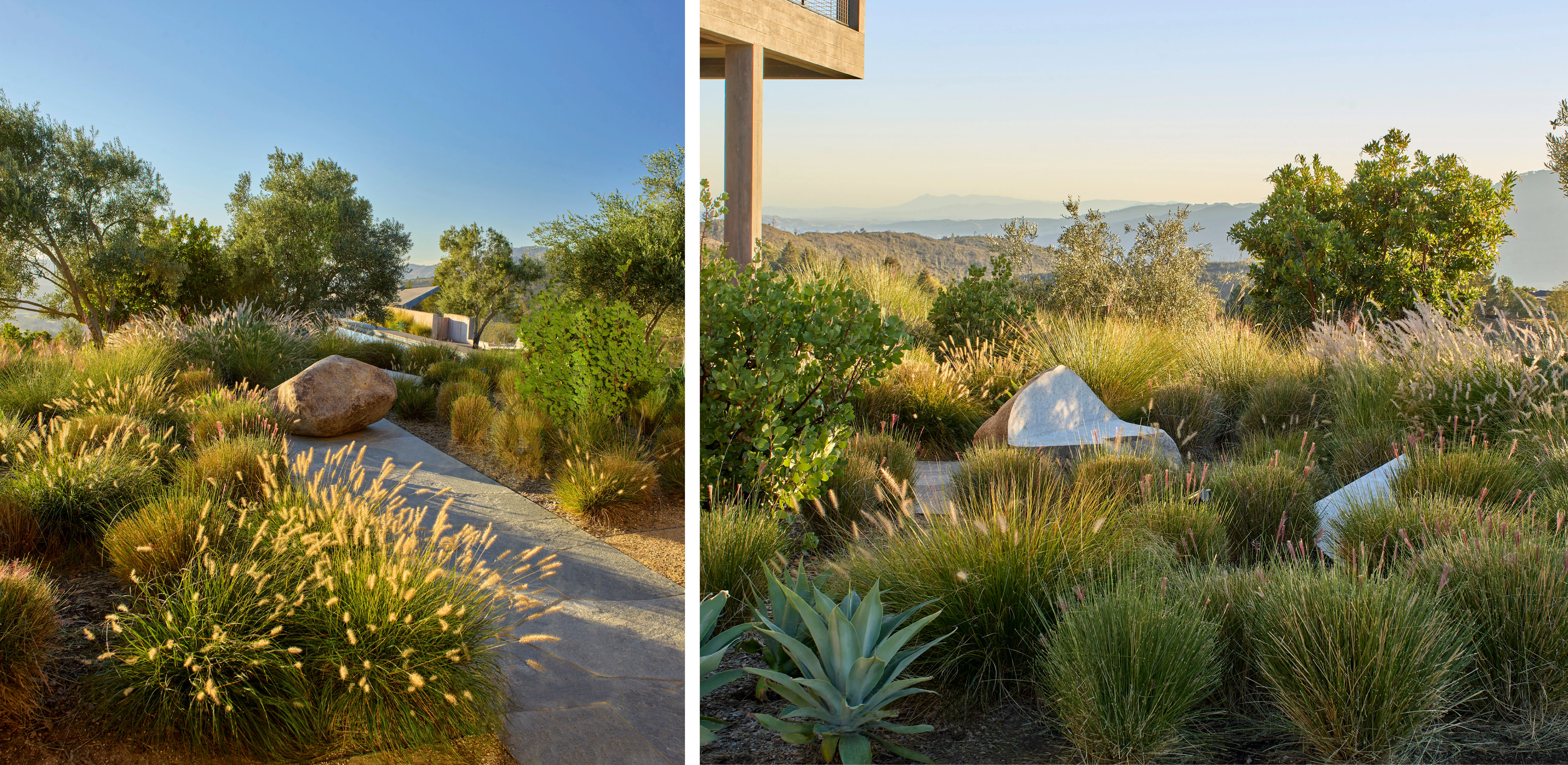
The story of Trinity Road unfolded over the past five years and is fundamentally a story of fire resilience and succession of the surrounding forest. The garden was designed and the project considered completed when two wildfires ravaged the hills immediately surrounding the site. After the fires the landscape design team was brought in to create a new vision for the site that knit together the original planting and a new series of paths and gardens.