

.webp?language=en-US)

Advertisement
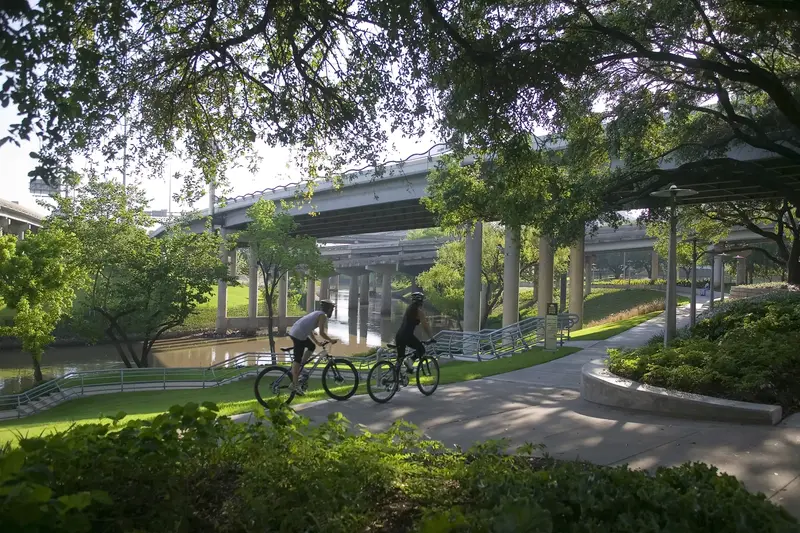
Transportation Planning and Design
Landscape architects help communities by designing safe, accessible, integrated transportation networks for all users, regardless of age, mobility, income, ethnicity, or mode of transportation. These multi-use transportation systems reduce reliance on a single-use automotive transport, which in turn reduces traffic, improves air quality, and promotes a healthy way of life. ASLA works with policymakers to support transportation for all.
Transportation Alternatives Program
-
ASLA supports policies that promote the design, construction, and management of transportation corridors and facilities that enhance public health and safety and promote interconnected transportation options for transit riders, pedestrians, bicyclists and other micromobility users.
-
The Transportation Alternative (TA) program was created in 1991 under the Intermodal Surface Transportation Efficiency Act of 1991 (ISTEA). Since then, the program has been the nation’s largest dedicated source of funding for bicycling, walking, and trails projects. Over time, TA has been known by several names and is currently a set-aside under the Surface Transportation Block Grant Program, which also may be referred to as the Transportation Alternatives Set-Aside (TASA).
Administered by the Federal Highway Administration (FHWA), TA provides funding to states for alternatives to single-occupancy vehicles, including on- and off-road pedestrian and bicycle facilities. TA funding may also be used for improvements to transportation assets. TA provides funds to state departments of transportation and metropolitan planning organizations for:
- Pedestrian and bicycle facilities
- Safe Routes to School program
- Recreational Trailsprogram
- Vegetation management practices in transportation rights-of-way to improve roadway safety, prevent invasive species and provide erosion control
- Stormwater mitigation in rights-of-way.
- Wildlife management
- Scenic turnouts and overlooks
- Historic preservation and rehab of historic transportation facilities
TA was reauthorized under the Infrastructure Investment and Jobs Act (P.L. 117-58, November 15, 2021) at roughly $1.44 billion annually, increased from about $850 million under the previous authorizing bill (MAP21, P.L. 112-141, July 21, 2012). The current reauthorization bill is set to expire in September 2026, at which time Congress must pass a new surface transportation law that includes TA.
Landscape architects are leaders in designing bicycle, pedestrian, and trail projects across the nation, and the profession accesses TA to plan and design these critical infrastructure projects. In a 2024 ASLA survey, members reported that they overwhelmingly access TA and other federal active transportation programs to build community projects in our state and across the nation.
-
On May 22, 2026, in a 62-2 vote, the House Transportation and Infrastructure Committee approved H.R. 8870, the BUILD America 250 Act, a five-year surface transportation reauthorization bill. The measure must now go to the full House of Representatives for a floor vote.
The Senate has not considered its version of a five-year surface transportation reauthorization bill.
-
- Transportation Alternatives Program: Talking Points | Leave Behind
- Landscape Architects Design Transportation Networks (Leave Behind)
- ASLA Sustainable Transportation Guide
- The Role of Landscape Architects in Roadway Design Projects, December 2024
- Transportation Alternatives Data Exchange (TrADE)
- FHWA -Transportation Alternatives Fact Sheet
- Complete Streets Issue Brief
- Dangerous by Design 2026 Report
- LAF’s Landscape Performance Series Case Study Briefs - Transportation
- House Transportation & Infrastructure Committee
- Senate Environment and Public Works Committee
Bike-Ped Funding in Jeopardy—Act Now!
Building Safer Streets Act (Updating the MUTCD)
-
The American Society of Landscape Architects (ASLA) supports legislation that creates multi-modal transportation systems that are safe, efficient, beautiful, ecologically sensitive, convenient, address climate change, support public health, and serve all people and modes of transportation.
Currently, many transportation policies, regulations, and design guides prevent transportation professionals from planning and designing rights-of-way that are safe for all users, resulting in increased fatalities and injuries. ASLA and its members work to update policies, regulations, and design guides that lead to safe rights-of-way for all users. ASLA is a founding member of the National Complete Streets Coalition whose mission is to promote the development and implementation of policies and professional practices that ensure streets are safe for people of all ages and abilities, balance the needs of different modes, and support local land uses, economies, cultures, and natural environments. -
Transportation corridors and facilities are major components of the nation’s landscape and public realm that connect, shape, and transform our communities. Transportation infrastructure is a vital part of public life, connecting individuals to families and friends, jobs and businesses, education, and recreation. Additionally, multimodal transportation systems reduce reliance on single-use automotive transport, which in turn reduces traffic, improves air quality, reduces carbon emissions, decreases vehicle wildlife collisions, and promotes a sustainable way of life.
While driving has decreased, the number of people injured and fatalities due to walking and bicycling incidents is at a record high – mainly due to outdated and poorly designed transportation infrastructure. The elderly and residents of low-income neighborhoods are at an increased risk of preventable incidents compared to individuals in other communities.
The Manual on Uniform Traffic Control Devices (MUTCD) plays a critical role in transportation infrastructure as it contains the national standards governing all traffic control devices, including setting minimum standards, providing guidance, and ensuring uniformity of traffic control devices across the nation. While the most recent version of the MUTCD includes some updates to improve safety for pedestrians, bicyclists, and road users, updated and improved design standards and guidelines are needed to effectively improve transportation infrastructure and make our streets safer for all.
Landscape architects are uniquely qualified to implement innovative design standards and interpret the MUTCD to create safe, accessible, and equitable active transportation networks. Landscape architects plan and design multimodal transportation projects in a manner that protects the public’s health, safety, and welfare, while also addressing other community needs. -
On November 7, 2023, Senator John Fetterman (PA) introduced S. 3246, the Building Safer Streets Act. This measure would update regulations, including the MUTCD, to improve street infrastructure that prioritizes multimodal development and pedestrian safety.
Specifically, the Act would:- Update the MUTCD to require the Government Accountability Office to conduct a study on how transportation professionals use the MUTCD.
- Update federal design standards and guidelines to consider surrounding land use of roads or highways.
- Provide design guidance regarding transit facilities and associated roadway design that considers safety, accessibility, and equity.
- Provide design guidance for multimodal streets while considering the distinct needs of urban, rural, and suburban roads.
- Prioritize designs that ensure all users have access to safe, comfortable, reliable, and healthy transportation options.
- Direct the Federal Highway Administration (FHWA) to develop recommended categorical design exceptions for multimodal projects and features.
- Update the Safe Streets for All (SS4A) program to provide a minimum amount of dedicated funding to small and rural communities.
-
On November 7, 2023, S. 3246 was introduced and referred to the Senate Committee on Environment and Public Works.
-
Senator John Fetterman (PA), and cosponsors.
-
The Bradford Era: Fetterman introduces bill to make American streets safer. November 9, 2023.
Safe Streets and Roads for All (SS4A) Grant Program
National Complete Streets Coalition
Dangerous by Design 2024 report
Letter to FHWA – Landscape architects are competent to interpret the MUTCD
Manual on Uniform Traffic Control Devices (MUTCD)
U.S. Access Board Issues Final Rule on Public Right-of-Way Accessibility Guidelines
GREEN Streets Act
-
ASLA believes that multi-modal transportation systems should be safe, efficient, beautiful, ecologically sensitive, convenient, address climate change, support public health, and serve all people and modes of transportation. Landscape architects are trained and uniquely qualified to plan and design multi-modal transportation networks that provide users with cost efficient transportation options, while also addressing other community needs.
-
Our nation’s transportation system is the backbone of our economy and critical to supporting the daily needs of all Americans. It also having adverse impacts on our daily lives, contributing to congestion, polluted stormwater runoff, poor air quality, and climate change. Currently, the transportation sector is one of the largest contributors to U.S. greenhouse gas (GHG) emissions. According to the Inventory of U.S. Greenhouse Gas Emissions and Sinks 1990–2022 (the national inventory that the U.S. prepares annually under the United Nations Framework Convention on Climate Change), transportation accounted for the largest portion (28%) of total U.S. GHG emissions in 2022. Cars, trucks, commercial aircraft, and railroads, among other sources, all contribute to transportation end-use sector emissions.
ASLA works with policy makers, state and local governments, and communities across the nation to promote increased active transportation projects. Active transportation modes like bicycling and walking produce zero carbon emissions and provide individuals and families with low-cost, healthy transportation options. -
Senator Edward Markey (MA) introduced S. 3669 and Representative Jared Huffman (CA) introduced H.R. 7286 as the Generating Resilient Environmentally Exceptional National (GREEN) Streets Act of 2024. This legislation:
- Directs the Secretary of Transportation to establish minimum standards for states to use to decrease greenhouse gas emissions and per capita vehicle miles traveled (VMT) on the national highway system;
- Directs the Transportation Secretary to establish measures that states can use to assess and reduce carbon dioxide and other greenhouse gas emissions on the national highway system;
- Requires states that have fallen out of compliance with the per capita VMT standards or carbon dioxide or greenhouse gas emission measures to dedicate federal highway funding to come into compliance;
- Requires states and Metropolitan Planning Organizations (MPOs) to consider projects and strategies that reduce per capita VMT and reduce greenhouse gas emissions from the transportation sector; and
- Requires states and MPOs to publish an analysis of the impact on per capita VMTs and mobile source greenhouse gas emissions for each project that adds new lanes or otherwise increases traffic capacity and costs more than $25 million.
-
S.2890, the GREEN Streets Act was introduced in the Senate on September 18, 2025 and referred to the Senate Committee on Environment and Public Works.
H.R. 5465, the GREEN Streets Act was introduced in the House of Representatives on September 18, 2025, and referred to the House Transportation and Infrastructure Committee's subcommittee on Highways and Transit.
-
S. 2890 Senator Edward Markey (MA) and cosponsors.
H.R. 5465 Rep. Jared Huffman (CA) and cosponsors.
-
Senator Edward Markey Press Release, 9-18-2025
Congressman Jared Huffman Press Release, 9/18/25
U.S. National Blueprint on Transportation Decarbonization
U.S. DOT Active Transportation Resources
EPA Fast Facts on Transportation Greenhouse Gas Emissions
ASLA Sustainable Transportation Guide
Complete Streets Act
-
ASLA believes that multi-modal transportation systems should be safe, efficient, beautiful, ecologically sensitive, and convenient. These qualities enable streets and roadways to serve all people and modes of transportation, support public health, and address climate resilience. Landscape architects are trained and uniquely qualified to plan and design multi-modal transportation networks that provide users with cost efficient transportation options, while also addressing other community needs.
-
Roadways should be designed for all users — including pedestrians, bicyclists, public transit riders, motorists, and persons with disabilities — to have safe, convenient, and comfortable access to transportation options. A Complete Streets approach integrates people and place in the planning, design, construction, operation, and maintenance of our transportation networks. This helps to ensure that our streets serve the full range of users, prioritize safety over speed, and support the sustainable and incremental development of local communities.
In 2023, the most recent year with federal data, 7,314 pedestrians were killed by motorists, marking one of the deadliest years. Designing more Complete Streets is critical to reversing this epidemic. Additionally, improving infrastructure and building more welcoming streets for all road users leads to higher rates of active transportation throughout communities. In turn, more frequent walking and bicycling supports the physical and mental health of community members.
ASLA is a founding member of the National Complete Streets Coalition, whose mission is to promote the development and implementation of policies and professional practices that ensure streets become safe for people of all ages and abilities, balance the needs of different modes, and support local land uses, economies, cultures, and natural environments. -
Senator Edward Markey (MA) introduced S. 1953, and Representative Steve Cohen (TN) introduced H.R. 3712 as the Complete Streets Act of 2025. This legislation would:
• Call on states to set aside five percent of their federal highway funding to create a “Complete Streets” program.
• Call on eligible entities that want to access funding to adopt a Complete Streets policy, participate in technical assistance, and create a prioritized plan for Complete Streets projects in their jurisdictions.
• Call on Metropolitan Planning Organizations (MPO) to certify that Complete Streets policies meet minimum requirements set out by the United States Secretary of Transportation.
• Call on the U.S. Secretary of Transportation, States, and MPOs to adopt design standards for federal surface transportation projects that provide for the safe and adequate accommodation of all users – including motorized and non-motorized users - in all phases of project planning, development, and operation. -
S. 1953, Senator Edward Markey (MA) and cosponsors.
H.R. 3712, Representative Steve Cohen (TN) and cosponsors.
Urge Congress to Support Complete Streets Legislation!
Transportation
Landscape architects design transportation systems that are safe, equitable, sustainable, and human-centered.