
.webp?language=en-US)
DUNESCAPE
Chelsea Andersson, Student ASLA; Olivia Bennett, Student ASLA; and Bradley Wells, Student ASLA
-
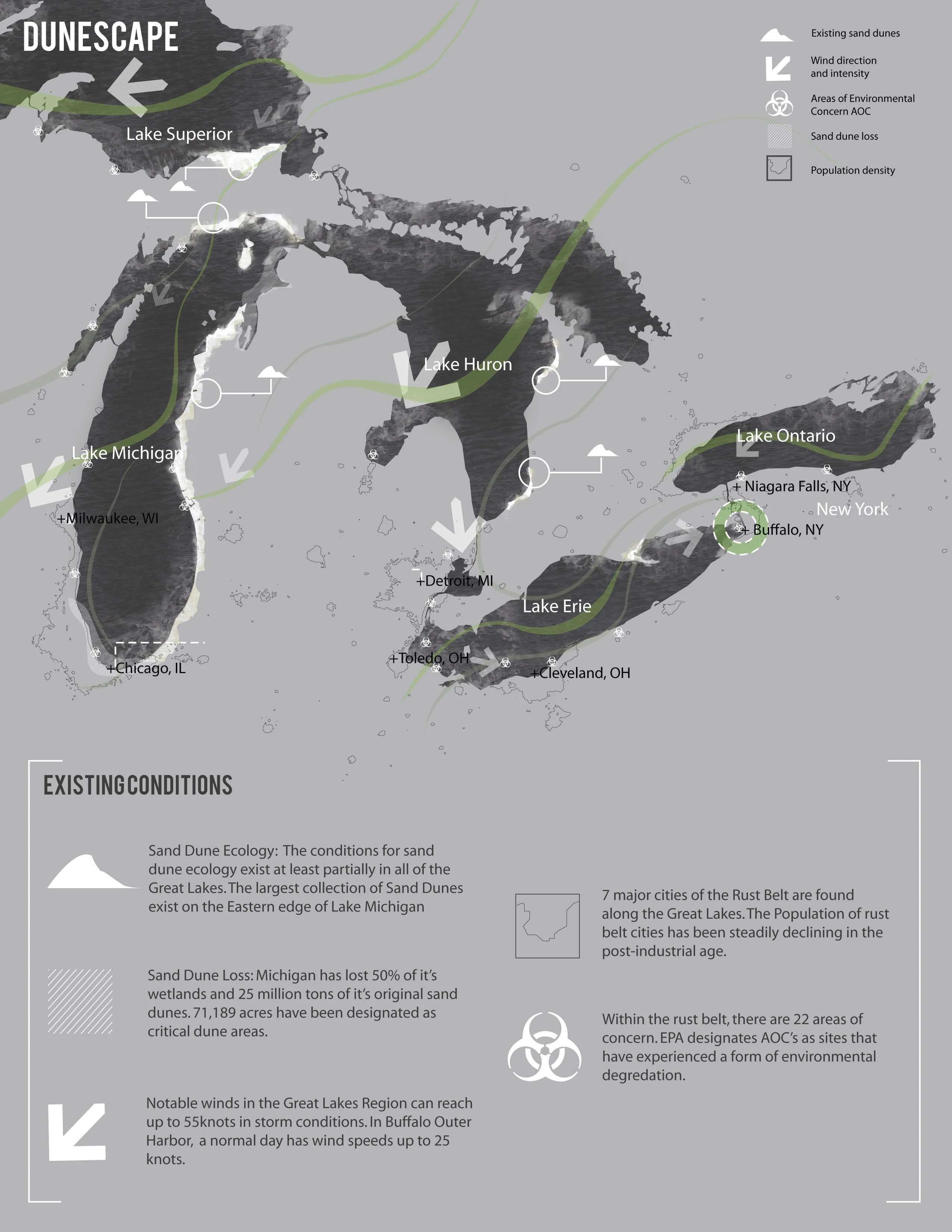
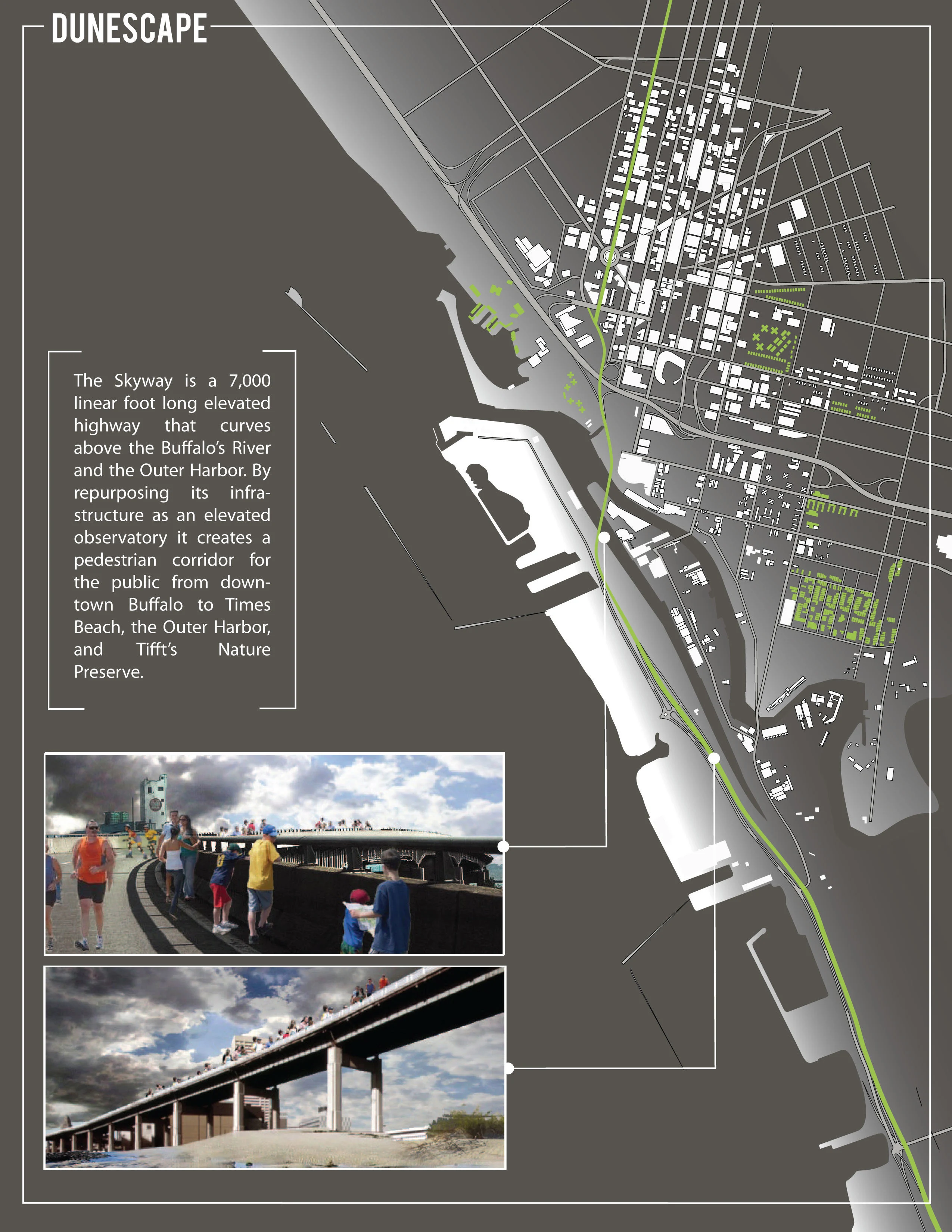
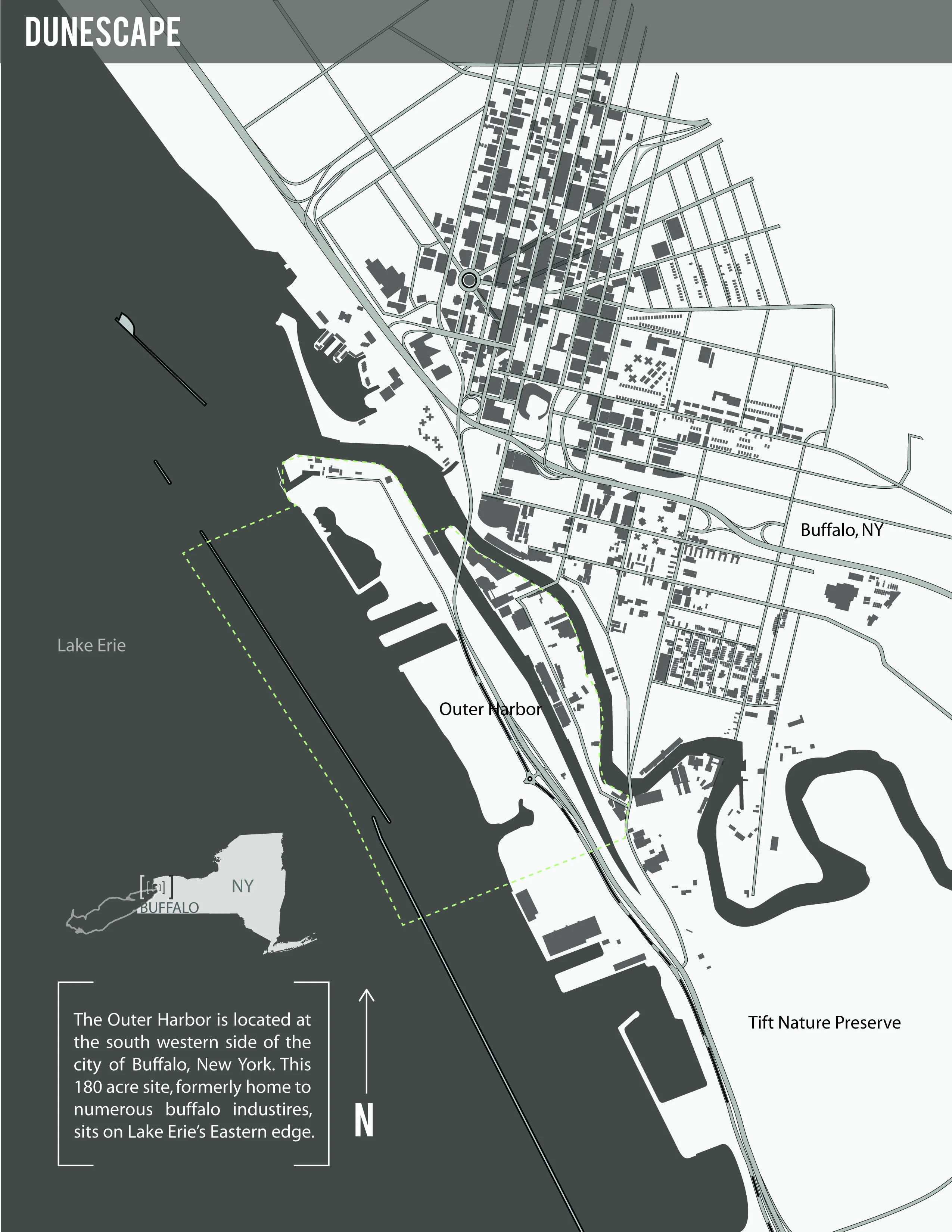
It is important to understand that redevelopment for any rust belt city should be conscientious of the unlimited time frame yet limited budget. Buffalo, New York was left with 180 acres of industrial wasteland along it’s outer harbor; a product of Erie Canal dredging. By utilizing existing site materials to create the foundations for an uninhibited landscape, and allowing natural systems to act upon it, the site becomes as “natural” as a man made site could ever be.
-
Buffalo’s Outer Harbor was once the center of the city’s shipping district. At this Western terminus of the Erie Canal, industry bloomed. The constant exchange made the city of Buffalo, New York, home to many major corporations. Manufacturers of steel, cement, copper, and other industrial materials made their livelihood on the city’s outskirts. They took advantage of this remarkable economic system and the ease with which they could receive, sell and dispose of their product.
The onset of globalization in recent years has left Buffalo struggling. Many once bustling water front cities grew stagnant as moves toward air and land transportation became more prevalent. Many industries that had once thrived in their location went bankrupt, leaving only contamination and vacant warehouses behind them.
Like many rust belt cities, Buffalo has had to radically re-plan in order to deal with hundreds of vacant properties, a struggling economy, acres of contaminated soils, and crumbling social and built infrastructure. While some areas have begun to see efforts of revitalization, the city will require years of input to reach its restoration potential.
Today, Buffalo is still required to dredge over 600,000 cubic yards of highly contaminated soil from the base of the Buffalo River. The city ships this soil to a combined disposal facility adjacent to the graveyard of Bethlehem Steel, a once major industry in buffalo and huge contributor to the pollution.
The city has no output from the transportation of these contaminated soils. In the CDF the soils occupy over 130 acres of property while they remain untreated, and unusable. There is no plan to revitalize this area of extreme toxicity.
The Outer Harbor itself occupies 180 acres, and over 10,000 linear feet of shoreline. In its current state, researchers have discovered elevated levels of metals, polychlorinated biphenyls (PCBs), polycyclic aromatic hydrocarbons (PAHs), and numerous other chemicals; with many hotspots of contamination exceeding recommended levels.
Industrial remains have scarred this landscape leaving flats of asphalt and concrete. These stagnate areas are impenetrable to plant life, and inhospitable to animals. Piles of illegal dumping give the only artifact of human presence. The only visitors pass from over 100 feet above on Buffalo’s outdated, and soon to be dismantled, elevated highway; the Skyway.
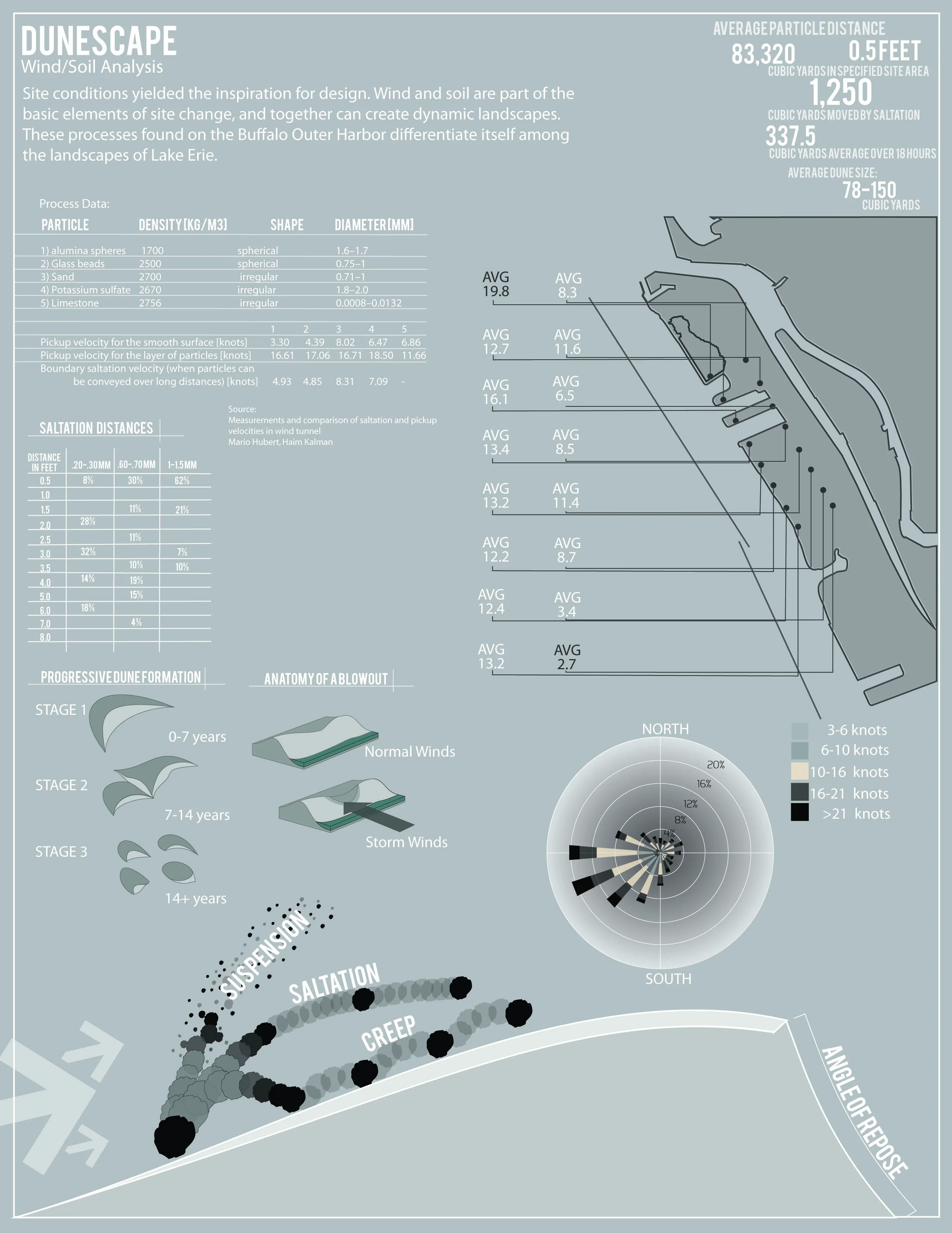
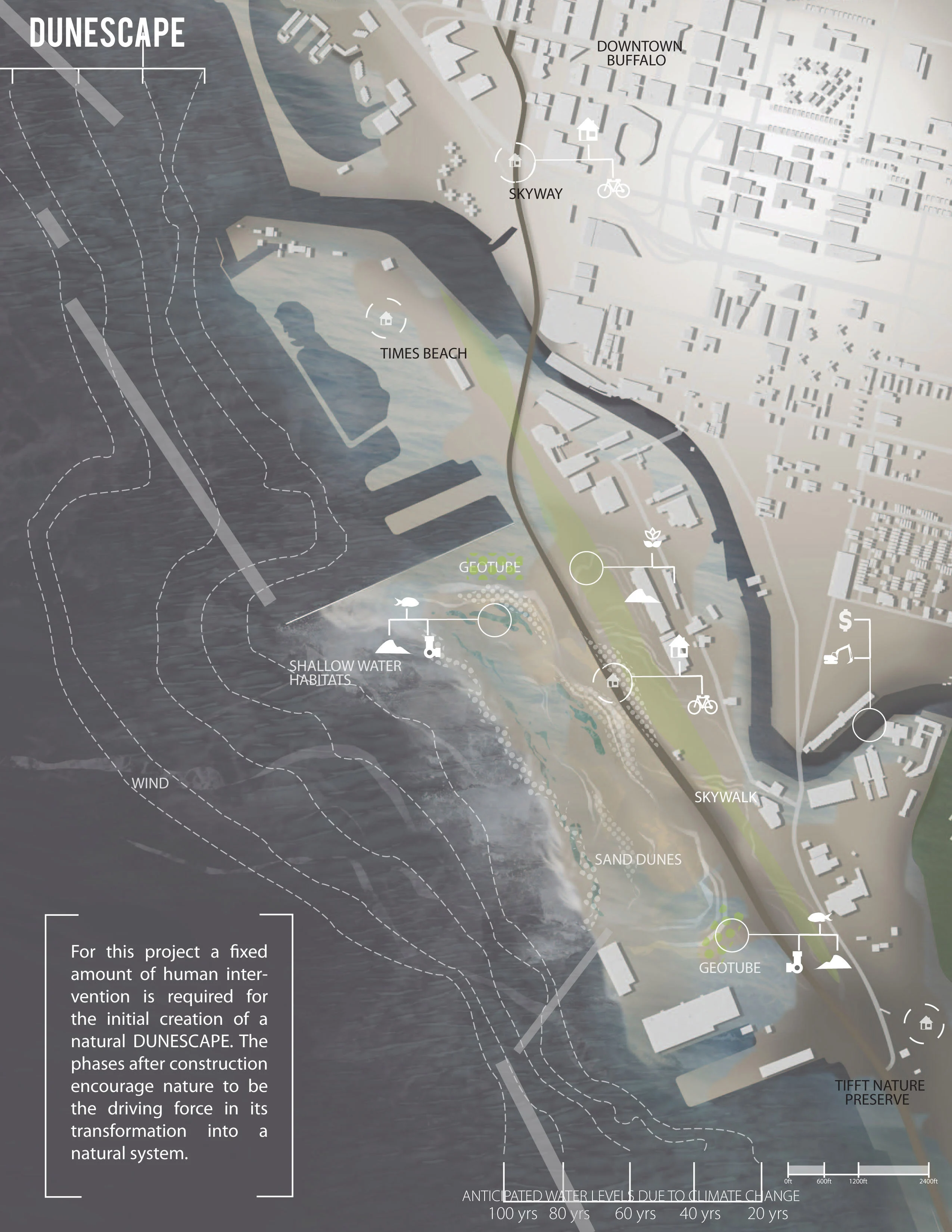
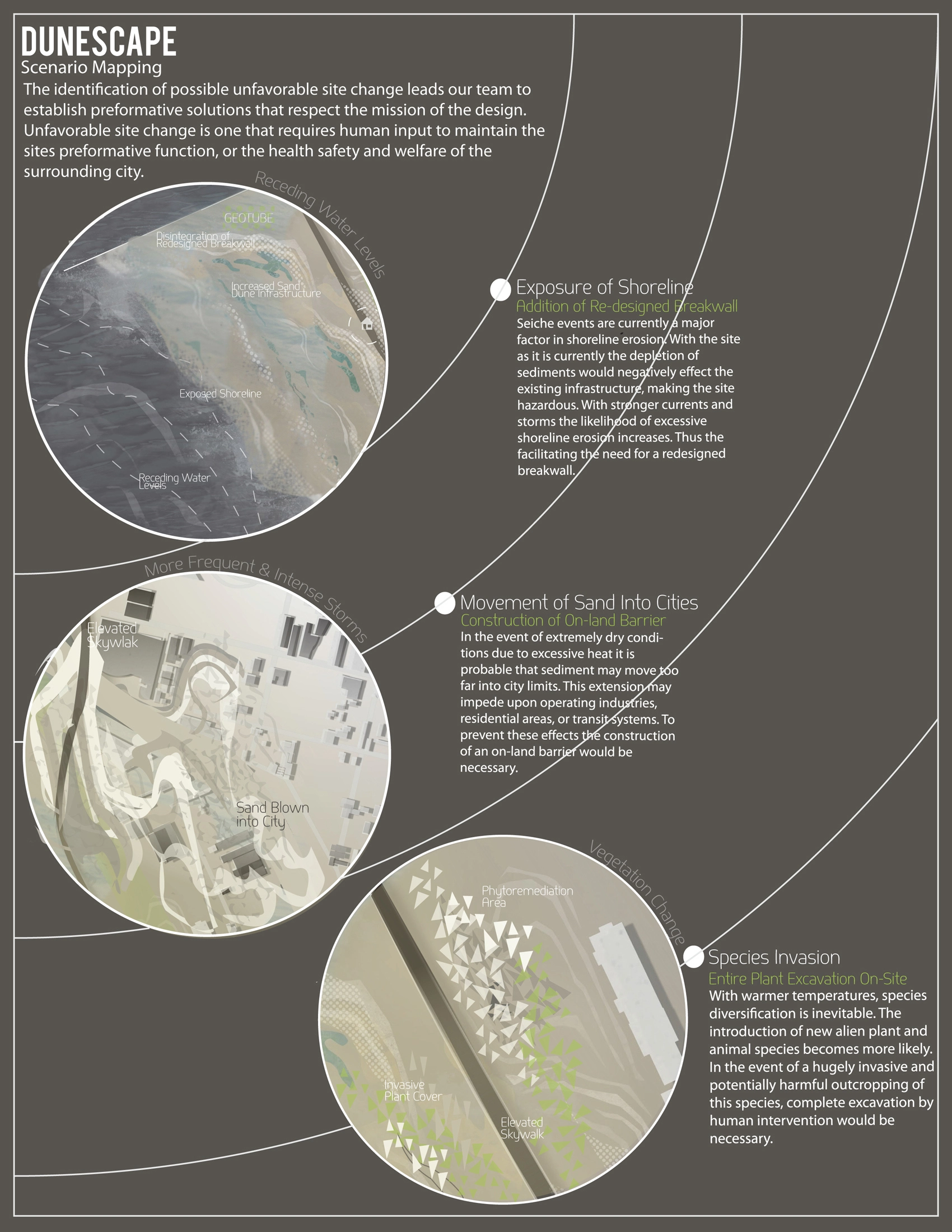
The site is a product of manmade landworks. It is the original output of soils moved in the creation of the Erie Canal. In this way, it has never known a “natural” landscape. It has even worked to shelter itself from a number of existing environmental conditions. Winds reach up to 24.5 knots on an average day. Storms are also frequent from turbulent Lake Erie, and annual “seiche” events. These events cause storm surges of up to eight feet, severely eroding the shoreline. The strong infrastructure of the break walls and 15 ft. bulkheads separate the site from nature even further.
Despite its appearance as a blank slate, this site has many extreme factors which work against design.One of the guiding principles of the effort to restore the Buffalo River is to allow the contaminant levels to be reduced to a point that would allow beneficial uses of sediments. The Buffalo River Restoration Partnership hopes to see future "beneficial re-use" of clean, dredged sediment for regional habitat and river restoration. Possible beneficial re-use opportunities include the use of dredged sediment for upland purposes, in-water restoration, or fill, rather than disposing of the sediment and taking up space in a CDF or landfill.
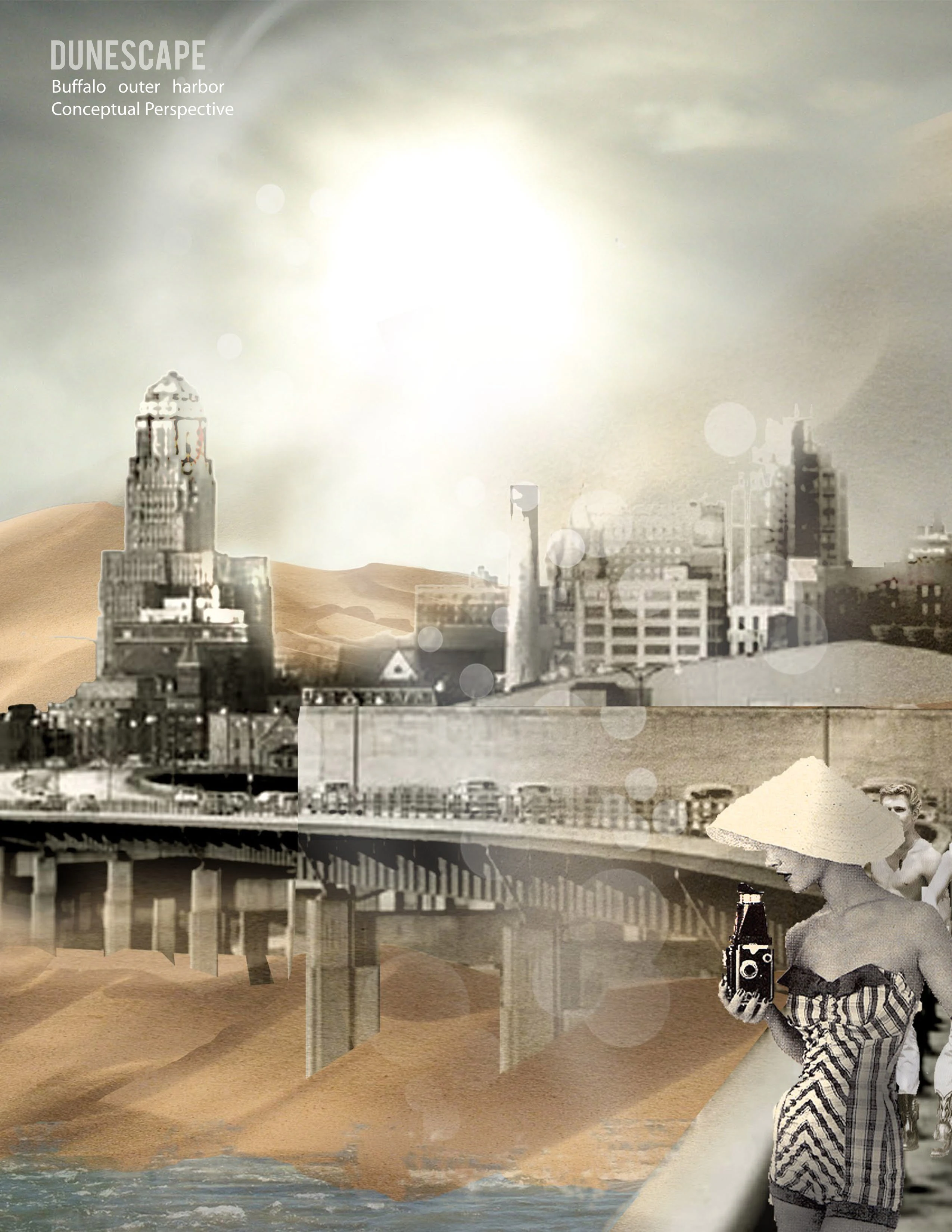
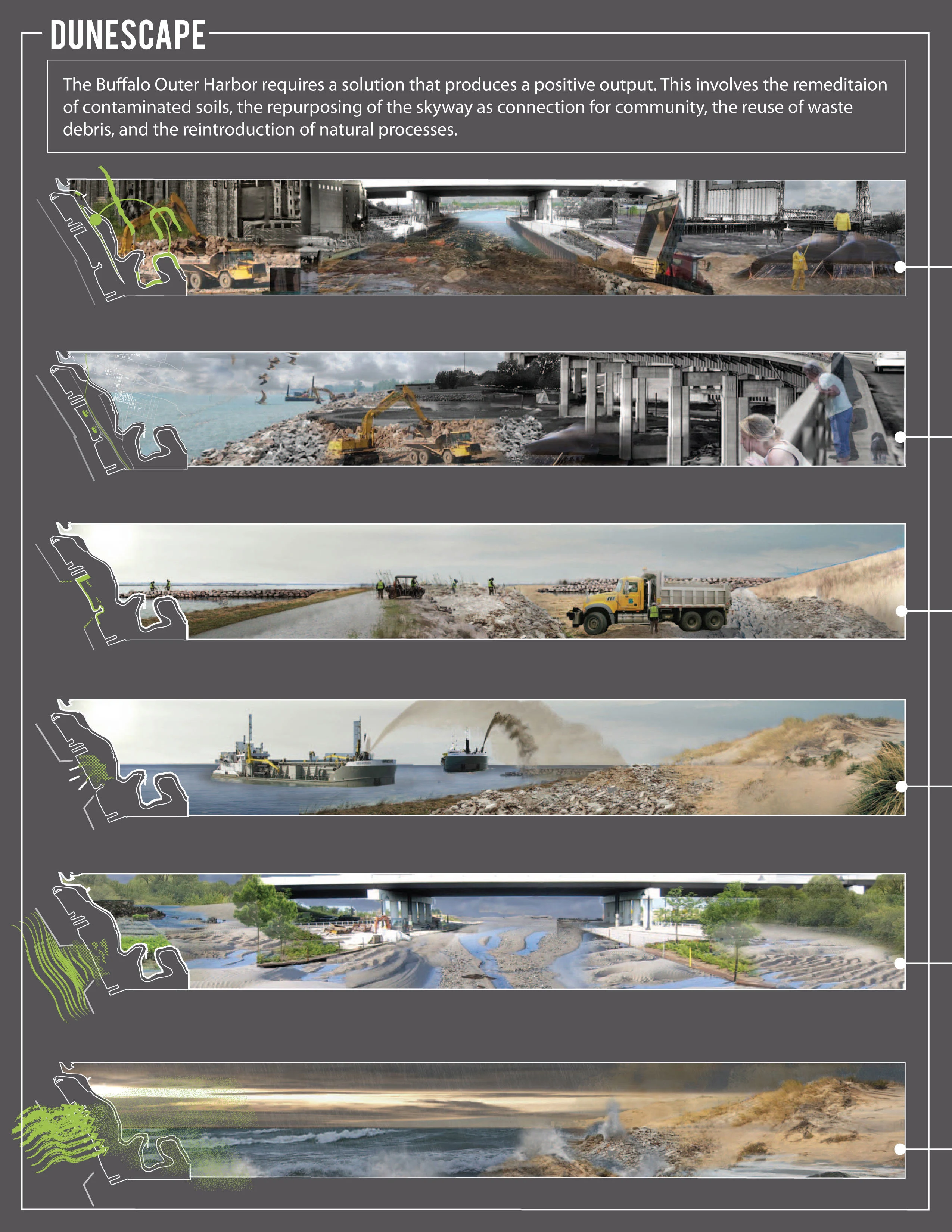
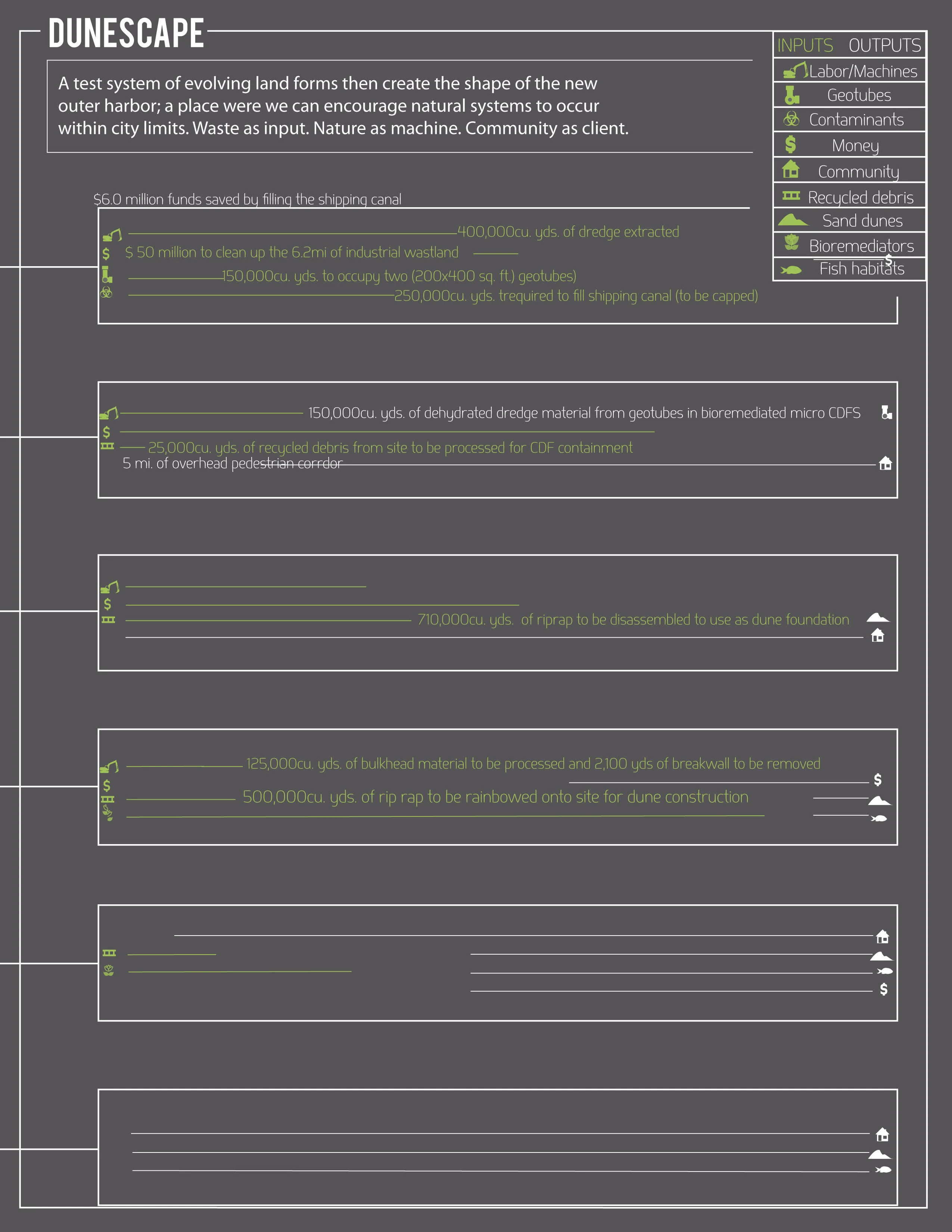
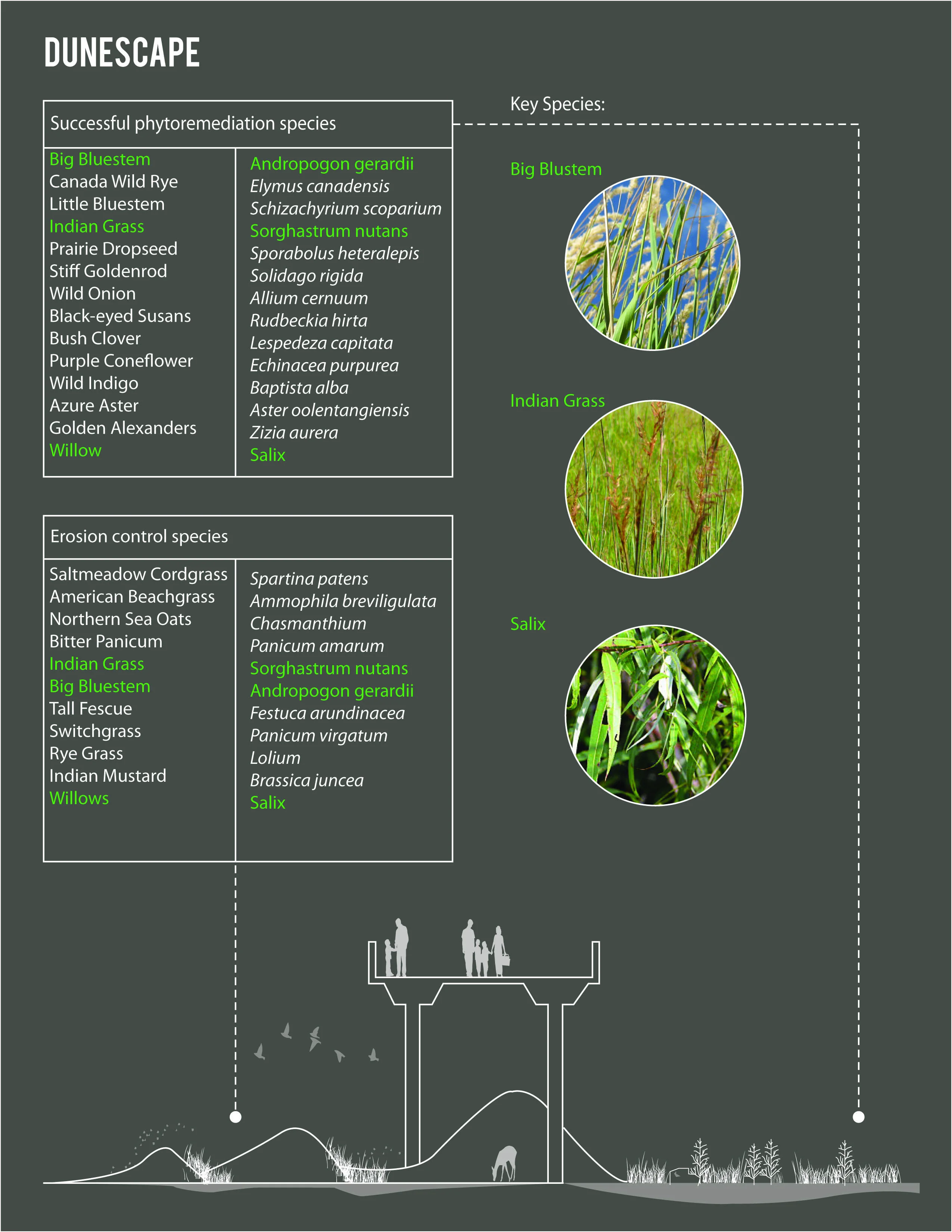
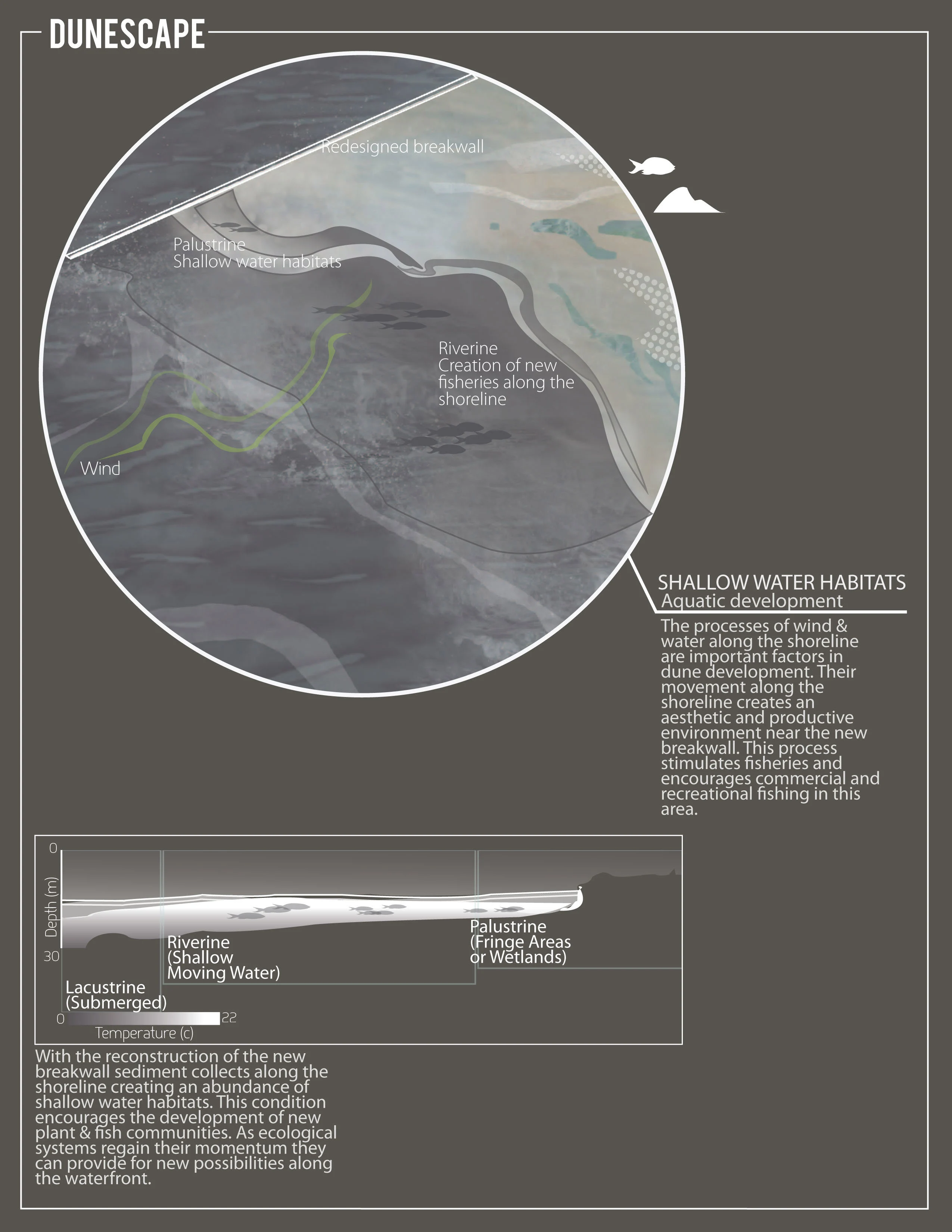
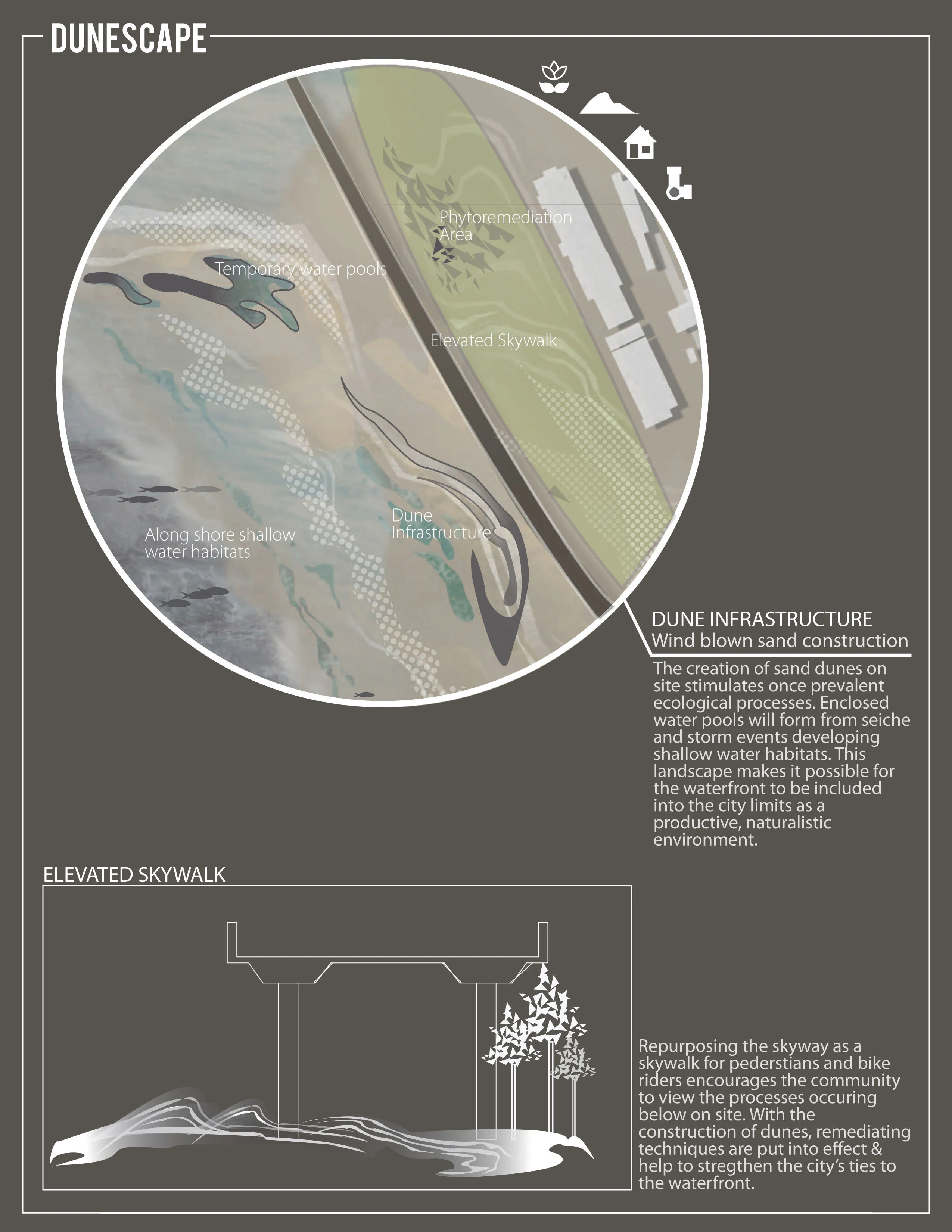
DUNESCAPE helps address these hopes by utilizing the contaminated soils to act as the foundation for diverse, and productive dune ecology, rather than remaining un-utilized in CDF #4. Over 450,000 cubic yards of material will be intercepted, re-distributed, and remediated on site, providing expanded usable area on the Buffalo Outer Harbor. Future navigational dredging, with soils more suitable to re-use form the substrate for a site-wide implementation of various forms of sand dunes. Thus, encouraging subsequent ecologies and habitats to form.
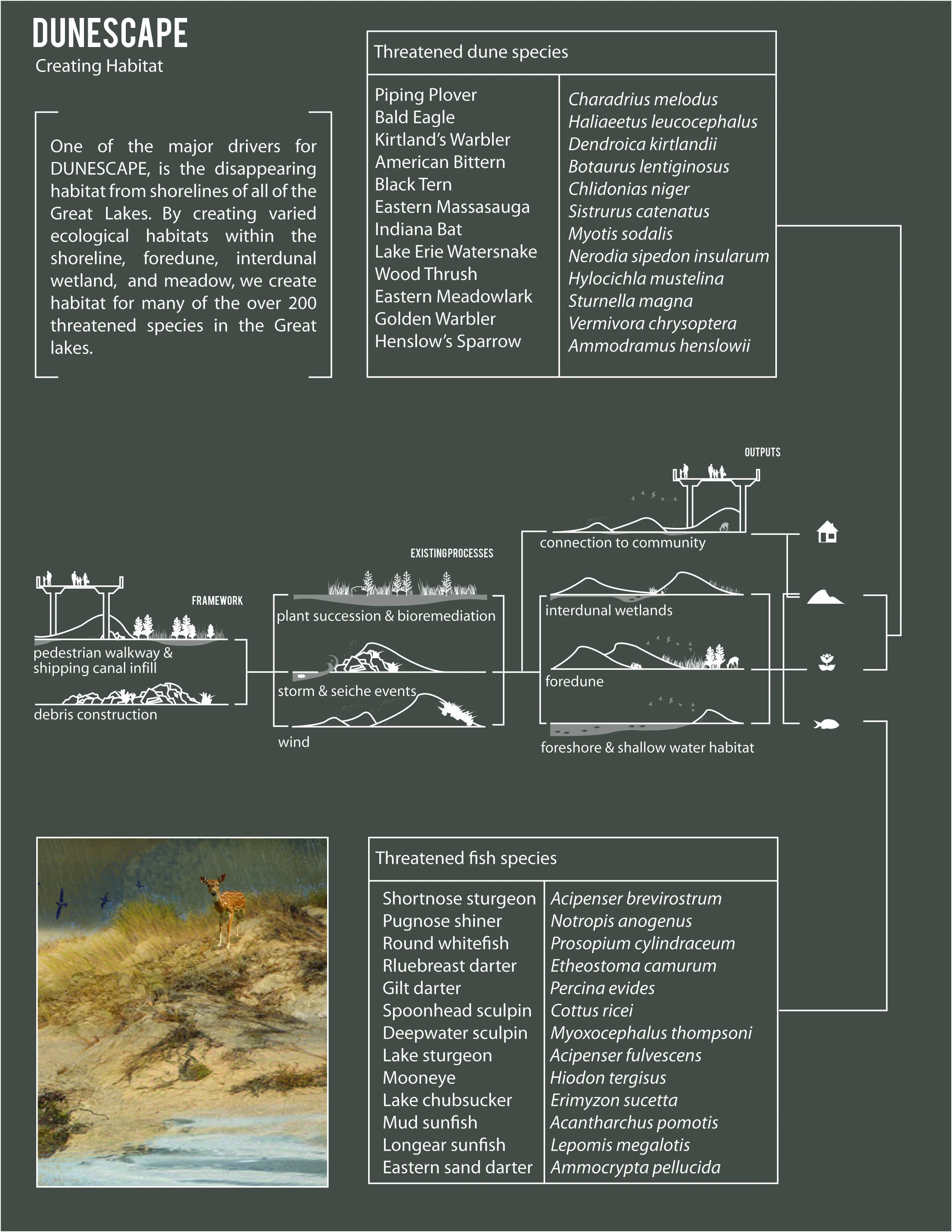
The establishment of this type of environment speaks directly to the strong, natural processes already present on the harbor; wind, seiche, and erosion; utilizing them for productive means. The resulting productivity of the site takes many forms. Increased shallow water habitat results from the removal of the costly breakwall adjacent to the site, with the dunes acting as shore stabilization measures. Pockets of reduced air velocity and vegetative growth promote the establishment of avian fauna, along with micro fauna capable of continued site remediation. The diverse nature of dunes make them an excellent attraction for travelers of not only the animal kingdom, but also of the community and the great lakes system.
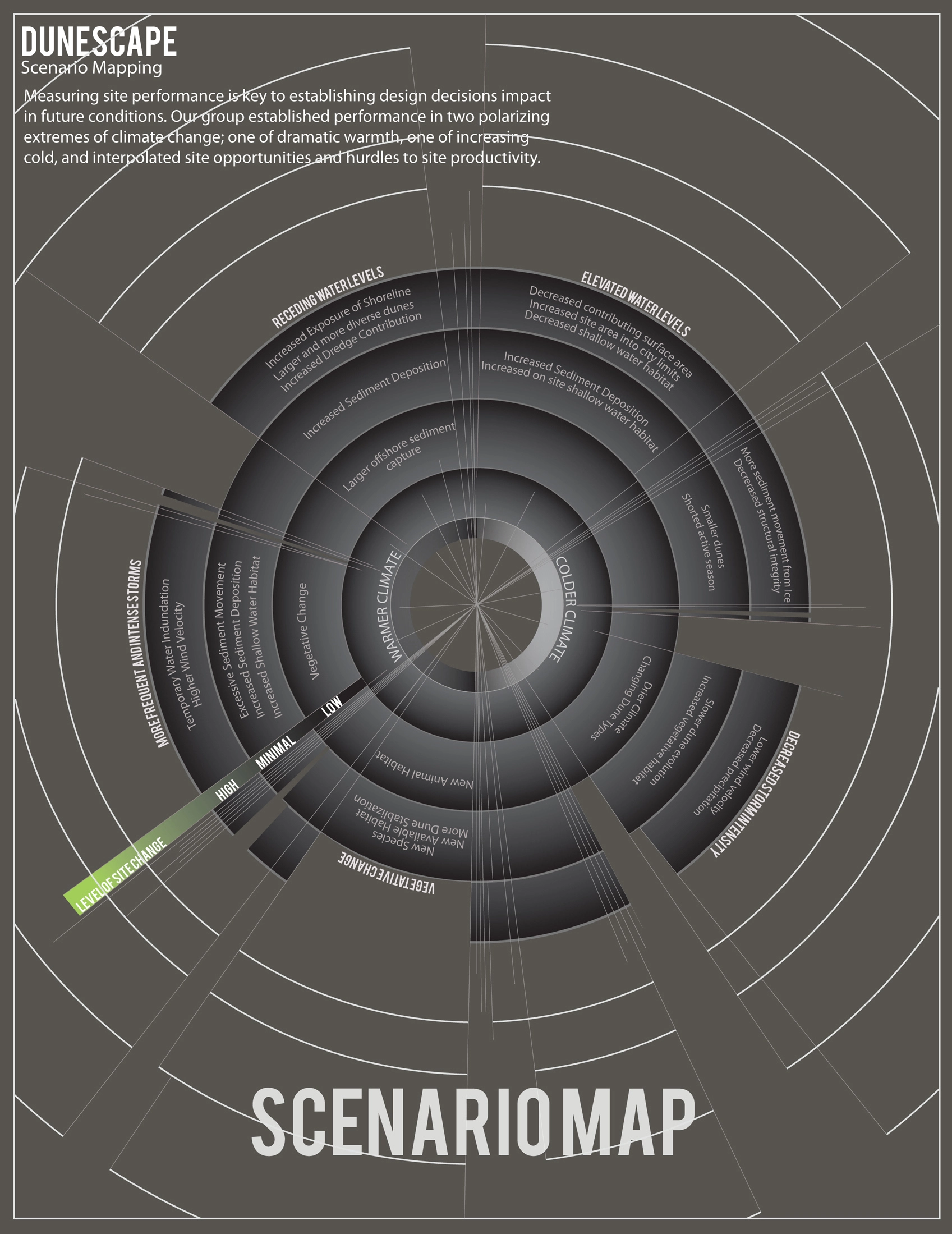
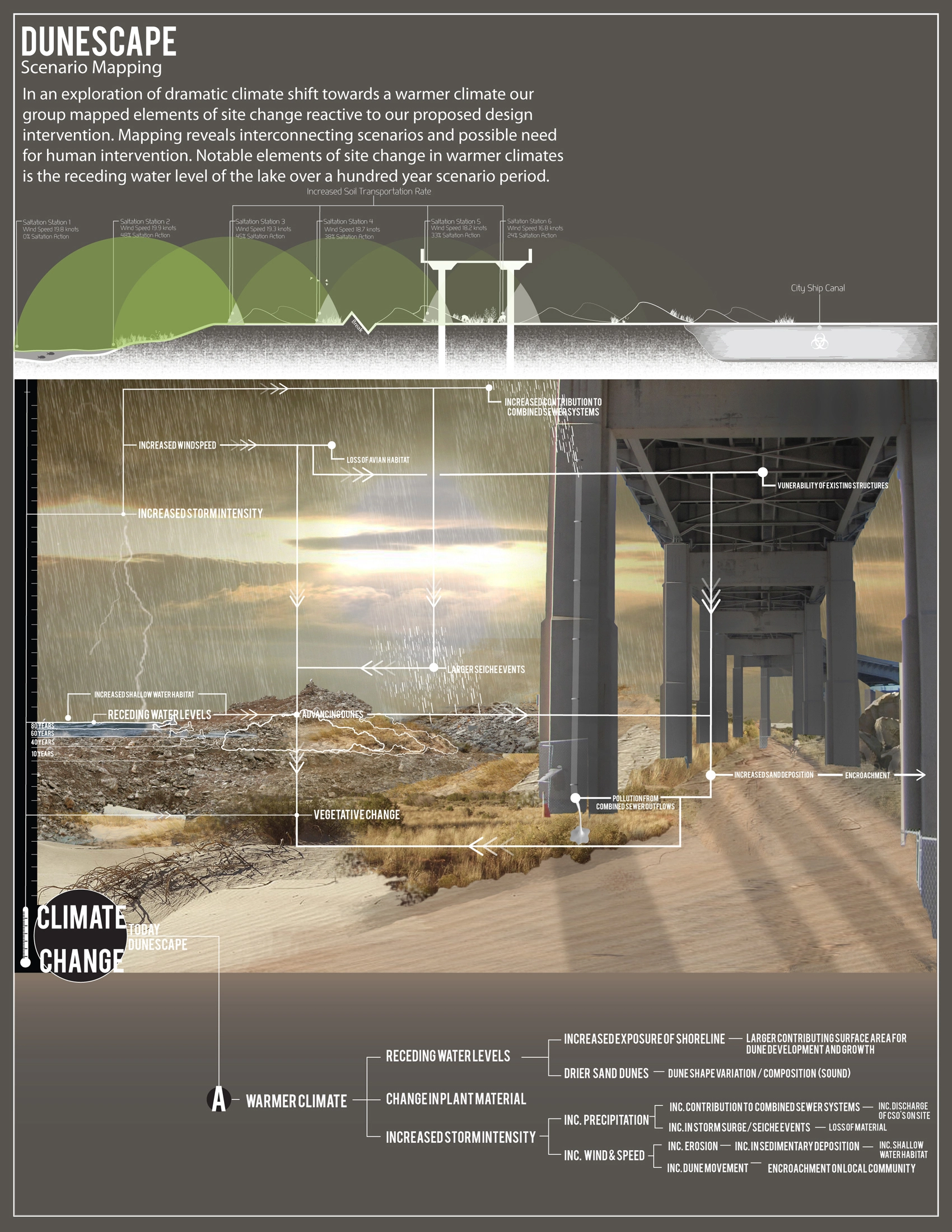
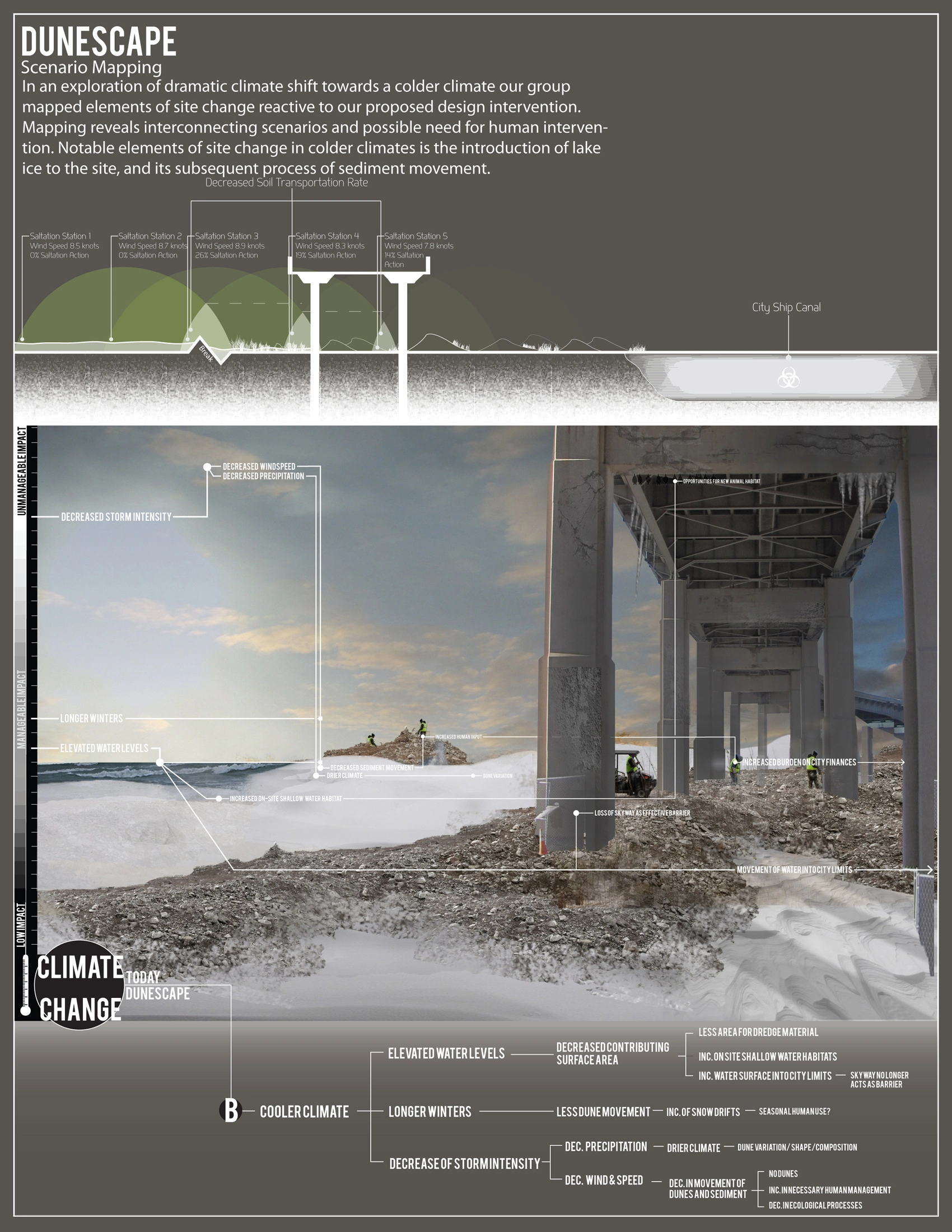
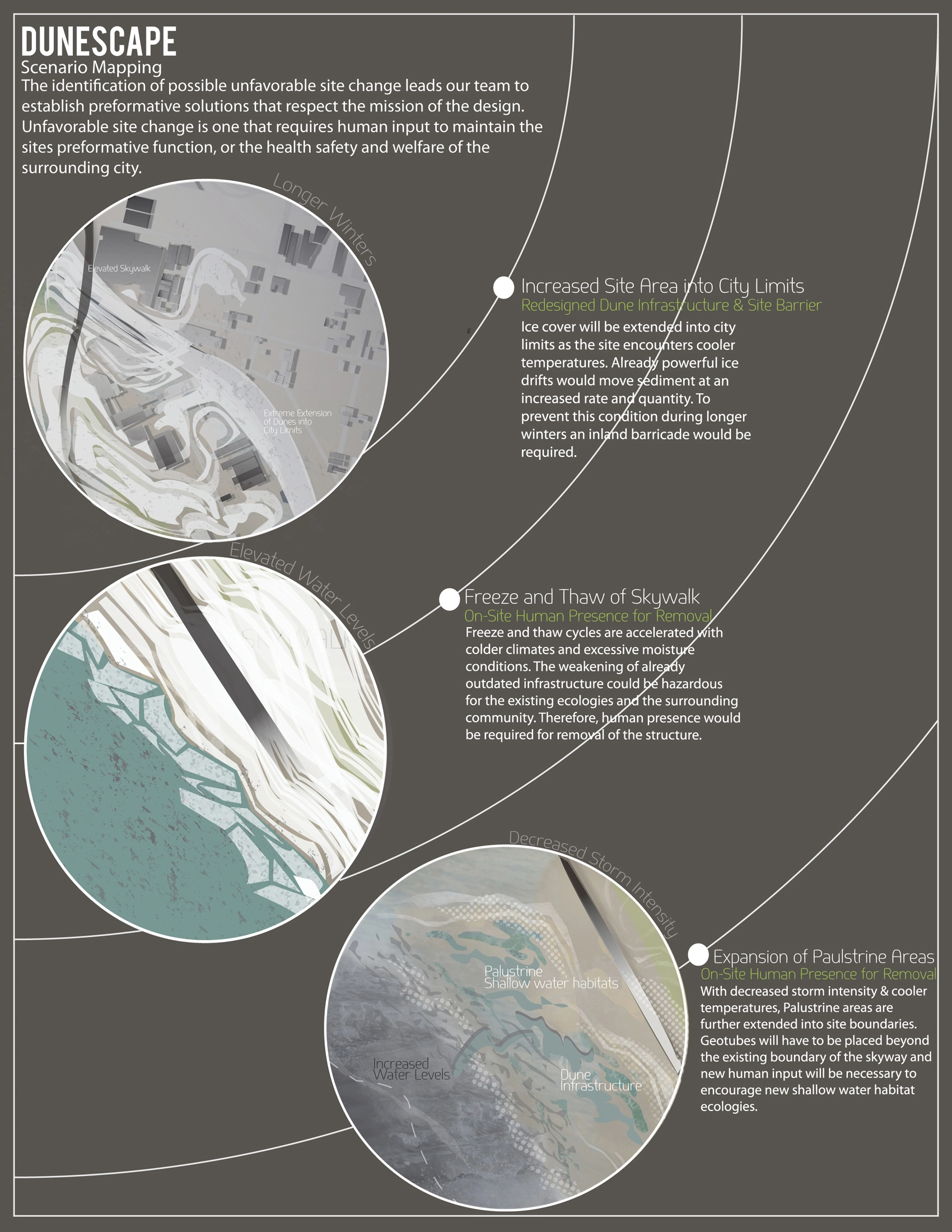
The ultimate challenge of this design is its mission; uninhibited, naturalized, productive landscape. Assessing these goals means testing the site through various scenarios, and reading if those goals still hold true over the extremes of environmental change. Within our research of dramatic climate shift both in the current direction, and the opposite colder variant, our site preformed well to environmental shift. Although vastly different on a visual characteristic level, through the snow and ice, wind and rain; DUNESCAPE was seen to perform successfully. As it continues to utilize the natural environmental as process and inspiration with significantly reduced human input than traditional solutions for this type of site.
-
Additional Faculty Advisors
Isabel Fernandez and Dan Reeder
Advertisement
Related Awards
Award of Excellence, General Design
A Floating Forest: Fish Tail Park in Nanchang City
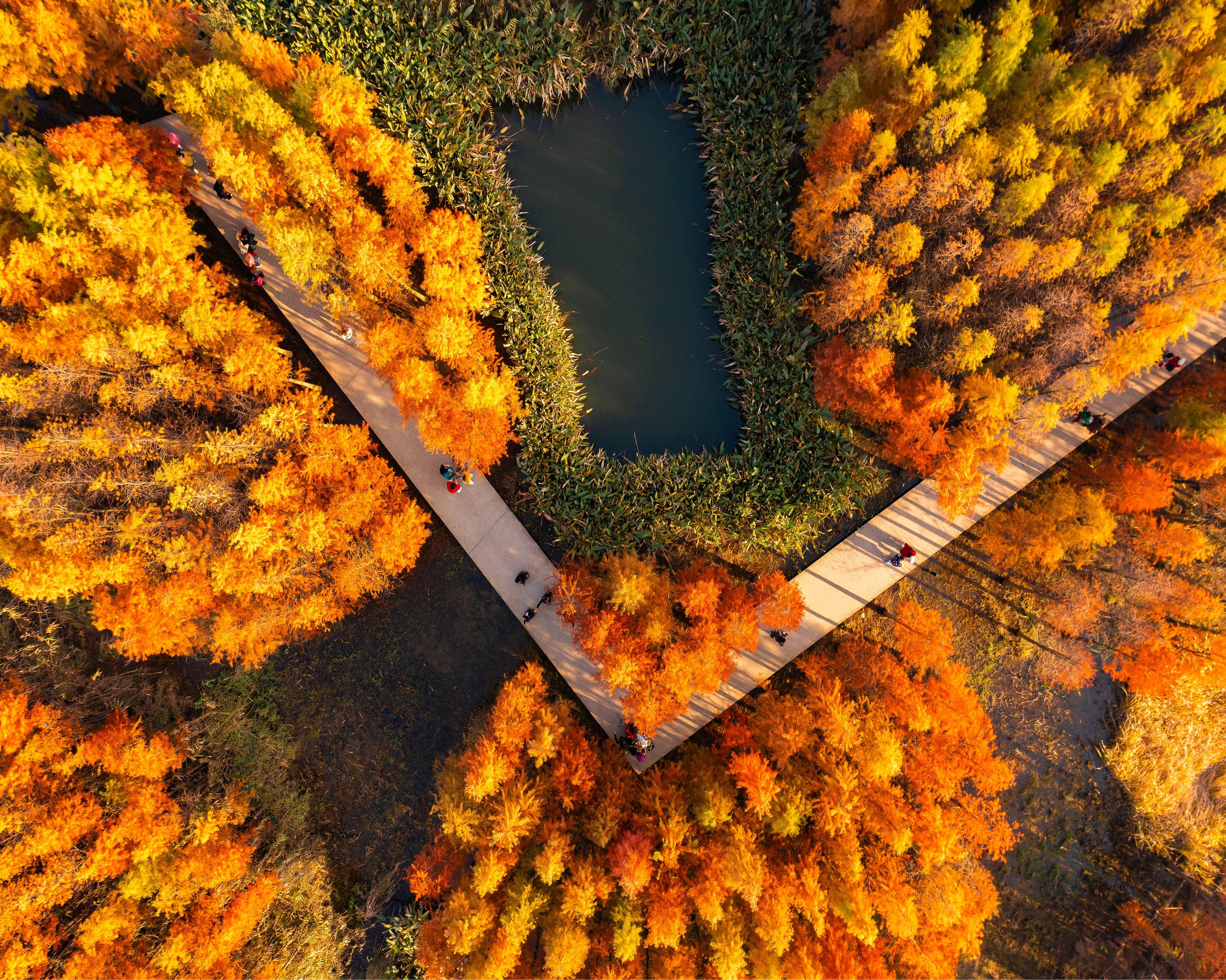
In Nanchang, within the Yangtze River floodplain, we revitalized a heavily degraded 126-acre landscape into a floating forest that manages stormwater, restores habitats, and provides diverse recreational spaces—all within a limited budget and a short timeline. This innovative urban nature model strengthens the district’s identity and spurs surrounding development. Fish Tail Park offers a scalable solution for flood-prone regions, seamlessly integrating flood resilience, ecological restoration