

.webp?language=en-US)

.webp?language=en-US)

ASLA Announces Keenan Gibbons as Climate & Biodiversity Action Fellow
Gibbons is an internationally recognized expert on how landscape architecture can reduce the impacts of extreme heat

ASLA announced a one-year fellowship with Keenan Gibbons, ASLA, PLA, principal and director of landscape architecture at SmithGroup and lecturer at the University of Michigan. As ASLA’s second Climate & Biodiversity Action Fellow, Gibbons will advance landscape architecture strategies that are most effective in addressing the climate and biodiversity crises. He will focus on reducing extreme heat impacts, particularly for underserved communities in the U.S. and worldwide.
“Keenan is a leader in applying new technologies to understand localized heat impacts and the nature-based solutions communities need to become cooler,” said ASLA CEO Torey Carter-Conneen, Hon. ASLA. “His work is grounded in deep research but he is also able to translate that research for broad audiences. Keenan will be a valuable ambassador for the landscape architecture community at the next Climate COP, showing policymakers how to address our growing urban heat challenges through smart design solutions made of trees, plants, water, and natural materials.”
“I am honored to be selected as ASLA’s Climate & Biodiversity Action Fellow. I am looking forward to advancing data-informed, nature-based heat strategies and making them more accessible to communities around the world. This work can increase awareness of what landscape architects do globally. We can incentivize heat solutions that empower policymakers and communities to take action,” said Gibbons.
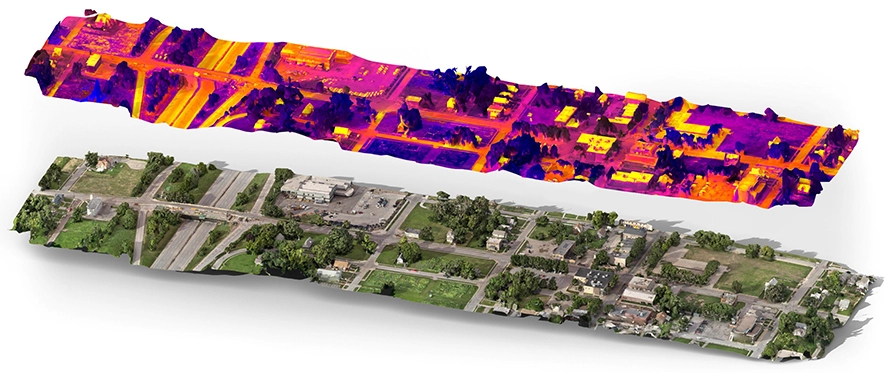
Gibbons began studying urban heat islands with drone technology a decade ago. In 2023, he and Salvador Lindquist, assistant professor of landscape architecture, University of Nebraska-Lincoln, were co-lead investigators of the research study Heat Waves: Visualizing Thermal Disparities, which received a Landscape Architecture Foundation (LAF) Research Grant in Honor of Deb Mitchell. Their 18-month-long research project resulted in Thermal Toolkit: Technologies and Techniques for Visualizing Heat, which offers a range of heat visualization methods and case studies of their use. Gibbons’ research has been featured in CNN, PBS Newshour, The Weather Channel, and NPR.
Extreme heat is the leading cause of climate change-related deaths in the U.S. and worldwide. Cities can experience urban heat islands, which form because of high concentrations of heat-absorbing materials like concrete and asphalt. Underserved and historically marginalized communities are disproportionately impacted by extreme heat because they have experienced underinvestment in trees, parks, and water systems.
Gibbons’ fellowship will advance the goals of ASLA’s Climate & Biodiversity Action Plan, which calls for all landscape architecture projects to accomplish the following goals by 2040:
- Achieve zero greenhouse gas emissions and double carbon sequestration from business as usual.
- Protect, conserve, restore, enhance, and manage biodiversity
- Provide significant economic benefits in the form of measurable ecosystem services, co-benefits, and livelihoods.
- Address climate and biodiversity injustices, amplify the power of communities, and increase the equitable distribution of climate and biodiversity investments.
ASLA’s first Climate & Biodiversity Action Fellow was Pamela Conrad, ASLA, PLA, founder of Climate Positive Design. She used her fellowship to develop Works with Nature: Low Carbon Adaptation Techniques for a Changing World.