

.webp?language=en-US)

.webp?language=en-US)
2026 President-Elect Candidate Forum: My Plan to Elevate the Visibility of Landscape Architecture
Candidates share how they would use their role to elevate the visibility of landscape architecture among external stakeholders.
Hear from the 2026 President-Elect Candidates
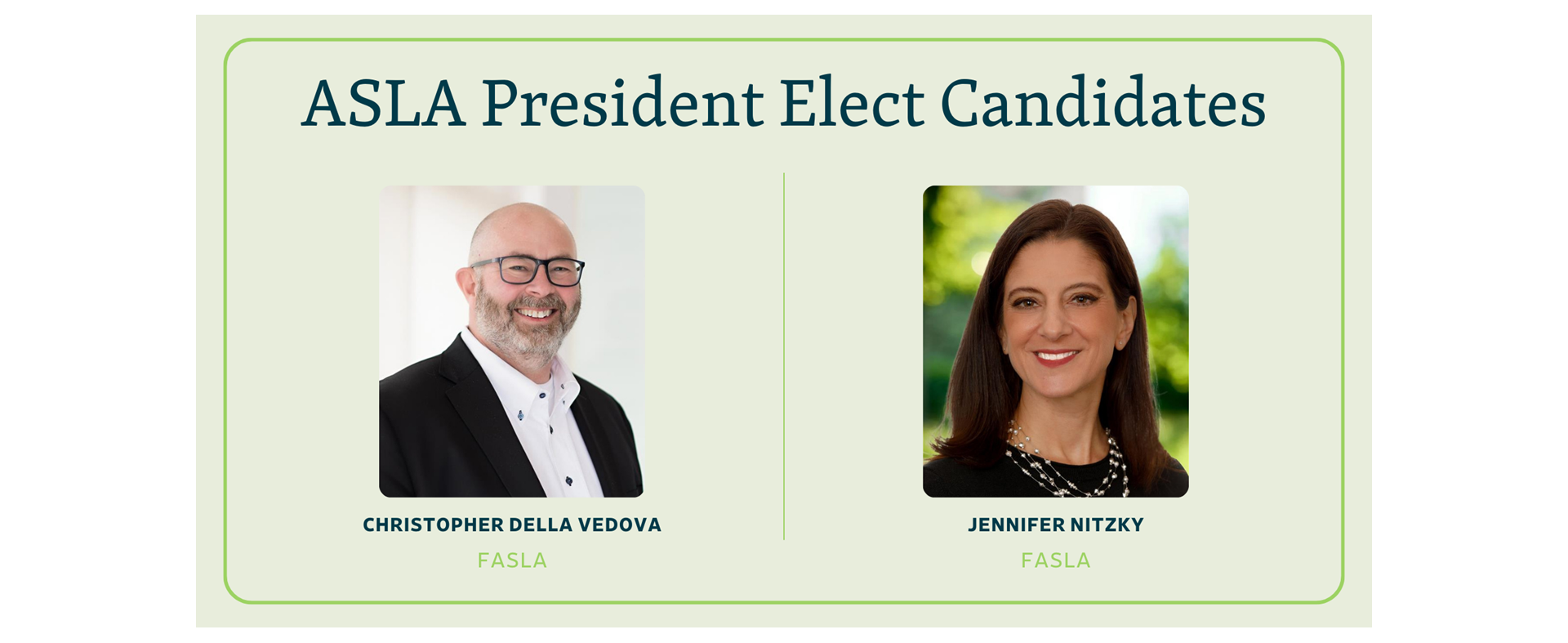
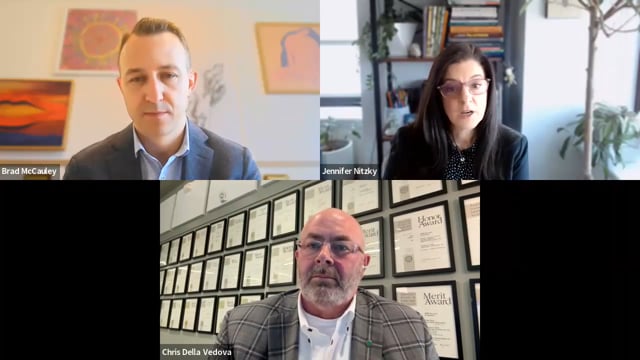
On April 23, 2026, Brad McCauley, FASLA, PLA, ASLA President, hosted a live online conversation with ASLA’s 2026 President-Elect candidates, Christopher J. Della Vedova and Jennifer Nitzky.
The candidates shared their bold ideas, creative visions, and hopes for the profession.
Ahead of the 2026 ASLA election, we asked the President-Elect candidates to share their vision for the Society. They discuss their primary motivations for seeking the presidency and how they plan to lead the profession forward.
This week's question: Along with the CEO, the ASLA President often serves as one of the primary 'voices' of the profession to external stakeholders, including policymakers, allied professionals, and the public. How do you plan to use your platform to elevate the visibility of landscape architecture?
Christopher J. Della Vedova, FASLA, PLA
Jennifer L. Nitzky, FASLA, PLA, ISA, AIA
Get all the information on the ASLA 2026 National Election.
Christopher J. Della Vedova, FASLA, PLA
President & CEO, Confluence, Inc.
How do you plan to use your platform to elevate the visibility of landscape architecture?
To elevate the visibility of landscape architecture, I plan to serve as a strategic facilitator, connecting our professional expertise directly to our stakeholders' specific priorities, much like we do with our clients. My approach is rooted in the belief that landscape architecture must be understood as essential infrastructure rather than an aesthetic layer. During my tenure as Vice President of Finance, I was fortunate to observe four different presidents, each with a unique leadership style. One consistent truth remained across their terms: each stayed authentic to who they were in the role, and I plan to do the same while ensuring our messaging aligns with the organization’s evolving strategic goals.
This leadership begins with a commitment to speaking the language of impact. To increase our visibility, we must communicate through the lens of our audience’s distinct needs. When engaging with a mayor, I would focus on issues affecting their community; with a developer, I would emphasize asset value and lifecycle savings; and with the public, I would highlight safety and quality of life. By using performance-first language, I will demonstrate that landscape architects are the primary bridge between high-level policy goals, such as public health and greenspace equity, and the physical realities of our communities.
Elevating the profession also requires us to reflect the diverse communities we serve. True to my background, I will use my platform to champion the next generation of practitioners and highlight the grassroots work occurring within our chapters. From rural main streets to urban schoolyards, showcasing the breadth of our impact builds a broader base of public support. This visibility shows the public that landscape architecture is a career path for everyone and that our work is happening in every neighborhood across the country, not just in high-profile downtown districts in major urban centers.
Visibility requires a proactive and collaborative approach to advocacy. We must ensure that ASLA is the first authority called when major environmental events occur or when federal infrastructure bills are being debated. I will highlight "proof of concept" projects from across our chapters that provide compelling evidence of how landscape-led solutions are already solving modern problems. By continuing to build strategic relationships both within and outside the AEC industry—with organizations such as the National League of Cities, the U.S. Conference of Mayors, and ULI —we can influence the decision-makers who shape the future of the built environment.
Ultimately, my goal is to ensure that landscape architecture is synonymous with effective problem-solving. By consistently appearing where decisions are made, translating when needed, ensuring we are understood, and providing undeniable evidence of our impact, I will work to keep ASLA a leading authority on the built environment.
Jennifer L. Nitzky, FASLA, PLA, ISA, AIA
Design Principal, Studio HIP Landscape Architecture
How do you plan to use your platform to elevate the visibility of landscape architecture?
Landscape architects shape the places that define everyday life for all people, regardless of where they live. Elevating our profession begins by making that connection visible. We must clearly communicate how our work improves health, strengthens communities, mitigates climate risk, and restores ecological systems. By telling the “why” behind our projects—highlighting problem-solving, user experience, and measurable outcomes—we demonstrate that landscape architecture is not just design, but essential infrastructure. Leveraging research and evidence-based tools will further reinforce our credibility and expand our influence.
Advancing public awareness has long been a passion of mine. My early involvement with ASLA as a chapter public awareness representative—and participation in national awareness summits—demonstrated the power of collective advocacy. Bringing together diverse voices from across the country generates ideas, builds energy, and equips members to return to their communities ready to act. As President, I will harness this spirit of collaboration to elevate awareness and empower chapters with tools, messaging, and strategies that translate national leadership into local impact. I will be a visible, inspirational voice for ASLA—actively promoting the value of landscape architecture in every forum, and consistently seeking new platforms to broaden our reach.
I will use the presidency to look beyond traditional boundaries, engaging external stakeholders—policymakers, allied professionals, and the public—and forging partnerships where missions align. Landscape architects must be present where transformative ideas and investments are shaped. We need to be at every table—and just as importantly, invite others to ours. By convening unlikely allies, including public health leaders, developers, educators, and infrastructure agencies, ASLA can position landscape architects as indispensable contributors to solving complex challenges. I will proactively seek out these intersections, ensuring our profession is not only included in critical conversations but helping to lead them.
Every chapter visit, conference, and stakeholder meeting is an opportunity to introduce someone new to landscape architecture. I will intentionally broaden our audience by welcoming allied professionals, policymakers, and community voices into our conversations. I will use my role to build connections, identify shared priorities, and bridge disciplines—creating new pathways for collaboration and influence. These connections expand our reach, deepen our relevance, and build lasting support for our work.
My experience in community leadership and cross-sector collaboration has reinforced a clear truth: landscape architects are most effective when we lead with outcomes. Whether addressing flood protection, extreme heat, mental health, biodiversity, or livability, our work delivers tangible benefits. When we frame landscape architecture as critical infrastructure—essential to healthier, safer, and more resilient communities—we elevate both our visibility and our value.
As ASLA President, I will champion a more visible, connected, and influential profession—one that looks outward, leads across boundaries, communicates with clarity, and is recognized as essential to shaping a better future.