

.webp?language=en-US)

.webp?language=en-US)
Meet the 2026 ASLA President-Elect Candidates
We are pleased to introduce the 2026 ASLA President-Elect Candidates Christopher Della Vedova, FASLA and Jennifer Nitzky, FASLA.
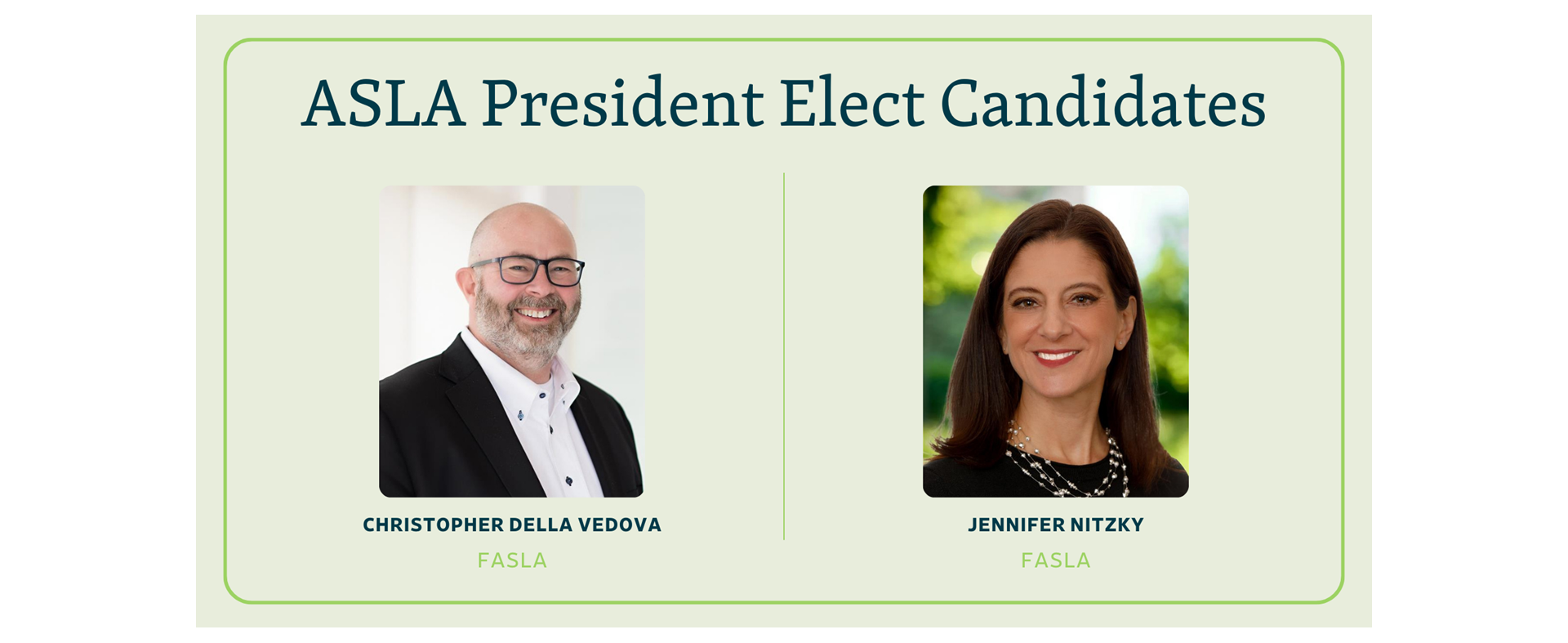
Ahead of the annual election, we are sharing the candidates’ biographies and goals and directions statements. Also, over the next three issues of LAND, the candidates will respond to questions about the future of the profession and ASLA, so please look for more over the next few months.
Christopher J. Della Vedova, FASLA, PLA
Jennifer L. Nitzky, FASLA, PLA, ISA, AIA
Additionally, we’ll hold a public forum for members in April when the two candidates will answer questions asked by President Brad McCauley. We’ll provide an opportunity for members to submit questions in advance.
All Full, Fellow, Associate, Student, and International Members in good standing will be eligible to cast a vote for President-Elect beginning May 5 and closing on June 5. They will receive a paper and/or email ballot to participate.
ASLA has partnered with Survey & Ballot Systems to administer the 2026 election. To ensure your election email arrives safely in your inbox on or around May 5, 2026, simply add the following email address as an approved sender: [email protected].
A reminder about ASLA’s election policy from the Society’s Bylaws (Section 828):
- All written statements about the nominees shall be restricted to the material published by the Society.
- No nominee shall write, or cause to be written, letters or campaign propaganda to be published or circulated. There shall be no derogatory remarks or insinuations concerning any nominee and nothing should be written or spoken that could be construed as an attempt to belittle any nominee’s qualifications for office.
- No chapter shall take an official stand in favor of a nominee from the chapter area or any other area or publish or circulate campaign propaganda on behalf of any nominee.
- No member shall actively seek the support of colleagues on behalf of a nominee by means of verbal or written contacts.
Hear from the 2026 President-Elect Candidates
On April 23, 2026, Brad McCauley, FASLA, PLA, ASLA President, hosted a live online conversation with ASLA’s 2026 President-Elect candidates, Christopher J. Della Vedova and Jennifer Nitzky.
The candidates shared their bold ideas, creative visions, and hopes for the profession.
Christopher J. Della Vedova, FASLA, PLA
President & CEO, Confluence, Inc.
Biographical Statement
Christopher J. Della Vedova, FASLA, PLA, is president and CEO of Confluence, Inc., based in Des Moines, Iowa. As a co-founder of the firm in 1998, he has led the growth from one office with six employees to nine offices across eight states and 85 employees. During his time at the helm of Confluence, he has focused on the firm's steady growth by thinking strategically, leveraging opportunities, and maintaining financial stability for the firm and its people. Chris’s leadership emphasizes listening, collaboration, and practical problem-solving.
Over the last 30 years, Chris’s ASLA service has included leadership roles in the Iowa Chapter (vice president, president, and two terms as Trustee) and national committee work (Finance & Investments, Audit, and the Annual Conference Education Advisory Committees). Chris most recently completed a three-year term as ASLA Vice President of Finance in 2025. During that time, he served on the Dues Task Force and oversaw the Finance & Investment and Audit Committees. He is currently serving on the SKILL ED Committee. An advocate for licensure and public policy, he took a lead role on the ad hoc committee that facilitated the update in Iowa’s licensure law.
Della Vedova is the immediate past chair of the Operation Downtown Board, the Des Moines downtown self-improvement district, and has served on the boards of Mentor Iowa and the Iowa Architectural Foundation (co-chairing the Community Design Program).
Chris holds a Bachelor of Landscape Architecture from Iowa State University, where he has served on the department’s advisory council, regularly presents on professional practice, and reviews studio work, staying connected to the next generation of professionals. He is currently licensed in Iowa, Nebraska, and North Dakota. He is CLARBcertified, a LEED AP, and a Construction Document Technologist (CSI).
Della Vedova describes landscape architects as “multipliers”: professionals who expand impact by creating space for others and building stronger, collaborative solutions. Rather than working alone, Landscape Architects convene voices, mentor colleagues, and advance projects through shared expertise. He views the American Society of Landscape Architects (ASLA) as the binding force that unites those voices to protect and elevate the profession.
Goals and Directions Statement:
“Start where you are. Use what you have. Do what you can.” — Arthur Ashe – This quote reflects my approach to a potential presidency.
The landscape architecture profession is confronting unprecedented challenges and opportunities. Demand for climate-resilient, equitable design has never been greater. Yet we face significant challenges — attacks on professional licensure, academic programs under threat, inconsistent policy support, and obstacles to practice growth. ASLA must continue to lead with clarity and purpose while responsibly stewarding our financial resources so landscape architects can prosper both today and in the future.
Strengthening Our Position Through Advocacy
Federal and state policies directly impact our members' ability to secure projects, maintain licensure, and compete for infrastructure funding. Recent regulatory rollbacks threaten the science-based frameworks that validate our expertise. ASLA must intensify engagement with decision-makers, positioning landscape architects as essential partners for investments in transportation, water systems, and community development. Strong advocacy translates into expanded opportunities while protecting the profession.
Building Brand Value and Client Awareness
Potential clients lack an understanding of the return on investment of landscape architecture. Strategic communications must demonstrate how our profession delivers measurable outcomes: reduced stormwater costs, increased property values, improved public health metrics, and enhanced community resilience. Clear messaging across multiple media platforms, allied professional networks, and our chapters will drive market demand and justify the need (and fees) for our expertise.
Empowering Firms and Practitioners
Small and mid-sized firms—the backbone of our profession—need practical resources to navigate complex procurement processes, leverage emerging technologies, and access continuing education that directly impacts success. Enhanced member services, including business development tools, contract templates, and peer learning networks, will continue to strengthen individual practices while elevating the profession's collective capacity. Supporting our members' successes ensures long-term professional vitality.
The profession's future depends on ASLA remaining the leading organization and finding opportunities to multiply our voices. I will lead by looking through these lenses of strategic advocacy, market positioning, and member empowerment, so landscape architecture can continue to grow its role as an essential, valued profession that drives sustainable prosperity for all.
Jennifer L. Nitzky, FASLA, PLA, ISA, AIA
Design Principal, Studio HIP Landscape Architecture
Biographical Statement:
Jennifer Nitzky, FASLA, is a passionate advocate for advancing the profession of landscape architecture and a nationally recognized leader dedicated to creating thriving, people-centered places. A seasoned practitioner in Chicago and New York City, she brings broad experience spanning small and large firms, multidisciplinary practices, and public agencies. As Design Principal of Studio HIP Landscape Architecture, Jennifer leads community-driven work rooted in participatory design, environmental stewardship, and implementation excellence.
A Landscape Architect and Certified Arborist, Jennifer has devoted her career to expanding access to high-quality public space. Since 2002, she has partnered with the Trust for Public Land to transform asphalt schoolyards across New York City into vibrant, green community playgrounds. Through a five-week, student-led participatory design process implemented at more than 230 schools, she has empowered young people to envision and create their own environments—cultivating agency, environmental literacy, and the next generation of landscape architects.
Jennifer’s deep commitment to ASLA began in graduate school and has grown into decades of sustained leadership. She has served two terms as Chapter President and Trustee, as Communications Chair, and Fellows Nominating Chair. Nationally, she has advanced strategic priorities through service on the K–12 Career Discovery, Chapter Success Institute, Public Awareness, Education, and SKILL/ED committees. She has chaired the Professional Awards Jury and currently serves on the ASLA Fund Advisory Council. A tireless champion of her peers, Jennifer has successfully nominated dozens of ASLA Fellows, medalists, and honor award recipients, elevating the profession's visibility and impact.
Her civic leadership extends beyond ASLA. Jennifer is Vice President of the Fine Arts Federation of New York, an Urban Design Forum Fellow, a member of the NYC Pollinators, and a former member of Community Board 7. In collaboration with the NYC Public Design Commission, she contributed to the publication Designing New York: Streetscapes for Wellness, advancing healthier, more equitable streets.
Raised in Michigan, Jennifer earned a B.S. in Architectural Design from Bowling Green State University and a Master of Landscape Architecture from Ball State University. She leads with optimism, collaboration, and an unwavering belief in landscape architecture's power to shape resilient, inclusive communities.
Goals and Directions Statement:
ASLA has the power to convene—bringing together practitioners, educators, students, and allied professionals to expand the reach of landscape architecture and address the defining challenges of our time. As we look ahead, we must evolve to meet the changing needs of our members, our communities, and our planet. By elevating awareness, growing the profession, and supporting our members, we will deepen our collective value and impact.
Elevating Awareness
ASLA is the voice of landscape architecture. We must lead with clarity and conviction—advancing climate action, public health, and resilient design. As president, I will build on our momentum to ensure landscape architecture is widely understood and valued. This means amplifying bold ideas in mainstream media while inspiring chapter-level action nationwide.
Awareness requires clearly communicating how our work improves health, strengthens communities, and restores ecological systems. By telling the “why” behind our projects—highlighting problem-solving, user experience, and measurable results—we make our value visible. Leveraging research and evidence-based tools will further demonstrate tangible outcomes and reinforce our credibility.
Growing the Profession
The future begins with students. Expanding the pipeline into landscape architecture is essential. Achieving STEM designation and advancing initiatives like the Design Academy for K–12 Educators strengthen career discovery. We must continue building pathways through high school programs, college partnerships, expanded scholarships, and strong ASLA student chapters that cultivate leadership.
Collaboration is equally critical. By working across disciplines and advancing shared priorities—climate resilience, equity, and community well-being—we expand our influence and attract new voices.
Supporting Our Members and Businesses
Our members are ASLA’s greatest asset—and their success defines our strength. In a rapidly evolving practice landscape, we must deliver the resources, tools, and professional development that enable firms, educators, and public practitioners to adapt and lead—especially small and under-resourced practices. By investing in business support and leadership development, celebrating excellence at every stage, and elevating diverse voices, we foster a profession where all members thrive.
Together, grounded in shared purpose, we will strengthen ASLA and shape a resilient, inclusive future for landscape architecture.