

.webp?language=en-US)

.webp?language=en-US)
When It Comes to Climate or Biodiversity, How Do I Choose?
By Pamela Conrad
Should landscape architects focus on A) climate adaptation B) climate mitigation C) biodiversity or D) all the above? Ding ding ding … The answer is D – landscape architects can do it all. I have been widely promoting our ability to achieve option D through nature-based solutions. But a meeting with a United Nations (UN) National Adaptation Plans leader at COP28 last December caught me off-guard.
With my North American work focused on coastal adaptation, I assumed everyone has been planning for adaptation for decades, and that the global conversation on carbon and biodiversity was progressing rapidly. However, it turns out that’s not the case.
Governments Need Guidance on Nature-Based Solutions
According to the UN leader we spoke to, many countries, especially developing ones, are struggling to even think about adapting to climate impacts like increased flooding, higher temperatures, and longer droughts.
Several key factors contribute to this:
1) Countries do not readily share adaptation lessons learned, especially between developed and lesser-developed countries. 2) There is a lack of technical implementation guidance. 3) There is a shortage of experienced technical professionals in this area.
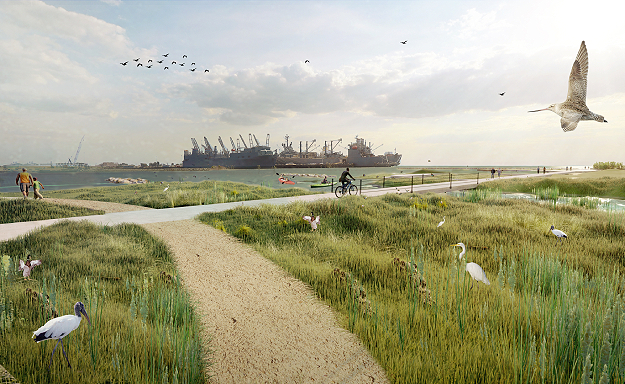
It never occurred to me how challenging it would be for a community to implement a low-carbon, green-but-structurally-sound living shoreline adaptation project in a country that only has a handful of landscape architects, none of whom are local. A living shoreline, as defined by National Oceanic and Atmospheric Administration, is a “protected, stabilized coastal edge made of natural materials such as plants, sand, or rock. Unlike a concrete seawall or other hard structure, which impedes the growth of plants and animals, living shorelines grow over time.”
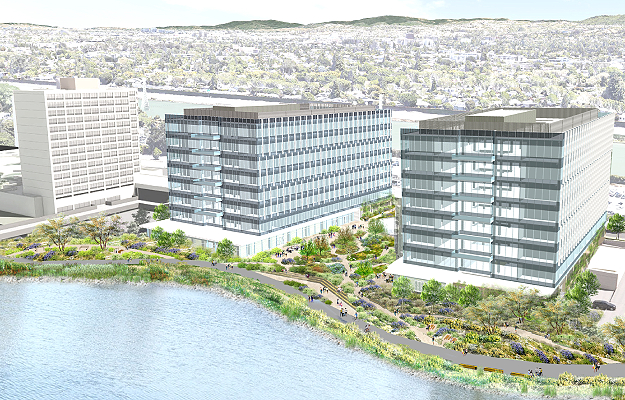
So, another gap presented itself. There are some good high-level resources to guide cities – including C40’s Achieve a Decarbonized and Climate-Resilient Built Environment resource and the World Economic Forum’s Nature-Positive Transition report. But we know the devil is in the details. Without more technical guidance to help implement low-carbon nature-based solutions, many countries' adaptation efforts will fall short.
As an outcome of the Global Stocktake at COP28, the UN is urging parties to develop National Adaptation Plans by the end of 2025 and make significant progress in implementing them by 2030. Throughout 2024, countries and organizations are forming financial partnerships to accelerate support and ensure the necessary quantity and quality of adaptations.
Landscape architects understand success lies in the details and their execution on construction sites. We have the opportunity to share this knowledge and expertise with others.
Communities Can Make the Smart Choice: Green Instead of Gray
Considering that 75% of the infrastructure needed by 2050 has yet to be built, we have a crucial choice ahead. Future communities and their risk reduction, water management, and transportation systems, can be green or gray.
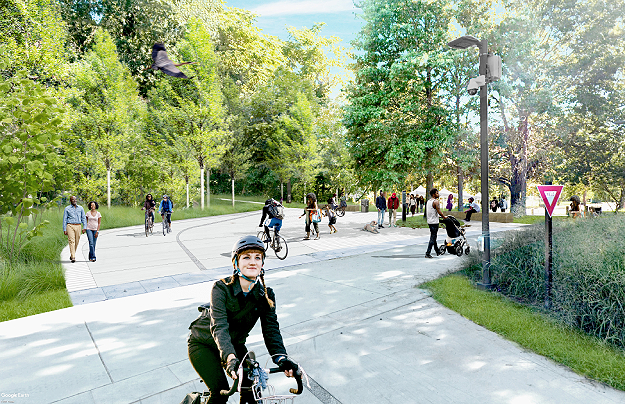
They can draw down greenhouse gases, emit fewer pollutants, support biodiversity, reduce extreme heat, and enhance community health and resilience. Or they can remain single-purpose – a path that has historically failed to serve society well.
Low-carbon nature-based solutions are reported to be 50-75% more cost-effective. More financial resources are necessary to support these solutions, but encouraging signs from the UN, The White House, and the U.S. Army Corps of Engineers provide reason for optimism.
We also face another choice: to act self-servingly or prioritize the needs of others.
Those who have contributed the least to the climate and biodiversity crises are often those most affected, particularly in developing countries and marginalized, underserved communities.
One thing I can do is share our collective stories, lessons learned, and work on nature-based solutions as landscape architects with others. My hope is to accelerate a more regenerative path.
Let's Get the Word Out
I will focus on explaining the many benefits of nature-based solutions during my ASLA fellowship. Throughout this year, I am gathering and documenting knowledge and plan to share my findings at this year’s COP29 Conference in Baku, Azerbaijan.
While I cringe at the airplane emissions and the irony of attending a conference hosted by a fossil fuel industry leader, silence achieves nothing. As a woman attending an event marked by gender inequities, my presence itself is a form of protest.
With the support of the ASLA membership, I will raise my voice as loud as I can.
So, will you join me in advocating for Option D? I hope so.
Stay tuned for monthly updates on my research findings – including exciting examples from lesser-developed countries – and my journey to sharing these design innovations at COP29.
Pamela Conrad, ASLA, PLA, LEED AP, is a licensed landscape architect, the founder of Climate Positive Design, faculty at Harvard’s Graduate School of Design, and ASLA’s inaugural Biodiversity and Climate Fellow. She was the chair and lead author of ASLA’s Climate Action Plan, 2019 LAF Fellow, 2023 Harvard Loeb Fellow, and currently serves as IFLA’s Climate and Biodiversity Working Group Vice-Chair, World Economic Forum’s Nature-Positive Cities Task Force Expert, Carbon Leadership Forum ECHO Steering Committee, and is an Architecture 2030 Senior Fellow.