

.webp?language=en-US)

.webp?language=en-US)
The Rights of Nature: How Landscape Architects Can Support a Global Movement
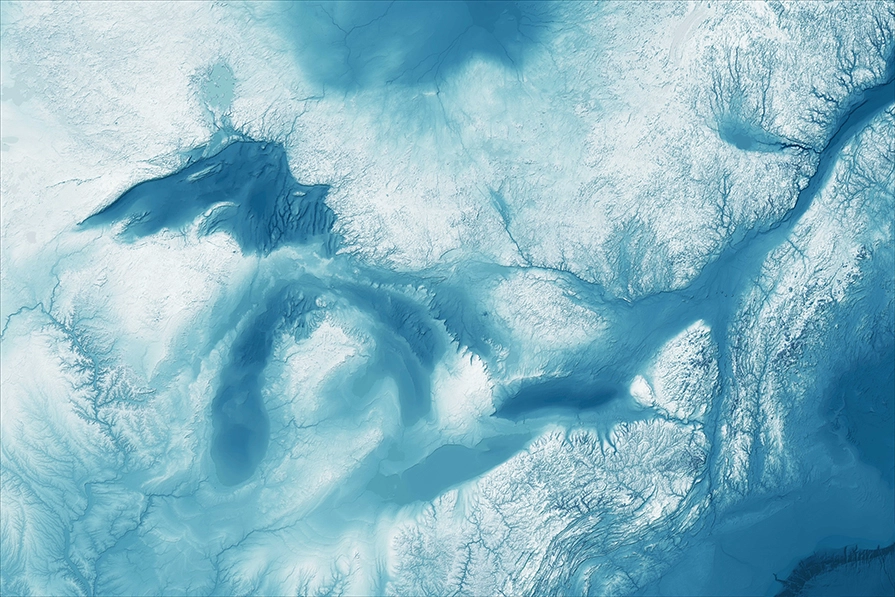
Great Lakes / Aaron Hernandez
By Jared Green
“The rights of nature movement is an emerging body of law for protecting, restoring, and stabilizing the functional interdependency of Earth’s life and life support systems,” explained Pamela Martin, professor of political science at Carolina Coastal University.
In an online discussion organized by the ASLA Climate & Biodiversity Action Committee, Martin joined Aaron Hernandez, an assistant professor of landscape at the University of Guelph, and MaFe Gonzalez, ASLA, a landscape designer at BASE Landscape Architecture to outline how landscape architects can support this burgeoning, Indigenous-led global movement.
Martin, author of The Politics of the Rights of Nature and a judge of the International Rights of Nature Tribunal, is a leading authority on the rights of nature.
She explained how Indigenous leaders and thinkers have shaped an international legal and political campaign to give rivers, mountains, forests, wetlands, and species legal rights.
This movement captured global attention in 2008 when Indigenous leaders in Ecuador worked to enshrine rights for all of nature into a new national constitution. Since then, natural systems have gained legal rights in New Zealand, India, Colombia, Canada, Brazil, the United Kingdom, the United States, and other countries.
In 2017 in New Zealand, the Maori Indigenous community negotiated with the government to establish legal personhood for the Whanganui River, which they call the entity Te Awa Tupua.
The same year, the High Court of Uttarakhand in India ruled that the Ganges and Yamuna rivers are living entities with legal rights. (Unfortunately, though, the Supreme Court of India later overturned this ruling upon appeal).
“There are 687 legal provisions on the rights of nature worldwide – some are laws, some are resolutions, and some are policies,” Martin explained.
According to data from the Eco Jurisprudence Monitor, the U.S. is a leader in crafting these legal provisions, with more than 180 created by Tribal and local governments. Ecuador has 82 provisions, and Brazil, Colombia, New Zealand, Mexico, and the UK each have more than 20.
While there is contemporary progress on the rights of nature, these ideas have been around for millennia. “Indigenous communities have an indelible connection – a kinship connection – with nature.” In many cultures, “rivers, trees, plants, and soils are family members. That has translated into a legal philosophy,” Martin said.
The Kichwa Indigenous community of Ecuador is guided by a philosophy of Sumak Kawsay, which can be translated as “good living.” This means “living with a healthy nature. ‘We are healthy because we are connected to the natural world.’” The new Ecuadorian constitution – the model for global rights of nature efforts – was informed by this ethos.
In the Western legal system, “people are separate from nature. Nature is individual stocks of resources and property. The goal is exponential growth in production and consumption – ‘development.’ And environmental harms are legalized through permitting.”
“These current laws are not working. We have PFAS in river systems. Climate change is impacting all our ecosystems,” Martin said.
Highlighting the absurdities of Western law, she said “corporations and municipal governments are considered people, but not rivers, mountains, forests, or the ocean.”
In contrast, the rights of nature framework offers a different conception of our responsibilities to nature. In this view, “people are part of nature. We are nested in living ecosystems, whose parts are interconnected through reciprocal relationships. The goal is to maintain balance and a dynamic equilibrium with healthy ecosystems. And to prevent extreme environmental harm.”
At the global level, there are a number of organizations advancing the movement, including the Global Alliance for the Rights of Nature, International Rights of Nature Tribunal, and the International Observatory for the Rights of Nature.
The International Union for the Conservation of Nature (IUCN) has issued motions on the rights of nature. These have focused on “integrating science and ecology to inform laws, living in harmony with rivers, and recognizing the crime of eco-cide, the rights of Antarctica, and the rights of nature in Indigenous communities.”
The United Nations (UN) General Assembly has passed resolutions on living in harmony with nature. The UN Secretary General has also made statements supporting the concept.
Martin outlined a range of Indigenous-led efforts in the U.S. to grant rivers and other natural systems legal rights – from California to Oklahoma and North Carolina. And there are a number of U.S.-based Indigenous-led organizations working on these issues, including Movement Rights and Seven Directions of Service.
Local governance approaches – which put the rights of natural systems into practice – are evolving. Some rivers with rights are represented by guardian or stewardship councils or ombudsmans. “Guardians protect the rights and interest of a river and act on its behalf." Local regulations and planning documents also create responsibilities to consider the needs of ecological systems.
Martin said landscape architects can support the movement by being catalysts. "You all have a deep understanding of the industry and nature nexus. You have connections with clients and communities and can help them live in harmony with nature. You work with local, state, and federal governments. Landscape architects can help lead a nature paradigm shift."
Mutehekau Shipu or the Magpie River in Quebec, Canada is another river that has received legal rights at the local level. In an example of Indigenous and non-Indigenous collaboration, the Innu Council of Ekuanitshit and the Municipality of Minganie issued dual resolutions in 2021 granting the 186-mile-long river legal personhood.
The river now has nine legal rights:
- The right to live, to exist and to flow.
- The right to respect for its natural cycles.
- The right to evolve naturally, to be protected and preserved.
- The right to maintain its natural biodiversity.
- The right to perform its essential functions within its ecosystem.
- The right to maintain its integrity.
- The right to be free from pollution.
- The right to regenerate and be restored.
- The right to sue.
Aaron Hernandez, an assistant professor at the University of Guelph and past Landscape Architecture Foundation (LAF) Leadership and Innovation Fellow, has been researching the Magpie River for a number of years.
Through his work, he found that “landscape architects can support the implementation of new legal rights for natural systems through research, communications, and visualization.”
Granting a river rights is abstract. Putting those rights into practice – weaving them into policy, planning, and management is another story. “It requires interacting with existing systems – the status quo,” Hernandez said.
“Landscape architects can interpret those rights for communities. Visualization and communication are instrumental to making these rights tangible.”
Indigenous and non-Indigenous organizations banded together to stop plans for hydroelectric dams on the Magpie. “They had a mutual interest to take legal action to protect the river.” This campaign led to new rights for the river and a local guardianship model to represent the river’s interests. (But Hernandez noted the provincial and federal governments of Canada still don’t recognize the river’s personhood).
As part of his LAF Fellowship, Hernandez conducted field research to explore the relationship between political and public support for the Magpie. “I sought to figure out: Who is the river? How is it governed? What is the political context? What is the landscape context?”
Hernandez said the river is a social and ecological hybrid. “It encompasses wildlife, plant communities, people, industry, and infrastructure.” His current research involves visualizing its complex governance system – the layers of local, provincial, and federal stakeholders – in order to “understand the relationships and create a roadmap for enacting the river’s personhood.”
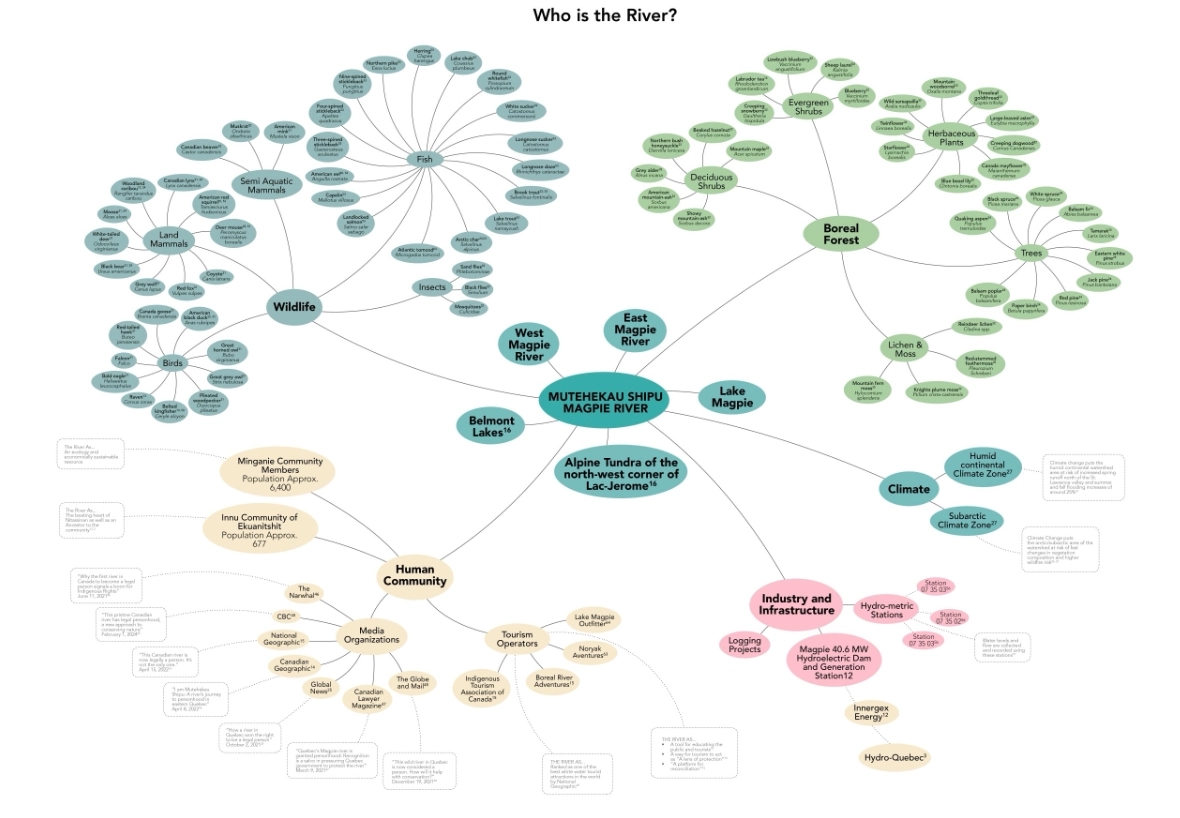
Who is the Magpie River / Aaron Hernandez
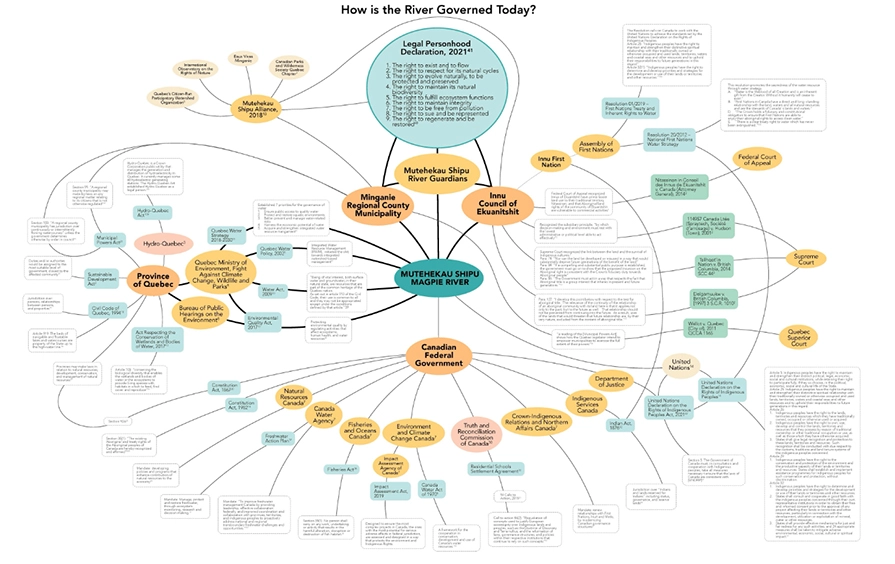
How is the Magpie River governed today? / Aaron Hernandez
To evaluate the landscape context, Hernandez developed a set of river transect drawings. These visualizations help translate the reality of river rights and relationships into practice. “Landscape architects can develop methods to facilitate the rights of nature.”
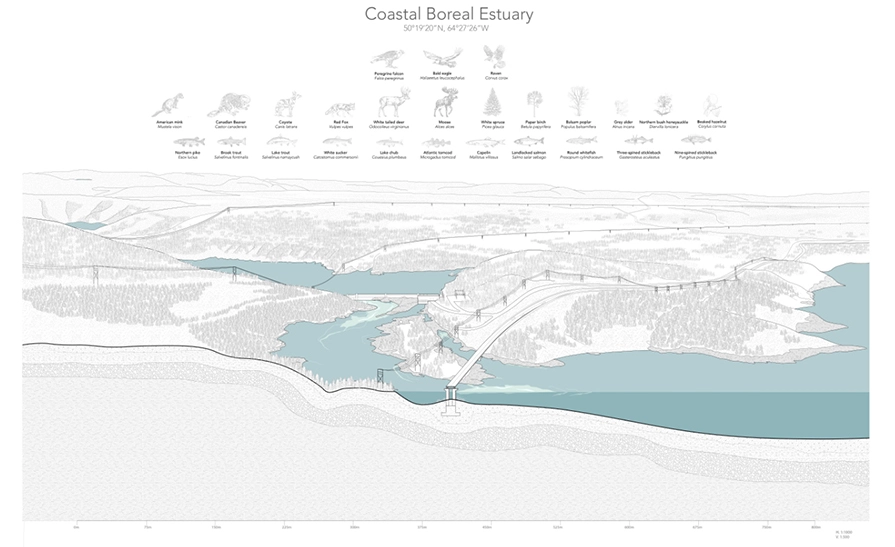 River transect / Aaron Hernandez
In California, there is also a growing movement to grant legal rights to the Salinas River, a 175-mile-long waterway along the central coast. MaFe Gonzalez, ASLA, a botanist and landscape designer with BASE Landscape Architecture, has been invested in the river for many years, first working along the river, then studying it in graduate school, and now partnering with local community groups and non-profits on the effort to protect it.
The Salinas River provides water to a fertile agricultural region – the “salad bowl of the world,” Gonzalez said. “But it has been hidden by design.” Public access to the river has largely been blocked by fences and private farmland.
An immigrant community supports the farms that line the river. “Among these farms, there is exploitation of workers, land, and the river.” But Gonzalez and local organizations believe there should be fairer access, and the river belongs to everyone. “We can reconnect public access to the river, creating a sense of belonging. The river supports immense biodiversity and cultural memories.”
“As a landscape designer, my challenge is to figure out: Who is our client? Is it the river? And if so, who is the Salinas River?” Gonzalez asked us to think through what happens when we view natural systems as our client. “We can design with the river at the center.”
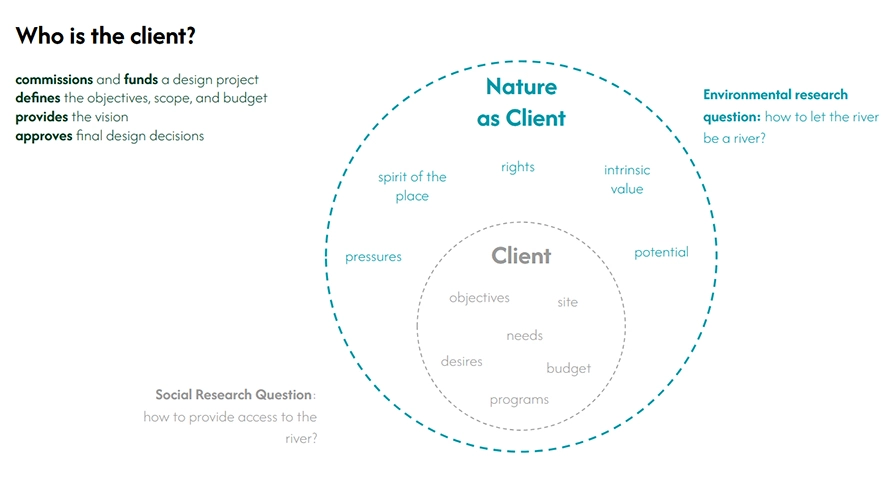 Who is the client / MaFe Gonzalez, BASE Landscape Architecture
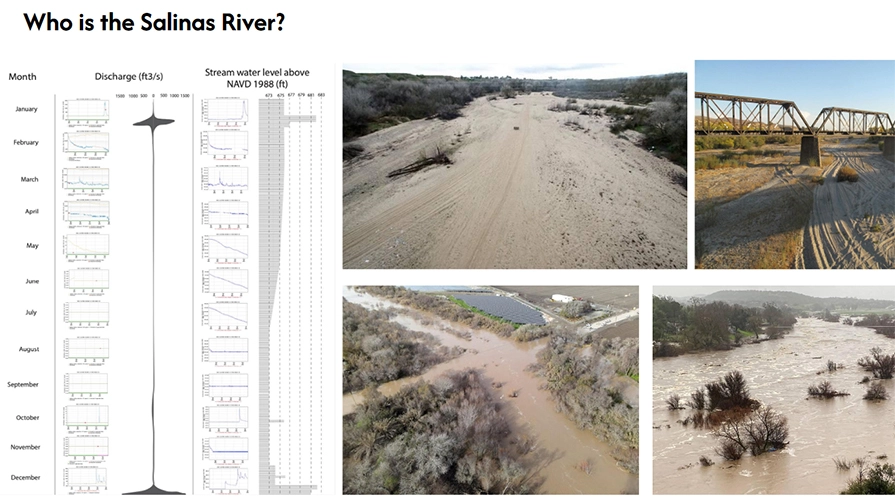 Who is the Salinas River / MaFe Gonzalez, BASE Landscape Architecture
Gonzalez partnered with the community to develop a river-centered vision and concept designs for a revitalized Salinas, building on its few public access points. Working with local organizations, BASE has helped lead the Salinas River Day celebration and community engagements that foster greater connection to the waterway.
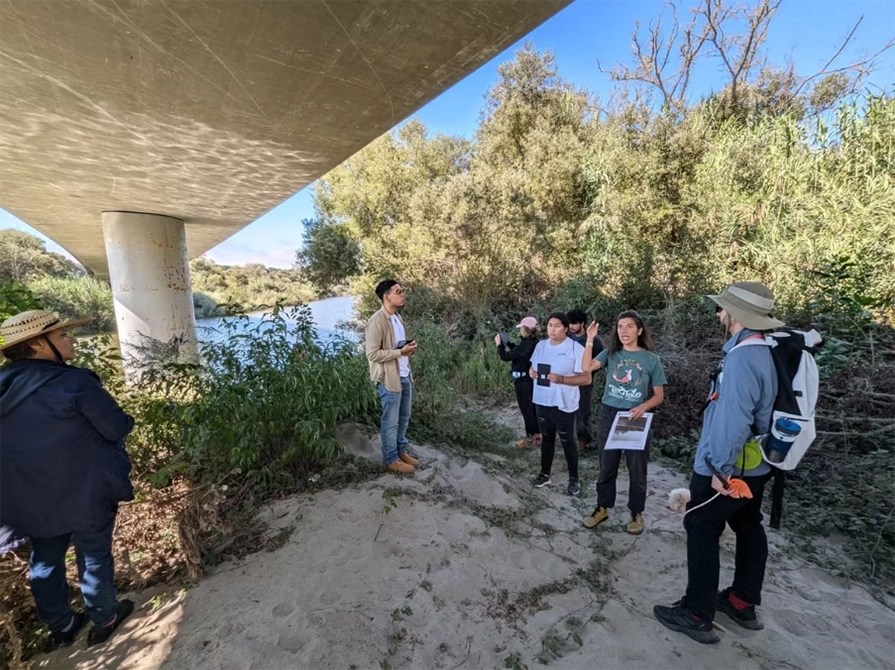
MaFe Gonzalez (second from right) speaking at a Salinas River community engagement event / BASE Landscape Architecture
Using a rights of nature approach has helped put the needs of the Salinas and community at the forefront. “The big-picture goal is to make the river a healthy, protected, and loved public park, with natural rights.”