

.webp?language=en-US)
.webp?language=en-US)
The Role of Commons in Our Future Resilience
By Jared Green
With the growing climate and biodiversity crises, communities' shared natural resources have become even more important.
How can commons, which include land, wetlands, and water, be better managed for the greater good? What can we learn from the stewardship of commons by historical Indigenous and European communities? And how do we avoid the tragedy of the commons in which shared resources are degraded to the future benefit of none?
Over two days, a symposium organized by Thaisa Way, FASLA, at Dumbarton Oaks in Washington, D.C. explored these questions.
According to Thomas B.F. Cummins, director of Dumbarton Oaks, commons are shared resources stewarded by a community. Access to these resources are governed in a public way. In our capitalist system, these resources can be "hotly contested," so there can be elaborate rights to ensure equitable access and use. Still, commons offer an alternative to purely private ownership of resources.
The climate and biodiversity crises will make collective land and water resources the source of future cooperation and conflict. If our commons aren't governed well, we can have a "future of global violence," Cummins said.
We can look to how Indigenous and other communities have managed shared resources in the past to gain insights for our current challenges.
For example, the Quechua people, who have lived for centuries in the Andean region of South America, used a "system of reciprocity" to share resources. Community members with reciprocal relationships could access resources from the coast to the mountains in the times of drought, disease, or flooding. The Quechua needed relationships to access commons.
Karl Zimmerer, a professor at Pennsylvania State University, looked at how the Quechua people of the Incan empire shared natural resources, in this case, seeds for crops. Today, the Quechua are considered the primary descendants of the Inca.
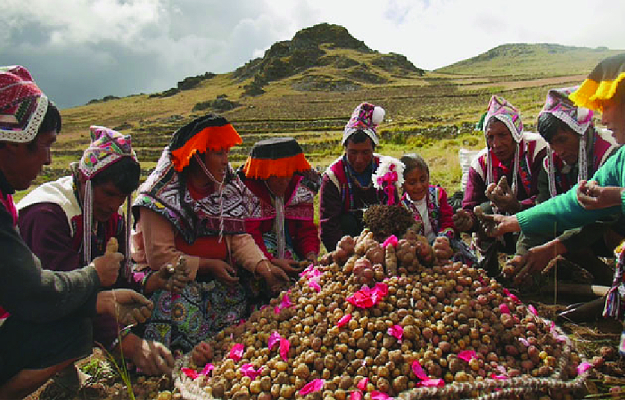
Quechua formed small-scale agricultural communities that were adaptable to weather and climate changes. In the Colca Valley of Peru, common irrigation systems enabled farming of shared lands. "What is less studied is the commons that formed around crop seeds," Zimmerer said.
The Inca had imperial seed storehouses, which were used to both maintain political control and preserve food biodiversity. But when the Spanish arrived -- and "catastrophically impacted Indigenous communities" -- seeds were increasingly traded and exchanged informally among the Quechua. "Communal seed banks were concealed from colonizers. Those who participated in exchanges were guardians of heritage."
As communities contended with drought, the exchange of seeds scaled up. Overlapping networks of seed sharing supported local agricultural resilience. Exchanges across even larger territories became "important for adaptation to weather changes and crop diseases," Zimmerer said.
Those informal networks and markets continue today. They are "not part of the market for proprietary seeds" run by multinational corporations.
Franscesco Vallerani, a professor at the University of Venice, then took us to the coastal marshes and lagoons surrounding the city of Venice.
The canals of Venice have been carefully managed by the city for centuries. There are records from the late 1400s explaining how water engineers regularly inspected their condition.
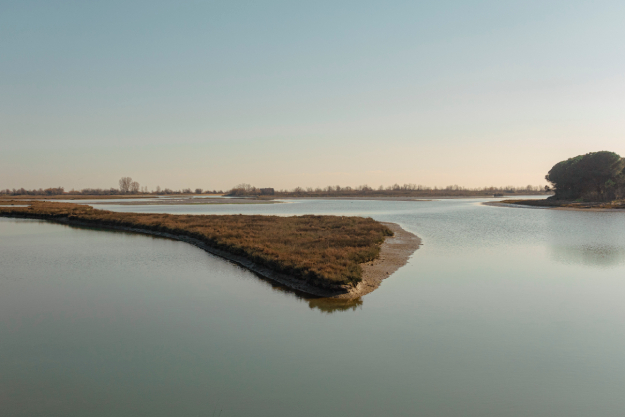
But outside the city, there were less managed natural systems -- semi-permanent marshes and lagoons shaped by seasonal floods. These areas formed a "water commons" that provided sustenance and income for fishing communities. "The fishermen had knowledge of the waterways' ecological niches and knew how to navigate and manage the resources."
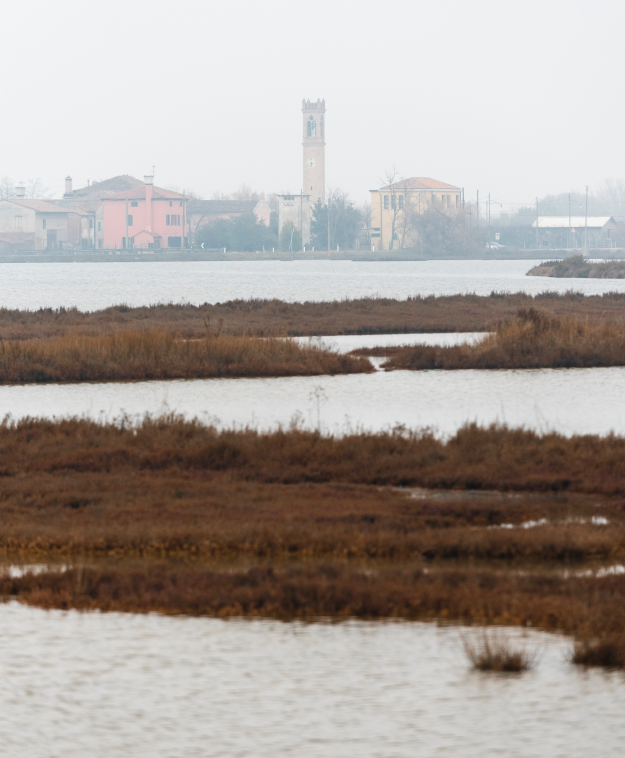
Vallerani explained how shared marsh resources became increasingly privatized and controlled over centuries. Many were filled in and became privately-held pasture and farmland.
In the 20th century, the fascist Mussolini regime then "demonized the swamps and wetlands," characterizing them as havens for mosquitoes and disease. This was part of an effort to exert further control over a space that had been a difficult to manage.
In recent years, the Italian government and other organizations have begun to protect and restore the marshlands and the ecosystem services they provide. There has been a growing realization of their role managing sediment, reducing urban heat, and preserving the city's waterways. There is a new awareness of the "urban wetland ecosystem" and the value of amphibian landscapes.
And then the discussion expanded to offer a global perspective. Wetland commons are under threat worldwide, said Caterina Scaramelli, a professor at Boston University. They make up 8 percent of the Earth's surface, store vast amounts of carbon, and provide livelihoods for millions of people.
There are wide ranges on the estimates of their destruction. One approach finds that 30 percent of the planet's wetlands have been lost, while another finds a 75 percent decrease. And this century, an additional 50 percent decrease is likely. The causes of wetland loss are water pollution, dams, mining, and agriculture.
Scaramelli sees some global trends at work. Some wetland commons are being "de-commoned," meaning they are being privatized and likely developed. Some are public land but being degraded, reflecting the tragedy of the commons. While others are being newly "re-commoned" and joining the list of global shared resources.
Around the world, grassroots organizations are forming to protect and restore these resources. But protection often entails taking these resources out of local hands and instead governing them according to national environmental laws and regulations. This process can upend local communal stewardship and cultural connections to these landscapes.
Her research in agricultural communities in the Lake Marmara delta region of Turkey shows that striking a balance between common resource use and conservation can be challenging. Conservation areas managed by the Turkish central government must accommodate common buffalo and cattle pastures, fishing, orchid farming, and leech harvesting.
Our commons need to be restored on a global scale to increase our resilience. Balancing the needs of local communities and conservation and restoration will require strong relationships between governments and the people who depend on commons for their livelihoods and culture.