

.webp?language=en-US)

.webp?language=en-US)
Climate & Biodiversity News (January 2026)
By Jared Green
Global Temperatures Dipped in 2025 but More Heat Records on Way, Scientists Warn, BBC News, January 13
Temperatures didn't reach the high levels of 2024 but the last three years were the hottest on record. Scientists now expect the planet will exceed 1.5 °C of warming by the end of this decade.
How Community Solar Turned a Superfund Site into Savings in Illinois, Grist, January 10
Highly contaminated brownfields like landfills are proving to be good places to put solar farms because of the low prices for the land, electricity connections, and community acceptance. In Illinois, the Yeoman Creek Landfill has been transformed into a 9.1-megawatt solar energy facility that powers a school district and 1,000 homes.
Marin Is Facing up to Its Future After Flooding - and a $17 Billion Price Tag, The San Francisco Chronicle, January 10
The Bay Area's Marin County has 70 miles of coastline and 40 miles of bay shore, making it one of the most vulnerable communities to sea level rise. An estimated $17 billion is needed to protect the county from the two feet of sea level rise expected by the end of the century. Kristina Hill, a professor of landscape architecture and urban planning at the University of California Berkeley, said the county should first focus on low-income communities in the low-lying areas most at risk.
California Is Completely Drought-free for the First Time in 25 Years, The Guardian, January 9
A map from the U.S. Drought Monitor found no part of California is currently experiencing drought. The lack of rain contributed to last year's extensive wildfires and challenges in the state's agricultural sector.
Plagued by Flooding, an African City Reengineers Its Wetlands, Yale Environment 360, January 6
Kigali, Rwanda, a city of 1.4 million, began restoring its natural defenses against flooding a decade ago. The success of a pilot project that transformed a degraded swamp into a high-functioning wetland is leading to more investment in nature-based solutions. The city is creating an "integrated wetland system" spanning 18,000 acres and planting 3 million trees to form a network of forests that will connect the restored wetlands.
These 6 U.S. Streets Will Become Scenic Pedestrian Zones in 2026, Fast Company, January 1
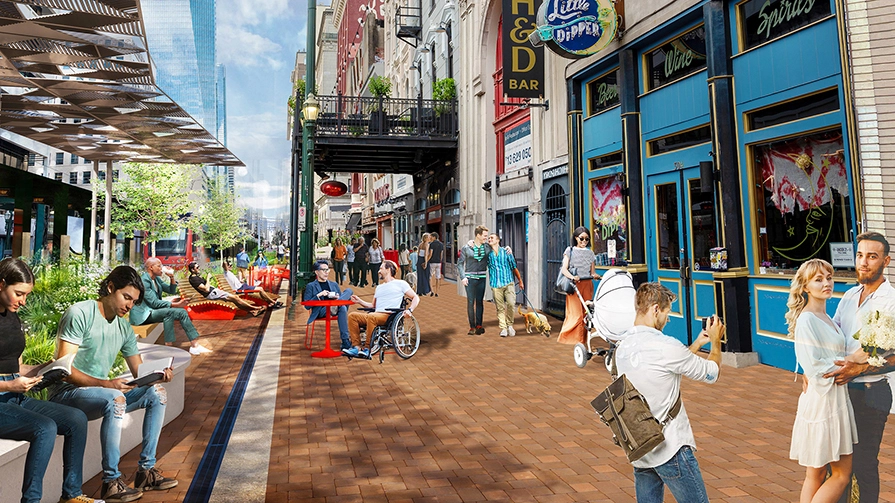
U.S. cities are taking cars off some significant streets. In San Francisco, a 2-mile stretch of highway will become a coastal park. And in Houston, landscape architecture firm Design Workshop is leading the redesign of the city's Main Street, creating a 11-block, pedestrian-only promenade. “I think we are certainly seeing momentum in the car-free or car-lite movement,” said Ben Crowther, policy director for the nonprofit America Walks.