

.webp?language=en-US)

Landscape-Based Approaches to Arid Photovoltaic Systems
by Magic Sun, Associate ASLA
Overview
As the world shifts from fossil fuels to renewable energy, solar power has emerged as a key player, driven by its decreasing costs. Mega solar power plants are now emerging in remote deserts worldwide, leveraging abundant sunlight and expansive vacant land. However, these enormous installations often clash with their surroundings, sparking controversy among local communities, many of which are impoverished and lack access to basic infrastructure. Yet, this challenge also presents a unique opportunity for landscape architects to innovate: How can we design photovoltaic (PV) panels to blend harmoniously with their environments? Can PV structures be utilized to create beneficial microclimates?
In this article, I want to present a conceptual project that examines the challenges of designing PV landscapes for arid communities and proposes multi-scale strategies within the scope of landscape architecture. Using the Noor Plant in Ouarzazate, Morocco, as a test site, the project explores innovative PV layouts for arid agropastoral systems that enhance microclimates and ecological services while also improving social infrastructure through solar power. This work aims to spark discussion and collaboration among those interested in the intersection of energy, ecology, and design.
About the Site
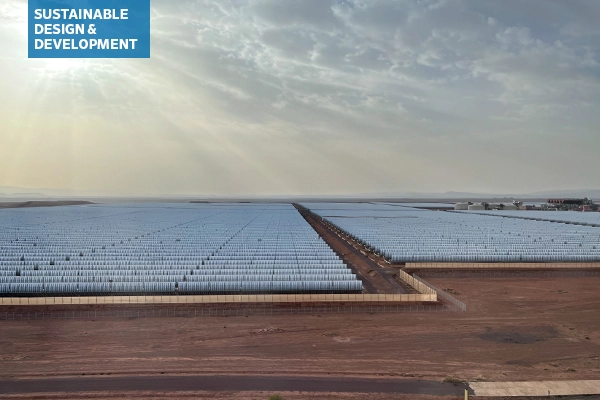
The Nour Power Station in Morocco, one of the world’s largest concentrated solar power plants, spans an area equal to 10 Central Parks. Built to reduce Morocco’s dependence on imported fossil fuels, it has supplied over a million homes with renewable energy since 2016.
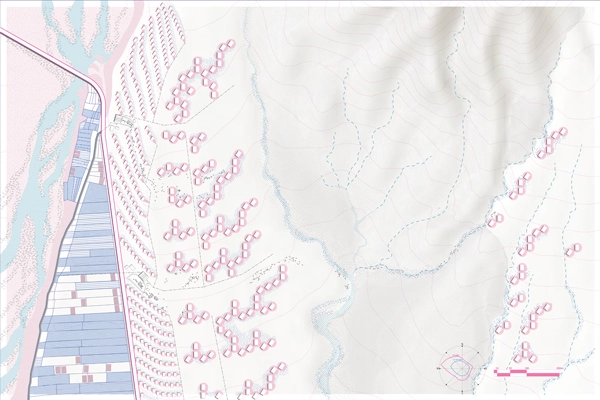
Located in the southern Moroccan desert near the Atlas Mountains, Nour sits on former communal grazing land (see diagram below). Despite its vast size, it employs only about 60 engineers, prioritizing energy production over local engagement.
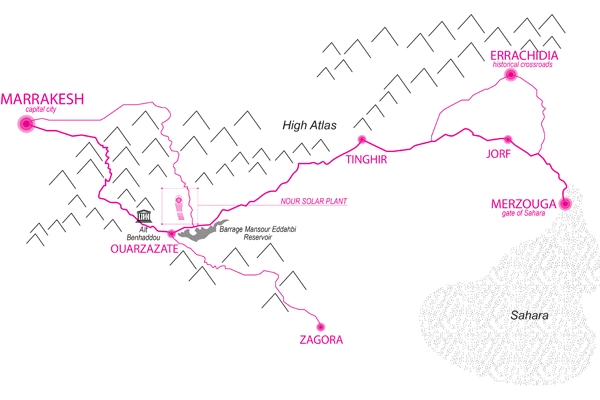
It’s easy to overlook, given the barren arid landscape, that the area around the Nour Plant is actually rich in culture and history. This location is at a cultural crossroads along the scenic Marrakesh-Merzouga route, a gateway to the Sahara. Just 10 minutes east of Nour, there’s a chain of oasis villages, some now abandoned, that rely on seasonal springs from the mountains. This traditional setting is in stark contrast to the high-tech solar plant nearby.
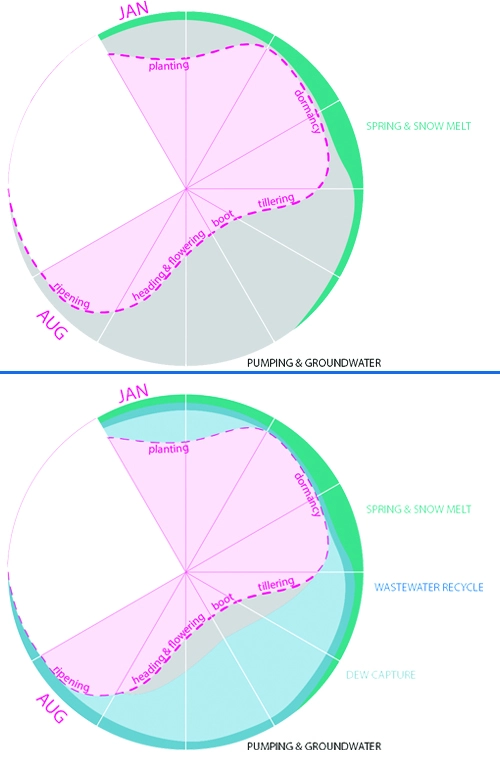
These villages, however, face increasing challenges. With jobs scarce and droughts worsening, traditional farming and nomadic lifestyles are declining. Water distribution is highly imbalanced, with upstream almond farms consuming more resources while downstream communities struggle with dry channels and dwindling groundwater. Meanwhile, Nour itself requires up to three million cubic meters of water annually for cooling and panel cleaning—equivalent to the yearly consumption of 5,000 households (see diagram below).
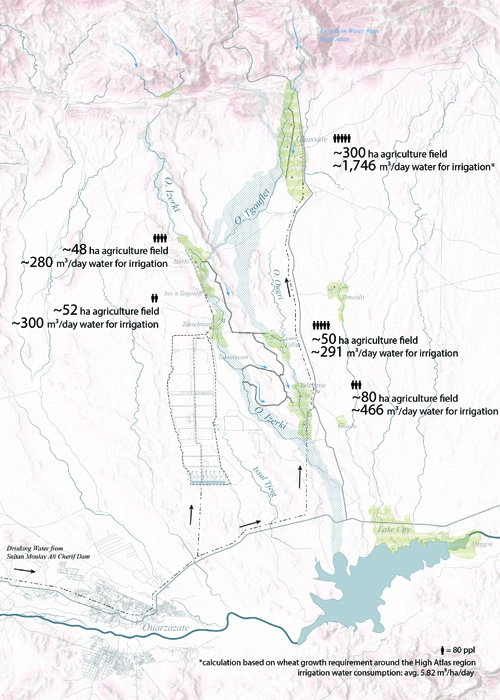
Over its four development phases, Nour has improved its cooling technology to reduce water use. As a massive infrastructure project attracting global investment, it has the potential to drive innovation, but this must come with a greater sense of social responsibility.
Design PV Landscape for the Arid Community
In arid regions, where resources are already scarce, introducing new developments like PV systems requires extra caution. Any unthoughtful expansion can lead to the destruction of fragile desert ecosystem and serious conflicts with communities. In a region rich in sunshine but scarce in water, dual land use with PV systems means harnessing solar power not only for energy production but also for improving water management practices and creating a more sustainable landscape.
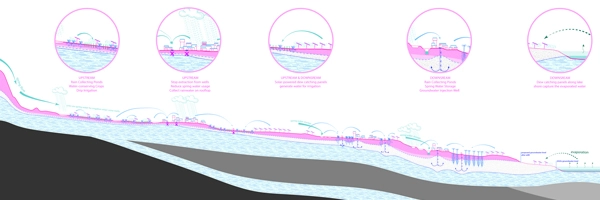
In case of Nour, my design proposal emphasizes effective water management powered by solar energy across three distinct scales:
1 – Rivershed Scale: Upstream areas should decrease the extraction of stream flow for irrigation, while downstream areas should enhance stream water storage. Excess water can be injected into wells to refill the declining groundwater table. (See section above.)
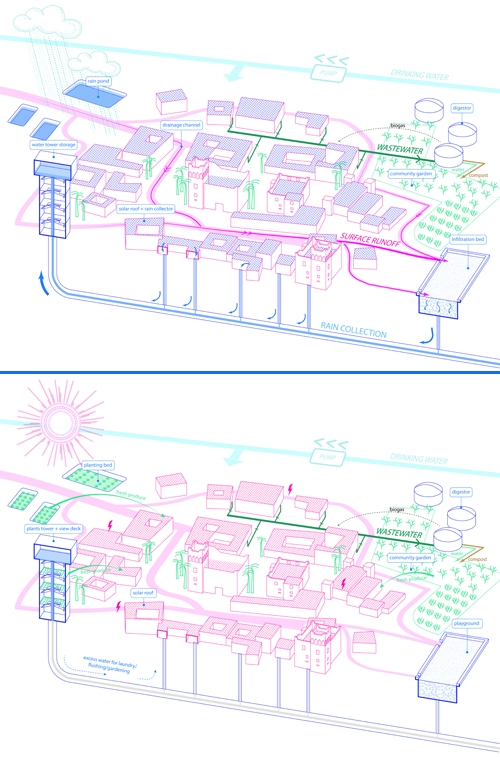
2 – Village Scale: The design integrates rainwater collection systems and wastewater management into public spaces. Key components such as rooftop collectors, drainage channels, infiltration beds, and storage tanks will be strategically placed to maximize efficiency. (See diagram below.)
3 – Site Scale: In underutilized fields, active dew catching panels, also known as “hydropanels,” will be installed to harness solar energy to extract water from air for irrigation during dry seasons. The ‘pore’ space between these hydropanels will support future agricultural and pastoral development.
The strategic placement of the hydropanels is crucial—not only must solar production be considered, but the location must also have the highest regional humidity levels to maximize water extraction. Without comprehensive site-scale humidity mapping, initial site selection is guided by landscape indicators such as proximity to water sources (e.g., areas downwind of snow-capped mountains, riverbeds, or palm groves) and natural depressions in the topography. Overall, a deep understanding of local microclimate is essential for the site selection of a PV system in arid regions.
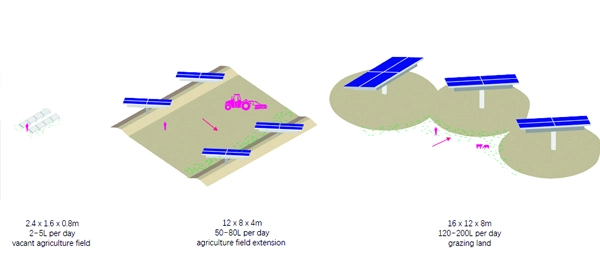
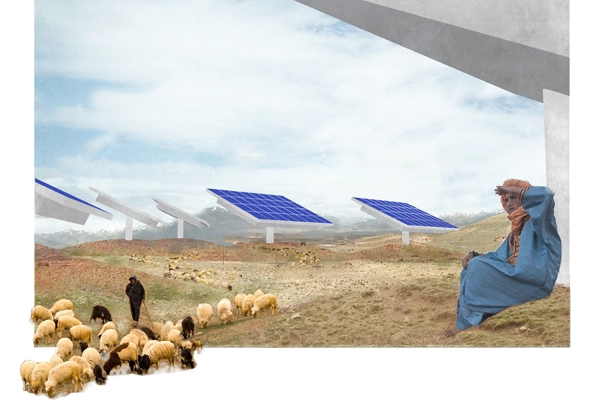
PV structures should be designed to create microclimates that support farming and grazing in arid regions, too. In agrivoltaics, solar panels can act like “cover crops,” lowering temperatures and improving rainwater capture. Inspired by local date palm farming, which uses berm-surrounded basins to retain water, my design adapts this concept to PV systems. Integrating soil work with PV installation enhances water retention and creates microclimates for arid agropastoral landscapes. Two types of landforms are designed to serve either agriculture or grazing purposes (see diagram below and site plan):
Agricultural Hydropanel Modules
Linear berms are placed along contour lines, creating sloped growing spaces that naturally accumulate soil moisture. The spacing between the berms allows for easy access by agricultural machinery, such as tractors.
Grazing Hydropanel Modules
For grazing areas, berm “hills” are constructed under the PV panels. These hills are arranged in enclosed patterns facing moisture-carrying winds, forming mini valleys that trap moisture and create wind-free zones for nomads and their livestock.
What's Next?
As landscape architects, we bring a unique perspective that can greatly contribute to energy planning, and it’s time for us to actively engage in this evolving field. This will be an ongoing research focus for me, and I hope to gain a deeper understanding of how solar panels impact the environment in three dimensions while exploring innovative layout strategies.
Magic Sun, Associate ASLA, is a recent graduate from Harvard Graduate School of Design with a strong interest in sustainable design, striving to create meaningful change toward a low-carbon society at both strategic and practical levels. She enjoys using digital tools for research and cross-disciplinary work. Since 2023, she has been a project designer at Coen+Partners.
For more about Magic, see her Voices of Women in Landscape Architecture profile.