

.webp?language=en-US)


At COP28, Countries Need to Get on Track to Hit 2030 Goals
By Jared Green
In 2023, temperatures were the hottest on record. This is because the current level of heat-trapping greenhouse gases in the atmosphere hasn't been seen in 3-5 million years. A slew of United Nations (UN) climate reports released over the past few months tell the same story: the world's governments are taking action to reduce global temperatures but are not moving fast enough. The lack of progress is only increasing climate risks.
The latest Emissions Gap Report from the UN Environment Program (UNEP) finds that current pledges by countries that signed on to the Paris Agreement will lead to a 2.5°C (4.5°F) to 2.9°C (5.2°F°) temperature rise this century, far surpassing the goal of a 1.5°C (2.7°F) temperature increase. And last year, global greenhouse gas emissions increased by 1.2 per cent to reach a new high of 57.4 billion tonnes of carbon dioxide (GtCO2e). This means governments, particularly the largest historical polluters, need to dramatically scale up their emission reduction efforts.
World leaders are looking to the upcoming global climate summit -- COP28 -- in Dubai, United Arab Emirates, to build new momentum. There, countries will confirm the "global stocktake," which analyzes emissions data from the past five years, and set new targets in 2025 to be achieved by 2035.
“Every fraction of a degree matters, but we are severely off track. COP28 is our time to change that,” said Simon Stiell, Executive Secretary of UN Climate Change. “It’s time to show the massive benefits now of bolder climate action: more jobs, higher wages, economic growth, opportunity and stability, less pollution and better health.”
The UN’s Intergovernmental Panel on Climate Change found that countries need to cut global greenhouse gases 43 percent by 2030 in comparison with 2019 levels to keep goals in reach.
Unfortunately, countries are only taking "baby steps" in this direction, Stiell has said. The UN analyzed the nationally determined commitments (NDCs) of 195 countries that signed on to the Paris Agreement. They found that if current commitments are met, global greenhouse gas emissions will increase by 2 percent by 2030 in comparison with 2019 levels, which is very far from the 43 percent drop needed.
To speed up the peaking process and start making more dramatic cuts, countries need to invest more in transforming their economies and communities, particularly the transition to renewable energy. The International Energy Agency (IEA) says $4.5 trillion of investment in renewable energy is needed each year by 2030 to keep the 1.5°C temperature increase goal in reach. In 2023, renewable energy spending is anticipated to be $1.8 trillion, less than half what is required.
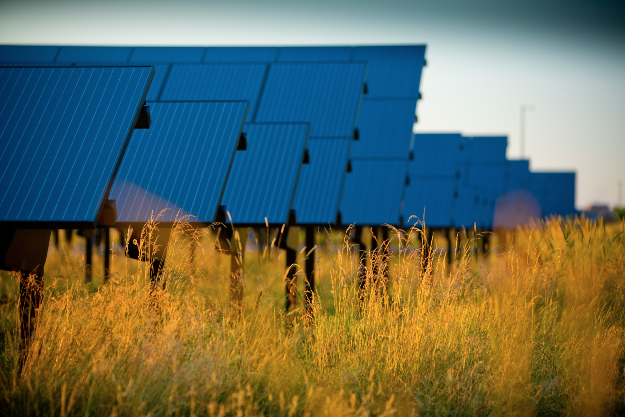
Greater investment in renewable energy also means more planning and design work will be needed to appropriately site the expansion of wind and solar power across landscapes. As Hood Design Studio demonstrated with the Solar Strand at the University at Buffalo, it can be done in a way that reduces impacts on wildlife and supports ecological restoration.
The risks of slow progress on reducing emissions are only becoming clearer. A report published in The Lancet by 114 scientists contends that "climate change continues to have a worsening effect on health and mortality around the world." The New York Times reports: "One of the starkest findings is that heat-related deaths of people older than 65 have increased by 85 percent since the 1990s."
The U.S. government also recently released its fifth national climate assessment. It states: "Across the country, efforts to adapt to climate change and reduce emissions have expanded since 2018, and U.S. emissions have fallen since peaking in 2007. However, without deeper cuts in global net greenhouse gas emissions and accelerated adaptation efforts, severe climate risks to the United States will continue to grow."
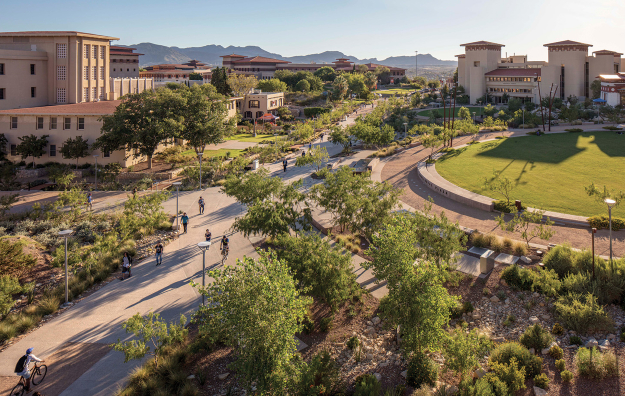
The assessment finds that states, tribal authorities, and cities are taking advantage of new adaptation measures, including "nature-based solutions, such as restoring coastal wetlands and oyster reefs." It also points to the growth of green infrastructure to tackle increased stormwater; efforts to manage vegetation to reduce wildfire risks; and the rise of urban heat plans, which leverage expanded tree canopies to reduce dangerous heat islands.
But they still conclude that even in a wealthy country like the U.S., "current adaptation efforts and investments are insufficient to reduce today’s climate-related risks and keep pace with future changes in the climate."
Extreme weather events -- longer heatwaves and droughts, worse floods and wildfires -- have grown in number. In the 1980s, the U.S. experienced approximately 3 billion-dollar disasters per year. But over the past four years, that has skyrocketed to more than 22 billion-dollar events annually, and many of these events are highly costly. "Extreme events cost the U.S. close to $150 billion each year—a conservative estimate that does not account for loss of life, healthcare-related costs, or damages to ecosystem services."
In this new era of increased climate impacts, landscape architects, planners, engineers, and architects are needed more than ever to envision new climate-resilient infrastructure that keep communities safe, and also pragmatic climate migration plans where this isn't feasible.
Climate policymakers also see the need for new global goals for adaptation, an area where landscape architects can provide leadership and effective strategies.
For example, in China, 70 cities have joined the "Sponge City" movement led by landscape architect Kongjian Yu, FASLA, founder of Turenscape and the 2023 Cornelia Hahn Oberlander International Landscape Architecture Prize winner. The goal is that by 2030, 80 percent of these cities will absorb 70 percent of rainfall through green infrastructure approaches, reducing the impacts of sea level rise and flooding.
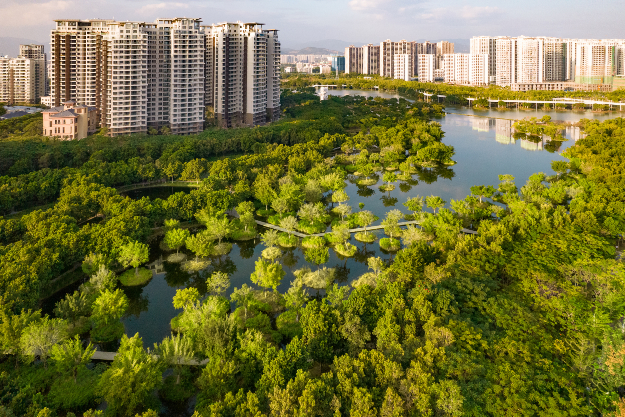
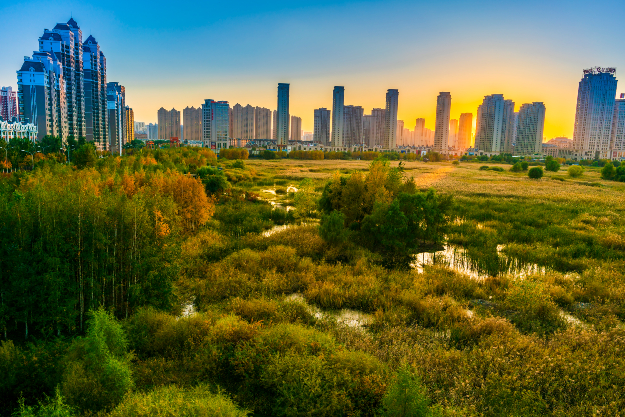
A range of adaptation targets, rooted in nature-based solutions, are needed to not only reduce damages from flooding and sea level rise, but also extreme heat, drought, and other climate health impacts.
Nature-based solutions are smart because they provide many additional benefits -- increased biodiversity, greater carbon drawdown, improved health, and economic growth. At COP28, landscape architect delegates will press global leaders to increase investment in these solutions.
Close watchers of the climate negotiations expect to see progress at COP28 on developing new adaptation goals. These targets can help drive the creation of more accurate climate financing goals, and spur wealthy countries to donate more loss and damage funds to the people and communities already experiencing impacts.