

.webp?language=en-US)

.webp?language=en-US)
Advertisement
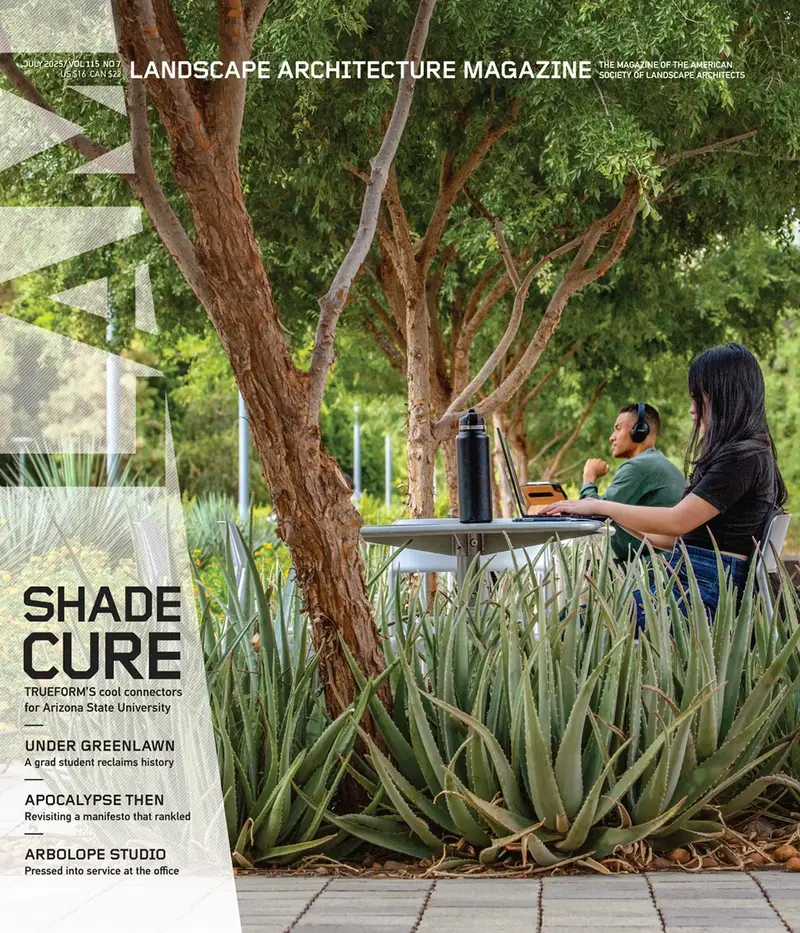
Landscape Architecture Magazine July 2025 Cover
Landscape Architecture Magazine Assessments
Founded in 1910, Landscape Architecture Magazine (LAM) is the monthly magazine of the American Society of Landscape Architects (ASLA). It is the magazine of record for the landscape architecture profession in North America. The magazine reaches more than 60,000 readers who plan and design projects worth over $140 billion each year.
LAM is included with ASLA membership. It is also available by subscription in both print and digital formats and can be found in more than 250 bookstores worldwide.
Advertisement
Measuring and Reporting Our Impact
In 2023, ASLA collected baseline data on greenhouse gas emissions from its headquarters operations, which includes Landscape Architecture Magazine.
-
ASLA released its second annual assessment of greenhouse gas emissions from its operations. In 2024, the organization reached its goal of reducing emissions by 20 percent from 2023 levels and continues to work toward zero emissions by 2040.
The 2024 assessment measures emissions from electricity use, magazine printing and shipping, business travel, employee commuting, waste, and more. The total emissions were 257 metric tonnes, down from 320.5 tonnes in 2023.
The assessment was developed with Honeycomb Strategies, a sustainability consulting company. ASLA and Honeycomb collected detailed data on:
Monthly business travel and commuting
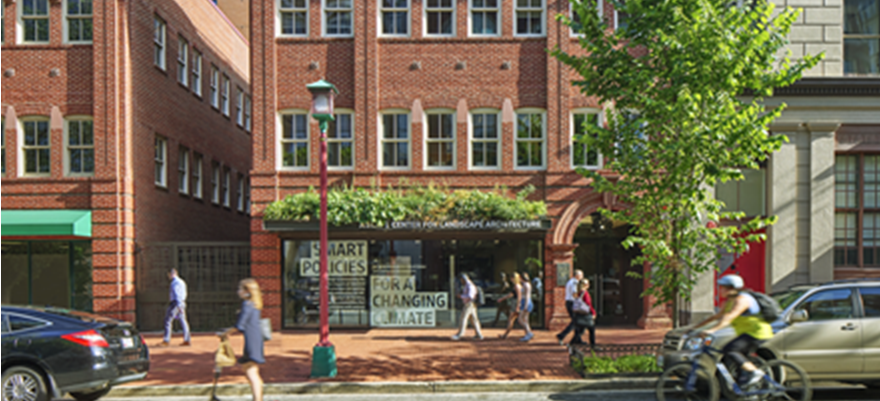
Energy use and waste from the ASLA Center for Landscape Architecture (LEED Platinum- and WELL Gold-certified)
Printing, shipping, and online use for Landscape Architecture Magazine (LAM)
Emissions by Scope
Scope 1 (Direct emissions): 0 tonnes
Scope 2 (Indirect emissions from electricity): 34.4 tonnes
Scope 3 (Other indirect emissions, including travel and purchased goods): 222 tonnes
Of the total 257 tonnes:
ASLA Center: 74 tonnes (29%)
LAM: 183 tonnes (71%)
Top Sources of Emissions
Category 2023 2024 Reduction % LAM print magazine distribution 112 t 104 t 7% LAM printing 71 t 65 t 8% ASLA Center electricity 52 t 34 t 19% Business travel 37 t 17 t 54% Employee commuting 28 t 8 t 71% LAM digital user computer use 13 t 13 t 0% ASLA.org user computer use 12 t 9 t 25% LA Bash student conference 10 t 3 t 70% Center waste 1 t 1 t 0% Center meals 0.5 t 0.5 t 0% Magazine Sustainability Practices
LAM tracks emissions from both print and digital content. To reduce its impact, the magazine:
Uses Forest Stewardship Council (FSC)-certified paper with at least 10% post-consumer recycled content
Works with partners who report and track energy use and carbon impact
Requests detailed emissions data to encourage transparency and efficiency in the printing supply chain
Print magazine emissions are calculated using: weight of each issue, number of issues mailed, and distribution locations.
ASLA Center Operations
Energy Use:
The Center used 112,827 kWh of electricity (8.9 kWh per square foot), below the national office average of 16.9 kWh per square foot, according to the U.S. Energy Information Administration (EIA)
Purchasing renewable energy credits cut energy-related emissions by 19% from 2023
Travel:
Staff commuted 2,761 times, covering 55,700 miles
40% by car (down from 69% in 2023)
52% by public transit (up from 27%)
6% by walking or biking (up from 4%)
Business travel: 90,000 miles, 92% by plane (down from 95%)
Waste:
Total waste: 7,280 pounds
71% sent to landfill
29% recycled
Digital Emissions:
Based on number of users, time spent reading online content, and user energy use
2024 Actions to Reduce Emissions
Purchased 100% renewable energy for the ASLA Center
Promoted low-carbon commuting: biking, walking, public transit, and carpooling
Encouraged train travel for trips under 250 miles
Reduced complimentary industry partner LAM subscriptions by 60%
Partnered with suppliers using renewable energy, energy efficiency programs, and sustainability assessments
Employee Incentives and Facilities:
Added bike parking and encouraged EV charging options
Offered locally sourced and mostly vegetarian meals for events
Continued to refine travel and commuting policies
-
In 2023, ASLA collected baseline data on greenhouse gas emissions from its operations, including headquarters energy use, staff commuting and business travel, magazine production, and events. The total emissions were 320.5 metric tonnes. This sets a starting point as ASLA works toward its goal of zero emissions by 2040. The first annual report was published in 2024.
The assessment was created with Honeycomb Strategies, a sustainability consulting firm. Together, ASLA and Honeycomb collected detailed data, including:
Monthly business travel and commuting
Energy use and waste at the ASLA Center for Landscape Architecture, a LEED Platinum- and WELL Gold-certified building
Printing, shipping, and online use of Landscape Architecture Magazine (LAM)
Emissions by Category
Scope 1 – Direct emissions: 0 tonnes
Scope 2 – Indirect emissions from purchased electricity: 52 tonnes
Scope 3 – Indirect emissions from other goods, services, and travel: 268.5 tonnesOf the total 320.5 tonnes:
ASLA Center: 124.5 tonnes (39%)
LAM: 196 tonnes (61%)
Top sources of emissions:
LAM print magazine distribution: 112 tonnes
LAM printing: 71 tonnes
ASLA Center electricity use: 52 tonnes
Business travel: 26 tonnes
Employee commuting: 22 tonnes
LAM digital use: 13 tonnes
ASLA.org user computer use: 12 tonnes
LA Bash student conference: 10 tonnes
ASLA Center waste: 1 tonne
ASLA Center meals: 0.5 tonnes
Magazine Sustainability Practices
LAM tracks emissions from both print and digital content. To reduce its impact, the magazine:
Uses Forest Stewardship Council (FSC)-certified paper with at least 10% post-consumer recycled content
Works with partners who report and track energy use and carbon impact
Requests detailed emissions data to encourage transparency and efficiency in the printing supply chain
Print magazine emissions are calculated using: weight of each issue, number of issues mailed, and distribution locations.
ASLA Center Operations
Emissions calculations for the headquarters include electricity, staff commuting, and business travel.
Electricity use: 170,000 kWh (13.4 kWh per square foot), below the U.S. office average of 16.9 kWh per square foot
Staff commuting: 3,882 trips covering 105,000 miles
69% by car
27% by public transit
4% walking or biking
Business travel: 228,000 miles (96% by plane)
Waste: 7,280 pounds (71% landfill, 29% recycled)
Digital Emissions
LAM digital and ASLA.org website emissions are based on:
Number of users
Time spent reading content
Energy use of users’ computers at home or office
Key steps taken so far:
LAM meets magazine industry standards for low-carbon publishing and is printed on Forest Stewardship Council (FSC)-certified paper.
In 2008, LAM began co-mailing with other publications to help cut shipping-related emissions.
Since 2009, LAM has also been available digitally through Zinio, and ASLA encourages members to choose the digital version to further reduce shipping emissions.