

.webp?language=en-US)

.webp?language=en-US)
Advertisement

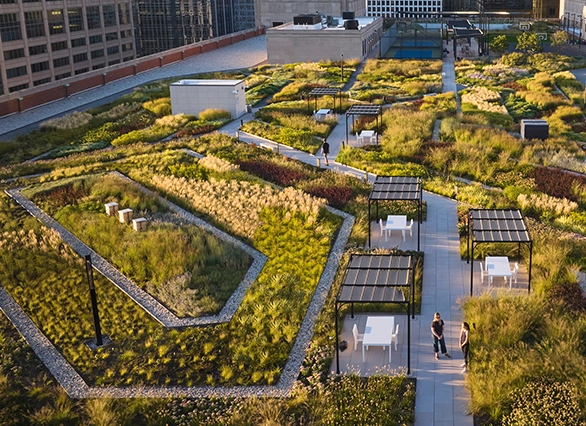
ASLA Center green roof
ASLA Center Assessments
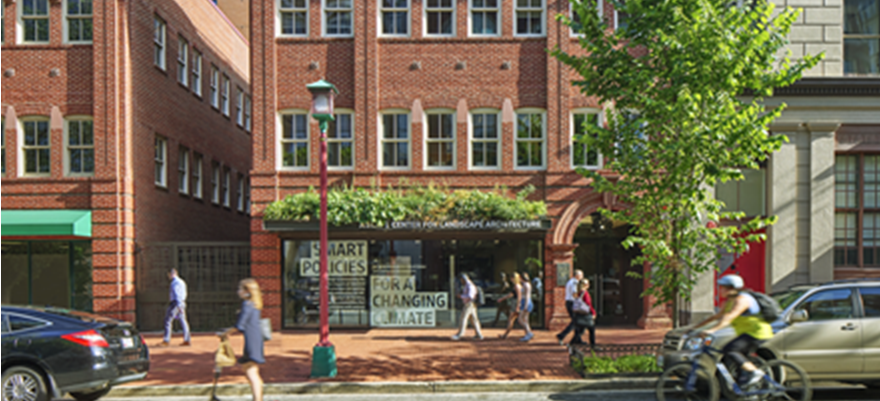
The ASLA Center for Landscape Architecture, the headquarters of the American Society of Landscape Architects in Washington, D.C, is a showcase for how to apply the highest standards of sustainable architectural and landscape design to reduce energy use and greenhouse gas emissions while improving occupant health and well-being.
Sustainability Features
- 100% Renewable Energy: The ASLA Center runs entirely on locally-sourced wind power.
- Green Building Certifications: The 12,600-square-foot headquarters was built in 1995 and completely renovated in 2016 to achieve LEED Platinum certification. The renovation focused on maximizing energy efficiency, storing carbon in sustainable wood materials and native trees and plants, and improving human health and well-being. ASLA also achieved WELL Gold certification by improving indoor air quality, lighting, nourishment, and promoting active lifestyles.
- Green Roof & Stormwater Management:The Center's green roof, designed by landscape architects at Michael Van Valkenburgh Associates and Conservation Design Forum, includes a unique sedum floor covered with a mesh grate that enables visitors to walk over much of the green roof surface. Some key benefits of the roof:
- Captures all stormwater: Any roof run-off is channeled to a 700-gallon cistern and used to irrigate the ground-level outdoor patio space, which is filled with native plants and features a green wall.
- Reduces the local urban heat island effect: the roof is as much as 59 F cooler than the conventional black roofs on neighboring buildings.
- Reduces building energy use: The roof's trees, plants, and engineered soils cool the center during the summer and providing insulation in the winter.
- Sequestering carbon: The roof captures and stores carbon in its trees, plants, and soils.
- Incentives for Low-Emission Commutes: Since 2005, ASLA has been named a Best Workplace for Commuters. ASLA provides financial incentivizes to employees to walk, bike, or ride Metro to work, which reduces transportation-related greenhouse gas emissions. ASLA also removed one of its parking spaces in order to make way for multiple bicycle parking spaces.
Advertisement
Measuring and Reporting Our Impact
Since 2023, ASLA has collected data on our business operations, including greenhouse gas emissions from headquarters operations, staff commuting and travel, Landscape Architecture Magazine, and the student-run LABash conference. Our first annual report was published in 2024. These reports help us track our progress and drive continuous improvement.
-
ASLA released its third annual assessment of greenhouse gas emissions from its operations. In 2025, the organization reduced its emissions by 56 percent in comparison with a 2022 baseline.
The 2025 assessment measures emissions from electricity use, magazine printing and shipping, business travel, employee commuting, waste, and more. The total emissions were 164 metric tonnes, down from 257 tonnes in 2024.
The assessment was developed with Honeycomb Strategies, a sustainability consulting company. ASLA and Honeycomb collected detailed data on:
- Monthly business travel and commuting
- Energy use and waste from the ASLA Center for Landscape Architecture (LEED Platinum- and WELL Gold-certified)
- Printing, shipping, and online use for Landscape Architecture Magazine (LAM)
Emissions by Scope
- Scope 1 (Direct emissions): 0 tonnes
- Scope 2 (Indirect emissions from electricity): 0 tonnes
- Scope 3 (Other indirect emissions, including travel and purchased goods): 164 tonnes
Of the total 164 tonnes:
- ASLA Center: 39 tonnes (24 percent)
- LAM: 126 tonnes (76 percent)
Top Sources of Emissions
Category 2024 2025 Increase / Reduction % LAM print magazine distribution 104t 67t -35% LAM printing 65t 45t -30% ASLA Center electricity 34t 0t -100% Business travel 17t 21.5t +20% LAM digital user computer use 13t 13.5t +3% ASLA.org user computer use 9t 2.6t -70% Employee commuting 8t 8.5t +6% LA Bash student conference 3t 5t +66% Center waste 1t 0.4t -60% Center meals 0.5t 0.5t 0% (In metric tonnes)
Magazine Sustainability Practices
LAM tracks emissions from both print and digital content. To reduce its impact, the magazine:
- Uses Forest Stewardship Council (FSC)-certified paper with at least 10 percent post-consumer recycled content
- Works with partners who report and track energy use and carbon impact
- Requests detailed emissions data to encourage transparency and efficiency in the printing supply chain
Print magazine emissions are calculated using: weight of each issue, number of issues mailed, and distribution locations.
ASLA Center Operations
Energy Use
- The Center used 163,651 kWh of electricity (12.8 kWh per square foot), below the national office average of 16.9 kWh per square foot, according to the U.S. Energy Information Administration (EIA)
- Purchasing renewable energy credits cut energy-related emissions by 100 percent from 2024.
Travel
- Staff commuted 2,496 times, covering 44,868 miles
- 43 percent by car (up from 40 percent in 2024)
- 49 percent by public transit (down from 52 percent in 2024)
- 6 percent by walking or biking (same as in 2024)
- Business travel: 126,891 miles, up 40 percent from 2024
- 95 percent by plane (up from 92 percent)
Waste
- Total waste: 3,974 pounds, down from 7,280 pounds in 2024
- 52 percent recycled, up from 29 percent in 2024
- 48 percent sent to landfill, down from 71 percent in 2024
Digital Emissions
Based on the number of users, time spent reading online content, and user energy use.
2025 Actions to Reduce Emissions
- Purchased 100 percent renewable energy for the ASLA Center
- Promoted low-carbon commuting: biking, walking, public transit, and carpooling
- Encouraged train travel for trips under 250 miles
- Partnered with suppliers using renewable energy, energy efficiency programs, and sustainability assessments
Employee Incentives and Facilities
- Provided indoor bike storage
- Requested the District of Columbia government add an EV charger nearby
- Offered locally sourced and mostly vegetarian meals for events
- Continued to refine travel and commuting policie4
-
ASLA released its second annual assessment of greenhouse gas emissions from its operations. In 2024, the organization reached its goal of reducing emissions by 20 percent from 2023 levels and continues to work toward zero emissions by 2040.
The 2024 assessment measures emissions from electricity use, magazine printing and shipping, business travel, employee commuting, waste, and more. The total emissions were 257 metric tonnes, down from 320.5 tonnes in 2023.
The assessment was developed with Honeycomb Strategies, a sustainability consulting company. ASLA and Honeycomb collected detailed data on:
Monthly business travel and commuting
Energy use and waste from the ASLA Center for Landscape Architecture (LEED Platinum- and WELL Gold-certified)
Printing, shipping, and online use for Landscape Architecture Magazine (LAM)
Emissions by Scope
Scope 1 (Direct emissions): 0 tonnes
Scope 2 (Indirect emissions from electricity): 34.4 tonnes
Scope 3 (Other indirect emissions, including travel and purchased goods): 222 tonnes
Of the total 257 tonnes:
ASLA Center: 74 tonnes (29%)
LAM: 183 tonnes (71%)
Top Sources of Emissions
Category 2023 2024 Reduction % LAM print magazine distribution 112 t 104 t 7% LAM printing 71 t 65 t 8% ASLA Center electricity 52 t 34 t 19% Business travel 37 t 17 t 54% Employee commuting 28 t 8 t 71% LAM digital user computer use 13 t 13 t 0% ASLA.org user computer use 12 t 9 t 25% LA Bash student conference 10 t 3 t 70% Center waste 1 t 1 t 0% Center meals 0.5 t 0.5 t 0% Magazine Sustainability Practices
LAM tracks emissions from both print and digital content. To reduce its impact, the magazine:
Uses Forest Stewardship Council (FSC)-certified paper with at least 10% post-consumer recycled content
Works with partners who report and track energy use and carbon impact
Requests detailed emissions data to encourage transparency and efficiency in the printing supply chain
Print magazine emissions are calculated using: weight of each issue, number of issues mailed, and distribution locations.
ASLA Center Operations
Energy Use:
The Center used 112,827 kWh of electricity (8.9 kWh per square foot), below the national office average of 16.9 kWh per square foot, according to the U.S. Energy Information Administration (EIA)
Purchasing renewable energy credits cut energy-related emissions by 19% from 2023
Travel:
Staff commuted 2,761 times, covering 55,700 miles
40% by car (down from 69% in 2023)
52% by public transit (up from 27%)
6% by walking or biking (up from 4%)
Business travel: 90,000 miles, 92% by plane (down from 95%)
Waste:
Total waste: 7,280 pounds
71% sent to landfill
29% recycled
Digital Emissions:
Based on number of users, time spent reading online content, and user energy use
2024 Actions to Reduce Emissions
Purchased 100% renewable energy for the ASLA Center
Promoted low-carbon commuting: biking, walking, public transit, and carpooling
Encouraged train travel for trips under 250 miles
Reduced complimentary industry partner LAM subscriptions by 60%
Partnered with suppliers using renewable energy, energy efficiency programs, and sustainability assessments
Employee Incentives and Facilities:
Added bike parking and encouraged EV charging options
Offered locally sourced and mostly vegetarian meals for events
Continued to refine travel and commuting policies
-
In 2023, ASLA collected baseline data on greenhouse gas emissions from its operations, including headquarters energy use, staff commuting and business travel, magazine production, and events. The total emissions were 320.5 metric tonnes. This sets a starting point as ASLA works toward its goal of zero emissions by 2040. The first annual report was published in 2024.
The assessment was created with Honeycomb Strategies, a sustainability consulting firm. Together, ASLA and Honeycomb collected detailed data, including:
Monthly business travel and commuting
Energy use and waste at the ASLA Center for Landscape Architecture, a LEED Platinum- and WELL Gold-certified building
Printing, shipping, and online use of Landscape Architecture Magazine (LAM)
Emissions by Category
Scope 1 – Direct emissions: 0 tonnes
Scope 2 – Indirect emissions from purchased electricity: 52 tonnes
Scope 3 – Indirect emissions from other goods, services, and travel: 268.5 tonnesOf the total 320.5 tonnes:
ASLA Center: 124.5 tonnes (39%)
LAM: 196 tonnes (61%)
Top sources of emissions:
LAM print magazine distribution: 112 tonnes
LAM printing: 71 tonnes
ASLA Center electricity use: 52 tonnes
Business travel: 26 tonnes
Employee commuting: 22 tonnes
LAM digital use: 13 tonnes
ASLA.org user computer use: 12 tonnes
LA Bash student conference: 10 tonnes
ASLA Center waste: 1 tonne
ASLA Center meals: 0.5 tonnes
Magazine Sustainability Practices
LAM tracks emissions from both print and digital content. To reduce its impact, the magazine:
Uses Forest Stewardship Council (FSC)-certified paper with at least 10% post-consumer recycled content
Works with partners who report and track energy use and carbon impact
Requests detailed emissions data to encourage transparency and efficiency in the printing supply chain
Print magazine emissions are calculated using: weight of each issue, number of issues mailed, and distribution locations.
ASLA Center Operations
Emissions calculations for the headquarters include electricity, staff commuting, and business travel.
Electricity use: 170,000 kWh (13.4 kWh per square foot), below the U.S. office average of 16.9 kWh per square foot
Staff commuting: 3,882 trips covering 105,000 miles
69% by car
27% by public transit
4% walking or biking
Business travel: 228,000 miles (96% by plane)
Waste: 7,280 pounds (71% landfill, 29% recycled)
Digital Emissions
LAM digital and ASLA.org website emissions are based on:
Number of users
Time spent reading content
Energy use of users’ computers at home or office
-
Each year, ASLA will update its carbon calculation methodologies to reflect the latest data, scientific advancements, and evolving regulations, ensuring accurate and standardized greenhouse gas (GHG) reporting across industries and regions. These updates incorporate changes in energy use, fuel types, industry practices, and technological advancements.
By regularly updating these co-efficients, regulatory bodies ensure that carbon calculations remain accurate, reflecting shifts in carbon intensity, energy efficiency, and technological innovations. Globally, this process is overseen by national and international regulatory bodies such as the U.S. Environmental Protection Agency (EPA), the European Environment Agency (EEA), and the Intergovernmental Panel on Climate Change (IPCC). For example, the EPA’s eGRID database is updated annually with the latest emission factors for electricity generation in the U.S. while the EEA provides carbon co-efficients for EU member states based on energy consumption and grid performance data. Through its GHG Inventory Guidelines, the IPCC offers a global framework with standardized emission factors that countries around the world use to align their carbon calculations with the latest science.
Businesses and governments use these updated emission factors to meet regulatory compliance and international climate goals, such as those outlined in the Paris Agreement.
What We Learn and How We Act
By reviewing business operations data, we identify the primary sources of waste, energy and water use, and greenhouse gas emissions. These insights help us create new internal policies and actions to further reduce impacts.
Join Us in Reducing Impacts
We encourage members, partners, and others interested in learning how to reduce emissions from their business operations to contact us. Please review our guide Towards Zero-Emission Business Operations and email us at [email protected]
Towards Zero Emission Business Operations Guide
Practical strategies to measure your carbon footprint and reduce business emissions.