

.webp?language=en-US)

.webp?language=en-US)


Advertisement
Water and Stormwater Management
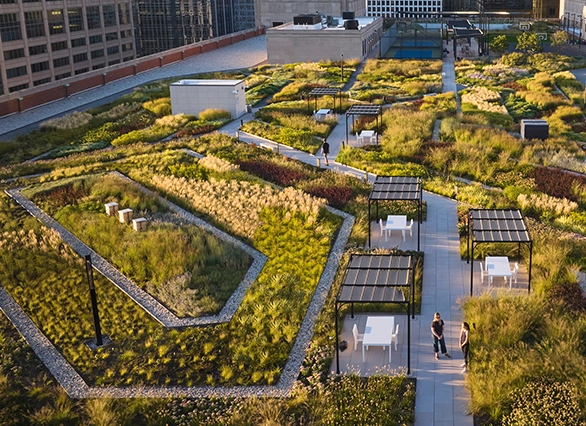
Economic vitality, homeland security, quality of life, and natural ecosystems all rely on ample, clean water. Landscape architects help communities large and small manage their stormwater with nature-based solutions techniques, such as green roofs, rain gardens, bioswales, and pervious pavements. ASLA works with policymakers to support innovative strategies that reduce stormwater runoff and improve our nation’s water supply.
Clean Water State Revolving Funds (CWSRF)
-
The American Society of Landscape Architects (ASLA) supports legislation that increases funding and other resources for federal clean water programs, including the Clean Water State Revolving Fund (CWSRF).
-
The Clean Water Act (CWA) of 1972 was passed to protect one of our most important and vital natural resources—water. It was specifically written as a remedy to clean the extremely polluted drinking water sources that were unusable for bathing, swimming, recreational activities, or cleaning, let alone consuming. Since 1972, the quality of America’s rivers, lakes, streams, and other bodies of water improved exponentially.
To assist states and localities in the implementation of the CWA, Congress passed an amendment in 1987 creating the Clean Water State Revolving Fund (CWSRF). This program provides states with low-cost financing to design, plan, build, or update water infrastructure. Project eligibility includes municipal wastewater facilities, nonpoint source pollution control, decentralized wastewater treatment systems, stormwater management and mitigation, green infrastructure, estuary protection, and water reuse. Under the CWSRF, states may provide various types of assistance, including loans, refinancing, purchasing, or guaranteeing local debt and purchasing bond insurance. States have the flexibility to target financial resources to their specific community and environmental needs.
It has been the policy of the Environmental Protection Agency, which administers the CWSRF, to promote and prioritize the use of green infrastructure in CWSRF projects. Established under the American Recovery and Reinvestment Act of 2009, the Green Project Reserve (GPR) requires a minimum of 10 percent of all CWSRF funding to be used for projects that utilize green infrastructure, water and energy efficiency, or other environmentally innovative activities. The GPR is not permanently authorized and is subject to annual actions of Congress and appropriators.
The CWSRF is one of the most-accessed federal funding sources for landscape architects to plan and design water infrastructure projects. -
On April 22, 2026, Representative Nikema Williams (GA) reintroduced the Water Infrastructure Sustainability and Efficiency (WISE) Act. This measure would allocate a minimum of 20 percent of all CWSRF funding to be used for GPR projects that utilize green infrastructure, water and energy efficiency, or other environmentally innovative activities.
-
On April 22, 2026, H.R. 8459 was reintroduced and referred to the House Committee on Transportation and Infrastructure, Subcommittee on Water Resources and Environment.
-
Representative Nikema Williams (GA), and cosponsors.
-
Congresswoman Nikema Williams Introduces the WISE Act to Permanently Fund Clean Water Projects. April 22, 2026.
U.S. Environmental Protection Agency: About the Clean Water State Revolving Fund
U.S. Environmental Protection Agency: CWSRF Results
U.S. Environmental Protection Agency: CWSRF Infographic
U.S. Environmental Protection Agency: Green Project Reserve Guidance for the Clean Water State Revolving Fund
Water Resources Development Act (WRDA)
-
The American Society of Landscape Architects (ASLA) supports a Water Resources Development Act (WRDA) that promotes sustainable water infrastructure projects, while also addressing climate change impacts, biodiversity, and environmental justice.
-
Operating through the U.S. Army Corps of Engineers (USACE), the U.S. government has responsibility for developing and maintaining U.S. ports, harbors, and waterways as a means of facilitating navigation and promoting commerce. USACE also protects communities against floods by building dams and levees, and other means. In addition, USACE undertakes ecosystem restoration projects — protecting not only people and infrastructure, but also restoring and preserving the country's vital natural resources.
Congress first enacted WRDA in 1974, as a measure to identify and authorize funding for USACE projects and provide policy guidance. Since 2014, Congress passed WRDA bills on a biennial basis due to its essential role in the 50 states, territories, and Tribal nations.
WRDA authorizes USACE to implement critical infrastructure projects, studies, and policies related to our nation’s waterways. WRDA seeks to protect communities from climate change while conserving natural resources. -
On June 29, 2026, Representative Sam Graves (MO) introduced H.R. 9497, the Water Resources Development Act of 2026. A Senate companion bill, S. 4949, was introduced by Senator Shelley Moore Capito (WV) on July 13, 2026. Both bills authorize the U.S. Army Corps of Engineers' (USACE) civil works program and support investments in water resources infrastructure, flood risk reduction, navigation, ecosystem restoration, recreation, and community resilience. The legislation also includes policy reforms to improve project delivery and strengthen the nation's water infrastructure.
The House bill, H.R. 9497, authorizes 131 new feasibility studies and 10 new construction projects. In addition to these authorizations, the legislation includes several policy reforms to improve project delivery, strengthen flood risk management, and encourage greater use of natural and nature-based features (NNBF) as part of the U.S. Army Corps of Engineers' water resources mission. The bill expands opportunities for the Corps to incorporate natural infrastructure into flood risk reduction, storm damage reduction, and drought resilience projects, recognizing the important role these approaches play in creating more resilient, sustainable, and cost-effective communities.
The Senate bill, S. 4949, authorizes 61 new feasibility studies and 15 new or modified construction projects. In addition to USACE authorizations, the bill reauthorizes key U.S. Environmental Protection Agency drinking water and wastewater infrastructure programs, including the Clean Water State Revolving Fund (CWSRF), Drinking Water State Revolving Fund (DWSRF), and the Water Infrastructure Finance and Innovation Act (WIFIA) program. The legislation also includes provisions to improve water infrastructure resilience, streamline project delivery, and support ecosystem restoration efforts.
The House version of WRDA 2026 also includes several provisions that ASLA worked with the House Transportation and Infrastructure Committee to advance. These provisions further integrate natural and nature-based features (NNBF) into the Corps' planning and decision-making process, helping ensure that natural infrastructure is fully considered alongside traditional engineering approaches when developing water resources projects. ASLA will continue working with Congress to preserve these provisions as the House and Senate negotiate a final WRDA 2026 package.
-
On June 29, 2026, H.R. 9497, the Water Resources Development Act of 2026, was introduced in the House and referred to the House Committee on Transportation and Infrastructure.
On July 14, 2026, the House Committee on Transportation and Infrastructure approved H.R. 9497 by a unanimous vote of 66-0.
On July 13, 2026, S. 4949, the Water Resources Development Act of 2026, was introduced in the Senate and referred to the Senate Committee on Environment and Public Works.
On July 15, 2026, the Senate Committee on Environment and Public Works approved S. 4949 by a unanimous vote.
-
S. 4949: Senator Shelley Moore Capito (WV) and cosponsors.
H.R. 9497: Representative Sam Graves (MO) and cosponsors.
-
Senate Committee on Environment and Public Works Press Release: EPW Committee Passes Bipartisan Water Resources Development Act of 2026. July 15, 2026.
Senate Committee on Environment and Public Works: WRDA 2026 Section-by-Section Overview. July 15, 2026.
House Committee on Transportation and Infrastructure Press Release: Committee Leaders Release Bipartisan Water Resources Development Act
House Committee on Transportation and Infrastructure Press Release: What They Are Saying in Support of WRDA 2026. July 13, 2026.
House Committee on Transportation and Infrastructure: WRDA 2026. WRDA 2026 Resource Center
ASLA Letter of Support for the House Transportation and Infrastructure Committee's Water Resources Development Act of 2026
Waters of the United States (WOTUS)
-
The American Society of Landscape Architects (ASLA) believes that water quality is an essential component of ecosystem health and plays a critical role in community sustainability and public health. ASLA supports policies—like the Clean Water Act (CWA)—that protect our waters and communities nationwide and enhance environmental and public health, economic growth, and national security.
-
Water, one of our nation’s vital natural resources, supports public health, economic growth, and environmental protection, among other things. To safeguard the quality of “navigable waters,” more commonly known as “waters of the United States” (WOTUS), Congress enacted the Clean Water Act (CWA) in 1972. Since 1972, the quality of America’s rivers, lakes, streams, and other bodies of water has improved. However, continued efforts are needed to ensure that our waters remain safe and healthy.
The two federal agencies responsible for administering the CWA—the U.S. Environmental Protection Agency (EPA) and U.S. Army Corps of Engineers (USACE), collectively “the agencies”—introduced various regulations to try to clearly interpret the CWA and define WOTUS, while the Supreme Court of the United States has reviewed and determined the CWA’s scope for federal jurisdiction. The U.S. Congress has also intervened to try to clarify the scope of WOTUS.
For decades, the three branches of the federal government have been unable to agree on the authority of the federal government in regulating certain waters and in determining what bodies of water are governed by the CWA. Landscape architects have been greatly impacted by the lack of a clear definition of WOTUS, causing significant delays in project execution and completion. Further, the patchwork of governing case laws and regulations provides another layer of uncertainty for landscape architects working on projects where water bodies and site topography do not coincide with legal jurisdictional boundaries. The landscape architecture profession is also concerned WOTUS inconsistencies leave many water bodies unchecked for contaminants and pollution, providing uncertainty for many communities about access to clean, healthy drinking water and other water supplies. A clear WOTUS definition that is grounded in science is needed to ensure proper protection of our nation’s waters. -
United States Supreme Court Legal Measures
1985: In United States v. Riverside Bayview Homes, Inc. (1985), the Supreme Court determined adjacent wetlands may be regulated as “waters of the United States” because they are ‘‘inseparably bound up’’ with navigable waters and usually have ‘‘significant effects on water quality and the aquatic ecosystem’’ in those waters.
2001: The Supreme Court in Solid Waste Agency of Northern Cook County v. U.S. Army Corps of Engineers (2001) held CWA protections do not extend to isolated, abandoned pits with seasonal ponds.
2006: In Rapanos v. United States (2006), a split decision resulted in two tests to determine what is considered a WOTUS and thus subject to federal jurisdiction. Under the first test, the Court stated WOTUS refers only to relatively permanent, standing, or continuously flowing bodies of water and wetlands with a continuous surface connection to other relatively permanent waters. Under the second test, the Court utilized a “significant nexus” test to define WOTUS, stating wetlands should be considered WOTUS if the wetland or water at issue significantly impacts the chemical, physical, and biological integrity of a traditionally navigable waterbody.
2023: On May 25, 2023, in Sackett v. Environmental Protection Agency (2023) the Supreme Court held adjacent wetlands are only subject to CWA protections if it has a continuous surface connection with a WOTUS that is relatively permanent and connected to traditional interstate navigable waters such as a stream, ocean, river, or lake. Specifically, the court wrote that Clean Water Act jurisdiction extends only to wetlands that are "indistinguishable" from larger bodies of water by having a "continuous surface connection." The plaintiffs, Sackett, asserted the significant nexus test was inappropriate to consider a wetland as WOTUS and that the wetlands on their property are not WOTUS pursuant to the “relatively permanent” test in Rapanos. This ruling significantly weakens the CWA and will leave millions of acres of wetlands unprotected causing significant repercussions for water quality and flood control throughout the nation. For now, this ruling is the “law of the land,” and supersedes previous court rulings, the agencies’ actions, and congressional action.
Agency Regulatory Actions
2015: Under the Obama administration, the agencies introduced a 2015 rule to clarify that the federal government does have the authority to limit pollution into smaller bodies of water like wetlands, gullies, and more. However, legal challenges caused more than half of the states to implement the 1980s regulations.
2019: A 2019 rule introduced under the Trump administration repealed the 2015 rule and reinstated the 1980s regulations consistent with subsequent U.S. Supreme Court cases and applicable guidance. In 2020, also under the Trump administration, the agencies replaced the 2019 rule with the Navigable Waters Protection Rule (NWPR). Both Trump administration rules would roll back CWA protections. In August 2021, a federal court vacated and remanded the NWPR under Pascua Yaqui Tribe v. U.S. Environmental Protection Agency (2021) due to “fundamental, substantive flaws that cannot be cured without revising or replacing the NWPR’s definition” causing the agencies to no longer implement this rule.
2021: In January 2021, the Biden administration issued Executive Order 13990 to direct EPA and USACE to review and act on WOTUS regulations. The proposed rule stated the Biden administration also intends to issue a second rule to reflect additional stakeholder engagement and environmental justice values.
2023: In January 2023, the Biden administration issued a final rule defining “waters of the United States” to clarify inconsistencies over WOTUS regulations and what United States waters are subject to federal protection. The rule was founded on pre-2015 WOTUS definitions but updated to reflect previous United States Supreme Court decisions, agency expertise, scientific findings, and extensive public comments. The rule took effect in March 2023, however, provisions concerning wetland protections were invalidated due to the Supreme Court’s May 2023 decision in Sackett.
In August 2023, EPA and USACE released a final rule amending the January 2023 definition of “waters of the United States” (WOTUS) to conform with the May 2023 United States Supreme Court’s decision in Sackett v. EPA. Specifically, the rule revised the January 2023 rule text that is invalid post-Sackett like references to the significant nexus standard, wetlands, and streams, as well as revised the definition of adjacent to mean “having a continuous surface connection.” -
2023: On February 2, 2023, Representative Sam Graves (MO) and Senator Shelley Moore Capito (WV) introduced H.J.Res. 27 and S.J.Res. 7, respectively, to overturn the Biden administration’s revised WOTUS definition. The measure(s) narrowly passed both chambers.
- On March 9, 2023, the House of Representatives voted 227 - 198 in favor of H.J.Res. 27
- On March 29, 2023, the Senate voted 53 - 43 in favor of H.J.Res. 27
- On April 6, 2023, President Biden vetoed the measure
- On April 18, 2023, the House of Representative failed to override the President’s veto of H.J.Res. 27 by a vote of 227-196, which left the Biden WOTUS Rule in place until the Supreme Court’s May 2023 decision in Sackett
-
Federal Register: U.S. Environmental Protection Agency and Department of Defense: Revised Definition of ‘‘Waters of the United States’’; Conforming. September 8, 2023.
U.S. Environmental Protection Agency and Department of the Army: Fact Sheet for the Final Rule: Amendments to the Revised Definition of “Waters of the United States”. August 2023.
ASLA: Press Release: U.S. Supreme Court Decision Undermines the Clean Water Act. May 25, 2023.
U.S. Environmental Protection Agency: Waters of the United States. August 29, 2023.
U.S. Supreme Court Opinion: Sackett v. Environmental Protection Agency (2023).
Congressional Research Service: Supreme Court Narrows Federal Jurisdiction Under Clean Water Act. June 21, 2023.
Congressional Research Service: Waters of the United States (WOTUS): Frequently Asked Questions About the Scope of the Clean Water Act. February 23, 2023.
White House Press Release: Statement from President Joe Biden on Supreme Court Decision in Sackett v. EPA. May 25, 2023.
White House Press Release: Message to the House of Representatives — President’s Veto of H.J. Res 27. April 6, 2023.
ASLA: WOTUS v. SCOTUS. October 3, 2022.
ASLA: New WOTUS Rule Includes ASLA Recommendations. January 24, 2023.
Great Lakes Restoration Initiative (GLRI)
-
The American Society of Landscape Architects (ASLA) supports legislation that provides resources and funding to protect and restore critical water systems, while also addressing climate change impacts, biodiversity, and environmental justice.
-
The Great Lakes are the largest system of freshwater lakes in the world and span over 750 miles. These critical waters provide significant environmental, economic, and social value nationwide including drinking water, transportation, power, recreation opportunities, habitat, and more. Lakes include Superior, Michigan, Huron, Erie, and Ontario, along with their connecting waterways.
The Great Lakes Restoration Initiative (GLRI) — a federal collaborative effort between the U.S. Environmental Protection Agency and 15 other federal agencies — aims to restore and protect the Great Lakes region. Established in 2010, GLRI is the largest investment in the Great Lakes in two decades. GLRI has funded thousands of projects to improve water quality, ecological and public health, economic vitality, and recreational opportunities. Key objectives include cleaning up areas of concern, combatting invasive species, reducing pollution, restoring habitat, and community engagement.
GLRI is set to expire at the end of Fiscal Year 2026. Ongoing challenges such as climate and biodiversity crises require continued and increased investments to support the Great Lakes and its critical water system.
Landscape architects manage water infrastructure affecting the Great Lakes region by designing and implementing nature-based solutions, participating in community engagement, and supporting climate adaptation and biodiversity efforts. -
In January 2025, Members of the Great Lakes Task Force — Senators Gary Peters (MI) and Elissa Slotkin (MI) and Representatives David Joyce (OH), Marcy Kaptur (OH), Bill Huizenga (MI), and Debbie Dingell (MI) — reintroduced S. 528/H.R. 284, the Great Lakes Restoration Initiative (GLRI) Act. This measure would extend funding for GLRI for another five years (2026–2031) and increase annual funding from $475M to $500M.
-
Senator Gary Peters (MI), and cosponsors.
Representative David Joyce (OH), and cosponsors.
Water & Stormwater
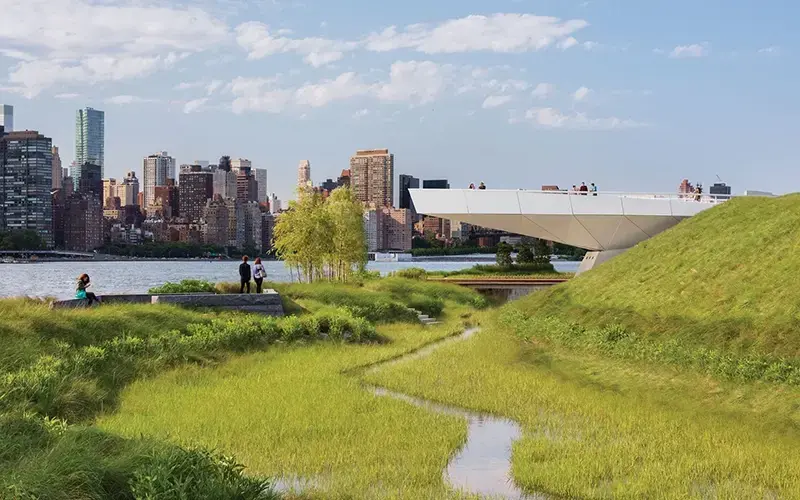
Landscape architects manage water and stormwater with nature-based solutions that protect communities and ecosystems.