

.webp?language=en-US)


Climate & Biodiversity News (August 2026)
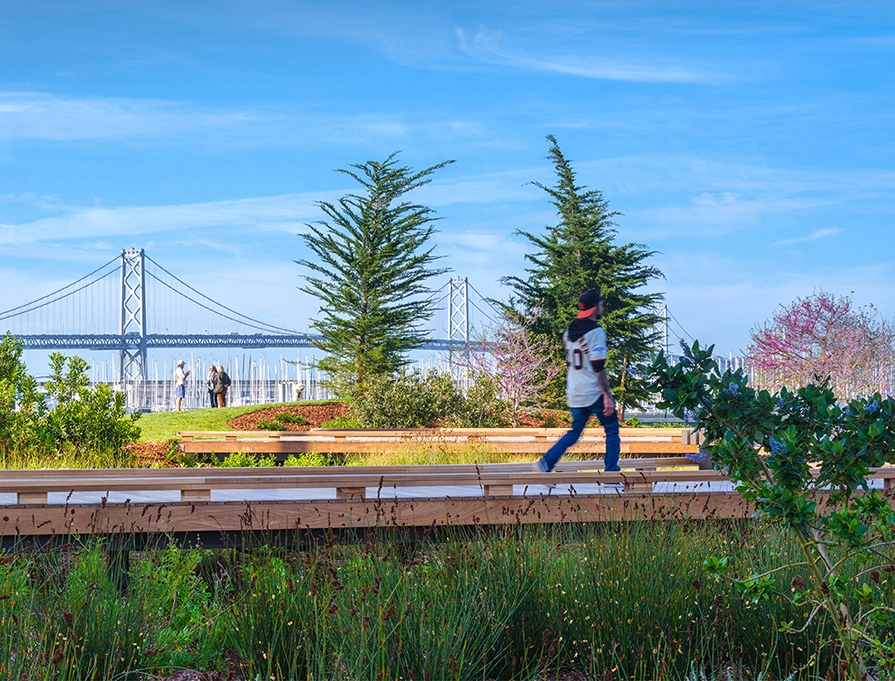
ASLA 2025 Professional Urban Design Honor Award. China Basin Park: A Dynamic Urban Connector. San Francisco, California. SCAPE / Jason O'Rear
By Jared Green
UN Biodiversity Talks Find World off Track for 2030 Targets, The Climate Watch, August 15
At the next gathering of the UN Convention on Biological Diversity in Armenia in October, world leaders will undertake the first review of progress towards the Kunming-Montreal Global Biodiversity Framework, which set ambitious goals for 2030. 196 countries have committed to achieving these goals, with 90 percent developing national biodiversity targets and 70 percent creating national biodiversity reports. But progress towards financing and implementing the 2030 goals remains uneven.
Urban Heat Islands Have Solutions; Many Tropical Cities Can’t Afford Them, Mongabay, August 13
Planting trees and integrating green infrastructure are effective strategies to combat urban heat islands in wealthy tropical cities like Singapore, which can afford tree planting and maintenance. But they are harder to achieve in cities like Lagos, Nigeria, which has much lower per-capita income. "Investing in solutions now in understudied, ill-funded, poorly prepared tropical cities will be imperative."
San Francisco’s Rain Gardens Mean Fewer Chemicals in the Bay, Governing, August 11
The City of San Francisco has set an ambitious goal: to use green infrastructure to prevent 1 billion gallons of stormwater from entering the Bay each year. To date, 575 green infrastructure projects, including hundreds of small rain gardens, have helped the City get a third of the way there. A recent study by the San Francisco Public Utilities Commission and the San Francisco Estuary Institute found small rain gardens not only successfully captured stormwater but also reduced 21 types of contaminants from entering the Bay, most by more than 90 percent.
The Spokane Burns Show that Not Even Suburbia Is Immune to Wildfire, High Country News, August 4
According to U.S. Forest Service research, approximately a third of U.S. homes are now in the wildland-urban interface (WUI), a zone that has a higher risk of wildfires. With sprawl, these zones are increasingly suburban. The communities that experienced wildfires in Washington State were a 15-min drive from downtown Spokane, the state's second largest city.
Rhine Falls to Record Low Levels as Drought Strains Europe's Rivers, BBC News, August 3
With extreme heat and drought, Europe's rivers are seeing record-low levels, which is impacting navigation, power generation, agriculture, and tourism. The Rhine River, which crosses from Germany into the Netherlands, saw the lowest levels ever recorded. The Danube River, which crosses 10 countries, fell to its lowest level in 30 years. And the Po river in Italy is no longer providing water to farms in some regions.
‘Wastelands’ No More: India Charts a Future for Its Grasslands, Yale Environment 360, July 30
India is shifting away from a colonial conception of grasslands as "wastelands" and starting to document the biodiversity and carbon storage capacities of these semi-arid landscapes. The government backed-Wildlife Institute of India, along with forest research agencies, have developed a plan to map the country's savannahs. These organizations are also creating restoration and management strategies that recognize grasslands as unique ecosystems and not empty places to plant trees to meet national afforestation goals.