
.webp?language=en-US)




A really ambitious project -- very approachable, clear, and understandable. The analysis had a straightforwardness that was effective.
Awards Jury
-
Baton Rouge and Louisiana are uniquely tied to the relationship between man and water. Water’s ability to impact people and people’s ability to influence water are inseparable. Currently this relationship is being tested as one of Baton Rouge’s iconic water systems struggles with its identity.
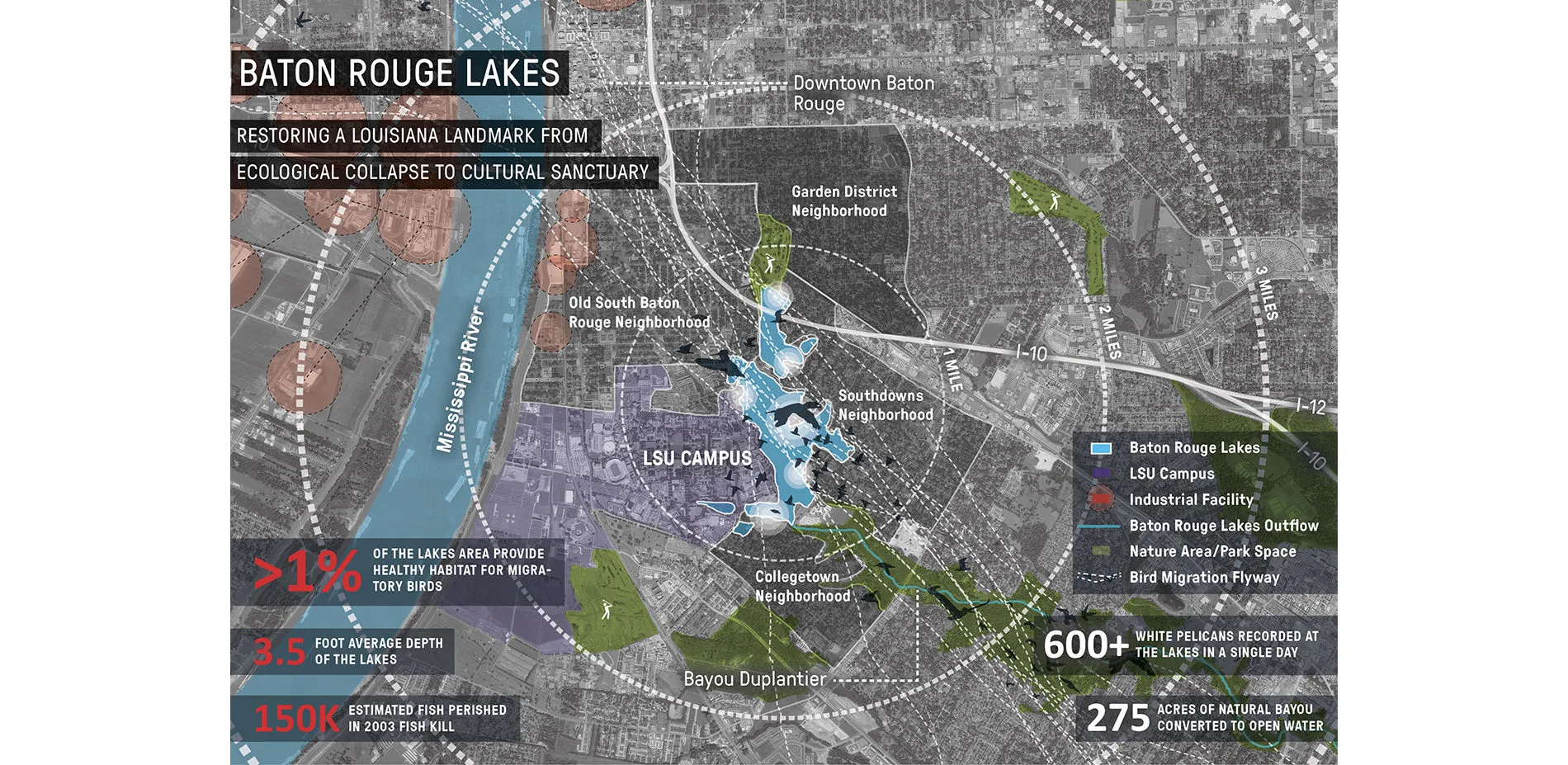
The Baton Rouge Lakes project recognizes opportunity in crisis. The 275 acre lakes system is a series of six lakes in central Baton Rouge. Adjacent to Louisiana State University, three major parks, and a demographically diverse mix of neighborhoods, the Lakes historically functioned as a cypress swamp. Shortly after their conversion, poor water quality resulting from inadequate water depth, ongoing sedimentation, elevated water temperatures, dissolved oxygen levels, and nutrient loading occurred immediately and are currently accelerating. Based on sound ecological underpinnings, the Lakes Master Plan uses restoration techniques and nature as a catalyst for healthy living where man and water exist in equilibrium. -
The Baton Rouge Lakes: “Restoring a Louisiana Landmark from Ecological Collapse to Cultural Sanctuary.”
Baton Rouge and Louisiana are uniquely tied to the relationship between man and water. Water’s ability to impact people and people’s ability to influence water are inseparable. Currently this relationship is being tested as one of Baton Rouge’s iconic water systems struggles with its identity.
The Baton Rouge Lakes project recognizes opportunity in crisis. As a centerpiece of Louisiana’s capital city, sound ecological restoration methods will heal a dying lake system while also reconnecting a city to its ecological and cultural heritage. No longer the epicenter of “cancer alley”, the Baton Rouge Lakes project has the potential to elevate the city’s identity to one based on sound best management practices where man and water exist in equilibrium.
Context
The 275 acre Baton Rouges Lakes system is a series of six lakes in central Baton Rouge. Adjacent to Louisiana State University, three major parks, and a demographically diverse mix of neighborhoods, the Lakes historically functioned as a cypress swamp and not the vast open water body seen today. In 1929, the first lake was constructed when the bayou running through the site was cleared of forest and then dammed. Other lakes followed shortly thereafter. Soon roads appeared along the edges, residential homes were built with ideal views, and an informal system of recreational amenities were constructed.
Challenges
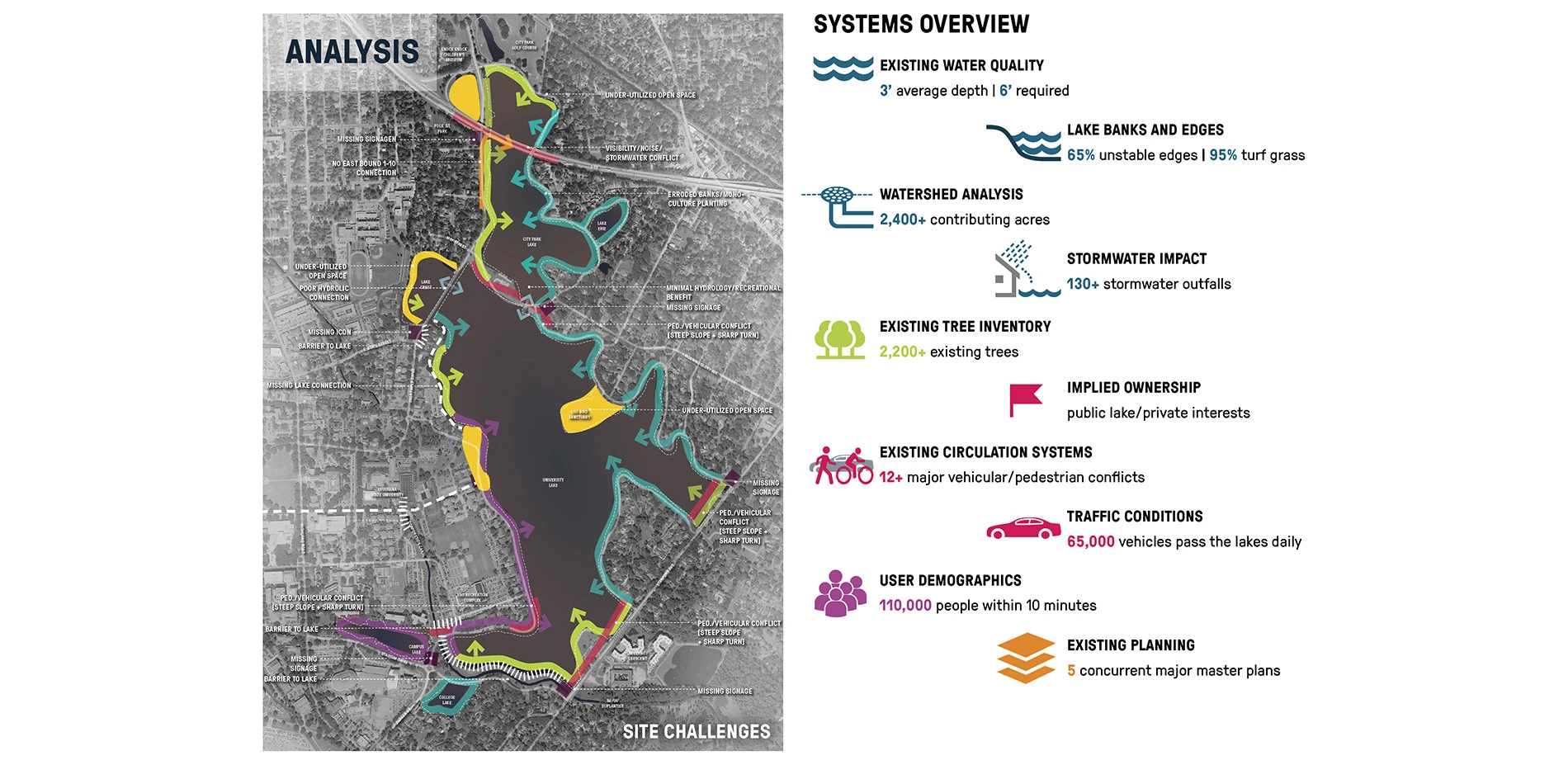
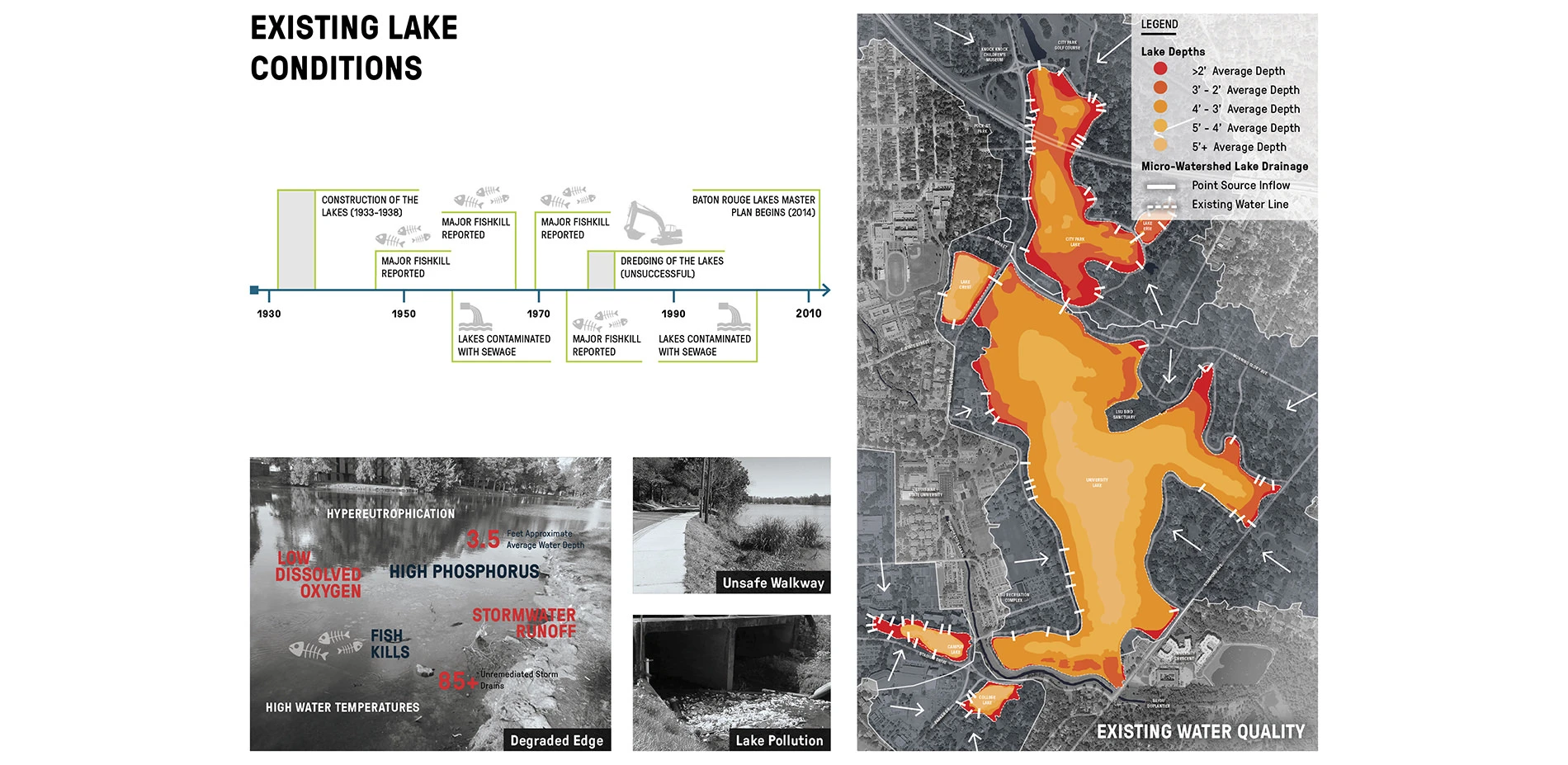
Shortly after its conversion, fish kills and algal blooms frequented the water surface giving evidence to failed ecological underpinnings. Poor water quality resulting from inadequate water depth, ongoing sedimentation, elevated temperatures, dissolved oxygen levels, and nutrient loading occurred immediately and remain to this day. A negative feedback loop further exacerbates the situation as the lakes continue to get shallower and the problems accelerate exponentially.
Serving as a major recreation site for the city, the draw to the water has been strong but few uses have been designed or are programmed. Steep lake edges force fragmented pedestrian circulation routes next to or within vehicular corridors, connections to neighborhoods are weak or dangerous, and water access points are limited. The adjacent internationally renowned university has little to no formalized presence on the Lakes, even though they are majority owner.
As an iconic site within the city, parish, and state, implied ownership issues present obstacles to rehabilitation as well. While adjacent residents are not technically primary owners, they have a vested interest in the future of the lakes, the restoration process, and the potential impacts on their daily lives. When differing recreational and landscape visions are considered, design solutions cannot avoid conflict.Objectives
- Create and regenerate thriving aquatic and terrestrial ecosystem that are self-supporting, result in high water quality, establish strong wildlife habit/lifecycles and provide reasonable public access
- Express the unique identity associated with adjacent neighborhoods, city, region, and state through varied mediums, scale, and time
- Create a safe environment where residents and visitors are motivated and encouraged to discover the world around them
- Promote meaningful physical and emotional connectivity to the lakes within and beyond the City of Baton Rouge
Analysis
A cultural and historic investigation provides insights into original regional ecology, lake conversion planning, construction obstacles, and the cultural meaning of the Lakes. Working with the client, LSU, and local historians, a timeline of events clearly demonstrates ongoing ecological and social challenges at the lakes.
An analysis of existing conditions utilizes the project’s bathymetric survey, geotechnical report, tree survey and assessment, lake edge stability analysis, and traffic engineering studies. Historic water quality measurements show nutrient levels and point source pollutant loading from over 100 lakeside outfalls. LSU academic staff members also provided key input on water quality issues, previous ecological restoration failures, and birding habitat and health on the lakes. Adjacent master plans for LSU and the Baton Rouge Park’s Department are considered as well.
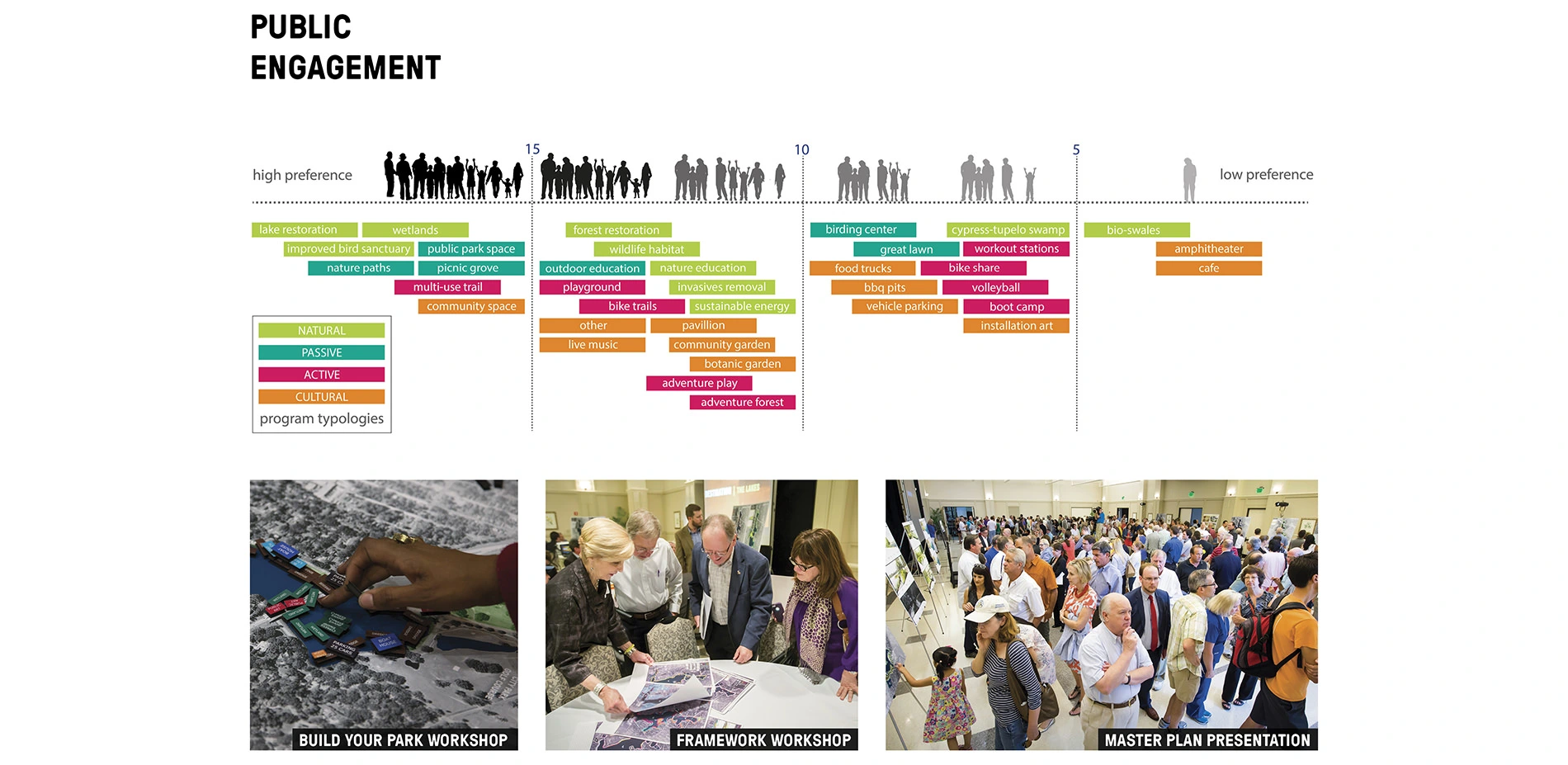
A five part public engagement process, stakeholder meetings, and advisory committee assessments also yielded valuable insights and provided momentum for the project. Public workshops included idea brainstorming, group workshopping, framework establishment, site visits with lakeside homeowners, and presentations of the draft and final Master Plans. Workshops typically exceeded 400 engaged citizens.
Master Plan
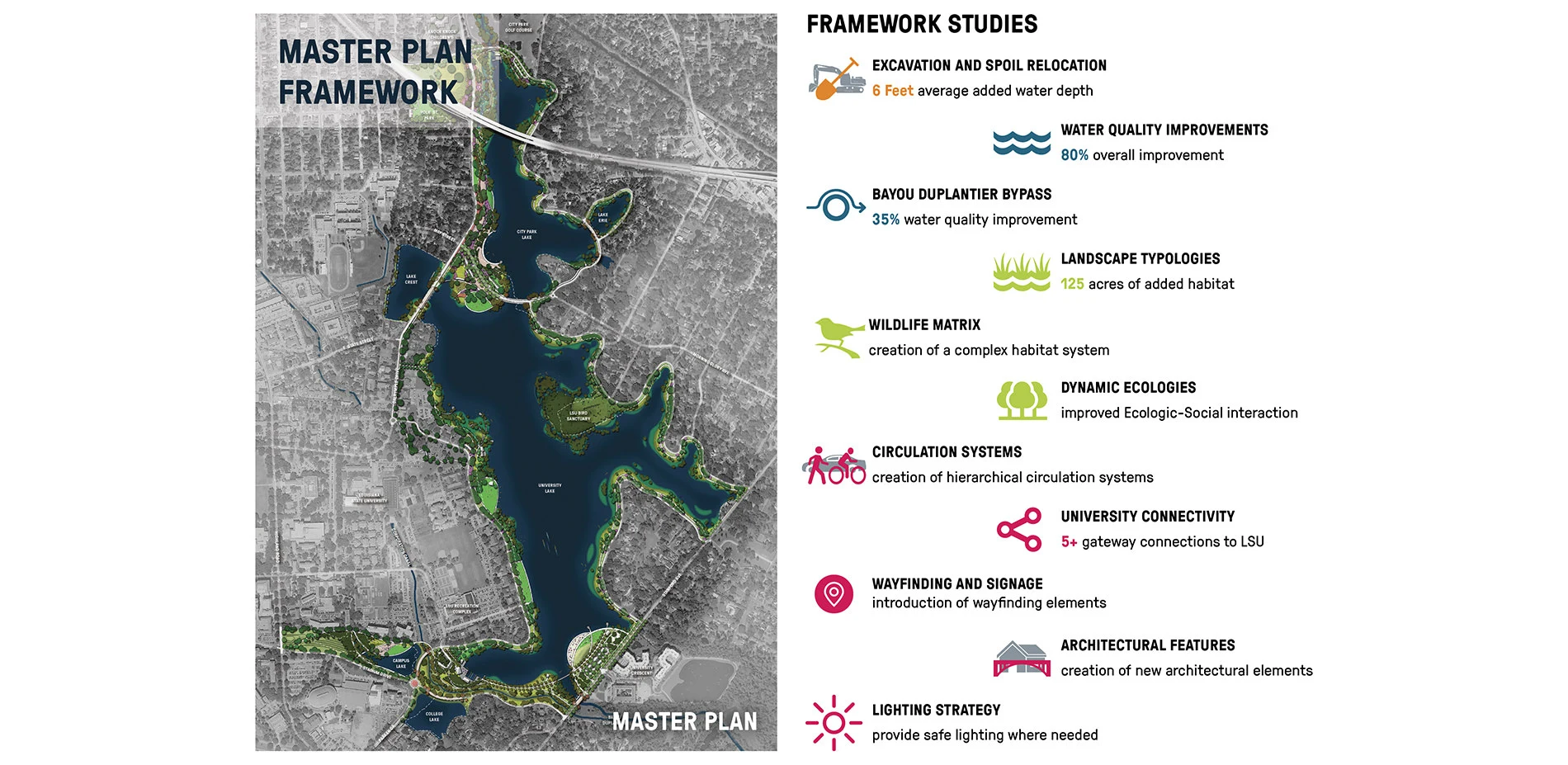
The Master Plan is based on several system frameworks that inform site specific design. Systems include excavation and spoil relocation, water quality improvements, landscape typologies, wildlife matrix, vehicular and pedestrian circulation, site programming, architectural features, lighting, and wayfinding.These systems layer together to create the following design recommendations:
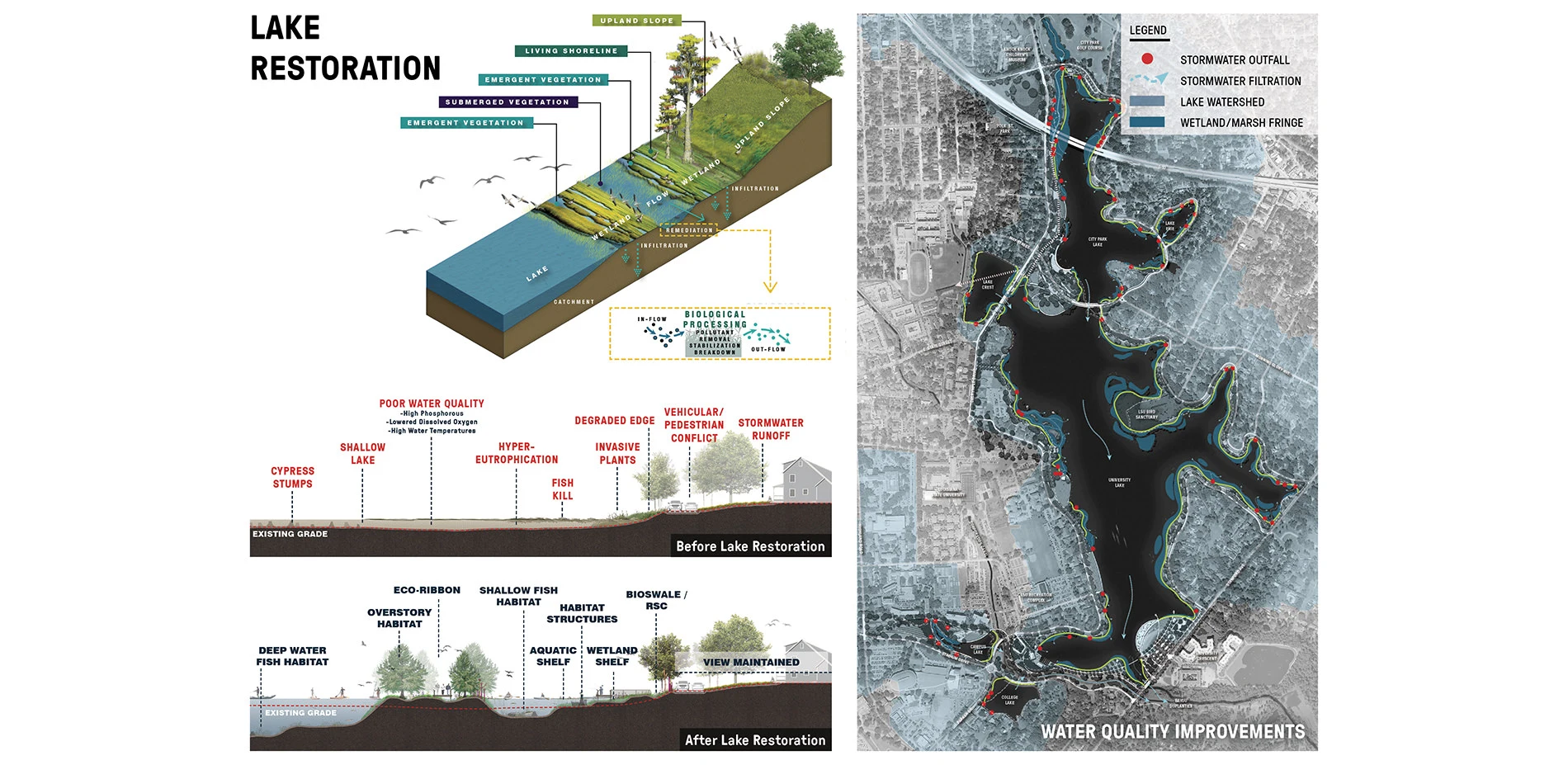
- Balance 600,000 cubic yards of lake excavation. Using a series of phased coffer dams, the lakes will be excavated to a typical pool depth of 6 feet with pockets as deep as 8-10 feet. The excavated material will be used to create wetland benches along the edges, repair failing slopes, and to create and expand lakeside park spaces.
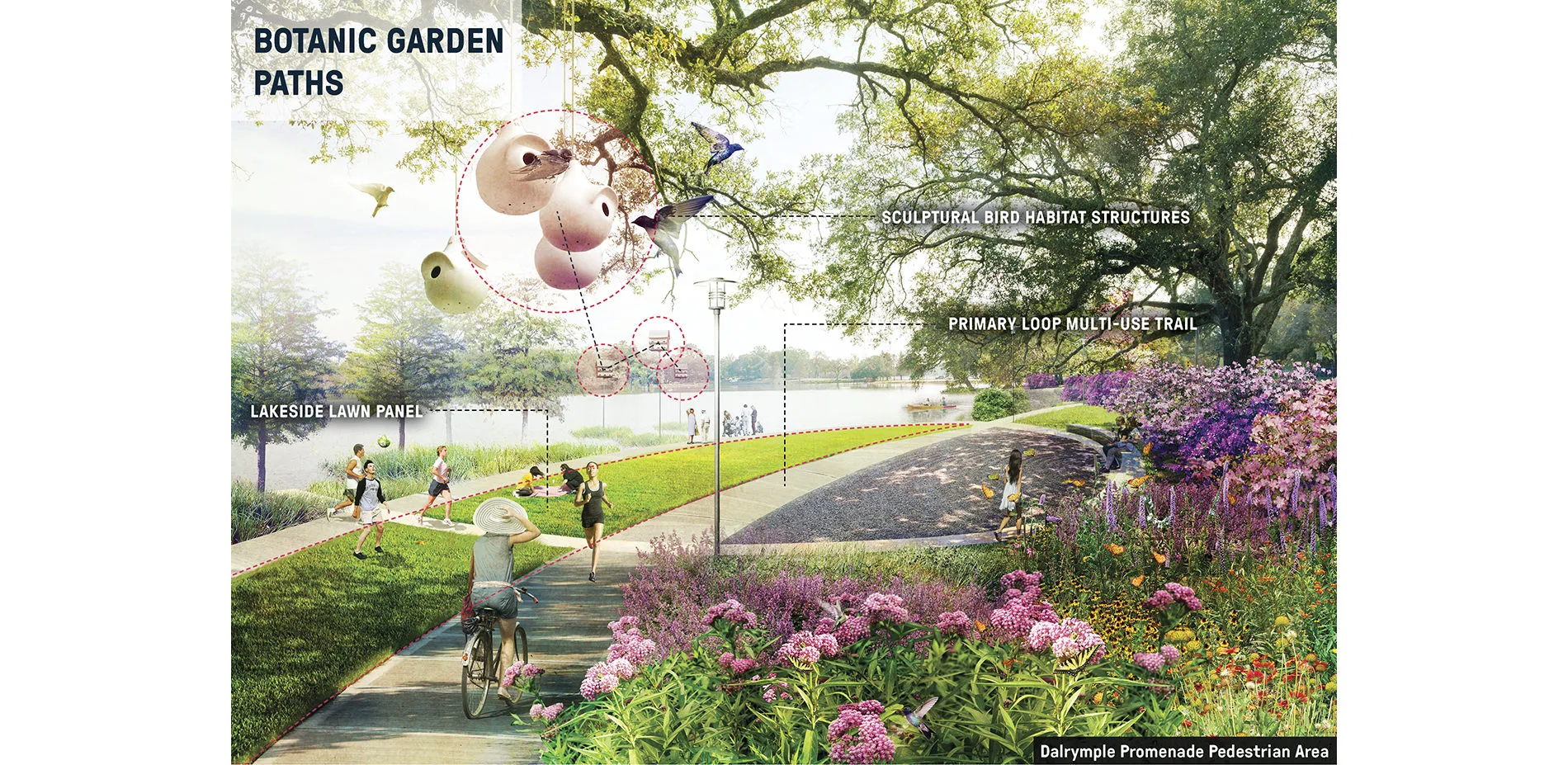
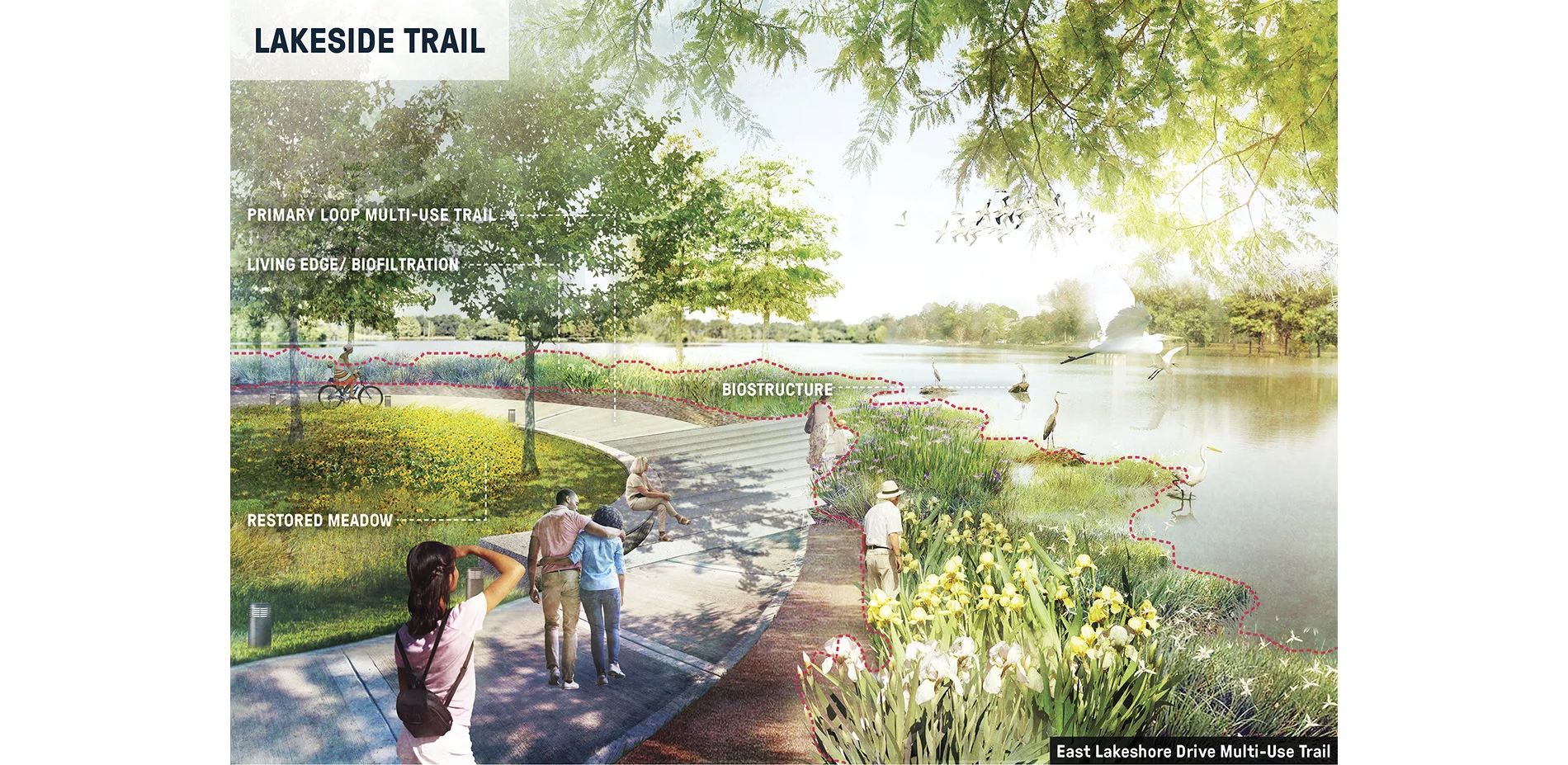
- Create a living edge of wetland and meadow around the lake that will act as a biofiltration mechanism while also providing habitat.
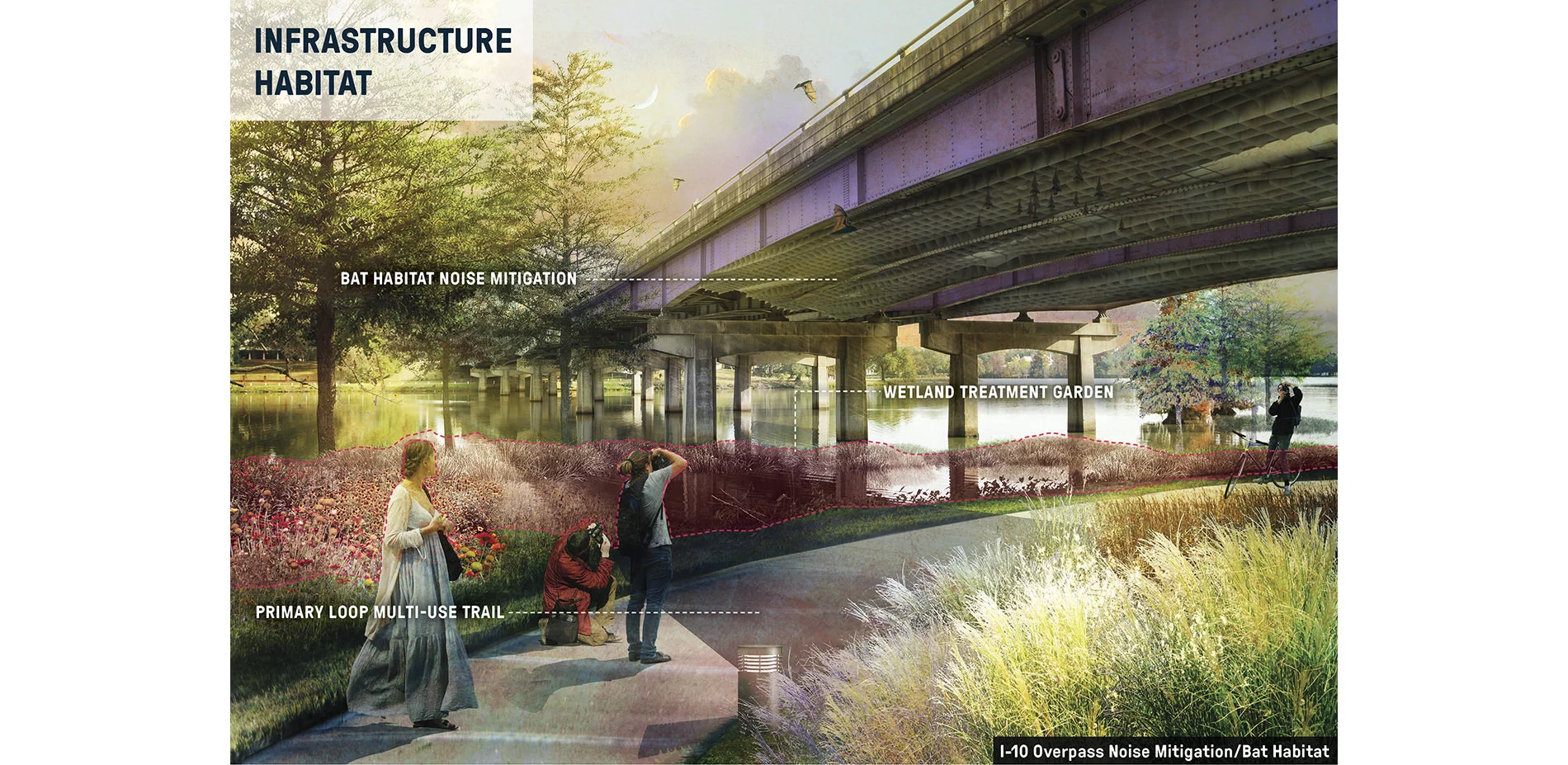
- Treat first flush flows from the headwaters of Bayou Duplantier by redirecting them through a wetland polishing garden.
- Design each major lake outfall to have a polishing pool/sedimentation basin to aid in removal of first flush pollutants entering the lake.
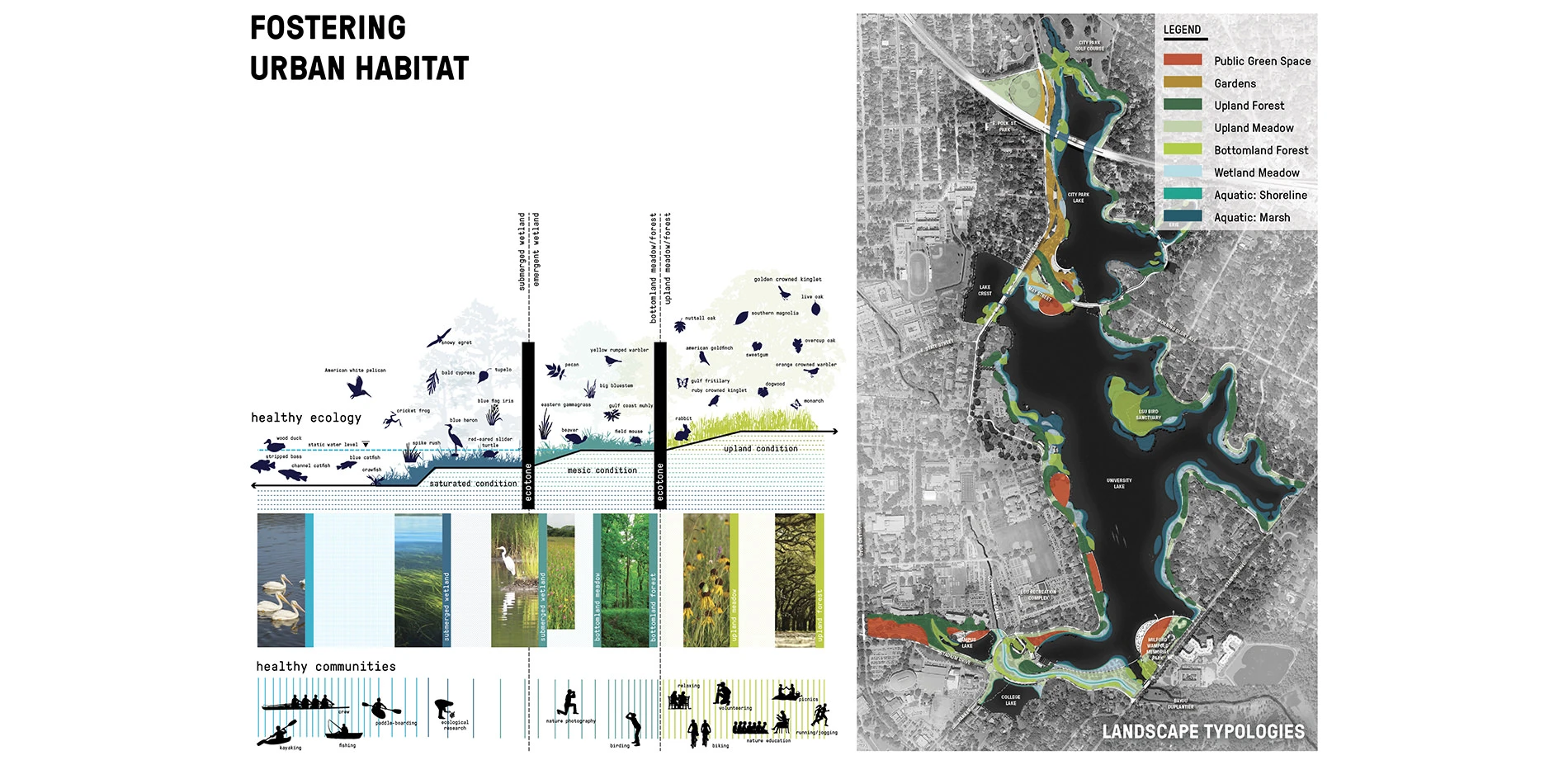
- Create a diversity of habitats and experiences by restoring six native landscapes typologies that relate hydric edge conditions.
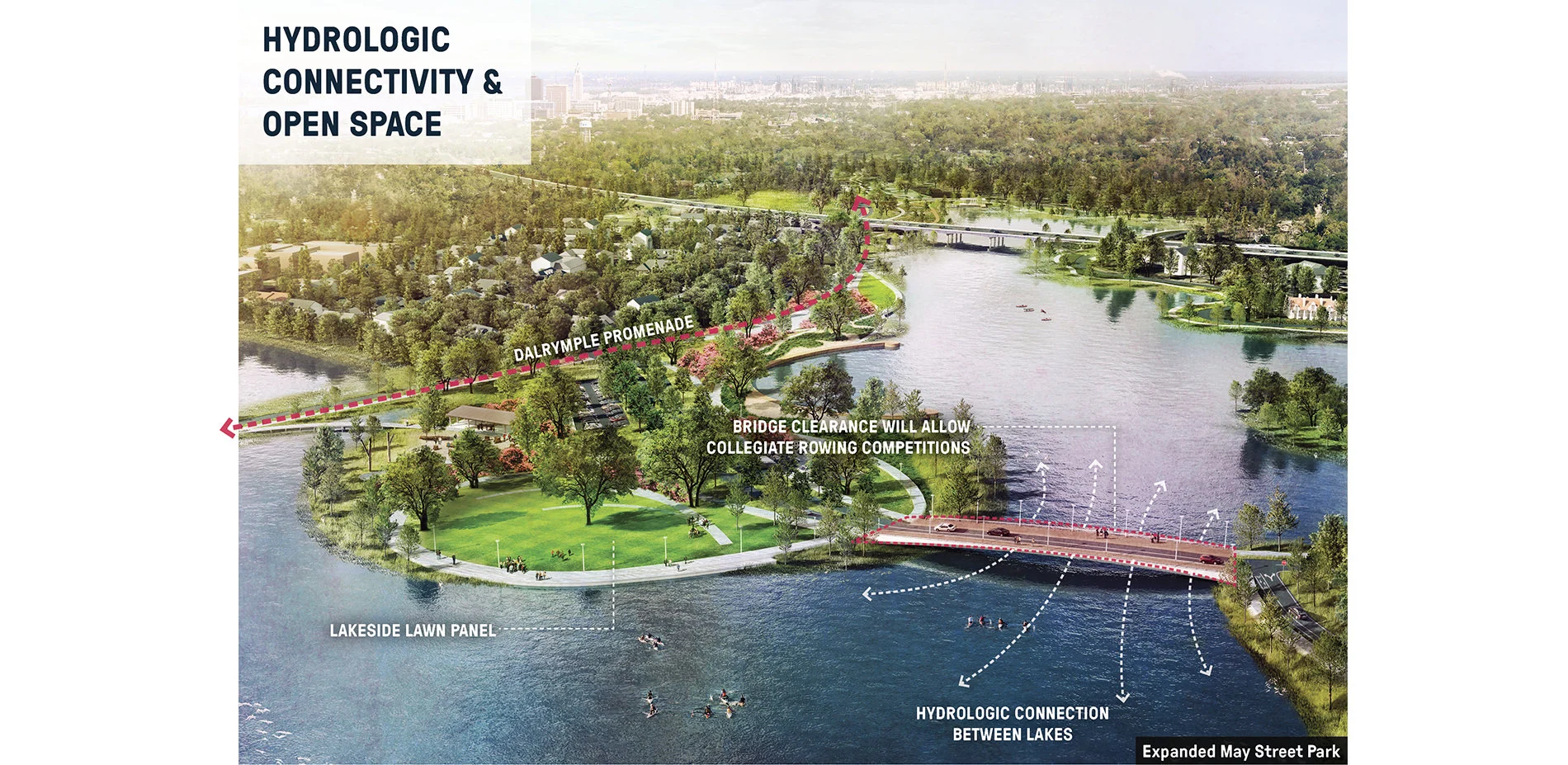
- Enhance the LSU experience by creating a northern university gateway, student lakeside promenade, and boathouse. The boathouse and the introduction of an iconic bridge will accommodate university sponsored crew events.
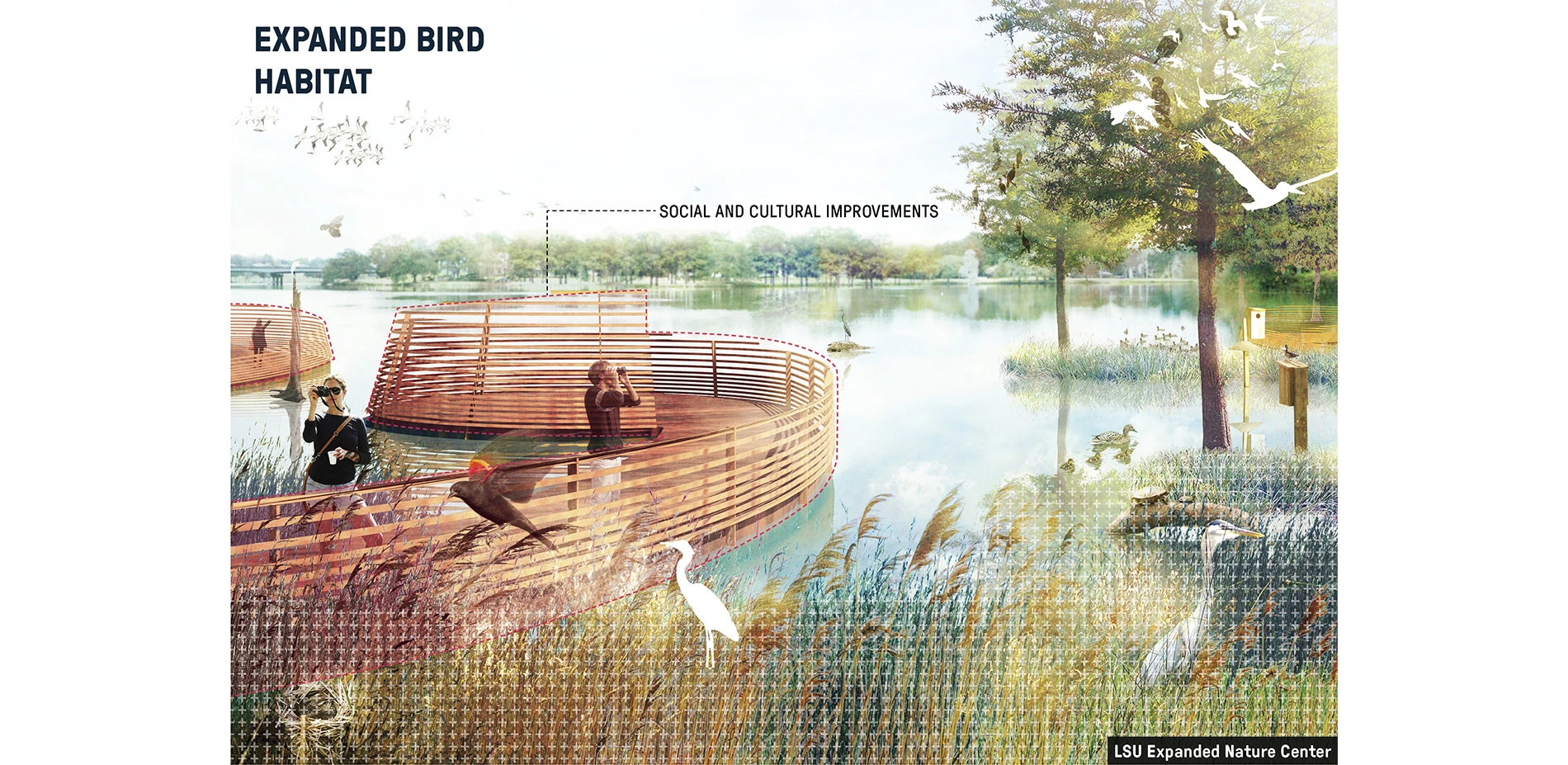
- Expand the existing bird sanctuary site by 40% and add a publicly accessible nature center adjacent to LSU.
- Create a hierarchy of circulation. Five miles of multi-use pedestrian trails will be constructed on lakeside fill while designated bike lanes will occur at street level. Converting roads on the east side of the lake to one way provide safe pedestrian buffer distances along the lake edge.
- Add designated water access areas. Include a public boathouse to the north, boardwalks, overlooks, and designated fishing zones.
- Provide access to all neighborhoods through the use of safe crossings and designated trails.
- Design architectural features that reflect south Louisiana culture and consider the project’s commitment to nature.
Next Steps
With an eye toward implementing the Master Plan, cost estimates, phasing strategies, and governance structures have been explored. The first phase of work identified in the Master Plan corrects water quality issuess. Phase two provides safe pedestrian, bike and vehicular connectivity. Phase three includes ten projects that create recreational opportunities for a broad cross section of users. To guide the project toward implementation, a nonprofit Lakes Conservancy has been created. Funding from the state has been secured and other funding sources are being explored. Currently available funds will significantly contribute the completion of design and construction for the first phase of the project.
Conclusion
The Baton Rouge Lakes Master Plan seeks to create a robust and scenic natural amenity in the heart of Baton Rouge. Using nature as a catalyst for healthy lifestyles while providing habitat infrastructure for migratory birds and aquatic wildlifem, the project will serve as a touch point for visitors from across the Parish and throughout the country to experience Louisiana in a new way. -
- Biohabitats Inc. – Ecological Planning
- BREC
- Center for Planning Excellence – Public Engagement and Outreach
- GEC – Civil Engineering
- Louisiana State University
- Pros Consulting – Maintenance and Implementation
- Stantec – Traffic Engineering
- Suzanne Turner Associates – Cultural Specialist & Historian
Advertisement
Related Awards
Honor Award, Analysis & Planning
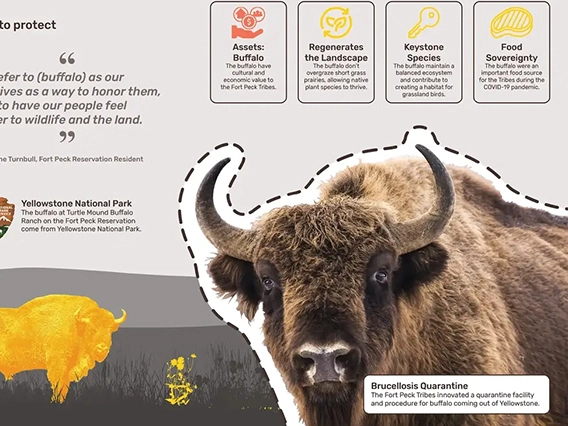
A Cultural Approach: The Fort Peck Tribes Hazard Mitigation Plan
In collaboration with the Fort Peck Assiniboine and Sioux Tribes, EPA, and FEMA, the Fort Peck Tribes Hazard Mitigation Plan (HMP) adopts a culturally responsive approach to hazard mitigation planning that features connection to place.