
.webp?language=en-US)
-
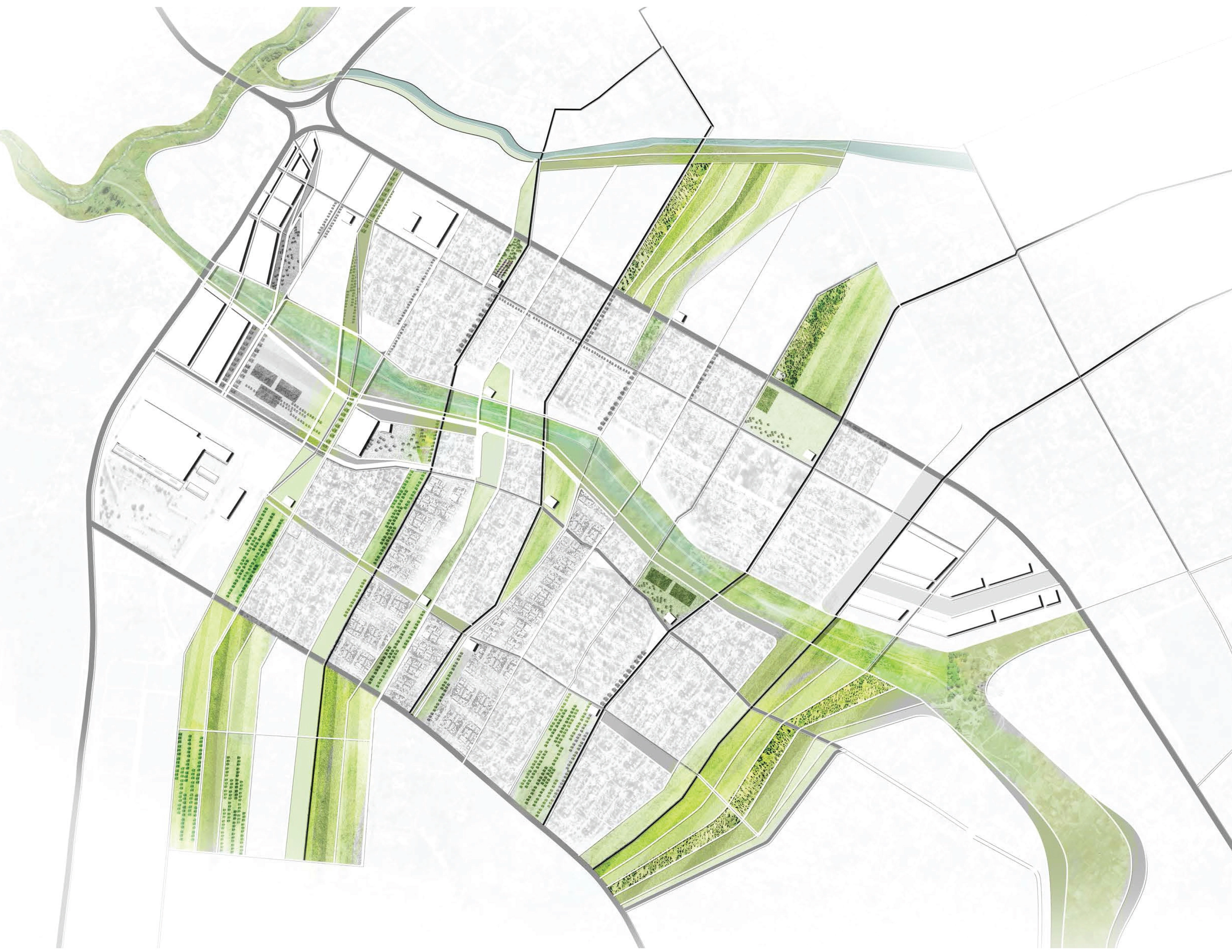
Through territorial and simple place-making moves, the project establishes a landscape framework for the growth of Hopley Farms, an informal settlement in Harare. The provision social hubs that informal dwellers usually don't build on their own, become the centerpiece infrastructures that complement the future self-built city. A territorial growth pattern, rainwater management and an agroforestry system are linked to create a healthy community by tackling issues that plague Harare and its future growth.
-
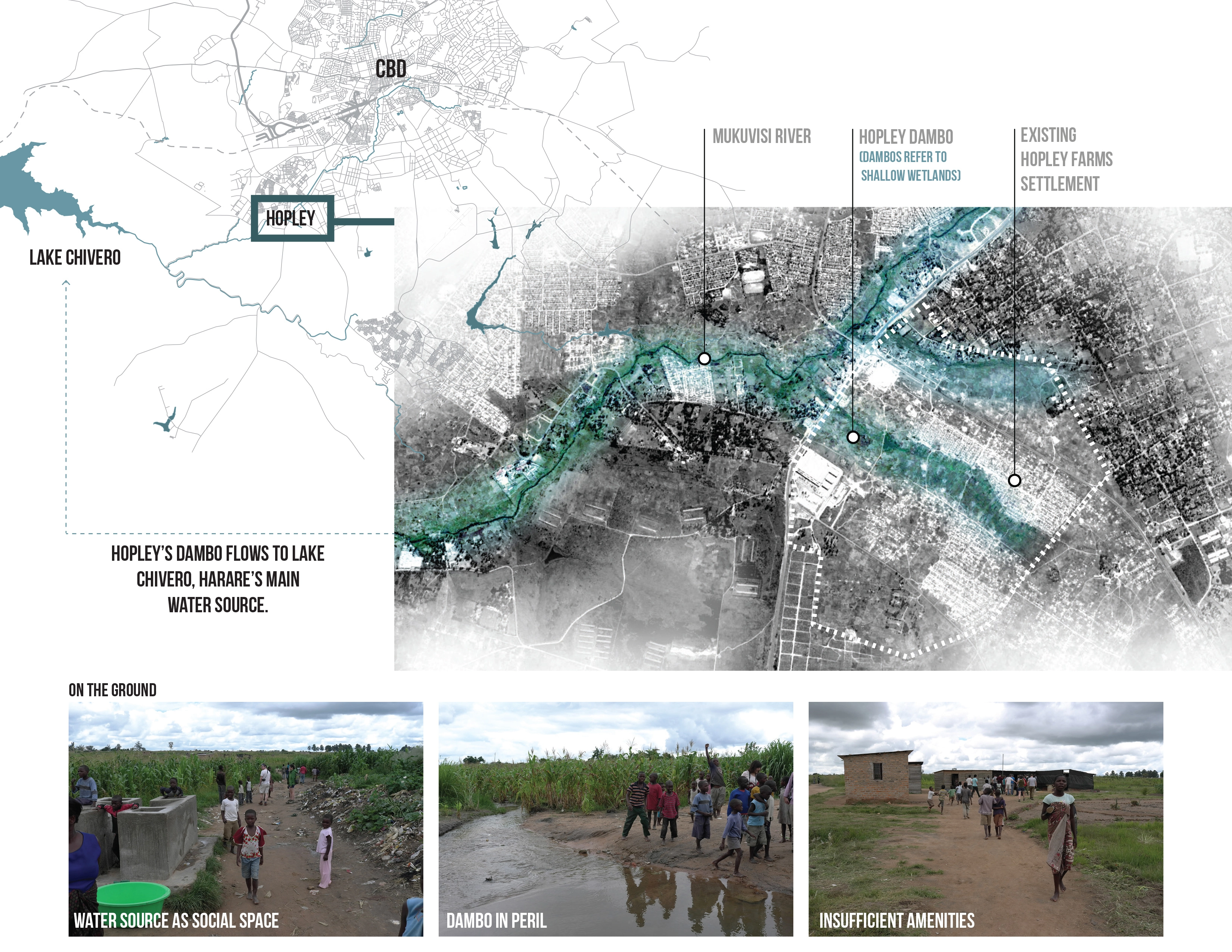
Cities in developing countries are predominantly informal. Communities self-construct their dwellings and adapt them to the needs quicker and better than any formal housing program. However, informal settlements are incomplete and unsustainable forms of urbanization, frequently lacking basic services, such as water supply, sanitation, accessibility, education, health, and amenities. This is the case of Hopley Farms in the city of Harare, Zimbabwe. Hopley Farms is a community of over 25,000 inhabitants which began to occupy an area of south Harare in 2007 after informal residents of the central city were forcefully evicted by the Zimbabwean Government. With the fear, anger and feeling of profound loss, they forcefully re-initiated life in this new location.
This project introduces the concept of Informal Landscape Armatures as a design method that allows to tap into the potential of informality by providing it with those aspects that the settlers cannot achieve on their own. The landscape armature bundles ecological, social, economic, infrastructural, water-management, and agricultural conditions. Through the establishment of this landscape framework, settlements elevate out of a state of submission in which they usually remain in relation to the formal city in relatively short periods of time.
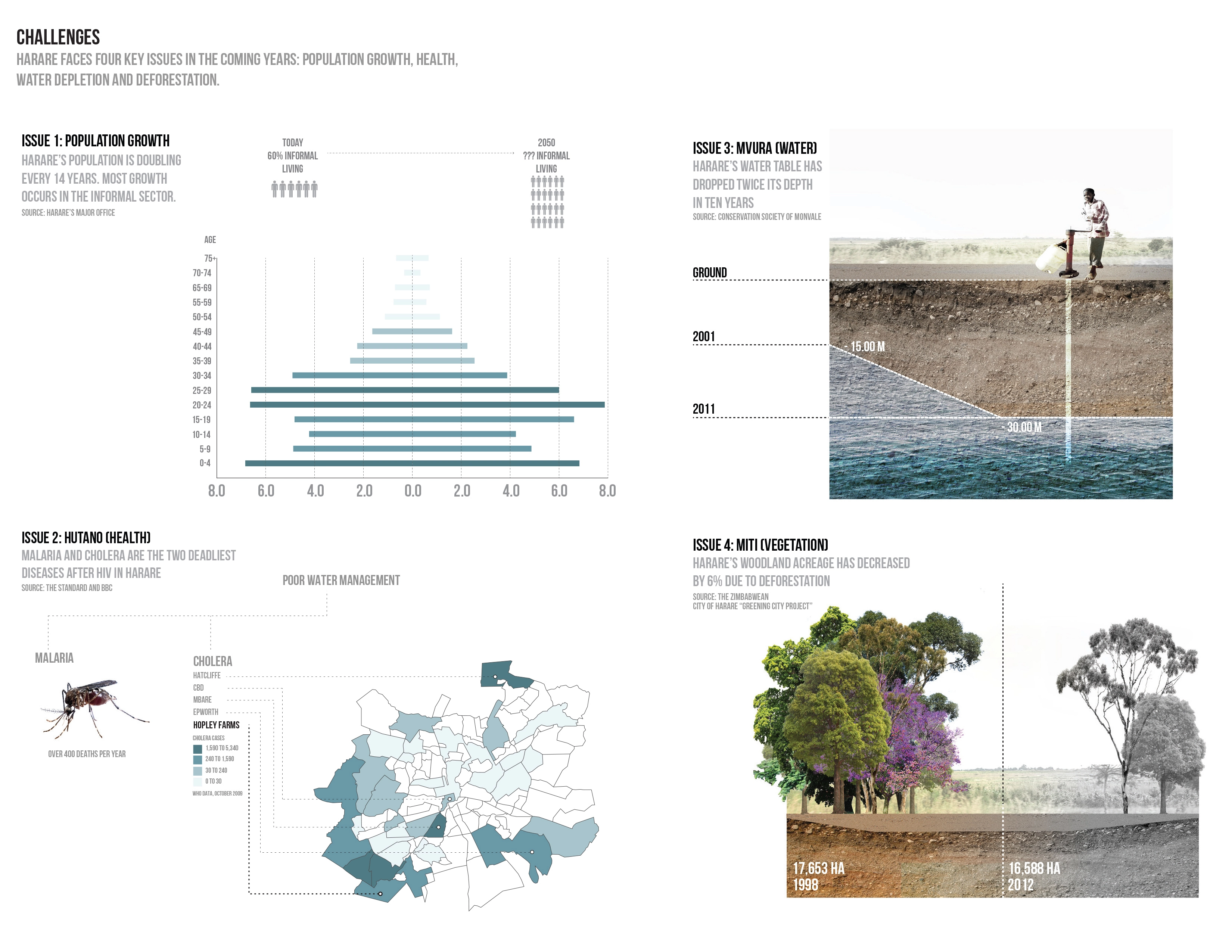
Hopley Farms is expected to double its population in the following two decades. The proposal addresses the current need of the existing community as well as those of future residents. The growth armature ties both the existing and the future through a balanced and integrated system by deploying a landscape framework of agriculture, water and social spaces. This strategy is a pre-emptive approach on informal growth by inserting the necessary socio-economic and ecological amenities for the new and existing areas.
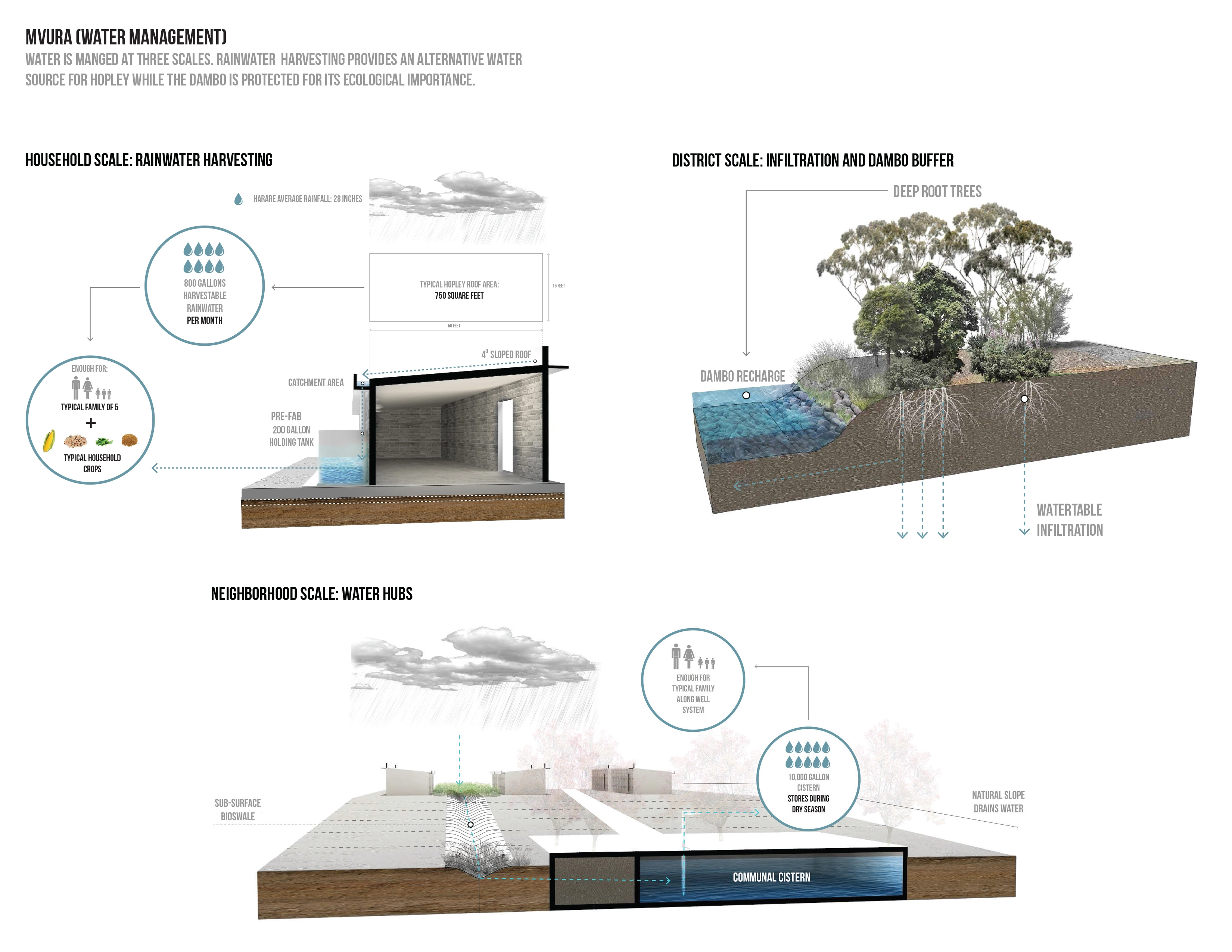
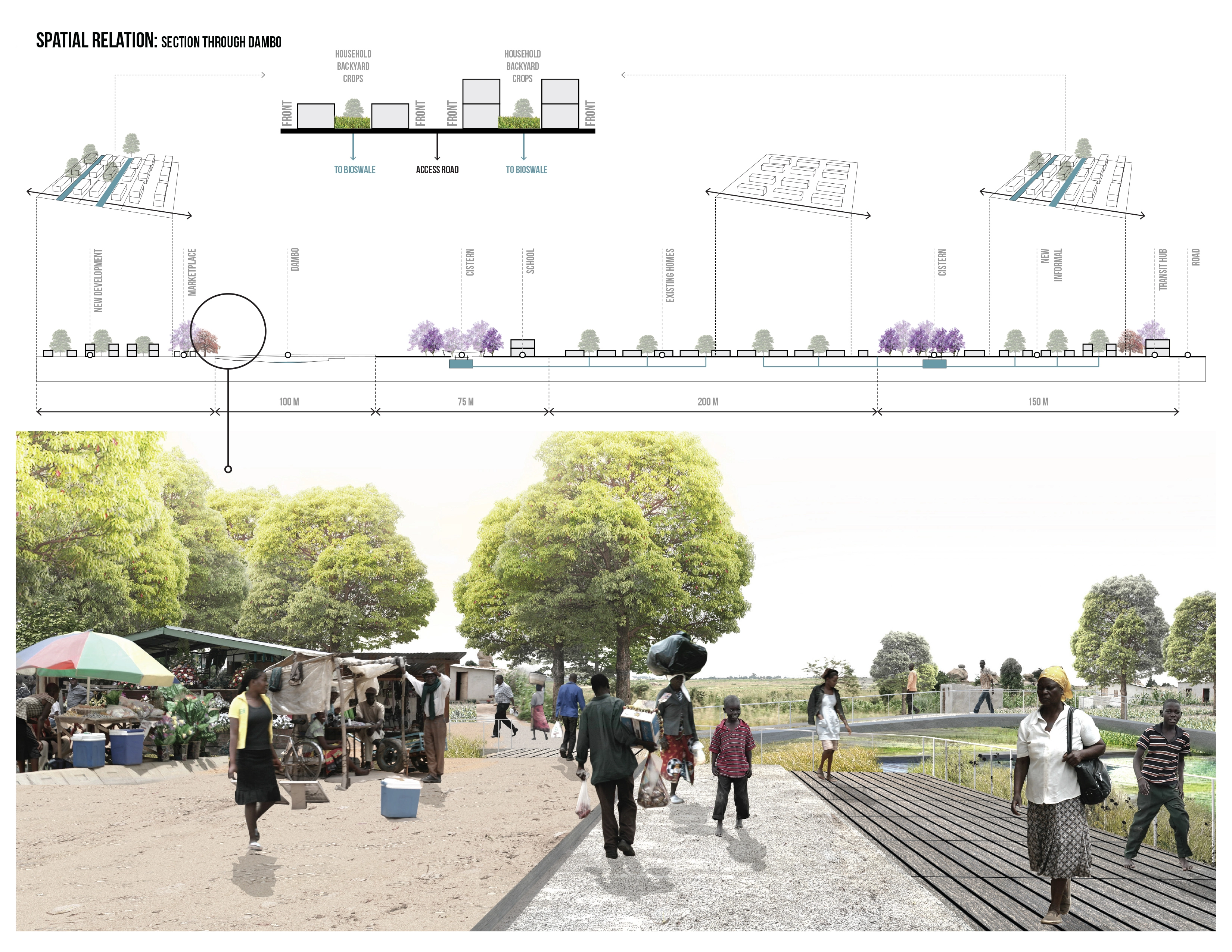
As many areas in Harare, Hopley Farms is traversed by a “dambo”, a local word that refers to shallow, sponge-like wetlands. The dambos are extremely important for the ecological balance of the city since they allow recharging of the aquifer and drain rainwater to Lake Chivero, Harare’s main water supply. Currently, the dambos are encroached by subsistence agriculture altering their ecological functions. Therefore, protection of these dambos is essential, and a need to rely on other water sources becomes important for the environment, the community and for the future of the city as a whole.
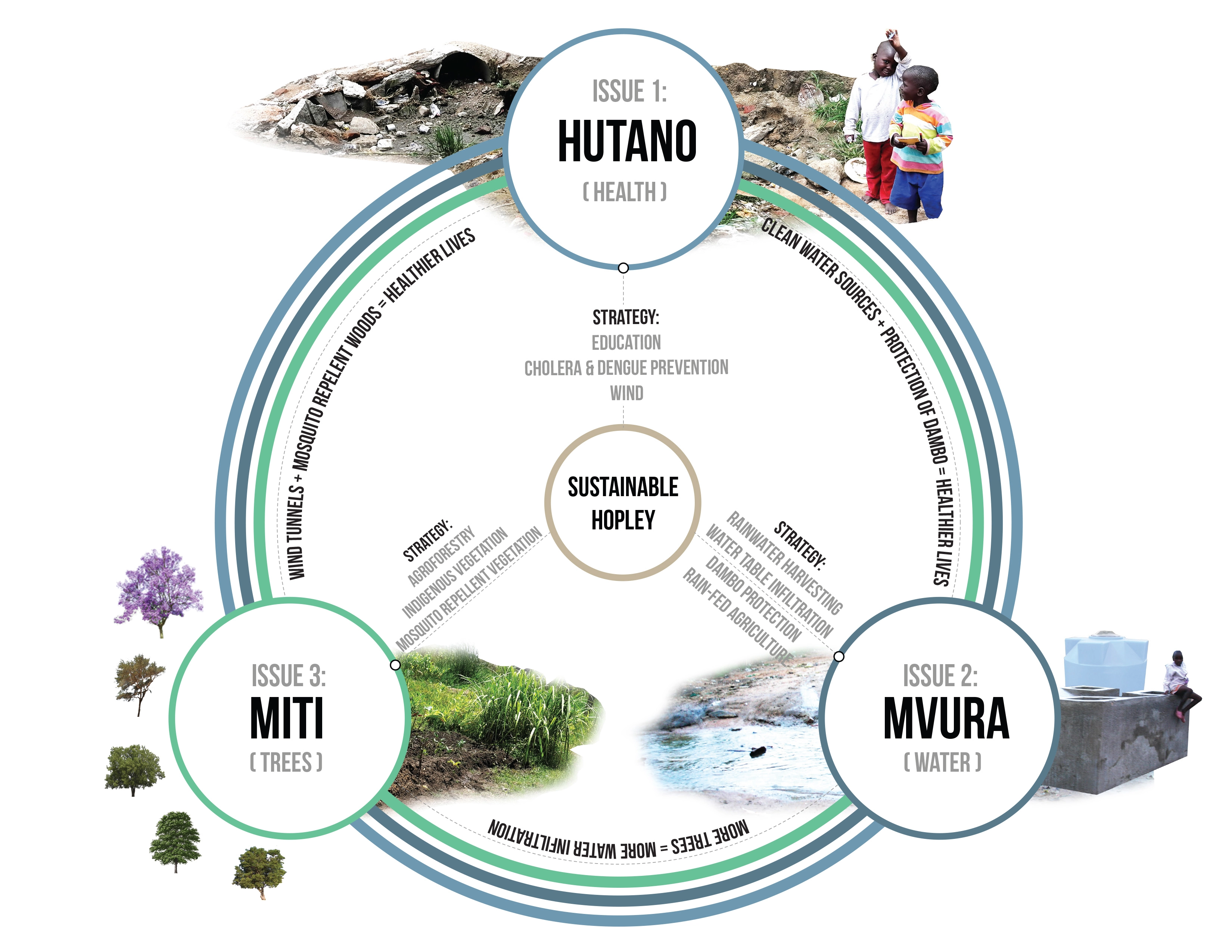
The project addresses three main issues affecting Harare and informal settlements like Hopley Farms:
- Hutano (Health): Malaria and Cholera are the two deadliest diseases in Harare after HIV, all having poor water management as their source.
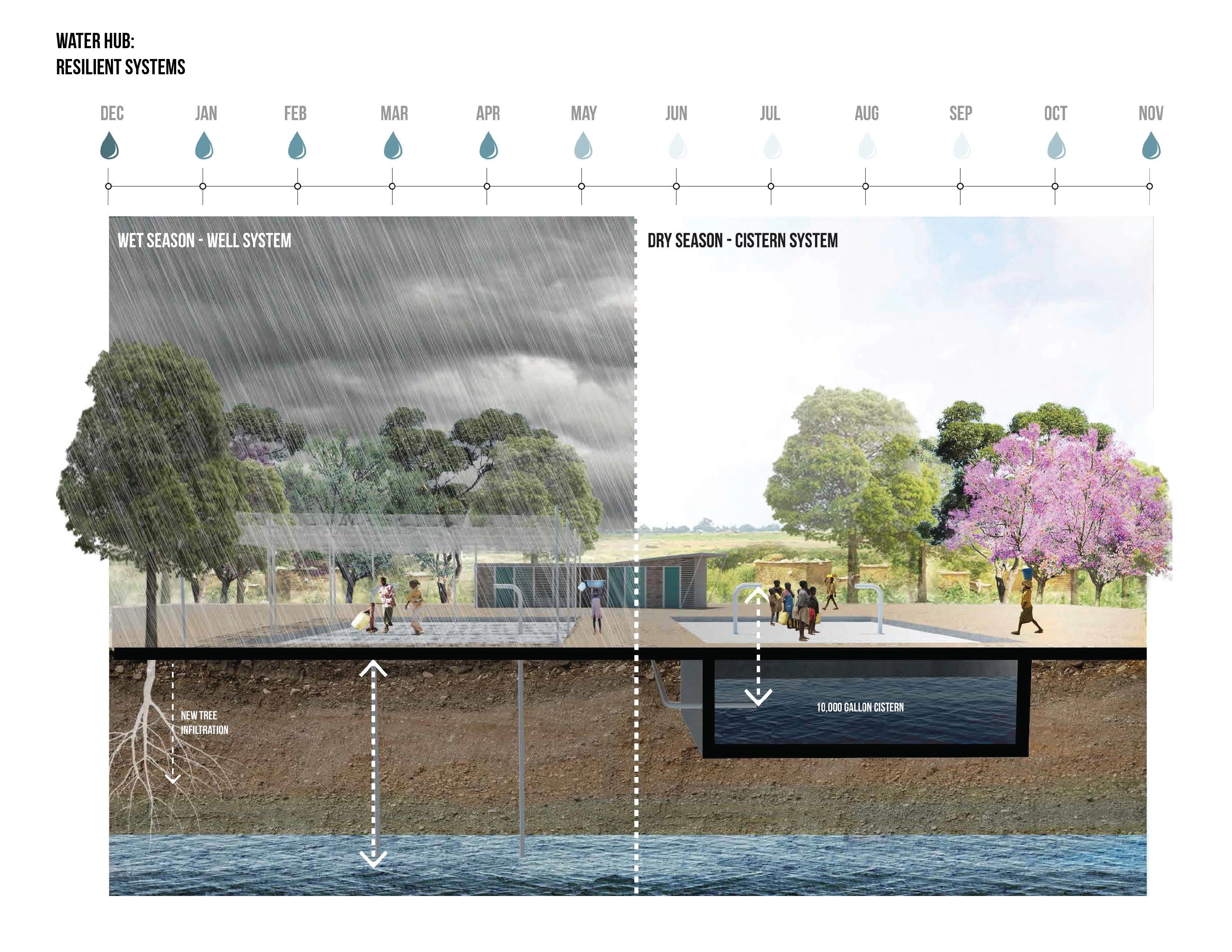
- Mvura (Water): The water table in Harare has dropped to twice its depth in the last ten years, making it harder for informal settlements to tap it and highlighting the need for alternative water sources beyond dambos.
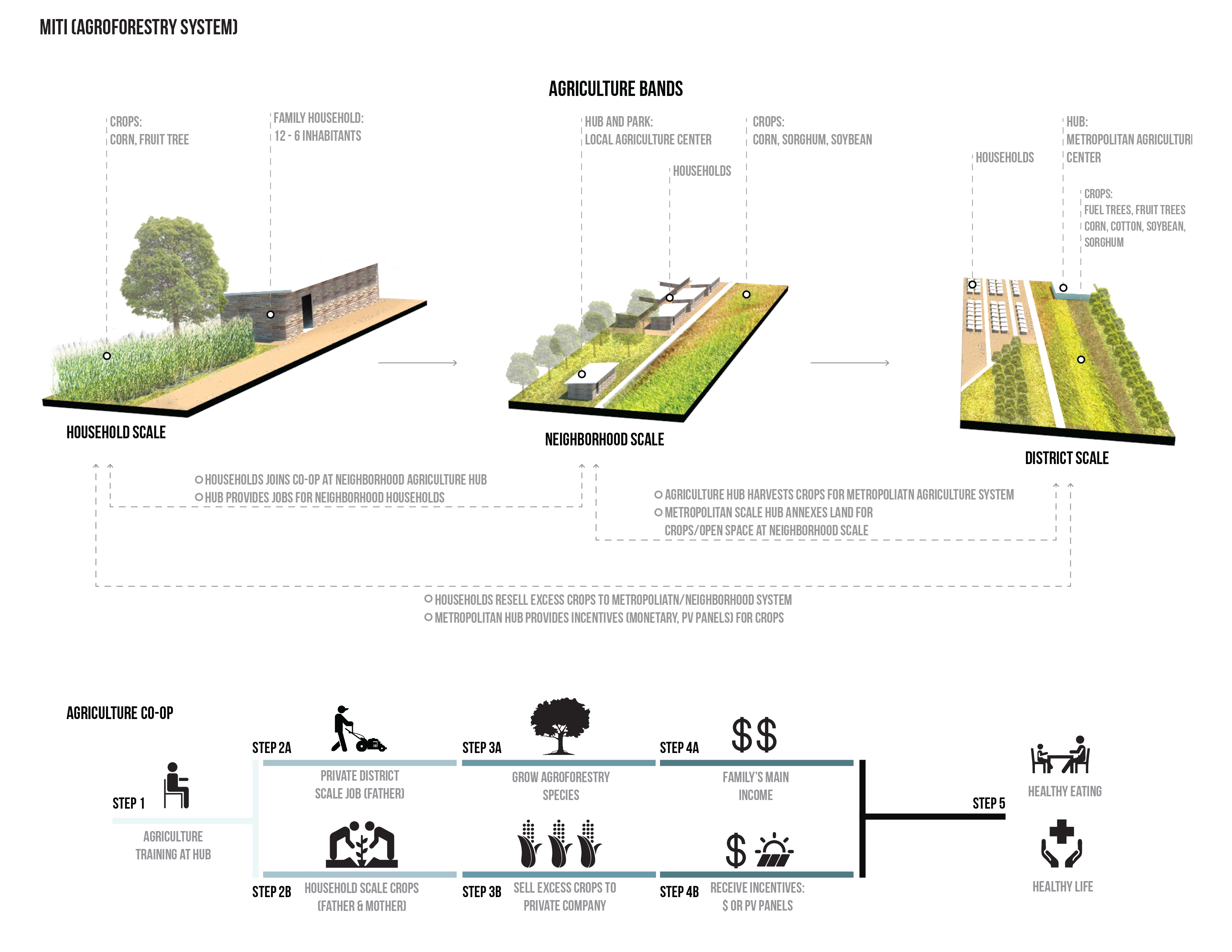
- Miti (Vegetation and Agriculture): Harare has lost most of its woodland acreage, revealing a need for reforestation and cultivation in sustainable ways.
In an area like Hopley Farms where children have no shoes and there is a lack of amenities and social spaces, “how” to design becomes just as important as “what” to design. Therefore, the project is about the essential and the humane, where soft infrastructure becomes social infrastructure. Through interventions that will have compelling and immediate impacts, the project seeks to educate and inspire the dwellers of Hopley Farms. These include: places of socialization and exchange, multiscalar options of rainwater harvesting, and a cooperative agroforestry system to green and feed Hopley Farms, all of which will contribute to create a balanced and robust community.
The landscape design strategy relies on simplicity; design moves that stem from existing site conditions and offer the benefits for a growing community:
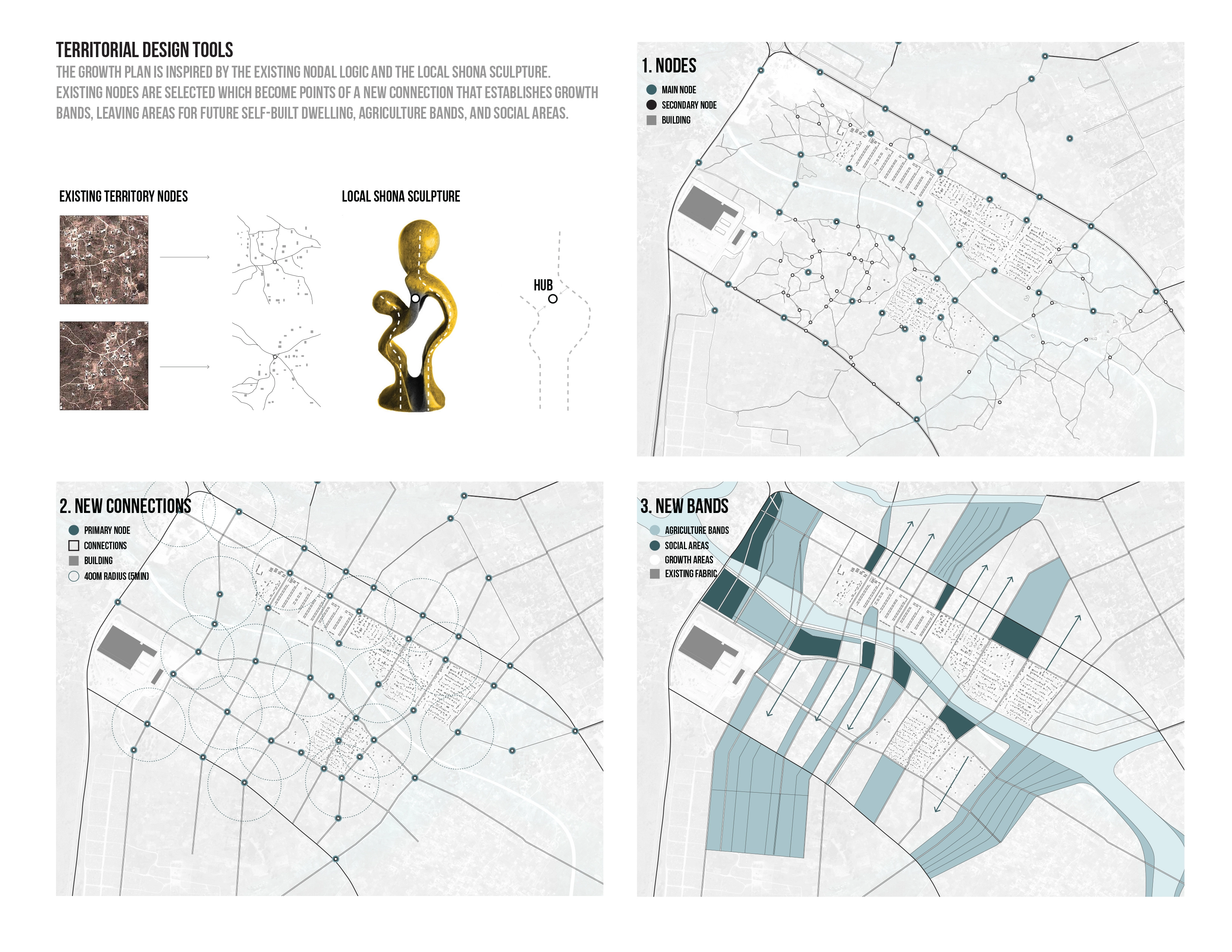
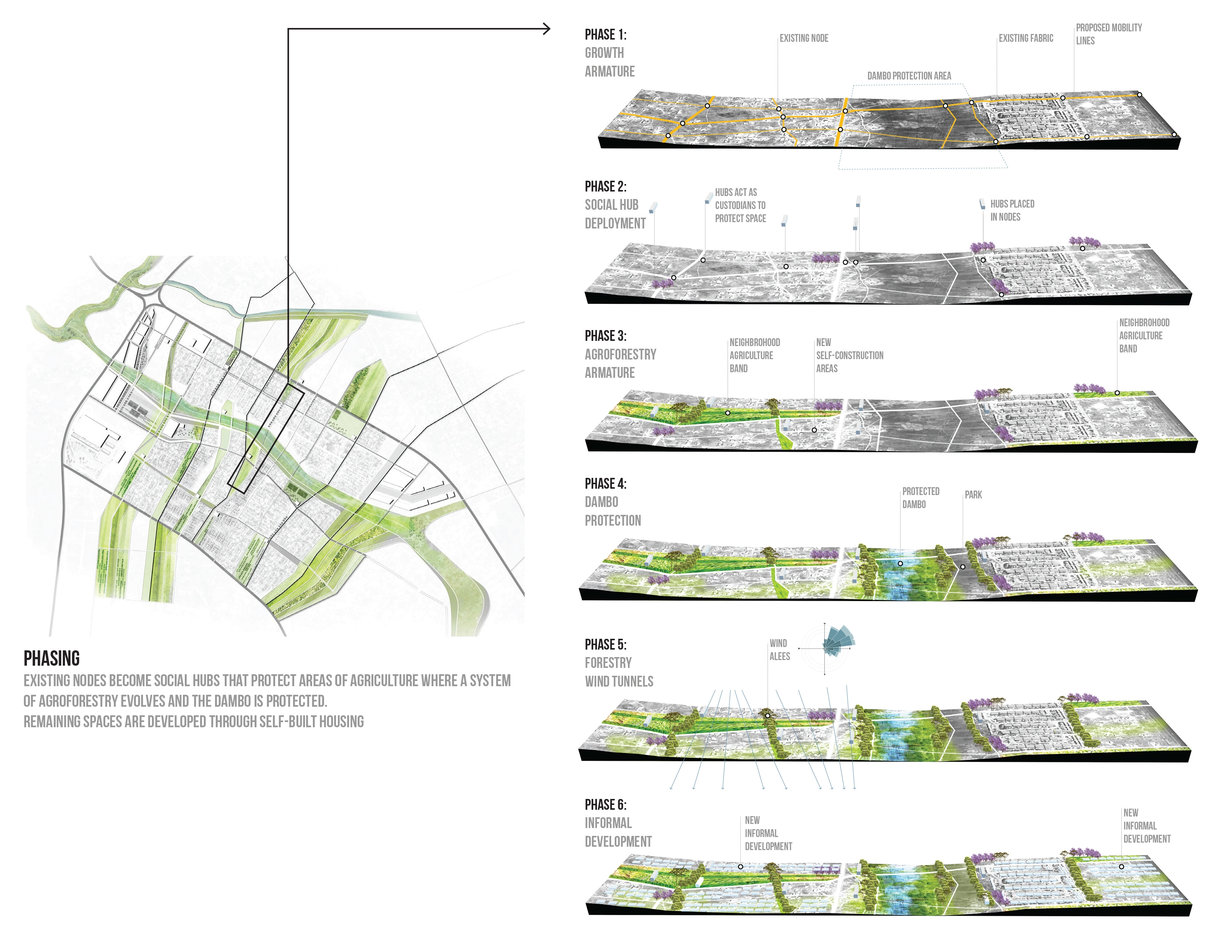
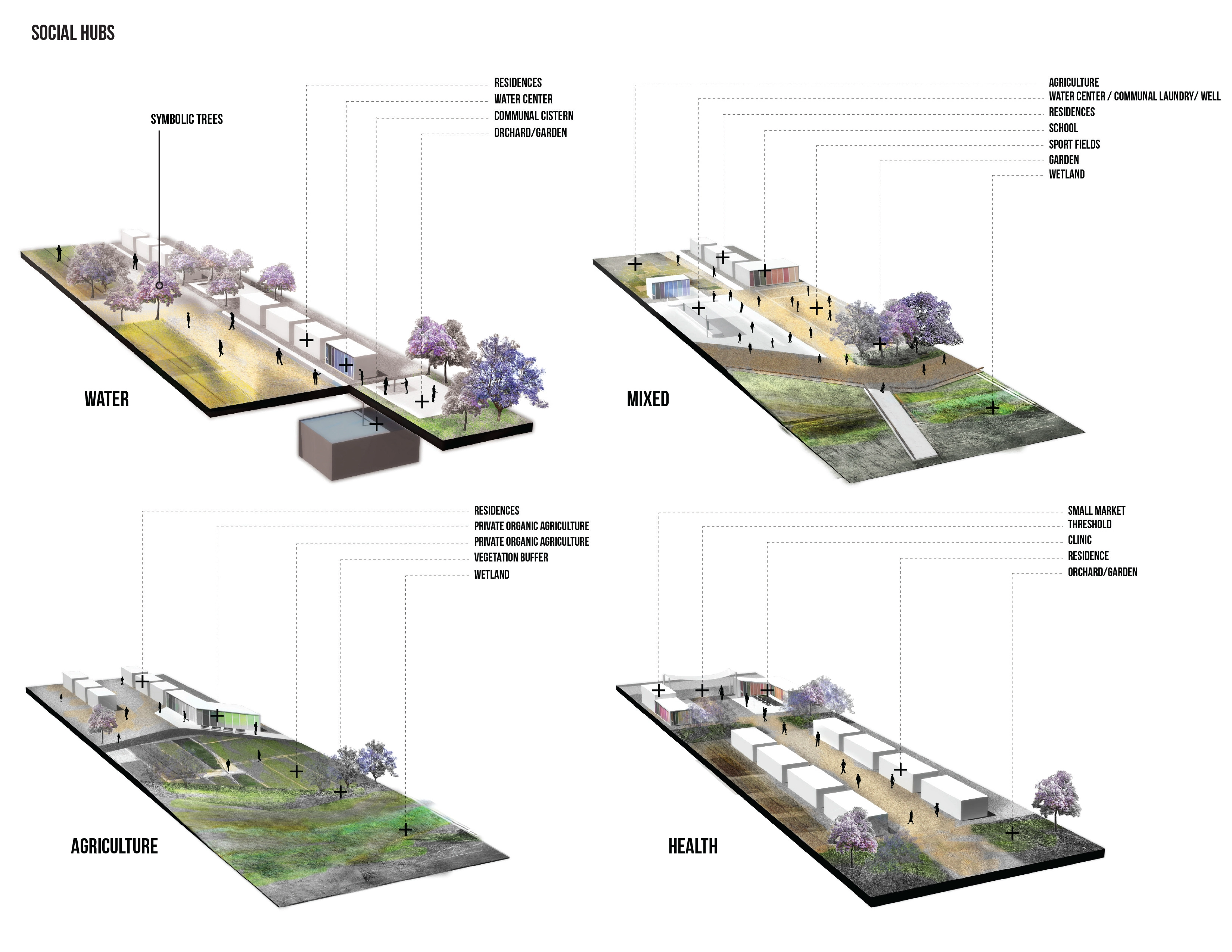
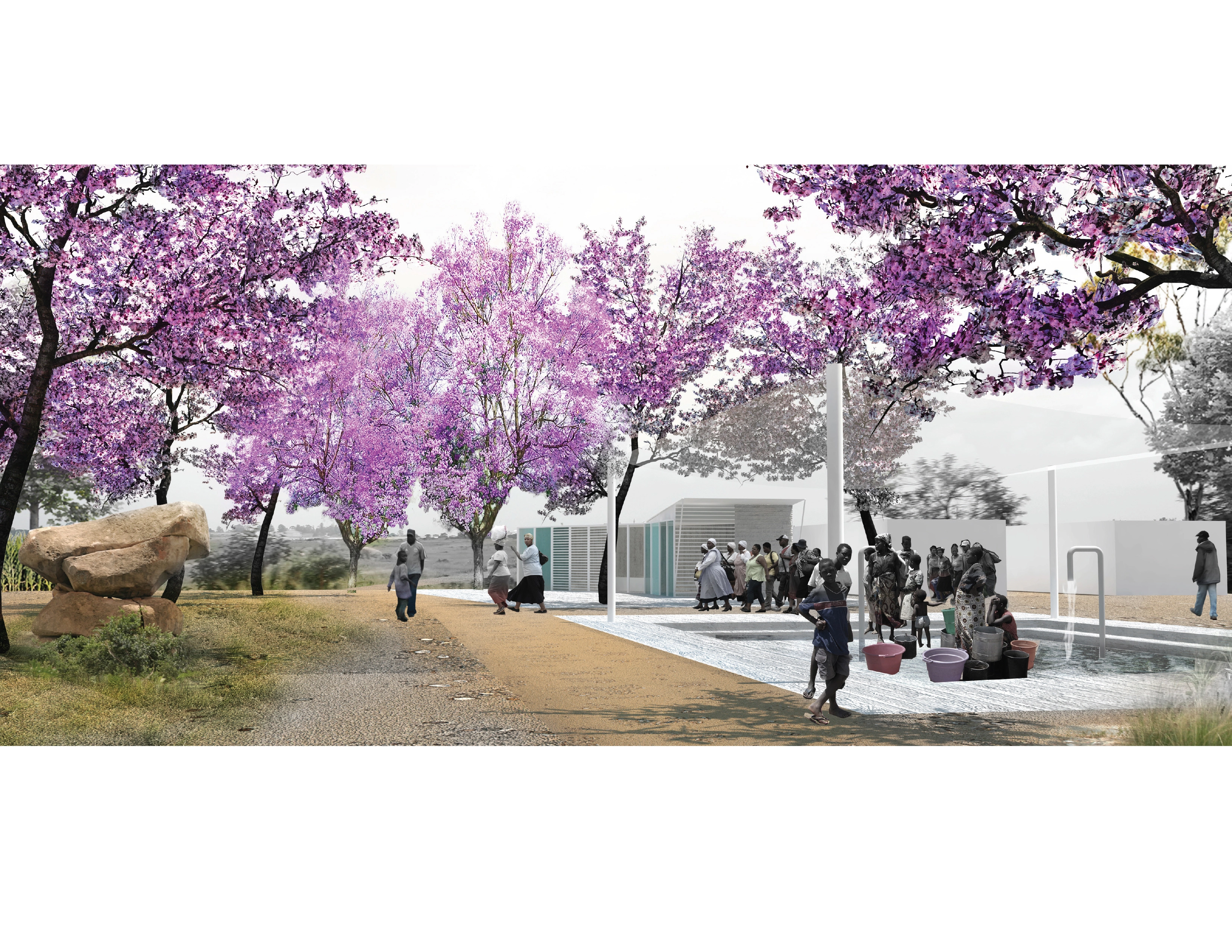
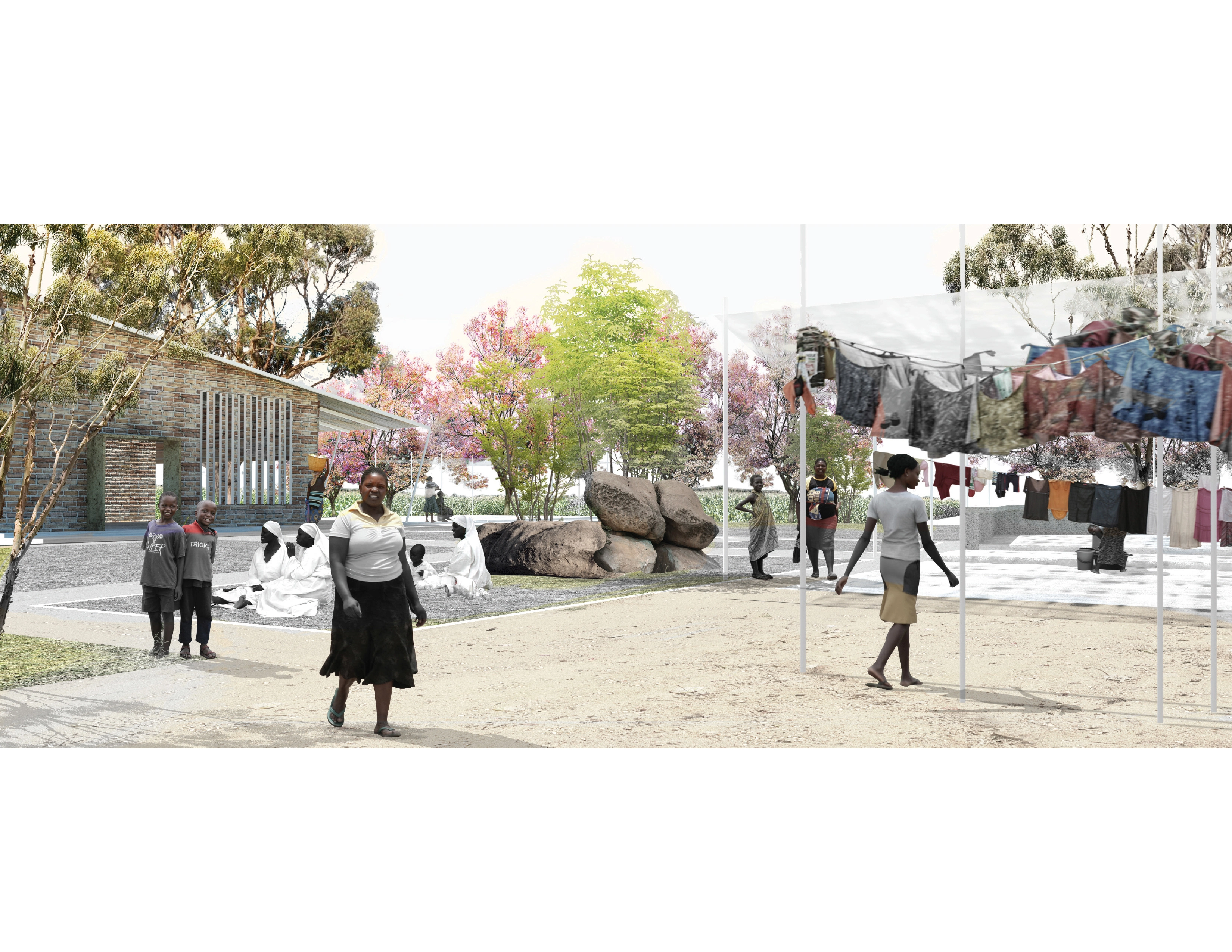
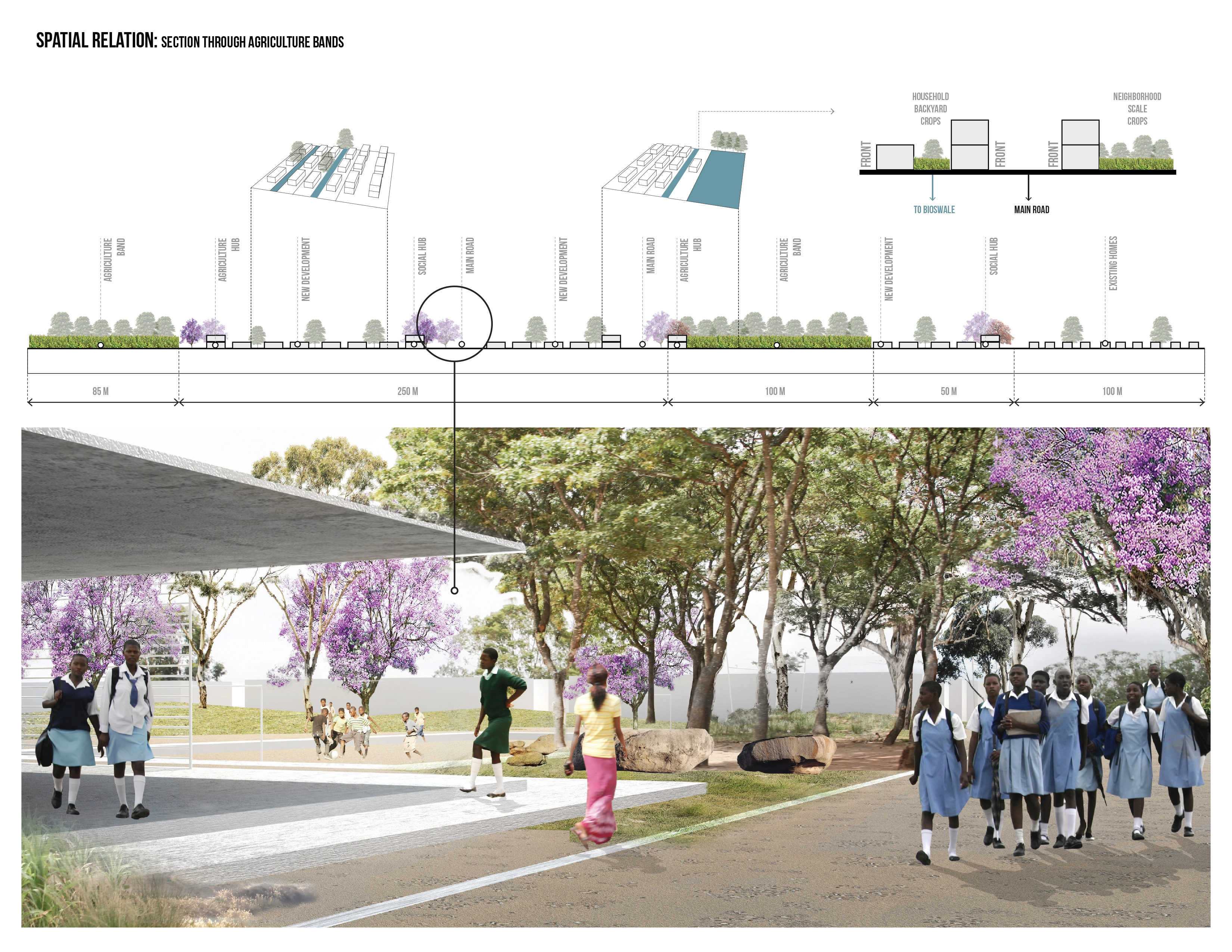
- Social hubs as points of social encounter, defined by crossings of existing paths. These include the presence of wells and communal cisterns, open air laundry areas, schools, clinics, sport fields and other programs that the community needs. Moreover, they become the first piece of future urbanization by acting as custodians that establish stewardship over nodes and protect areas from informal invasion. This helps demarcate the areas where the self-built city can grow.
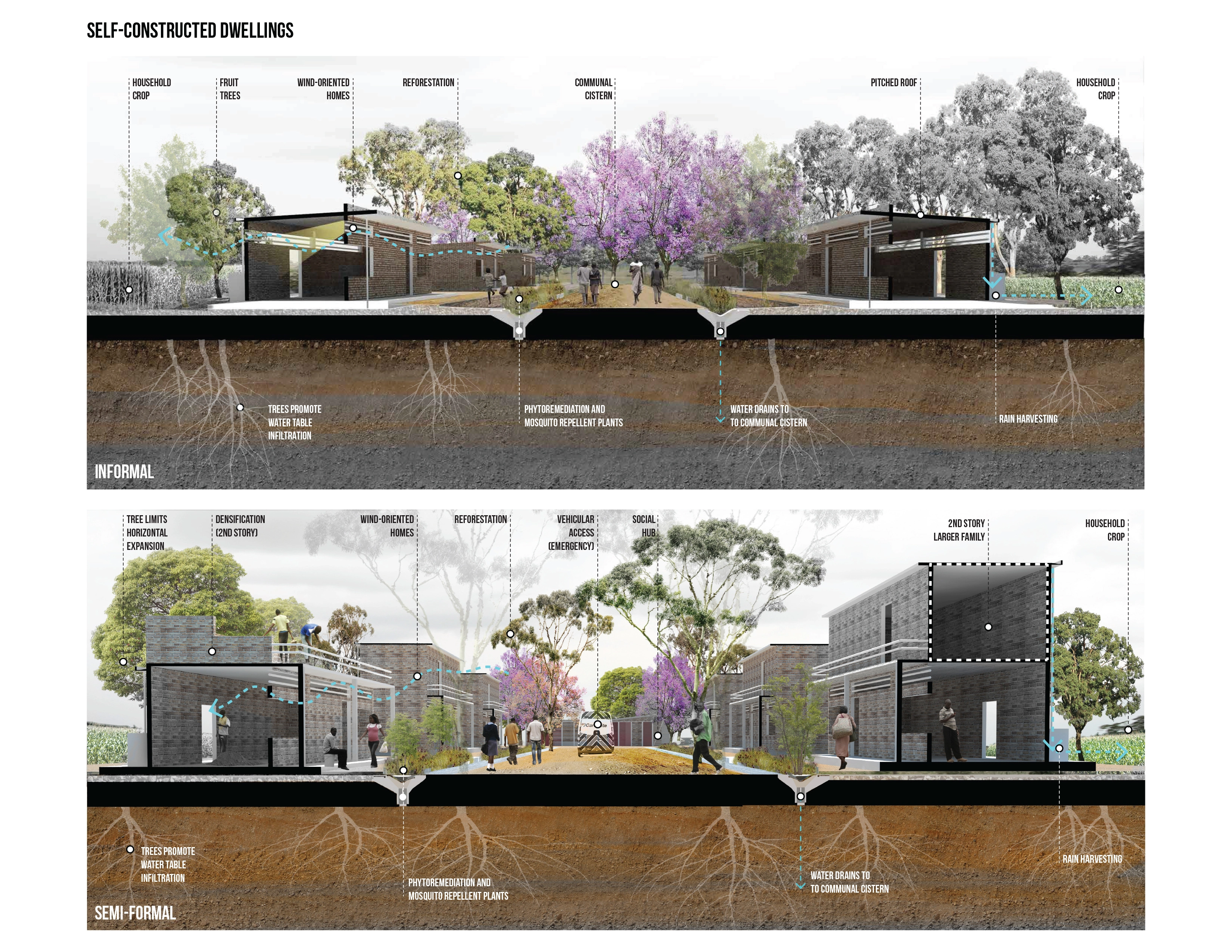
- The introduction of rainwater harvesting as a water source. Harare’s climate offers a potential to tap this resource and eliminate the dependency on one water source and help protect the dambos.
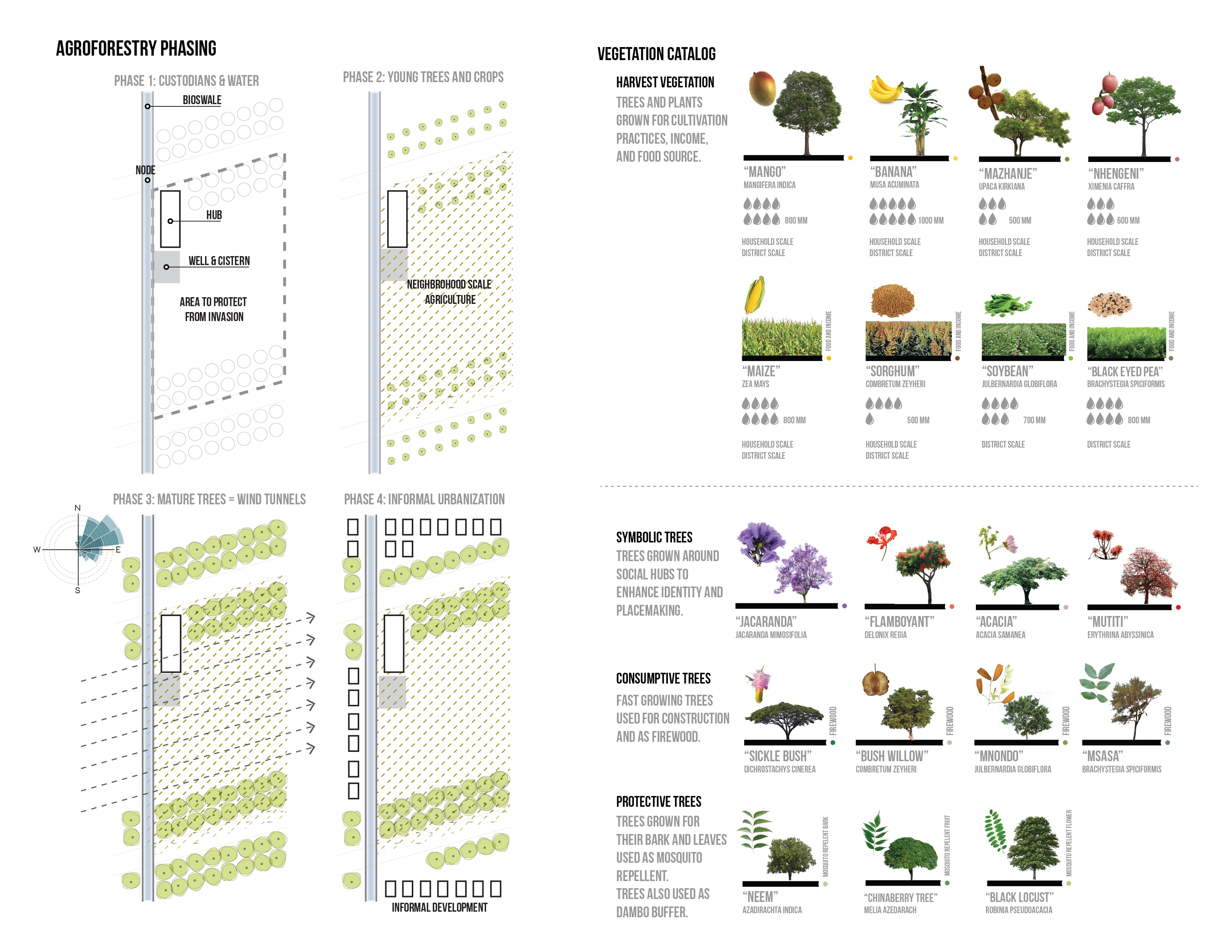
- Communal and family agriculture, organized in cultivation bands which include, hubs for education and job opportunities for residents through a multi-scale agriculture co-op. Agriculture species are selected for their water needs and traditional rain-fed irrigation as exhibited in Harare.
- Pedestrian paths and a few main roads that allow for simple forms of public transportation, which also help to define growth patterns.
- A reforestation campaign that utilizes indigenous and non-invasive species with distinct advantages such as helping recharge the aquifer, firewood harvesting, and aesthetical place making. Moreover, the reforestation campaign creates wind tunnels that combat the concentration of mosquitoes.
These design moves go beyond the spatial. They strive to educate the existing and future residents of Hopley Farms. Social hubs provide assistance by educating residents on how to harvest rainwater, how to become part of the agriculture cooperative, and how to improve their homes so as to take advantage of the climate. Therefore, through simple moves that relate water and vegetation, a new healthier community is created by providing the spaces where it can socially interact and learn.
Advertisement
Related Awards

Award of Excellence, General Design
A Floating Forest: Fish Tail Park in Nanchang City
In Nanchang, within the Yangtze River floodplain, we revitalized a heavily degraded 126-acre landscape into a floating forest that manages stormwater, restores habitats, and provides diverse recreational spaces—all within a limited budget and a short timeline. This innovative urban nature model strengthens the district’s identity and spurs surrounding development. Fish Tail Park offers a scalable solution for flood-prone regions, seamlessly integrating flood resilience, ecological restoration