

.webp?language=en-US)

.webp?language=en-US)

Archives and Collections of Executed Works of Landscape Architecture
ARCHIVAL GUIDE FOR LANDSCAPE ARCHITECTURE DOCUMENTATION
Advertisement
A Guide Prepared by the ASLA Archives & Collections Committee
Written by Richard H. Powell, FASLA | Edited by Lisa Jenkins, ASLA
-
As a landscape architect, you may relate to the following list—the tools of our trade. These are the instruments and reflections of our work as landscape architects:
- sketches on paper cocktail napkins
- photographs
- terrain models and maquettes
- watercolors
- yellow trash and onion skin
- letters
- e-mails
- PowerPoint presentations
- other electronic media
- slides
- specifications
- contracts
- project files
- drawings on vellum, mylar and even linen
- Photoshop files
- computer aided drafting (CAD) digital files
- computer generated electronic files
- papers
- books
- testimony and reports prepared and presented in litigation and administrative proceedings.
Many of us look at this list as a record of our career, a timeline or an organizational task that can wait for retirement. Unfortunately, anecdotal accounts tell us that these materials have been tossed into waste dumpsters, destroyed in fires, lost in floods, or disposed of by estate executors unaware of the historical value of the papers and drawings in their care. Materials not organized, catalogued and or indexed can result in boxes stored in the attic or garage limiting the value to those interested in a collection’s history and current applications.
Often these papers, books, designs, plans and documents, are ground breaking, the first of a kind and the labor of many “all nighters”. The work undertaken by landscape architects is an important expression of our efforts to make our surroundings better places to live, work and play.
These plans, specifications, and drawings can be the basis for justification of licensure to state legislatures intent on sun-setting landscape architecture license statutes. These materials can contribute not only to the history of our profession but also to local, regional, geographical and cultural history.
This purpose of this article is an attempt to remind and inform individual practitioners of the importance of preserving and documenting a project archive. It is an important segment of the landscape architecture practice and is meant to begin a dialogue that recognizes the issues associated with preservation and archiving of these materials at the individual practitioner’s level.
The ASLA Archives and Collections Committee has compiled a list of repositories willing to accept landscape architecture records and documents. Periodically, the Committee renews its request for potential repositories and since May 2009 has identified over fifty collection locations. These locations are posted on the ASLA website.
-
A daunting yet important task to the design profession, archiving and documenting one’s work can bring back wonderful memories.
- Where do I start?
- What do I save? How do I undertake the preservation of these materials?
- Who wants these materials ?
- Does one just give the papers to them and let them do as they wish?
- Who can help in the decisions of what to keep and what to discard?
- What equipment is needed to undertake this task?
These are common questions. One should develop a plan for the task, seeking assistance and advice from individuals knowledgeable in these matters.
Institutions
The search for an institution willing to accept the materials can set the stage for the process. Issues for consideration are:
- The institutions’ mission statement, goals, and its policies on access to the collection for research and scholarship;
- Provision for restriction of access to sensitive materials;
- An institutions’ capacity to exhibit and/or policy on the loaning of collection materials;
- The physical capacity and conditions for storage of a collection(s);
- An institution’s requirements for the acceptance of materials including the condition of the collection materials and how the collection should be packaged for transfer;
- whether any special equipment (slide projectors, computer, equipment for reading electronic media) that should accompany the collection; and
- any requirements for financial contributions to inventory and maintain the collection.
Some specific questions
- What would be the conditions of storage ?
- Is the humidity within the facility controlled ?
- What are the facilities’ methods of fire and water protection ?
- Is the facility equipped with alarms ?
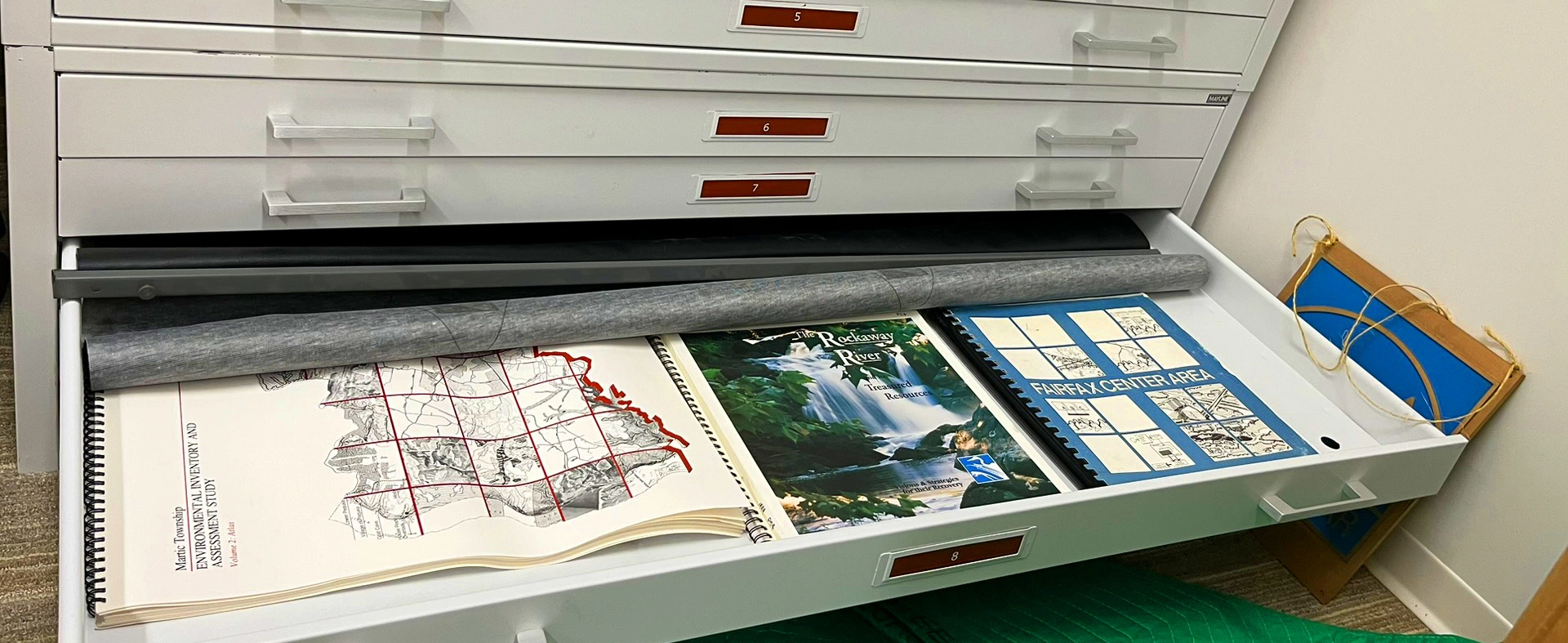
- Are there file cabinets, flat files for large drawings D-sized sheets and above ?
- Does the facility have older versions of computers, readers and slide projectors, with the ability to use the older electronic storage technologies?
- Will hard copies of documents, photographs and drawings be maintained along with the electronic storage media?
Not all institutions are capable of accepting materials for archiving without some financial assistance to undertake the storage, protection, cataloging for the use by researchers. Committee members have learned of institutions with collection and materials that are not available for scholarly research due to a lack of cataloging and indexing. Sometimes this situation can be addressed by the donation of monies that can be used to hire archivists and knowledgeable college students (especially those studying landscape architecture) with supervision that can catalog and index these materials.
Archivists
An archivist can assist in determining what to save, tackling an inventory, surveying and recommending which items to be donated and establishing the manner in which the collections is best preserved, stored and catalogued. Often archivists on the staff of the institution selected for accepting the collection can recommend archivists to assist in the inventory and/or survey of the materials to be placed in the collection. Also check with librarians or a city or county clerk for names of archivists in the public service.
Attorneys
An attorney can assist in the legal matters of transferring the materials to the institution One needs to consult with an attorney knowledgeable in copyrights and intellectual property to determine the most appropriate manner in which papers, drawings, etc. should be transferred. According to the University of Illinois paper, “Donating Faculty, Alumni or Family Papers”, the legal review should examine the issue of whether some portions of the collection are sensitive and whether access should be restricted to protect the privacy of the donor or others.
Appraisers
When the collection materials are determined, an appraiser can assist in determining the value of the materials for tax purposes and legal documentation. According to the American Society of Appraisers, an appraisal is a report providing an opinion of value at a given point in time of any sort of property. The appraisal helps in estate tax planning and providing an opinion of monetary value to the Internal Revenue Service . The American Society of Appraisers is an international association of appraisal professions and others interested in the appraisal profession. This Society has a website. (See www.appraisers.org/).
Accountants
Accountants knowledgeable in income and estate tax matters can assist in the tax decisions that may be associated with the donation of the collections.
-
Just as there was need to store “D” size sheets of drawings sets in the office (until the electronic files came into use), similar storage is necessary for the donated materials. Flat files, letter and legal file cabinets and or cardboard storage boxes along with photographic slide storage containers, electronic media, and possibly the computers, etc. (More on electronic media and computers later).
Photographs: Storage for permanence
Photos should be stored in folders, boxes and cabinets. Direct sunlight and other forms of light should be avoided because of potential for color fading and damage to the print finish.
When handling photographic media, wear clean lint-free gloves. Use paper or plastic sleeves and albums for photographs to provide protection from fingerprints, scratches and tears. All storage materials should have passed the Photographic Activity Test (PAT) as specified in ISO 14523:1999. If you are unsure if a product has passed the PAT, inquire with the supplier of the protective sleeves and albums. Some general identification regarding the photos’ content is always helpful to those who will survey and catalogue the materials.
Photographic slides need similar storage containers. Consider providing a slide projector, slide trays and projector bulbs with any collections. The availability of slide projectors in the future could be doubtful. The American Society of Media Photographers (ASMP), the Library of Congress and the Copyright Clearance Center offer guidance and information on documentary photography issues.
Electronic Media and Digital Electronic Information: Record Permanence
Webster indicates that it is questionable whether one will be able to preserve digital information more than ten years. Few data administrators believe that three migrations of archival data can take place from one storage media to the next without some data loss.
There are those advocating that hard copy of text and stored and digital images should be printed and preserved in the same manner as present photography. (According to Webster, there is a big gap in the confidence of data administrators as to their ability to perform long-term digital preservation. A 100-year Archive Task Force has been formed to address this issue).
The loss of information stored digitally is often due to corruption, loss of access, discoverability, or readability, with a loss of control or the inability to keep up with the overwhelming volume of information moving into new media and logical formats. Pinola suggests that the best electronic media storage is a gold-coated archival Blu-Ray disc that is kept away from heat and light can last 100 years.
Consider Donating Hardware
The ability to read 8.5 inch floppy discs may be unattainable without someone having a Commodore computer loaded with the appropriate software with the disc reader or a reader printer for microfilm or microfiche. The donation of floppy discs, CDs, DVDs, will likely need software and readers, some of which no longer exist. One should consider donation of computers, software, and associated equipment, with the electronic files.
-
Albright, Gary, & Fischer, Monique. Northeast Document Conservation Center Preservation Leaflet. Photographs 5.3 Care of Photographs. 10/10/12. http://www.nedcc. org/resources/leaflets.list.php
American Society of Appraisers www.appraisers.org/ASAHome.aspx Both the new and the old website have relevant information.
Institute of Museum and Library Services (www.imls.gov) Connecting to Collections: A Call to Action. A Guide to Online Resources (www.imls.gov/collections) contains 266 links to resources and common questions about collections care.
Image Permanence Institute: http://archivaladvisor.com
Melanie Pinola. “Future-Proofing Your Data”. Popular Mechanics Magazine. December, 2012.
Webster, John. “ How long is long-term storage?” CNET News 08/13/00. http: //news.cnet.com/8301-21546_3-10309283-102534564. html?tag=nl.e7038/15/09
Manuscripts and Archives Staff. Yale University. About Manuscripts and Archives :: Donating Materials. 10/12/12. http://www.library.yale.edu/mssa/about_donating.html
University of Illinois Archives. Working with An Archivist. 10/12/12. http://archives. illinois.edu/deposit-records/work-with-an-archivist/
University of Illinois Archives. Transfer Electronic/Digital Records. 10/12/12. http:// archives.illinois.edu/deposit-records/transfer-electronic-records/
ASLA Library
Explore thousands of landscape architecture volumes, journals, archives, and remote research support for members and the public.