

.webp?language=en-US)

.webp?language=en-US)
Can Non-Natives Play Nice with Natives? Part 3
by John Kamp
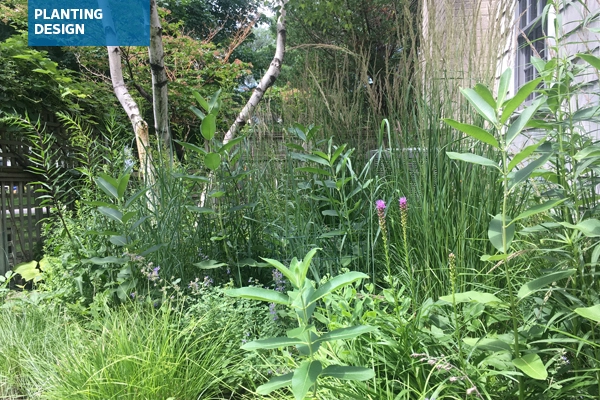
Can non-natives play nice with natives? A rework of a butterfly garden in Minnesota sought to find out.
This is the last installment in this series—check out part 1 and part 2 in case you missed them.
Learning from the results
What was clear from the numbers over the course of the five years of study was that the cultivars we had planted didn’t suddenly proliferate with aplomb and push out the native plants. In some ways, the opposite started happening: two of the most prolific plants—the Zizea aptera and the Solidago juncea—are plants native to the Minnesota prairie. And some of the native Asclepias syriaca ultimately started to grow within a clump of the non-native cultivar Calamagrostis x acutiflora ‘Karl Foerster’ and not the other way around.
We also didn’t start to see large empty spaces around the cultivars where they were somehow preventing the native plants from growing or see the nursery cultivars run amok or start “escaping” from the space and planting themselves elsewhere in nearby garden spaces. In fact, we in some ways observed the opposite—a Vernonia fasciculata suddenly appeared in the landscape in 2019 at the time of the rework, having self-sown presumably from a specimen in one of the adjacent garden spaces. And a Rudbeckia hirta and Coreopsis palmata appeared in 2021.
The closest we observed of one of the non-native plants moving into native territory was the Perovskia multiplying from 3 in 2019 to 11 in 2023. And yet in my experience with Perovskia, it does not seem to like growing within dense plantings but rather at edges or on its own, which makes sense given its native habitat is dry, rocky slopes in southwestern and central Asia. Within the Minneapolis butterfly garden, it is growing on the eastern edge of the landscape, where the original stand of Perovskia is and where there is full sun for much of the day and plenty of space between plants. In short, I’d be surprised if it made its way further west into the parts of the garden that are denser and that don’t get nearly amount of sun the eastern part of the space does.
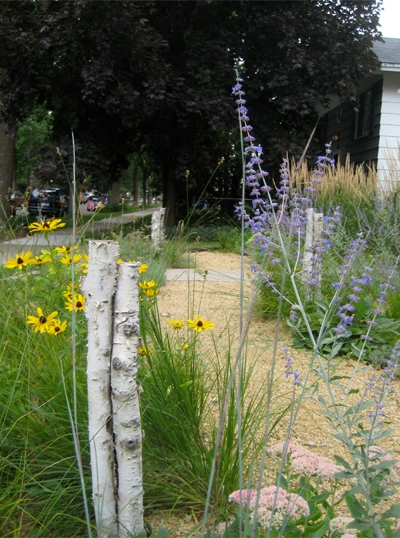
Had we done the study for another five years, would this situation have changed? Would the dynamic have shifted to where the non-natives would choke out the natives? Although we can’t say with 100% certainty that this wouldn’t happen, given the lack of any kind of self-sowing on the part of the cultivars, and given that several are sterile, and then just the overall dynamic of the space’s ecology thus far, it would seem very unlikely.
So what about the plants that started to somewhat behave like weeds in the butterfly garden, or at least those that started making their presence known in the landscape very quickly (re: the Zizea aptera and the Solidago juncea)? Is this a problem? Well, if the starting point for a landscape was a lot of space that needed to be filled in quickly, these species could be handy additions, almost immediately giving the space some real flower power early in the season (re: the Zizea aptera) and mid-season (re: the Solidago juncea). However, within the small space of this garden, they started to feel like something bordering on a minor nuisance and I think contributed to a kind of weedy look that at certain points during the growing season I didn’t particularly like.
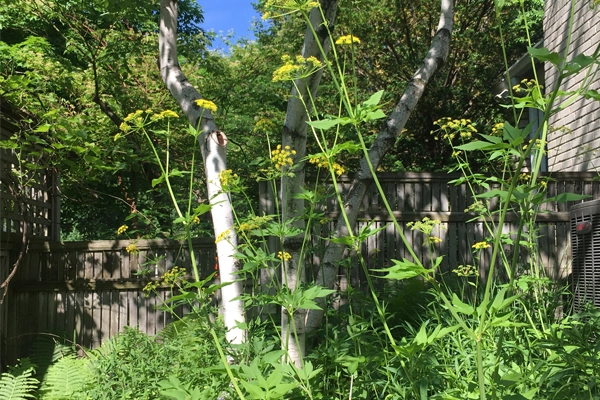
Had the landscape been in a public setting and thus with an accompanying maintenance plan, I would have recommended some cutting back of certain plants once their flowers were spent (the Zizea aptera in particular, and perhaps some of the Solidago juncea). I also would have recommended cutting back or removing certain taller self-sowing plants (e.g., Asclepias syriaca) that started moving toward/populating the front of the landscape. As the front of the landscape intentionally consisted of lower-growing plants, their presence really did give the sense of a weed invading that space. In a similar vein, if I was to update the landscape again, I would add in even more structural plants than are already there—more Hylotelephiums, more ‘Karl Foerster.’
Beyond the subject of weediness as an aesthetic, what actual weeding did we have to do? The answer is not much, aside from weeding out a very persistent mint that had been planted in the space years earlier and will probably always be in the space to varying degrees. Had that not been in the space to begin with, the landscape would have required almost no weeding. Of course, the weeding question speaks to a larger challenge with maintenance of such a landscape within a public setting. A certain level of skill and knowledge of plants is basically a requisite for maintaining this kind of landscape. To the untrained eye, especially in late spring when the plants start to emerge, many of these plants will look like weeds. Even once fully grown in mid-summer, many will, to an unskilled garden maintenance worker, look like weeds. And given the sheer diversity of plants in the space, even I wasn’t sure sometimes what certain plants were—especially if they weren’t in bloom or were still newly emerging.
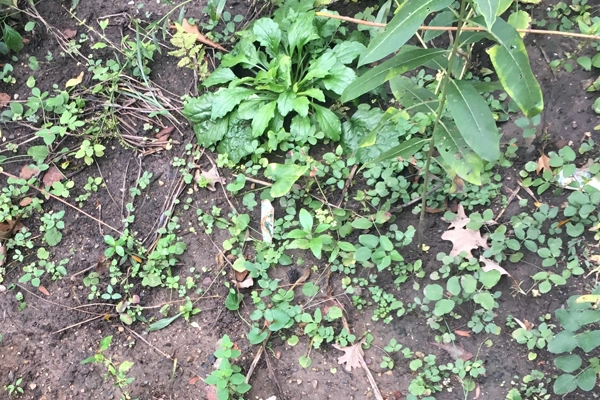
This speaks to one of the reasons why so many nursery cultivars are widely used: to the untrained eye and to low-skilled maintenance crews, they look like they’re supposed to be there. Thus their presence can help ensure some kind of long-term viability of the landscape and assurance that the investment in it won’t be for naught. Additionally, many nursery cultivars tend to have staying power. Of the cultivars we planted, we only had one casualty—one ‘Karl Foerster.’
Indeed, I had picked these particular cultivars not simply for their shape, form, and wildlife appeal, but also because over the years of doing landscape design and installation I had learned that they are virtually foolproof—and now I know from this project that they are foolproof and reliable even with competition from lots of other plants, including some extremely aggressive self-sowers. In fact, this has been one of the most valuable lessons of this project—that these particular plants can hold their own and stake their claim within a wilder landscape, and that, yes, this overall approach to landscape creation of letting natives and cultivars eke out an existence together can be a viable one, given, as pretty much all landscapes need, the right infrequent but skilled maintenance.
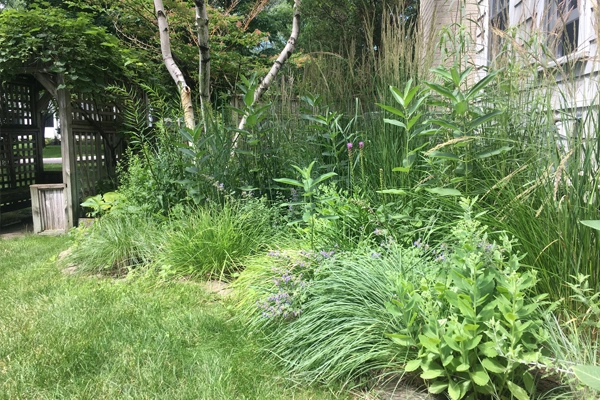
Yet, aside from notion that this approach can be a viable option for a kind of hybrid native-/non- landscape creation, my more philosophical hope is that this study of a small but information-rich landscape can serve to underscore how it’s never as cut-and-dried as “all native plants good,” “all cultivars bad.” We live in a world of gray areas, and the plants within our landscapes do, too. Landscapes and gardens are not an argument to be won but a set of spaces that can stir the senses and spark a larger conversation. Sometimes that conversation will lead from the beauty of the space to larger topics of, say, wildlife and water conservation. Other times, it will simply center on just how lovely and wonderful it is to be in that space, and that is just fine, too.
John Kamp is a landscape and urban designer and licensed landscape contractor (C-27 #1039171) based in Oakland, CA, where he runs the landscape, design, and community-engagement practice Prairieform. He is co-author of the book Dream Play Build: Hands-On Community Engagement for Enduring Spaces and Places (Island Press 2022).