

.webp?language=en-US)

.webp?language=en-US)
Designing with Pulse, Not Permanence: Lessons from California’s Vernal Pools
by Peixuan Wu, Associate ASLA
Holding Water, Holding Time
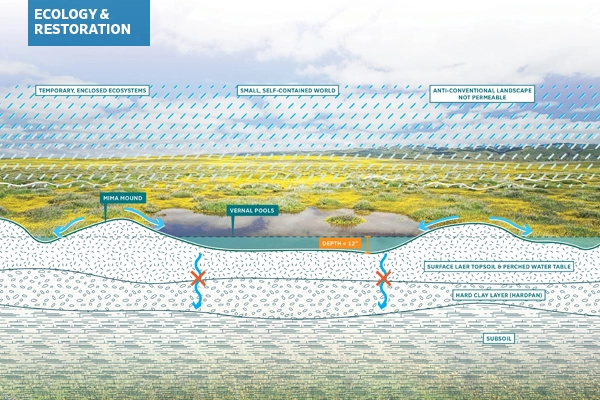
Across California’s Central Valley, small depressions blush with wildflowers each spring before vanishing again under the summer sun. These are vernal pools, ephemeral wetlands formed entirely by rainfall and held in place by dense claypan soils that prevent water from seeping away. For a few brief months each year, they become self-contained worlds: shallow basins that fill, bloom, and dry in rhythmic sequence.
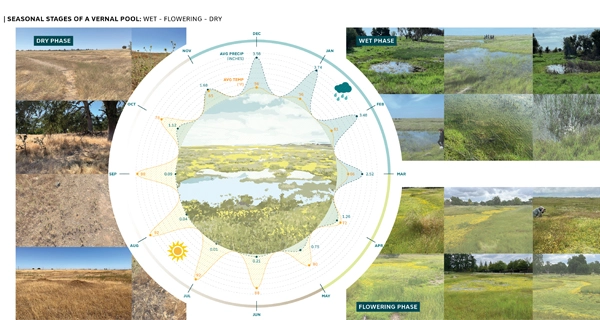
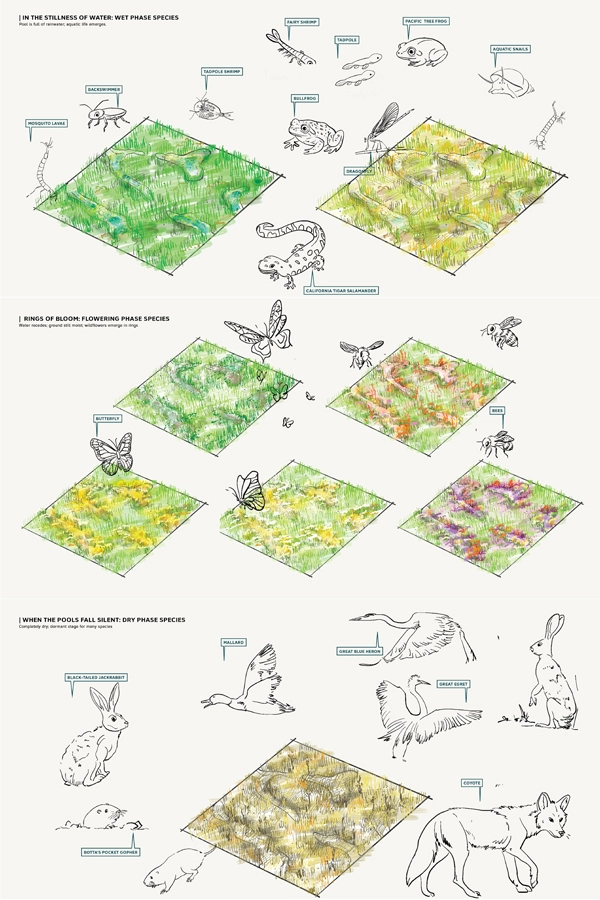
Through winter rains, the pools brim with water and teem with tiny aquatic lives: fairy shrimp, tadpole shrimp, and frog tadpoles which are all racing to mature before the water disappears. As the surface recedes, seedlings rise and burst into color, forming concentric rings of bloom which are yellows, purples, and pinks that ripple outward like a living kaleidoscope. By late summer, the pools lie cracked and still quietly holding within their clay the dormant seeds and cysts of next season’s return.
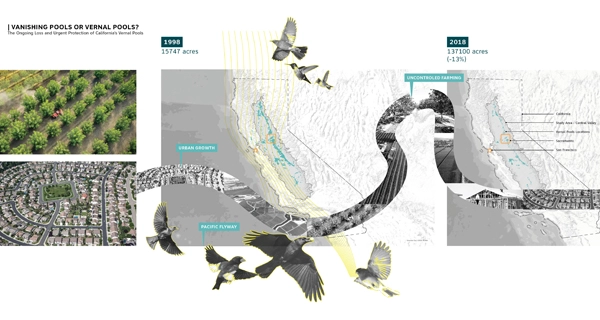
Vernal pools defy our conventional landscape logic. They are fleeting, enclosed, impermeable and rhythmic worlds that prize timing and pulse over permanence or perfection. Once widespread across central valley in California, more than ninety percent have vanished to agriculture and development, leaving fragile mosaics of rare species and seasonal wonder.
In a profession often obsessed with stability and performance metrics, these short-lived ecosystems ask a radical question:
What if resilience depends not on permanence, but on timing?
“To design with pulse is to accept flux as form.”
A Year of Watching Water Move
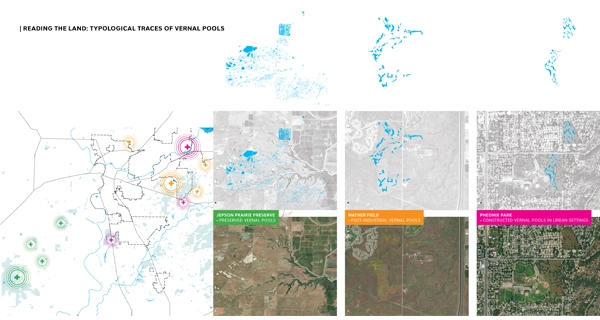
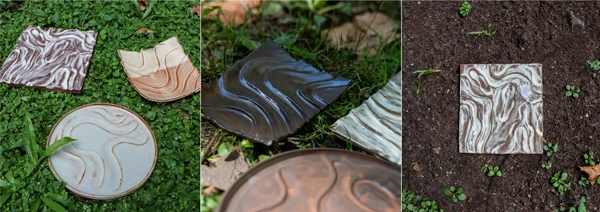
Through SCAPE’s 2024–2025 SEED Research Program, an internal research fellowship that supports staff in exploring ecological, cultural, or design-driven inquiries beyond project work, I spent a year tracing the full ecological cycle of California’s vernal pools, moving between literature review, field observation, analytical mapping, and ceramic study. Between January and July 2025, I visited three vernal pool landscapes near Sacramento across four trips and three seasons: wet, flowering, and dry:
- Jepson Prairie Preserve: an intact grassland and one of California’s best-preserved vernal pool ecosystems, managed for conservation since the 1980s.
- Mather Field: a post-industrial site on remediated military land, where pools persist as quiet survivors within altered terrain.
- Phoenix Park: a suburban park where constructed pools weave habitat restoration into everyday recreation.
I chose these sites for their accessibility from San Francisco and for the contrasting ways they hold tension between ecology and human design. Sacramento sits at the center of California’s vernal pool belt—where preservation, adaptation, and invention coexist within one region.
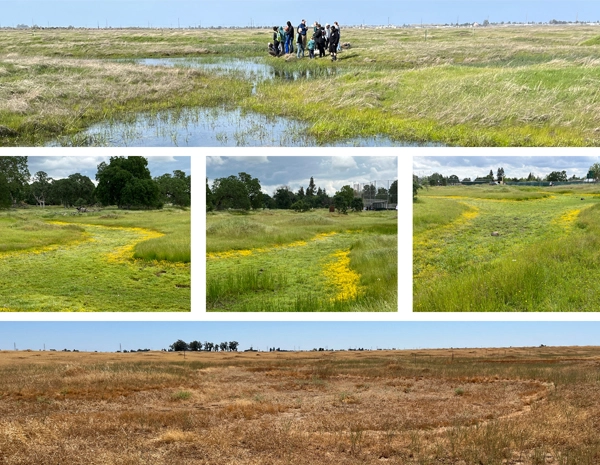
Across the seasons, I watched rainfall, soil, and light redraw the pools’ shifting edges. Winter held quiet basins alive with shrimp and tadpoles; spring unfolded in color as waterlines retreated, leaving rings of bloom across the prairie; summer returned with silence and cracked clay, storing seeds beneath the surface.
Each trip became both study and meditation. I photographed, sketched, mapped subtle shifts in topography and hue, a practice of observing rhythm and restraint. Jepson taught continuity, Mather revealed resilience amid disturbance, and Phoenix modeled coexistence within the everyday.
Lessons from the Pools
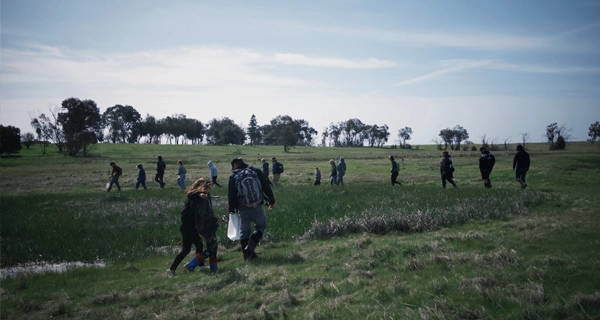
During my second field trip, I joined a tour with Splash Sacramento, a nonprofit dedicated to fostering environmental stewardship through hands-on education about local vernal pools and watersheds. There, a conversation with an ecologist changed the way I saw everything—and how I approached my research afterward.
I asked, “How can we bring vernal pools into cities in California?”
He paused and replied simply: “Intervene as little as possible.”
That response reframed my entire study. Vernal pools resist simplification. They don’t fit neatly into frameworks of permanence, productivity, or control. Yet they are profoundly resilient, responding quietly to climate, surviving through rhythm and restraint. Their beauty lies not in abundance, but in timing, subtlety, and surprise. They remind us that resilience can be still, and that natural aesthetics can arise from enclosure, delay, and dormancy.
As designers, our instinct is often to intervene, to solve, improve, or formalize. But here, the challenge is different: to observe instead of impose, to learn instead of replicate, to stay curious amid irregularity, and to step, if only briefly, into a world ruled by pulse, not permanence.
What if embracing the unconventional timing and stillness of vernal pools could reshape not only how we restore wetlands, but how we design altogether?
Learning Through Vernal Pools
Beyond photographs, I sought to study these places through a more humble and systematic lens, by mapping, comparing, and translating what I observed.
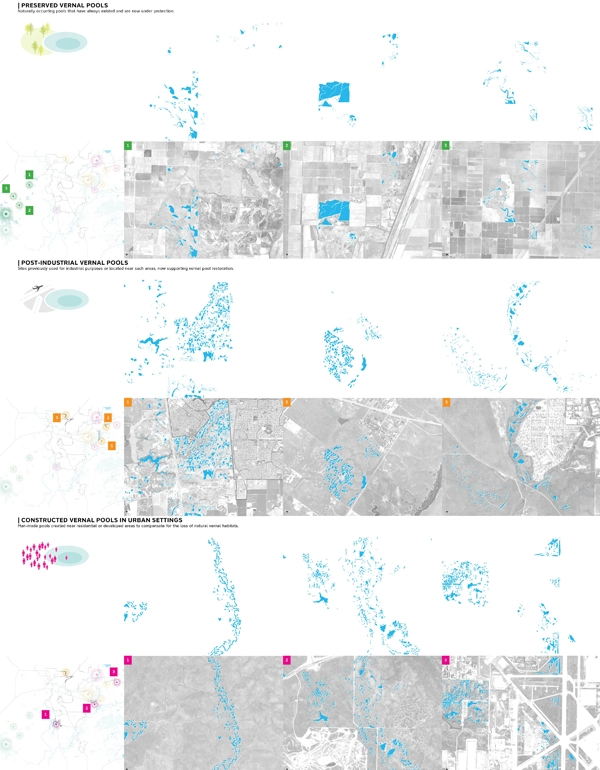
I began by classifying the three types of vernal pools I visited, along with others across the Sacramento region:
- Preserved Vernal Pools – soft, irregular patches scattered like raindrops across the land. Their shapes follow topography rather than human order, forming loose networks shaped by water and geology, surrounded by remnant grasslands.
- Post-Industrial Vernal Pools – smaller, fragmented, often squeezed between infrastructure. Some curve naturally; others bear traces of past use, balancing ecological memory and human imprint.
- Constructed Vernal Pools in Urban Settings – deliberate, rounded basins designed for restoration and education, often within parks or buffer zones. Though artificial, they still create room for life and learning.
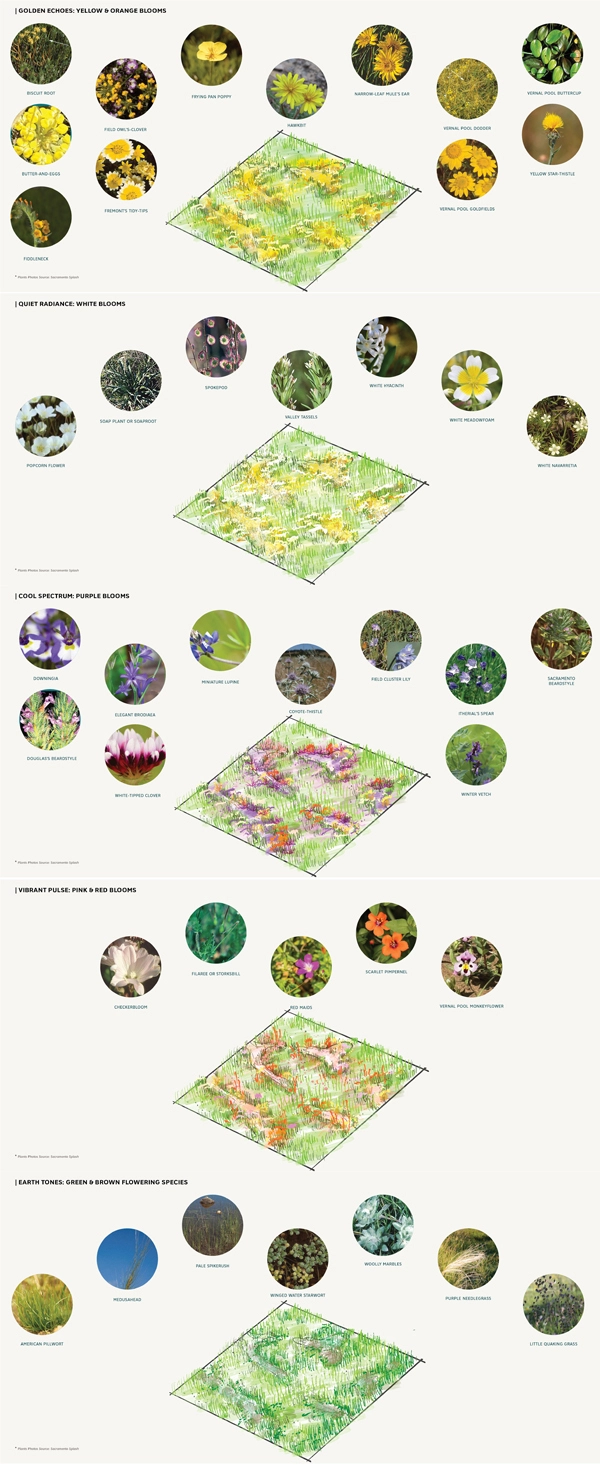
From these observations, I developed a seasonal planting palette—a toolkit that links species and colors to each phase of the pools.
Finally, I asked: How might we design with this rhythm?
Not as fixed features, but as flexible frameworks that hold and release water, time, and life.
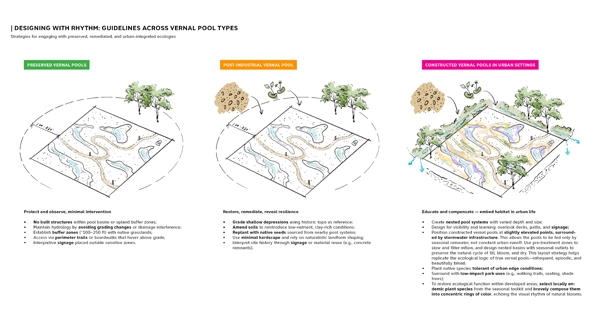
Design Strategies Inspired by Vernal Pools (see the images for more details)
- Preserved Pools: Protect and Observe
Avoid altering hydrology or topography; maintain generous buffers of native grassland; limit access to raised trails and interpretive edges.
- Post-Industrial Pools: Restore and Reveal
Grade shallow depressions following historic contours; reintroduce clay-rich soils; collect and seed native species from nearby sites; reuse remnants of the site to tell the land’s story.
- Urban Pools: Reimagine and Integrate
Build nested basins fed only by rainfall; plant in concentric rings echoing natural bloom halos; design pre-treatment zones for filtration; blend education, recreation, and habitat to bring nature’s pulse into the city.
Through this process, I realized that to design with pulse is not to imitate nature’s form, but to honor its timing—to let water, soil, and patience become the true materials of design. In that rhythm of appearance and retreat lies another kind of resilience—one that accepts change, values pause, and measures beauty by time rather than permanence.
This research also opened up a path forward: it sharpened how I read seasonality and local ecological typologies in California projects, and it begins to form a small toolkit within SCAPE’s broader resilience work. Looking ahead, I hope to bring these lessons into California future projects, carefully and scientifically, and continue building on them through collaborations with scientists and further site-based inquiry.
Acknowledgment
This work was supported by SCAPE Landscape Architecture’s 2×10 SEED Research Program (2024–2025).
References
California Department of Fish and Wildlife – Vernal Pools Overview
Provides state-level definitions, legal protections, and conservation guidelines.
City of San Diego Vernal Pool Habitat Conservation Plan (2017)
A detailed planning document on vernal pool mitigation and long-term management strategies.
Sacramento Splash: Vernal Pool Education & Outreach
Public education resource with species guides, habitat tours, and K–12 programming.
Windmiller, B., & Calhoun, A.J.K. Conserving Vernal Pool Wildlife in Urbanizing Landscapes
In: Urban Herpetology. Herpetological Conservation Volume 3. (2008). Society for the Study of Amphibians and Reptiles. Case studies and policy considerations for integrating vernal pool protection in urban areas.
Recovery Plan for Vernal Pool Ecosystems of California and Southern Oregon
US Fish & Wildlife Service (2005) Core regulatory and restoration framework covering 33 threatened and endangered species.
Witham, C. W. (Editor). (1998). Ecology, Conservation, and Management of Vernal Pool Ecosystems: Proceedings from a 1996 Conference. Sacramento, CA: California Native Plant Society.
Landmark proceedings with ecological, legislative, and design-focused research.
Holland, R.F. (2009). California’s Great Valley Vernal Pool Habitat Status & Loss Report, 2005. Prepared for the US Fish and Wildlife Service.
Key mapping and status update for Central Valley vernal pools.
Bauder, E.T. (2005). The Effects of Urbanization on Vernal Pool Hydrology in San Diego County. San Diego State University Field Station Bulletin.
Focuses on hydrologic fragmentation and design implications.
Cohen, S., et al. (2016). Green Infrastructure and Biodiversity: Vernal Pools in the Built Environment. Landscape Architecture Frontiers, 4(2).
Explores how vernal pools can be integrated into landscape infrastructure systems.
Zedler, P.H. (2003). Vernal Pools and the Concept of “Restoration” in Ecology
Madroño, 50(3): 109–113. Challenges and limits of replicating vernal pool function in designed systems.
Vernal Pool Resources and Projects, San Francisco Estuary Institute (SFEI)
A curated collection of SFEI’s projects, reports, and data layers related to vernal pools in California. Includes landscape-scale analyses, restoration strategies, and mapping efforts aligned with conservation planning and habitat connectivity.
Peixuan Wu, Associate ASLA, is a Senior Designer and licensed Landscape Architect at SCAPE in San Francisco. Her work explores the intersection of ecology, materiality, and cultural narrative, with a focus on climate-adaptive and site-specific design. A 2024 WxLA Scholar and member of the ASLA Northern California Chapter Executive Committee, she is dedicated to advancing resilient and inclusive landscape practice.