

.webp?language=en-US)

.webp?language=en-US)


How Landscape Architects Can Partner with Manufacturers to Decarbonize Design
By Jared Green
"We know natural resources are finite," said Amy Syverson-Shaffer, ASLA, sustainability leader at Landscape Forms, but "there is also an 'efficiency resource' -- and we don't know the limits of that yet."
Given the extent of the climate and biodiversity crises, we need to end business-as-usual. Landscape architects and product manufacturers can work together to pursue efficiencies, reduce use of polluting materials, and transform design and construction. These approaches will help us all get on a path to zero greenhouse gas emissions by 2040.
A recent discussion organized by the ASLA Biodiversity and Climate Action Committee explored how companies that create products and services for landscape architects are planning for a different future.
More cities and states are setting embodied emission targets. The federal government is making major investments in "Buy Clean" programs. And a significant share of landscape architects are aware of the climate impacts of the products they specify.
The Sustainable SITES Initiative (SITES), a rating system for landscapes, is building awareness on the climate impacts of design decisions. It also helps landscape architects partner with manufacturers to shift the marketplace towards low-carbon products, explained Daniellle Pieranunzi, SITES director, with GBCI.
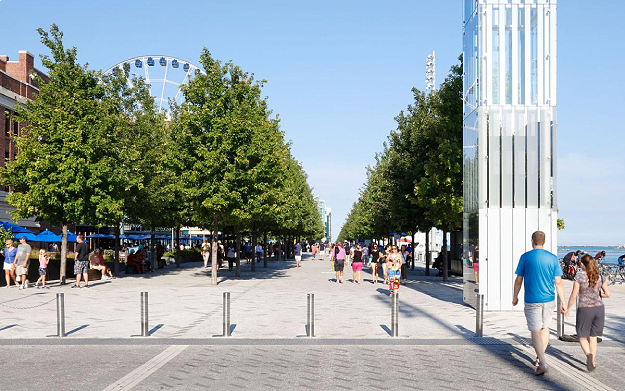
One example: Landscape architecture firm Field Operations wanted a more sustainable paver for their Chicago Navy Pier project. But what they were looking for -- a paver with 30 percent recycled content -- didn't exist in the marketplace.
They ended up partnering with Unilock to create a new paver just for the project. They were able to advocate for a new solution because they needed over half a million pavers for the pier. The scale of demand enabled Unilock to make an investment.
Now, that paver is a new product line available to all landscape architects. Field Operations' advocacy efforts with Unilock and use of the paver helped the project achieve a rare SITES Gold certification.
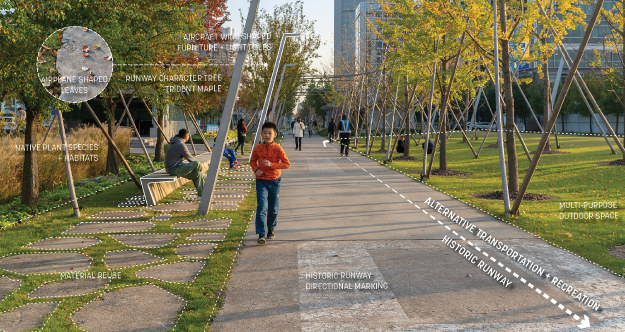
SITES also incentivizes circular economy approaches that eliminate waste. The rating system awards points for reusing materials from existing sites. It also gives points for using new products that can be disassembled, recycled, or reused. If planned with product manufacturers from the start, more new materials can be diverted from landfills.
"Even small actions multiplied can add up and make a difference." Pieranunzi said.
Syverson-Shaffer said Landscape Forms is looking at those small efficiencies that add up to real carbon reductions. She showed images of mysterious industrial parts, explaining how they all serve an important purpose.
One device enables Landscape Forms to easily collect all the metal shavings that fall on the floor. Another creates right-sized cardboard boxes that reduce waste.
And there was a wood pallet made of reclaimed wood instead of the usual new wood. "If you are sending out 50,000 of these a year, using reclaimed wood can save thousands of tons of emissions."
To support more systemic change, Landscape Forms has also invested in environmental product declarations (EPDs), which are transparent, third-party verified, and publicly-accessible reports. They are rooted in a life-cycle assessment (LCA) approach.
They enable landscape architects to gauge the carbon, water, and biodiversity impacts of a product. And to compare products in the same categories "apples to apples."
EPDs are already widely available for building products. With recent efforts by the federal government, they will also be more widespread for raw concrete, glass, aluminum, and steel -- materials that go into landscapes and landscape products.
The challenge is how to enable all the manufacturers who sell products to landscape architects -- both large and small -- to generate EPDs.
An estimated 72 percent of the products that manufacturers develop for landscape architects don't have an EPD, explained Bryce Carnehl with Hunter Industries. "There is room to grow."
One challenge is EPDs are expensive. There also needs to be greater demand to make more of them happen.
A recent ASLA survey found that 24 percent of landscape architects currently ask to see some form of an EPD before specifying products. For the manufacturers not receiving requests for EPDs, it is hard to see the demand or return on investment in developing them.
Carnehl encourages landscape architects to use a guide he and ASLA Biodiversity and Climate Action Committee members developed -- Collaborating with Industry Partners on Climate Action and Biodiversity: A Guide to Conversations Among Landscape Architects, Vendors, and Product Manufacturers. It offers 70 questions landscape architects can ask, including: "Do your products have EPDs?"

Landscape architects can "ask for them and drive change."
For smaller manufacturers that may still find EPDs too expensive, one way forward is to start collecting data and self-report carbon performance. "This is the entry level and can help manufacturers hit the ground running," Syverson-Shaffer said.