

.webp?language=en-US)

.webp?language=en-US)
Sadafumi Uchiyama, ASLA
on Designing Peace and Harmony
The mission of the Portland Japanese Garden is "inspiring peace and harmony." The Garden identifies itself as a place of inclusion, anti-racism, and cultural understanding. How has the garden advanced these goals throughout its history? How have these goals taken form in the landscape?
It’s not what we do, but who we are and how we exist. We take a passive approach, but that doesn’t mean we don't contribute to these goals.
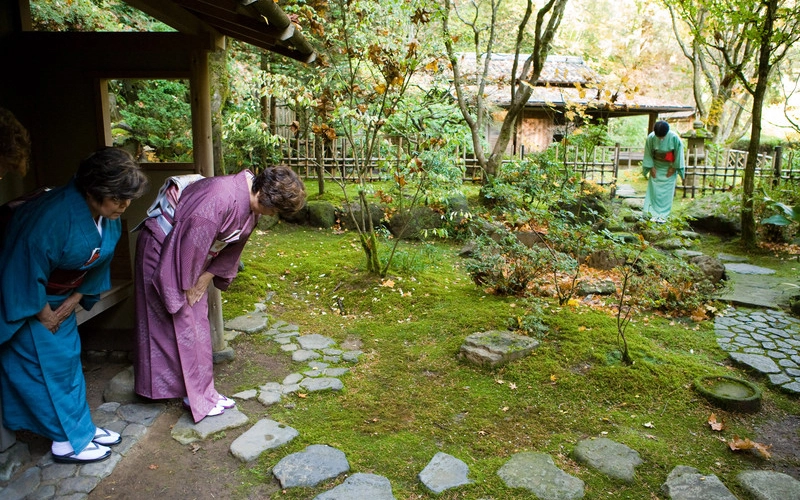
There’s no prescription for how to enjoy the garden. Typically, a tour involves listening to what the guide is talking about, but we intentionally do not do that and only offer basic guidance. Our tours are very quiet. We just answer questions. We leave everything up to the visitors, because they have their own reasons for coming to the garden. It could be for tourism or because someone lost a loved one or had a new baby.
We don't prescribe but be there all the time in the same way. We listen and then if a visitor chooses, we strike up a conversation. We have conversations that may be difficult, but we listen and talk.
We see our Japanese garden as a depository of all kinds of emotions. There’s not much signage and interpretation. Each visitor comes with a bag full of things or nothing. And then when the conversations start, we are ready to engage.
Everyone is a human being. Language, cultural background, and ethnicity doesn’t matter. We are accepting. We welcome the human being. We provide the essential experience of being a human being in harmony with nature. We try to bring human beings closer to that harmony.
When Nobuo Matsunaga, former ambassador of Japan to the U.S. visited Portland Japanese Garden, he proclaimed it to be "the most beautiful and authentic Japanese garden in the world outside of Japan." Some 300 Japanese gardens were designed in the U.S. in the aftermath of World War II to help heal the relationship between the countries and create understanding. What makes the Portland Japanese Garden so beloved in Japan and the U.S.?
Well, it took 60 years at this point. You can imagine how bumpy the relationship was with the city just barely 10 years after the war. But we believed in the power of the garden. We owe a lot to local people, the community. We still define ourselves as caretakers of the garden for the community, which has been our tradition. Portland and the people of the city made the garden possible.
Instead of trying to overcome the differences, we embrace similarities. There are so many similarities between the Pacific Northwest and Japan. The climate is one thing. The hills, beautiful streams and rivers; that’s what Portlanders and Oregonians embrace. There was a natural acceptance of what is Japanese because it wasn’t totally foreign. We are a Japanese garden in the Pacific Northwest forest.
Designed in 1963 by Professor Takuma Tono of Tokyo Agricultural University, the garden combines eight different Japanese garden styles. What are these styles and what do they signify? How do they come together as a whole?
Professor Tono was clear from the get-go why he designed the garden. It’s really nothing but education in a broader sense: community education. He didn’t intend to create a masterpiece, but wanted to offer an introductory range of gardens.
That approach led to his original five gardens. Normally, when we design Japanese gardens, there is usually one theme or type, but he intentionally showed the spectrum of gardens, all different but what we call Japanese gardens. He designed a strolling pond garden, sand and stone garden, flat garden, tea garden, and natural garden, then we added a few, including through the recent Cultural Crossing expansion.
Advertisement
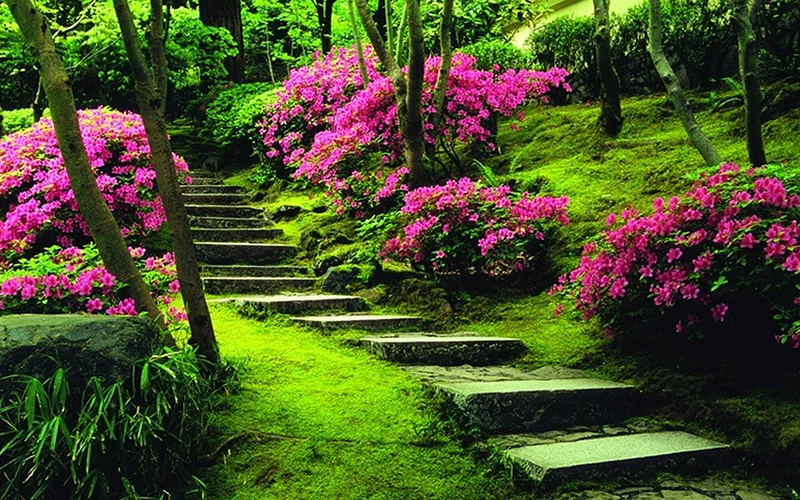
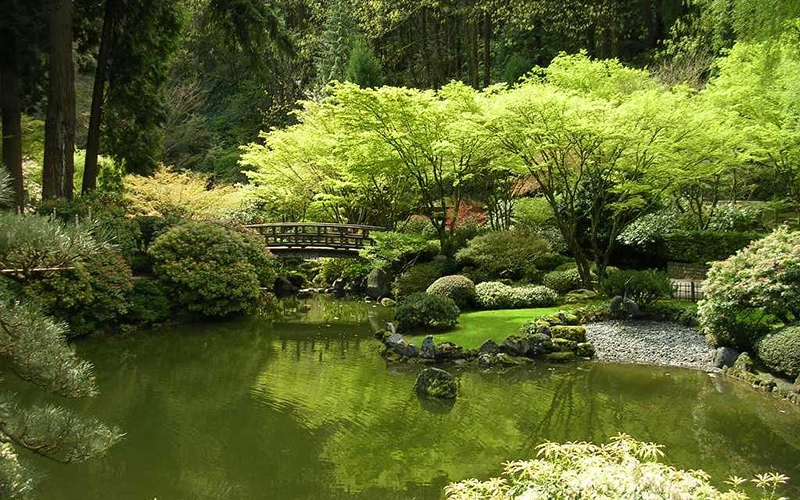
We are very conscious about not copying or recreating the classic garden style, but advancing it. What can Japanese gardens become? Our responsibility is to also move the tradition forward, because tradition is only one little step within a long evolution.
A new, smaller courtyard garden is more like an agricultural field. Then we added a cascade garden to the forefront of the Japanese Garden, which is actually outside of the garden itself, because we like to provide for those who are not paying admission.
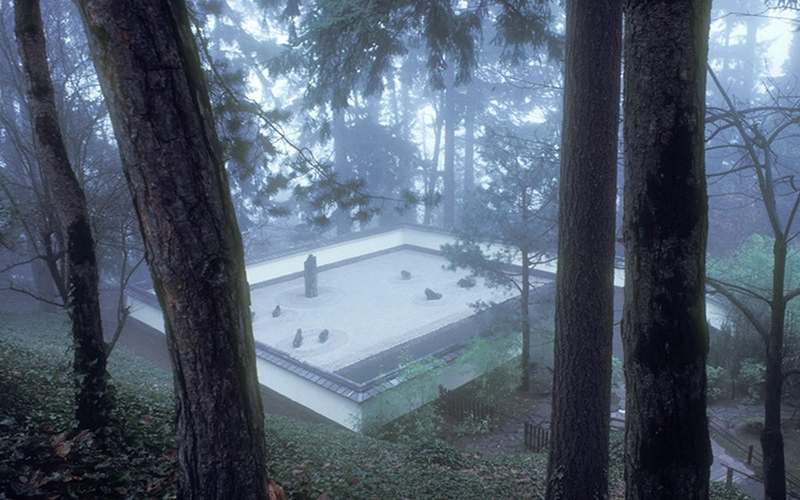
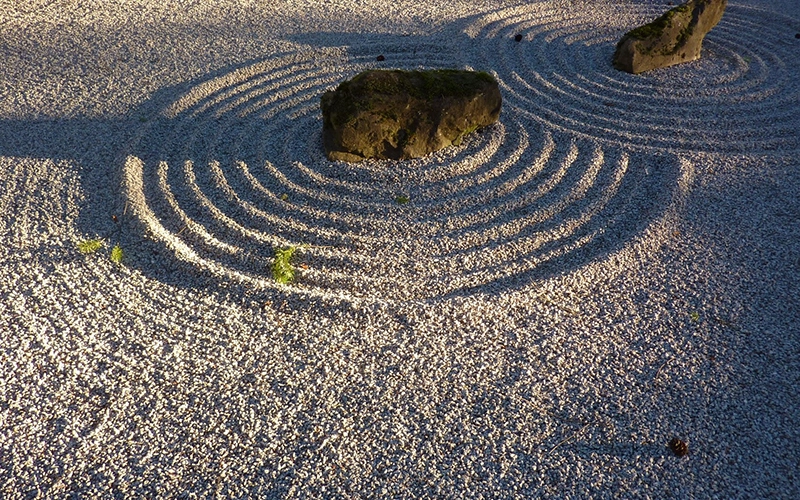
Often sand and stone gardens are referred to as Zen gardens in the US. but that isn’t accurate. They are dry landscapes, referred to as karesansui gardens, guided by the principle of the "beauty of blank space." These gardens are designed for contemplation, rather than meditation. How do you explain the growing interest in "blank space" landscapes and buddhism over the past few decades?
It’s about the feeling of relief. An object is tangible -- visible and touchable. We conceive what it is and generate feelings. But a void, or nothing, makes us think. In some ways, it actually frees us to change the mode, or forces us to change the mode of thinking, by not thinking. If you have all objects, there is friction. Having the void space provides lubricant for our thinking.
Void space is very important in all Japanese art: calligraphy, for example. An object only exists because of the void.
It’s important, especially in today’s world, to step out. Our ability to learn is tied to our ability to step out of "us," "me," and "my."
You are there in the garden because of others. It's a similar notion: only because of the void can the object exist and be identified. It's relevant to how we live in our society and cross-cultural. The void is a very wise tool. If we can carry that tool, we can be able to see.
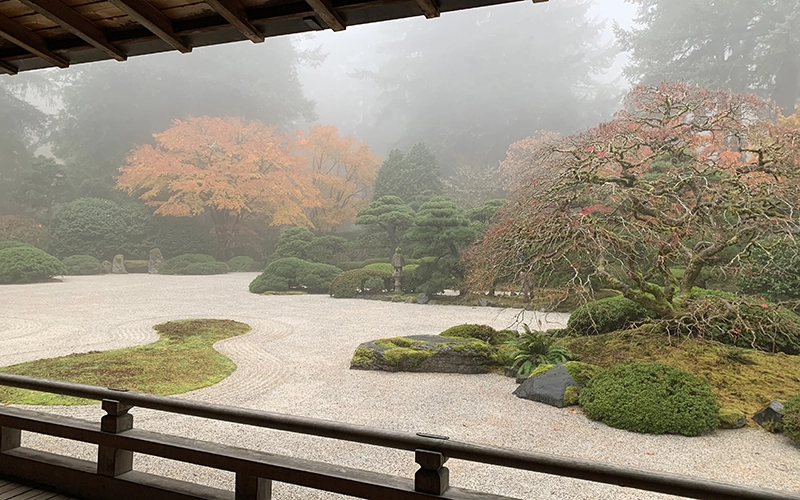
The flat garden (hira-niwa) further elaborates on this dry landscape style, adding trees and plants that provide color for all seasons. The garden is meant to be experienced from a single viewpoint, looking out beyond Shogi screens in the pavilion. You describe the void as a way to focus on an object in the sand and stone garden, but here that idea has evolved. Why is the expression of seasonal change important in this landscape?
The experience of the garden has both physical and temporal aspects. The flat garden with white sand, lined with pine, cherry, and maple trees, presents the notion of the passage of the time. By providing essentially a still picture through the flat garden, you become much more keen it. You are not physically moving, so you can catch time. But time also has its own way to move independent from our movement.
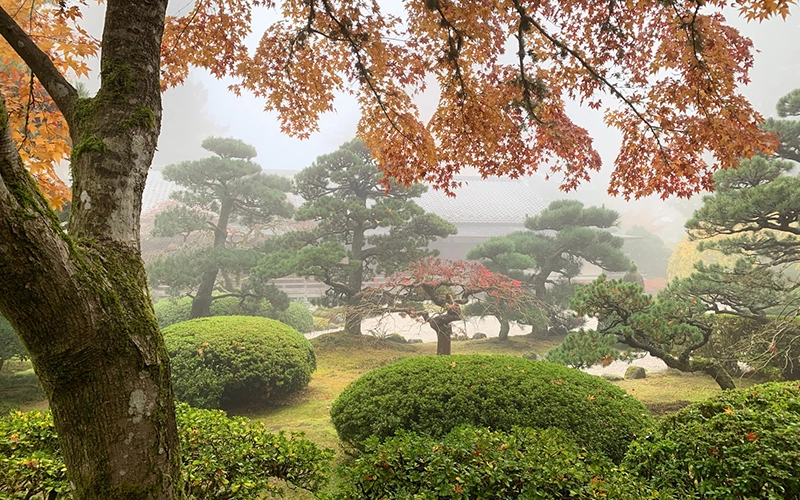
Often, there are no flowers in Japanese gardens. Compared with English gardens, there are certainly less. But when flowers exist in Japanese gardens, they are manifesting the passage of time.
Japanese gardens, in a skillful way, give you a sense of the clear passage of a season. That means you can anticipate what’s coming next. That anticipation is the beautiful part. We need to place ourselves in that cycle, so there’s the reason to live and something to look for.
A few years ago, you led the Cultural Crossing expansion of the garden with Portland-based landscape architecture firm Walker Macy and Japanese architect Kengo Kuma, creating a 3.4-acre set of spaces that includes a new pathway to the garden, entry sequence, visitor buildings. The addition seamlessly blends architecture and landscape architecture, Japanese aesthetics with ecological design. What does this project mean to you and how did you guide the project?
Given I have been garden curator for 14 years, it's really the culmination of my service. The intent of the expansion was to release pressure on the existing garden. In 2015, we started to see close to 400,000 visitors a year. That’s a lot for five and a half acres.
We knew the time to expand would come, so we were well-prepared. Our goal was not expansion in the sense of make the space bigger, but to instead create a new experience outside the garden. The goal is to maintain the tranquility of the original garden, because that’s why people come. No matter if the visitor is in high school student or elderly, they are coming for tranquility, so we have to absolutely defend and maintain that. It’s nice to have shelters, and, in the wintertime, have a sip of tea and visit exhibition and workshop spaces. In Japan, gates delineate sacred space and secure activities. The entire new space and the facilities serve as a gate to the existing garden.
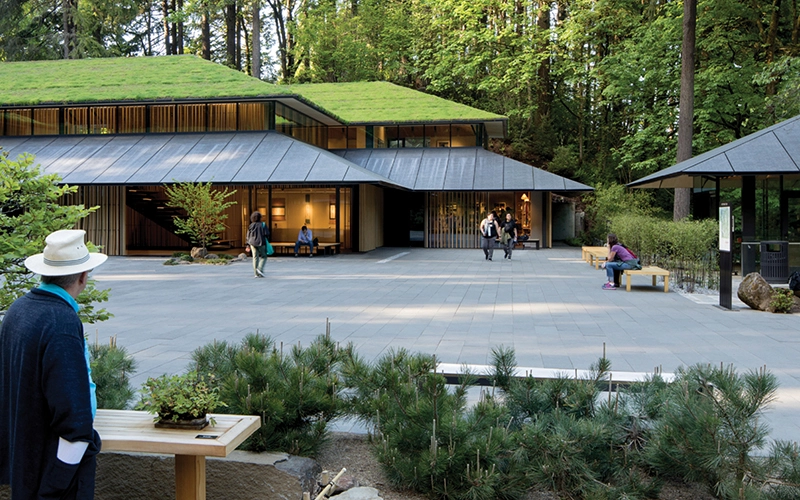
It’s a quintessential Japanese experience. Like in a small village, there’s the agricultural field surrounding the village, then semi-natural wooded areas, then wild nature. Typically, the village shrine is built right on the edge of the wild nature, so there is always the journey. We have emulated that.
When Kengo Kuma first visited the garden and looked at the site, the only one thing he said was, “Uchiyama-san, I don’t think we need to do much.” He was totally in tune with the land. We termed the concept for our expansion as editing the land, as opposed to creating something. We worked with what’s given. After all, we are surrounded by the triple environmental zone, so it's the most difficult place in Portland to do anything. We embrace and treasure and only touch what is needed. That was the only discussion I had with him in a really substantial way. Once we agree on that editing part, the rest was really easy, because we know where we’re going. And the land actually told us.
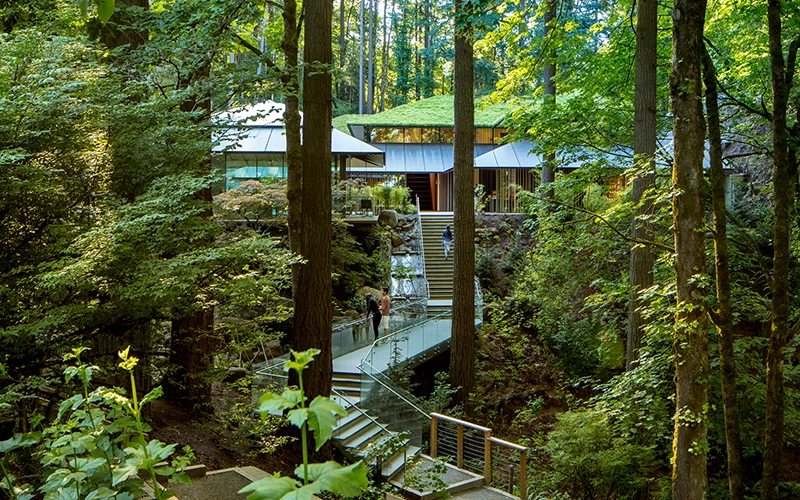
The new entry sequence also gives people to time to switch their mindset from the hustle and bustle to being ready to see.
We live in such a divided country and world. How does Portland Japanese Garden offer principles that can guide other cultural landscape exchanges in post-conflict contexts? And can approaches taken in the Portland Japanese Garden serve as a model for other forms of cultural exchange beyond landscape?
Our goal is not necessarily to have a Japanese garden. That’s really the means. A Japanese garden is really just a beautiful means. The garden enables us to invite everyone. Everyone can enjoy. But we are a place, an occasion in time, to enable them to think and have conversation that otherwise may be harder to have elsewhere.
I’ve never seen anyone fighting in the garden. Somehow the garden brings emotional stability. The garden helps people go back to who they are -- human beings, just speaking different languages and with different hair and skin colors. Those things don’t matter. We have all been around the same height for 150,000 years. Two eyes; two ears. That creature feels the same fundamental things.
We’re passive as opposed to active in terms of addressing those issues. But there is very few places in the world that just welcomes any time, rain or shine. We are there to receive your emotion. And that's what we’re talking about exactly: that is the model. We are rebuilding the model by way of Japanese garden. Creating a space where everyone can express emotions and can have a conversation. That's all.
The garden is non-denominational. If you think of a building, once it’s complete, it has functions and names. A garden is a garden, that’s it. A garden can be a wedding venue or a place to cry. The beauty of gardens, and not just necessarily Japanese gardens, is the space is built with our psyche as human beings.
We, nature, and the garden are the facilitators. The important thing is to facilitate.
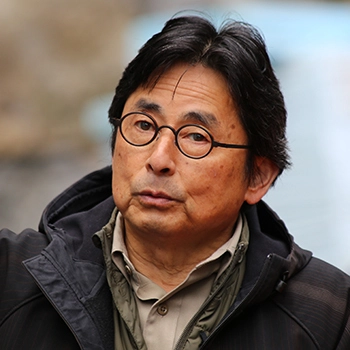
Sadafumi (Sada) Uchiyama, ASLA, is the Chief Curator and Director of the International Japanese Garden Training Center at Portland Japanese Garden. Uchiyama is a third-generation Japanese gardener from southern Japan, where his family has been involved in gardening for over a century. In addition to his background as a gardener born and trained in Japan, Uchiyama is also a registered landscape architect in Oregon and California, with Bachelor's and Master's of Landscape Architecture degrees from the University of Illinois.
Interview conducted by Jared Green at the ASLA 2021 Conference on Landscape Architecture in Nashville.