

.webp?language=en-US)
.webp?language=en-US)
Mikyoung Kim, FASLA
on How to Design for Our Hybridized Lives
A recent study found 85 percent of parents allow their children under the age of six to use technology at home, despite concerns that too much time with phones, tablets, and computers cuts into their time playing outside. Another study found one-third of all children worldwide spend less than 30 minutes a day outside and half spend less than an hour a day outside, which is lower than the average amount a prison inmate spends outdoors. Meanwhile, childhood obesity rates throughout the developed world have skyrocketed. Now one in five children in the U.S. are obese. What can landscape architects do to combat these trends?
We all spend too much time on our digital toys! When I see a group of teens walking down the street together and texting other friends, I have to admit I feel confused. But lately I’ve been trying to be more optimistic about the role of technology in our lives. I think it’s clear that technology has some benefits for kids—they have access to information quickly and they can connect easily to a wider group of friends. With my son, he’s able to find really obscure musical composition events for teens in Boston in a way he wouldn’t have been able to do before. So, there are real benefits with technology.
Do phones disconnect us from the natural world? Probably, I think. There are lots of studies that say, yes, it does. But I don’t want to be too nostalgic. I think we have to accept that the world has changed. We live a hybridized life.
Just recently, we went to see the redwoods in Northern California, Max had no desire to pull out his phone when we were hiking even though on the car ride there he was texting with friends. It’s really about how compelling a place is.
Young people these days are very nimble. They’re able to toggle between two worlds and use technology to help them better understand the world that they inhabit. As landscape architects, we must embrace the fact that people live in both digital and analog worlds.
But there’s clearly a connection between childhood obesity and technology. As landscape architects, we can help municipalities and cities plan their neighborhoods better because it’s the daily rituals that really matter.
Instead of focusing on large centralized parks, it’s important for us to also advocate for a more atomized green neighborhood plan where kids can walk through a pocket park, a neighborhood park, every day, or even twice a day.
For the Chicago Botanic Garden, you designed the five-acre Regenstein Learning Campus, which features grass-covered mounds, a waterway channel, willow tunnels, nature play, and discovery gardens. How do you define nature play? And how do you design a space that will really encourage it?
The Chicago Botanic Gardens is an amazing place for families and kids. When we first started working on the project, the Botanic Garden was interested in creating a place that went beyond just visual beauty and encouraged multi-sensory engagement. They wanted to create gardens that encourage kids to touch things; places where the leaves rustle in a way that really encourages listening. Through this process of engagement in a multi-sensory garden, children learn something about natural processes.
Advertisement
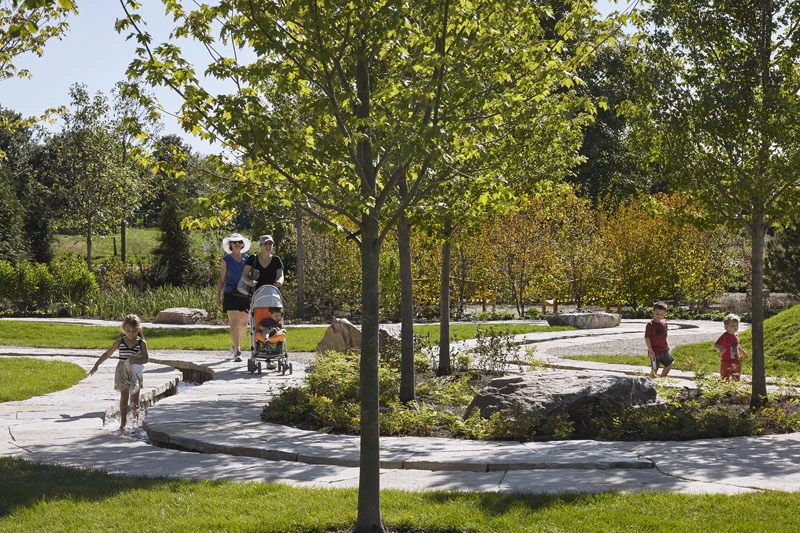
As I’ve said, I think “nature” is a pretty loaded word. I’m not sure that anything near Chicago is really “natural” anymore. Instead, what we did was to try to capture and abstract natural systems.
Programming was also very important to the Botanic Garden. We engaged the community to create complex and layered programming for visitors of all ages; from toddlers to seniors. We also worked closely with the design team to create an integrated inside/outside classroom experience.
You have said that your design for the campus also encouraged “inquiry-focused learning.” Can you explain what that is? And why it was important to encourage?
I’ve been interested in this since the beginning of my practice. How do we teach kids through hands-on learning?
We work with kids to understand how we can make playgrounds and landscapes that move away from the homogeneity of off-the-shelf playground equipment, and encourage hands-on learning- this encourages kids to ask questions.
We’re interested in etching deep memories. I’m very opportunistic about creating these places for children-especially in the city — you have to be. We work with families and try to find these moments — in pocket parks or pop up parks.
I am not necessarily concerned about kids and their interaction or lack of interaction with the natural world, but more with the kind of digital and analog worlds we’re making for them. For example, the homogeneity of playgrounds is a real issue. You can go to Omaha or Boston and see the same play equipment. The games they play have answers already defined by some adult somewhere. Even with Legos. When I was a kid, you would spill out like a whole bunch of Legos and then create your own world. Now you know you’re making a boat at the end. And kids love it. I know they do, but I really feel, as a landscape architect, that we need to create places that highlight open ended experiences, places that encourage children to be inquisitive and creative.
Having said that, all we can do as landscape architects is to strive to create environments that engender inquiry. “Imagination” should be a verb, right?
Maybe the answer is that we should try to create landscapes that are more open-ended, that allow for the imagination to thrive for children and adults. Adults need to play as well; they need to be able to find different interpretations in the landscapes we create.
You said the land forms you designed applied the “concept of the dignity of risk,” which is such an interesting phrase. Can you explain what you mean? And why is it important to incorporate that into designed nature play areas?
Too much of our built environment is designed from a place of fear. I understand there are concerns with litigation, but this is an idea that our client emphasized at the Chicago Botanic Garden.
We discussed different ways of bringing kids up to various elevations as a way of encouraging discovery play– we studied tree houses and land forms which would allow kids to move up and down and run around.
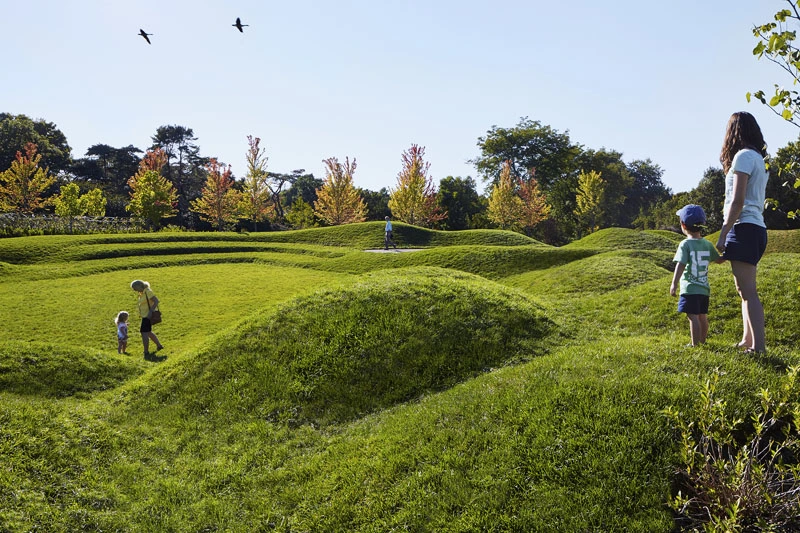
The only constraint the Botanic Garden had was that the landscape had to be accessible to all kids. In all of our work, we’re trying to create landscapes that allow for kids to understand the range of what their body can do but also challenge them to discover new things.
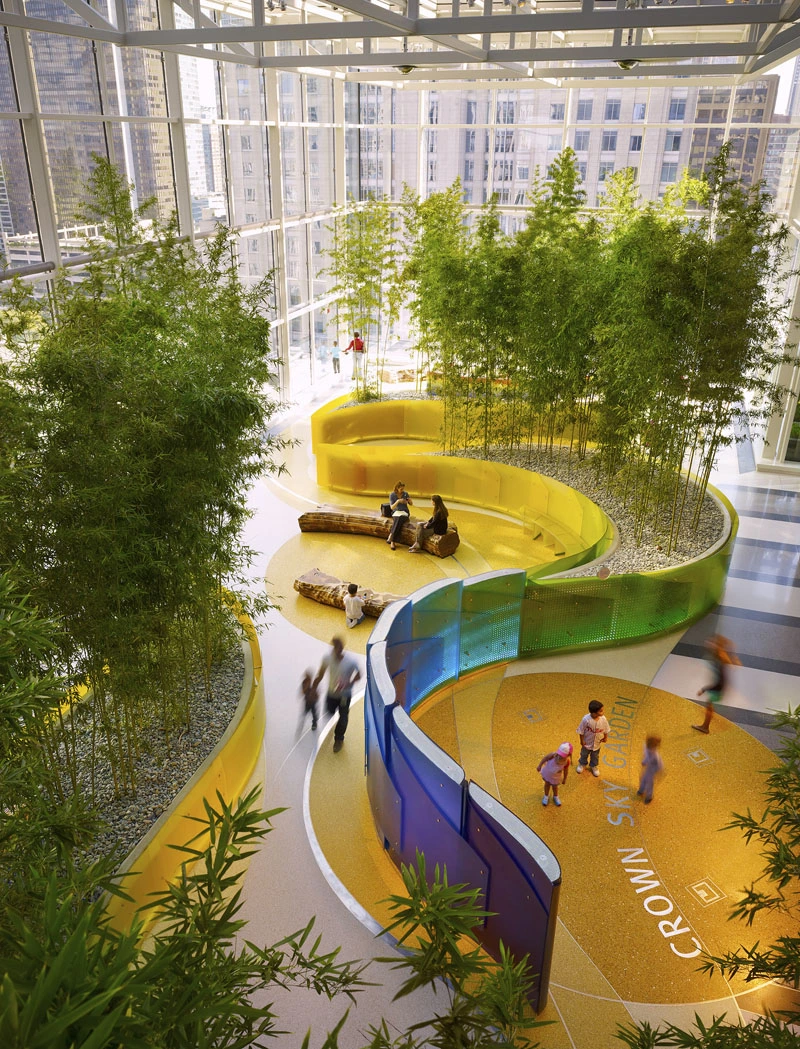
You brought nature play indoors, too, at the Crown Sky Garden at the Ann & Robert H. Lurie Children’s Hospital in Chicago. You transformed 11,000 square feet space on their 11th floor into an interactive engaging healing garden for ailing and recovering children and their families. The space is designed to offer access to light and plants, reduce stress and boost physical activity, while offering a safe space for children with compromised immune systems. How did you design the space to protect patients’ immune systems?
We met with families, caregivers, and patients for days and just tried to understand what was important to them. The difference between this garden and some of the other healing gardens we’ve designed is that this was the only garden they had. Within this singular garden, we had to pack in a lot of aspiration and hope.
Working on these healthcare projects, I’ve learned to be a better listener. I remember that as we were working through this project, President Obama talked about the empathy deficit. I think as a landscape architect I always strive to be more empathetic and really hear people’s stories — and learn how that can help me better understand their aspirations and needs.
We had to make a decision while we were working on this project, as all these requirements emerged. Each time we said — “Well, we want water. We want to hear the sound of trickling water” — they would present evidence that if we did that, a certain population at the hospital could contract Legionnaires’ disease. We decided we wanted a garden that was accessible to everybody.
When I interview patients, I’ll go to their bedside and meet them. It’s the most fragile patients, especially in pediatric hospitals, who need these gardens the most. So, the last thing we wanted is a sign that said, “patients with these kinds of immune deficiencies are not allowed in the garden.”
We had to put aside our preconceived notions of what healing gardens are and really start to abstract nature in order to create this indoor experience for these families and patients.
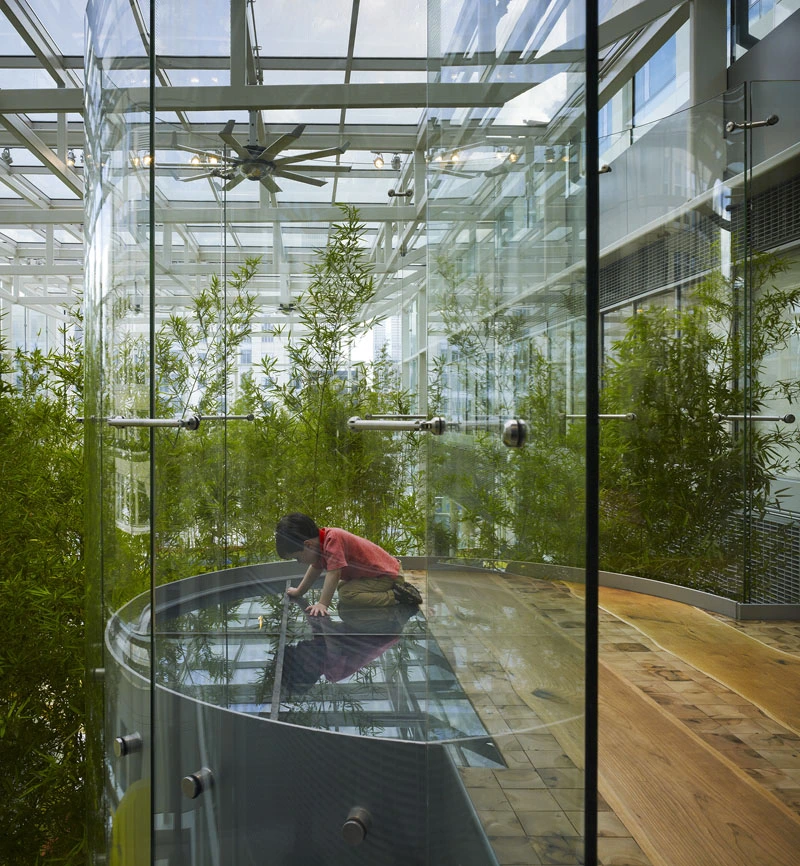
At the Crown Sky Garden, it was the client who actually saw in us the possibility of merging our arts background and our ability to creatively innovate with materials with our interest with kids. We learned we had a way of transforming the landscape that’s artistic, but also compassionate.
With ubiquitous technology increasingly winning the competition for attention, how does nature play need to evolve, or perhaps co-evolve with technology? Do landscapes need to be designed to be resilient to technological or cultural change?
Kids find their own hybrid definition of digital and analog play. They’re able to easily text friends in the car while playing some video game and then go into the park and put the phone in their pocket and run around and climb a tree. I don’t think one necessarily precludes the other.
We need green spaces that are more accessible, but what’s more important today than ever before is creating something compelling in a park that will draw kids there. I have yet to see technology in the landscape advanced enough to compete with technology a teen has in their phone.
However, merging technologies into the landscape itself so that our landscapes become a large video game is something I don’t buy. Our technology is just not advanced enough. Kids are incredibly smart. They’ll look at that and say, “Well, that’s lame,” you know?
Throughout our design process at the Crown Sky Garden, we worked closely with different constituents. We worked with families and patients and brought two options. We brought an option that used more natural materials, and then we brought in a design that had more innovative materials — materials people hadn’t seen before — more contemporary materials built in innovative ways. I’d say 99-percent of kids were drawn to those. They said, “Cool, that’s amazing. I’ve never seen that before.”
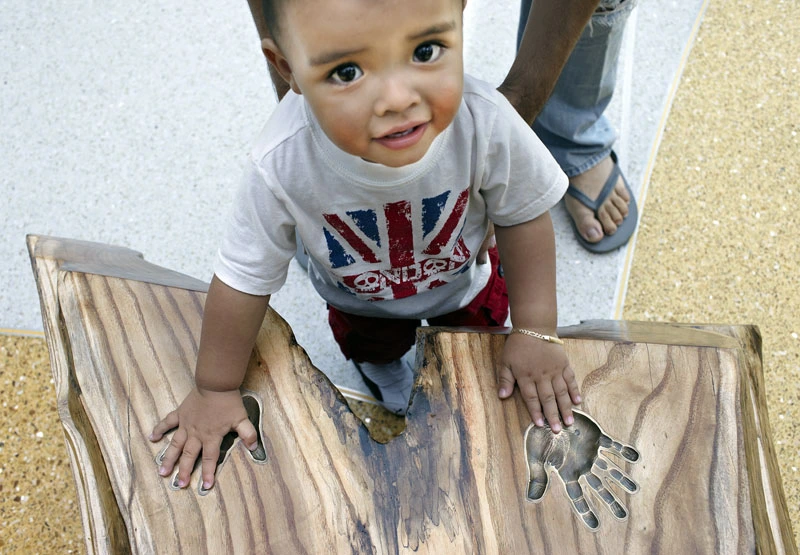
Innovative materials draw kids. They ask a lot of questions: “What is this? How is it made?” They really wanted something that was more open-ended and unique — something that was beautiful, interesting, strange, and vibrant. Maybe there is something to this.
Lastly, you’re known for your truly-innovative explorations with materials. For example, you’ve created wave forms out of stone for the Alexander Art Plaza in West Palm Beach. And you have sculpted metal in many of your projects. You seem to enjoy transforming the properties of materials. Nothing appears static. What is your creative process for approaching materials?
Like kids these days, we approach the process in a hybrid fashion. We use both analog and digital tools. Personally, I love technology. It’s really transformed the kind of landscapes we can make. It’s allowed us to inhabit our landscapes in ways that I could never do when I started my practice. I love being able to walk through the landscapes we make in Rhino.
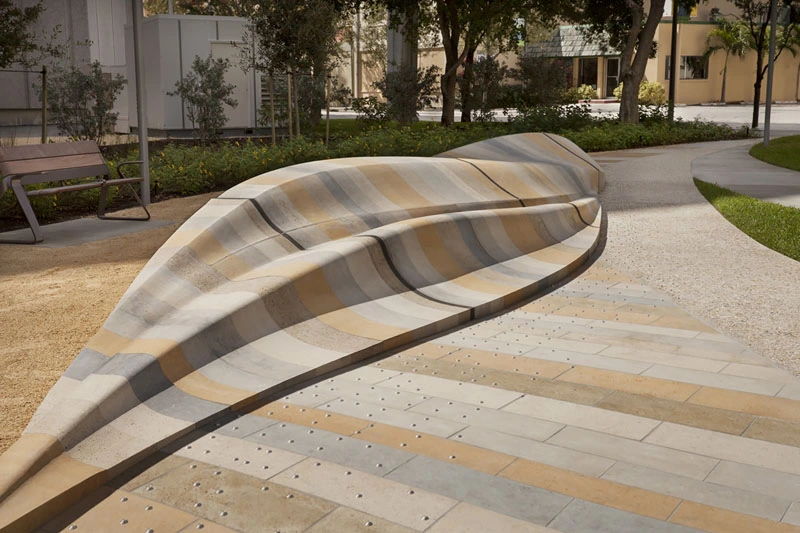
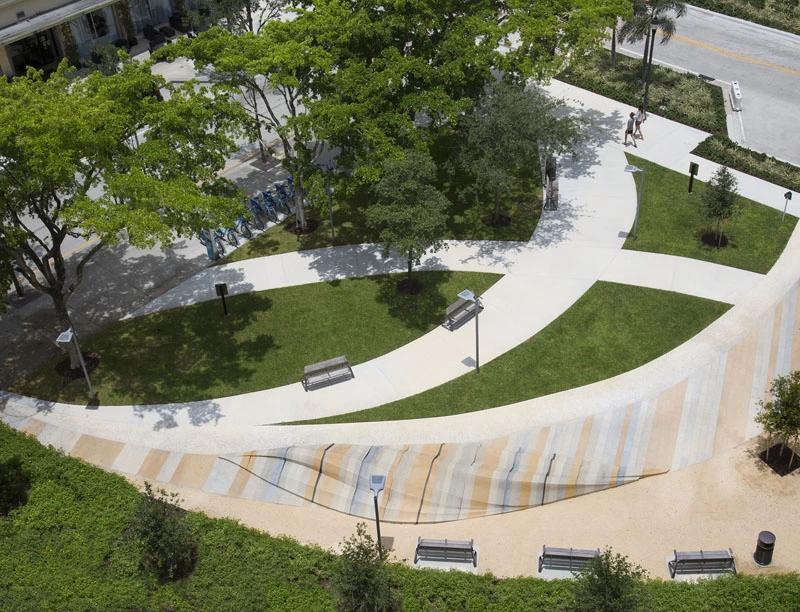
But then I’m also a little suspicious of those beautiful but singular perspectives that have emerged from these rendering technologies; that’s not how our perception works. In one minute, our eye can see 3,000 different perspectives. In singular perspectives, we tend to pick the hero shot and neglect the shots that don’t look at great. For us, we use walk-throughs to say, “well, this spot doesn’t look so great. Let’s try to work on it further.” The fluidity and kinetic qualities that you talked about in some of our work comes from this technology.
We’ve been talking about community engagement and being empathetic. For us an empathetic community allows for us to find new ways of designing. it just helps make our work richer.
And meeting with people also builds trust. It builds trust between us and our client groups. Our clients often have very high expectations — they are patients in a hospital, developers who are building very high-end developments, etc. Through our process, they enter a shared design space with us; one that is a collective experience that hopefully yields a unique landscape in the end.
Mikyoung Kim, FASLA, is an award-winning landscape architect and founder of Mikyoung Kim Design.
Interview conducted by Jared Green at the ASLA 2017 Annual Meeting in Los Angeles.