

.webp?language=en-US)
.webp?language=en-US)
Mary Margaret Jones, FASLA
on the Transformative Impact of Landscape Architecture

Across Tennessee, HargreavesJones has transformed inaccessible, polluted industrial riverfronts into rich, multifaceted parks. What has the investment in the revitalization of Tennessee’s riverfronts meant to you? What trends are you seeing in Tennessee with public space more broadly?
It's not just Nashville and Tennessee. We have found mid-tier cities are not just thinking about their post-industrial riverfronts, but also their place in the market and their ability to draw businesses and people. They’re more open to transformation, so that’s how we ended up doing major riverfront projects in cities such as Louisville, Kentucky; Chattanooga and Nashville, Tennessee; and Davenport, Iowa.
The steel industry left the riverfront in Nashville in a post-industrial state. The community embraced the idea of truly making something completely different out of their riverfront because they had nothing. It's harder to come into cities like Los Angeles, New York City, or San Francisco with such sweeping transformations. In Nashville, Chattanooga, and Louisville, landscape architects can design signature waterfront experiences, address the dynamics of rivers, and restore ecosystems that can be a healthy part of a river system.
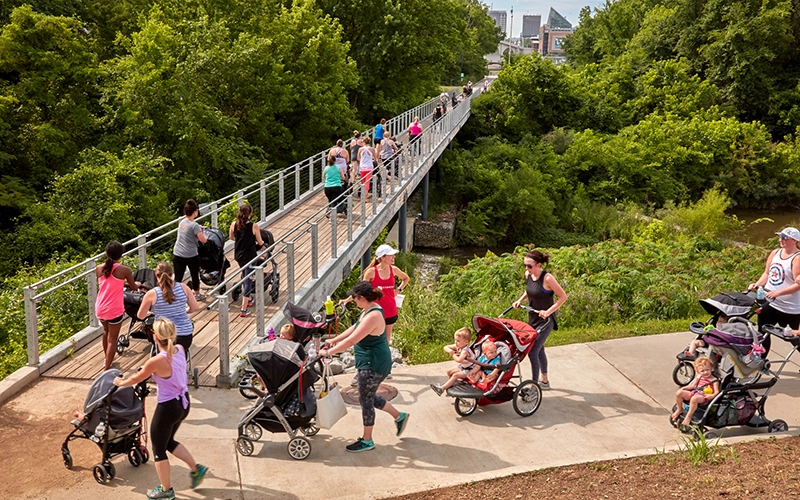
In Nashville, your firm designed the 6.5-acre Cumberland Park as part of a broader riverfront revitalization plan. The park is a model of sustainability and resilience, reuses a bridge structure, sources geothermal, preserves the flood plain, captures and reuses a million gallons of stormwater, remediates toxic soils, and improves biodiversity. How did you make all the pieces fit together?
It was so evident, the opportunities were there. Just focusing on stormwater for a minute: there were walls beneath the gantry structure, so the first thing we said was, “don’t take this gantry structure down, it’s beautiful. Not only will we build a bridge to it and let it become an overlook, we'll also leave the heavy-duty concrete retaining walls below it. Let’s use the space to create an outlet for stormwater from the site and from the two bridges into a cistern.” We created a cistern that has an open air top so it’s actually quite beautiful to look down on, like a reflecting pool. You kind of want to jump in. Then there’s the river, so in flood times, it spills over to the river.
Advertisement
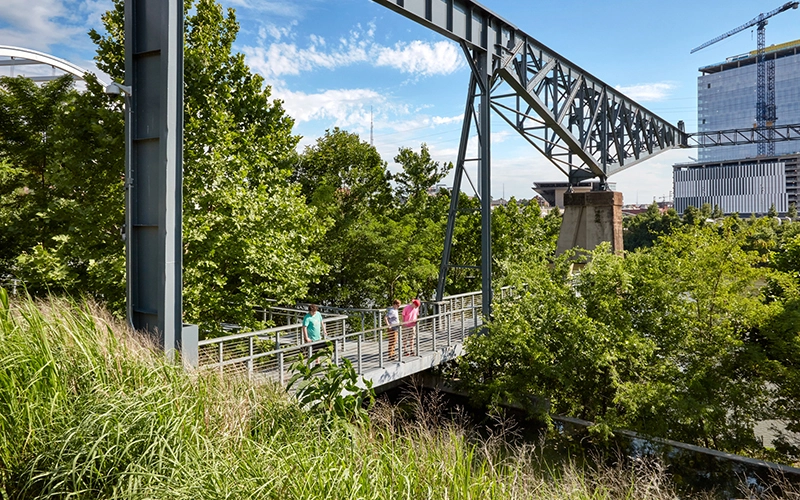
Bio-remediation is just dealing with the soil, which is the case on almost every project we do. We have to either bake or bury and cap soils, depending on the toxic substances and conditions. Geothermal became part of the building, an existing piece of infrastructure from the steel industry, which was then retrofitted by architects on our team to become the stair tower, concessions booth, and park office building. Even the toilets are mindfully designed for low water usage. With science, there are all these opportunities.
In Chattanooga, Tennessee, your firm also designed a 23.5-acre Renaissance Park, which transformed a former industrial site into a wetland park, and the 21st Century Waterfront Park, which reconnects the city to its riverfront and has led to $1 billion in new residential and retail development nearby. How do you design for multiple needs at once -- social life, economic development, equitable access, and environmental restoration? How do you prioritize?
As landscape architects, that’s our job. That is the beauty of landscape architecture. We are not just doing the science; it’s not just a matrix of solving problems. We also create places people will love. The result of that will be economic investment and stewardship. If we don’t make places people love, they won’t be taken care of.
We create social and economic change around these projects, but at the same time we’re providing something to the neighborhood around these projects. We’re revitalizing these neighborhoods.
We don’t think we can just restore nature. We can’t just make form, design, and feel good about that. We have to do both those things and think about what is fiscally responsible because that’s what is ultimately going to give a project its long life.
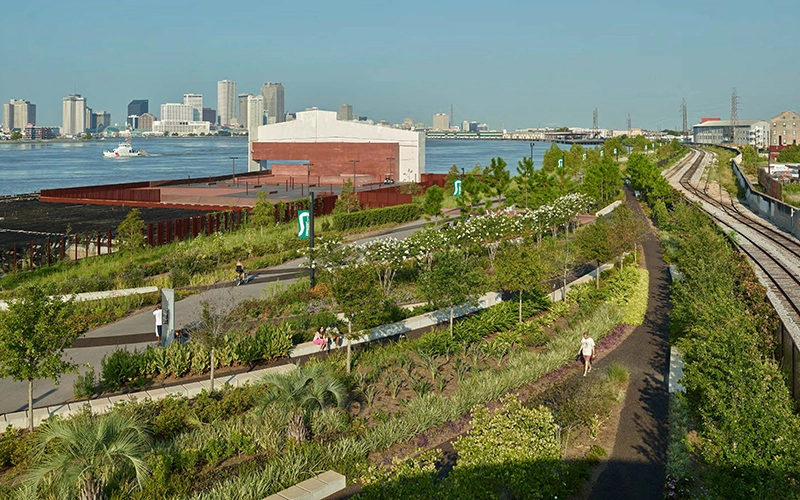
Another significant new riverfront park in the South that HargreavesJones designed is Crescent Park along the Mississippi River in New Orleans. By reusing surplus wharfs and derelict railroad sites a new public space was formed that celebrates the city’s infrastructural legacy instead of wiping it. What is the best way to tell landscape stories using the past? What are the other benefits of adapting and reusing legacy infrastructure?
Sometimes adaptive reuse -- reinventing and reinterpreting remnants -- makes your budget spread farther. An early groundbreaking project in this regard was Richard Haag’s Gas Works Park in Seattle. He left the old structures as is and created a green space around them.
But we’re taking it further now. There are remnants, but we interpret them in new ways. We aren’t just saving the rail tracks, we’re making gardens that follow the path of those rail tracks. We’re not strictly preserving, we’re amplifying through reinterpretation and twisting things that makes you see the infrastructure in a new way.
The transformation of Oklahoma City has been accelerated by the 70-acre Scissortail Park, the grand new central park that will connect the city to its waterfront and realize its core to shore plan. How did your firm's design for the park advance the plan?
We were really interested in the transition from urban to river and making that legible in the park design. Rather than thinking of the park as one piece, we thought of it as a gradation of landscape types so it progresses quite a lot as you move toward the river in terms of its design, landscape, and materials. Of course, there are some consistencies. The promenade and the lighting of the promenade goes all the way from core to shore, but the landscapes and the planting around it evolve quite a bit, as do some of the uses.
We wanted to accentuate that experience of moving toward the river, so that as a visitor, you become aware you’re entering a landscape that gets wilder and wetter. There’s an upper park and lower park, and they’re linked by the fabulous Skydance Bridge designed by Hans Butzer, who was part of our team. Before, visitors couldn’t see the river because of the levy along the river, so we created a high point at the southern terminus of the project, closest to the river.
We also designed the park to respond to climate change. That area of the city floods, so the design of the park accommodates floodwater with a big lake. The lake is also a holding basin for irrigation.
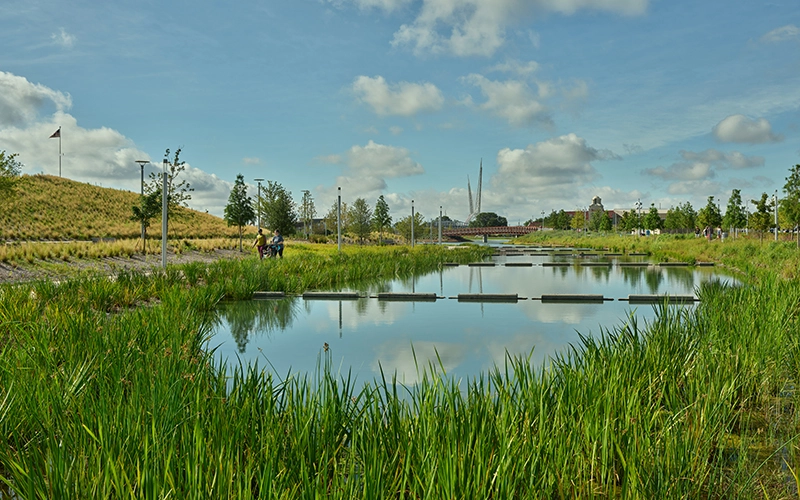
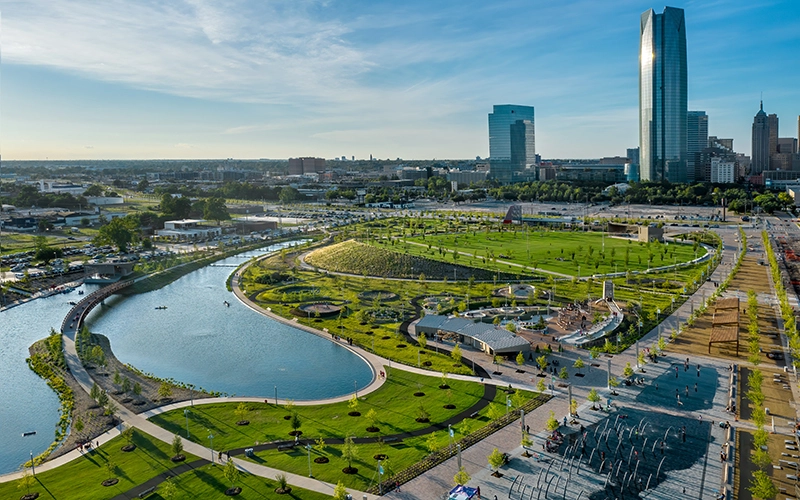
During construction, we had 60 straight days of rain, and the whole lake filled, unfortunately, before it was fully shaped, so that really delayed construction. Then, we were forced to plant trees in August, because the Mayor had promised the citizens a concert on opening day. So we planted trees at 4 a.m., because it was too hot any later in the day. We did everything to keep the trees alive. Once the project was built, they had a freak ice storm in early fall when all the leaves were still on all the trees. The city lost hundreds and hundreds of trees, which is very tragic. And do you remember that cold spell that hit that part of the country later that winter, when it was below 10 degrees for 10 straight days? All the plants got hit. So climate change is impacting us. That’s where large parks are important because they can have a built-in resilience and robustness. They’re large enough to recover their systems.
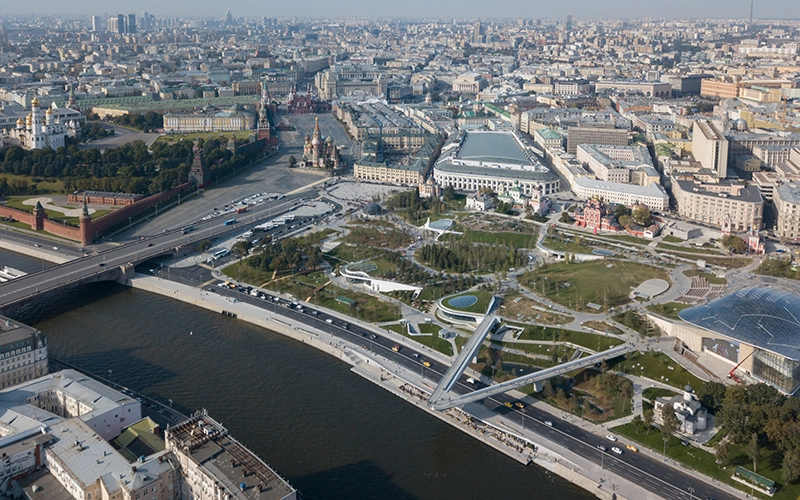
A few years ago, HargreavesJones with Diller, Scofidio + Renfro designed a new "National Park" for Russia, the 35-acre Zaryadye Park in Moscow, next to St. Basil’s Cathedral, Red Square, and the Kremlin. The largest new public space in the city in 50 years, the park is based on the principle of wild urbanism, which is meant to complement Moscow’s historically symmetrical public spaces. You have stated the park "samples Russia’s distinct regional landscapes, tundra, steppe, forest, and wetland forest." What is wild urbanism and how did you realize it through regional inspirations?
Our proposal was part of an international competition, and we were the only American team. We didn’t think we would win especially since our scheme was based on openness and being welcoming, a very democratic idea of porosity and inclusion. We wanted to contrast the traditional parks of Moscow that are very rigid -- their pathways have edges and there’s 500 tulips all the same color, and then the next row a different color. Very, very formal. We wanted to create an informality.
In Moscow, the landscapes were formal and rigid in the city, but outside the city was nature. The Russians love their forests. Forests are a part of their fairy tales, music, ballets, their lore. We thought why not bring the forest into the city and make a place of the city but not of the city where you could move through it and at times completely lose the city and then come out of it to the steppe landscape, which is a big meadow on a big hill. And then suddenly, you’re in the heart of these UNESCO World Heritage sites. All the new architecture in the park is tucked into the folds of the new topography. The site slopes considerably from high to low toward the river, so we were able to then interpret topographically from tundra to lowland.
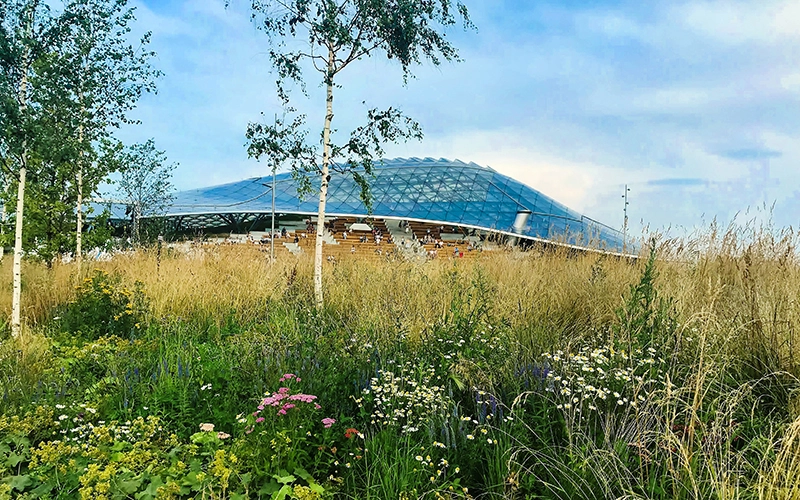
Substantial buildings were created as part of this park, but they’re all below your feet, folded into these topographic waves that cascade from high to low. The paving is pixelated across the site so there are no edges. The landscape morphs from all paving to a blend of paving and landscape to all landscape in ways that allow you to move through the site fairly freely without very prescribed routes. The landscape eats into the paved surfaces and then selection of plants added to the informality.
We had to work really hard with the locals to understand we did not mean annuals. We did not mean 500 tulips. We really did mean perennials that are less controlled, still quite beautiful, and pollinator heaven. We created a kind of wildness that people love.
I think the project is extremely important because it is so public and open and gives people a sense of freedom, to some of the authorities, maybe a little too much. They discovered early on that people were making out in the forest -- and we kind of love that, but there are so many security cameras that it’s not a real issue.
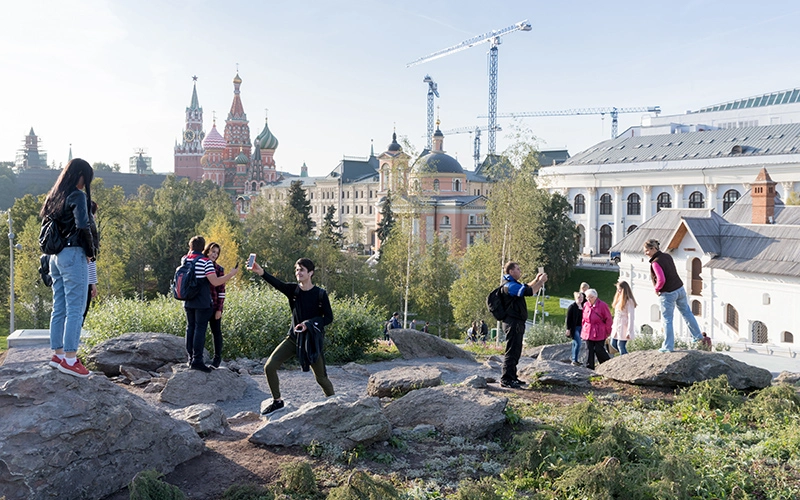
People love in it and love it because they feel it’s unique. The idea was to create a new perspective on a place you think you’re familiar with, that you think you know, and kind of rattle you out of that. Of course, there are the features that are fantastic, like the flyover bridge that takes you out over the river and boomerangs you back. At first, they said, “why would anybody want to go out there? You can’t cross the river; you just go out and come back.” People now line up to go out and come back. There are yoga studios at the end of it. You’re out there and suddenly you’re looking back at the city. You have a perspective of the river and the city you don’t have any other way.
This year is the 20th anniversary of your firm’s design of a now iconic park: Crissy Field in San Francisco. In the past two decades, the park has welcomed millions of visitors and become beloved by both locals and tourists. What is the primary legacy of this project? What has it meant for the field of landscape architecture?
When I go back to San Francisco, I almost always go to Crissy Field, not just as a designer observing one’s own work but just because I love to be there. It was a groundbreaking project for the National Park Service. They’d never done a project that was so sustainable. All the material was kept on site -- there was stuff below grade we dealt with it on site instead of carting it offsite.
The project was also unique for the National Park Service, because we were working with both their natural resource and cultural resource staff, and they had very different, in some ways opposing goals. They could have found themselves in a position of doing nothing because they couldn’t see how to fully realize the restoration of both cultural resources and natural resources. We convinced them that Crissy Field could do both, become a palimpsest and layer together.
There is a stormwater wetland and a tidal marsh. It may not have the highest habitat value you could possibly have, but that can be accomplished 20 miles away. Here in the city, create a marsh with a bridge across it. There was a big battle about the bridge.
The tidal marsh is not as big as they might have liked it, but that’s because there is a grassy airfield that is a historic landmark and needed to be restored. So the marsh creeps around that grassy airfield, and the airfield becomes a kind of plinth, or almost a pier into the marsh. We blended them, overlaid them in a way.
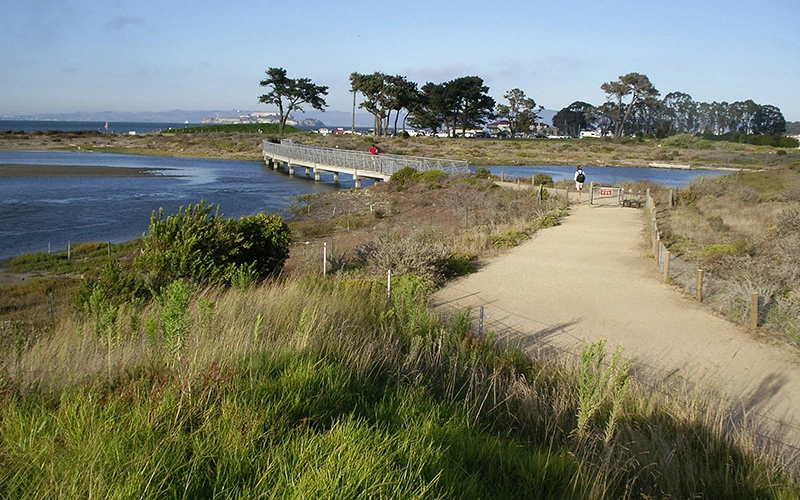
We moved a hundred thousand cubic yards of dirt but it was not high budget. When we started, many people told us: “Don’t mess it up. What’s out there has a kind of awesome rawness we love.” Well, it was mostly asphalt and chain-link fence but still it had a quality that people loved.
As you’re walking down the promenade and come upon the airfield, the airfield is quite a bit above your head, because we made the airfield almost a flat plane. As you walk west along the gently sloping promenade adjacent to the grassy airfield, you get to the tip of it -- and it’s at your feet, so you’ve made eight feet of grade change in that walk along this planar landscape. So there are big moves, and that’s what makes it last.
There’s nothing fussy at Crissy Field, because that would not last. As you stated, millions of people visit it to run, bike, picnic, play with their kids and dogs. It’s one of the top windsurfing spots in the world. And the mouth of the marsh continues to move. It’s a dynamic landscape.
Mary Margaret Jones, FASLA, is President and CEO of HargreavesJones and leads the firm’s offices in New York City, San Francisco, and Cambridge. HargreavesJones has been recognized with the Cooper Hewitt National Design Award and the Rosa Barba International Landscape Prize.