

.webp?language=en-US)

.webp?language=en-US)
Marion Pressley, FASLA
on Designing with History
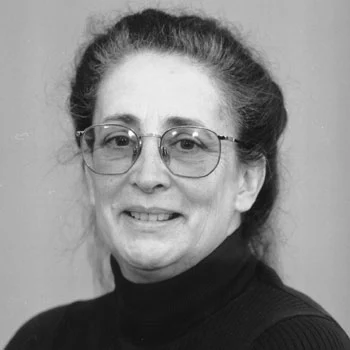
For almost 30 years, you have restored and updated Frederick Law Olmsted's Emerald Necklace, his famed system of parks. What has this project taught you about Olmsted? What do you think he did best? What do you think he should've done differently?
We started on it in 1984, and, actually, I worked on some parts of the system back in the mid-seventies. It has been a long time. It was part of an important statewide-Olmsted initiative that included 12 park sites.
What it really taught me is the man had the ability to not worry about politics. This system is owned by two municipalities and the parkway is under state jurisdiction. You have Brookline, with a small amount of the Emerald Necklace, and Boston, with the majority of the Necklace. When he designed it, he really didn't care who owned it. In Olmsted Park along Riverdale Parkway, the system for pedestrians was sometimes on the Boston side and sometimes on the Brookline side. For him, this was one landscape. He reset the boundaries between the municipalities. That's really one the most important things I learned about what he was doing.
I haven't really looked to see if there's other park systems he worked on that have been owned by different entities. I don't know of one. Buffalo, the first system of parks he designed, was owned by Buffalo.
What he did best is bring all the parties together as he did the design. So that's the attitude we took with the rehabilitation: This was one park and all groups met together. It didn't matter whether you were municipal or state; everything was done that way. That's possibly the best thing he accomplished when he created this system of parks and parkways.
What would he have done differently? One thing he never really thought about is the maintenance of these parks. The maintenance could be uneven because one town could have more money than the other. One might have a different aesthetic than the other, even though Olmsted designed it as one place. He also didn't foresee as much active recreation coming into any flat space it possibly could, although I think it was late enough for him to recognize it would happen. He didn't really provide a lot of space for active recreation. His Emerald Necklace was really a passive, linear system. You would pass through it in a linear way. That's one of the things he might have done differently.
In his writings, there was one thing about Central Park that struck me: if his landscape was still intact 50 years or 100 years from now, he would know he's been successful. The best thing he's achieved is that this system has held itself together. The individual parks have had some changes. Some of the changes came with the dam going in, and changing saltwater to fresh at the Fens, but he created a system that was able to sustain itself.
Advertisement
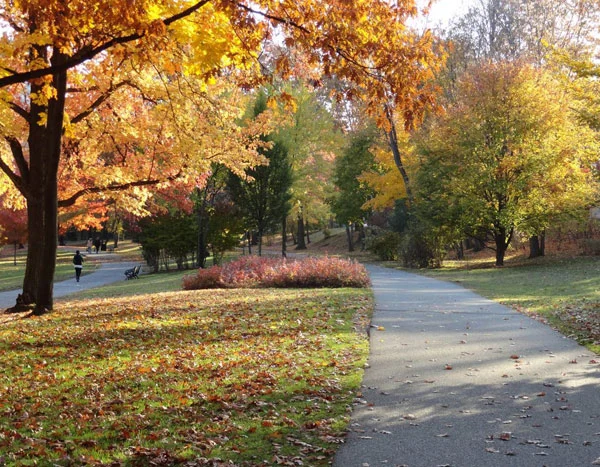
With your deep understanding of Frederick Law Olmsted's designs, what do you think he would make of Boston today? What would he approve of? What developments would dismay him?
He would very much approve of the Emerald Necklace Conservancy and Brookline, Boston, and the state, getting together and recognizing it as one park. He would be amazed that it happened, in some ways. He would be really pleased with the fact that the park system has maintained itself. Different ownerships really could have allowed it to split. He would be most pleased that his vision continues today.
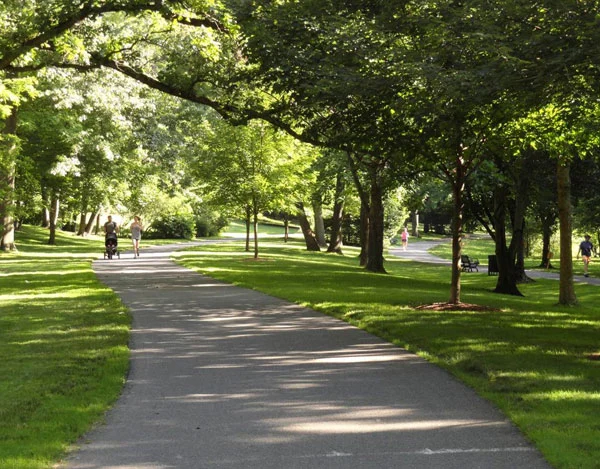
One of the things that would dismay him is the fact that most of the understory areas in critical places, like the Riverway and Olmsted Park, were wiped out over time. But this happened in all parks. It happened in universities. It happened everywhere where people all of a sudden felt unsafe, so the shrub and herbaceous layer had to be wiped out. That's something that he wouldn't have foreseen.
All of his plantings were very dense -- if you look at photos in 1906, a few years after it was finished in 1895, and then, the 1920s, you see it as he envisioned. He was trying to use the density of the planting to achieve the picturesque. To see these plants totally wiped out would have upset him, because he was trying to create and control views with the plants. He was creating this vegetation with openings in it, so you could see the water. There was a very definite sequence of open and closed and open and closed, as you went down through. The fact now that some areas that are just totally open or totally closed off would really disturb him.
Beyond Olmsted, you've worked on other important historic landscapes, too. The Museum of Fine Arts, Boston recently got a Norman Foster design addition. His new building sits right on top of a courtyard created by landscape architect Arthur Shurtleff, a site you had updated in the 1990s. I understand you were brought back in after the Foster additions. How did you reconcile the remnants of the old Shurtleff design with the new Foster one?
We were frustrated when it happened because there's not a lot of Arthur Shurtleff's work in existence that you can go and see. The 1928 courtyard had been closed and went into benign neglect. They literally just closed the door and left it like that for many, many years. The trees were still extant. All four were growing beautifully. The Shurtleff landscape was extant. So the reopening and rehabilitation was a fairly easy thing. It was frustrating, given it was such a perfect example of his work, to see them take it out. But the new building is beautiful.
We were brought in by one of the major donors from the museum, who was very concerned the landscape hadn't achieved what they had hoped it was going to achieve. So we were called in to look at it. It was mostly vegetation that they were concerned about; they wanted a native woodland theme. Interestingly, Foster kept a part of the Shurtleff design, because the building was placed within a sunken area in the middle of the courtyard.
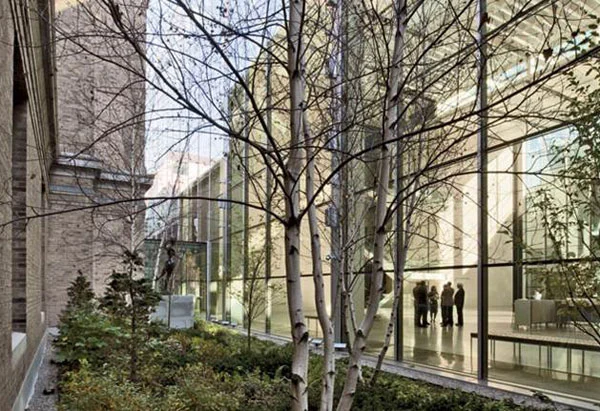
In the Shurtleff design there was a pool with a fountain, four major deciduous trees, and plantings. There were these outer areas that were lower in elevation that were like long slots containing garden quality sculpture, paving, and plantings. Those edges are what remained as four small courtyards, when Foster's building addition was constructed within the courtyard.
What Foster did was a very unique thing. If you haven't had a chance to see it, you should go into the museum. As you're walking through the new building you see into the four courtyards or what are now called slot gardens. It's quite beautiful, actually. As you're walking through the museum, and everything's always so enclosed, all of a sudden, you get this little vignette of woodland planting and sculpture. This just happens all the way around, and it's a very nice thing.
You also have worked on the landscape surrounding Philip Johnson's Glass House and the other buildings in that compound so they are more accessible. What was it like to work with Johnson's vision of this place and update this historic landscape?
We were asked by the National Trust to make it possible for people to get into the Glass House, and the brick house, its counterpoint, and other structures: the sculpture studio, the painting studio, the Monster, etc. What were most concerned about was the main core area. We were asked to do this to meet current codes without destroying it.
Putting ramps all over the place would've been a disaster, so we looked very closely at the grading and met the 5-percent rule. We just regraded paths slightly in order to achieve the right pitch. We had an idea, which we've used at one of our Harvard projects many years ago: a temporary ramp that is brought out, put down, and allows you to not have these ramps all over the place. The temporary ramp allows you to provide access for a person in the wheelchair or with a cane and then take it away.
This is all possible because every visitor has to check in at the historical society before they are taken to the site. They society knows before anybody comes if there's a need for universal access so when they put them on the bus and bring them there, they're all set for it. It has been working beautifully because we didn't have to totally change the landscape. We were able to regrade pathways, including his little eyebrow bridge. We were able to work with the local municipality so we did not have to put handrails.
In short, we were able to make it like when you go in for a haircut and you come out and don't want anybody to know you had your haircut.
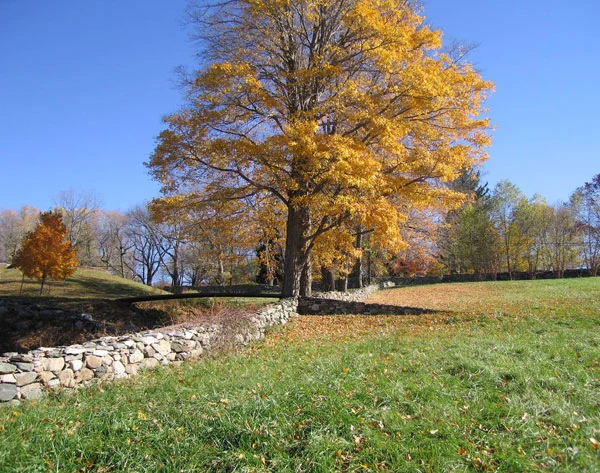
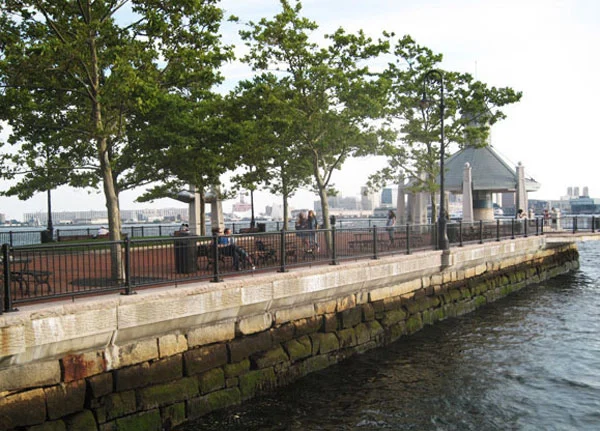
Among your contemporary projects, you have done some wonderful work in Boston. You have transformed some brownfields into real community assets. In East Boston, you turned an old pier that was a brownfield into a park. A 600-foot long promenade takes visitors out into the water, where they get some of the best views ever of Boston. What was the experience of that project working with the community? And what do you think the legacy of that project is in East Boston?
A park was a very important thing for the community of East Boston. I don't know how much you know about this Boston community, but these were the same women who had been out at the Boston airport runways with their baby carriages, telling Massport that they couldn't put in more runways. You had a group of people who absolutely wanted a park. They had also lost an Olmsted park, which now sits under an airport runway. This was absolutely the most important thing to this community. They wanted it to be a community park for everyone. They wanted it to be the best park it could possibly be. They worked very, very hard to get it. They were absolutely great fun to work with, actually.
The site was a brownfield. It has three foot of cover. There's the layer so you know when you hit it. The whole park had to be raised because of flooding. If we knew what we know today, we probably would've raised it higher. But at that time, three feet was enough.
The pier was the only solid piece. It was an area where grain and other goods were delivered. There were larger wooden boardwalks on either side. But there was this core of soil and, basically, riprap on the sides. We were able to save that as this 600-foot linear pier.
It's a very popular place for wedding pictures. The park is heavily used. It has playgrounds, spray pools, an amphitheater, an exercise area. It has everything these people wanted.
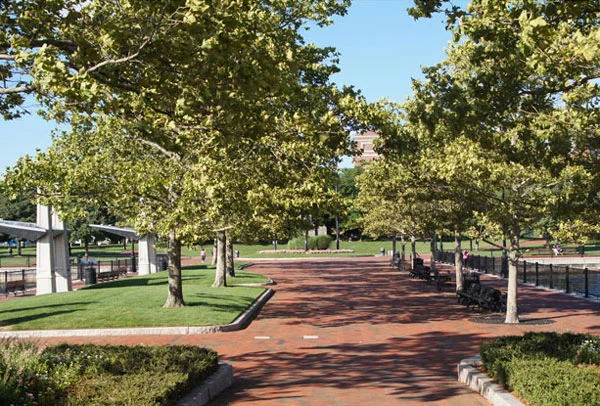
Plus the pier promenade, which gives them the view of the city. They have one of the absolutely best views of Boston.
You also transformed a landfill into a park. With the Pope John Paul II Park, your firm built natural land forms, brought back native plants, created meadows set within wetlands. What were the challenges in making all that a reality?
Another very important brownfield, but, of course, brownfields always so much depend on the engineers, as it did with the East Boston piers. The engineers made it possible to have these things happen. In this particular case, we were able to do more with the site.
We had a garbage dump and we had a drive-in theater. The dump was used for trash for years. That's why there's this rolling landscape, which we kept and accentuated.
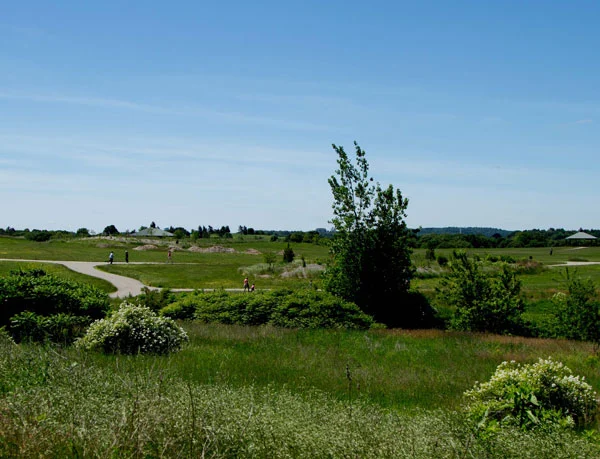
All of the area had completely become overgrown with invasive plants. The landscape was a complete urban wild. But it was still an important park to these people, even in that condition because everybody walked their dog there. There were paths people had cut through themselves. Nobody had made it into a park. It was a community asset, as far as they were concerned, for certain things.
Again, we had a very active community. We worked with a state agency. At that time, it was the Metropolitan District Commission.
We were able to create wetland areas. Because this area is tidal, just like Piers Park, there's a nine-foot tidal change of water here.
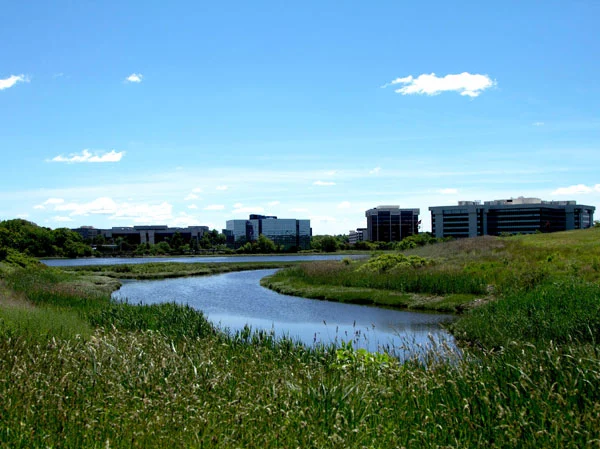
We were able to what they wanted: A place where they could walk or wander through. There were plantings and an area of community gardens. There were shade structures that looked out over the water.
We took the brownfields area that was the drive-in theater, which was really one of the more contaminated areas, and turned into a series of fields now mostly used for soccer. That was very popular. A playground with a shelter structure was also added. This became a totally new park with both active and passive uses. The community invested in its design.
Lastly, looking over your multi-decade career, what advice do you have for young people who want to get into landscape architecture today? And what special advice do you have to those who want to focus on historic preservation and design?
One of the hard parts about going into preservation is that most of our academic institutions don't really teach you enough landscape architectural history to make you an authority on even American landscapes. Forget about European or Asian or any place else. Most of us who are in this field at my age, and who started in the early seventies, are self-taught in many ways. What it really means is you need to build up a base of understanding of history. If you're going to do preservation, you need to understand the theories and how things were done at particular times. You need to obtain this knowledge by either supplementing it with additional courses or you need to teach yourself.
There are some programs who are trying very much to add to this. There are four or five programs now doing this. Georgia is definitely one. I know ESF has a program. Education is an important piece and hopefully they will expand it, but no matter how much they expand it, you really have to know your history to know when you walk into a design what you're looking at. You have to know what its context is. There's so much you have to know to do these cultural landscape reports. It's a process of self-education.
For example, with Steepletop, which was Edna St. Vincent Millay's house, you have to look at other writers and artists who had similar landscapes during the period of significance. The homes of Edith Wharton, Robert Frost, or Theodore Dreiser are examples. There's a whole series of these people, who were writers who created their own landscapes. You have to have that context in order to know what you're preserving or bringing back. You have to know what's important and what has integrity.
I would advise young landscape architects entering this field that they have to realize there's going to be a lot of work they have to do before they get to this point. They should join a firm that's doing that kind of work because that's how they'll learn to do it.
Most people who go into landscape architecture and stay with landscape architecture absolutely love their jobs. There's a great deal of love in the profession. That's one of the reason landscape architects keep working to such an old age. They just can't give it up.
Marion Pressley, FASLA, is principal at Pressley Associates. In addition to her practice, Pressley has taught for the past 40 years landscape history at the Landscape Institute of the Arnold Arboretum at Harvard University, and now at the Landscape Institute at Boston Architectural College. Marion received the 2004 BSA Women in Design Award of Excellence and the 2002 Massachusetts Horticultural Society Gold Medal Award.
This interview was conducted by Jared Green at the ASLA 2013 Annual Meeting in Boston.