

.webp?language=en-US)
.webp?language=en-US)
Herbert Dreiseitl
on Designing with Water
Your sustainable landscape architecture work is focused on water in urban areas. Please describe a few urban projects that illustrate your approach to designing with water.
We have quite a number of projects, and it’s hard to select the right ones. On a very large scale, I would pick out the central watershed master plan for Singapore. The project is really about thinking about the entire island, a huge city, and its vision of the future. It's about making the city more independent and less reliant on other countries for their water resources. At the moment they need a lot of water from abroad, coming in via pipeline from Malaysia, which is actually typical for any major city. From a broad perspective, what is needed for the future is more harmony, partnerships, intelligent and better use of the resources. With a holistic approach, the large amounts of tropical rain that currently flows out to sea can be taken and used in a different manner. That’s why Singapore is a very important project.
What we're trying to do is collect rain water from the entire city central catchment, which includes hard surfaces, rooftops, roads, plazas and so on. We try to harvest the water and release it slowly into the central rivers before it enters the Marina Barrage, a freshwater catchment reservoir. However, we need a treatment train -- bio-swales and structures which are integrated in the urban grid and the city. These have to be accepted by the local people; it has to be part of their culture.
Therefore, this is not only a technical solution. It's involved with the politic and people. The government has been very supportive of this and they created the "ABC Water Guidelines" to get people, and public and private sectors on board together with their thinking. The letters "ABC" is an acronym: "A" for Active; "B" for Beautiful; and "C" for Clean. That’s one of the projects I’m working on right now that illustrates the long-term vision and integrated approach to our work with water.
With this project, we are also doing different pilot projects. One of them is the Bishan Park, a major heartland park in the city that is well loved by people and has more than three million visitors each year. The project involves park planning and looking at how we can make it better. We are integrating the park with the Kallang River that flows beside it. The canal was once a river, and it's also a tributary of Singapore. Right now, it acts as a barrier between the park and people. We want to use the river and its water to reach out to people by re-naturalizing it, and changing their perceptions of the river from fear to hope. As such, this project includes a completely different way of stabilizing the edges within an urban environment. We integrate bioengineering, which is completely new in Singapore. It was never been done before, so we do a lot of research and build a test bed to try out new ideas.
Advertisement
.webp?language=en-US)
Let’s pick out another project -- the Paragon, the Science Center for McLaren in London. A project we did together with Norman Foster’s office in London. I was responsible for the water and the water design. We collect water from the whole plant, the whole factory, as well as from the rooftops and parking lots. We bring this into a formal lake, which is integrated with the architecture, so it’s like a yin-yang composition when you look from the top.
It's not just about aesthetics -- this water is harvested for a purpose. It's used in the cooling system for the whole factory. In this factory they conduct Formula One car production and research so you can imagine the heat and energy. Just think of the energy involved in a wind tunnel test! To get rid of that excess heat in the building, we have a heat exchanger, and we bring that out over a big cascade, a cooling tower, which is expressed as a five-meter high cascade, 170 meters long. The water trickles down, and by that time, there is a temperature drop. We get the water back into this formal lake, and the circulation starts again. This is very successful. We don’t need any additional cooling system. This cools the whole plant.
.webp?language=en-US)
The water concept is a holistic concept. Harvesting the salt water, using the salt water for a heat exchanger, and using the art as cooling tower. That’s very exciting for me, and that’s the type of things that I love to do with my team.
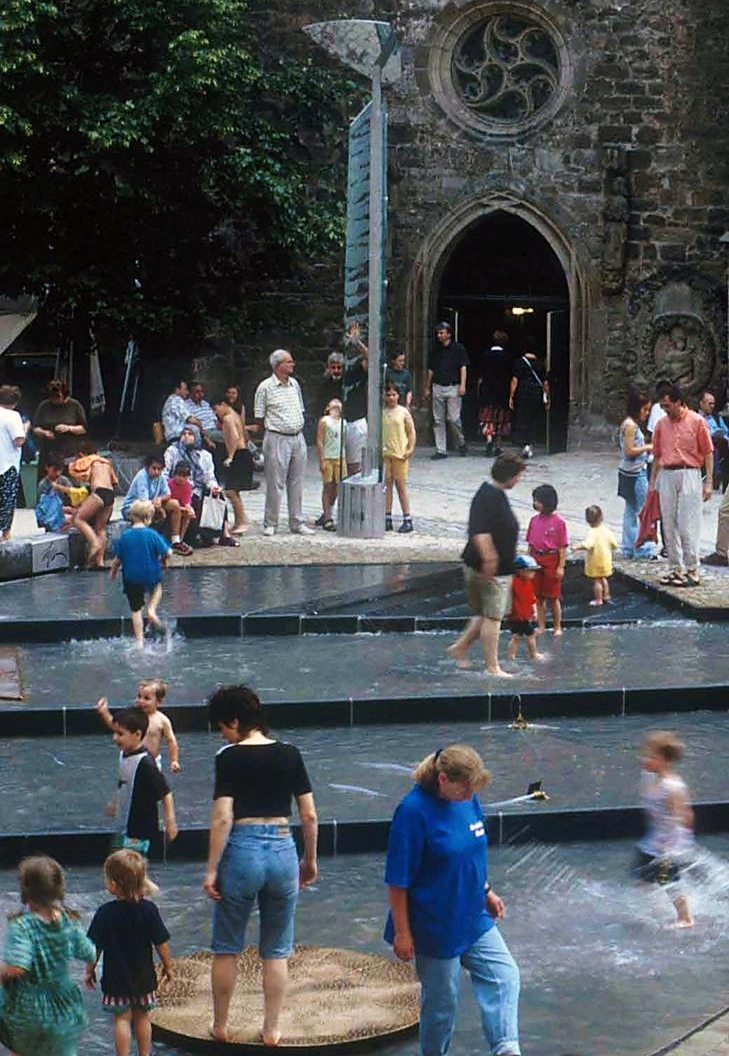
Lastly, we did a project at Hannoversch Münden, a small project on a very historic site. There is a city square in a town that is more than a thousand-years-old. When we started, it was a bus station, where people were going in and out. Now it's a totally pedestrian walkway area. Now, there is a water feature, which is interactive. The water feature is a piece of art. We capture the sounds of the city using microphones and this sound is then transformed into vibrations on plates under the water. These plates create different ripples and textures in the water. To express this vibrancy, we use lights to reflect these hot spots of movement. Light is directed at the water and its patterns are then reflected onto different building facades. Suddenly, the backside of the town hall has enormous and interesting light textures. These reflections are influenced by the people's movement if they step into the water feature, and they can they leave their own "trace" here. It shows the flexibility and creativity and dynamics of water, which can be interactive.
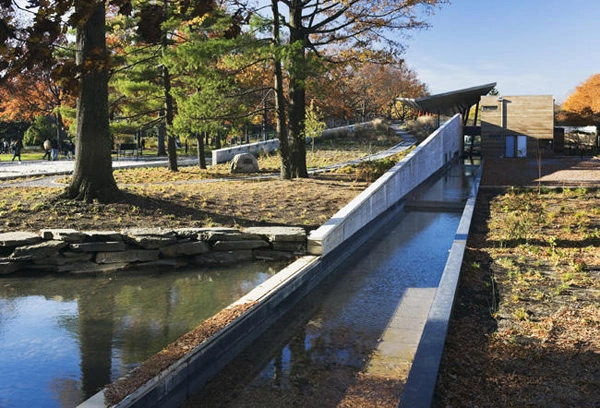
Your firm designed the sustainable water management systems for the Queens Botanical Garden, an award-winning LEED Platinum facility. The complex is a model of water efficiency. Uses water recycling facilities and other conservation technologies. What are some of the key technologies involved, and how were they integrated into the site?
It's completed now. The LEED Platinum Award is only a little part of the whole project. The whole project is a master plan that outlines a long-term vision for the Botanical Garden taking into account the new programming needs as well as stormwater management. This is interactive and deals with soil contamination management, new infrastructure, restoration of existing garden elements, and siting new water gardens.
The integration is transparent for the visitor when they come into the visitor center. We infiltrate the water with green parking lots. The water feature canal that wraps around the building is more than aesthetic, it's part of a water circulation which begins at the fountain and flows into a cleansing biotope. Rainwater is collected from the paving, roof and comes into a channel and brought into a buffer cistern where we can store water in the buildings. As the water cascades off the lowest corner of the roof canopy, it falls onto a stone splash pad before entering the channel.
So, we've turned this stormwater infrastructure into a beautiful art form, and it is designed so that visitors immediately learn and understand what’s going on.
When you speak with clients, how do you convince them to invest in sustainable water management? How do you quantify the benefits of sustainable water in landscape management practices?
Well, usually, I do it in two ways. One is I bring clients to projects we have already done and show them the success. We let them interview former clients and ask questions. Beside all the statistics and points you can show, that is the most convincing case. It’s very much about emotions. It’s not only about statistics.
The other way is that we try to make clear the benefits of integrated water systems. For example, Gummersbach, a town in Germany where we did all the restoration and the water project, had 35 percent more turnover in restaurants and shops. With the new water feature, we turned that around. So they were very, very successful with that. They have less vandalism and crime. These are all facts that are convincing. I usually list these facts, but I can really convince people if I show them the projects.
Your firm has done a lot of work in China, including a recent master planning project in Tianjin. China faces enormous challenges with decertification, reduced availability of water resources, and extensive water pollution. However, China has also made major investments in renewable energy and updated its environmental regulations and enforcement. In your mind, what are the opportunities and challenges facing China and its water use?
Let’s start with the challenging points first, and then give the points of hope. First, everyone knows that China is in a process of fast growth. Also, the values and expectations of the society are very much going towards those of America and Europe. For example, people like to have more flexibility in their commute and travel options. They want to have their own cars. This is the lifestyle standard they think they should have being in the middle class.
The government there is quite aware of the issues, at least from the conversations I've had. They see the need and are looking forward to more environmentally friendly solutions and more urban ecology. That’s why everyone in China talks about eco-cities, eco-villages, and so on. However, everyone talks about ecology and sustainability, but no one knows what that really means. And I have to say, to be honest, a lot of people, even in our profession, don’t know what it means. Or at least they don’t really behave in that way.
The word sustainability actually came out of forestry. This concept came from Austria. It’s an old term, "nachhaltigkeit" and it means that you can only take so many trees out of the forest if you want the forest to reproduce. In China, people really don’t know about ecological urbanism, or what sustainability means, especially in terms of water, soils, etc.
We try to be very, very careful, very honest, and encourage companies to take the next step in terms of sustainable design, and show leadership. I think China will probably move in this direction very quickly, and on a very large scale.
Clean, potable water is becoming scarce in many places. Many countries in both the developed and developing worlds are also concerned about anticipated reduction in the availability of drinking water. How can designers help create new policy and regulatory approaches to water? How can innovations happening at the project level be turned into widely-used approaches?
Small-scale projects are good for creating a sense of hope. They are good learning experiences that plant the seed for something bigger. As innovations, it's important to learn out of failing. On a broader scale, it's very important that we discover ways to recycle water, and treat water so it can be renewed. Again, as an example, I mention Singapore, a city that is at the forefront of new water technology. However, they are smart enough to know it’s not only about technology. It's also about aesthetics. The emotions must come in. People need to have a feeling, an understanding of what happens. That's where we can come in to make cities more beautiful. I am not just being altruistic. Function and form and aesthetics really need to get together, and can complement each other, or even encourage progress.
Everyone knows money is always hard to find. Resources are limited. Our will to do something is also probably getting less and less because people are focused on their day-to-day needs. Long-term needs are ignored. Our political system includes very short election periods. Politicians are only focused on how to get reelected so they only do popular things, and avoid unpopular decisions that may be needed, at least in our Western democratic systems.
So what is needed is a paradigm shift. “What are our priorities?”, we should ask ourselves. If money isn't available, it is very important that people focus on key values: “We want to have a healthy environment, good water, good schools, good places where kids can play outside instead of three cars." Lifestyle values should focus on how to create a healthy, harmonious life with the environment. It will be a very big challenge to create this environment where people can say, “This is the total alternative to all that shit we had in the past.”
A recent discussion on the Sustainable Sites Initiative, Jose Alminana of Andropogon said current water infrastructure is unnatural. "Drains are unnatural," and water infrastructure should be further decentralized so it’s more like a natural system. Alminana added that transmission lines for waste water cost five to six times more than wetland systems, and produce C02 emissions. As you’re saying, a paradigm shift is needed in water infrastructure. How do you think urban water infrastructure needs to be re-thought? What would your ideal water infrastructure look like?
Cities and urban areas have to change their systems into waterscapes. Waterscapes are living systems that provide a living, cleansing process like nature. The value of what a river gives a wetlands through cleaning the water is enormous! If we take the intelligence of nature and bring it back to cities through very smart technology back to the cities, we can re-create this. The water body in a city is like an organism. It has different ways of interacting. Water has to be decentralized, brought to the surface, and integrated into what we actually see. What we see is what we take care of.
We also need more space. To put it together in a very clear and simple formula, we need to give time and space for the process of water. That is what we have to create in our cities. Cities need to be waterscapes, and these waterscapes have to be healthy. We have to work at this and create prototypes.
If you were working on a project with a very limited budget, where would you put your money in terms of improving water efficiency? What are the most cost-effective ways designers and planners can reduce water waste?
The best would be to prevent pollution from going into the water. If we find better ways to control waste so that waste isn't going into the water, we can reduce all the costs, because we don’t have to spend money to get the waste out again. We need to integrate the green and blue. If we integrate bio-swales, or infiltration areas beside streets, develop parks with multi-functional uses so there is water detention or retention functions that are integrated, we don’t have to spend a lot of money on all the infrastructure, repairs, and getting all the shit out we put in the water.
Herbert Dreiseitl is the principal of Atelier Dreiseitl.
Images by Atelier Dreseitl.
Interview conducted by Jared Green.