

.webp?language=en-US)

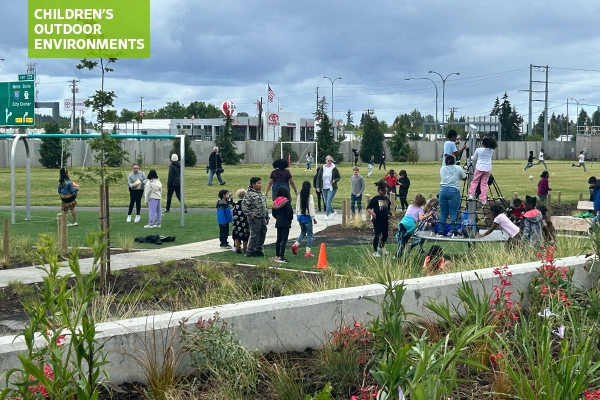
The ASLA Children’s Outdoor Environments Professional Practice Network (PPN) was thrilled to host co-authors, pediatricians, moms, and nature advocates Pooja Sarin Tandon, MD, MPH, FAAP, and Danette Swanson Glassy, MD, FAAP, to discuss their book, Digging into Nature: Outdoor Adventures for Happier and Healthier Kids on May 5, 2025, for their seventh Zoom Book Club.
Digging into Nature is a must-read for anyone who cares about getting children away from their screens and outside and playing. Published in September 2024, Drs. Tandon and Glassy make an engaging and accessible evidence-based case that the entire family (not just children) will be happier, healthier, and more resilient when they spend time in nature. The book includes a treasure trove of inclusive, age-appropriate, child-centered, nature-forward activities and tips for making time in nature a priority.
Pooja Sarin Tandon, MD, MPH, FAAP, is a general pediatrician and researcher at the Seattle Children’s Research Institute, associate professor at the University of Washington’s School of Medicine, and Director of Health at the Trust for Public Land. Dr. Tandon attended Brown University for undergraduate and medical school, and the University of Washington for a Master of Public Health degree. She has published widely on the importance of physical activity, outdoor time, and nature contact for health. Her publications include over 50 peer reviewed papers, book chapters, and Digging into Nature.
Danette Swanson Glassy, MD, FAAP, is a primary care pediatrician and child advocate. Retired after 32 years from Mercer Island Pediatrics and University of Washington Clinical Professor, she now concentrates her professional time as the director of the non-profit BestStart Washington and promoting Project Nature, a program to support pediatric medical providers as they encourage children to spend time in nature. Her child advocacy work locally and nationally is focused on the promotion of quality early education for all children, in addition to access to nature. She is the co-chair of the executive committee for Caring for our Children: National Health and Safety Performance Standards; Guidelines for Early Care and Education Programs, 3rd and 4th editions and is the Director for BestStart Washington.
Would you tell us where your most treasured nature place is and what makes you think of it this way? Does this special place involve your children or is it a ‘you’ place?
Just as there are many seasons in your life, there have been many different ones. For Dr. Glassy, there’s a small cabin in the Eastern Cascades on a river that her family has visited since the 1990s. The smells were different from home, and everyone could recreate outside year round. This was both a personal favorite and to be able to share that with the kids and now the grandkids makes it a special place.
Dr. Tandon has different favorites for different things. She has been visiting Lake Sammamish right outside Seattle with her two boys, now teenagers, since they were very little, for weeknight picnics or to go paddleboarding. It is easy to get to and have a shared experience together at this beautiful lake surrounded by views of the mountains. When she goes now, even without the boys, it brings back memories of those times.
Moderator and PPN co-chair Amy Wagenfeld, Affil. ASLA, PhD, OTR/L, SCEM, FAOTA, noted how she loved the anecdotes about the co-authors’ children spread throughout the book.
Both in research and practice, we struggle with how to define nature. How do you define nature?
It can come down to dose—how much do you need to experience the health benefits? Incidental exposures, indirect exposures, virtual exposure—there are so many different ways that aspects of nature can be defined, there is no succinct answer.
With the idea of the nature pyramid, the base of the pyramid is daily, frequent, easy to access ways to connect with nature (pocket parks, trees, going to school). You then proceed upwards to weekly connections (local community parks), then state parks and monthly visits to more distant locations, and then to the top of the pyramid: deeper nature experiences that may only be possible a few times a year. There is a whole spectrum of ways to think about nature.
You do a wonderful job of infusing evidence of the importance of getting children outside in nature throughout the book. How do you (as pediatricians, and as moms) address the skeptics who no matter the evidence continue to devalue nature?
As primary care pediatricians, this is something we spend our time doing: building relationships with patients and families. If a family does not take us up on a suggestion (unable, unwilling), we often have time on our side to come back to it. One of the most powerful tools for interacting with skeptics is to re-engage in a thoughtful way later on. Convince them over time. Keep revisiting the goals you are trying to reach about nature access. Eventually, you will be seen as a safe person to talk to, and they may share what’s keeping them from nature (don’t feel safe, lack of transportation). Use time and make a safe space to hear about their access issues and finally convince them.
If you only have one shot, you try to guess what the source of reticence is and try to address it.
Do you ever find that sharing personal stories has an impact?
Absolutely. “For my family, we’ve chosen to do this…”—this is a way to join with skeptics in a respectful way. Become a bit more vulnerable, and share a personal struggle.
Going into nature doesn’t have to look one way (you don’t need to be off grid without electricity or water). You can find a nature experience that works with your preferences. Find that personalized experience and what appeals to you.
Would you expand on how nature time can and does promote health and more so, treat disease? Is this information important for a design team responding to a project proposal to discuss?
There are multiple categories of types of health benefits of time in nature. There are benefits related to preventing disease, treating disease, and benefits across lifespan regardless of diagnoses. The strongest evidence of these benefits is in areas related to physical activity and mental health. Children in nature are more likely to be active. Mental health benefits include stress reduction and attention restoration when you spend time in nature. There’s also health benefits for vision: 20-40 minutes outdoors can slow the progression of myopia. Nature also protects you from harmful environmental factors (noise pollution, air pollution).
If there’s a certain health benefit you want to prioritize, studies have shown the presence of a track or certain types of spaces may be important. To support the development of fine and gross motor skills, there should be opportunities to climb and jump and manipulate loose parts. If you are designing in a hot place (which applies to more and more places, thanks to climate change), it will be 10-17 degrees cooler with a tree canopy, so shade is a critical piece.
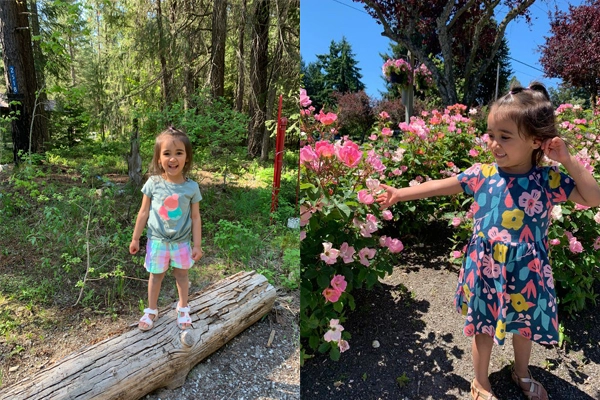
From a medical perspective, how would you see landscape architects incorporating awe into children’s outdoor spaces, or outdoor spaces in general?
I love awe—whenever we can, we should talk about awe with young children, because it is somewhat of a learned behavior. And, awe shared with friends or family is multiplied. It’s also very personal. It can be in response to something very tiny, or vast: the Grand Canyon or Denali, or a ladybug landing on your hand and walking across it. For landscape architects, think about awe inspired by all five senses. Stand back and think about this for your projects. Will there be enough leaf matter for there to be insects? Will there be child-sized rocks to pick up? Are there vistas that people can look to? Will birds come by, will we hear them?
Think about features that promote biodiversity and that allow kids to use all their senses in a variety of ways, like a water feature. The ability to manipulate the environment nurtures their sense of curiosity.
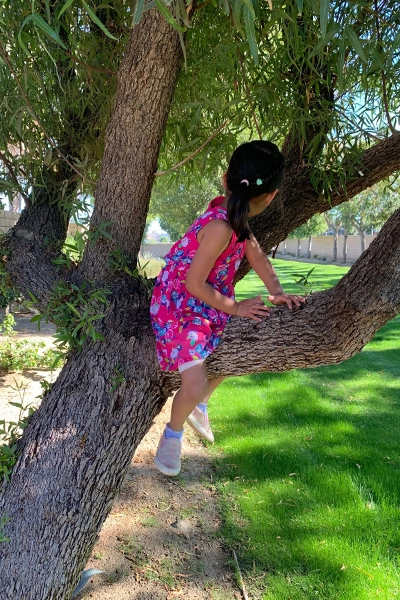
The idea of risky play often comes up—inviting children to stretch not just intellectually but also physically beyond their comfort zone. Awe and joy are right there together. It may be as simple as having something to climb up and then jump off of. There are many ways to provide an abundance of opportunities and affordances to experience awe and joy.
You talk about the value of both manufactured play equipment and natural play elements throughout the book. What other thoughts could you add from the perspective of pediatric medicine?
Different affordances of play areas will support different types of activities, and outdoor time is not the same as nature play. Physical activity outdoors, even in a mostly concrete or plastic-dominated space, is still better than being indoors in front of a screen.
One preschool teacher we worked with was a big fan of nature play and incorporating more outdoor time for early childhood. When three-year-olds started at the preschool, the teacher could tell right away how much access to nature they’d had before. Some children had not walked on grass or on uneven ground often. Others could jump on a log and could balance. Children become more comfortable over time, with more nature access. In less predictable settings, children develop feedback mechanisms to be able to navigate uneven, unexpected, and varied environments, encouraging development.
The best parks had a bit of both the manufactured and the natural elements. Kids were drawn to big, bright, plastic climbing structures, but the most appealing parks had that and natural settings. Very quickly, they did the big slide and got bored. Then they shifted to the natural setting, and spent more time there, with more creative play happening in natural settings.
For places children are going to regularly, kids are there for so many hours a day, for years, so play structures tend to become boring quicker. Having natural elements is especially important for schoolyards to nurture creative and social interactions in ways manufactured structures do not over long periods of time.
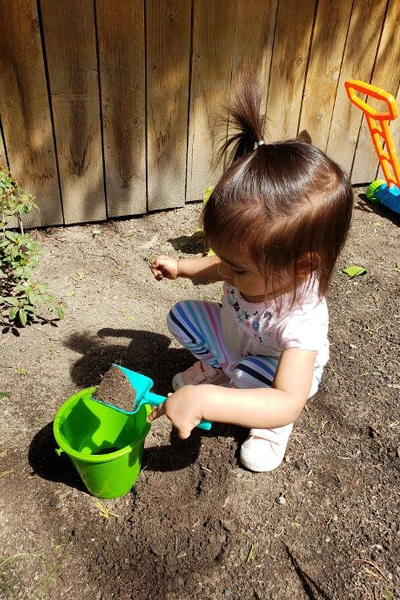
Please tell us a bit about phytoncides and if and how landscape architects should be thinking about this regarding children’s outdoor spaces. Living in the Pacific Northwest, you are the experts!
We want to engage the sense of smell, and trees happen to have one category called phytoncides. Forest bathing experts in Japan were able to quantify and measure their effect on stress hormones and blood pressure. These studies were mostly on adults, and looked at how long the effects lasted (a month after exposure).
Trees use phytoncides to affect their own immune health via chemical messages sent between trees. When applied to the human immune system, phytoncide exposure boosts our immune systems as well.
These are all early studies, so we will know more in the future. Trees are very important for our health and it may be because of these chemical messages. Whenever you can incorporate trees and plants, do so. It also helps with awe!
Would you tell us more about park activation and more generally your thoughts about park or nature prescriptions?
Park prescriptions have become more commonly talked about, and now there are different versions of it. The scientific evidence for the original model of park prescriptions (go outside for 30 minutes a day) is not too compelling. Getting people to change their behavior is hard. The original model did not take into account the limitations or concerns of families and everything that can prevent people from following the instructions.
More creative versions of nature prescriptions have been much more successful, such as events at parks supported by healthcare institutions. One example is Dr. Nooshin Razani and other pediatricians in California who set aside one day a month, inviting patients to meet at a park. They hand out bus or transit vouchers to make getting there doable, and have great retention. Health outcomes are measured (blood pressure, BMI, cortisol levels).
With the Project Nature program, pediatricians and clinicians that do check-ups use that time to share information about nature play and give out tools and resources (like a bug box) to support nature play.
People may not feel safe, or not know if a park is safe. Park activations and having a scheduled event with other people is reassuring. One patient started playing basketball in a park once he realized he could go at the same time as a pickleball group—with other people there, he felt safe playing.
With Trust for Public Land maps or Google Maps, people can find parks near them, but they may not know if those parks are safe to visit, so bringing healthcare practitioners together with patients and others can be empowering.
How can landscape architects create opportunities for incidental and intentional nature experiences?
Kids enjoy being with their grownups (parents, older siblings, relatives, teachers)—it’s fun to do things as a group.
An experience can be something intentional, like making up a challenge (we’re going out and we’re all going to find 5 different leaves). Or it can be incidental: let the kids go out, and they may be a little bored and not know what to do right away. They may struggle at first without a set activity but handling your boredom is an important skill to learn. When they have a question for themselves, they can explore to find the answer (are there bugs under these rocks?). They learn to come up with their own questions and investigate them. Over time, they feel more confident as they explore.
It’s good to have a mix, with some prescribed activities (like a track) and also totally natural areas that anyone could do anything in.
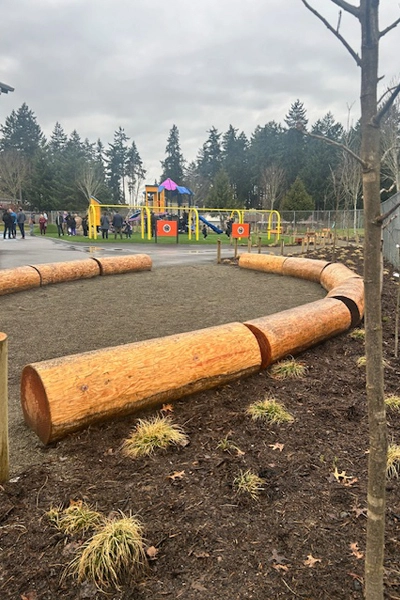
We would like to hear more about your MD recommendations about green schoolyards and how best, through your lens of thinking, to convince administrators and other decision makers of their importance not only for learning but overall development.
Green schoolyards can be so important for both kids and whole communities. Trust for Public Land designs with community input and participation and works toward shared use agreements. Space that creates access to park-like features for the broader community outside of school hours can have an even larger impact. Schoolyards are of course critical for in-school use (recess, sports) and for behavior and learning (improved outcomes for students), and beyond that, for other users (teachers, community members, multigenerational use).
We don’t have metrics on this, but having access to outdoor space could play a role in reducing teacher burnout. They also represent an opportunity to bring teaching outdoors, such as with STEAM curriculums facilitated by outdoor learning spaces.
Heat domes in the Pacific Northwest have been shockingly deadly. Paris, France, had a heat dome and then greened up all the schools in the city—they took action right away, and it reduced temperatures during the next heat dome. So, green schoolyards can also help save the planet and reduce extreme temperatures during these temperature crises.
Green schoolyards could also be part of addressing equity issues with access to nature and environmental justice issues. In Takoma, WA, there’s a school right on I-5, a major highway. That school needs to change their air filters more often than other schools, and they are looking into adding more trees to mitigate noise and air pollution.
We love the concept of green time (vs, screen time). What other thoughts can you share about this? Having just read The Anxious Generation by Jonathan Haidt, this is important to talk about (and worry about?). What actions would you recommend for moving from a screen time to a more green time culture?
It is on parents a bit to make this happen. Not only do you have all the usual things to parent about, but now you need to parent about screens.
Any changes you want to implement should be easy to remember and easy to apply on the fly. For example, if you go outside for 30 minutes, you can have 10 more minutes on the computer. Or it can be a matter of timing, such as waiting until eighth grade for kids to have a phone with internet access.
We are still learning what will be effective and what will be helpful to kids, and what will be doable for parents. Rules for limiting screen time can be overwhelming, and kids have to live with screens. Our hope for their teenage years is that they are equipped with strategies for resilience. How will they limit their own screen time when they’re in college? Kids need to learn strategies for when they are feeling overwhelmed so they know how to deal with screens.
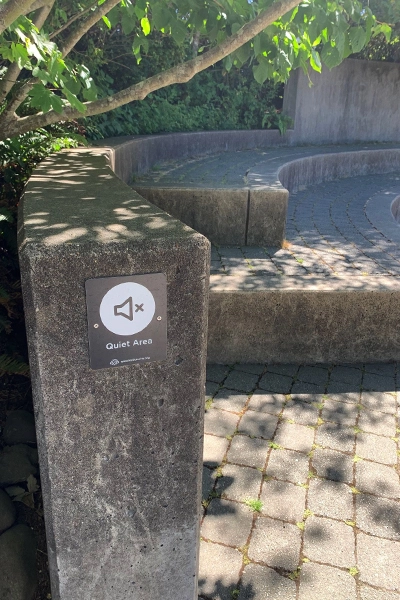
Do you have any thoughts and suggestions for children and caregivers for children with invisible disabilities (sensory or mental health challenges)?
Even when a park is fully ADA compliant, it may still be insufficient. So how can we design spaces where all are included and everyone can engage in the fullest way?
Neuro-atypical encompasses such a wide spectrum. Nature can be very overwhelming, so a nook or enclosed natural space could be more manageable than a big open area. Others need to move more and find comfort and joy from physical movement. Some uses need big open spaces that are safe (they may not know when to stop, so a barrier or fence is important) and quieter nooks for those who need a spot to gather themselves and work on their big emotions.
We are seeing this more in zoos and aquariums: nooks and spaces that say ‘Quiet Area’ for anyone who needs a moment. Or, there are set quiet hours for those who might be over-stimulated (special hours with fewer people or a quieter setting).
When designing, ask communities what they need. See everyone and all their different abilities and understand their needs. Always invite the people who know the conditions and who know the community best to share their input.
For recaps of the PPN’s previous Zoom Book Clubs:
- September 2024: The Nature of Inclusive Play: A Guide for Designers, Educators and Therapists by Amy Wagenfeld, Affil. ASLA, PhD, OTR/L, SCEM, CAPS, EDAC, FAOTA, and Chad Kennedy, ASLA, PLA, CPSI
- May 2024: Balanced and Barefoot: How Unrestricted Outdoor Play Makes for Strong, Confident, and Capable Children by Angela Hanscom
- January 2024: Nature Swagger: Stories and Visions of Black Joy in the Outdoors by Rue Mapp
- October 2023: Naturally Inclusive: Engaging Children of All Abilities Outdoors by Ruth Wilson, PhD
- May 2023: Schools That Heal: Design with Mental Health in Mind by Claire Latané, FASLA, MLA, SITES AP
- January 2023: Letting Play Bloom: Designing Nature-Based Risky Play for Children by Lolly Tai, PhD, RLA, FASLA