

.webp?language=en-US)


by Tami Banh, ASLA
The Recreation–Conservation Tension
Over the past few decades, public demand for access to the outdoors has surged. The pandemic emphatically reminded us how vital nature and outdoor environments are for physical, mental, and emotional well-being. From urban parks to forest preserves, people are increasingly seeking opportunities to (re)connect with the natural world. Yet this growing enthusiasm presents a complex challenge: how do we invite people into nature without loving it to death? As trails widen from overuse, wildlife habitats fragment, and sensitive plant communities erode, the ecological costs of over-accessibility have become undeniable.
Rather than closing off access altogether, a more productive approach might lie in promoting ecological preservation through public stewardship. Thoughtfully planned and managed access can cultivate a collective sense of responsibility and care. Historically, the American conservation movement has prioritized the protection of "pristine" wilderness, emphasizing preservation over coexistence and often casting humans as separate from—or even harmful to—the wild (Marris, 2011). But growing recognition of Anthropocene realities challenges this separation. We humans have been part of nature all along. Attempts to keep the human and nonhuman worlds apart are increasingly seen as futile, and even counterproductive. Indigenous land management practices offer a valuable alternative: a model in which humans are integral to the ecological web, playing an active role in its stewardship alongside other nonhuman agents (Kimmerer, 2013; Wickham et al., 2022).
Is there a way to tread lightly—to foster connection, embrace stewardship, and protect the ecological integrity of a place all at once?
Balancing Access and Ecological Integrity
Landscape architects and planners are uniquely positioned to navigate the delicate space between access and preservation. Sensitively planned and designed trail systems can minimize harm while maintaining meaningful access to nature.
Strategies such as trail hardening and the creation of ecological buffers help concentrate impact on more durable areas while protecting sensitive zones. For example, at Arbor Hills Nature Preserve—an environmental education park located in the fragile Texas Blackland Prairie—MESA Design Group strategically placed trails and overlooks to highlight natural features while steering visitors away from vulnerable habitats.
Similarly, adaptive strategies like seasonal closures and permit systems, commonly used in National Parks, allow access patterns to respond to critical ecological rhythms such as breeding or migration seasons, ensuring protection during the most sensitive times of year.
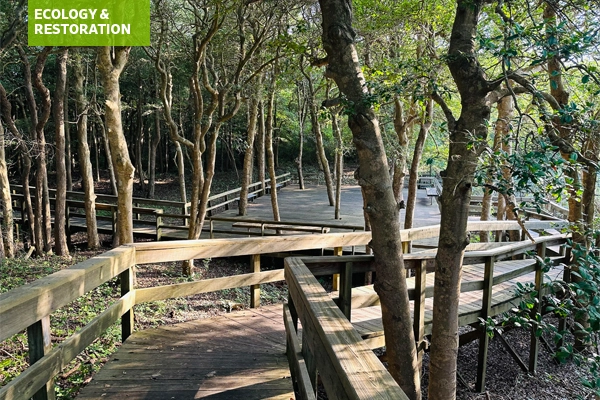
Additionally, elevated pathways, controlled access, and carefully placed infrastructure can maintain a sense of wildness while providing for human interaction. At the Loures Riverfront in Portugal, designed by Topiaris, a raised wooden boardwalk stretches across the estuary mudflats, safeguarding critical bird-feeding and nesting areas. The boardwalk, built on stilts, allows water to flow freely beneath it, reducing flood risk to the walkway and protecting sensitive marshland ecosystems. Along the path, five observation and rest areas—slightly suspended off the main trail—invite visitors to pause, fostering connection without compromising ecological integrity.
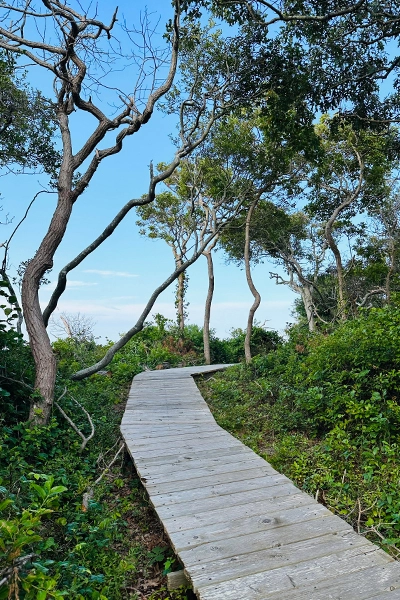
Interpretive signage, guided walks, and citizen science projects can further transform access points into educational platforms that further inspire long-term stewardship. At the Loures Riverfront, strategically placed signage provides information about the estuary ecosystem, introducing visitors to its rich biodiversity. Interactive exhibits explain the crucial role of salt marshes in mitigating climate change impacts and reducing environmental toxicity by absorbing heavy metals and pollutants.
Yet, balancing access and preservation requires more than physical design; it demands inclusive, collaborative management practices. Co-management models rooted in Indigenous stewardship offer a vision of participatory care, where access is not solely recreational, but a pathway to long-term ecological responsibility.
At Pinnacles National Park in California, Amah Mutsun Tribal Band is partnering with the park managers, government agencies, and land trusts to restore access and ecological stewardship practices to sacred landscapes that are the tribe’s historic homeland. These collaborations ensure that Indigenous ecological knowledge shapes management decisions, honoring both cultural significance and environmental resilience.
Similarly, at Ridgewood Reservoir in Brooklyn, NY—a decommissioned reservoir now home to a thriving mix of plant and animal species—the nonprofit NYC H2O has worked to expand public access into the reservoir while promoting stewardship. Through monthly volunteer events, the organization engages the community in invasive species management, encouraging hands-on participation in the care and preservation of this urban ecological sanctuary.
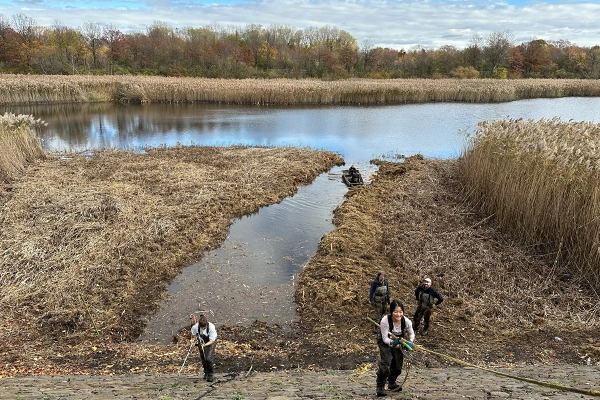
Lastly, scientific ecological research should inform every aspect of planning. For instance, design interventions might include visual and physical buffers for species sensitive to disturbance, or protect microclimatic conditions that function as refugia. By aligning design with ecological specificity, designers can reinforce both biodiversity and public connection.
Moving from Tension to Reciprocity
Resolving the tension between access and conservation requires a shift toward a framework of reciprocity. Public access should not be framed solely as a threat to ecological health, nor should landscapes be approached merely as sites for recreation and consumption. Instead, access can—and should—be understood as a tool for cultivating deeper connection, care, and collective stewardship.
Through thoughtful design, adaptive stewardship, and collaborative imagination, landscape architects, planners, ecologists, and communities can create spaces where people and non-human species can thrive in mutual support. In doing so, we acknowledge that humans are not separate from nature, but necessarily, intimately, palpably part of it.
Special thanks to Brandon Herman, ASLA, and Susan Kenzle, ASLA,PLA, PMP, ISA, for their encouragement and editorial support on this post.
References
Cary Institute of Ecosystem Studies. 2021. "Balancing Access and Ecology." YouTube.
Kimmerer, Robin Wall. 2013. Braiding Sweetgrass: Indigenous Wisdom, Scientific Knowledge, and the Teachings of Plants. Minneapolis: Milkweed Editions.
Kling, Jessica. 2024. "Accessible Nature: Balancing Contradiction in Protected Areas." Ecology and Society 29 (1).
Marris, Emma. 2011. Rambunctious Garden: Saving Nature in a Post-Wild World. New York: Bloomsbury.
Mesa Design Group. n.d. "Arbor Hills Nature Preserve."
Topiaris. n.d. "Loures Riverfront." Landezine.
California Native Plant Society (CNPS). 2023. "Restoring Access and Stewardship to Culturally Significant Landscapes in an Era of Climate Change: Lessons from the Amah Mutsun Tribal Band." Artemisia Journal.
Malina, Matthew. 2020. "Saving Water." Urban Omnibus.
Wickham, Sara B., Skye Augustine, Andra Forney, Darcy L. Mathews, Nancy Shackelford, Jennifer Walkus, and Andrew J. Trant. 2022. "Incorporating Place-Based Values into Ecological Restoration." Ecology and Society 27 (3): 32.
Tami Banh, ASLA, is a New York–based architect and landscape architect and the 2025–2026 Ian McHarg Fellow at the University of Pennsylvania. She previously led and supported public projects at SCAPE, SHoP, and ZGF. Tami holds an MArch II and MLA I from Harvard University.