

.webp?language=en-US)


by John Kamp
While there is still much to be explored on the ecological value of natives relative to non-natives, this three-part series offers a fascinating look at the competition aspect of this conversation. Natives are not always the wimps and non-natives are not all bullies! – Dan Greenberg, ISA, ASLA, and Barbara Yaeger, ASLA, Planting Design Professional Practice Network (PPN) leaders
Can non-natives play nice with natives? A rework of a butterfly garden in Minnesota sought to find out.
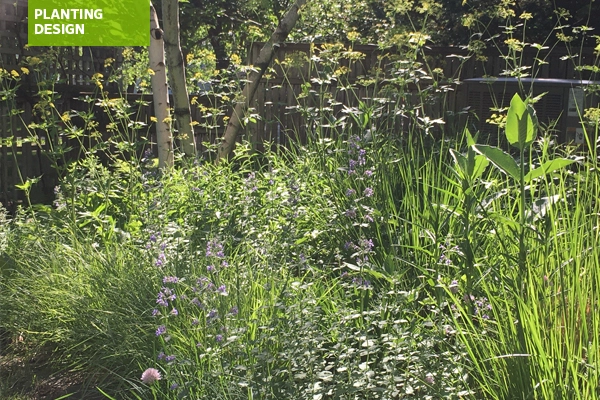
A rework of a well-intentioned but weedy-looking butterfly garden in Minneapolis led to a five-year-long study documenting what happens when native plants of the prairie and nursery-created cultivars are planted within the same space and are allowed to run amok and eke out an existence together. Will one species reign supreme? Will the cultivars push out the natives? And what will the garden look like over time? The answers might be surprising and might challenge folks to rethink what they know and understand about our landscapes and inherent assumptions we have about both their ecological value and how they evolve over time.
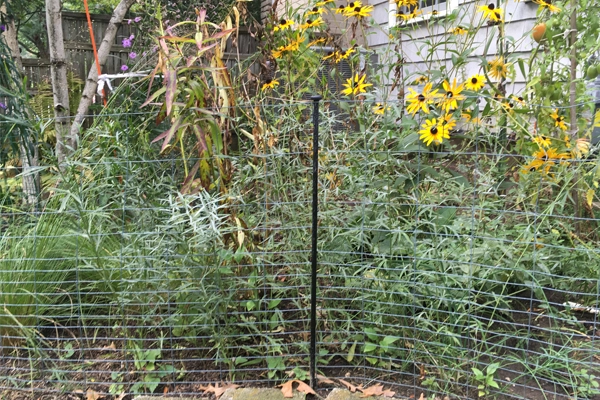
In the fall of 2019, I was tasked with taking a somewhat unsightly butterfly garden made up of native plants of the prairie and completely rethinking it. Like many smaller habitat landscapes that are penned in by suburban or urban built form, the garden was the victim of good intentions that failed to deliver in the looks department. Rather than looking the hoped-for (and promised by the nursery) wild and free, the space ended up looking weedy and unkempt.
In my experience, while larger landscape spaces can readily borrow from adjacent sweeping views, sight lines, mature trees, etc., and thus be a little looser in their design, small landscape spaces—especially those penned in by hard, pre-existing, occasionally unsightly, edges (in this case a fence, an arbor, a central air-conditioner condenser, and a building face)—will benefit from a more discernible structure to both hold up against those edges and say to the eye, “I am intentional.” Lacking any kind of discernible pattern or definition, this small butterfly garden simply looked like a wash of small, similarly colored leaves with nothing to hold it against what penned it in (see photo of landscape before rework).
I will clarify here that while I readily use native plants (that is, plants endemic to the region I’m working in) in the landscapes I design and install, I have long been troubled by some of the broad and sweeping claims that the most fervent of native-plant accolades have made over the years—in particular, that native plants need to be planted with each other and can’t be mixed in with nursery-bred cultivars (that is, plants bred and selected for nursery production) or plants from other parts of the country or world because those interlopers will take over and choke out the natives. Over the past 15 years of doing landscape design and installation, these claims simply haven’t squared with what I have literally observed on the ground and in the dirt.
Still, it is one thing to observe and another thing to actually take a microscope to a space and study it long-term. Perhaps I was wrong. Perhaps over time, the composition of a landscape will change to the point where the nursery-grown cultivars will push out the natives. And this is what I set out to explore and learn after we had retooled the Minneapolis butterfly garden.
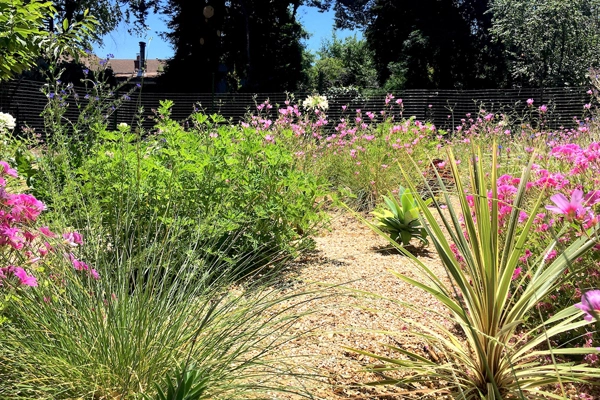
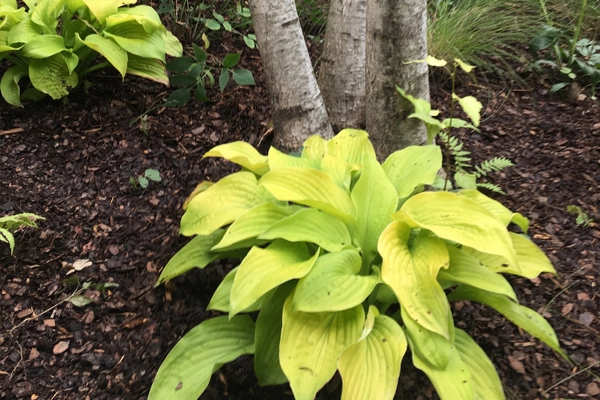
To serve as the non-native component to the experiment (and to simultaneously provide the space with some much-needed structure, a discernible pattern and rhythm, and a hint of formality as a nod to the rest of the yard), we would plant a set of nursery-bred cultivars and plants from other regions of the world within the existing space of all native plants of the prairie. Then we would document how the species composition and number of plants within the overall space changed over time. In this way, I could get closer to knowing instead of simply observing what happens long-term within a space of “natives” and “non-natives” eking out an existence together.
On this level, the project had similarities to a project landscape writer and educator Noel Kingsbury had done called Competition Time, which looked at eight 5’ x 5’ plots of plants that also consisted of self-sowing plants and nursery cultivars and how the species composition of these plots evolved over time. While our space in question was a single one, much larger than 25 square feet (ours closer to 112’), not perfectly square at all, and set within a climate radically different from the Competition Time plots (which were located in Hertfordshire in the UK), some of the plants we were planning on using were the same as those Kingsbury had used (Calamagrostis x acutiflora ‘Karl Foerster’ and Panicum virgatum, to name a couple). And the curiosity and some of the fundamental questions driving each project were the same: will one plant or set of plants ultimately reign supreme, or will a kind of equilibrium be reached?
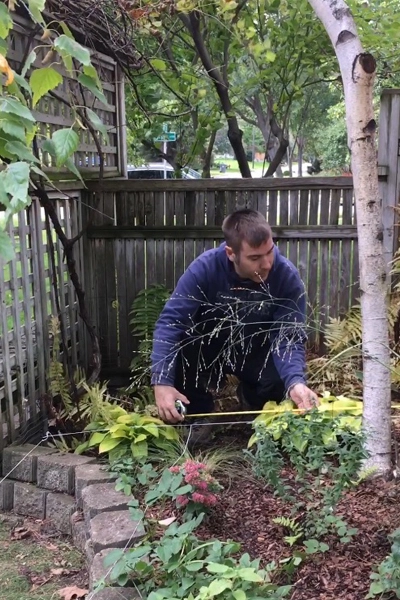
Given these similarities, I reached out to Noel to see if he would be interested in having the Minneapolis butterfly garden rework be a kind of North American / Minnesota outpost for the Competition Time project, and he was on board. So for the next five years, I monitored the species composition of the Minnesota site and how it changed over time, laying a grid of 3’ x 3’ squares atop the site once per summer and documenting and counting what was growing within each.
The project has ended up being a veritable journey of discovery, not necessarily confirming what I had suspected but painting a more complex and nuanced picture of what happens when you allow a kind of native/non-native ecology to take hold within a space and evolve as it will. While some of the discoveries and findings I made had to do with the initial questions at hand (i.e., would one or a set of species end up dominating the space?), others leaned more toward the aesthetics of the space, maintenance, and the challenges/opportunities of expanding this type of landscape creation out into a broader space and within a public setting where a crew, not myself, would be maintaining it.
This post continues next week—read on for part 2!
John Kamp is a landscape and urban designer and licensed landscape contractor (C-27 #1039171) based in Oakland, CA, where he runs the landscape, design, and community-engagement practice Prairieform. He is co-author of the book Dream Play Build: Hands-On Community Engagement for Enduring Spaces and Places (Island Press 2022).